
Crime and Social Policy Dr Boran A Mercan
Crime and Social Policy Dr. Boran A. Mercan
Policing, Prison and Imprisonment � what � the it is that the police do? issues of policing � Ensuring social order and the role of police � Governmentality
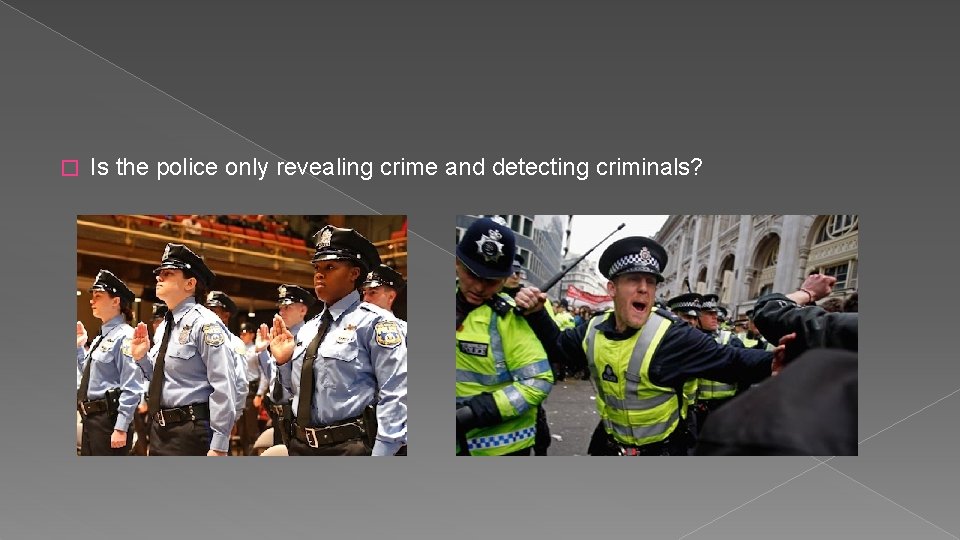
� Is the police only revealing crime and detecting criminals?
� Police officers, according to the mainstream approach, keeping the ‘peace officer’, � This means the police is not directly to do with keeping the ‘law’, so empirically spending less time enforcing the law than otherwise might be. � The functional definitions of police work come on the agenda of criminology. � The maintenance of order is an actual concern.
What do the Police do? � The security of person and property, the preservation of the public tranquillity, and all other objects of a police establishment will thus be better effected than by the detection and punishment of the offender after he has succeeded in committing the crime. This should be constantly kept in mind by every member of the police force, as the guide for his own conduct. Officers and police constables should endeavour to distinguish themselves by such vigilance and activity as may render it impossible for any one to commit a crime within that portion of the town under their charge (The Metropolitan Police’s first instruction book)
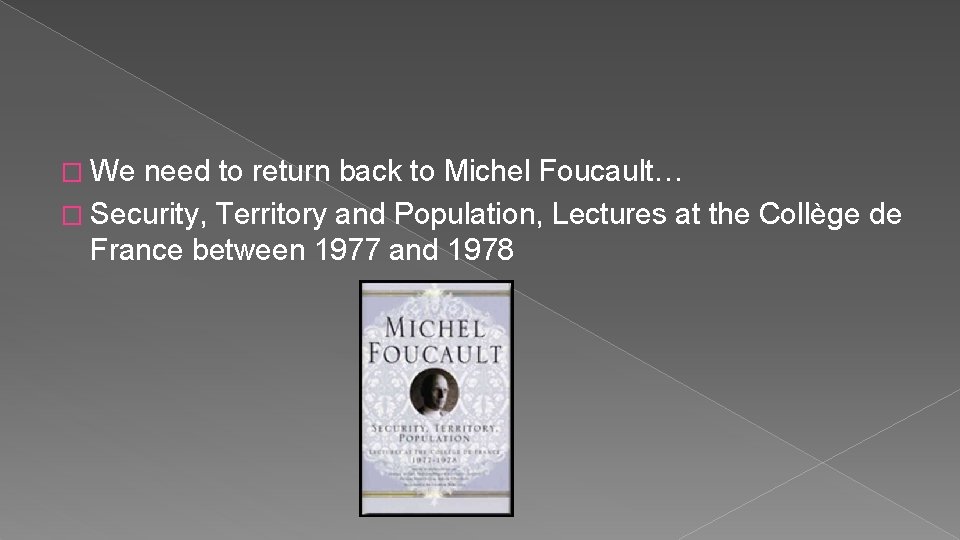
� We need to return back to Michel Foucault… � Security, Territory and Population, Lectures at the Collège de France between 1977 and 1978
Police is the apparatus (technological assemblage) that makes reason of state function – “the set of means by which the state’s forces can be increased while preserving the state in good order. ” (Foucault, Security, Territory, Population)
Police is the “laws and regulations that concern the interior of a state and which endeavour to strengthen and increase the power of this state and make good use of its forces. ” (J. H. G. von Justi, Éléments généraux de police)
� Population size (relative to territory, resource, economy) � Provision of the necessities of life (food, clothing, shelter, etc. ) � Provision of health (epidemics and everyday health) � Regulation of activity (prevention of idleness, regulation of professions, etc. ) � Circulation of things and people
� Fabrication of Order - Born of security apparatuses - Right-hand of the state - Governmentality and policing
� Neocleus (2000): � Police Begets Good Order’ � Mastering the masterless; imposing order � Mastering the market, imposing work and policing the poor � The means of regulation and surveillance of the workingclass � Social police
� Neocleus (2000) � Ordering Insecurity: � The fabrication of wage labour � Social classes, criminals and relief recipients � 19 th Poor Law � Medical police � Towards the legal reconstruction of policing practices
� Modern policing: How modern? And What is modern? � Plural policing (Loader, 2000) � Not the matter of the state, but the democratic regulation of social control � an attempt to critique policing by searching a democratic ‘public good’ in and through governance, � We’re in the age of neo-liberal order and security
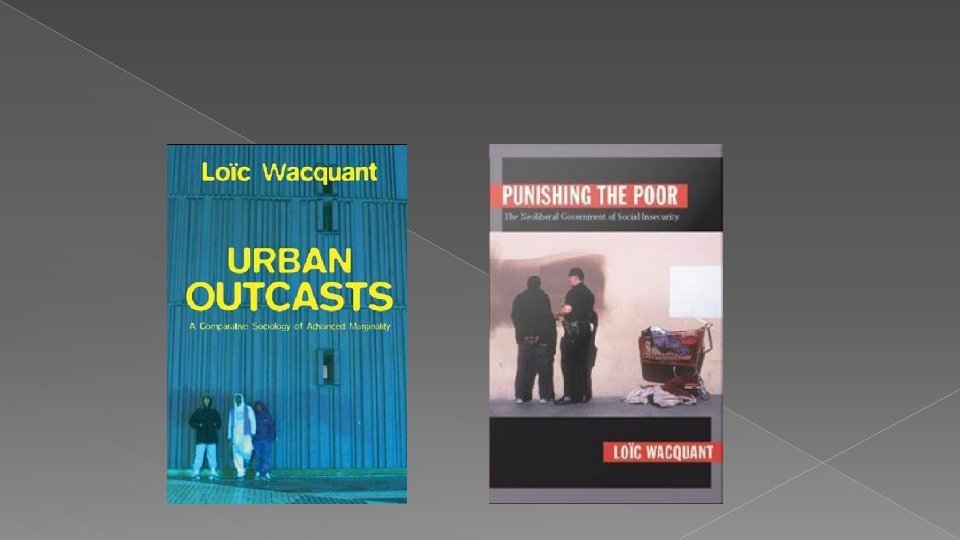
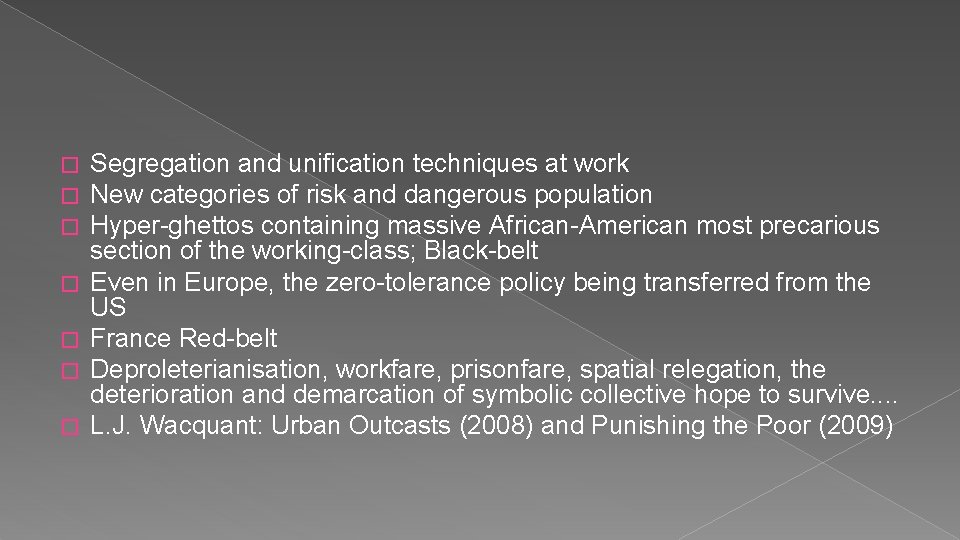
� � � � Segregation and unification techniques at work New categories of risk and dangerous population Hyper-ghettos containing massive African-American most precarious section of the working-class; Black-belt Even in Europe, the zero-tolerance policy being transferred from the US France Red-belt Deproleterianisation, workfare, prisonfare, spatial relegation, the deterioration and demarcation of symbolic collective hope to survive. . L. J. Wacquant: Urban Outcasts (2008) and Punishing the Poor (2009)
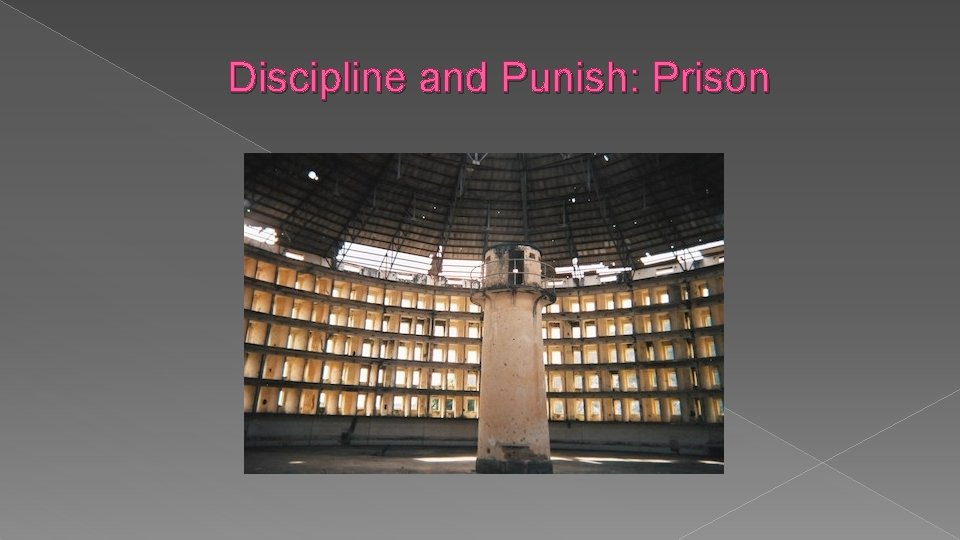
Discipline and Punish: Prison
� The emergence of the prison as the modern system of punishment - Discipline and Punish: The Birth of the Prison(Foucault, 1977) - The idea of Panopticon - Regulation of bodies and internalisation of surveillance
� D&P focuses on the language through which we know and make sense of the world (archaeology) and reveals the role of power that changes it (genealogy). � D&P presents a history of the present (Nietzsche) � The aim of such a history is to understand evaluate present rules, practices and institutions like prison. � Foucault helps us dislocate the notion of historical progress and civilisation – the transition from vengeance to rehabilitation or more medical forms
A historical transformation from torture to detention Torture was the main form of punishment Painful the interrogation and public torture (Robert Damiens in D&P) Principles of Utility (Bentham) Three elements appear in the logic of torture: the infliction of a measured amount of pain; the regulation of that pain; and the ritualistic character of the application of techniques producing pain What is the rationale of this punishment? : - the king, as the sovereign body, - He uses sovereignty � � �
the 18 th century humanism: � a group of reformers sought to change the form and content of punishment � Penalties to be regulated, proportioned and even abolished wherever they go against humanity � New logic of punishment emerged. � Punishment should regain the offender back in society and be corrective to pain inflicted on individuals or society � So punishment must be efficient, effective and humane �
“Discipline is basically the mechanism of power through which we come to control the social body in its finest elements, through which we arrive at the very atoms of society, which is to say individuals […] How to oversee someone, how to control their conduct, their behaviour, their aptitudes, how to intensify their performance, multiply their capacities, how to put them in the place where they will be most useful: this is what discipline is, in my sense” (M. Foucault, ‘The Meshes of Power’, p. 159)
The birth of the prison was the emergence of detention as a preventive form � The prison was the main form of punishment � � The punishment in the form of prison both incorporates and contradicts the ideas and aims of humanist reformers Public torture is no longer important because the aim is to modify behaviour. � A single defined punishment for all crimes instead of arbitrarily matching punishment to crime. �
� the birth of prison is merely the birth of a disciplinary society � - Some dimension of discipline can be identified: hierarchical observation, normalising judgment, Examination � � Panopticon by Bentham (1791) The birth of prison complex with all “carceral agents and institutions: social workers, psychologists, psychiatrists, judges, family doctors, personal counsellors, the legal system, and so forth
� how prison policy has changed in recent decades in the West? - The Anglo-American case � who is incarcerated in prison? - The intersection of social and criminal justice - Assistantial-carceral net (Wacquant, 2009) - Swollen population of inmates - New roles and functions of the prison
� Prison functions as a satellite of hyperghettos � Containment of massive wage-labour population � Ethno-racial and socio-economic, multidimensional means of control � Huge numbers of inmate population in the US � Neo-liberal governmental technology to keep deproleterianised population within workfare � The emergence of prisonfare � Social & criminal justice (worfare + prisonfare)
- Slides: 25