
Crime and Mass Incarceration Reform or a new
- Slides: 35
Crime and Mass Incarceration: Reform or a ‘new normal’? Dr. Paul Leighton Eastern Michigan University Osher Lifelong Learning Institute lecture, January 21, 2016 Pauls. Justice. Page. com
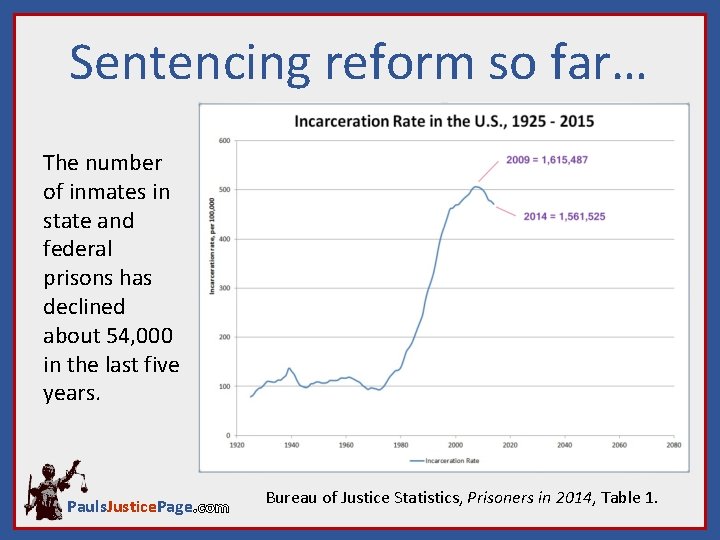
Sentencing reform so far… The number of inmates in state and federal prisons has declined about 54, 000 in the last five years. Pauls. Justice. Page. com Bureau of Justice Statistics, Prisoners in 2014, Table 1.
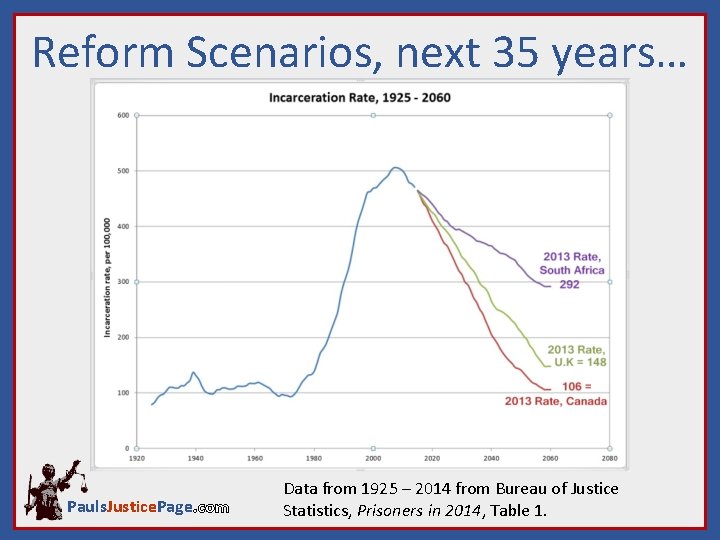
Reform Scenarios, next 35 years… Pauls. Justice. Page. com Data from 1925 – 2014 from Bureau of Justice Statistics, Prisoners in 2014, Table 1.
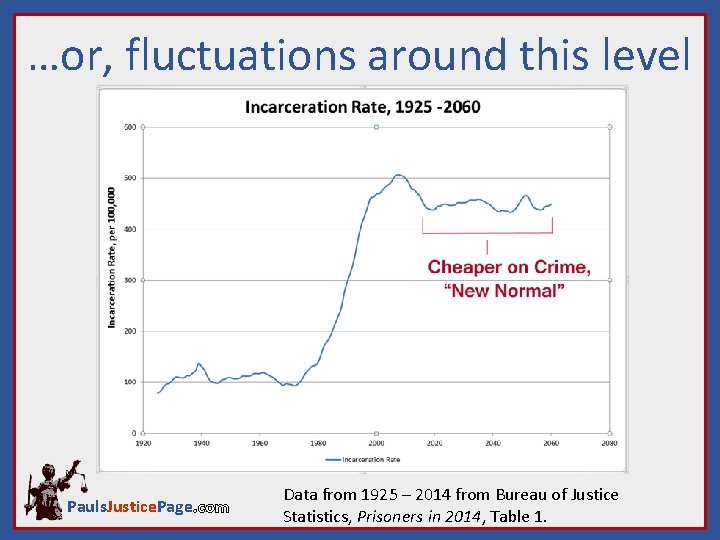
…or, fluctuations around this level Pauls. Justice. Page. com Data from 1925 – 2014 from Bureau of Justice Statistics, Prisoners in 2014, Table 1.
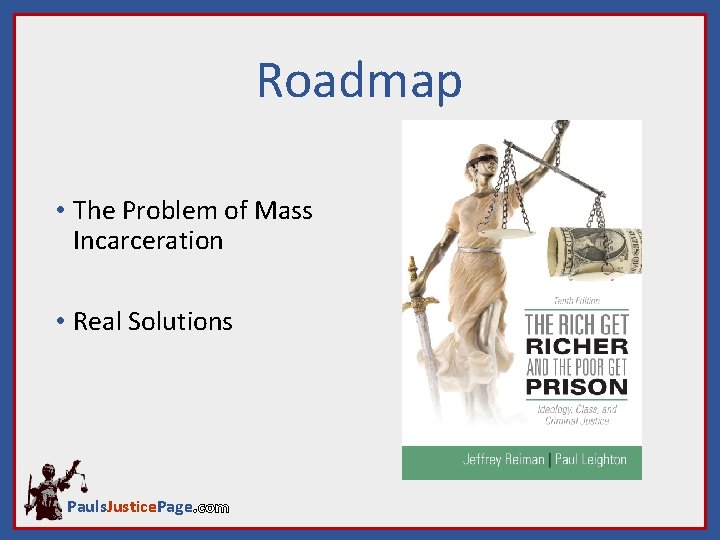
Roadmap • The Problem of Mass Incarceration • Real Solutions Pauls. Justice. Page. com
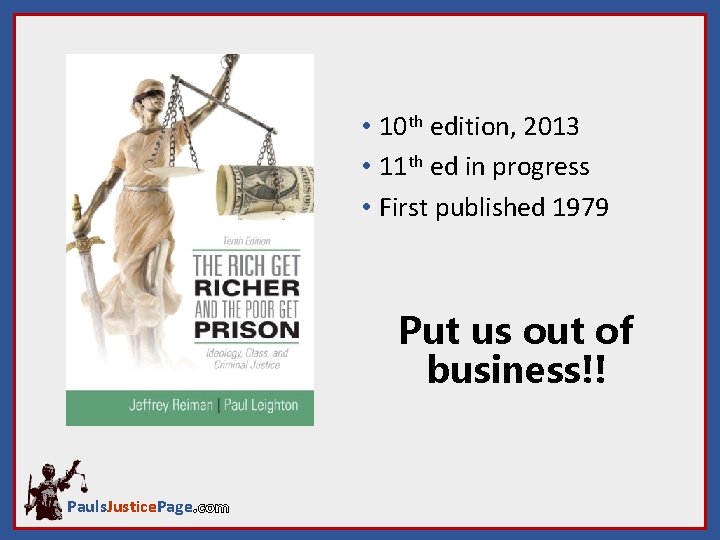
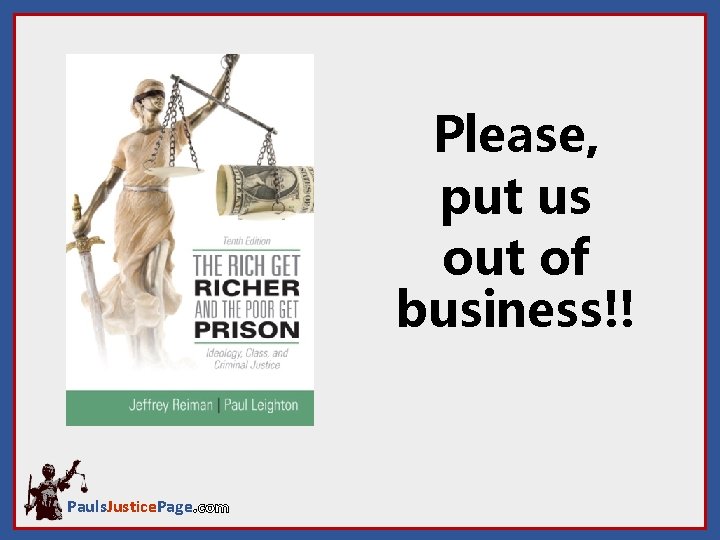
• 10 th edition, 2013 • 11 th ed in progress • First published 1979 Put us out of business!! Pauls. Justice. Page. com
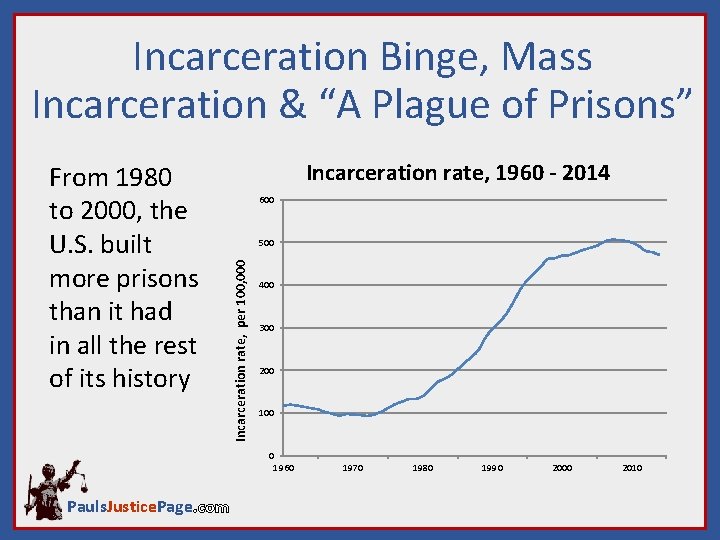
Incarceration Binge, Mass Incarceration & “A Plague of Prisons” Incarceration rate, 1960 - 2014 600 500 Incarceration rate, per 100, 000 From 1980 to 2000, the U. S. built more prisons than it had in all the rest of its history 400 300 200 100 0 1960 Pauls. Justice. Page. com 1970 1980 1990 2000 2010
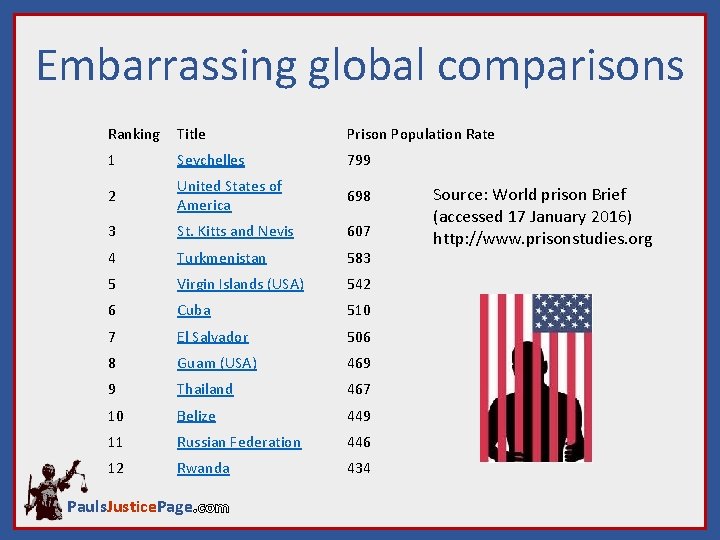
Embarrassing global comparisons Ranking Title Prison Population Rate 1 Seychelles 799 2 United States of America 698 3 St. Kitts and Nevis 607 4 Turkmenistan 583 5 Virgin Islands (USA) 542 6 Cuba 510 7 El Salvador 506 8 Guam (USA) 469 9 Thailand 467 10 Belize 449 11 Russian Federation 446 12 Rwanda 434 Pauls. Justice. Page. com Source: World prison Brief (accessed 17 January 2016) http: //www. prisonstudies. org
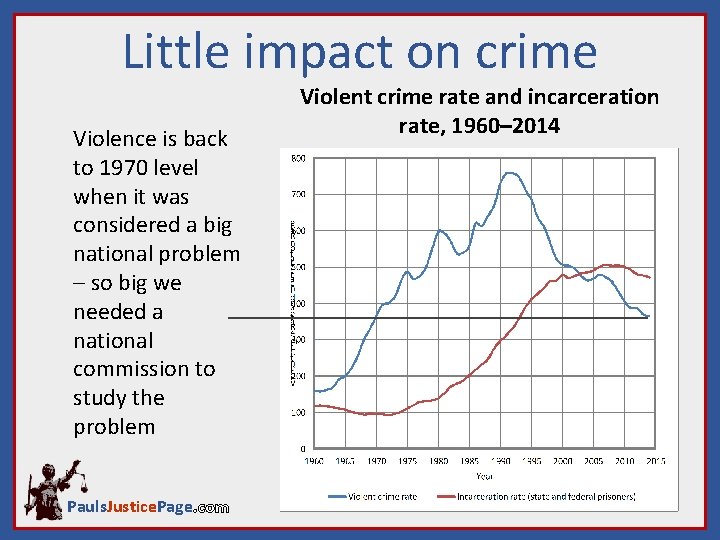
Little impact on crime Violence is back to 1970 level when it was considered a big national problem – so big we needed a national commission to study the problem Pauls. Justice. Page. com Violent crime rate and incarceration rate, 1960– 2014
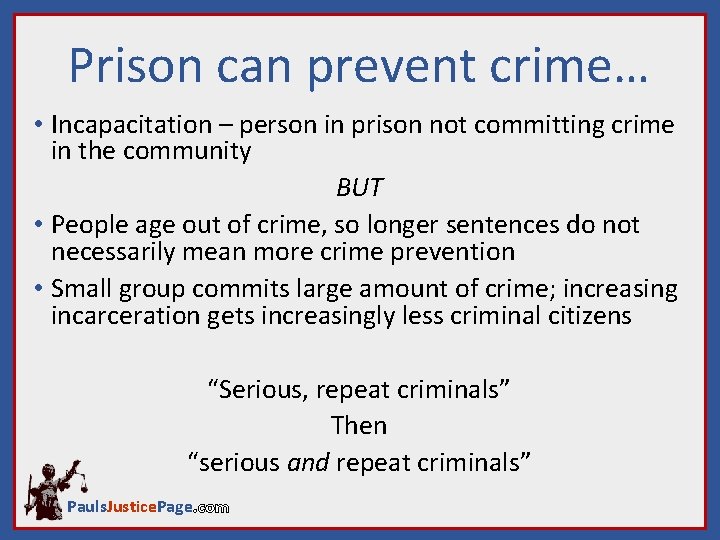
Prison can prevent crime… • Incapacitation – person in prison not committing crime in the community BUT • People age out of crime, so longer sentences do not necessarily mean more crime prevention • Small group commits large amount of crime; increasing incarceration gets increasingly less criminal citizens “Serious, repeat criminals” Then “serious and repeat criminals” Pauls. Justice. Page. com
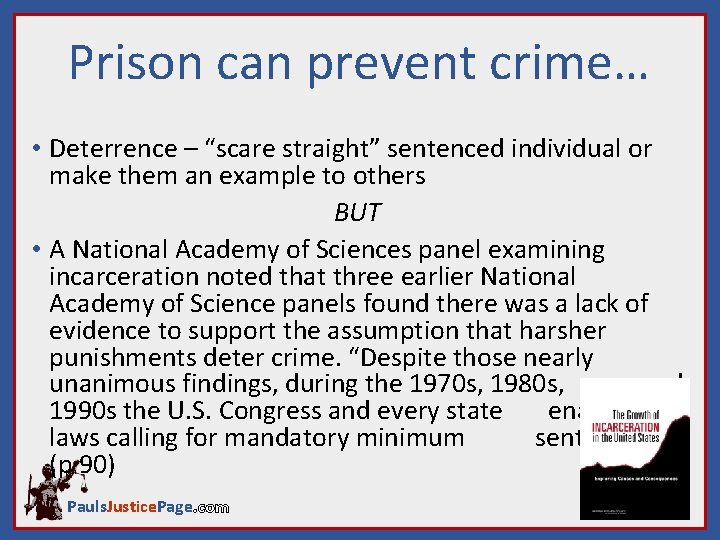
Prison can prevent crime… • Deterrence – “scare straight” sentenced individual or make them an example to others BUT • A National Academy of Sciences panel examining incarceration noted that three earlier National Academy of Science panels found there was a lack of evidence to support the assumption that harsher punishments deter crime. “Despite those nearly unanimous findings, during the 1970 s, 1980 s, and 1990 s the U. S. Congress and every state enacted laws calling for mandatory minimum sentences. ” (p 90) Pauls. Justice. Page. com
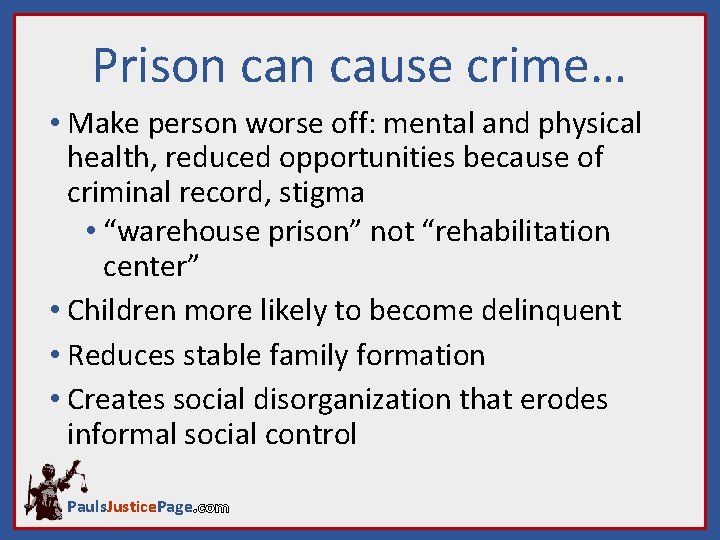
Prison cause crime… • Make person worse off: mental and physical health, reduced opportunities because of criminal record, stigma • “warehouse prison” not “rehabilitation center” • Children more likely to become delinquent • Reduces stable family formation • Creates social disorganization that erodes informal social control Pauls. Justice. Page. com
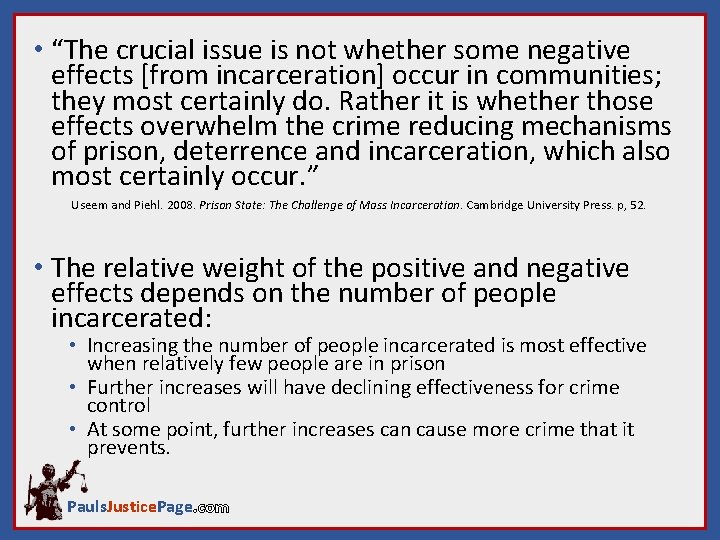
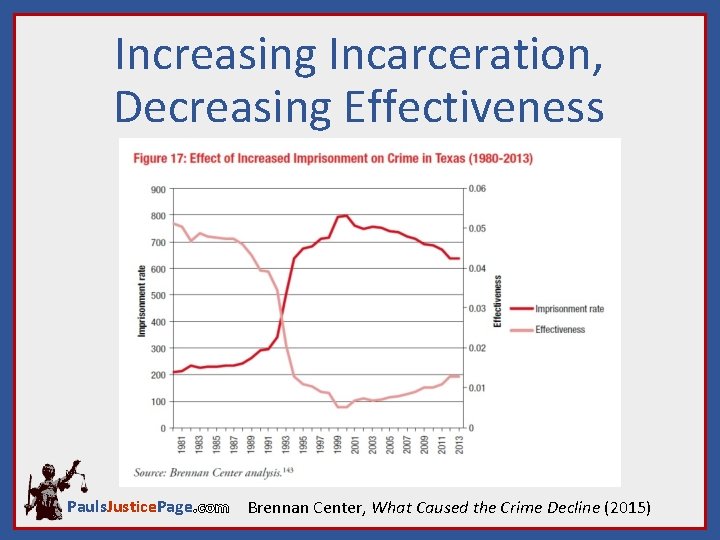
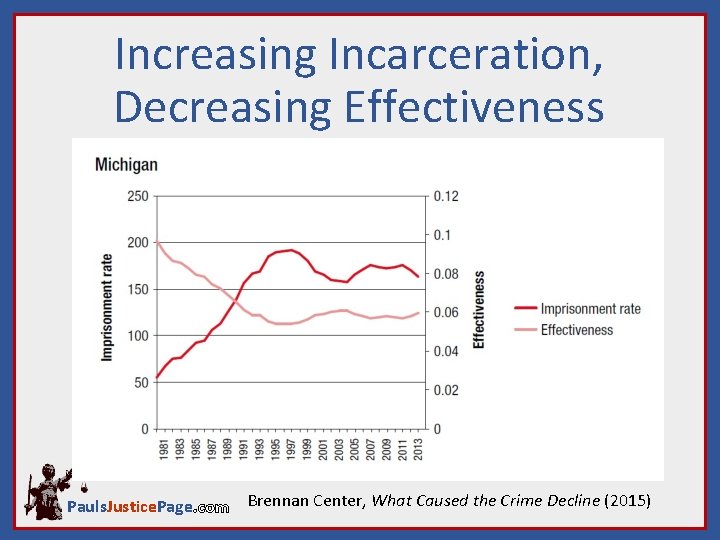
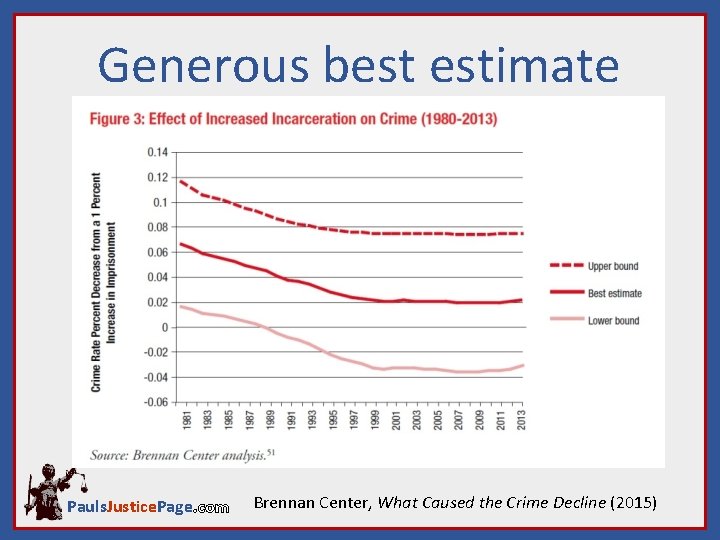
• “The crucial issue is not whether some negative effects [from incarceration] occur in communities; they most certainly do. Rather it is whether those effects overwhelm the crime reducing mechanisms of prison, deterrence and incarceration, which also most certainly occur. ” Useem and Piehl. 2008. Prison State: The Challenge of Mass Incarceration. Cambridge University Press. p, 52. • The relative weight of the positive and negative effects depends on the number of people incarcerated: • Increasing the number of people incarcerated is most effective when relatively few people are in prison • Further increases will have declining effectiveness for crime control • At some point, further increases can cause more crime that it prevents. Pauls. Justice. Page. com
Increasing Incarceration, Decreasing Effectiveness Pauls. Justice. Page. com Brennan Center, What Caused the Crime Decline (2015)
Increasing Incarceration, Decreasing Effectiveness Pauls. Justice. Page. com Brennan Center, What Caused the Crime Decline (2015)
Generous best estimate Pauls. Justice. Page. com Brennan Center, What Caused the Crime Decline (2015)
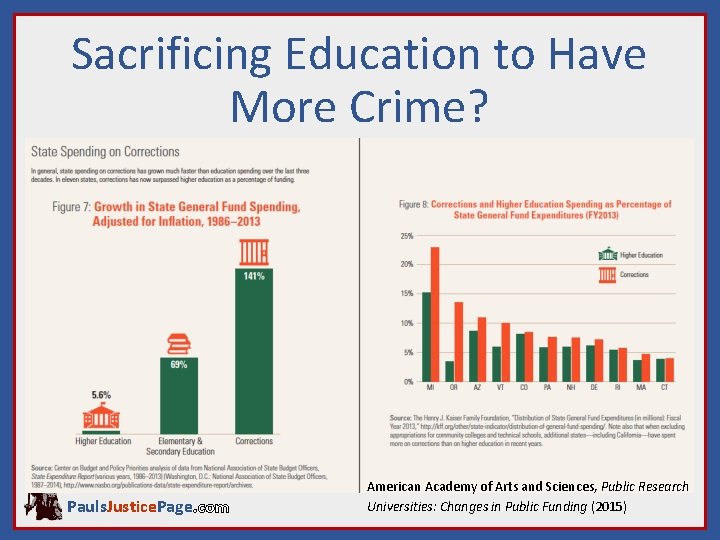
Sacrificing Education to Have More Crime? Pauls. Justice. Page. com American Academy of Arts and Sciences, Public Research Universities: Changes in Public Funding (2015)
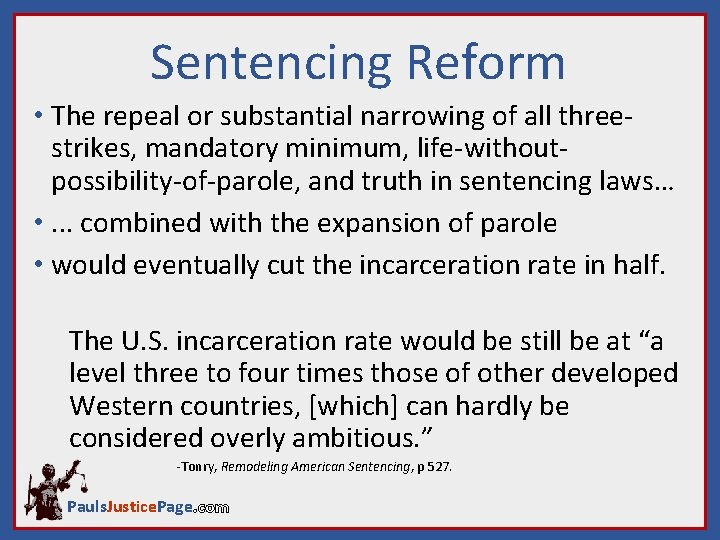
Sentencing Reform • The repeal or substantial narrowing of all threestrikes, mandatory minimum, life-withoutpossibility-of-parole, and truth in sentencing laws… • . . . combined with the expansion of parole • would eventually cut the incarceration rate in half. The U. S. incarceration rate would be still be at “a level three to four times those of other developed Western countries, [which] can hardly be considered overly ambitious. ” -Tonry, Remodeling American Sentencing, p 527. Pauls. Justice. Page. com
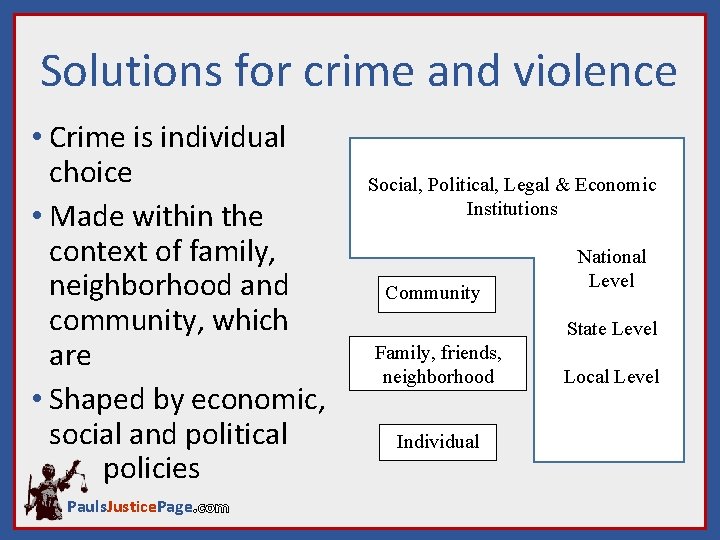
Solutions for crime and violence • Crime is individual choice • Made within the context of family, neighborhood and community, which are • Shaped by economic, social and political policies Pauls. Justice. Page. com Social, Political, Legal & Economic Institutions Community National Level State Level Family, friends, neighborhood Individual Local Level
Solutions for crime and violence • “four priorities seem especially critical: preventing child abuse and neglect, enhancing children’s intellectual and social development, providing support and guidance to vulnerable adolescents, and working extensively with juvenile offenders. ” -Currie, Crime and Punishment in America, p. 81 “the best of [the programs] work, and they work remarkably well given how limited and underfunded they usually are. ” p 98 Pauls. Justice. Page. com
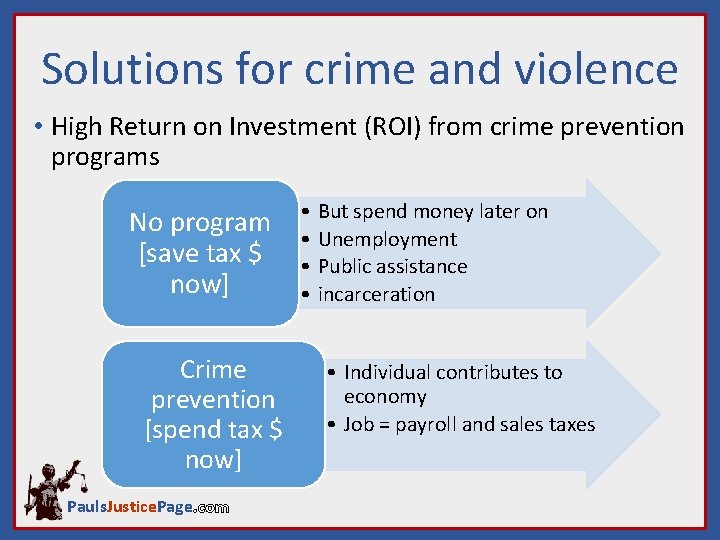
Solutions for crime and violence • High Return on Investment (ROI) from crime prevention programs No program [save tax $ now] Crime prevention [spend tax $ now] Pauls. Justice. Page. com • • But spend money later on Unemployment Public assistance incarceration • Individual contributes to economy • Job = payroll and sales taxes
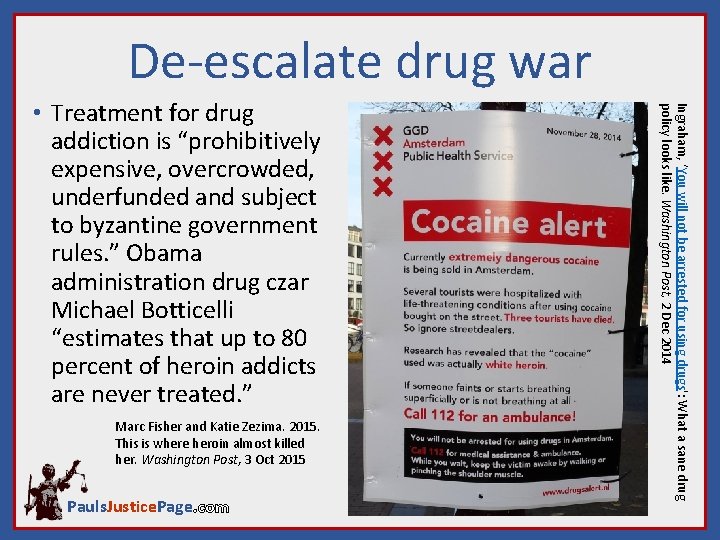
De-escalate drug war Marc Fisher and Katie Zezima. 2015. This is where heroin almost killed her. Washington Post, 3 Oct 2015 Pauls. Justice. Page. com Ingraham, ‘You will not be arrested for using drugs': What a sane drug policy looks like. Washington Post, 2 Dec 2014 • Treatment for drug addiction is “prohibitively expensive, overcrowded, underfunded and subject to byzantine government rules. ” Obama administration drug czar Michael Botticelli “estimates that up to 80 percent of heroin addicts are never treated. ”
De-escalate drug war • In 2001 Portugal eliminated criminal penalties for all drugs in amounts for personal use. • Possession still triggers a hearing before the Commission for the Dissuasion of Drug Addiction, a three-person tribunal that discourages drug use and encourages addicts to get treatment. • An evaluation found reductions in problematic drug use and concludes that Portugal’s experience demonstrates that—contrary to some predictions— decriminalization does not inevitably lead to rises in drug use. It can reduce the burden upon the criminal justice system. It can further contribute to social and health benefits. Moreover, such effects can be observed when decriminalizing all illicit drugs. This is important, as decriminalization is commonly restricted to cannabis alone. Pauls. Justice. Page. com Hughes and Steven. 2010. What Can We Learn From The Portuguese Decriminalization Of Illicit Drugs? British Journal of Criminology, 50(6), p. 1016.
Remove lead • Neurotoxin – poisons brain cells and connections • No safe level, accumulates [childhood exposure esp problematic] • Lower IQ, attention deficit, impulsivity, homicide rates, delinquency, and violent crime (Barrett, Lead and Crime. Oxford Bibliographies in Criminology. 2013) Lead abatement leads to permanent crime reduction of “at least 10 percent. All the other cognitive and health benefits would be gravy. It’s hard to imagine any other crime-control expenditure with anything like that much bang for the buck. ” Kleiman, Smart on Crime. Democracy: A Journal of Ideas. Spring 2013. Pauls. Justice. Page. com
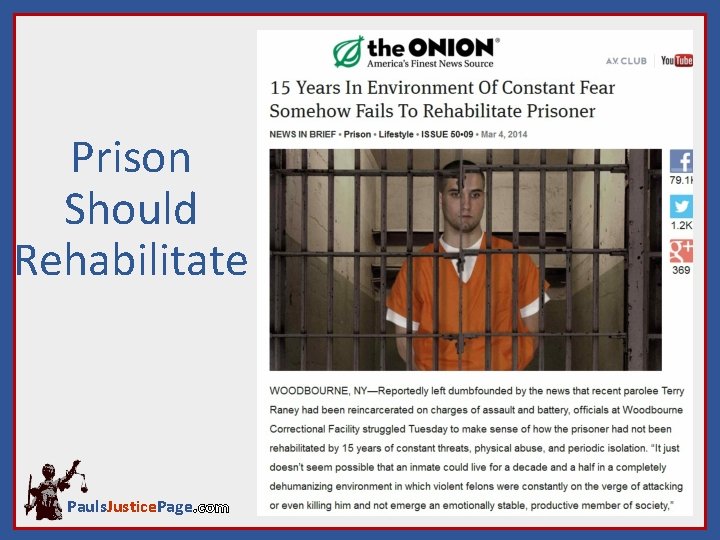
Prison Should Rehabilitate Pauls. Justice. Page. com
Reduce Inequality • Not “just” poverty – inequality, relative deprivation and concentrated disadvantage “Inequality worsens both crimes of poverty motivated by need and crimes of wealth motivated by greed” Braithwaite, Poverty Power and White Collar Crime, in Schlegel and Weisburd, White-Collar Crime Reconsidered. Northeastern University Press (1992). Pauls. Justice. Page. com
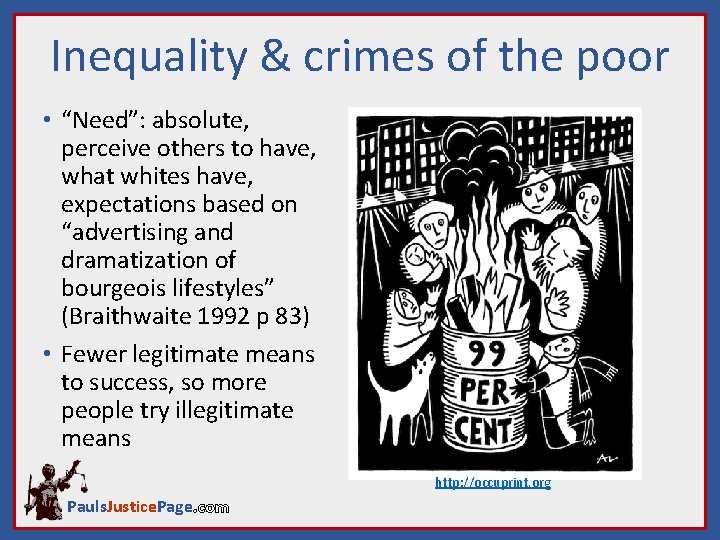
Inequality & crimes of the poor • “Need”: absolute, perceive others to have, what whites have, expectations based on “advertising and dramatization of bourgeois lifestyles” (Braithwaite 1992 p 83) • Fewer legitimate means to success, so more people try illegitimate means http: //occuprint. org Pauls. Justice. Page. com
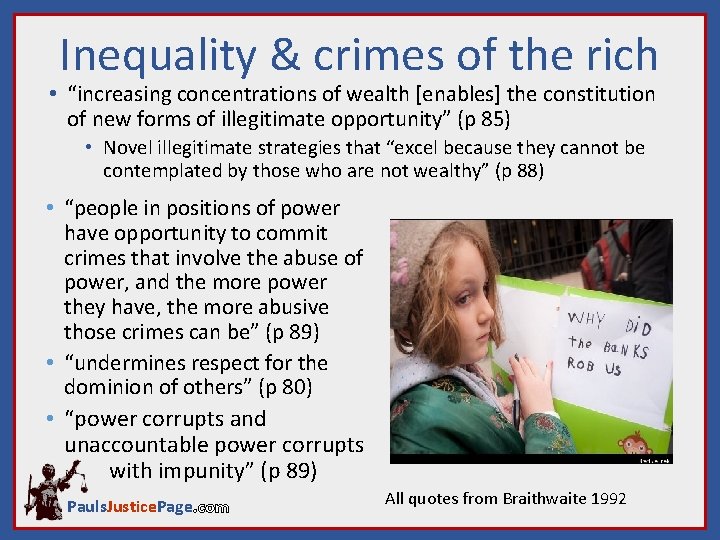
Inequality & crimes of the rich • “increasing concentrations of wealth [enables] the constitution of new forms of illegitimate opportunity” (p 85) • Novel illegitimate strategies that “excel because they cannot be contemplated by those who are not wealthy” (p 88) • “people in positions of power have opportunity to commit crimes that involve the abuse of power, and the more power they have, the more abusive those crimes can be” (p 89) • “undermines respect for the dominion of others” (p 80) • “power corrupts and unaccountable power corrupts with impunity” (p 89) Pauls. Justice. Page. com All quotes from Braithwaite 1992
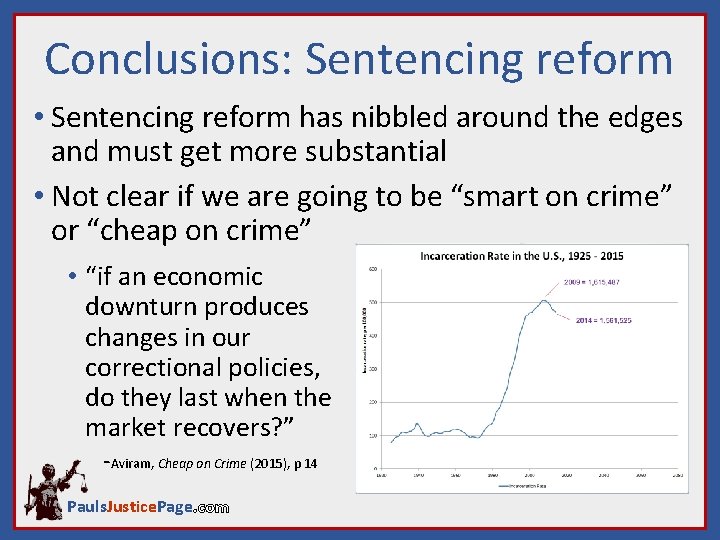
Conclusions: Sentencing reform • Sentencing reform has nibbled around the edges and must get more substantial • Not clear if we are going to be “smart on crime” or “cheap on crime” • “if an economic downturn produces changes in our correctional policies, do they last when the market recovers? ” -Aviram, Cheap on Crime (2015), p 14 Pauls. Justice. Page. com
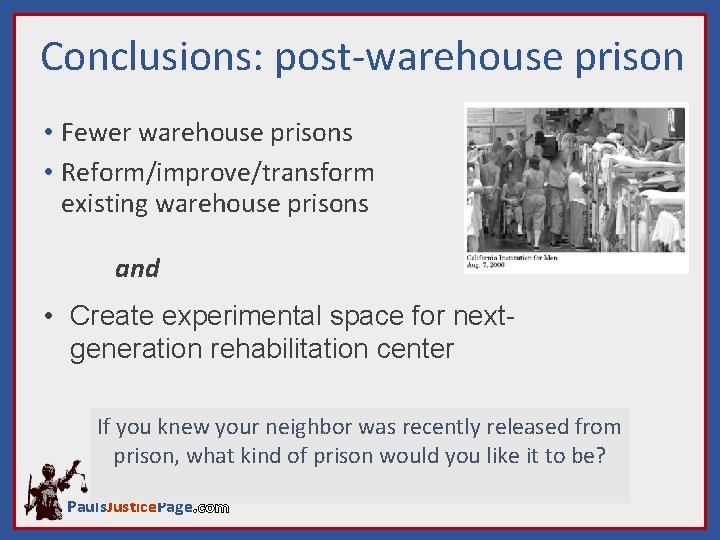
Conclusions: post-warehouse prison • Fewer warehouse prisons • Reform/improve/transform existing warehouse prisons and • Create experimental space for nextgeneration rehabilitation center If you knew your neighbor was recently released from prison, what kind of prison would you like it to be? Pauls. Justice. Page. com
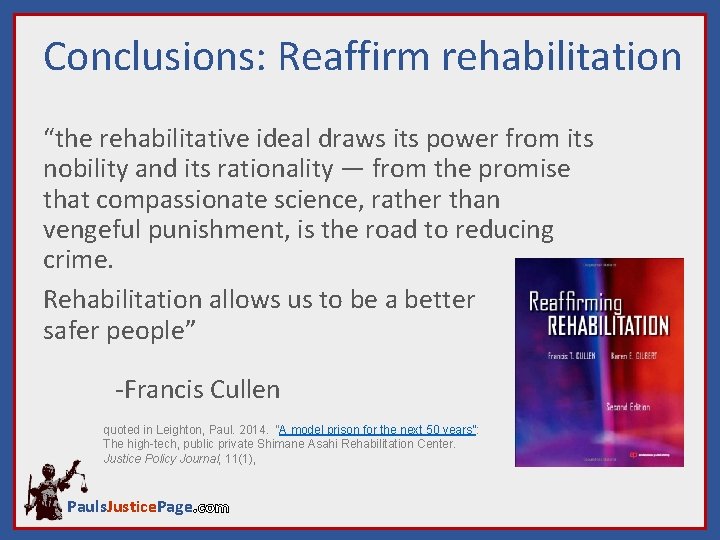
Conclusions: Reaffirm rehabilitation “the rehabilitative ideal draws its power from its nobility and its rationality — from the promise that compassionate science, rather than vengeful punishment, is the road to reducing crime. Rehabilitation allows us to be a better and safer people” -Francis Cullen quoted in Leighton, Paul. 2014. “A model prison for the next 50 years”: The high-tech, public private Shimane Asahi Rehabilitation Center. Justice Policy Journal, 11(1), Pauls. Justice. Page. com
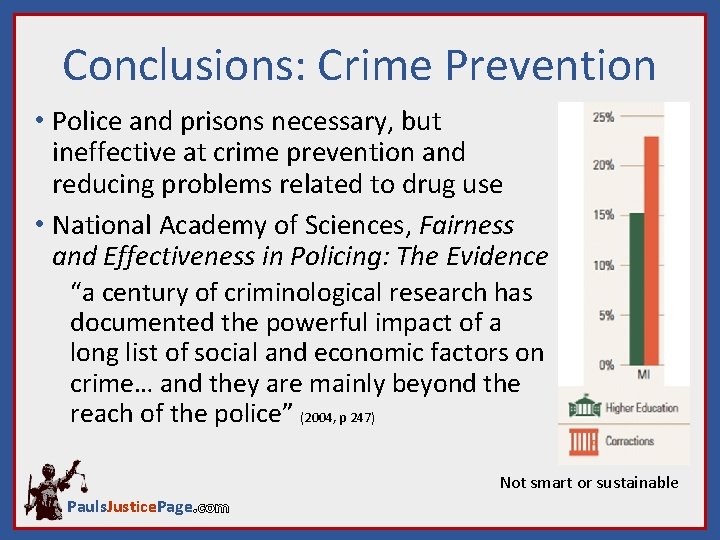
Conclusions: Crime Prevention • Police and prisons necessary, but ineffective at crime prevention and reducing problems related to drug use • National Academy of Sciences, Fairness and Effectiveness in Policing: The Evidence “a century of criminological research has documented the powerful impact of a long list of social and economic factors on crime… and they are mainly beyond the reach of the police” (2004, p 247) Not smart or sustainable Pauls. Justice. Page. com
Conclusions: Crime Prevention • Invest in crime prevention • Hundreds of evidence-based programs for individuals, families – need the political will to spend on them • Changes to produce more social and economic justice – need the political to make changes “We are called upon to raise certain basic questions about the whole society” MLK, as quoted in Alexander, The New Jim Crow (2012), p 259. Pauls. Justice. Page. com
Please, put us out of business!! Pauls. Justice. Page. com
Dr. Paul Leighton is a professor in the Department of Sociology, Anthropology & Criminology at Eastern Michigan University. More information about him is available on his website, http: //paulsjusticepage. com/pauls-cv. htm See also: The Problems With Private Prisons, http: //www. paulsjusticeblog. com/2013/04/the_problems_with_private_prisons. php Prison Privatization in the U. S. and Japan (2014 OLLI lecture) http: //www. paulsjusticeblog. com/2014/06/we_need_a_postwarehouse_prison. php Pauls. Justice. Page. com