
Cricket Umpiring Levels Module 2 1 Incorporating the
- Slides: 63
Cricket Umpiring Levels Module 2. 1 Incorporating the MCC Laws of Cricket 2000 code - 4 th edition 2010
Level 2 Here we take the preliminary steps to become a recognised umpire By necessity, some issues covered in the Level 1 modules must be repeated here – but in more detail Other issues will also be covered, these include Matches played on artificial pitches Limited-over matches Umpiring techniques Scoring Level 2 comprises three modules 2
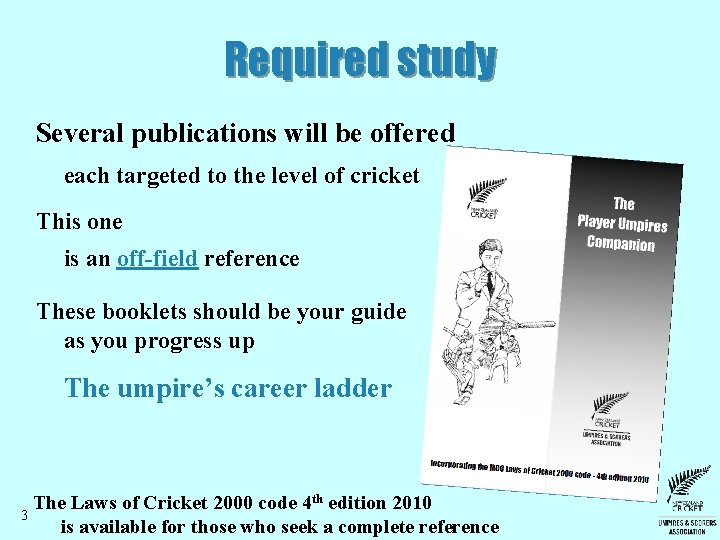
Required study Several publications will be offered each targeted to the level of cricket This one is an off-field reference These booklets should be your guide as you progress up The umpire’s career ladder The Laws of Cricket 2000 code 4 th edition 2010 3 is available for those who seek a complete reference
Cricket Law Cricket has 42 Laws however, none stand alone Every Law has linkages to others - sometimes to several Complicating matters even further the Laws can be varied by agreement between captains or by Regulations, or by Playing Conditions, published by competition administrators In these modules, we deal mainly with Cricket Law and some of the accepted provisions applicable to Limited-Over Matches – F 50 & T 20 matches Matches that are played to Overs, Overs rather than to Time 4
Umpires should know all the correct terms used in cricket How to assume the responsibilities of an umpire Know their responsibilities to match authorities, the groundsman, their umpiring colleague and to the scorers How and when to communicate to their colleague How and when to communicate to the scorers and to wait for acknowledgement of each separate signal What constitutes a complete innings What is required if a mistake in scoring occurs, and How a result can be achieved 5
The Spirit of Cricket At first reading of the Spirit of Cricket one could easily gain the impression that it has been written solely for players Clearly this is not so It is equally important for umpires too The umpires are the guardians of the Spirit alongside the captains The Spirit of Cricket is compulsory reading for everyone 6 If everyone follows the Spirit of Cricket then everyone will enjoy their game
The Spirit of Cricket is compulsory reading for everyone - it sets the tone of a match and our role in it - it confirms the captain, is responsible for the conduct of his team - it confirms the umpires, are the sole judges of fair & unfair play - it requires the umpires, to intervene if there any unfair acts - it requires the highest standards of sportsmanship - it confirms that there is no room for any form of bad behaviour - it confirms that there is no place for violence in any form - it confirms that captains & umpires, together set the tone of the conduct of a match and expects every player to contribute to this In short, the Spirit of Cricket sets the guidelines to ensure every participant enjoys their game 7
The Spirit of Cricket As umpires, you must only intervene when called upon either on Appeal or when the Laws require Always remember the order of the first four laws Law 1 - deals with the players Law 2 - deals with substitutes & runners Law 3 - deals with the umpires Law 4 - deals with the scorers Clearly we are being told that cricket is a game first & foremost for players 8 then the umpires
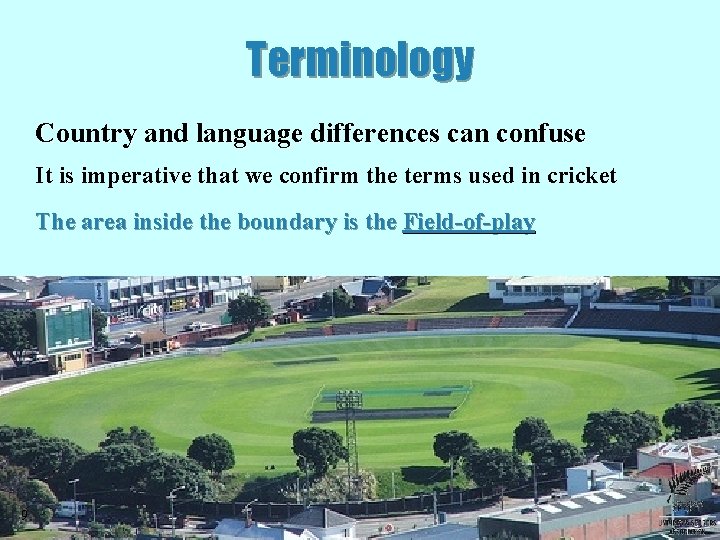
Terminology Country and language differences can confuse It is imperative that we confirm the terms used in cricket The area inside the boundary is the Field-of-play 9
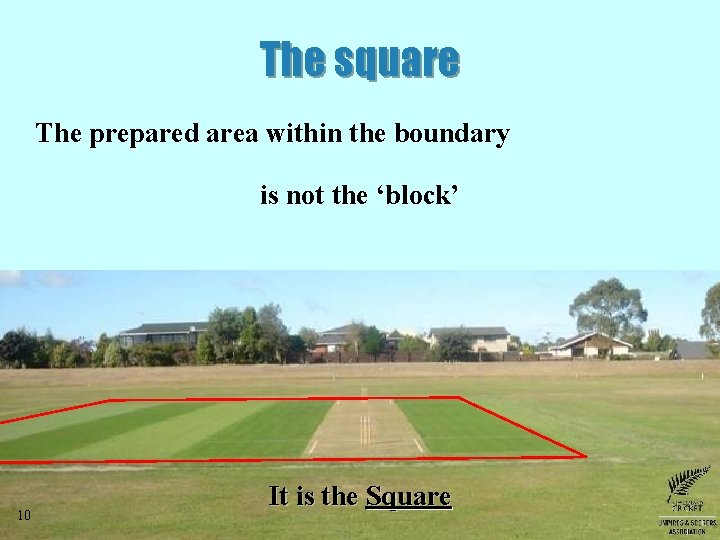
The square The prepared area within the boundary is not the ‘block’ 10 It is the Square
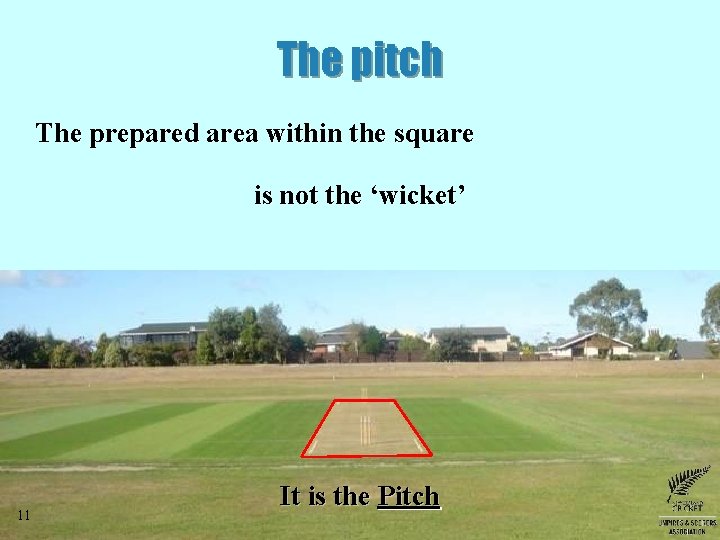
The pitch The prepared area within the square is not the ‘wicket’ 11 It is the Pitch
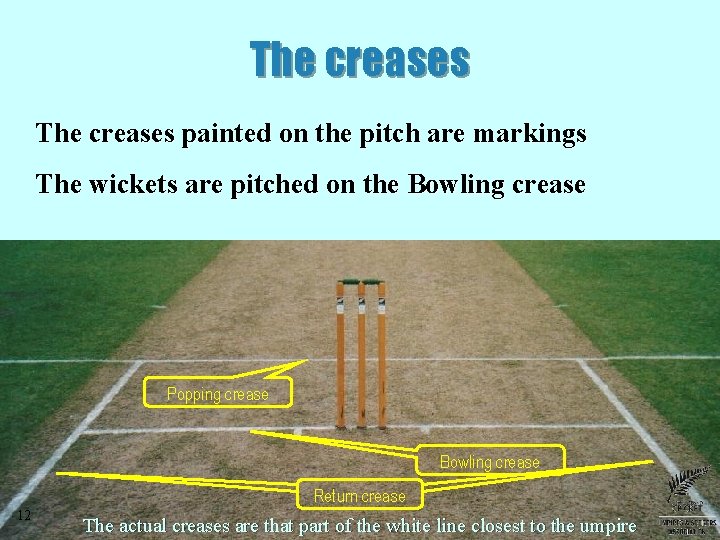
The creases painted on the pitch are markings The wickets are pitched on the Bowling crease Popping crease Bowling crease Return crease 12 The actual creases are that part of the white line closest to the umpire
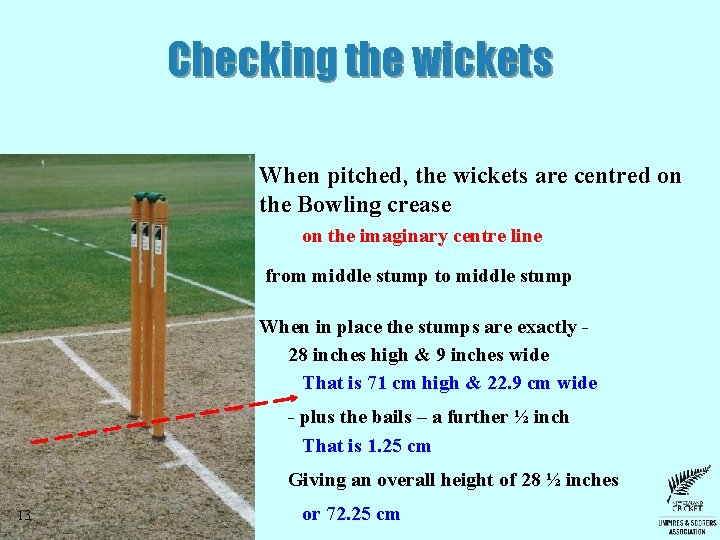
Checking the wickets When pitched, the wickets are centred on the Bowling crease on the imaginary centre line from middle stump to middle stump When in place the stumps are exactly 28 inches high & 9 inches wide That is 71 cm high & 22. 9 cm wide - plus the bails – a further ½ inch That is 1. 25 cm Giving an overall height of 28 ½ inches 13 or 72. 25 cm
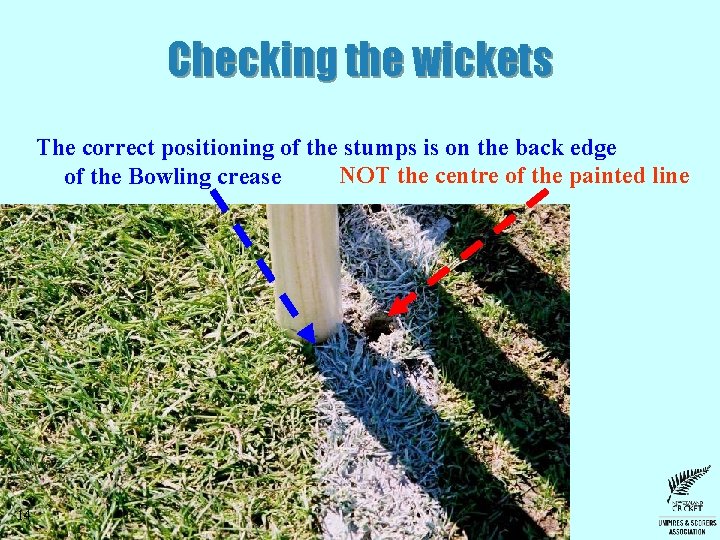
Checking the wickets The correct positioning of the stumps is on the back edge NOT the centre of the painted line of the Bowling crease 14
The Umpires Appointment of umpires Two umpires must be appointed before the toss one for each end - not one for each team If you are a player you cease to be a player when you take the role of umpire Umpires must report to the ground no later than 45 minutes before the scheduled time to start play 15
The Umpires Changing an umpire After the toss an umpire cannot be changed except in cases of illness, injury or exceptional circumstances If replaced, the replacement umpire must stand at the STRIKER’S END unless BOTH captains agree otherwise This may be negated by competition regulations 16
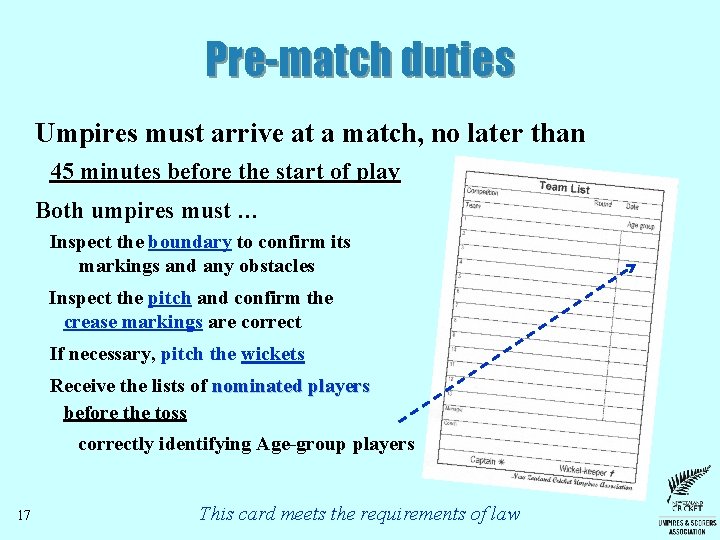
Pre-match duties Umpires must arrive at a match, no later than 45 minutes before the start of play Both umpires must … Inspect the boundary to confirm its markings and any obstacles Inspect the pitch and confirm the crease markings are correct If necessary, pitch the wickets Receive the lists of nominated players before the toss correctly identifying Age-group players 17 This card meets the requirements of law
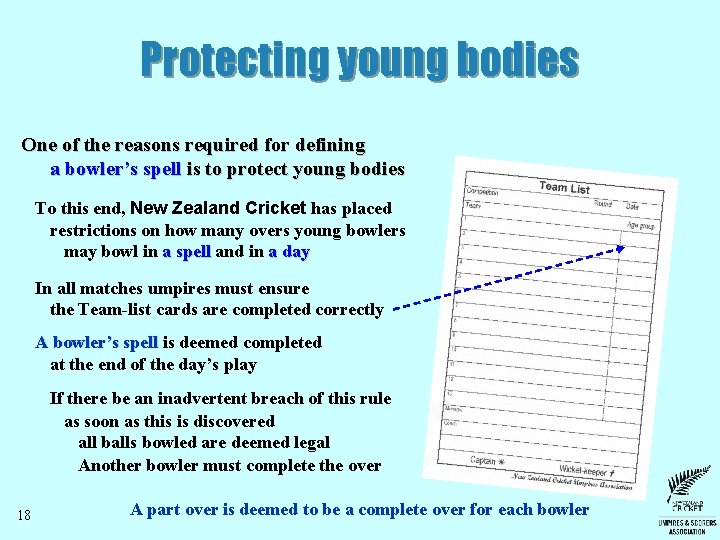
Protecting young bodies One of the reasons required for defining a bowler’s spell is to protect young bodies To this end, New Zealand Cricket has placed restrictions on how many overs young bowlers may bowl in a spell and in a day In all matches umpires must ensure the Team-list cards are completed correctly A bowler’s spell is deemed completed at the end of the day’s play If there be an inadvertent breach of this rule as soon as this is discovered all balls bowled are deemed legal Another bowler must complete the over 18 A part over is deemed to be a complete over for each bowler
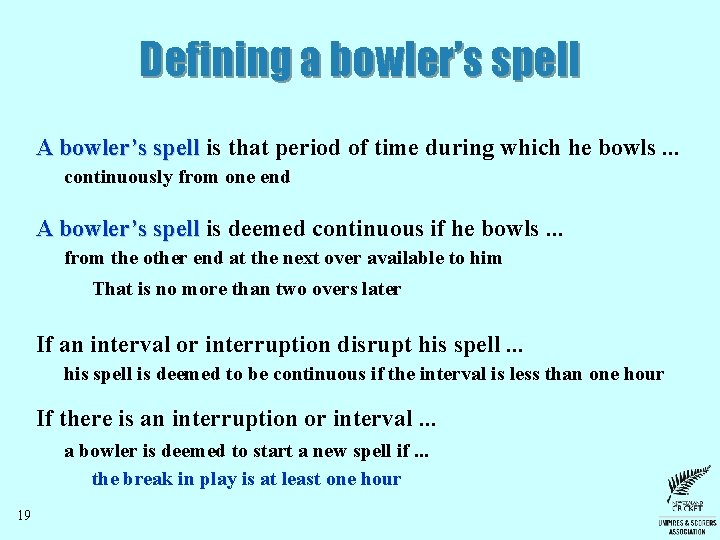
Defining a bowler’s spell A bowler’s spell is that period of time during which he bowls. . . continuously from one end A bowler’s spell is deemed continuous if he bowls. . . from the other end at the next over available to him That is no more than two overs later If an interval or interruption disrupt his spell. . . his spell is deemed to be continuous if the interval is less than one hour If there is an interruption or interval. . . a bowler is deemed to start a new spell if. . . the break in play is at least one hour 19
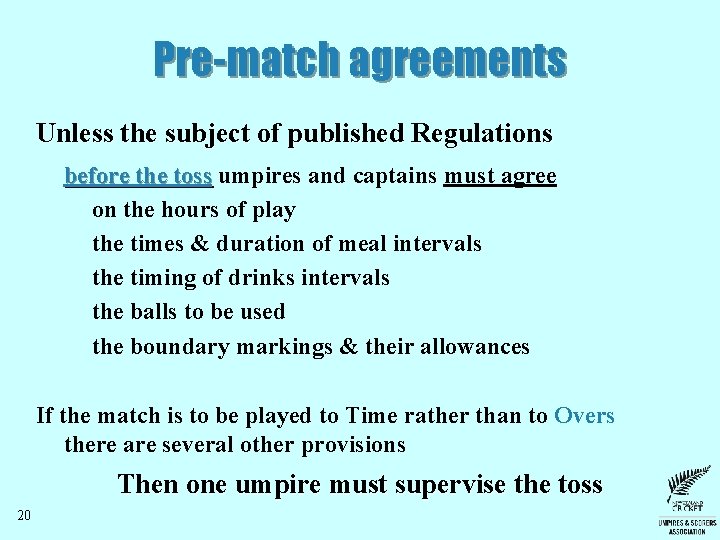
Pre-match agreements Unless the subject of published Regulations before the toss umpires and captains must agree on the hours of play the times & duration of meal intervals the timing of drinks intervals the balls to be used the boundary markings & their allowances If the match is to be played to Time rather than to Overs there are several other provisions Then one umpire must supervise the toss 20
Pre-match agreements Before the toss umpires and captains must agree on any special playing conditions any bowling or fielding restrictions any local customs – boundaries, trees etc and clarify the competition regulations It can be seen that the umpires must be completely conversant with the Laws and the competition Regulations This can only happen with regular reading & study of the Laws and the Regulations 21
Informing the captains Before the toss umpires must agree and inform both captains of the master clock or watch to be used the umpires’ watches MUST be synchronised with the master time-piece which shall be the back-up time-piece the boundary allowances what happens if the ball makes contact with any obstacle (trees etc) inside the boundary Alternatively, what local provisions apply 22
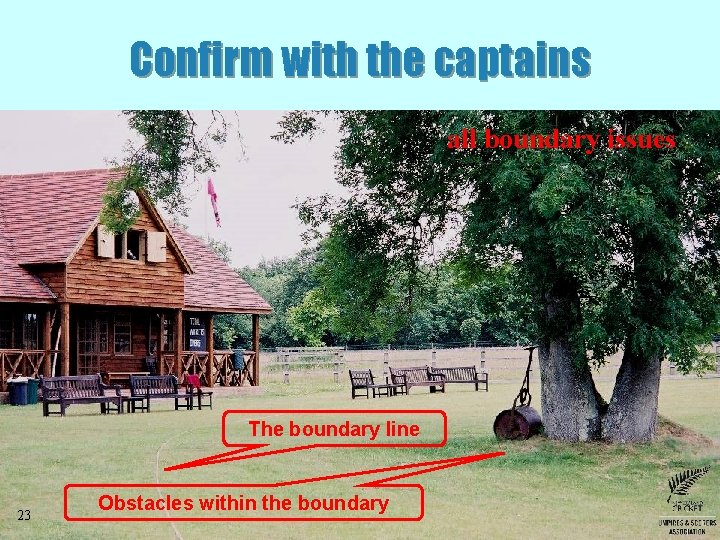
Confirm with the captains all boundary issues The boundary line 23 Obstacles within the boundary
The umpires must advise the scorers of all the matters agreed with the captains including which master clock or watch is to be used the scorers’ should synchronise theirs accordingly which is the back-up timepiece the hours of play 24 the times & duration of meal intervals the times of drinks intervals boundary markings & their allowances obstacles within the field of play and the allowances applicable any special provision
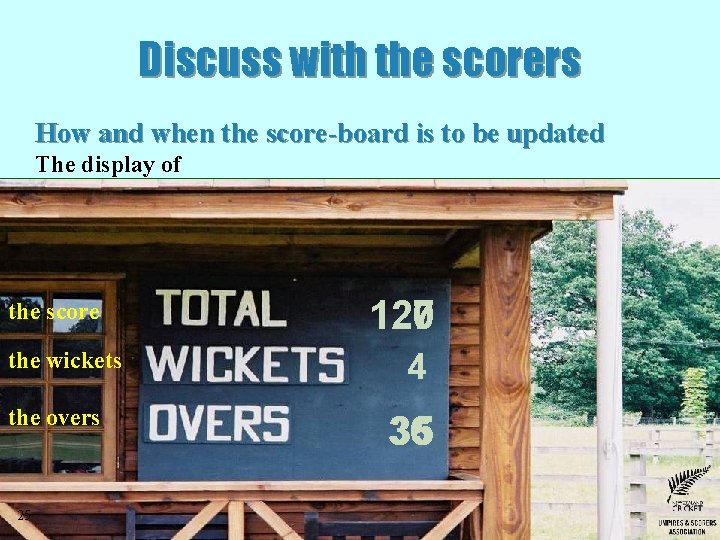
Discuss with the scorers How and when the score-board is to be updated The display of the score the wickets the overs 25 120 127 4 36 35
Updating the score-board is NOT the scorers’ duty With members of the batting side available it is not unreasonable to expect them to fulfil this duty The scorers are there to score. . . however, they should be able to ensure the score-board is updated – at least at the end of every over Being responsible for the score the umpires must keep an over-view of the progress of the score-board, and if necessary, instruct the off-field batsmen to update it 26
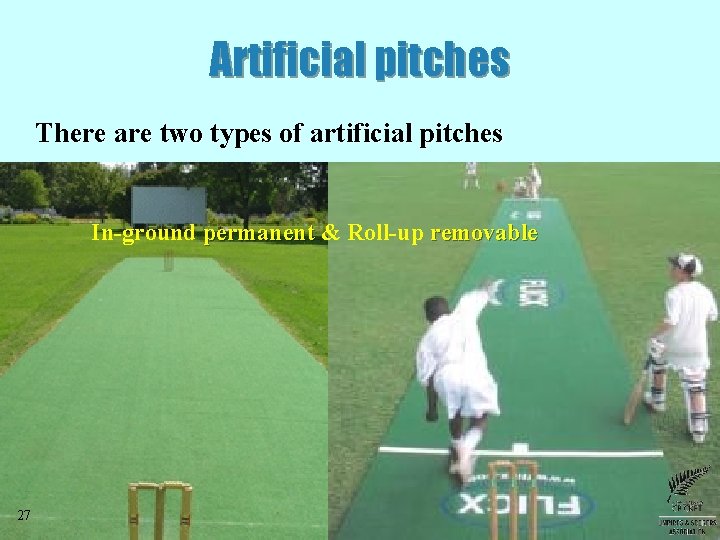
Artificial pitches There are two types of artificial pitches In-ground permanent & Roll-up removable 27
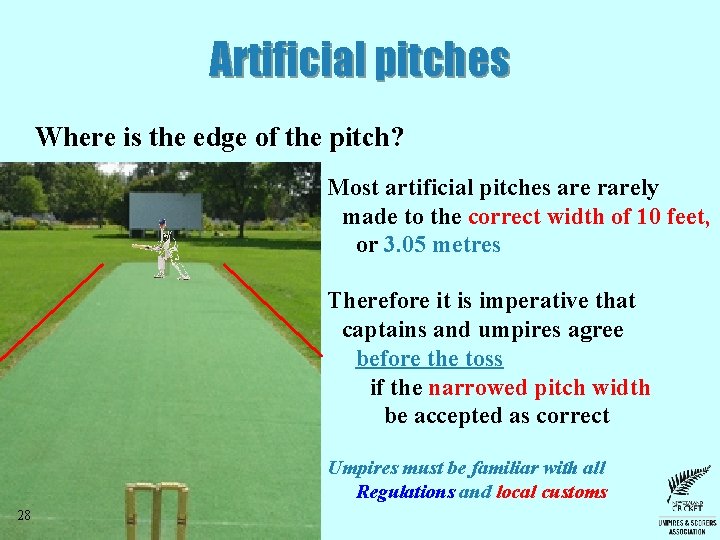
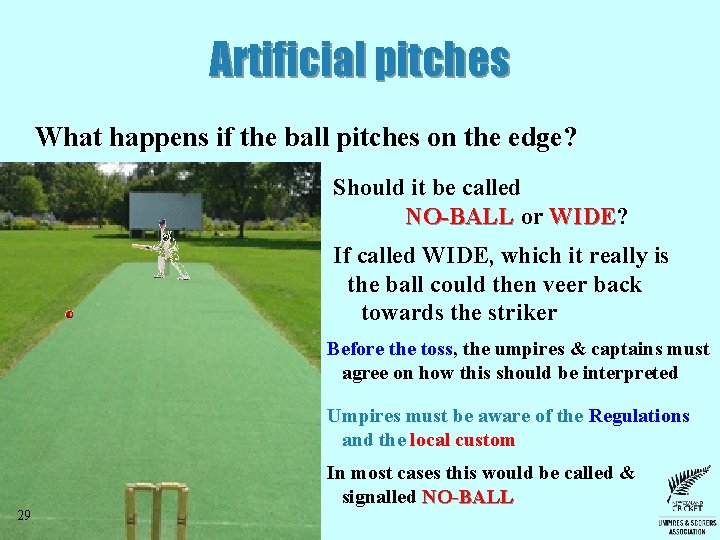
Artificial pitches Where is the edge of the pitch? Most artificial pitches are rarely made to the correct width of 10 feet, or 3. 05 metres Therefore it is imperative that captains and umpires agree before the toss if the narrowed pitch width be accepted as correct Umpires must be familiar with all Regulations and local customs 28
Artificial pitches What happens if the ball pitches on the edge? Should it be called NO-BALL or WIDE? WIDE If called WIDE, which it really is the ball could then veer back towards the striker Before the toss, the umpires & captains must agree on how this should be interpreted Umpires must be aware of the Regulations and the local custom 29 In most cases this would be called & signalled NO-BALL
Artificial pitches What happens if the Return creases are not painted? While the popping crease and the bowling crease will always be permanently painted on the pitch regulations or local custom should require either when bowling, the bowler must have one foot, wholly on the pitch, or the bowler must have his front foot, wholly on the pitch In the absence of any such regulation it is imperative that captains and umpires agree before the toss, what provision should apply Regulations may also include the type of footwear bowler’s must use, perhaps prohibiting sprigs 30 Umpires must be familiar with all Regulations and local customs
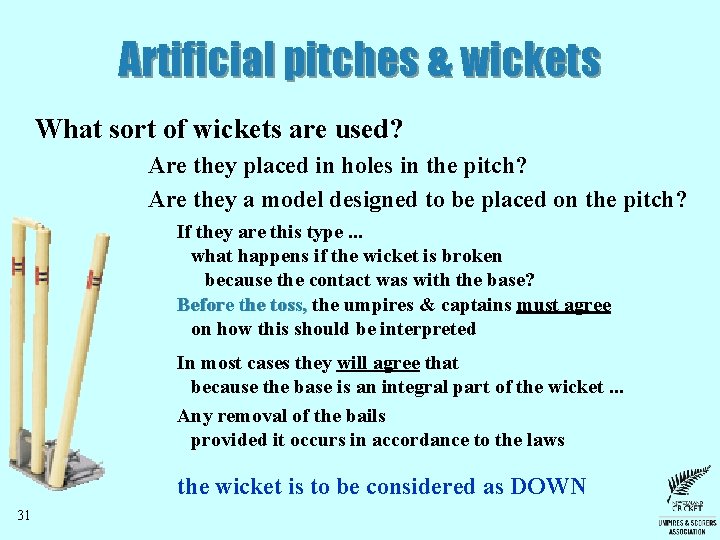
Artificial pitches & wickets What sort of wickets are used? Are they placed in holes in the pitch? Are they a model designed to be placed on the pitch? If they are this type. . . what happens if the wicket is broken because the contact was with the base? Before the toss, the umpires & captains must agree on how this should be interpreted In most cases they will agree that because the base is an integral part of the wicket. . . Any removal of the bails provided it occurs in accordance to the laws the wicket is to be considered as DOWN 31
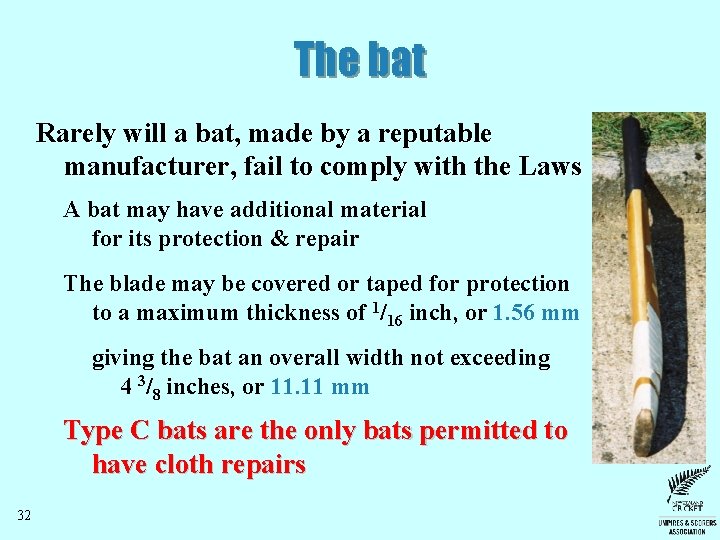
The bat Rarely will a bat, made by a reputable manufacturer, fail to comply with the Laws A bat may have additional material for its protection & repair The blade may be covered or taped for protection to a maximum thickness of 1/16 inch, or 1. 56 mm giving the bat an overall width not exceeding 4 3/8 inches, or 11. 11 mm Type C bats are the only bats permitted to have cloth repairs 32
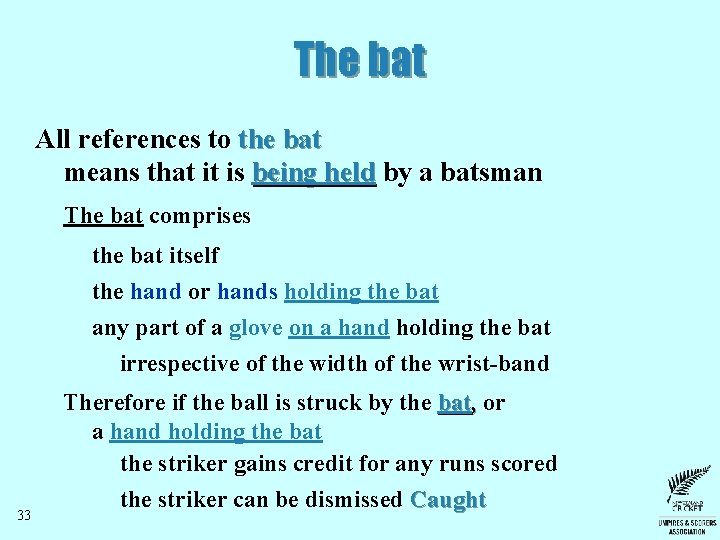
The bat All references to the bat means that it is being held by a batsman The bat comprises the bat itself the hand or hands holding the bat any part of a glove on a hand holding the bat irrespective of the width of the wrist-band 33 Therefore if the ball is struck by the bat, or a hand holding the bat the striker gains credit for any runs scored the striker can be dismissed Caught
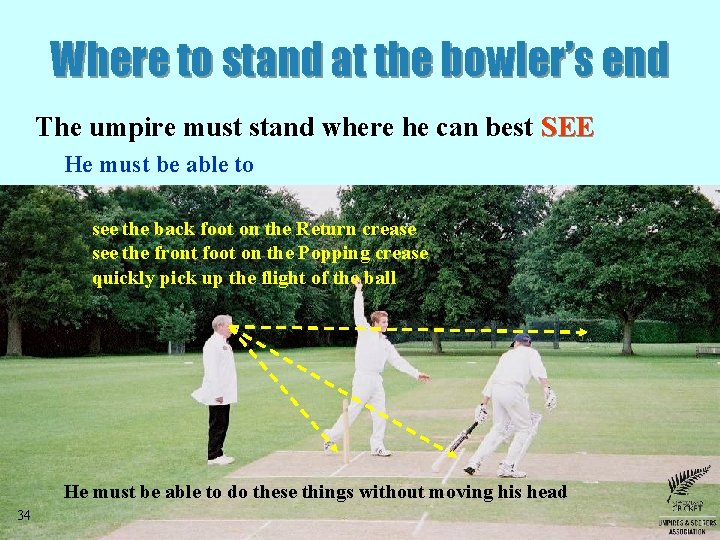
Where to stand at the bowler’s end The umpire must stand where he can best SEE He must be able to see the back foot on the Return crease see the front foot on the Popping crease quickly pick up the flight of the ball He must be able to do these things without moving his head 34
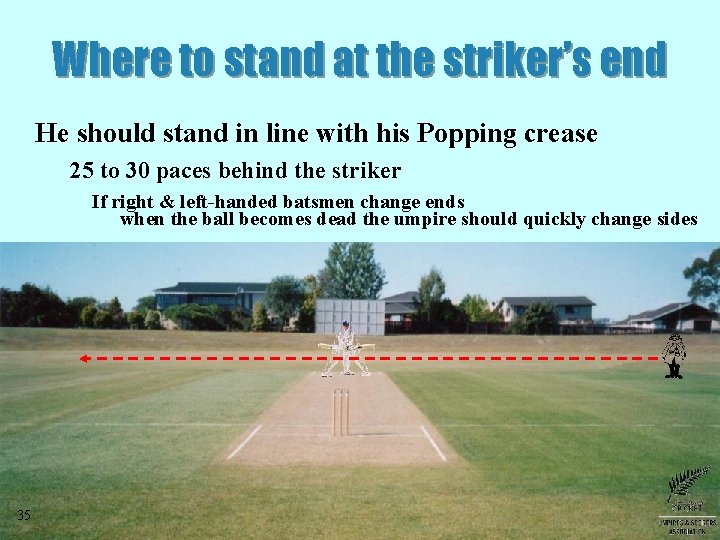
Where to stand at the striker’s end He should stand in line with his Popping crease 25 to 30 paces behind the striker If right & left-handed batsmen change ends when the ball becomes dead the umpire should quickly change sides 35
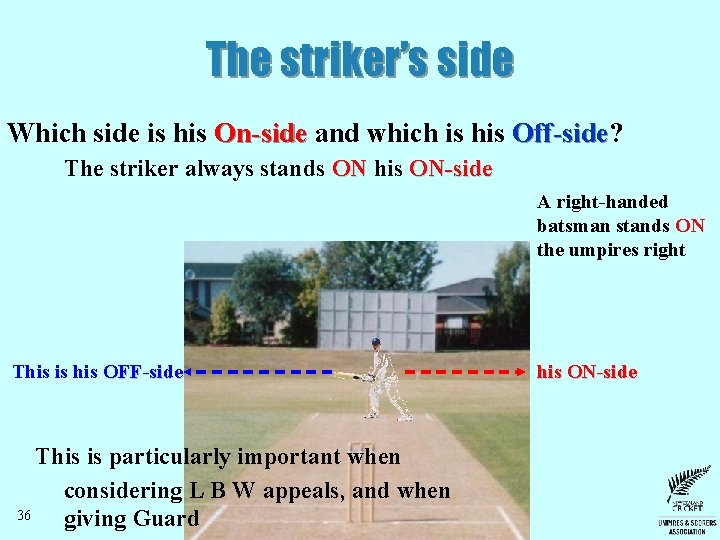
The striker’s side Which side is his On-side and which is his Off-side? The striker always stands ON his ON-side A right-handed batsman stands ON the umpires right This is his OFF-side This is particularly important when considering L B W appeals, and when 36 giving Guard his ON-side
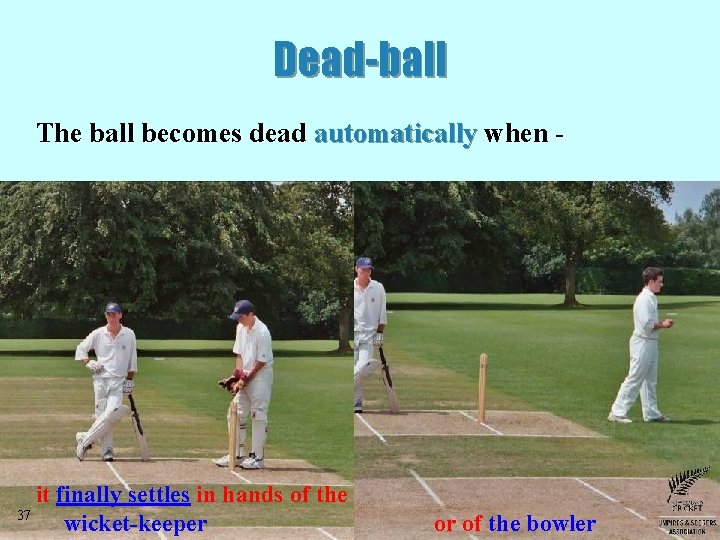
Dead-ball The ball becomes dead automatically when - it finally settles in hands of the 37 wicket-keeper or of the bowler
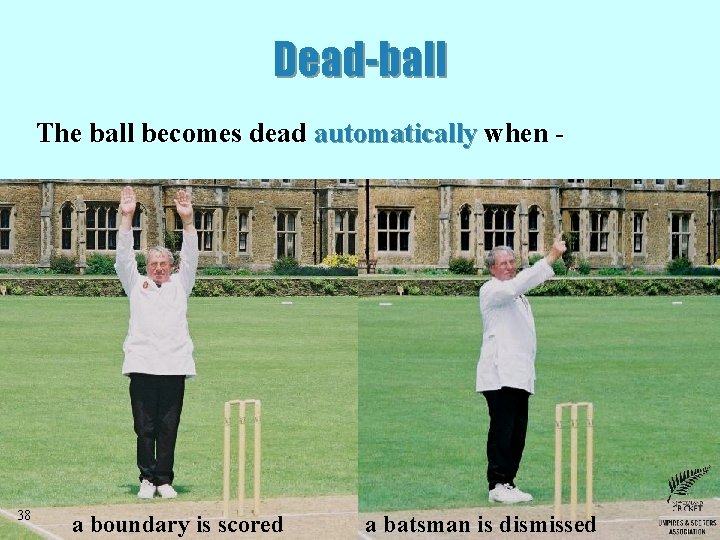
Dead-ball The ball becomes dead automatically when - 38 a boundary is scored a batsman is dismissed
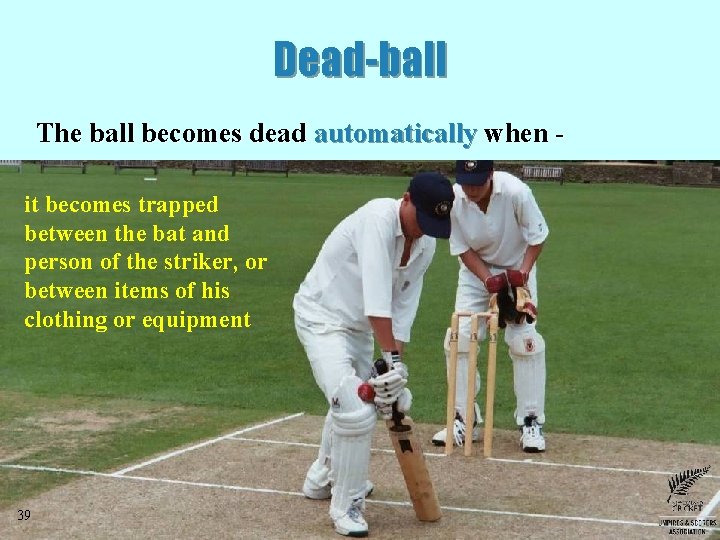
Dead-ball The ball becomes dead automatically when it becomes trapped between the bat and person of the striker, or between items of his clothing or equipment 39
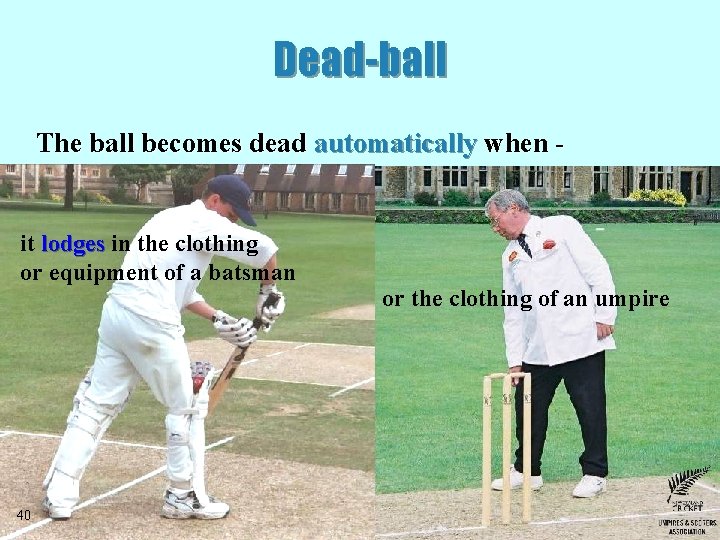
Dead-ball The ball becomes dead automatically when - it lodges in the clothing or equipment of a batsman 40 or the clothing of an umpire
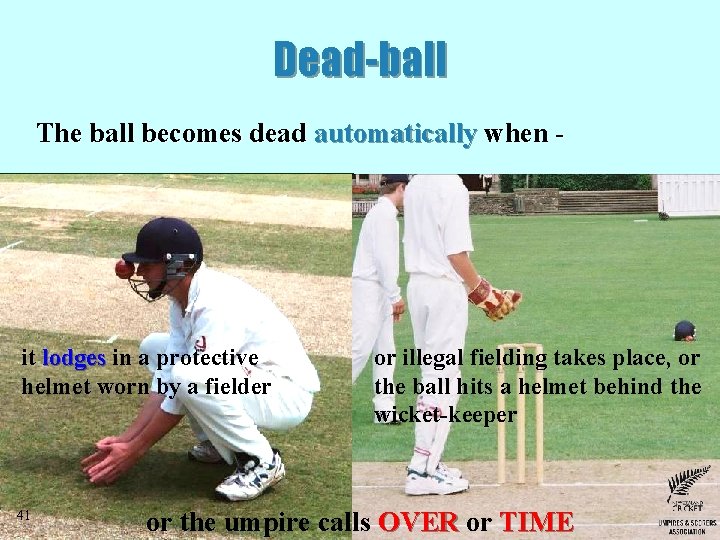
Dead-ball The ball becomes dead automatically when - it lodges in a protective helmet worn by a fielder 41 or illegal fielding takes place, or the ball hits a helmet behind the wicket-keeper or the umpire calls OVER or TIME
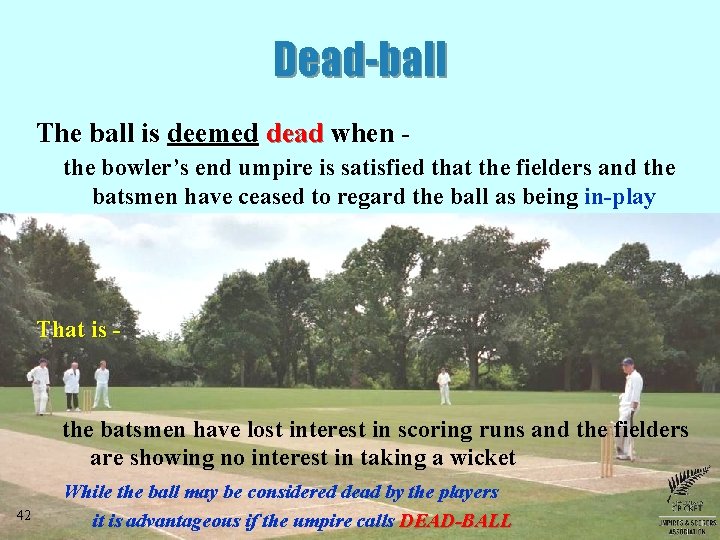
Dead-ball The ball is deemed dead when the bowler’s end umpire is satisfied that the fielders and the batsmen have ceased to regard the ball as being in-play That is - the batsmen have lost interest in scoring runs and the fielders are showing no interest in taking a wicket 42 While the ball may be considered dead by the players it is advantageous if the umpire calls DEAD-BALL
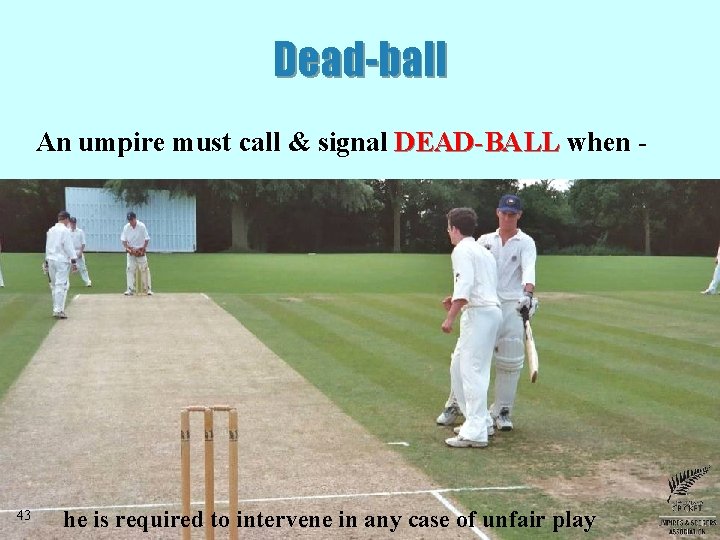
Dead-ball An umpire must call & signal DEAD-BALL when - 43 he is required to intervene in any case of unfair play
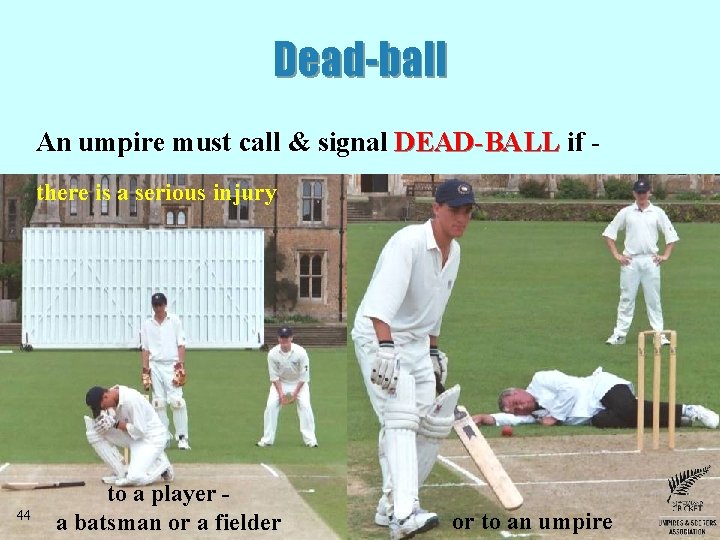
Dead-ball An umpire must call & signal DEAD-BALL if there is a serious injury 44 to a player a batsman or a fielder or to an umpire
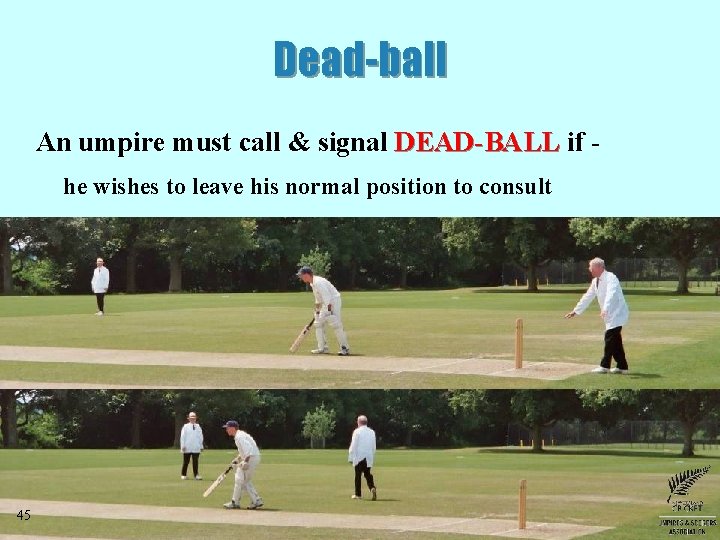
Dead-ball An umpire must call & signal DEAD-BALL if he wishes to leave his normal position to consult 45
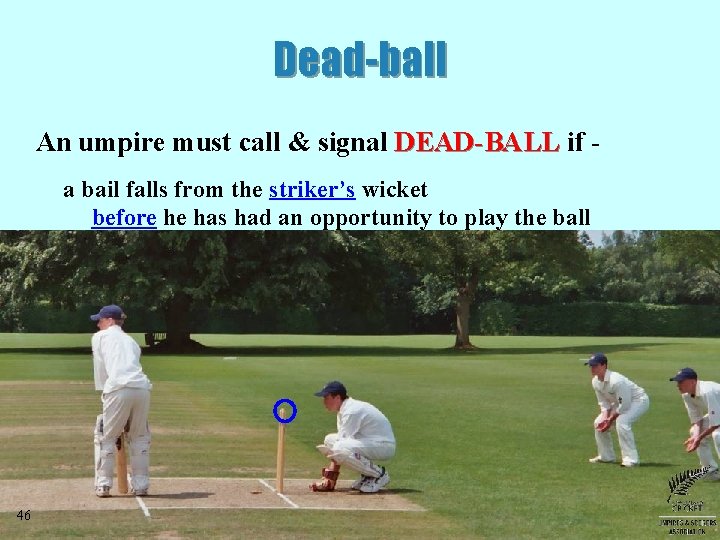
Dead-ball An umpire must call & signal DEAD-BALL if a bail falls from the striker’s wicket before he has had an opportunity to play the ball 46
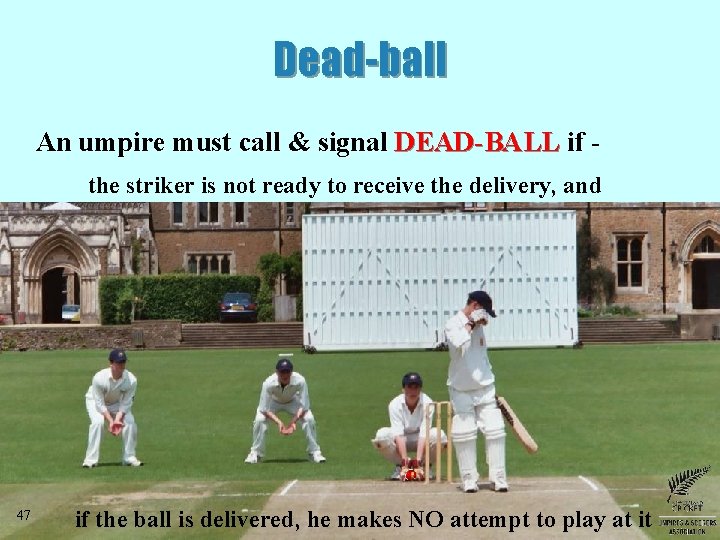
Dead-ball An umpire must call & signal DEAD-BALL if the striker is not ready to receive the delivery, and 47 if the ball is delivered, he makes NO attempt to play at it
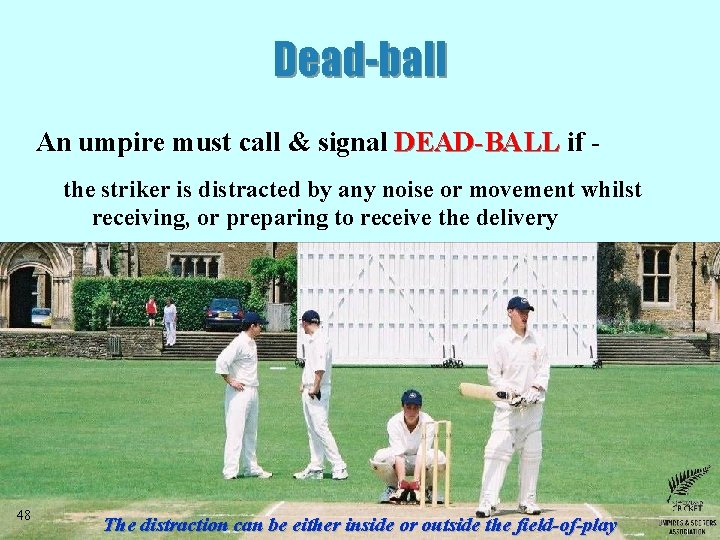
Dead-ball An umpire must call & signal DEAD-BALL if the striker is distracted by any noise or movement whilst receiving, or preparing to receive the delivery 48 The distraction can be either inside or outside the field-of-play
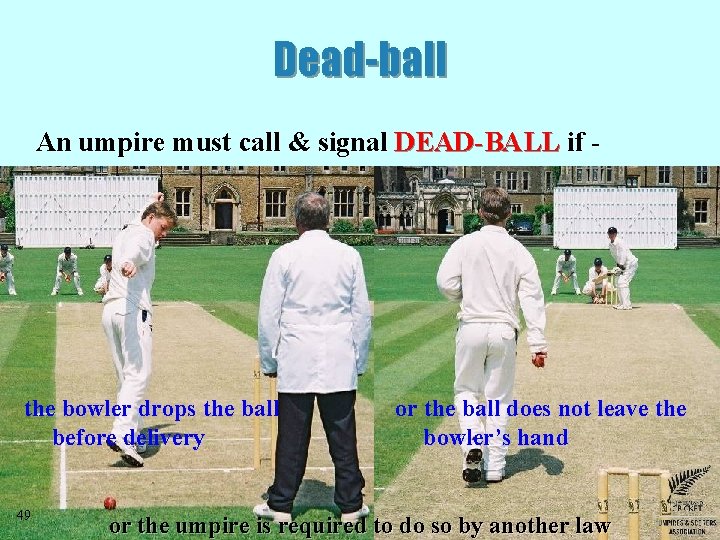
Dead-ball An umpire must call & signal DEAD-BALL if - the bowler drops the ball before delivery 49 or the ball does not leave the bowler’s hand or the umpire is required to do so by another law
Dead-ball If the ball is called DEAD before the striker has had an opportunity to play at it that ball is not counted as a ball of the over It must be re-bowled If the ball is called DEAD after the striker has had a chance to play it that ball is counted as a ball of the over It is not re-bowled 50
Unfair play – the ball The umpires must make frequent and irregular inspections of the ball It is Unfair to attempt to change the condition of the ball Fielders are permitted to dry a wet ball or polish the ball on any item of their clothing but they may not use any artificial substance Fielders are permitted to remove mud from a seam but only under the supervision of an umpire The bowler can be suspended if anyone offends 51 Even on fine days, umpires should always carry a cloth with them to dry a wet or damp ball
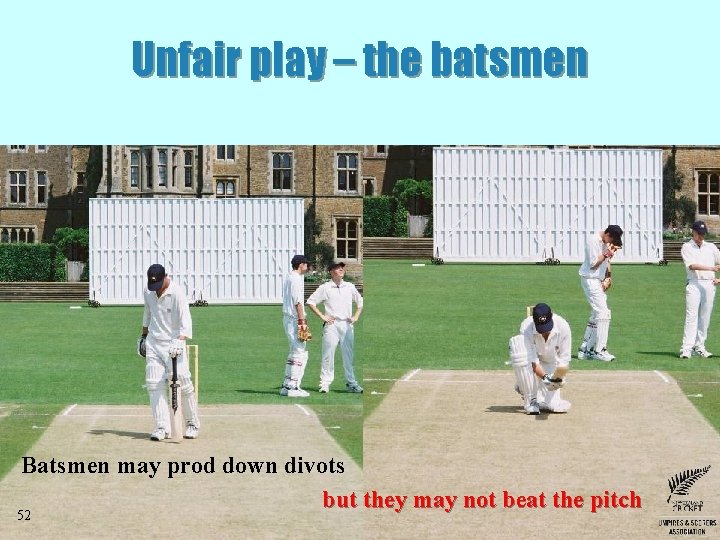
Unfair play – the batsmen Batsmen may prod down divots but they may not beat the pitch 52
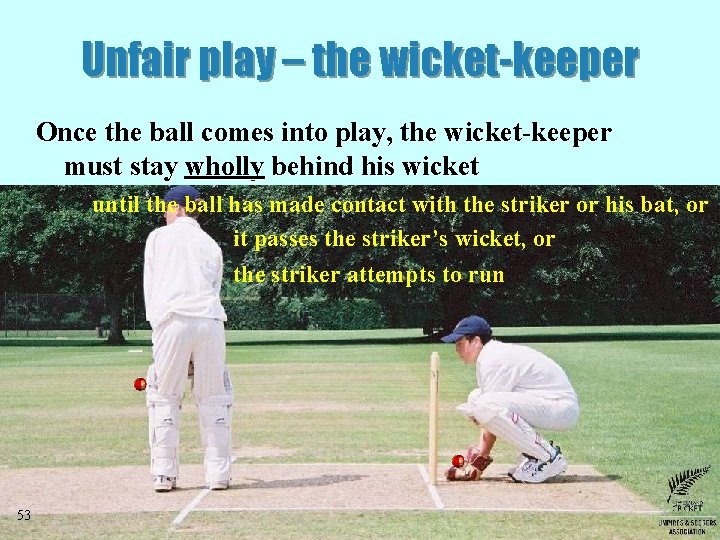
Unfair play – the wicket-keeper Once the ball comes into play, the wicket-keeper must stay wholly behind his wicket until the ball has made contact with the striker or his bat, or it passes the striker’s wicket, or the striker attempts to run 53
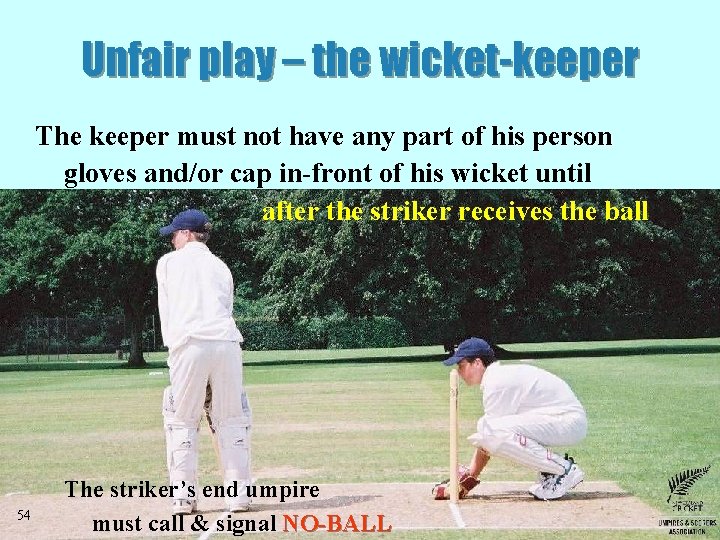
Unfair play – the wicket-keeper The keeper must not have any part of his person gloves and/or cap in-front of his wicket until after the striker receives the ball 54 The striker’s end umpire must call & signal NO-BALL
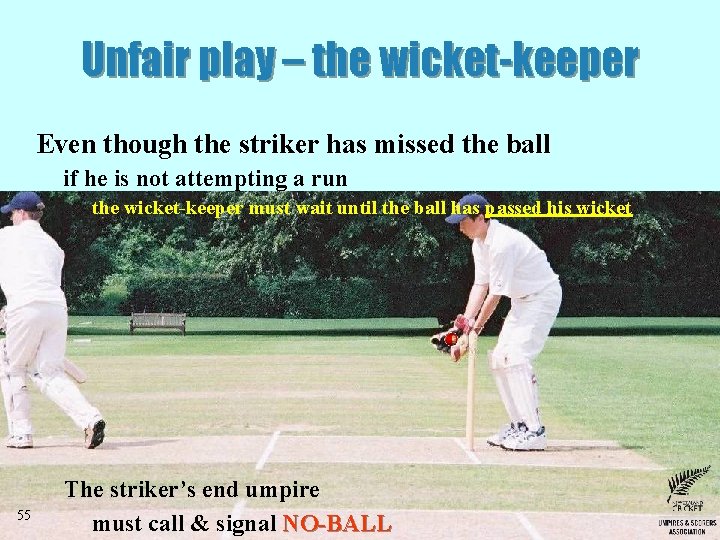
Unfair play – the wicket-keeper Even though the striker has missed the ball if he is not attempting a run the wicket-keeper must wait until the ball has passed his wicket 55 The striker’s end umpire must call & signal NO-BALL
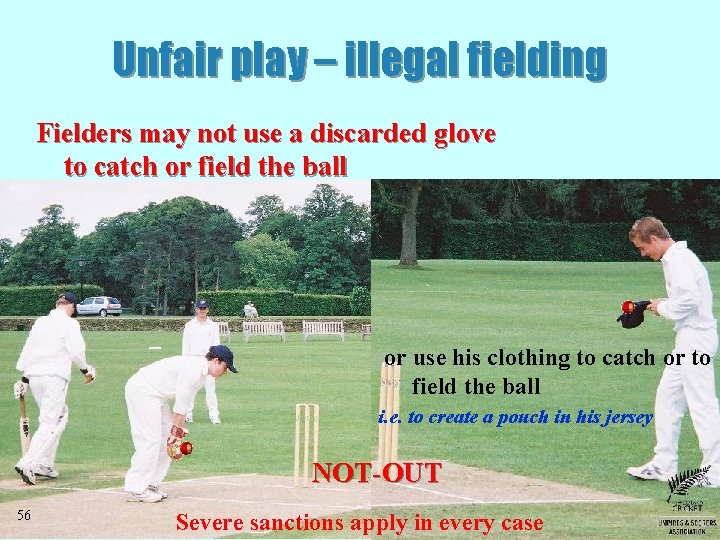
Unfair play – illegal fielding Fielders may not use a discarded glove to catch or field the ball or use his clothing to catch or to field the ball i. e. to create a pouch in his jersey NOT-OUT 56 Severe sanctions apply in every case
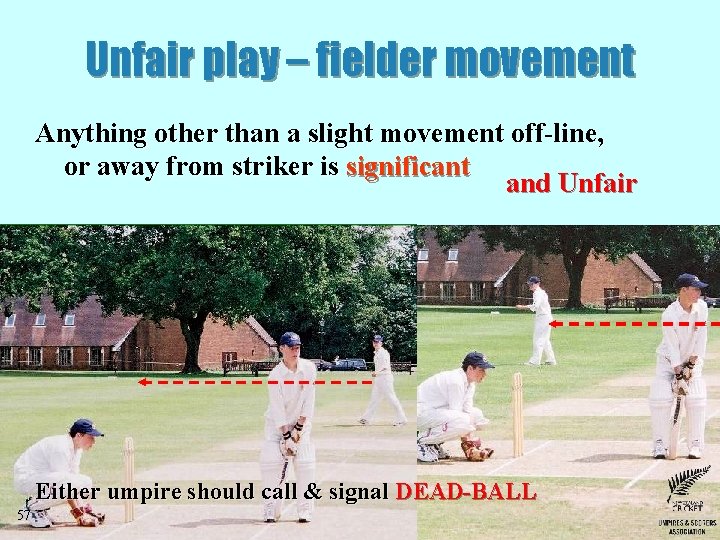
Unfair play – fielder movement Anything other than a slight movement off-line, or away from striker is significant and Unfair Either umpire should call & signal DEAD-BALL 57
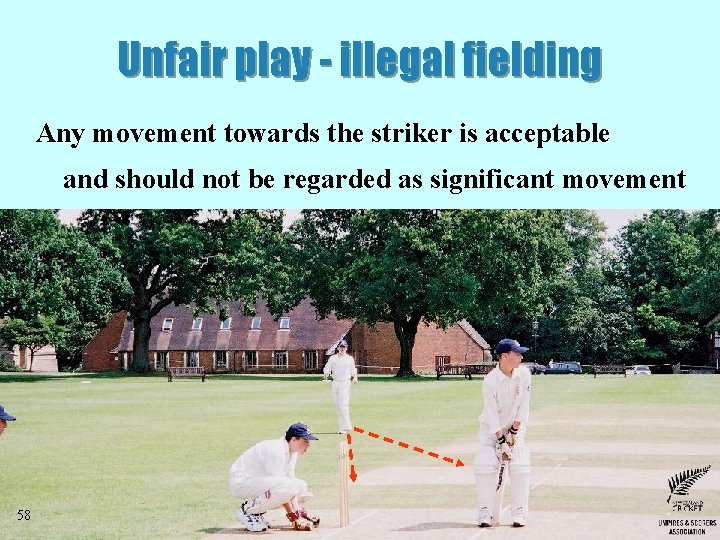
Unfair play - illegal fielding Any movement towards the striker is acceptable and should not be regarded as significant movement 58
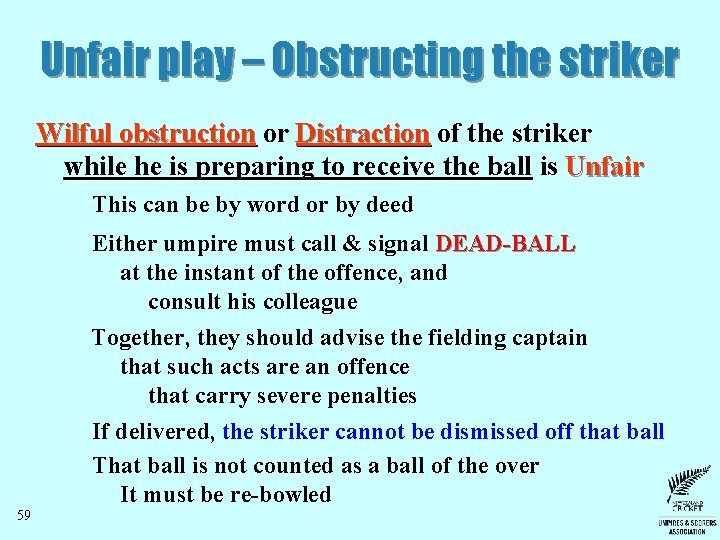
Unfair play – Obstructing the striker Wilful obstruction or Distraction of the striker while he is preparing to receive the ball is Unfair This can be by word or by deed Either umpire must call & signal DEAD-BALL at the instant of the offence, and consult his colleague 59 Together, they should advise the fielding captain that such acts are an offence that carry severe penalties If delivered, the striker cannot be dismissed off that ball That ball is not counted as a ball of the over It must be re-bowled
Unfair play – Obstructing a batsman Wilful obstruction or Distraction of either batsman after the ball is delivered is Unfair This can be by word or by deed Accidental collisions between players are part of the game and should not normally be considered deliberate If either umpire deems such act as Deliberate he must call & signal DEAD-BALL If at the instant of the offence, the batsmen have not crossed they continue running to the other end Neither batsman can be dismissed off that ball That ball is not counted as a ball of the over It must be re-bowled 60 The batsmen have a choice of who faces the next ball
Unfair play – time wasting Time wasting by either side is Unfair The striker should be ready to face the delivery when the bowler is ready to start his run-up The non-striker should be ready when the striker is ready The bowler should be ready to commence his run-up when his captain has set the field, and the batsmen are ready If for any reason, any player attempts to slow the game down the umpire must consider if it is Time wasting He must call & signal DEAD-BALL and consult his colleague Then inform the offenders, or the fielding captain that this is Unfair and insist that play resume without unnecessary delays 61 Severe sanctions apply if Time wasting persists
The end of Module 2. 1 In the next module we will review the reasons why you want to umpire the Bowler’s Mode of delivery the Over the wicket is down Boundaries a Batsman’s ground a Batsman out of his ground a Batsman with a Runner Conflict situations Thank you for your attention 62 Do not forget to study your copy of The Player Umpires Companion
These modules were written & produced for New Zealand Cricket by the New Zealand Cricket Umpires & Scorers Association 63 © 2010 NZC-NZCUSA