
Cricket Tutorial on using cricket location system MIT
- Slides: 29
Cricket Tutorial on using cricket location system MIT 6. 893; SMA 5508 Spring 2004 Larry Rudolph Lecture Cricket tutorial
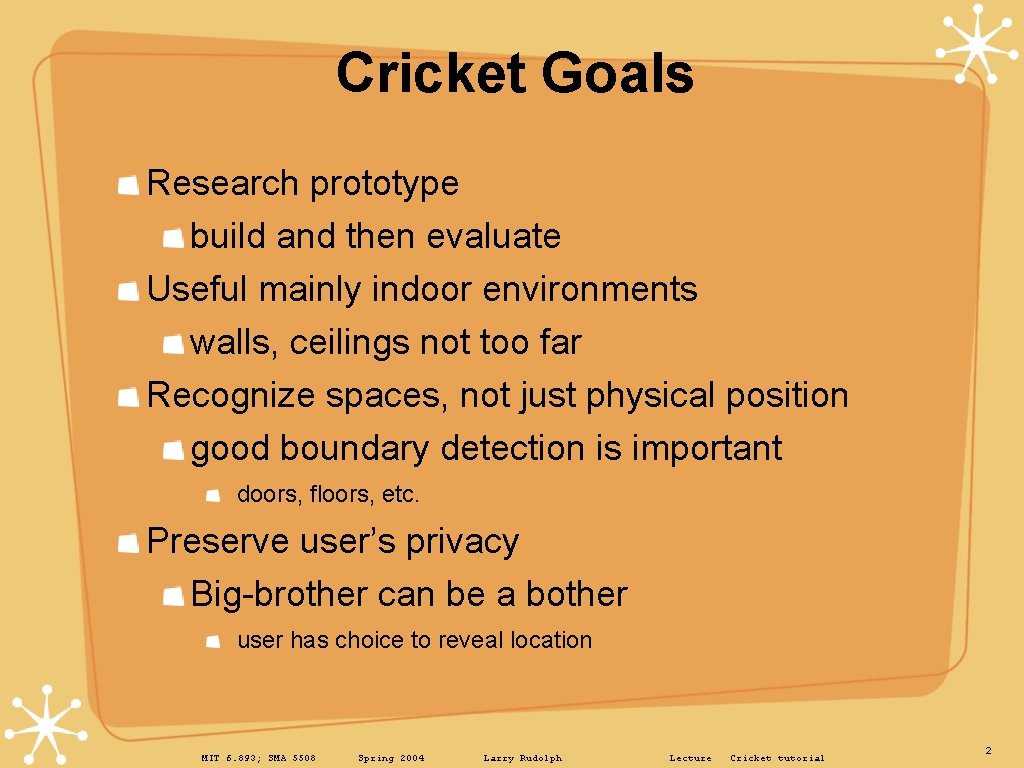
Cricket Goals Research prototype build and then evaluate Useful mainly indoor environments walls, ceilings not too far Recognize spaces, not just physical position good boundary detection is important doors, floors, etc. Preserve user’s privacy Big-brother can be a bother user has choice to reveal location MIT 6. 893; SMA 5508 Spring 2004 Larry Rudolph Lecture Cricket tutorial 2
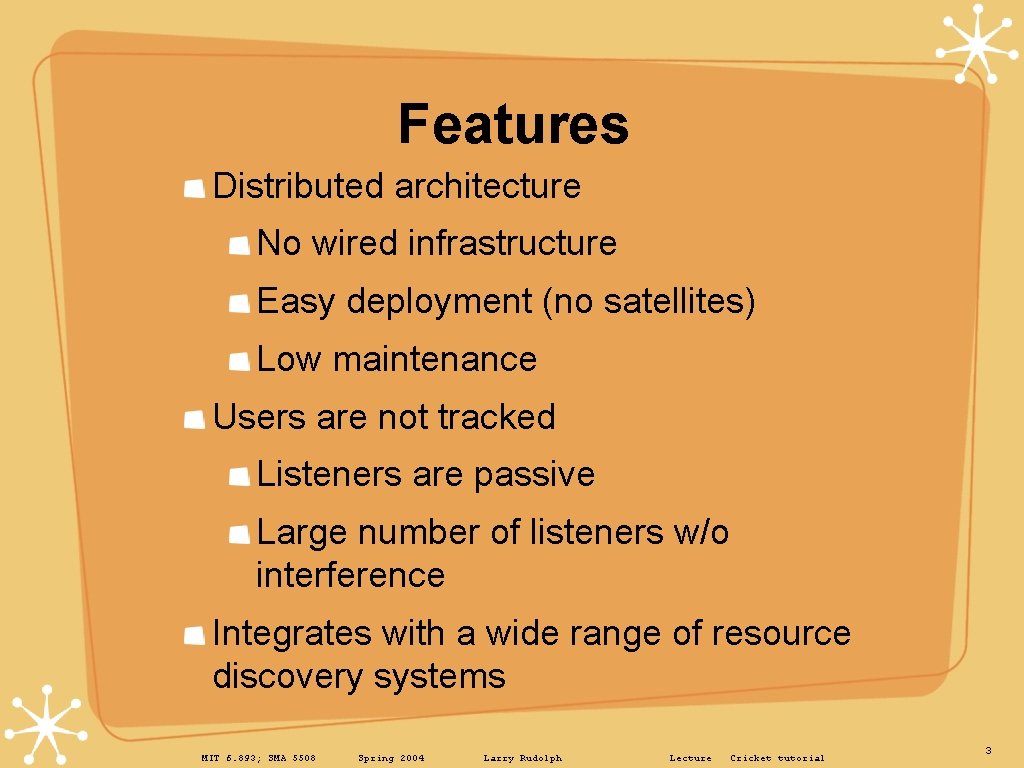
Features Distributed architecture No wired infrastructure Easy deployment (no satellites) Low maintenance Users are not tracked Listeners are passive Large number of listeners w/o interference Integrates with a wide range of resource discovery systems MIT 6. 893; SMA 5508 Spring 2004 Larry Rudolph Lecture Cricket tutorial 3
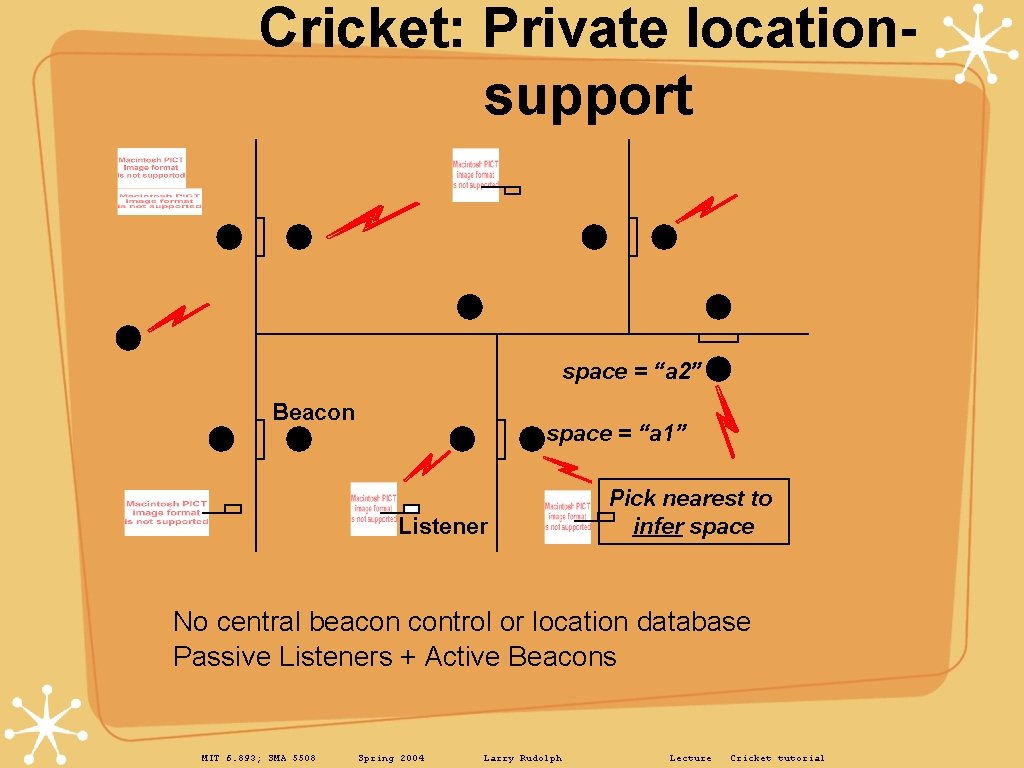
Cricket: Private locationsupport space = “a 2” Beacon space = “a 1” Listener Pick nearest to infer space No central beacon control or location database Passive Listeners + Active Beacons MIT 6. 893; SMA 5508 Spring 2004 Larry Rudolph Lecture Cricket tutorial
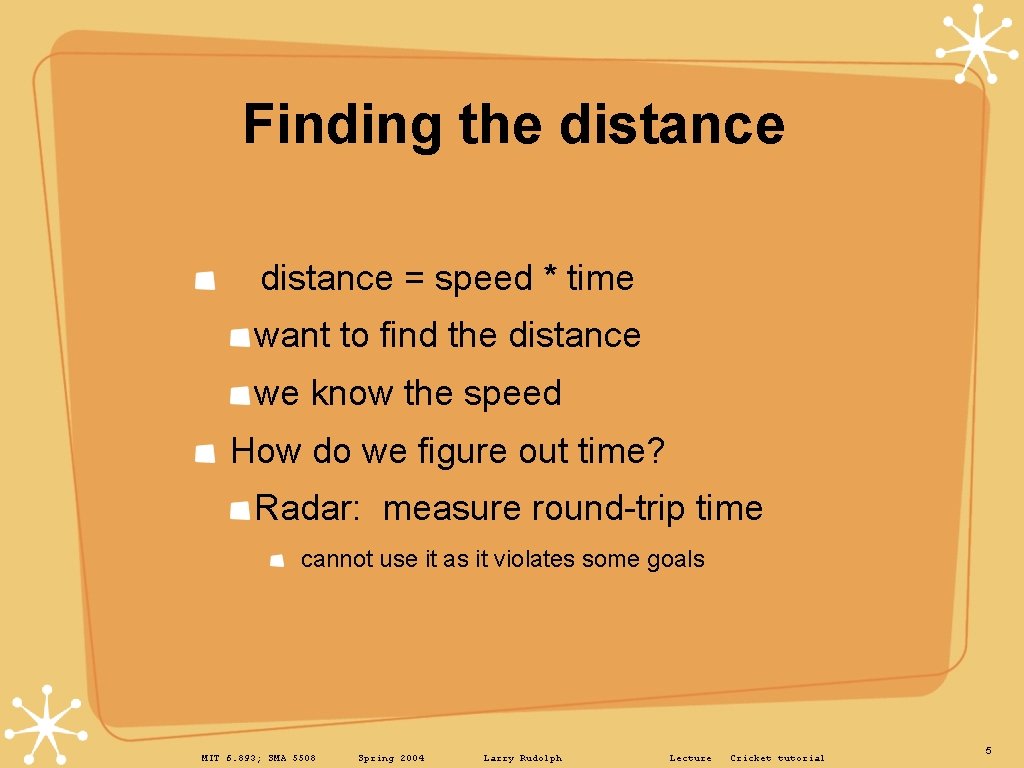
Finding the distance = speed * time want to find the distance we know the speed How do we figure out time? Radar: measure round-trip time cannot use it as it violates some goals MIT 6. 893; SMA 5508 Spring 2004 Larry Rudolph Lecture Cricket tutorial 5
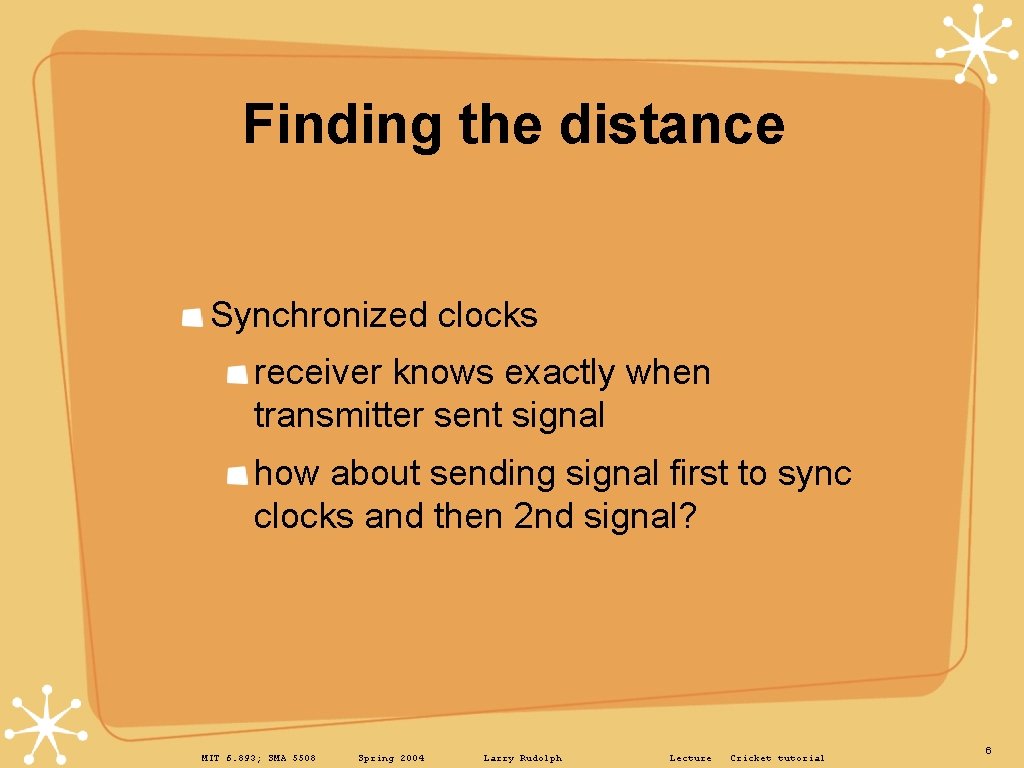
Finding the distance Synchronized clocks receiver knows exactly when transmitter sent signal how about sending signal first to sync clocks and then 2 nd signal? MIT 6. 893; SMA 5508 Spring 2004 Larry Rudolph Lecture Cricket tutorial 6
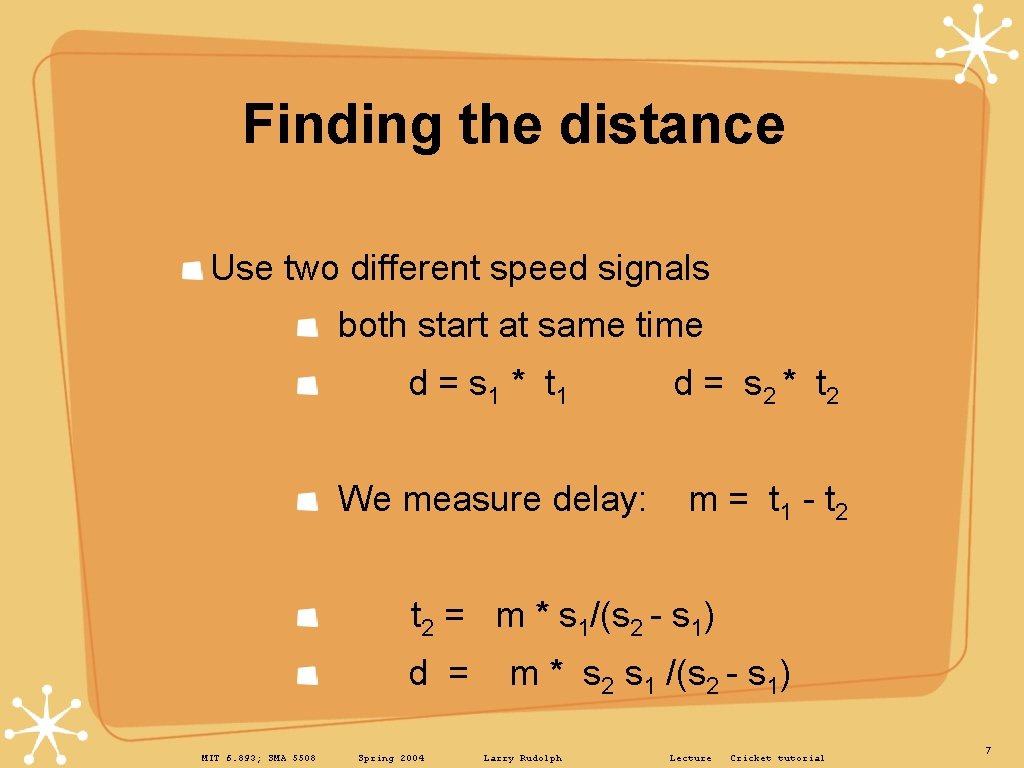
Finding the distance Use two different speed signals both start at same time d = s 1 * t 1 We measure delay: d = s 2 * t 2 m = t 1 - t 2 = m * s 1/(s 2 - s 1) d = MIT 6. 893; SMA 5508 Spring 2004 m * s 2 s 1 /(s 2 - s 1) Larry Rudolph Lecture Cricket tutorial 7
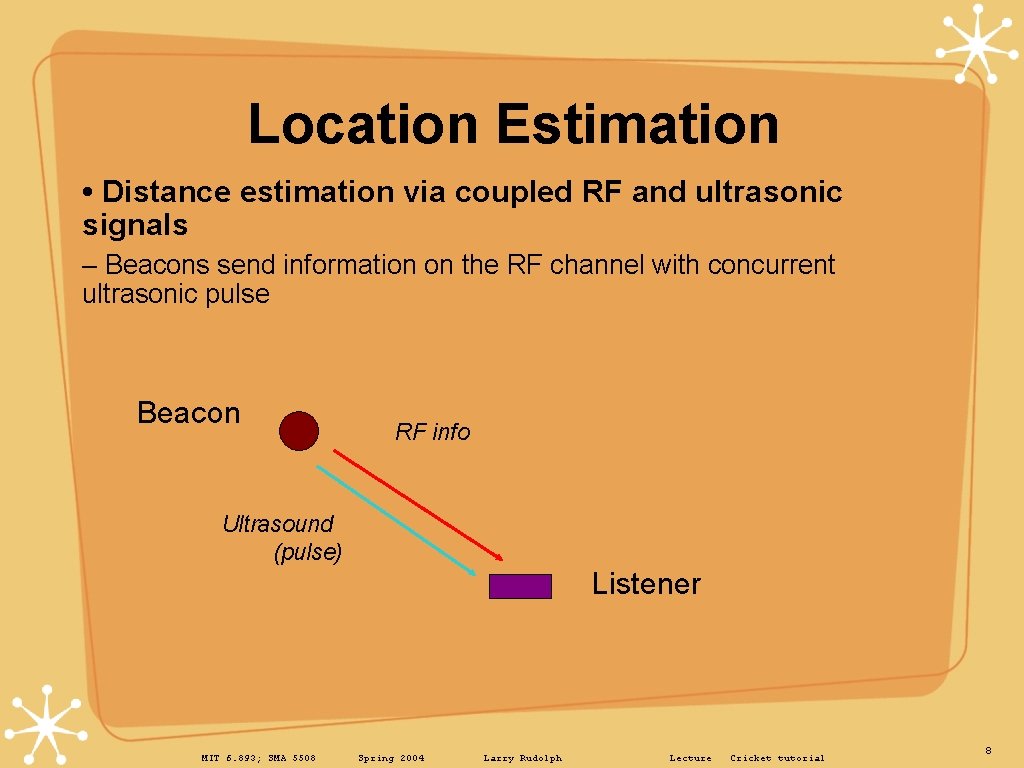
Location Estimation • Distance estimation via coupled RF and ultrasonic signals – Beacons send information on the RF channel with concurrent ultrasonic pulse Beacon RF info Ultrasound (pulse) Listener MIT 6. 893; SMA 5508 Spring 2004 Larry Rudolph Lecture Cricket tutorial 8
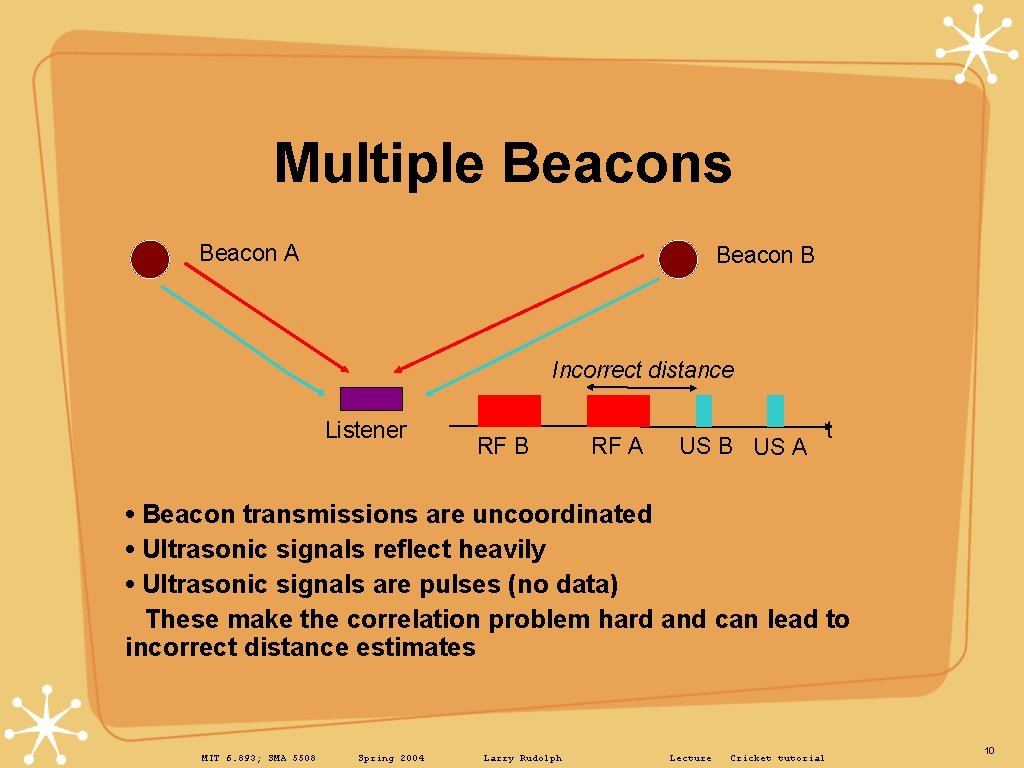
Multiple Beacons Beacon A Beacon B Incorrect distance Listener RF B RF A US B US A t • Beacon transmissions are uncoordinated • Ultrasonic signals reflect heavily • Ultrasonic signals are pulses (no data) These make the correlation problem hard and can lead to incorrect distance estimates MIT 6. 893; SMA 5508 Spring 2004 Larry Rudolph Lecture Cricket tutorial 10
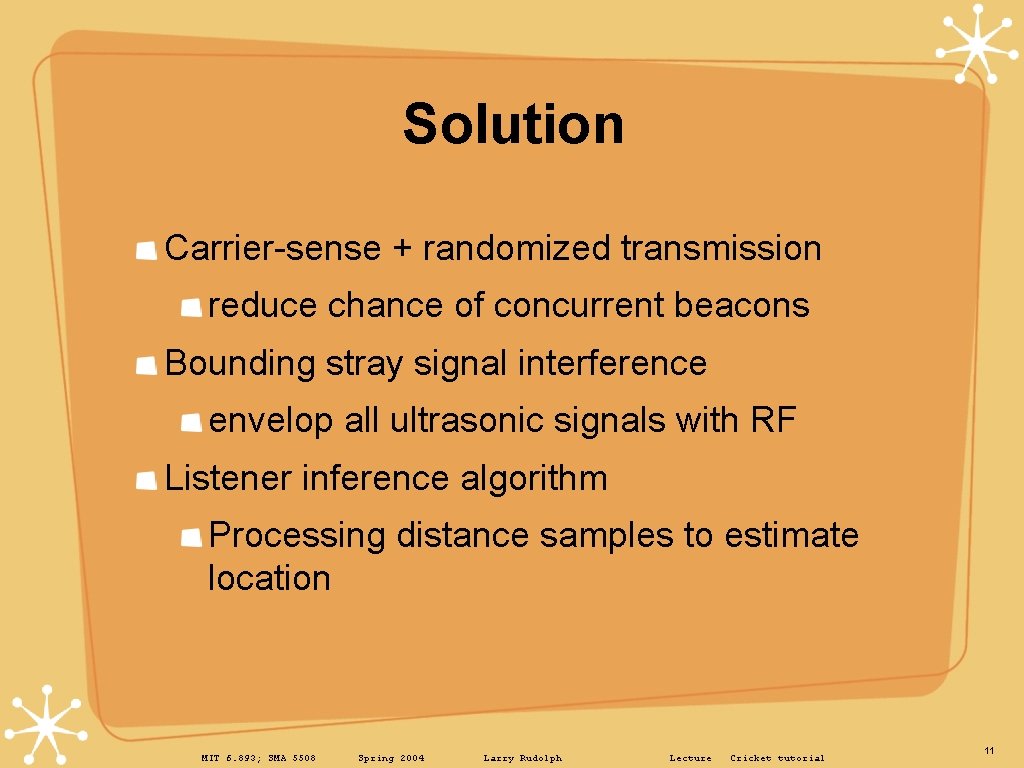
Solution Carrier-sense + randomized transmission reduce chance of concurrent beacons Bounding stray signal interference envelop all ultrasonic signals with RF Listener inference algorithm Processing distance samples to estimate location MIT 6. 893; SMA 5508 Spring 2004 Larry Rudolph Lecture Cricket tutorial 11
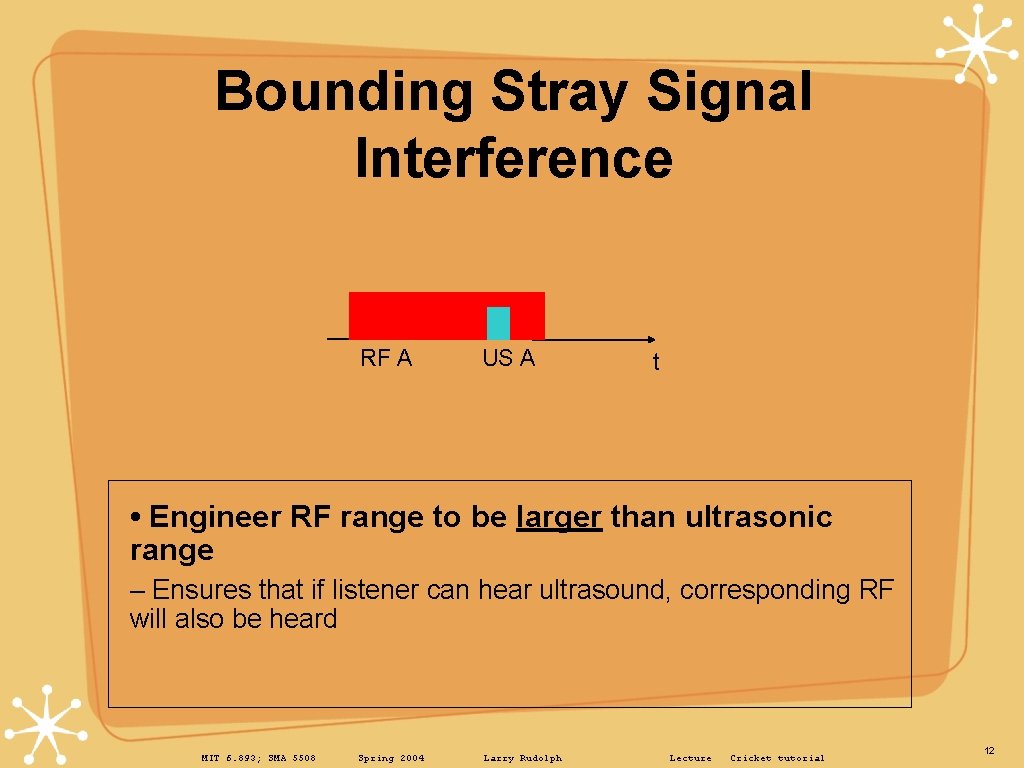
Bounding Stray Signal Interference RF A US A t • Engineer RF range to be larger than ultrasonic range – Ensures that if listener can hear ultrasound, corresponding RF will also be heard MIT 6. 893; SMA 5508 Spring 2004 Larry Rudolph Lecture Cricket tutorial 12
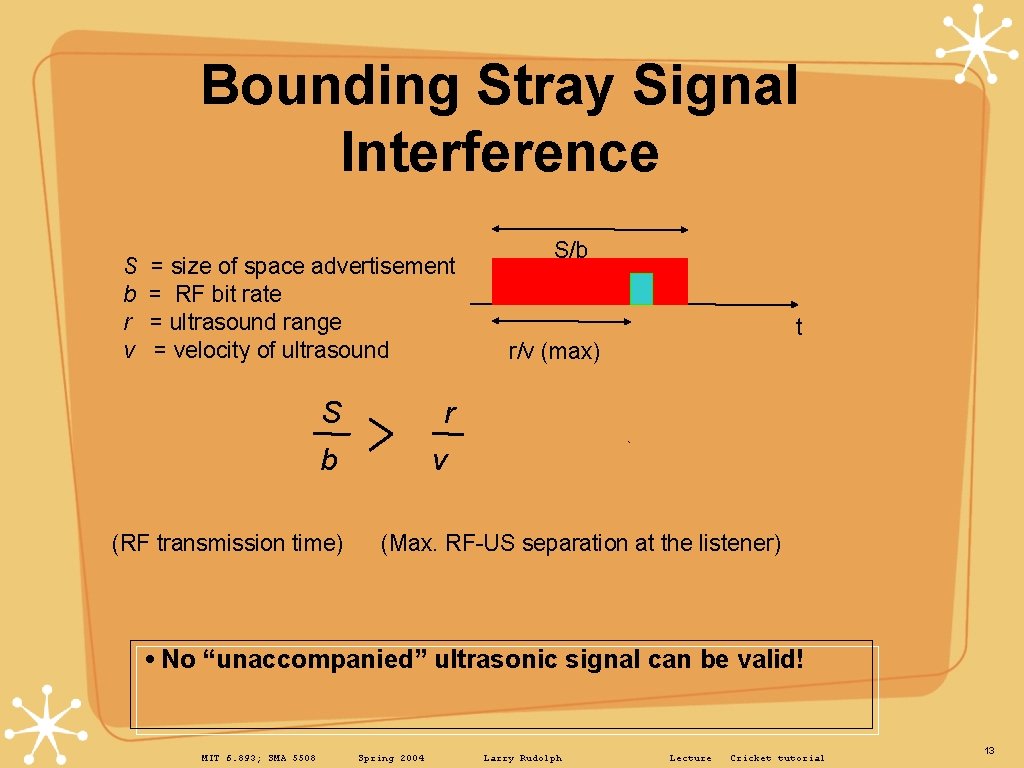
Bounding Stray Signal Interference S b r v = size of space advertisement = RF bit rate = ultrasound range = velocity of ultrasound S b (RF transmission time) S/b t r/v (max) r v (Max. RF-US separation at the listener) • No “unaccompanied” ultrasonic signal can be valid! MIT 6. 893; SMA 5508 Spring 2004 Larry Rudolph Lecture Cricket tutorial 13
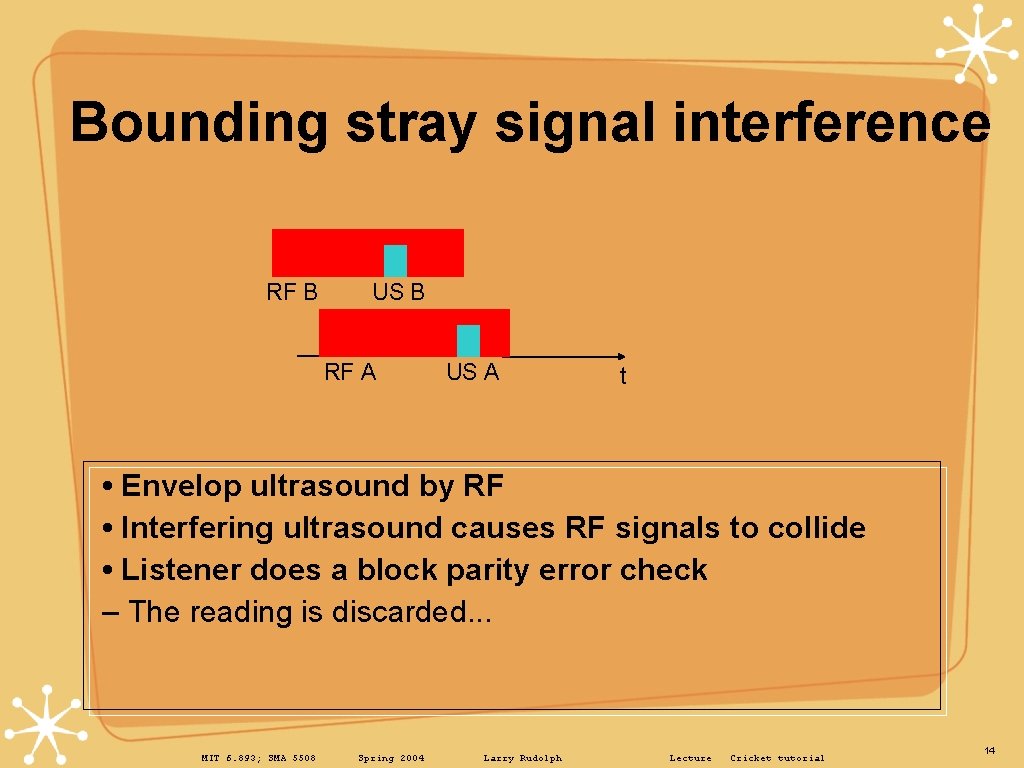
Bounding stray signal interference RF B US B RF A US A t • Envelop ultrasound by RF • Interfering ultrasound causes RF signals to collide • Listener does a block parity error check – The reading is discarded. . . MIT 6. 893; SMA 5508 Spring 2004 Larry Rudolph Lecture Cricket tutorial 14
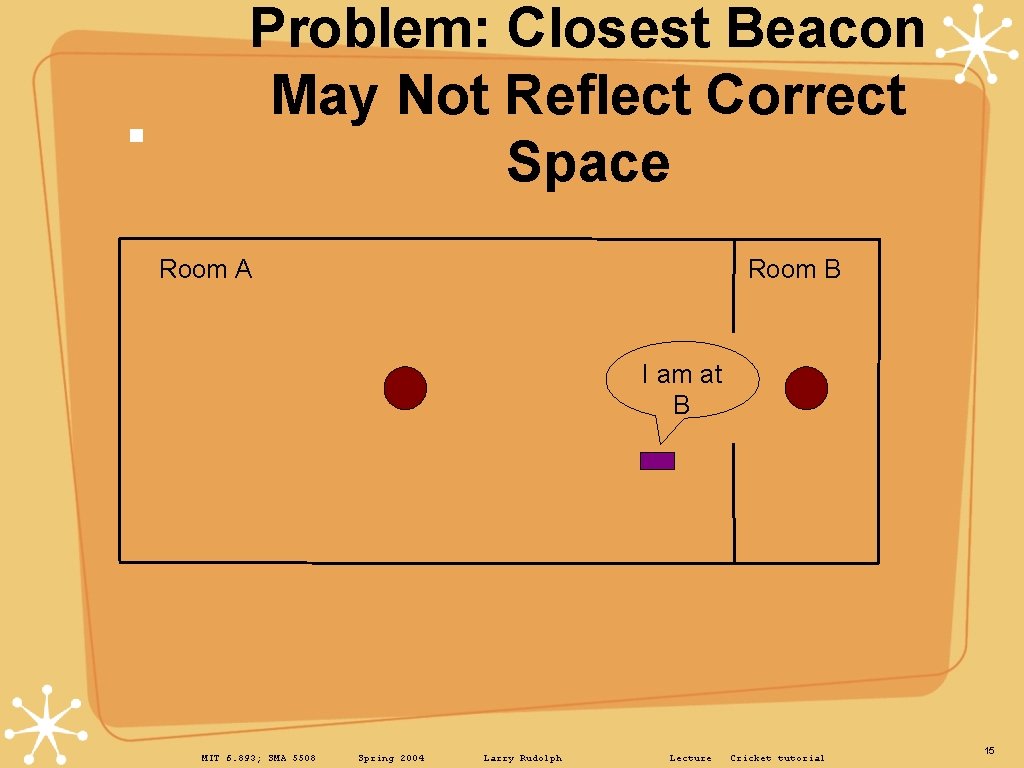
Problem: Closest Beacon May Not Reflect Correct Space Room A Room B I am at B MIT 6. 893; SMA 5508 Spring 2004 Larry Rudolph Lecture Cricket tutorial 15
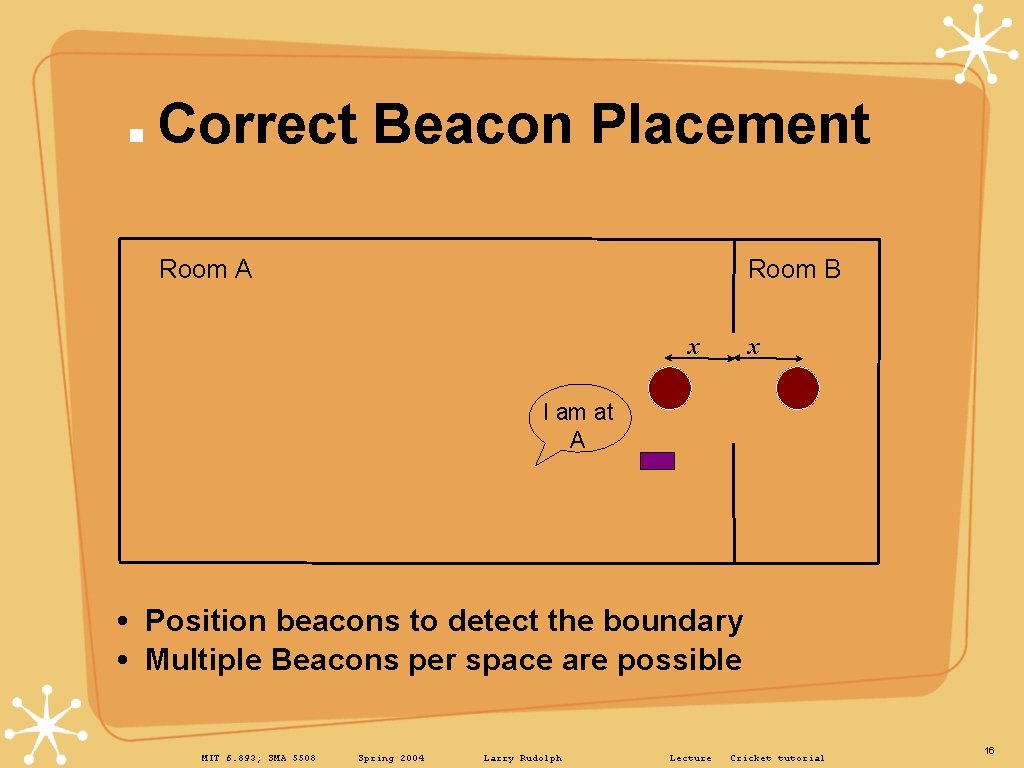
Correct Beacon Placement Room A Room B x x I am at A • Position beacons to detect the boundary • Multiple Beacons per space are possible MIT 6. 893; SMA 5508 Spring 2004 Larry Rudolph Lecture Cricket tutorial 16
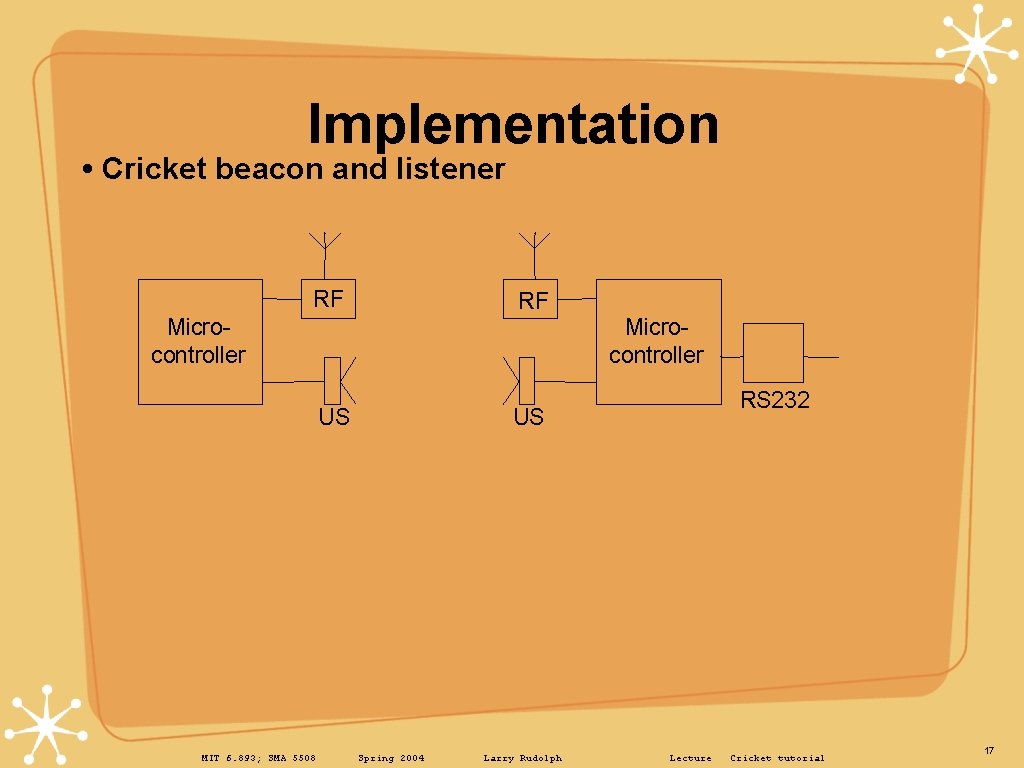
Implementation • Cricket beacon and listener RF RF Microcontroller US MIT 6. 893; SMA 5508 RS 232 US Spring 2004 Larry Rudolph Lecture Cricket tutorial 17
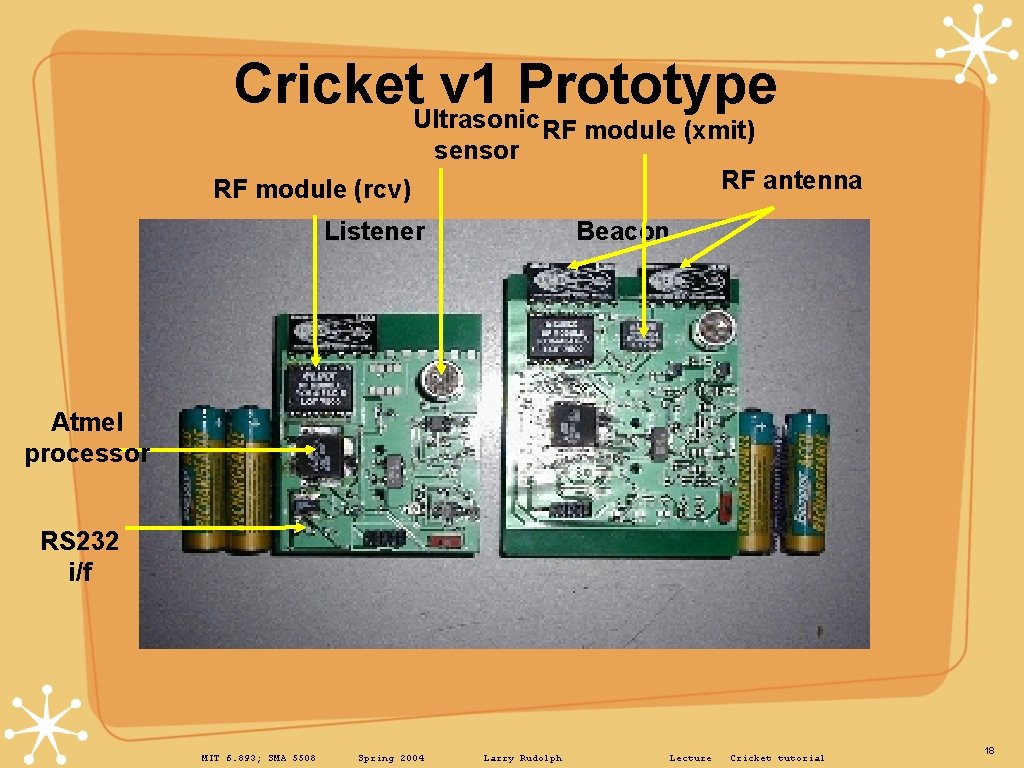
Cricket. Ultrasonic v 1 Prototype sensor RF module (xmit) RF antenna RF module (rcv) Listener Beacon Atmel processor RS 232 i/f MIT 6. 893; SMA 5508 Spring 2004 Larry Rudolph Lecture Cricket tutorial 18
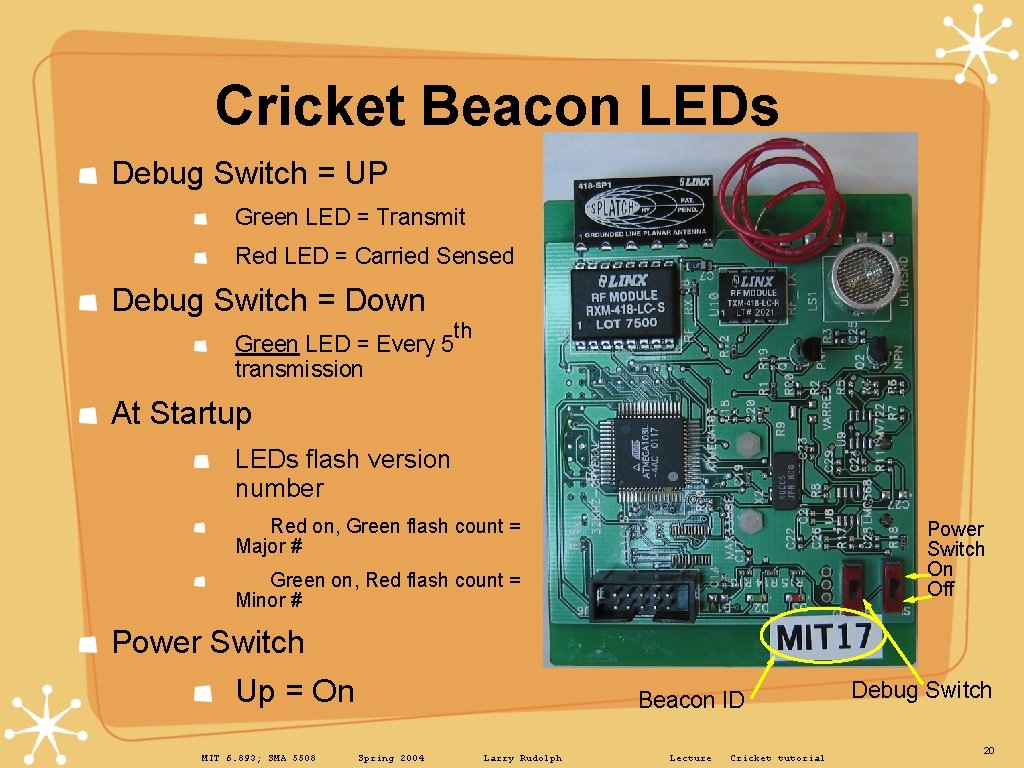
Cricket Beacon LEDs Debug Switch = UP Green LED = Transmit Red LED = Carried Sensed Debug Switch = Down Green LED = Every 5 transmission th At Startup LEDs flash version number Red on, Green flash count = Major # Power Switch On Off Green on, Red flash count = Minor # Power Switch Up = On MIT 6. 893; SMA 5508 Beacon ID Spring 2004 Larry Rudolph Lecture Cricket tutorial Debug Switch 20
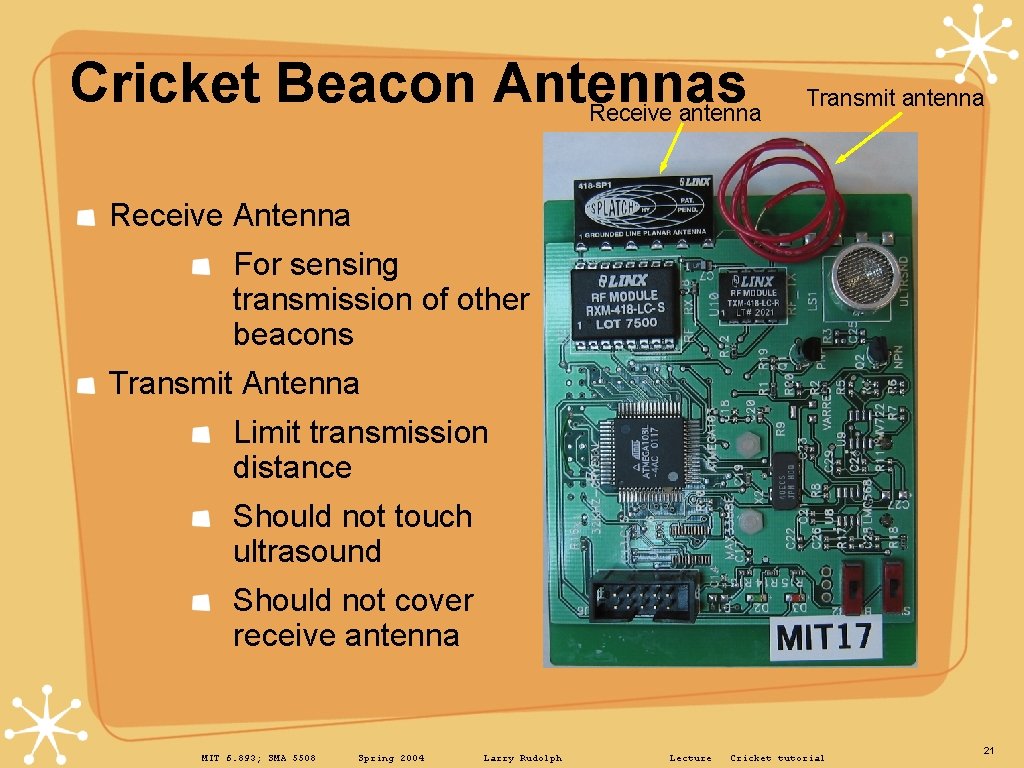
Cricket Beacon Antennas Receive antenna Transmit antenna Receive Antenna For sensing transmission of other beacons Transmit Antenna Limit transmission distance Should not touch ultrasound Should not cover receive antenna MIT 6. 893; SMA 5508 Spring 2004 Larry Rudolph Lecture Cricket tutorial 21
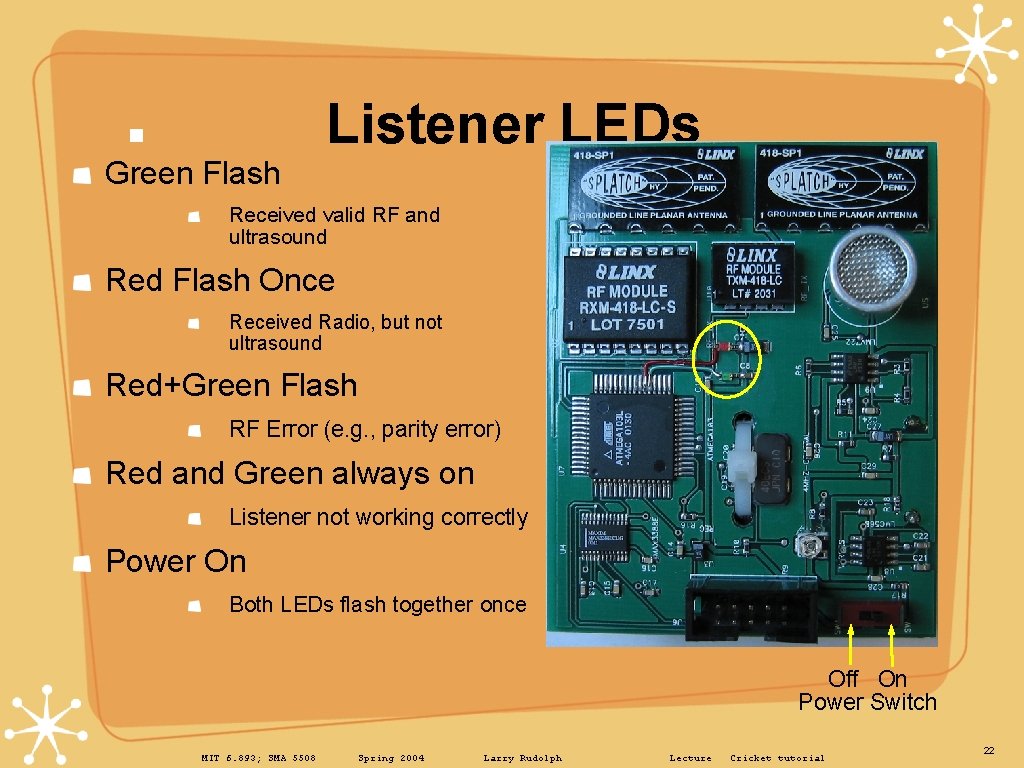
Green Flash Listener LEDs Received valid RF and ultrasound Red Flash Once Received Radio, but not ultrasound Red+Green Flash RF Error (e. g. , parity error) Red and Green always on Listener not working correctly Power On Both LEDs flash together once Off On Power Switch MIT 6. 893; SMA 5508 Spring 2004 Larry Rudolph Lecture Cricket tutorial 22
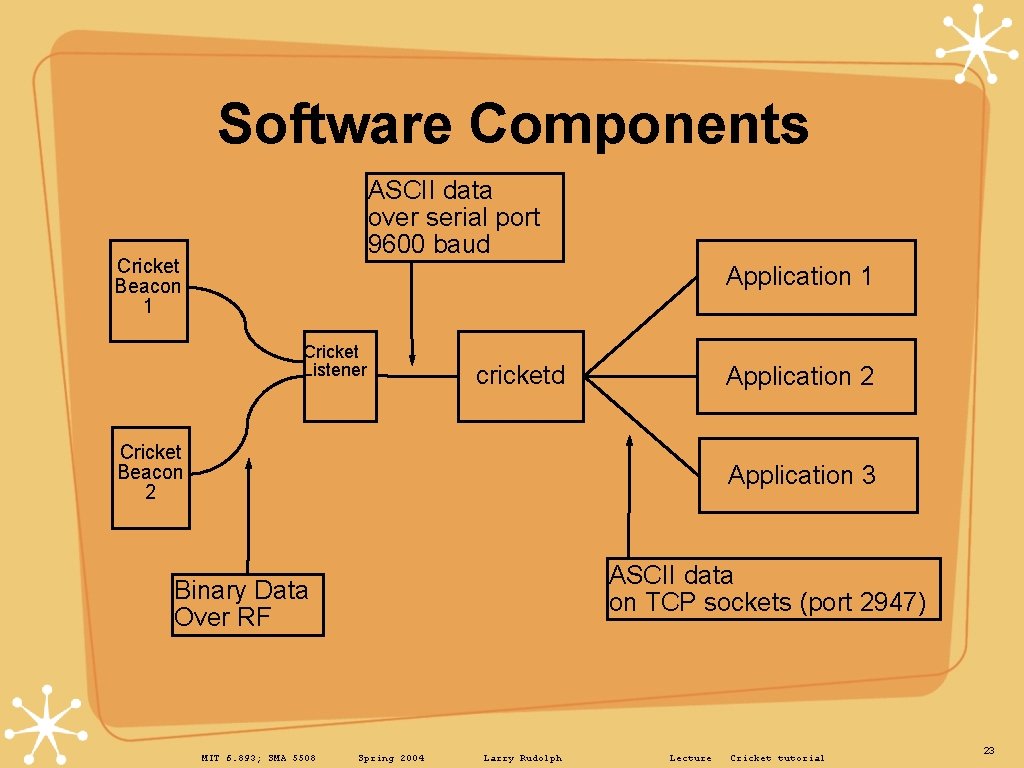
Software Components ASCII data over serial port 9600 baud Cricket Beacon 1 Application 1 Cricket Listener cricketd Application 2 Cricket Beacon 2 Application 3 ASCII data on TCP sockets (port 2947) Binary Data Over RF MIT 6. 893; SMA 5508 Spring 2004 Larry Rudolph Lecture Cricket tutorial 23
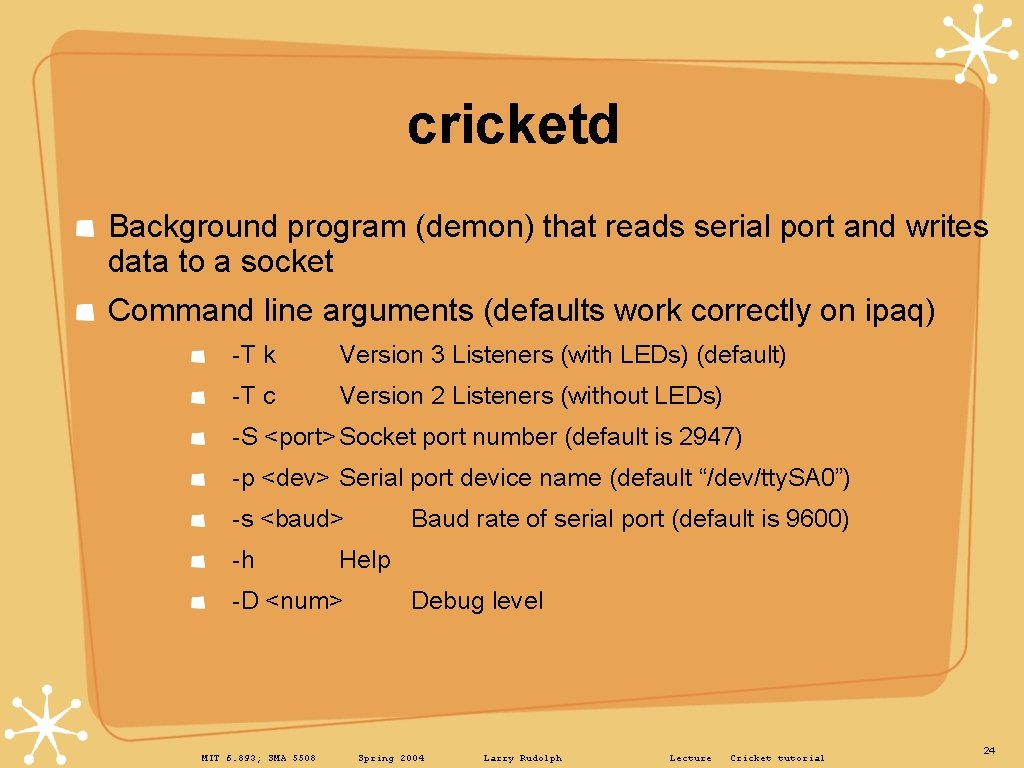
cricketd Background program (demon) that reads serial port and writes data to a socket Command line arguments (defaults work correctly on ipaq) -T k Version 3 Listeners (with LEDs) (default) -T c Version 2 Listeners (without LEDs) -S <port> Socket port number (default is 2947) -p <dev> Serial port device name (default “/dev/tty. SA 0”) -s <baud> -h Help -D <num> MIT 6. 893; SMA 5508 Baud rate of serial port (default is 9600) Debug level Spring 2004 Larry Rudolph Lecture Cricket tutorial 24
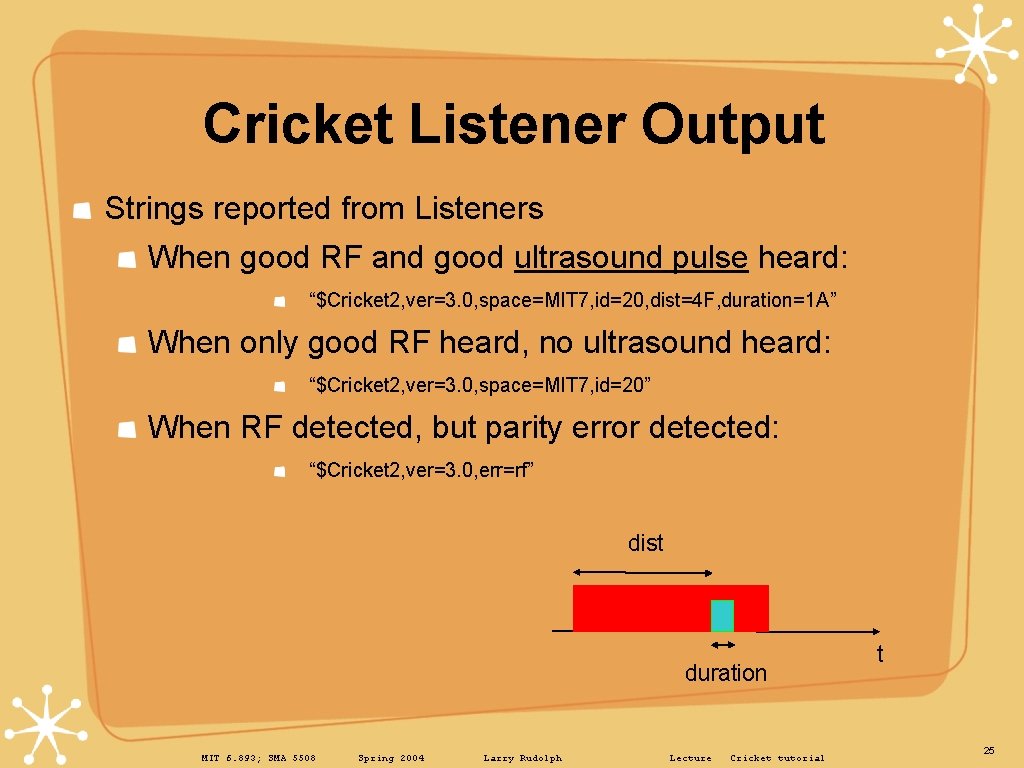
Cricket Listener Output Strings reported from Listeners When good RF and good ultrasound pulse heard: “$Cricket 2, ver=3. 0, space=MIT 7, id=20, dist=4 F, duration=1 A” When only good RF heard, no ultrasound heard: “$Cricket 2, ver=3. 0, space=MIT 7, id=20” When RF detected, but parity error detected: “$Cricket 2, ver=3. 0, err=rf” dist duration MIT 6. 893; SMA 5508 Spring 2004 Larry Rudolph Lecture Cricket tutorial t 25
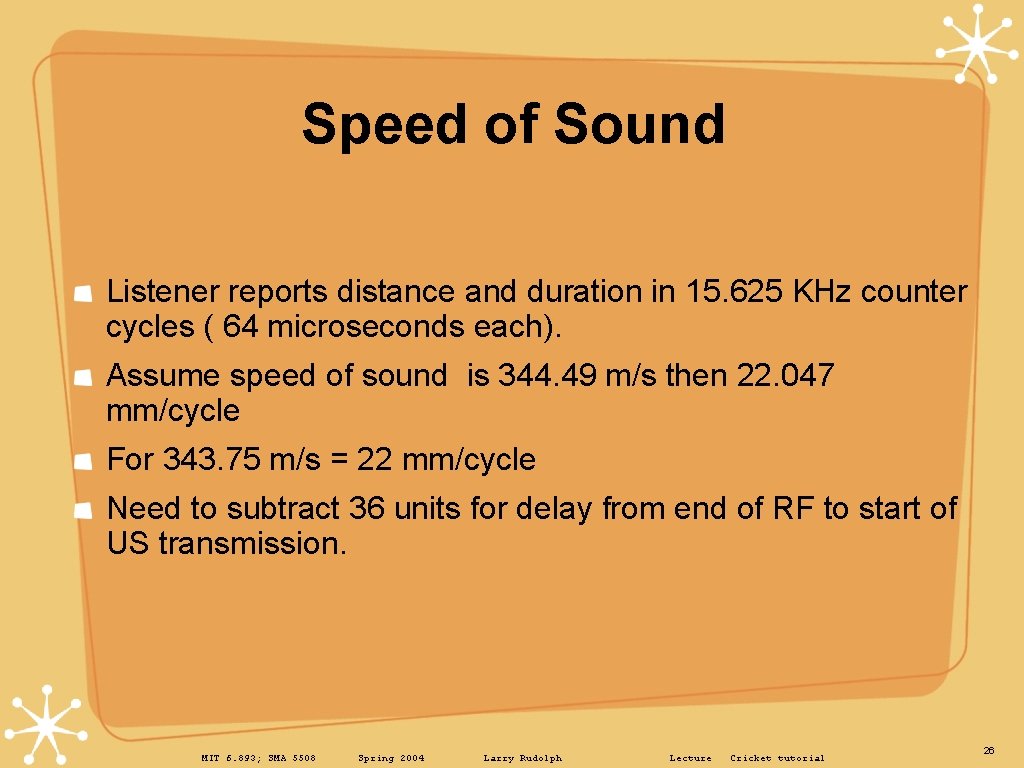
Speed of Sound Listener reports distance and duration in 15. 625 KHz counter cycles ( 64 microseconds each). Assume speed of sound is 344. 49 m/s then 22. 047 mm/cycle For 343. 75 m/s = 22 mm/cycle Need to subtract 36 units for delay from end of RF to start of US transmission. MIT 6. 893; SMA 5508 Spring 2004 Larry Rudolph Lecture Cricket tutorial 26
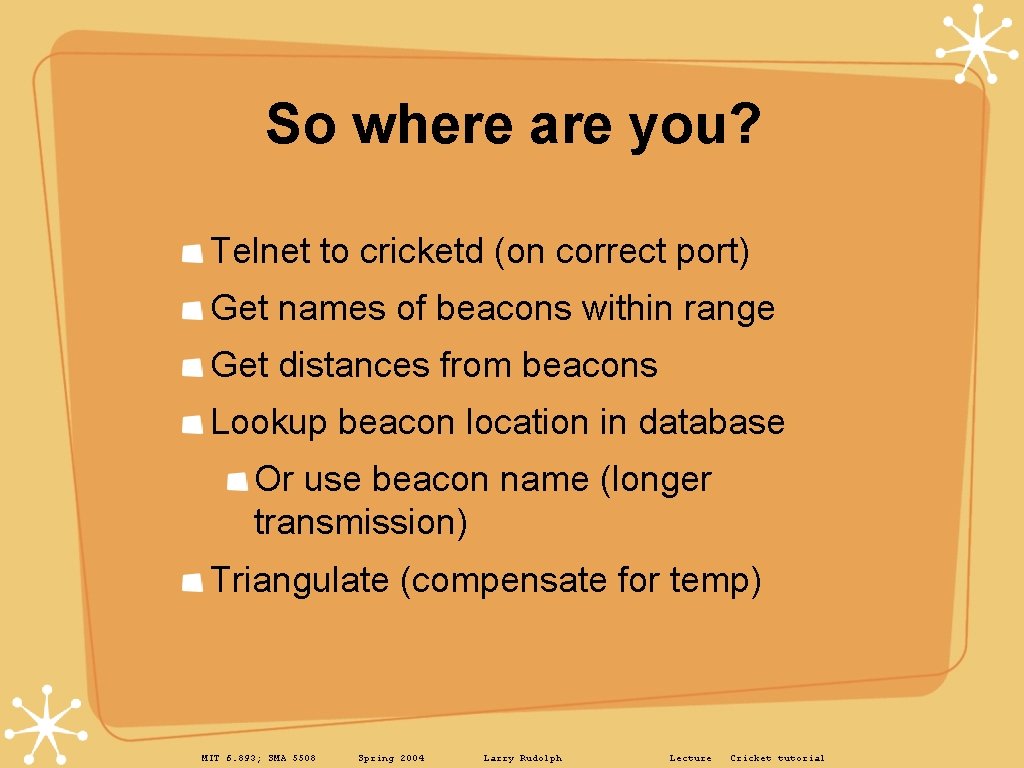
So where are you? Telnet to cricketd (on correct port) Get names of beacons within range Get distances from beacons Lookup beacon location in database Or use beacon name (longer transmission) Triangulate (compensate for temp) MIT 6. 893; SMA 5508 Spring 2004 Larry Rudolph Lecture Cricket tutorial
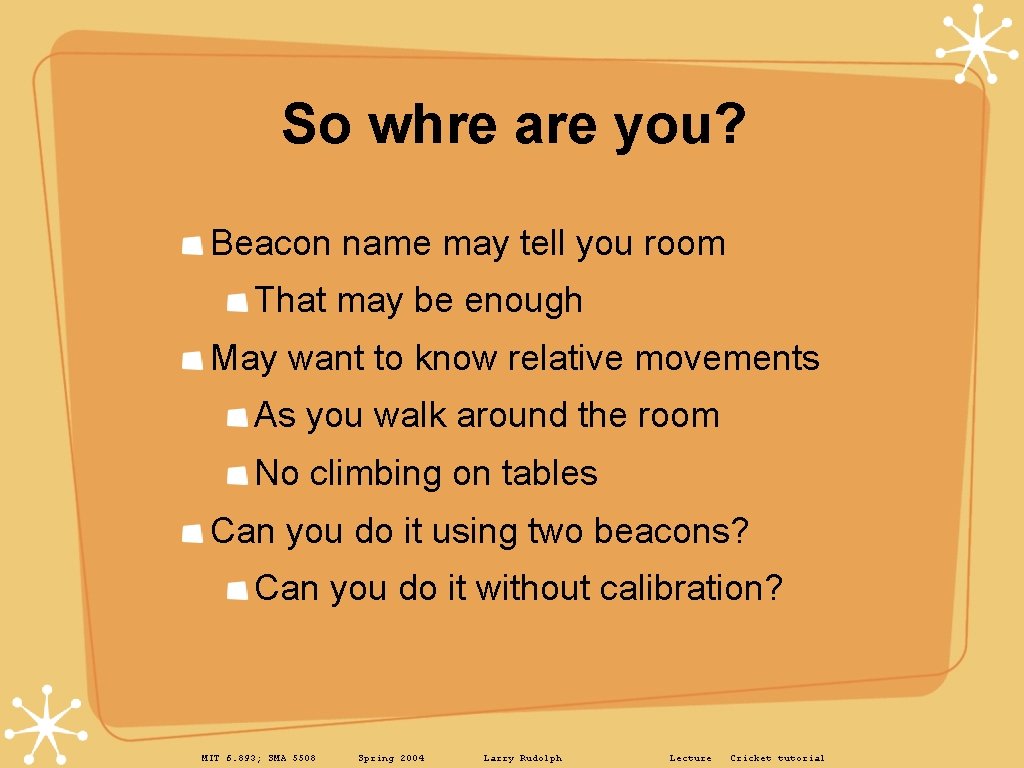
So whre are you? Beacon name may tell you room That may be enough May want to know relative movements As you walk around the room No climbing on tables Can you do it using two beacons? Can you do it without calibration? MIT 6. 893; SMA 5508 Spring 2004 Larry Rudolph Lecture Cricket tutorial
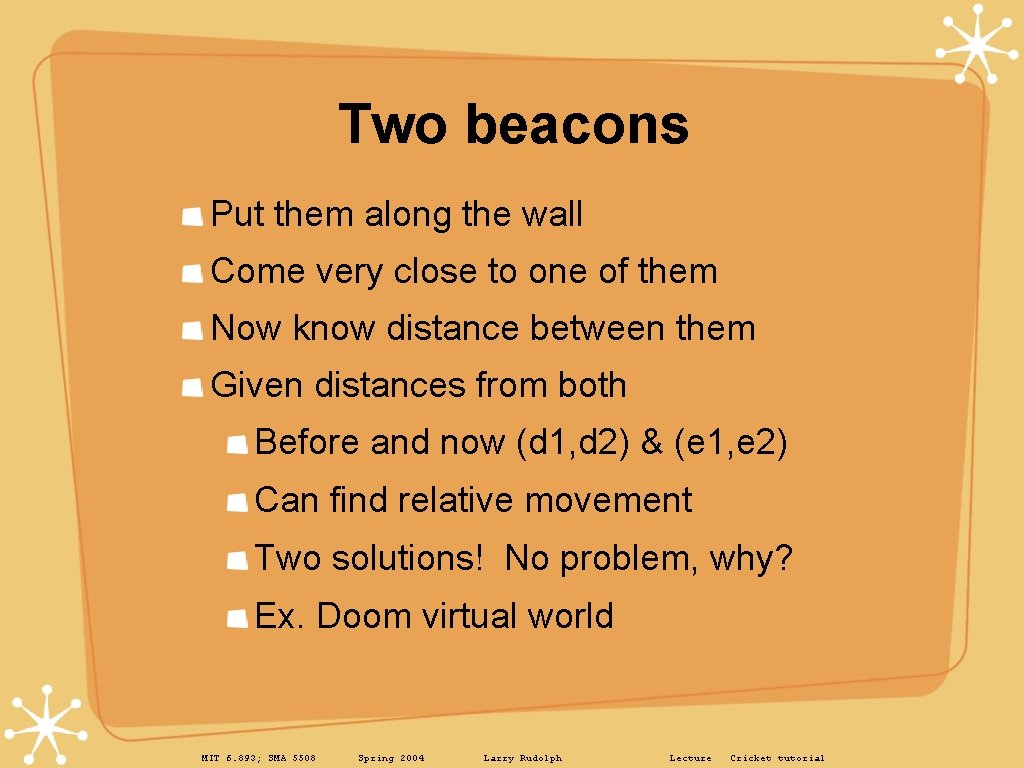
Two beacons Put them along the wall Come very close to one of them Now know distance between them Given distances from both Before and now (d 1, d 2) & (e 1, e 2) Can find relative movement Two solutions! No problem, why? Ex. Doom virtual world MIT 6. 893; SMA 5508 Spring 2004 Larry Rudolph Lecture Cricket tutorial
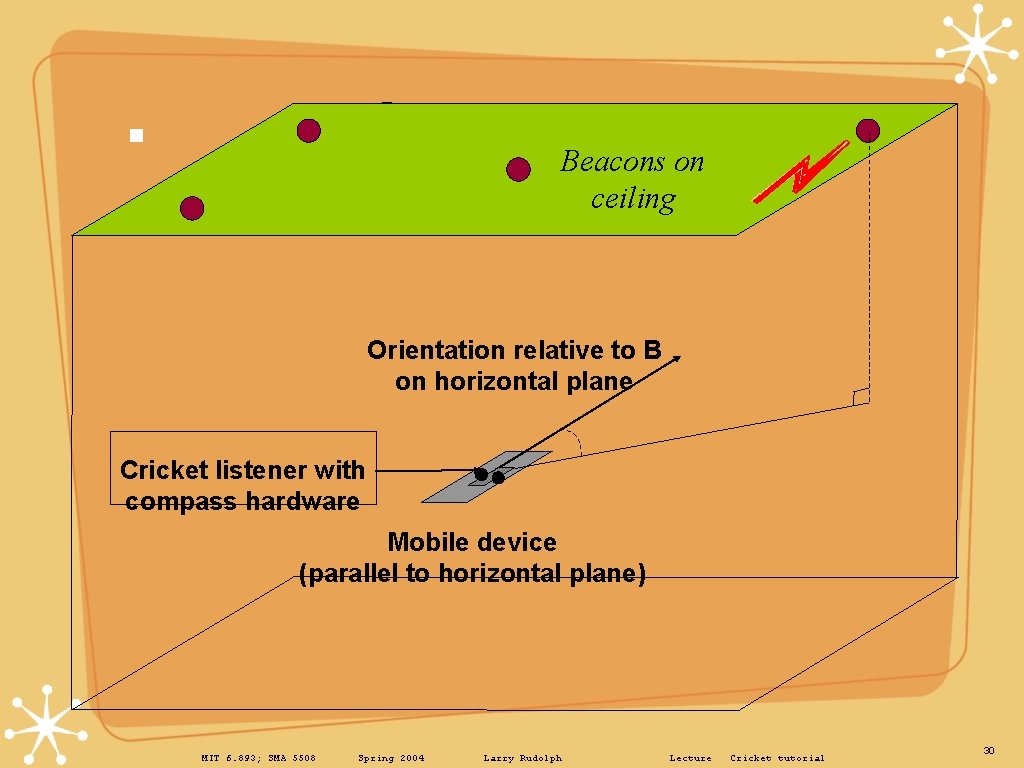
Orientation Beacons on ceiling Orientation relative to B on horizontal plane Cricket listener with compass hardware Mobile device (parallel to horizontal plane) MIT 6. 893; SMA 5508 Spring 2004 Larry Rudolph Lecture Cricket tutorial 30
Hardware Design http: //nms. lcs. mit. edu/projects/cricket http: //nms. lcs. mit. edu/cricket/fab Need user & password http: //nms. lcs. mit. edu/cricket/distrib Need user & password MIT 6. 893; SMA 5508 Spring 2004 Larry Rudolph Lecture Cricket tutorial 31