
Crewcentered Design and Operations of ships and ship
- Slides: 19
Crew-centered Design and Operations of ships and ship systems <No. 313972> The Cyclades Framework: Why, what and how?
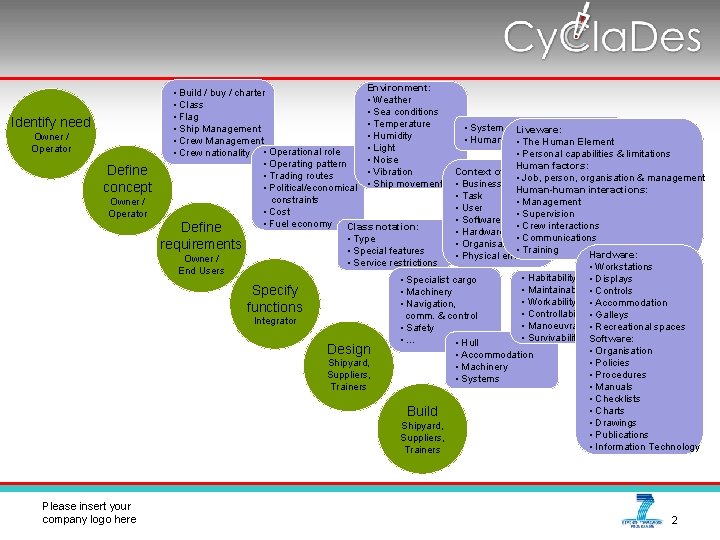
Identify need Owner / Operator Define concept Owner / Operator Environment: • Build / buy / charter • Weather • Class • Sea conditions • Flag • Temperature • System ergonomic requirements • Ship Management Liveware: • Humidity • Human vs technology • Crew Management • The Human Element • Automation • Light • Crew nationality • Operational role • Personal capabilities & limitations • Manning levels • Noise • Operating pattern Human factors: • Crew capabilities • Vibration Context of use: • Trading routes • Job, person, organisation & management • Training specification • Ship movement • Business • Political/economical Human-human interactions: • Task constraints • Management • User • Cost • Supervision • Software • Fuel economy • Crew interactions Class notation: Define • Hardware • Communications • Type • Organisational envir, requirements • Training • Special features Hardware: • Physical environment Owner / • Service restrictions • Workstations End Users • Habitability • Displays • Specialist cargo • Maintainability • Controls Specify • Machinery • Workability • Accommodation • Navigation, functions • Controllability • Galleys comm. & control Integrator • Manoeuvrability • Recreational spaces • Safety • Survivability Software: • … • Hull Design • Organisation • Accommodation • Policies Shipyard, • Machinery • Procedures Suppliers, • Systems • Manuals Trainers • Checklists • Charts Build • Drawings Shipyard, • Publications Suppliers, • Information Technology Trainers please Please insert your company logo on the logo master here slide 2
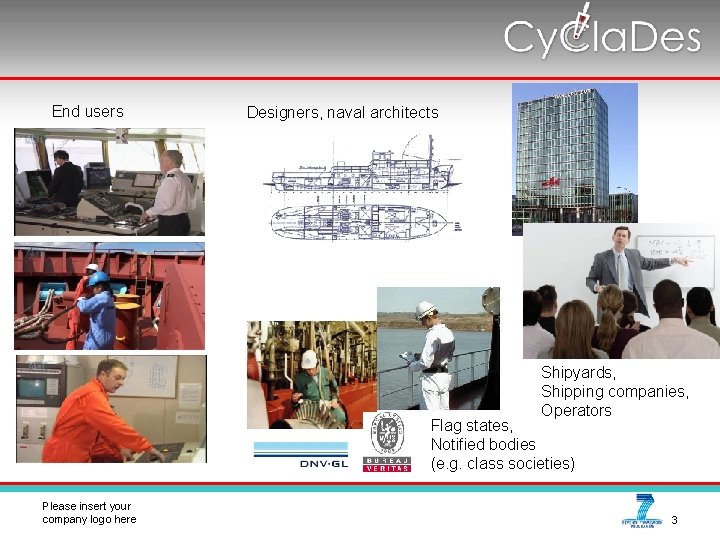
End users Designers, naval architects Staff training Shipyards, Shipping companies, Operators Flag states, Notified bodies (e. g. class societies) please Please insert your company logo on the logo master here slide 3
Crew Centred Design? please Please insert your company logo on the logo master here slide 4
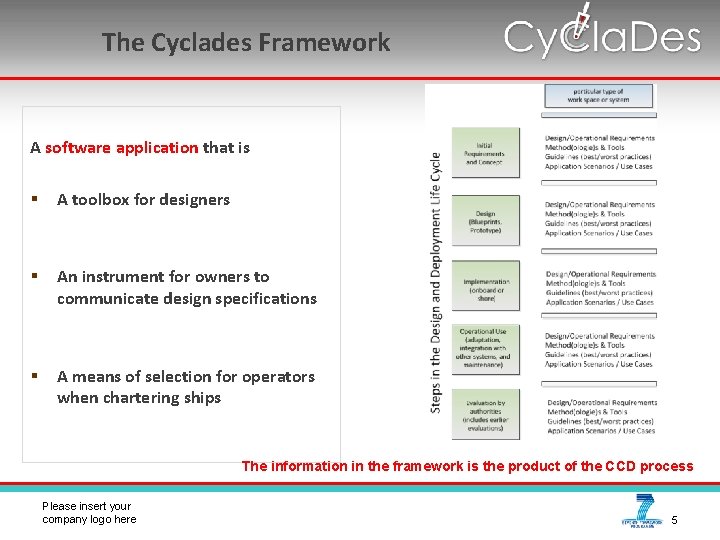
The Cyclades Framework A software application that is § A toolbox for designers § An instrument for owners to communicate design specifications § A means of selection for operators when chartering ships The information in the framework is the product of the CCD process please Please insert your company logo on the logo master here slide 5
The goal of the framework is to: A. Improve access to already existing information about crew centred design (CCD) and guidelines for the design of ships and ship systems B. Encourage various stakeholders to make use of CCD knowledge in the maritime domain and to encourage each other to apply CCD principles to design (the elearning modules) C. Contribute with knowledge about CCD and its application to the maritime industry please Please insert your company logo on the logo master here slide [Grundevik et al. 2009] 6
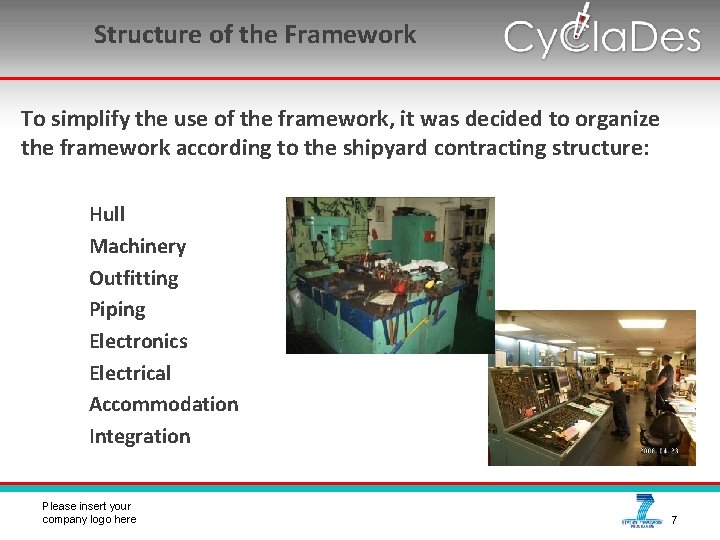
Structure of the Framework To simplify the use of the framework, it was decided to organize the framework according to the shipyard contracting structure: Hull Machinery Outfitting Piping Electronics Electrical Accommodation Integration please Please insert your company logo on the logo master here slide 7
How to use the framework and navigate through its components please Please insert your company logo on the logo master here slide 8
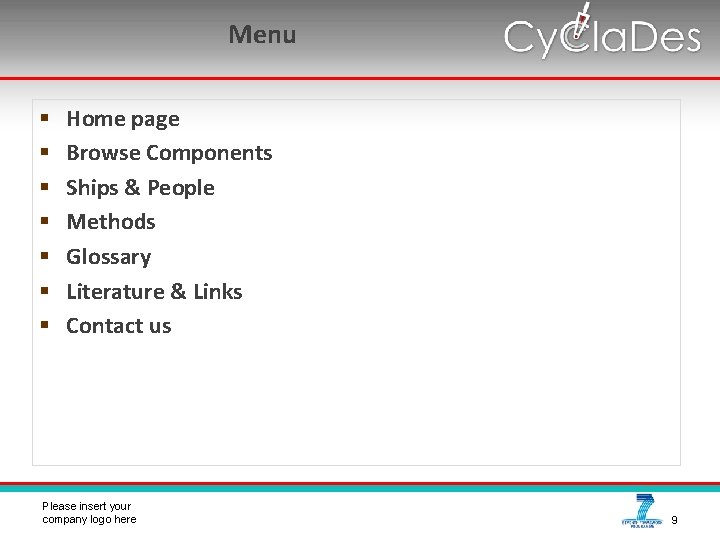
Menu § § § § Home page Browse Components Ships & People Methods Glossary Literature & Links Contact us please Please insert your company logo on the logo master here slide 9
Browse Components § Using the search and filter functions to browse components please Please insert your company logo on the logo master here slide 10
Example 1: Searching for components related to the winch control panel please Please insert your company logo on the logo master here slide 14
Example 2: Filtering information about the winch control panel please Please insert your company logo on the logo master here slide 18
Example 3: Using the export function to export information about the winch control panel please Please insert your company logo on the logo master here slide 23
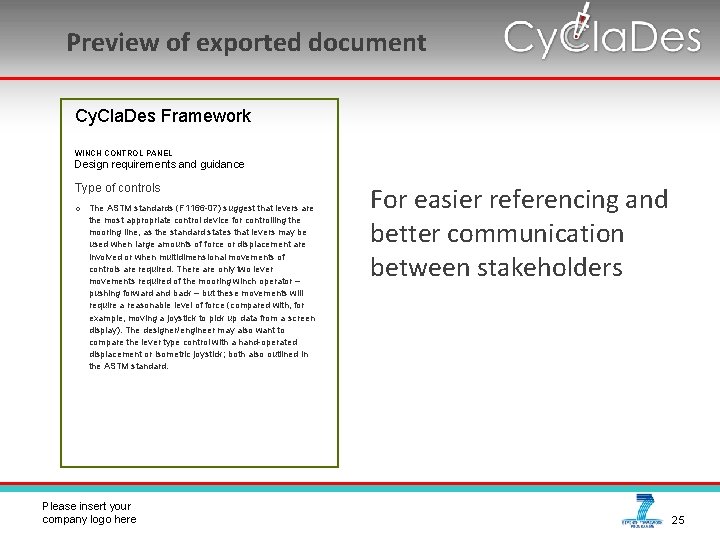
Preview of exported document Cy. Cla. Des Framework WINCH CONTROL PANEL Design requirements and guidance Type of controls o The ASTM standards (F 1166 -07) suggest that levers are the most appropriate control device for controlling the mooring line, as the standard states that levers may be used when large amounts of force or displacement are involved or when multidimensional movements of controls are required. There are only two lever movements required of the mooring winch operator – pushing forward and back – but these movements will require a reasonable level of force (compared with, for example, moving a joystick to pick up data from a screen display). The designer/engineer may also want to compare the lever type control with a hand-operated displacement or isometric joystick; both also outlined in the ASTM standard. please Please insert your company logo on the logo master here slide For easier referencing and better communication between stakeholders 25
Ships & People Section § Concrete examples of good and bad design please Please insert your company logo on the logo master here slide 26
Methods section: Doing HCD § Human centred design in practice: – – Introduction and Overview Pre-design HCD Iterative Design HCD Evaluation HCD § Structure will be similar to the Ships & People section please Please insert your company logo on the logo master here slide 27
Glossary Section § Definitions of key concepts § Related concepts and examples § References please Please insert your company logo on the logo master here slide 28
Literature & Links § Further reading § Copyright issues to be resolved please Please insert your company logo on the logo master here slide 29
Contact Us § The framework is to be maintained by one of the partners also after the project is concluded please Please insert your company logo on the logo master here slide 30