
Crestwood Casey Trees for Crestwood Community Tree Planting
- Slides: 13
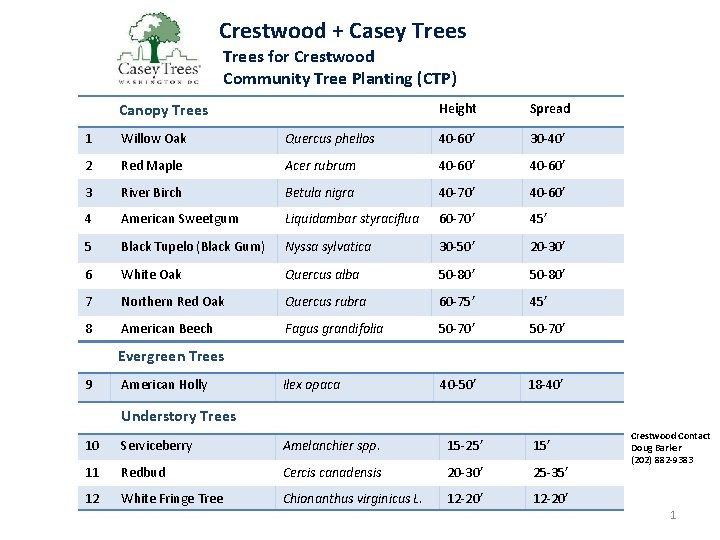
Crestwood + Casey Trees for Crestwood Community Tree Planting (CTP) Canopy Trees Height Spread 1 Willow Oak Quercus phellos 40 -60’ 30 -40’ 2 Red Maple Acer rubrum 40 -60’ 3 River Birch Betula nigra 40 -70’ 40 -60’ 4 American Sweetgum Liquidambar styraciflua 60 -70’ 45’ 5 Black Tupelo (Black Gum) Nyssa sylvatica 30 -50’ 20 -30’ 6 White Oak Quercus alba 50 -80’ 7 Northern Red Oak Quercus rubra 60 -75’ 45’ 8 American Beech Fagus grandifolia 50 -70’ Ilex opaca 40 -50’ 18 -40’ Evergreen Trees 9 American Holly Understory Trees 10 Serviceberry Amelanchier spp. 15 -25’ 11 Redbud Cercis canadensis 20 -30’ 25 -35’ 12 White Fringe Tree Chionanthus virginicus L. 12 -20’ Crestwood Contact Doug Barker (202) 882 -9383 1
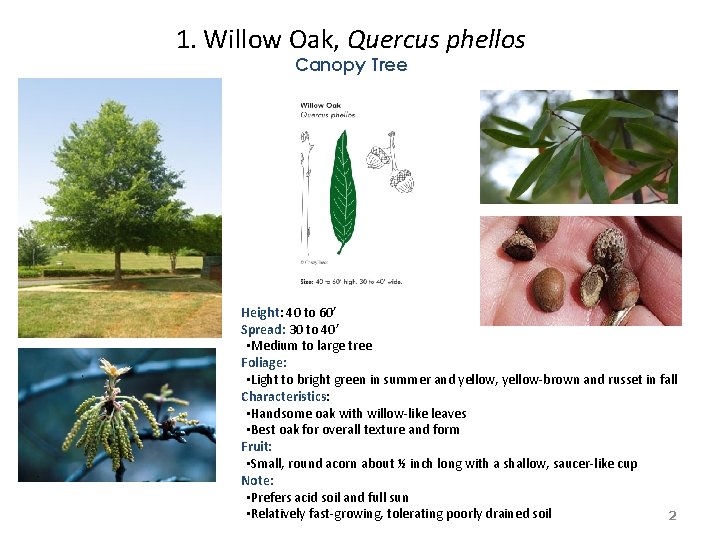
1. Willow Oak, Quercus phellos Canopy Tree Height: 40 to 60’ Spread: 30 to 40’ • Medium to large tree Foliage: • Light to bright green in summer and yellow, yellow-brown and russet in fall Characteristics: • Handsome oak with willow-like leaves • Best oak for overall texture and form Fruit: • Small, round acorn about ½ inch long with a shallow, saucer-like cup Note: • Prefers acid soil and full sun • Relatively fast-growing, tolerating poorly drained soil 2
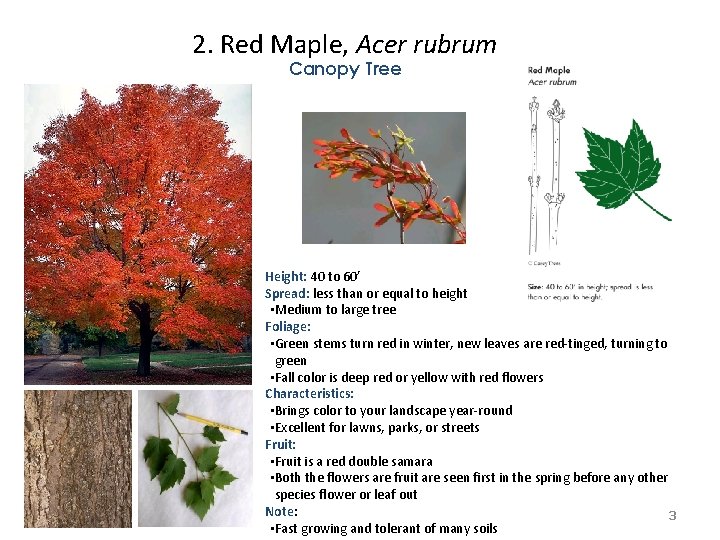
2. Red Maple, Acer rubrum Canopy Tree Height: 40 to 60’ Spread: less than or equal to height • Medium to large tree Foliage: • Green stems turn red in winter, new leaves are red-tinged, turning to green • Fall color is deep red or yellow with red flowers Characteristics: • Brings color to your landscape year-round • Excellent for lawns, parks, or streets Fruit: • Fruit is a red double samara • Both the flowers are fruit are seen first in the spring before any other species flower or leaf out Note: 3 • Fast growing and tolerant of many soils
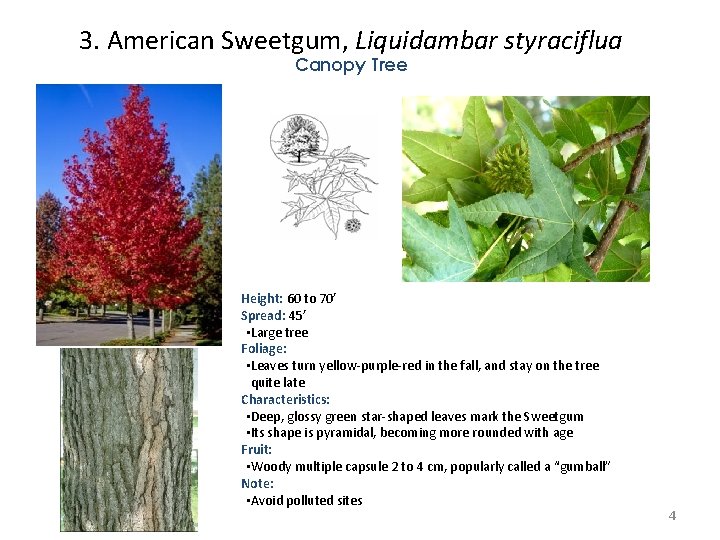
3. American Sweetgum, Liquidambar styraciflua Canopy Tree Height: 60 to 70’ Spread: 45’ • Large tree Foliage: • Leaves turn yellow-purple-red in the fall, and stay on the tree quite late Characteristics: • Deep, glossy green star-shaped leaves mark the Sweetgum • Its shape is pyramidal, becoming more rounded with age Fruit: • Woody multiple capsule 2 to 4 cm, popularly called a “gumball” Note: • Avoid polluted sites 4
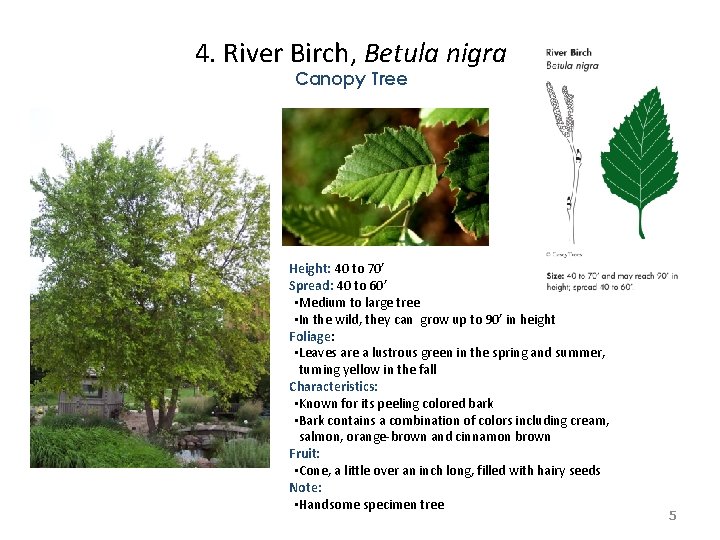
4. River Birch, Betula nigra Canopy Tree Height: 40 to 70’ Spread: 40 to 60’ • Medium to large tree • In the wild, they can grow up to 90’ in height Foliage: • Leaves are a lustrous green in the spring and summer, turning yellow in the fall Characteristics: • Known for its peeling colored bark • Bark contains a combination of colors including cream, salmon, orange-brown and cinnamon brown Fruit: • Cone, a little over an inch long, filled with hairy seeds Note: • Handsome specimen tree 5
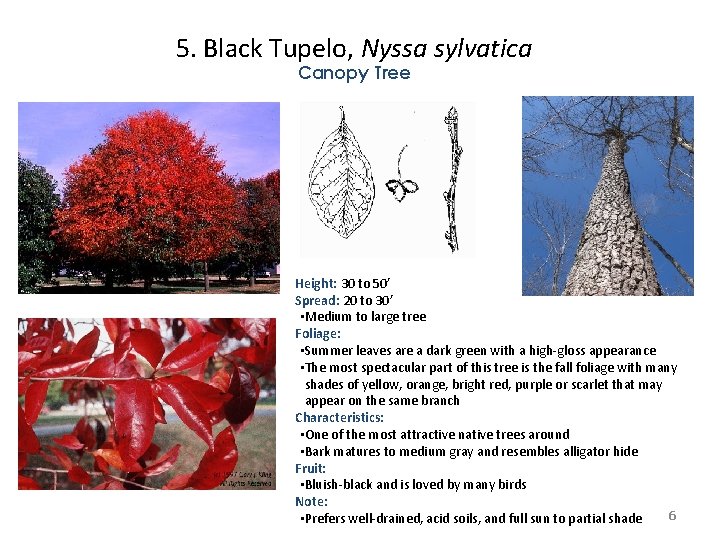
5. Black Tupelo, Nyssa sylvatica Canopy Tree Height: 30 to 50’ Spread: 20 to 30’ • Medium to large tree Foliage: • Summer leaves are a dark green with a high-gloss appearance • The most spectacular part of this tree is the fall foliage with many shades of yellow, orange, bright red, purple or scarlet that may appear on the same branch Characteristics: • One of the most attractive native trees around • Bark matures to medium gray and resembles alligator hide Fruit: • Bluish-black and is loved by many birds Note: 6 • Prefers well-drained, acid soils, and full sun to partial shade
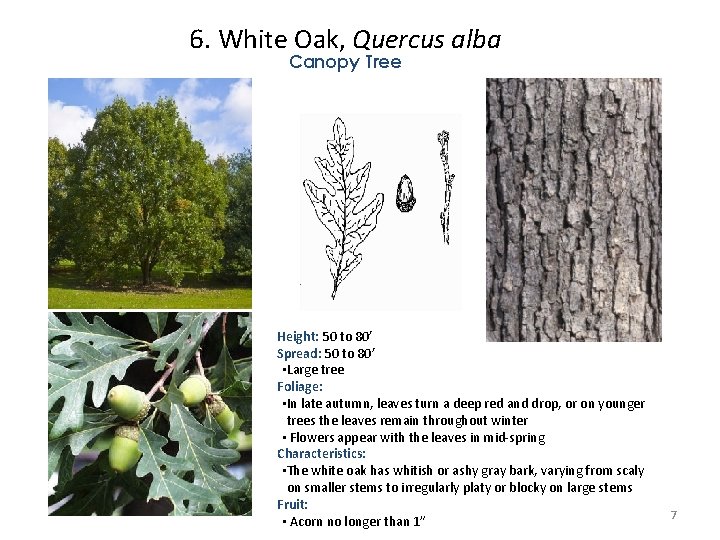
6. White Oak, Quercus alba Canopy Tree Height: 50 to 80’ Spread: 50 to 80’ • Large tree Foliage: • In late autumn, leaves turn a deep red and drop, or on younger trees the leaves remain throughout winter • Flowers appear with the leaves in mid-spring Characteristics: • The white oak has whitish or ashy gray bark, varying from scaly on smaller stems to irregularly platy or blocky on large stems Fruit: • Acorn no longer than 1” 7
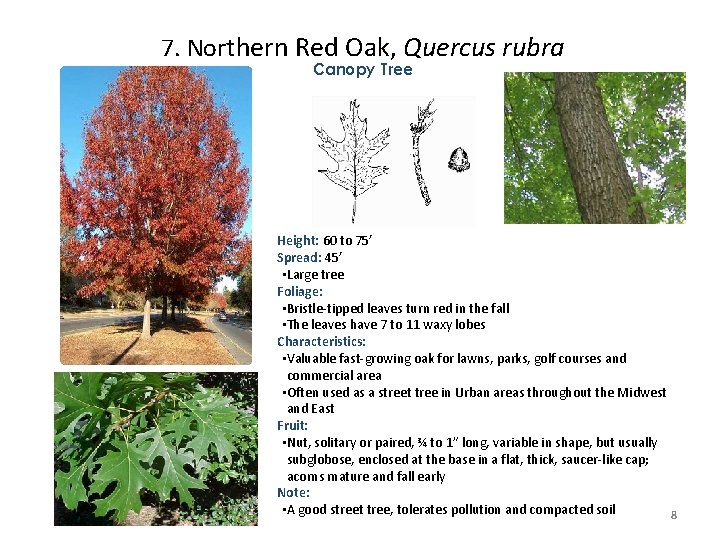
7. Northern Red Oak, Quercus rubra Canopy Tree Height: 60 to 75’ Spread: 45’ • Large tree Foliage: • Bristle-tipped leaves turn red in the fall • The leaves have 7 to 11 waxy lobes Characteristics: • Valuable fast-growing oak for lawns, parks, golf courses and commercial area • Often used as a street tree in Urban areas throughout the Midwest and East Fruit: • Nut, solitary or paired, ¾ to 1” long, variable in shape, but usually subglobose, enclosed at the base in a flat, thick, saucer-like cap; acorns mature and fall early Note: • A good street tree, tolerates pollution and compacted soil 8
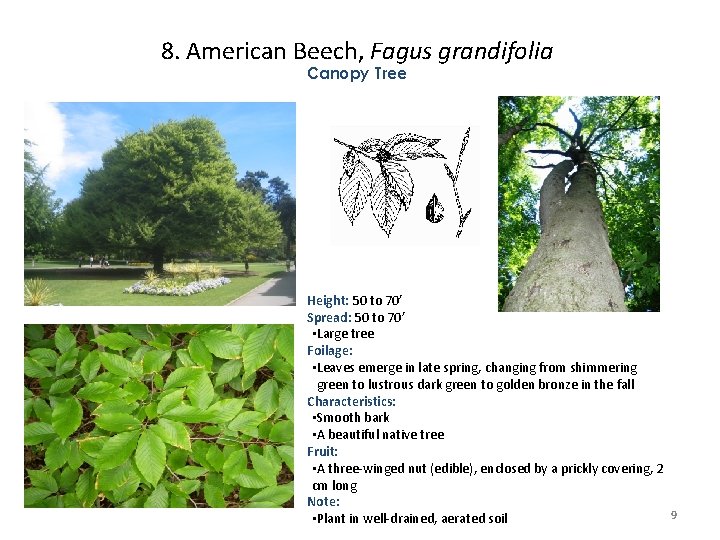
8. American Beech, Fagus grandifolia Canopy Tree Height: 50 to 70’ Spread: 50 to 70’ • Large tree Foilage: • Leaves emerge in late spring, changing from shimmering green to lustrous dark green to golden bronze in the fall Characteristics: • Smooth bark • A beautiful native tree Fruit: • A three-winged nut (edible), enclosed by a prickly covering, 2 cm long Note: 9 • Plant in well-drained, aerated soil
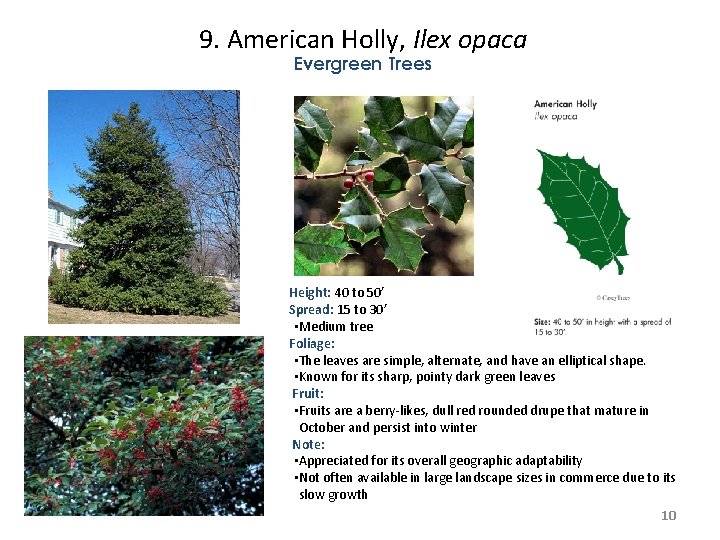
9. American Holly, Ilex opaca Evergreen Trees Height: 40 to 50’ Spread: 15 to 30’ • Medium tree Foliage: • The leaves are simple, alternate, and have an elliptical shape. • Known for its sharp, pointy dark green leaves Fruit: • Fruits are a berry-likes, dull red rounded drupe that mature in October and persist into winter Note: • Appreciated for its overall geographic adaptability • Not often available in large landscape sizes in commerce due to its slow growth 10
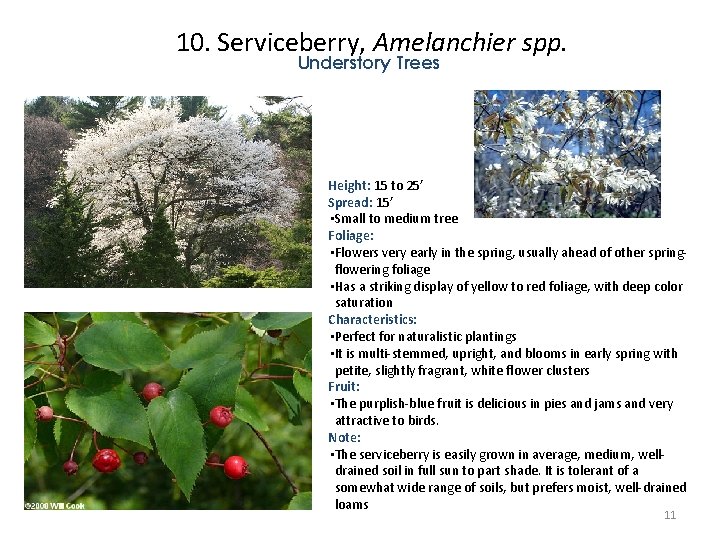
10. Serviceberry, Amelanchier spp. Understory Trees Height: 15 to 25’ Spread: 15’ • Small to medium tree Foliage: • Flowers very early in the spring, usually ahead of other springflowering foliage • Has a striking display of yellow to red foliage, with deep color saturation Characteristics: • Perfect for naturalistic plantings • It is multi-stemmed, upright, and blooms in early spring with petite, slightly fragrant, white flower clusters Fruit: • The purplish-blue fruit is delicious in pies and jams and very attractive to birds. Note: • The serviceberry is easily grown in average, medium, welldrained soil in full sun to part shade. It is tolerant of a somewhat wide range of soils, but prefers moist, well-drained loams 11
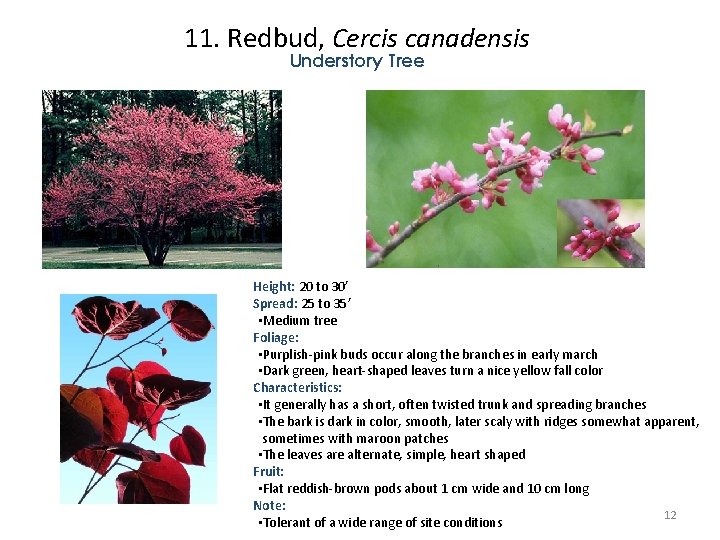
11. Redbud, Cercis canadensis Understory Tree Height: 20 to 30’ Spread: 25 to 35’ • Medium tree Foliage: • Purplish-pink buds occur along the branches in early march • Dark green, heart-shaped leaves turn a nice yellow fall color Characteristics: • It generally has a short, often twisted trunk and spreading branches • The bark is dark in color, smooth, later scaly with ridges somewhat apparent, sometimes with maroon patches • The leaves are alternate, simple, heart shaped Fruit: • Flat reddish-brown pods about 1 cm wide and 10 cm long Note: 12 • Tolerant of a wide range of site conditions
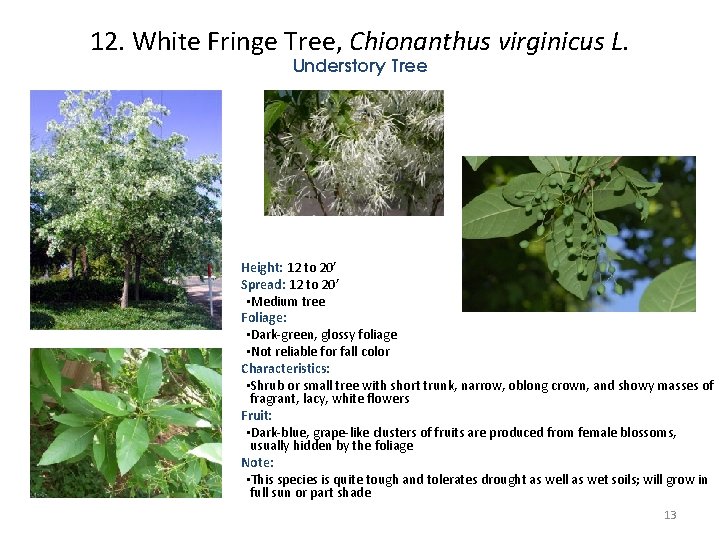
12. White Fringe Tree, Chionanthus virginicus L. Understory Tree Height: 12 to 20’ Spread: 12 to 20’ • Medium tree Foliage: • Dark-green, glossy foliage • Not reliable for fall color Characteristics: • Shrub or small tree with short trunk, narrow, oblong crown, and showy masses of fragrant, lacy, white flowers Fruit: • Dark-blue, grape-like clusters of fruits are produced from female blossoms, usually hidden by the foliage Note: • This species is quite tough and tolerates drought as well as wet soils; will grow in full sun or part shade 13