
Creeping Flows Steven A Jones BIEN 501 Wednesday
Creeping Flows Steven A. Jones BIEN 501 Wednesday, March 21, 2007 Start on Slide 53 Louisiana Tech University Ruston, LA 71272 1
Creeping Flows Major Learning Objectives: 1. Compare viscous flows to nonviscous flows. 2. Derive the complete solution for creeping flow around a sphere (Stokes’ flow). 3. Relate the solution to the force on the sphere. Louisiana Tech University Ruston, LA 71272 2
Creeping Flows Minor Learning Objectives: 1. Examine qualitative inertial and viscous effects. 2. Show symmetry simplifies the equations. 3. Show creeping and nonviscous flows simplify the momentum equations. 4. Give the origin of the Reynolds number. 5. Use the Reynolds number to distinguish creeping and nonviscous flows. 6. Apply non-slip boundary conditions at a wall and incident flow boundary conditions at . Louisiana Tech University Ruston, LA 71272 3
Creeping Flows Minor Learning Objectives (continued): 7. Use the equations for conservation of mass and conservation of momentum in spherical coordinates. 8. Use the stream function to satisfy continuity. 9. Eliminate the pressure term from the momentum equations by (a) taking the curl and (b) using a sort of Gaussian elimination. 10. Rewrite the momentum equations in terms of the stream function. 11. Rewrite the boundary conditions in terms of the stream function. 12. Deduce information about the form of the solution from the boundary conditions. Louisiana Tech University Ruston, LA 71272 4
Important Concepts • • • Flow Rate Cross-sectional average velocity Shear Stress (wall shear stress) Force caused by shear stress (drag) Pressure loss Louisiana Tech University Ruston, LA 71272 5
Creeping Flows Minor Learning Objectives (continued): 13. Discuss the relationship between boundary conditions and the assumption of separability. 14. Reduce the partial differential equation to an ordinary differential equation, based on the assumed shape of the solution. 15. Recognize and solve the equidimensional equation. 16. Translate the solution for the stream function into the solution for the velocity components. . 17. Obtain the pressure from the velocity components. 18. Obtain the drag on the sphere from the stress components (viscous and pressure). Louisiana Tech University Ruston, LA 71272 6
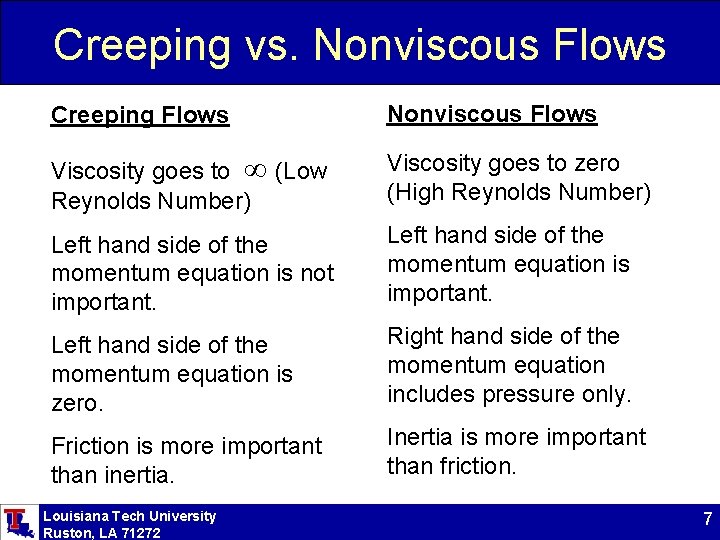
Creeping vs. Nonviscous Flows Creeping Flows Nonviscous Flows Viscosity goes to (Low Reynolds Number) Viscosity goes to zero (High Reynolds Number) Left hand side of the momentum equation is not important. Left hand side of the momentum equation is zero. Right hand side of the momentum equation includes pressure only. Friction is more important than inertia. Inertia is more important than friction. Louisiana Tech University Ruston, LA 71272 7
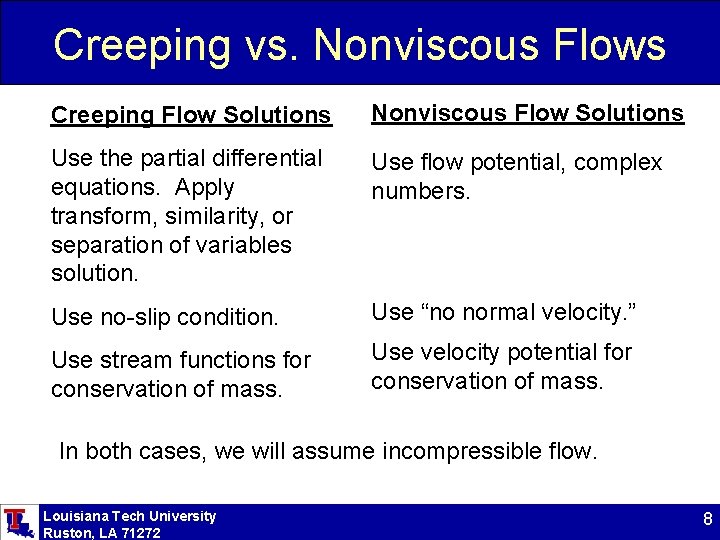
Creeping vs. Nonviscous Flows Creeping Flow Solutions Nonviscous Flow Solutions Use the partial differential equations. Apply transform, similarity, or separation of variables solution. Use flow potential, complex numbers. Use no-slip condition. Use “no normal velocity. ” Use stream functions for conservation of mass. Use velocity potential for conservation of mass. In both cases, we will assume incompressible flow. Louisiana Tech University Ruston, LA 71272 8
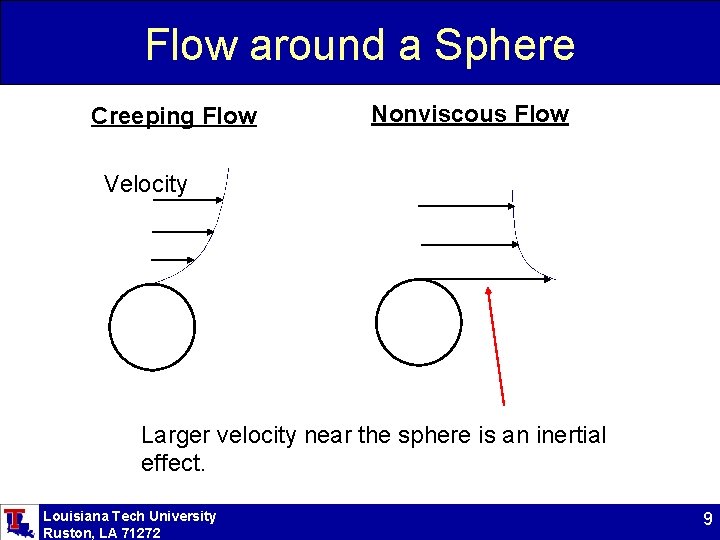
Flow around a Sphere Creeping Flow Nonviscous Flow Velocity Larger velocity near the sphere is an inertial effect. Louisiana Tech University Ruston, LA 71272 9
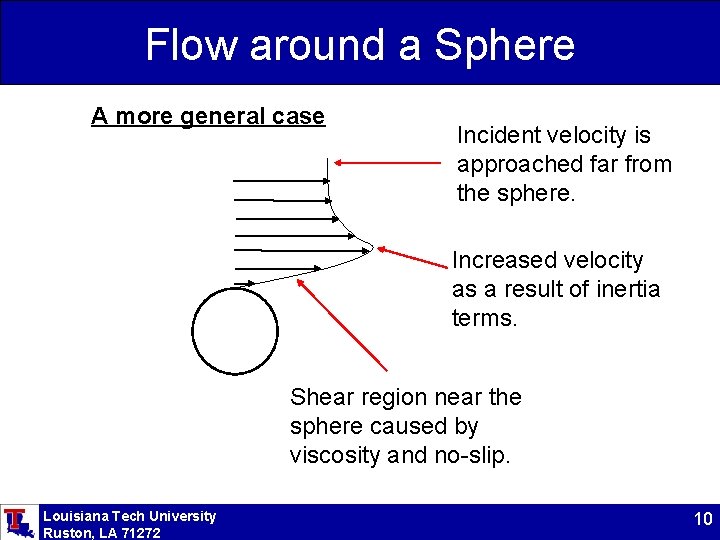
Flow around a Sphere A more general case Incident velocity is approached far from the sphere. Increased velocity as a result of inertia terms. Shear region near the sphere caused by viscosity and no-slip. Louisiana Tech University Ruston, LA 71272 10
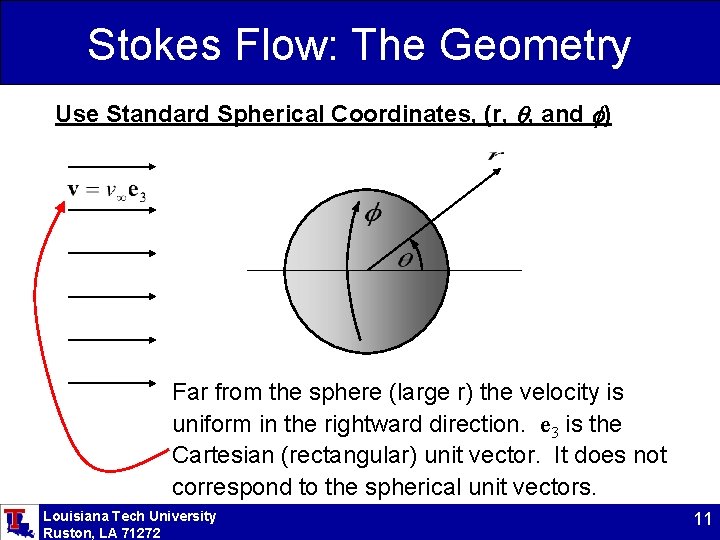
Stokes Flow: The Geometry Use Standard Spherical Coordinates, (r, , and ) Far from the sphere (large r) the velocity is uniform in the rightward direction. e 3 is the Cartesian (rectangular) unit vector. It does not correspond to the spherical unit vectors. Louisiana Tech University Ruston, LA 71272 11
The Objective 1. Obtain the velocity field around the sphere. 2. Use this velocity field to determine pressure and drag at the sphere surface. 3. From the pressure and drag, determine the force on the sphere as a function of the sphere’s velocity, or equivalently the sphere’s velocity as a function of the applied force (e. g. gravity, centrifuge, electric field). Louisiana Tech University Ruston, LA 71272 12
Some Applications 1. What electric field is required to move a charged particle in electrophoresis? 2. What g force is required to centrifuge cells in a given amount of time. 3. What is the effect of gravity on the movement of a monocyte in blood? 4. How does sedimentation vary with the size of the sediment particles? 5. How rapidly do enzyme-coated beads move in a bioreactor? Louisiana Tech University Ruston, LA 71272 13
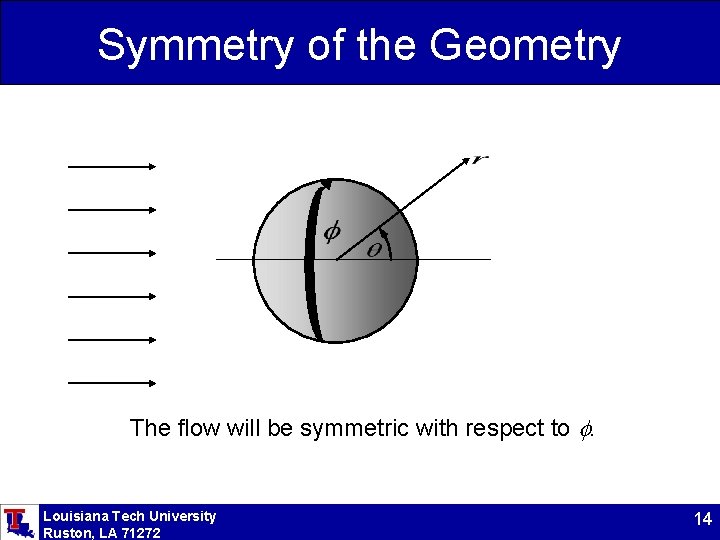
Symmetry of the Geometry The flow will be symmetric with respect to . Louisiana Tech University Ruston, LA 71272 14
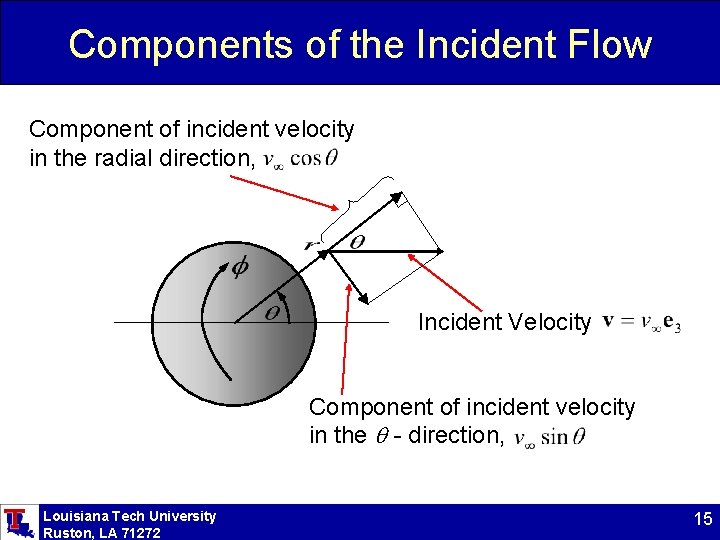
Components of the Incident Flow Component of incident velocity in the radial direction, Incident Velocity Component of incident velocity in the - direction, Louisiana Tech University Ruston, LA 71272 15
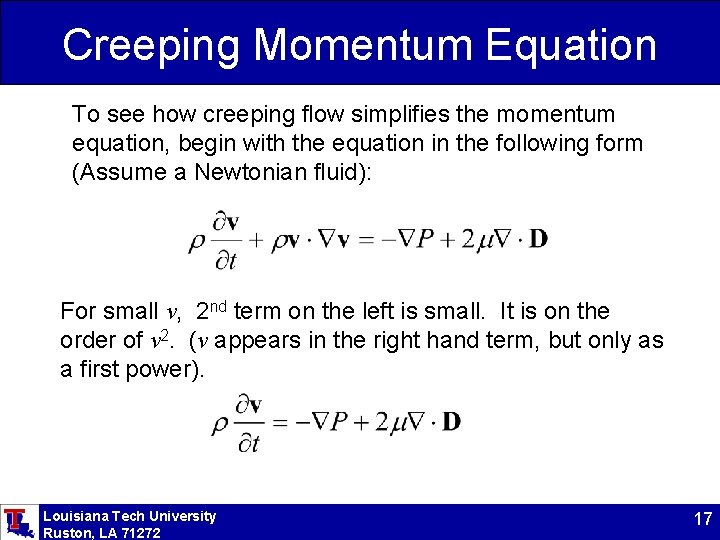
Creeping Momentum Equation To see how creeping flow simplifies the momentum equation, begin with the equation in the following form (Assume a Newtonian fluid): For small v, 2 nd term on the left is small. It is on the order of v 2. (v appears in the right hand term, but only as a first power). Louisiana Tech University Ruston, LA 71272 17
Convective Term in Spherical Coordinates Louisiana Tech University Ruston, LA 71272 18
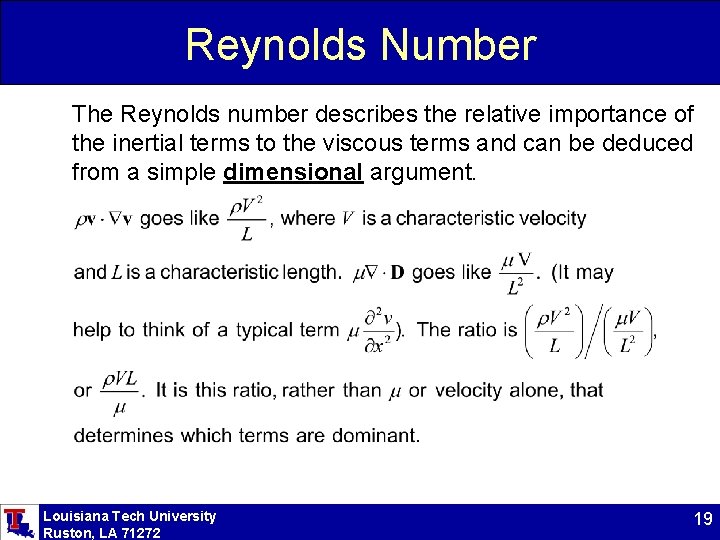
Reynolds Number The Reynolds number describes the relative importance of the inertial terms to the viscous terms and can be deduced from a simple dimensional argument. Louisiana Tech University Ruston, LA 71272 19
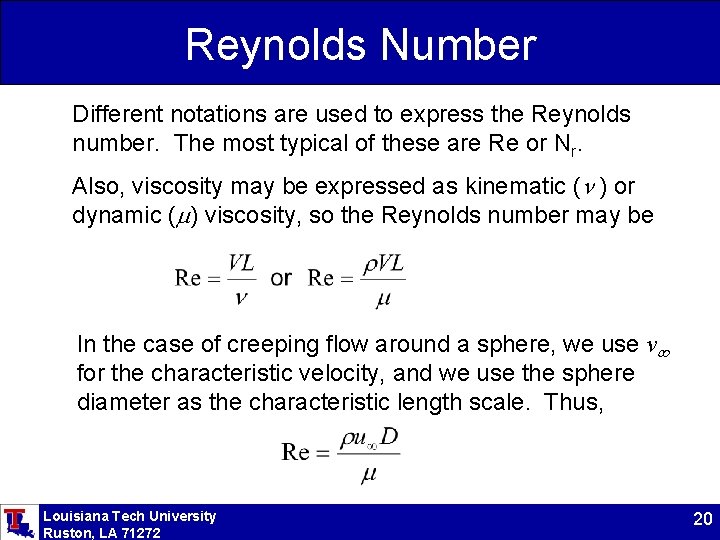
Reynolds Number Different notations are used to express the Reynolds number. The most typical of these are Re or Nr. Also, viscosity may be expressed as kinematic ( ) or dynamic ( ) viscosity, so the Reynolds number may be In the case of creeping flow around a sphere, we use v for the characteristic velocity, and we use the sphere diameter as the characteristic length scale. Thus, Louisiana Tech University Ruston, LA 71272 20
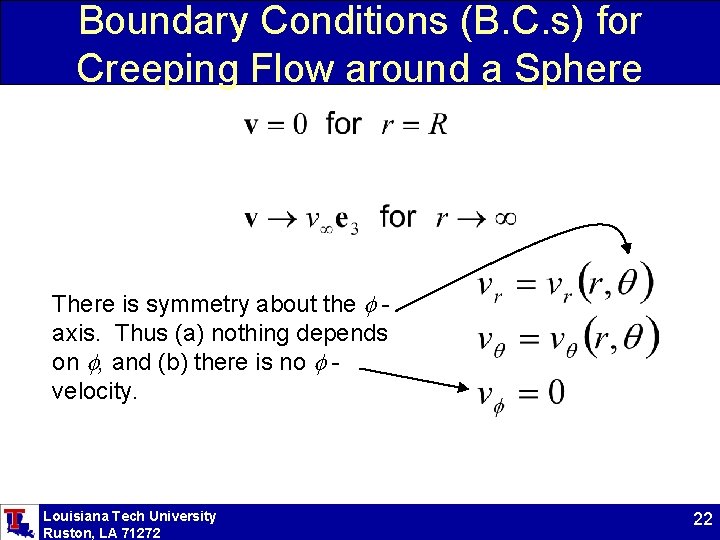
Boundary Conditions (B. C. s) for Creeping Flow around a Sphere There is symmetry about the axis. Thus (a) nothing depends on , and (b) there is no velocity. Louisiana Tech University Ruston, LA 71272 22
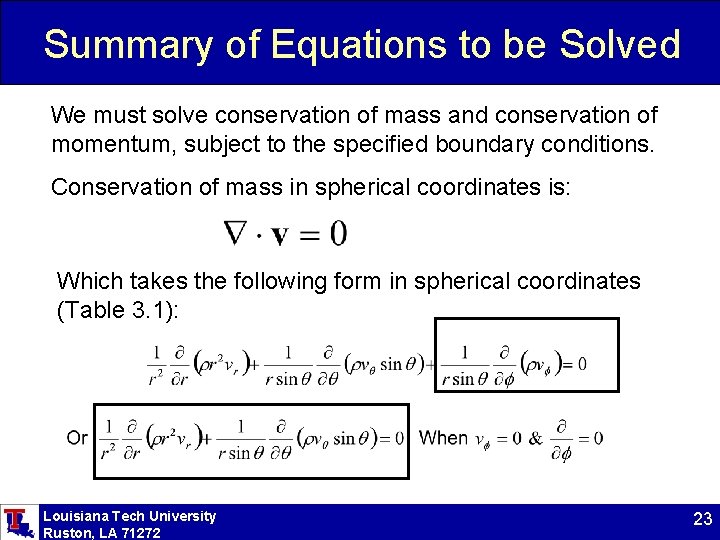
Summary of Equations to be Solved We must solve conservation of mass and conservation of momentum, subject to the specified boundary conditions. Conservation of mass in spherical coordinates is: Which takes the following form in spherical coordinates (Table 3. 1): Louisiana Tech University Ruston, LA 71272 23
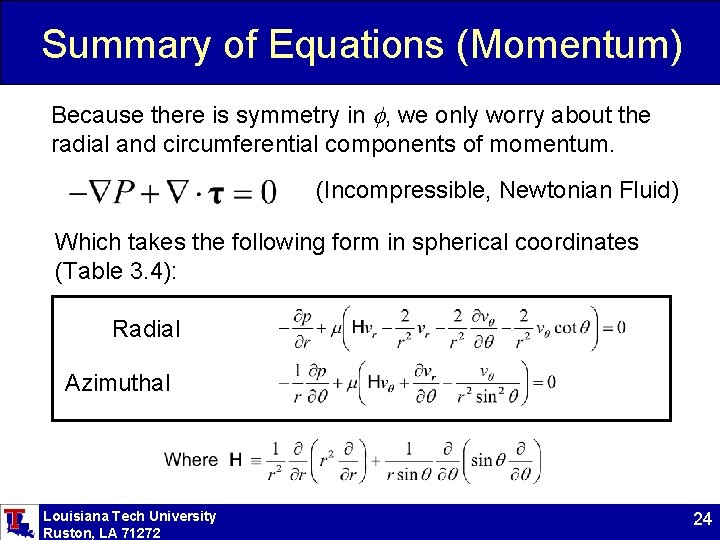
Summary of Equations (Momentum) Because there is symmetry in , we only worry about the radial and circumferential components of momentum. (Incompressible, Newtonian Fluid) Which takes the following form in spherical coordinates (Table 3. 4): Radial Azimuthal Louisiana Tech University Ruston, LA 71272 24
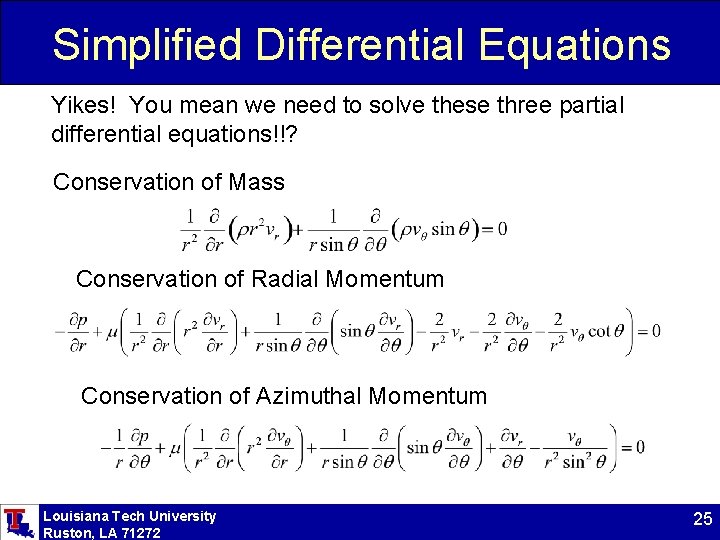
Simplified Differential Equations Yikes! You mean we need to solve these three partial differential equations!!? Conservation of Mass Conservation of Radial Momentum Conservation of Azimuthal Momentum Louisiana Tech University Ruston, LA 71272 25
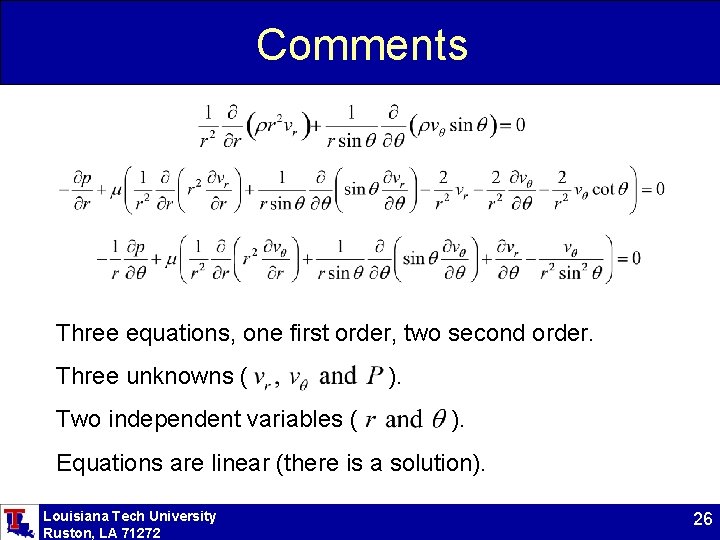
Comments Three equations, one first order, two second order. Three unknowns ( Two independent variables ( ). ). Equations are linear (there is a solution). Louisiana Tech University Ruston, LA 71272 26
Stream Function Approach We will use a stream function approach to solve these equations. The stream function is a differential form that automatically solves the conservation of mass equation and reduces the problem from one with 3 variables to one with two variables. Louisiana Tech University Ruston, LA 71272 27
Stream Function (Cartesian) Cartesian coordinates, the two-dimensional continuity equation is: If we define a stream function, , such that: Then the two-dimensional continuity equation becomes: Louisiana Tech University Ruston, LA 71272 28
Summary of the Procedure 1. Use a stream function to satisfy conservation of mass. a. Form of is known for spherical coordinates. b. Gives 2 equations (r and momentum) and 2 unknowns ( and pressure). c. Need to write B. C. s in terms of the stream function. 2. Obtain the momentum equation in terms of velocity. 3. Rewrite the momentum equation in terms of . 4. Eliminate pressure from the two equations (gives 1 equation (momentum) and 1 unknown, namely ). 5. Use B. C. s to deduce a form for (equivalently, assume a separable solution). Louisiana Tech University Ruston, LA 71272 29
Procedure (Continued) 6. Substitute the assumed form for back into the momentum equation to obtain an ordinary differential equation. 7. Solve the equation for the radial dependence of . 8. Insert the radial dependence back into the form for to obtain the complete expression for . 9. Use the definition of the stream function to obtain the radial and tangential velocity components from . 10. Use the radial and tangential velocity components in the momentum equation (written in terms of velocities, not in terms of ) to obtain pressure. Louisiana Tech University Ruston, LA 71272 30
Procedure (Continued) 11. Integrate the e 3 component of both types of forces (pressure and viscous stresses) over the surface of the sphere to obtain the drag force on the sphere. Louisiana Tech University Ruston, LA 71272 31
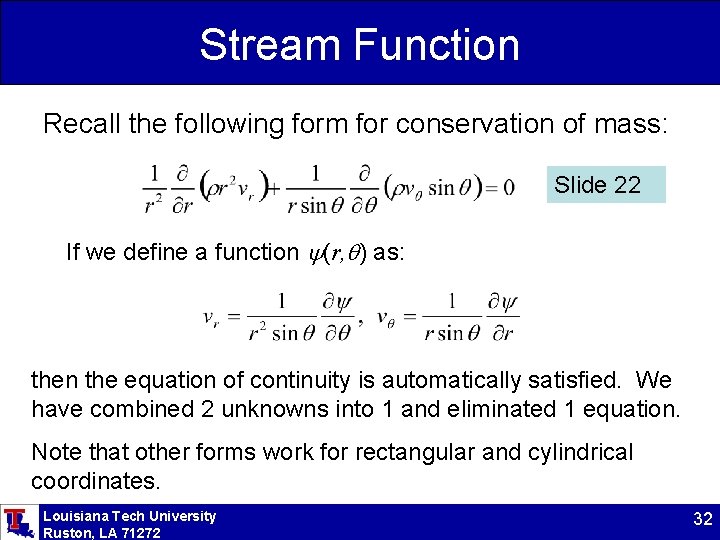
Stream Function Recall the following form for conservation of mass: Slide 22 If we define a function (r, ) as: then the equation of continuity is automatically satisfied. We have combined 2 unknowns into 1 and eliminated 1 equation. Note that other forms work for rectangular and cylindrical coordinates. Louisiana Tech University Ruston, LA 71272 32
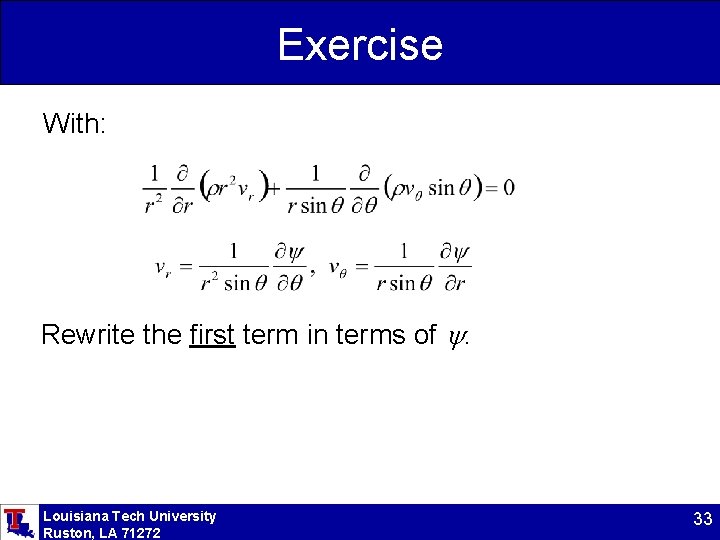
Exercise With: Rewrite the first term in terms of . Louisiana Tech University Ruston, LA 71272 33
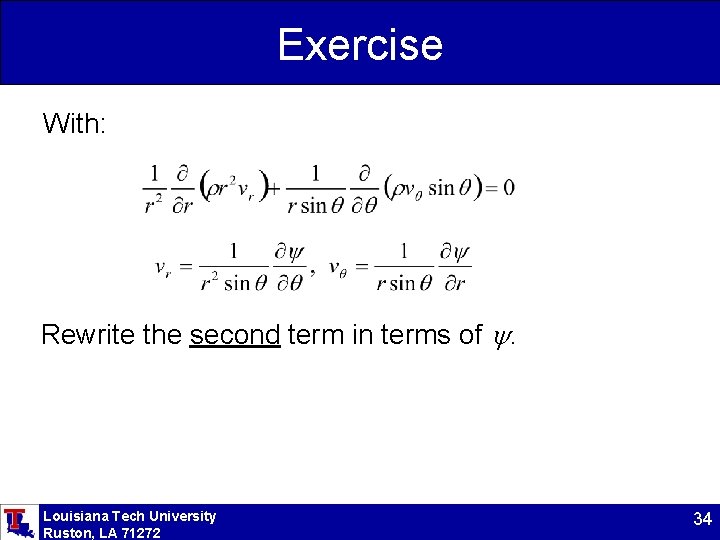
Exercise With: Rewrite the second term in terms of . Louisiana Tech University Ruston, LA 71272 34
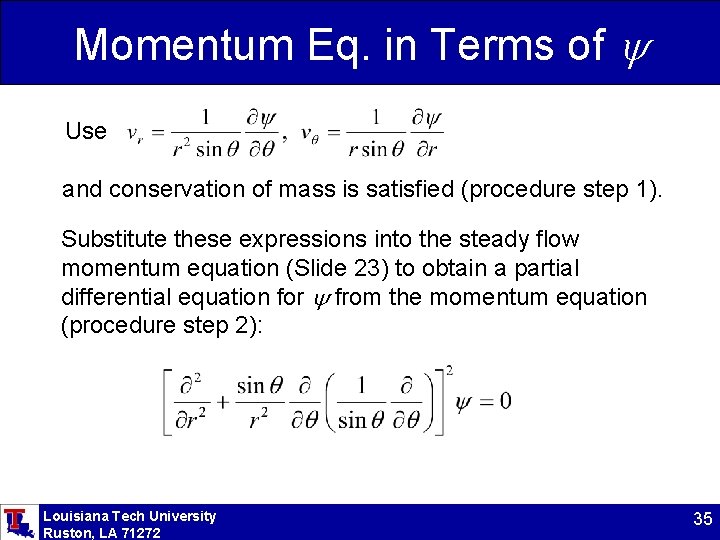
Momentum Eq. in Terms of Use and conservation of mass is satisfied (procedure step 1). Substitute these expressions into the steady flow momentum equation (Slide 23) to obtain a partial differential equation for from the momentum equation (procedure step 2): Louisiana Tech University Ruston, LA 71272 35
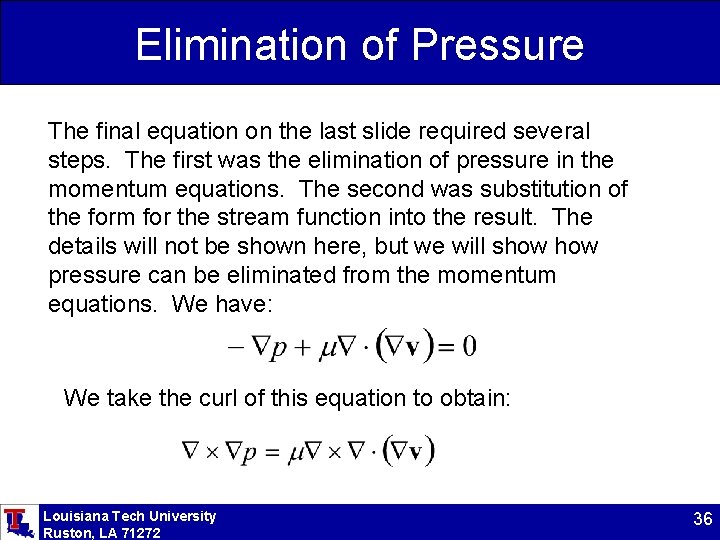
Elimination of Pressure The final equation on the last slide required several steps. The first was the elimination of pressure in the momentum equations. The second was substitution of the form for the stream function into the result. The details will not be shown here, but we will show pressure can be eliminated from the momentum equations. We have: We take the curl of this equation to obtain: Louisiana Tech University Ruston, LA 71272 36
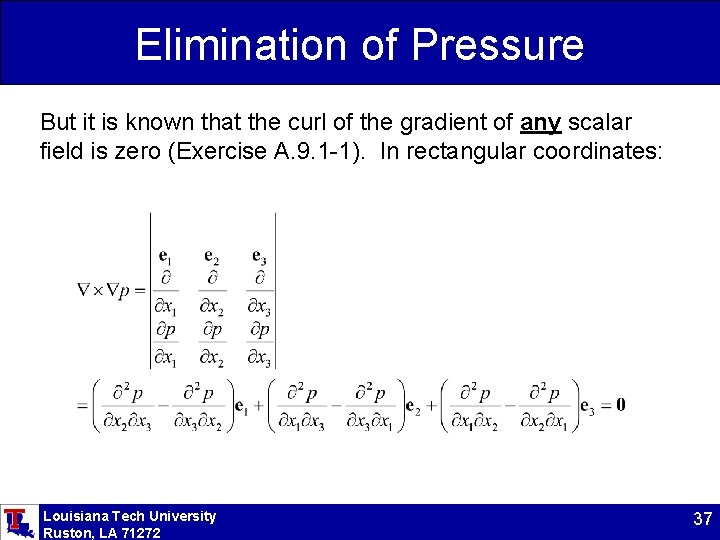
Elimination of Pressure But it is known that the curl of the gradient of any scalar field is zero (Exercise A. 9. 1 -1). In rectangular coordinates: Louisiana Tech University Ruston, LA 71272 37
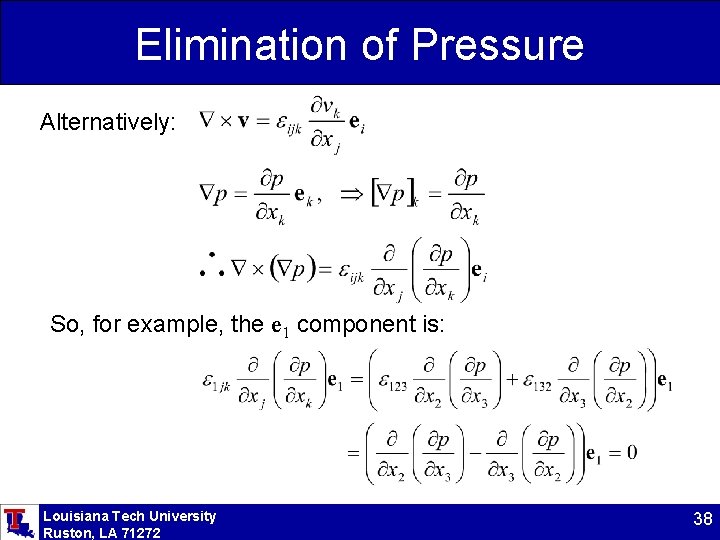
Elimination of Pressure Alternatively: So, for example, the e 1 component is: Louisiana Tech University Ruston, LA 71272 38
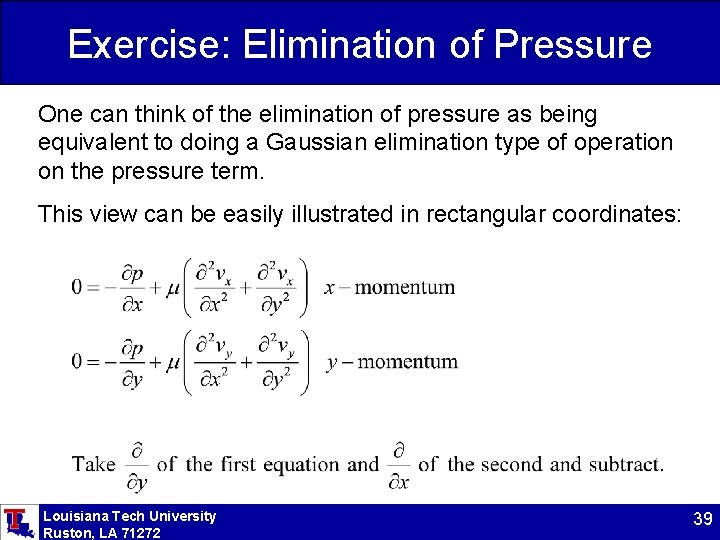
Exercise: Elimination of Pressure One can think of the elimination of pressure as being equivalent to doing a Gaussian elimination type of operation on the pressure term. This view can be easily illustrated in rectangular coordinates: Louisiana Tech University Ruston, LA 71272 39
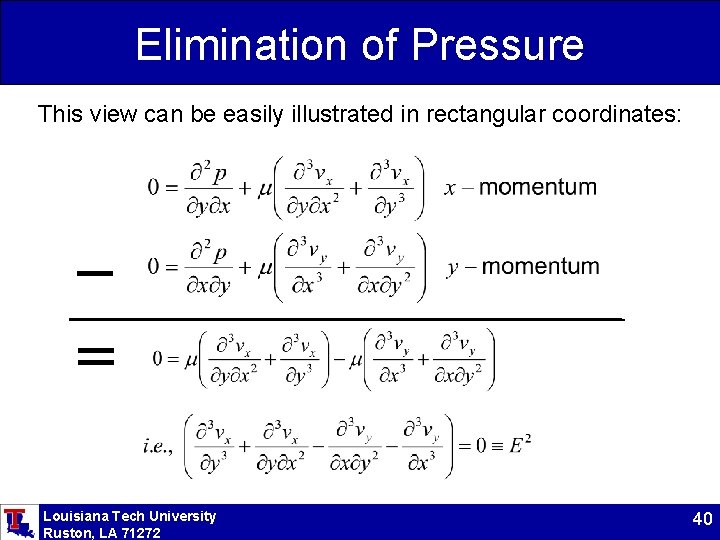
Elimination of Pressure This view can be easily illustrated in rectangular coordinates: Louisiana Tech University Ruston, LA 71272 40
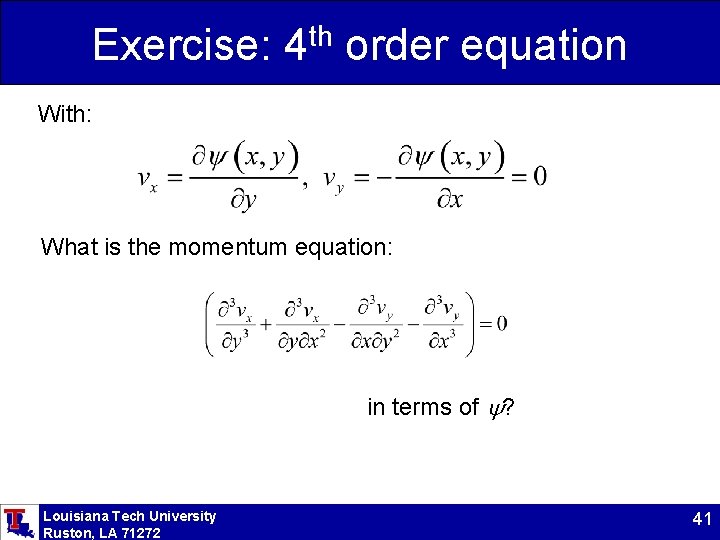
Exercise: 4 th order equation With: What is the momentum equation: in terms of ? Louisiana Tech University Ruston, LA 71272 41
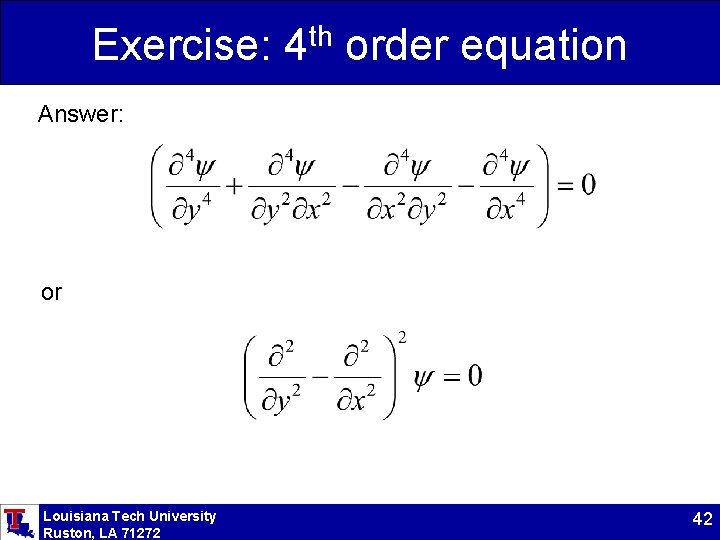
Exercise: 4 th order equation Answer: or Louisiana Tech University Ruston, LA 71272 42
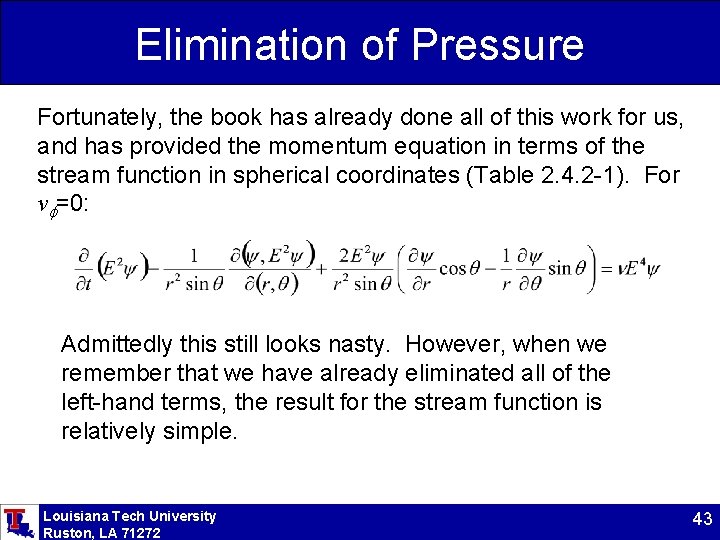
Elimination of Pressure Fortunately, the book has already done all of this work for us, and has provided the momentum equation in terms of the stream function in spherical coordinates (Table 2. 4. 2 -1). For v =0: Admittedly this still looks nasty. However, when we remember that we have already eliminated all of the left-hand terms, the result for the stream function is relatively simple. Louisiana Tech University Ruston, LA 71272 43
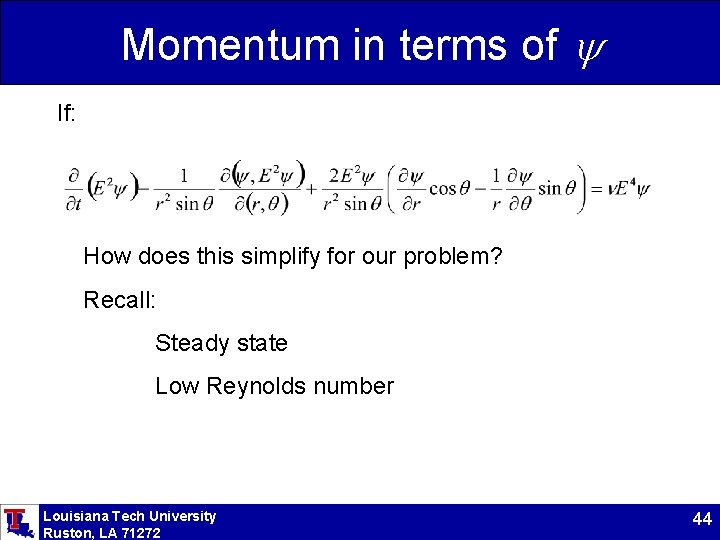
Momentum in terms of If: How does this simplify for our problem? Recall: Steady state Low Reynolds number Louisiana Tech University Ruston, LA 71272 44
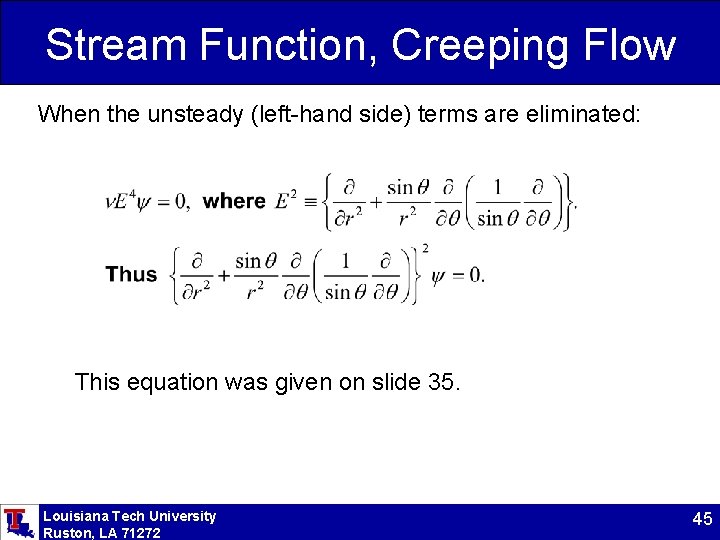
Stream Function, Creeping Flow When the unsteady (left-hand side) terms are eliminated: This equation was given on slide 35. Louisiana Tech University Ruston, LA 71272 45
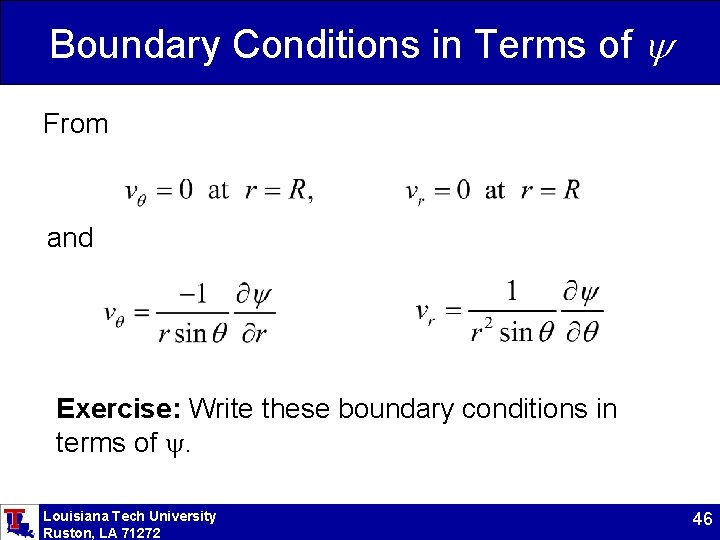
Boundary Conditions in Terms of From and Exercise: Write these boundary conditions in terms of . Louisiana Tech University Ruston, LA 71272 46
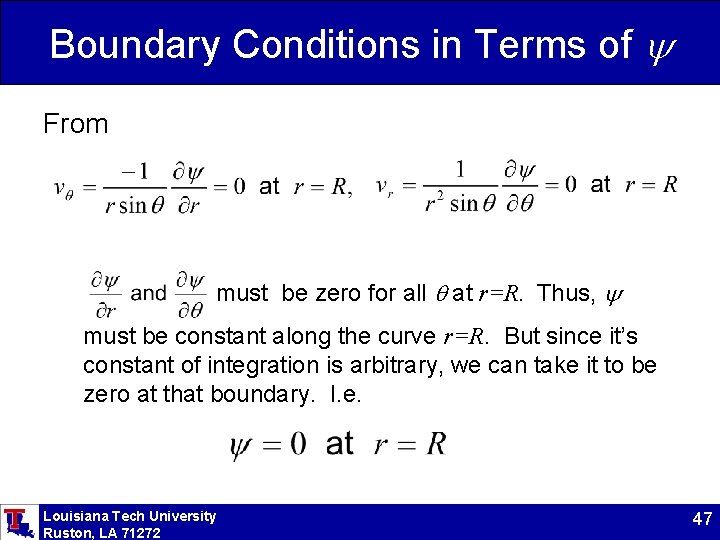
Boundary Conditions in Terms of From must be zero for all at r=R. Thus, must be constant along the curve r=R. But since it’s constant of integration is arbitrary, we can take it to be zero at that boundary. I. e. Louisiana Tech University Ruston, LA 71272 47
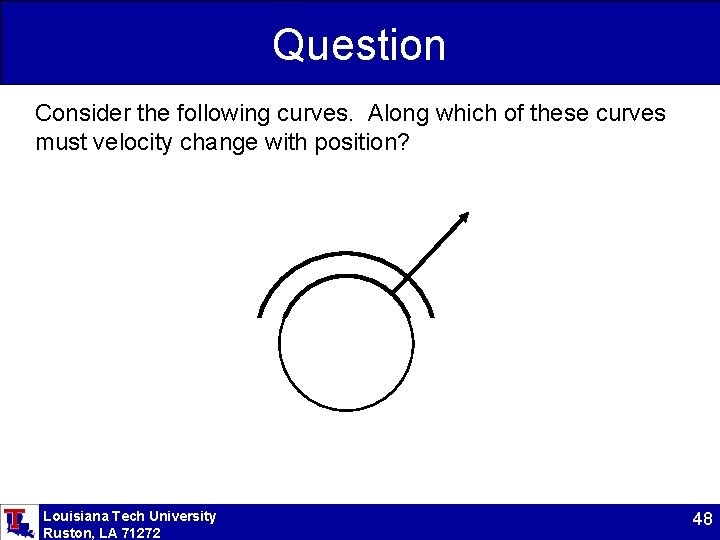
Question Consider the following curves. Along which of these curves must velocity change with position? Louisiana Tech University Ruston, LA 71272 48
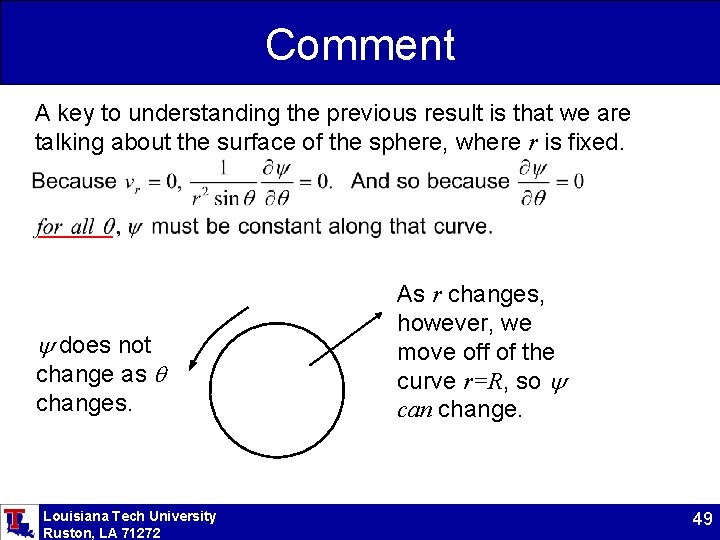
Comment A key to understanding the previous result is that we are talking about the surface of the sphere, where r is fixed. does not change as changes. Louisiana Tech University Ruston, LA 71272 As r changes, however, we move off of the curve r=R, so can change. 49
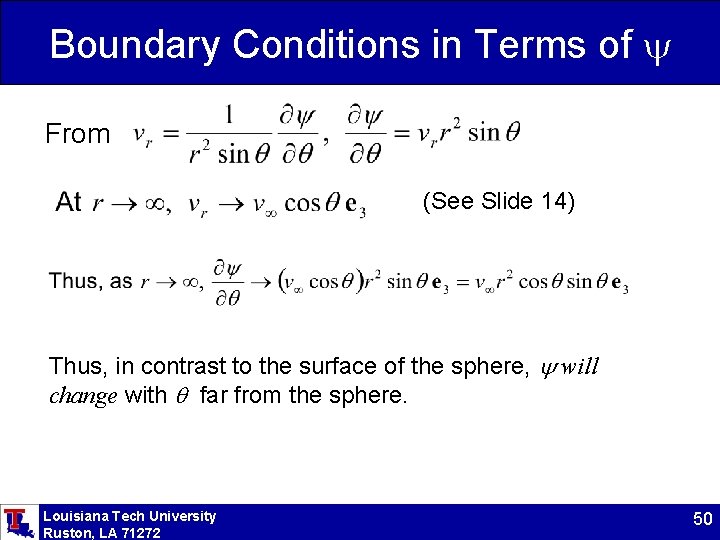
Boundary Conditions in Terms of From (See Slide 14) Thus, in contrast to the surface of the sphere, will change with far from the sphere. Louisiana Tech University Ruston, LA 71272 50
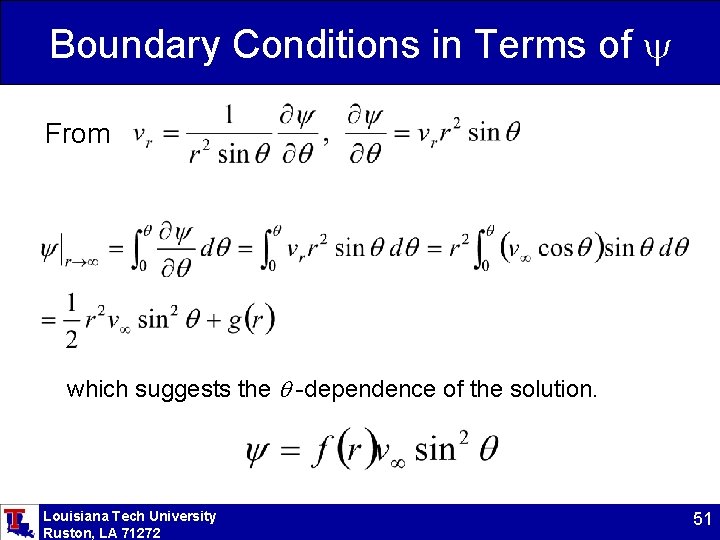
Boundary Conditions in Terms of From which suggests the -dependence of the solution. Louisiana Tech University Ruston, LA 71272 51
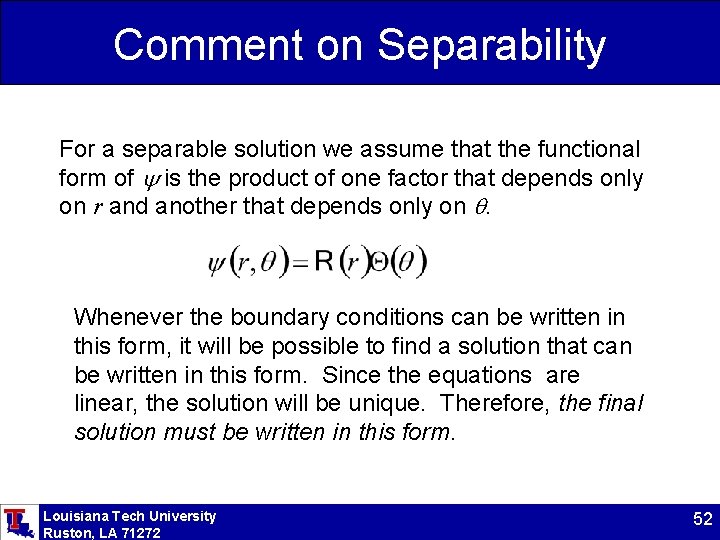
Comment on Separability For a separable solution we assume that the functional form of is the product of one factor that depends only on r and another that depends only on . Whenever the boundary conditions can be written in this form, it will be possible to find a solution that can be written in this form. Since the equations are linear, the solution will be unique. Therefore, the final solution must be written in this form. Louisiana Tech University Ruston, LA 71272 52
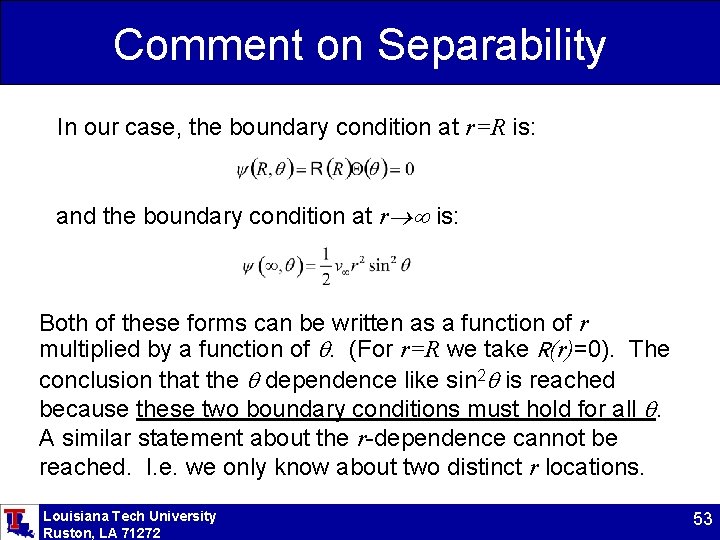
Comment on Separability In our case, the boundary condition at r=R is: and the boundary condition at r is: Both of these forms can be written as a function of r multiplied by a function of . (For r=R we take R(r)=0). The conclusion that the dependence like sin 2 is reached because these two boundary conditions must hold for all . A similar statement about the r-dependence cannot be reached. I. e. we only know about two distinct r locations. Louisiana Tech University Ruston, LA 71272 53
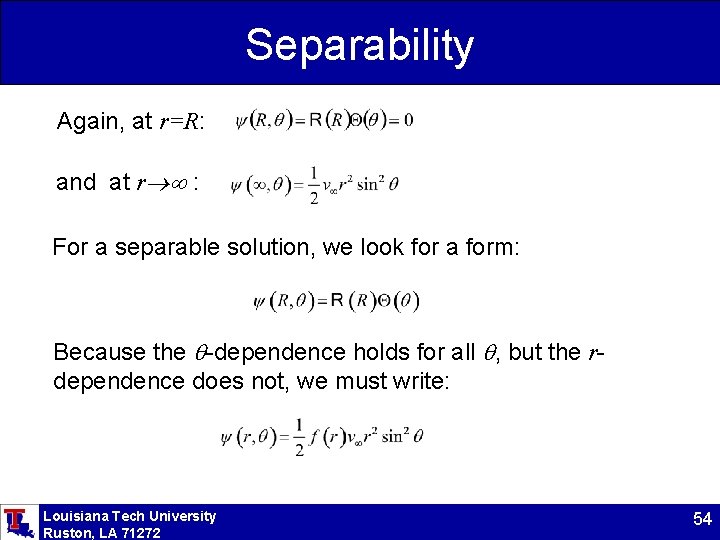
Separability Again, at r=R: and at r : For a separable solution, we look for a form: Because the -dependence holds for all , but the rdependence does not, we must write: Louisiana Tech University Ruston, LA 71272 54
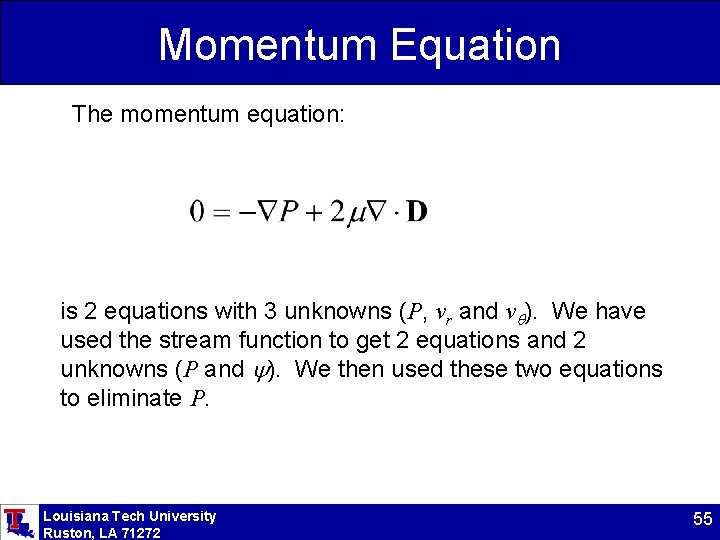
Momentum Equation The momentum equation: is 2 equations with 3 unknowns (P, vr and v ). We have used the stream function to get 2 equations and 2 unknowns (P and ). We then used these two equations to eliminate P. Louisiana Tech University Ruston, LA 71272 55
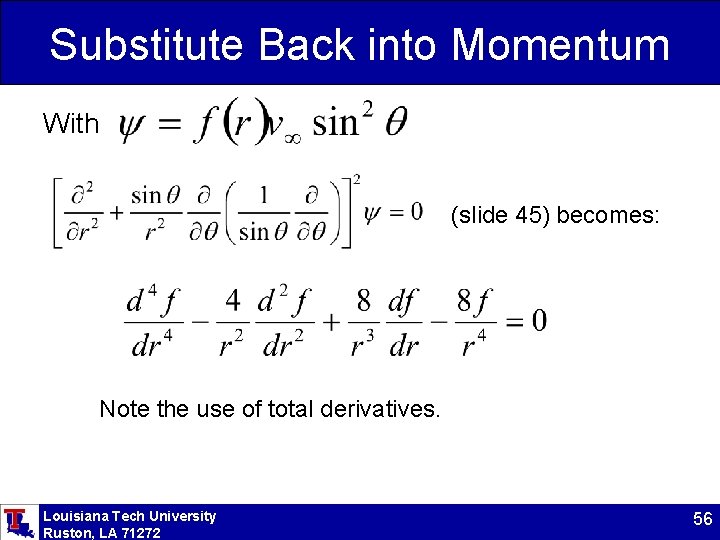
Substitute Back into Momentum With (slide 45) becomes: Note the use of total derivatives. Louisiana Tech University Ruston, LA 71272 56
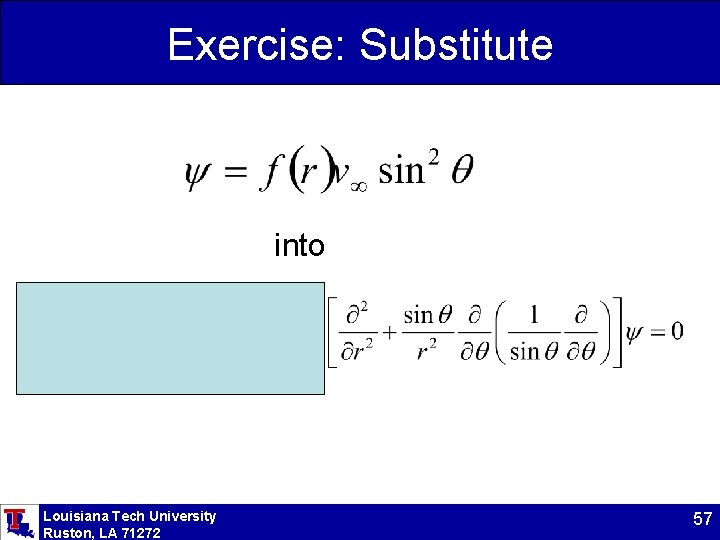
Exercise: Substitute into Louisiana Tech University Ruston, LA 71272 57
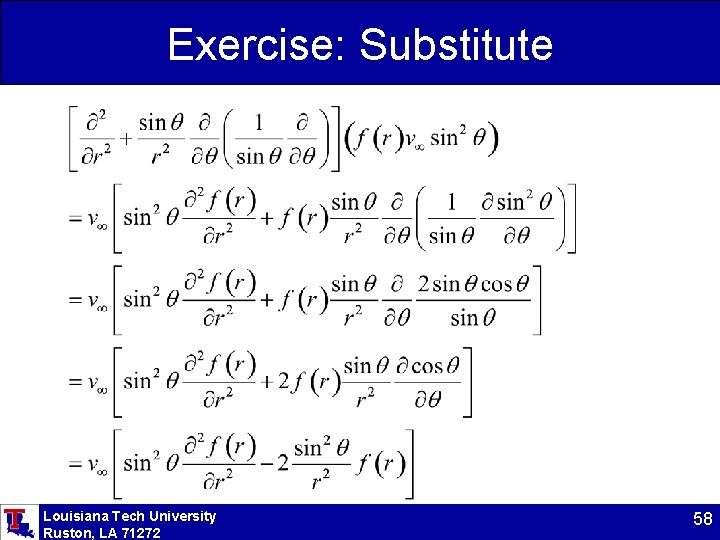
Exercise: Substitute Louisiana Tech University Ruston, LA 71272 58
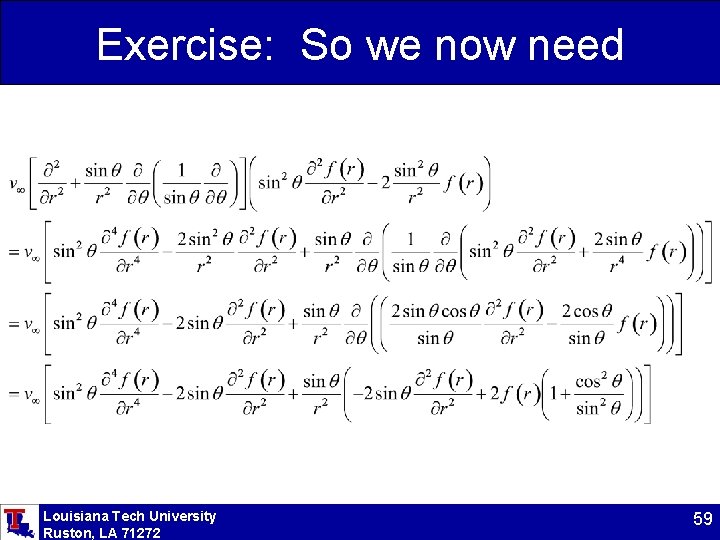
Exercise: So we now need Louisiana Tech University Ruston, LA 71272 59
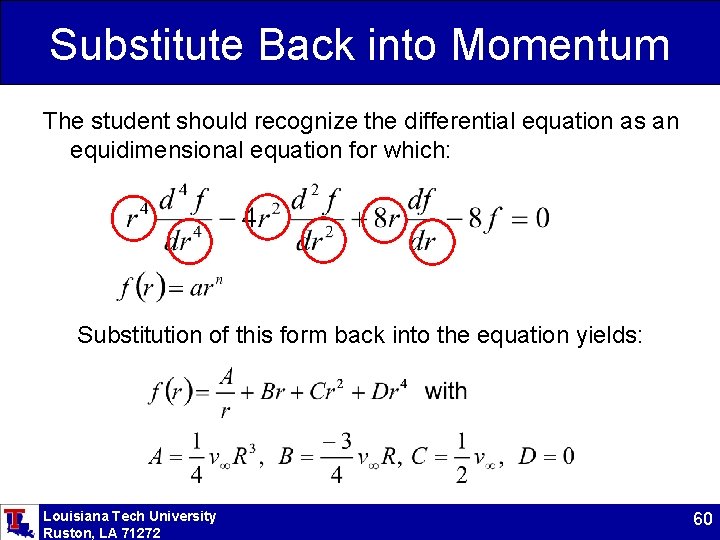
Substitute Back into Momentum The student should recognize the differential equation as an equidimensional equation for which: Substitution of this form back into the equation yields: Louisiana Tech University Ruston, LA 71272 60
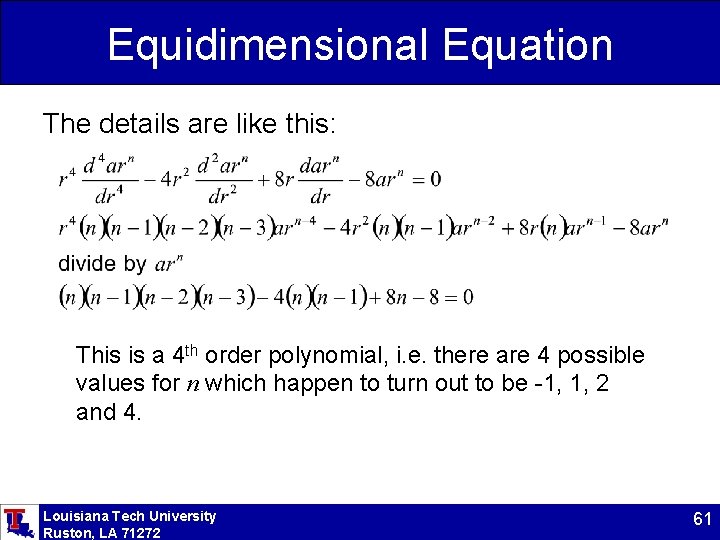
Equidimensional Equation The details are like this: This is a 4 th order polynomial, i. e. there are 4 possible values for n which happen to turn out to be -1, 1, 2 and 4. Louisiana Tech University Ruston, LA 71272 61
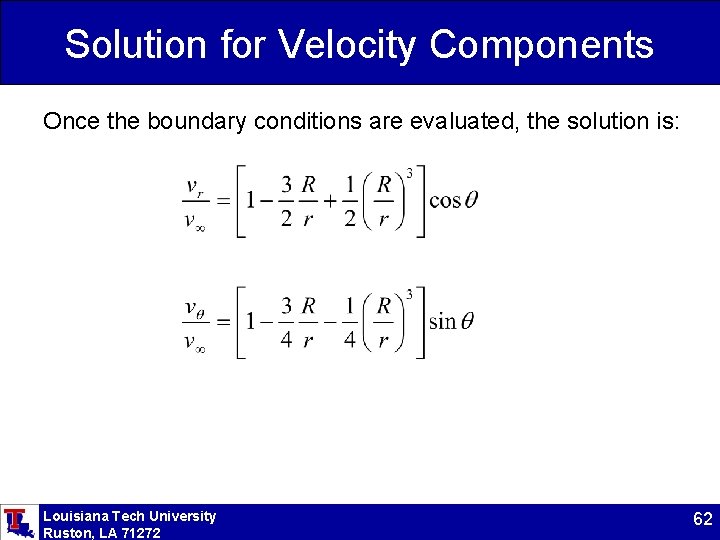
Solution for Velocity Components Once the boundary conditions are evaluated, the solution is: Louisiana Tech University Ruston, LA 71272 62
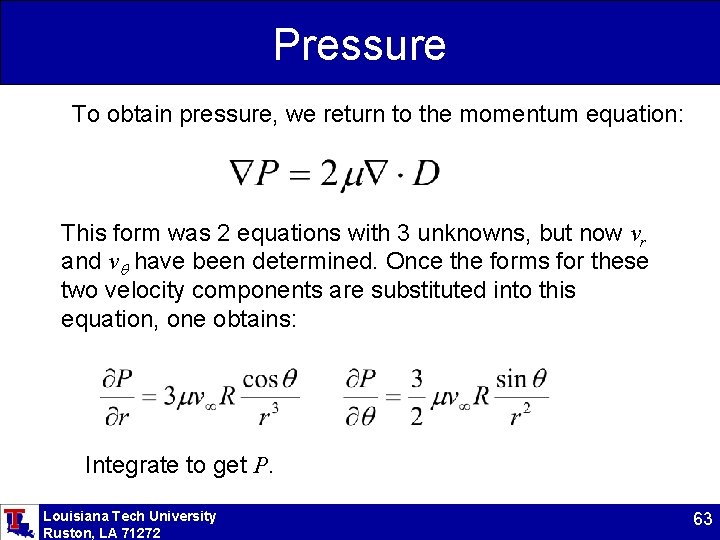
Pressure To obtain pressure, we return to the momentum equation: This form was 2 equations with 3 unknowns, but now vr and v have been determined. Once the forms for these two velocity components are substituted into this equation, one obtains: Integrate to get P. Louisiana Tech University Ruston, LA 71272 63
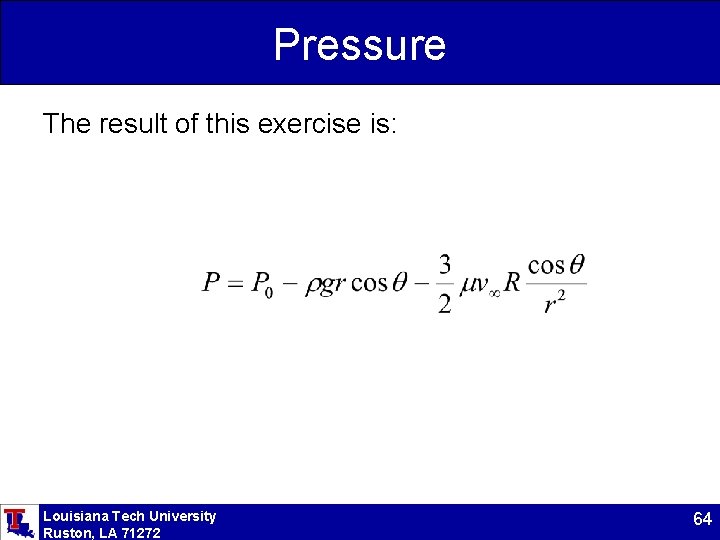
Pressure The result of this exercise is: Louisiana Tech University Ruston, LA 71272 64
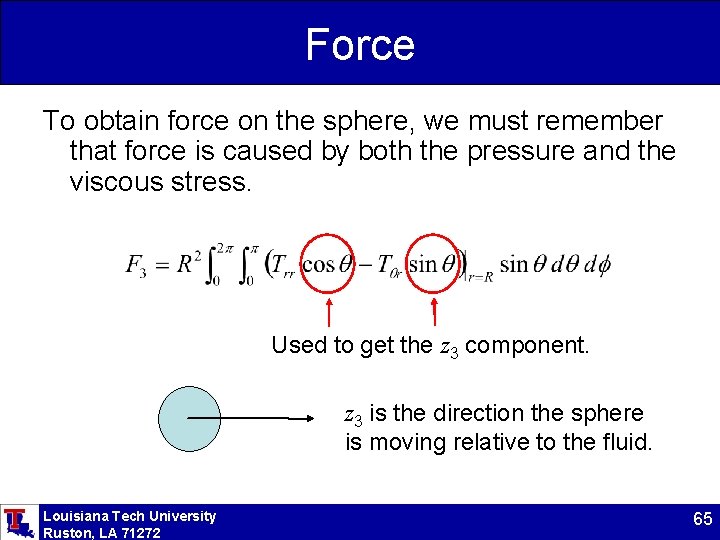
Force To obtain force on the sphere, we must remember that force is caused by both the pressure and the viscous stress. Used to get the z 3 component. z 3 is the direction the sphere is moving relative to the fluid. Louisiana Tech University Ruston, LA 71272 65
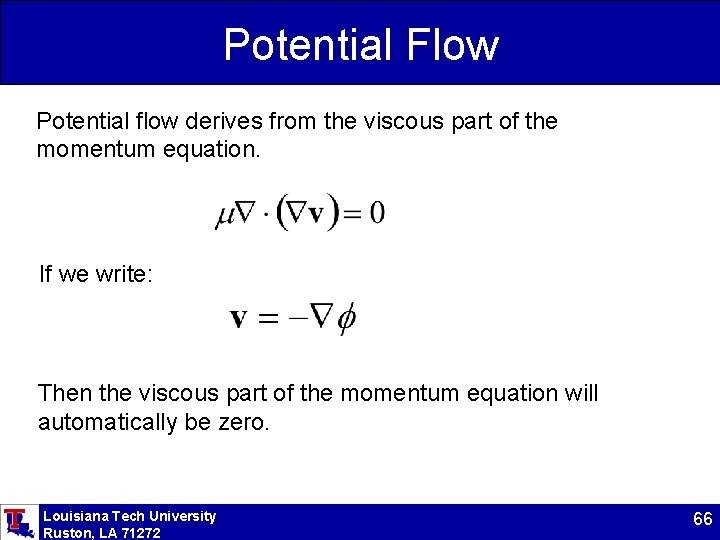
Potential Flow Potential flow derives from the viscous part of the momentum equation. If we write: Then the viscous part of the momentum equation will automatically be zero. Louisiana Tech University Ruston, LA 71272 66
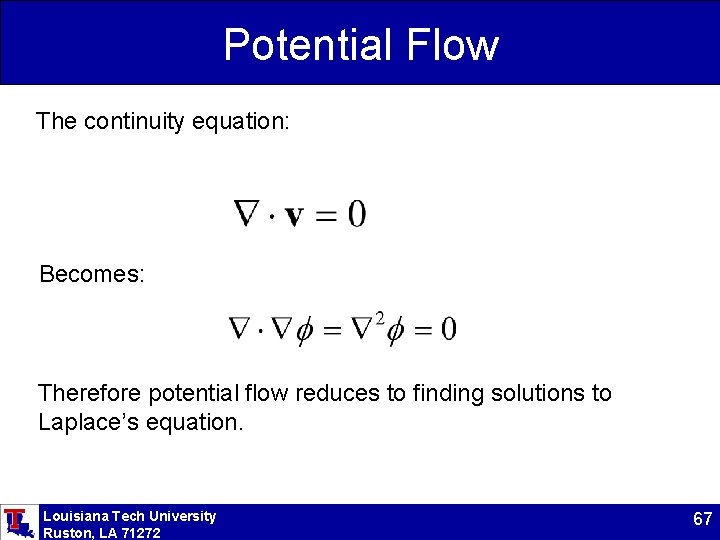
Potential Flow The continuity equation: Becomes: Therefore potential flow reduces to finding solutions to Laplace’s equation. Louisiana Tech University Ruston, LA 71272 67
- Slides: 65