
CREDITS THE GAME Cells Working Together Cell Functions


- Slides: 53
CREDITS THE GAME
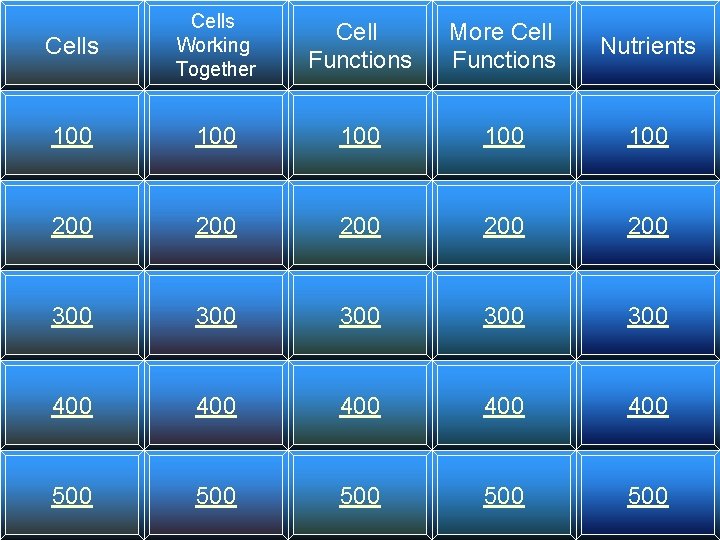
Cells Working Together Cell Functions More Cell Functions Nutrients 100 100 100 200 200 200 300 300 300 400 400 400 500 500 500
Cells 100 l How do single celled organisms grow? Answer
Cells 200 l How do multicellular organisms grow? Answer
Cells 300 l What are stem cells? Answer
Cells 400 l What is differentiation? Answer
Cells 500 What are the different parts of cell theory? Answer
Cells Working Together 100 l What are cells? Answer
Cells Working Together 200 l What are tissues? Answer
Cells Working Together 300 l What are organs? Answer
Cells Working Together 400 l What are organ systems? Answer
Cells Working Together 500 l Why would an organ system be important for your survival? Answer
Cell Functions 100 l What is the process that your cells use to burn oxygen and glucose to make energy? Answer
Cell Functions 200 l I had a friend that told me that plants aren’t important for us to survive. Why is he wrong? Answer
Cell Functions 300 l What is the purpose of photosynthesis in plants? Answer
Cell Functions 400 l Why is sunlight important in photosynthesis? Answer
Cell Functions 500 l What is the main difference between cellular respiration and fermentation? Answer
More Cell Functions 100 l What is osmosis? Answer
More Cell Functions 200 l What type of process was the movement of iodine particles through the membrane of our plastic bag? Answer
More Cell Functions 300 l I was at a concert and I started out in a parking lot with very few people. I moved inside of the building into an area of many people. What type of movement within the cell would this be like? Answer
More Cell Functions 400 l Where does the process of photosynthesis take place? Answer
More Cell Functions 500 l Can photosynthesis take place at night? Answer
Nutrients 100 l What do proteins do for your body? Answer
Nutrients 200 l What do carbohydrates do for your body? Answer
Nutrients 300 l What do lipids do for your body? Answer
Nutrients 400 l What are all of the nutrients in your body composed of? (What elements make them up? ) Answer
Nutrients 500 l What are carbohydrates made up of? Answer
Cells 100 Answers l Single celled organisms grow by taking in nutrients and their actual cell increasing in size.
Cells 200 Answers l Multicellular organisms grow through an increase in the number of cells that makes them up.
Cells 300 Answers l Stem cells are a special type of unspecialized cell. Stem cells do not have a particular function in the body.
Cells 400 Answers l Differentiation is the process that stem cells undergo in order to become specialized cells. They receive a signal that tells them to begin producing proteins and this is what determines what type of cell they will become. Stem cells stop multiplying when they differentiate.
Cells 500 Answers l The 3 parts of cell theory are: l All organisms are made up of one or more cells l The cell is the basic unit of all living things l All cells come from existing cells
Cells Working Together 100 Answers l Cells are the smallest unit that can perform all of the processes necessary for life.
Cells Working Together 200 Answers l Tissues are groups of cells that work together to perform a specific job.
Cells Working Together 300 Answers l Organs are a collection of tissues that carry out a specialized function within the body
Cells Working Together 400 Answers l Organ systems are a group of organs that work together to perform different body functions.
Cells Working Together 500 Answers l Organ systems carry out the different processes within the body, such as breaking down food and water, taking in air and removing waste from the body. Without organ systems your body would not be able to function.
Cell Functions 100 Answers l That process is cellular respiration. ATP is produced as energy, along with the waste products carbon dioxide and water, when glucose and oxygen are broken down.
Cell Functions 200 Answers l Plants are very important to our survival. We require oxygen for the process of cellular respiration. When undergoing photosynthesis plants give off oxygen as a byproduct. We use this oxygen in order to survive!
Cell Functions 300 Answers l Plants use photosynthesis to make glucose, the simple sugar that they use for food.
Cell Functions 400 Answers l In photosynthesis sunlight is necessary to break the bonds in carbon dioxide and water.
Cell Functions 500 Answers l The main difference between cellular respiration and fermentation is that cellular respiration uses oxygen to make energy. Fermentation uses carbon dioxide to make some energy but lactic acid is produced as a byproduct. A build up of lactic acid will eventually give you muscle cramps.
More Cell Functions 100 Answers l Osmosis is the movement of water through a semi-permeable membrane.
More Cell Functions 200 Answers l The movement of the iodine particles through the bag was an example of diffusion. The particles moved from an area of high concentration (the beaker) to an area of low concentration (the bag).
More Cell Functions 300 Answers l Because I am moving from an area of low concentration to an area of high concentration this would be an example of active transport.
More Cell Functions 400 Answers l Photosynthesis takes place in the chloroplasts of plant cells.
More Cell Functions 500 Answers l Photosynthesis cannot naturally take place at night. If I were to use an artificial light that simulated sunlight I could have photosynthesis take place at night.
Nutrients 100 Answers l Proteins are the main source of amino acids for your body. Proteins are important because they are used to build cell structures and to help cells carry out various processes in your body. Proteins are also used to help build and repair muscles.
Nutrients 200 Answers l Carbohydrates are important for your body because they are broken down for energy through cellular respiration.
Nutrients 300 Answers l Lipids such as fats and oils are used as a form of energy storage. If your body does not get enough carbohydrates it will break down the fats that your body has stored for energy.
Nutrients 400 Answers l The nutrients that we take in (carbohydrates, proteins and fats & oils) are all made up of the elements carbon, hydrogen and oxygen.
Nutrients 500 Answers l Carbohydrates are made up of many glucose molecules that have been bonded to one another. Bibliography And End
l Author(Unknown) Rochester Community Schools. 2009. Http: //www. rochester. k 12. mi. us Accessed 3/3/09 The Game Finish