
Credit Understanding Credit Credit the supplying of money
- Slides: 41
Credit Understanding Credit
Credit: the supplying of money, goods, or services at present in exchange for the promise of future payment n Creditor: the business or organization that extends credit n
Credit Principal: the original amount borrowed n Ex: you borrow $5, 000, You pay a total of $5, 754 when payments are done n $5, 000 is your principal, $754 is your interest n
Credit Types of credit: n Cash credit: if you take out a loan and receive cash/check n Sales credit: you buy something now and wish to pay for it later n Secured credit: is backed by a pledge of property n
Credit Collateral: the property that is pledged to guarantee repayment of a loan n Collateral reduces the lender’s risk, the lender has a security interest n This means that they can take your property if you fail to repay the loan n
Credit Closed-end credit: is a one-time extension of credit for a specific amount and time period. The total interest paid is known at the beginning of the loan n Ex: car loan n
Credit Open-ended credit: cardholders makes monthly payment on all or part of an account balance n Also known as a line of credit n Ex: credit cards, equity loans n The interest paid is determined by the length of time and amount of your balance n
Credit Installment loans: a set portion of the loan amount that the borrower must pay at regular scheduled intervals. n Ex: furniture store allows you to purchase a item and pay for it in four easy payments n
Credit Pros and cons of credit n Advantages: n 1. Temporary expansion of income, especially helpful with unexpected expenses n 2. Convenience: You can carry less cash, shop online, n
Credit 3. Financial responsibility: good credit provides proof to others of financial responsibility n Costs of credit: n 1. Interest and fees, also known as finance charges n
Credit 2. Increased cost of merchandise, retailers may increase their prices to help pays the must pay banks to collect their credit sales n 3. Opportunity cost: in the long run it reduces your purchasing power. n
Credit Other credit concerns: n 1. Security: risk of being lost, stolen, or used fraudulently n 2. Impulse buying: May cause you to buy on the spur of the moment without considering the purchasing decision n
Credit 3. Overspending: Can make purchases seem free, will lead into financial trouble down the road n What are some guidelines that should be put into place? n
Credit Three C’s of credit: n 1. Character: refers to a person’s reputation concerning repaying debt on time n 2. Capacity: refers to a persons earning power and their ability to pay debt from a regular income n
Credit 3. Capital: refers to items owned or assets available to the creditor if necessary n Credit history: a pattern of past behavior in regard to repaying debt. n Equal Credit Opportunity Act: ensures that all consumers are given equal chance to obtain credit n
Credit Bureau: known as credit reporting agency's. They collect information about credit worthiness of consumers. n They get info from stores, banks, and from public record n Equifax, Experian, and Trans Union are three national credit agencies n
Credit When credit bureaus and agencies compile info it is put into a n Credit report: a record of particular consumer’s transactions and payment patterns n It includes the number of credit cards open, balances, monthly payment amounts, and late payments n
Credit If you get approved for a loan and the interest rate paid is determined by your n Credit rating: an evaluation of a consumers credit history n Your rating leads to a numerical score known as your n
Credit score: a numerical rating based on credit report information n These scores range from 300 to 850 n Fair Credit reporting Act: assures consumers rights to access his or her credit file and dispute incorrect information n
Credit Establishing credit: n 1. Open a checking and savings account, make regular deposits, and avoid overdrawn checks n 2. Put utility bills in your name and pay bills promptly n 3. Apply for a credit card and use the card. Pay the bill on time. n
Credit Another way to establish credit is to have a cosigner n Cosigner: a person with a good credit history who also signs the application n Secured credit card: one that requires you to keep a savings account as security n
Credit Types of cards n 1. Private Label: can only be used at a single retailer ex: JC Penny n 2. General purpose: known as bank cards or major credit card. Can be used across the country and ATM’S n
Credit Revolving credit: card holder has several options of payment n 1. Pay in full. n 2. Pay minimum n 3. Pay amount in between n Interest accrues in balance is not paid in full n
Credit card variations: n 1. Status cards; gold or platinum cards usually have an increased line of credit and benefits. May have higher annual fee n 2. Co-branded cards: carry the name of both the card network and company. Shell/Visa United/Visa n
Credit Affinity cards: carries the name of a non-profit or charitable organization. n These groups will receive a small percentage of every dollar charged n Smart cards: have computer chips which store information n
Credit Things to compare between cards will include: n Annual fee, APR (annual percentage rate) n Fixed or variable rate n If you are offered an introductory or teaser rate look at the terms after the rate expires n
Credit Grace period: a period of time during which the balance may be paid in full to avoid finance charges n Typically grace periods run 20 to 25 days n Also compare minimum payments, fees for late payments, cash advances, annual fees n
Credit Limit: the maximum amount of credit that the creditor will extend to the borrower. n Do not be fooled by incentives and special offers n Truth and Lending Act: Lenders must adequately inform consumers about credit terms and costs n
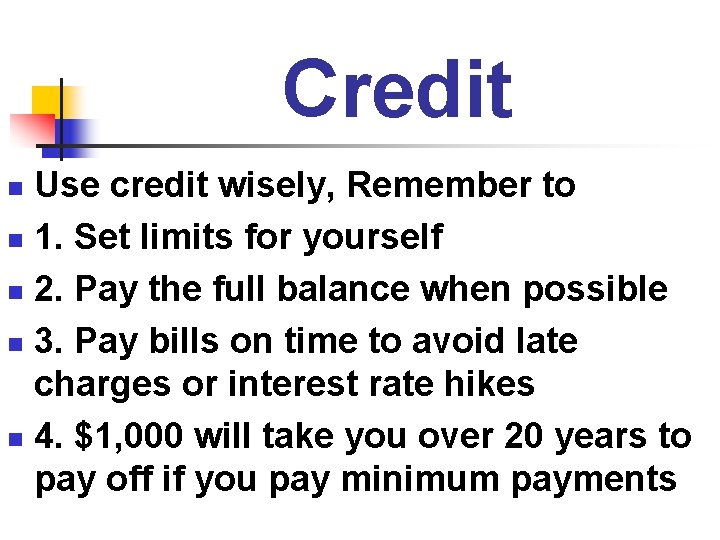
Credit Use credit wisely, Remember to n 1. Set limits for yourself n 2. Pay the full balance when possible n 3. Pay bills on time to avoid late charges or interest rate hikes n 4. $1, 000 will take you over 20 years to pay off if you pay minimum payments n
Credit Fair Credit Act: outlines procedures for settling credit card disputes n You must contact them within 60 days of finding an error in writing n They must respond in 30 days; 90 days to resolve n
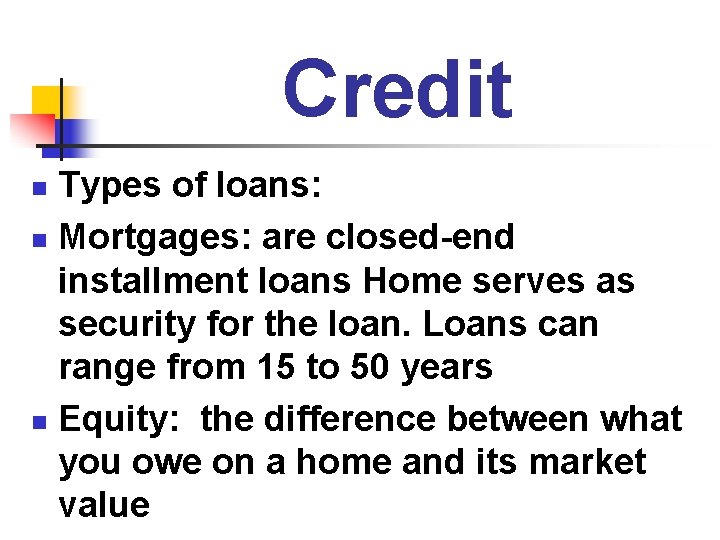
Credit Types of loans: n Mortgages: are closed-end installment loans Home serves as security for the loan. Loans can range from 15 to 50 years n Equity: the difference between what you owe on a home and its market value n
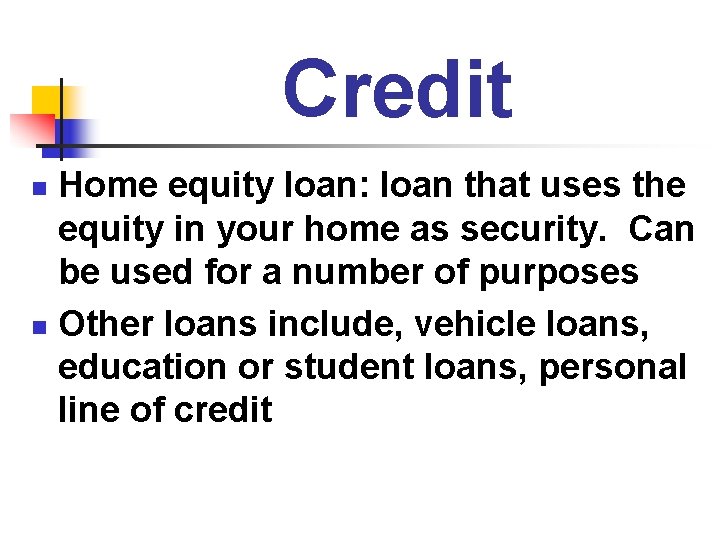
Credit Home equity loan: loan that uses the equity in your home as security. Can be used for a number of purposes n Other loans include, vehicle loans, education or student loans, personal line of credit n
Credit Consumer Finance Company: are business that specialize in making small and personal loans n The typical borrower is usually a greater credit risk, because of the risk the lenders fees and interest rates are usually much higher than a bank n
Credit Insurance policies can be a source of a loan, as can Payday loans: short term, high interest rate loans, typically must be paid back in a two week to one month period n Interest rates can run as high as 500% n
Credit Concepts and terms to know: n Loan shark: unlicensed lender who operates illegally and charges excessive interest n Down payment: a portion of the purchase price paid at the time of purchase Ex: $2, 000 down on a $15, 000 auto purchase n
Credit Balloon Payments: a final payment that is much larger than the other installment payments n Acceleration clause: gives the seller the right to declare the entire balance due if the buyer misses even one installment payment n
Credit Add-on clause: allows additional purchases to be added on to an installment contract n Right of rescission: If you are pledging your home as security, you have the right to cancel the loan within 3 business days n Cancellation must be in writing n
Credit Delinquent: over due payments n Default: failure to fulfill the obligations of a loan, more aggressive action will be taken to collect the debt n Repossession: Taking away property due to failure to make payments n Services can also be shut-off Ex: electric or water n
Credit Collection agency: business that collects unpaid debt for others. They receive a portion of what they collect n Collection agencies reflect very poorly on your credit ratings n Lien: a claim upon property to satisfy a debt n
Credit Garnishment: the legal withholding of a specified sum from a persons wages in order to collect debt n Credit counseling: programs to help train people to learn to live with-in their means n Debt consolidation loan: combines all existing debt into a new loan with more manageable payments n
Credit Bankruptcy: legal relief from repaying certain debt n Chapter 7 May lose property, creditors is receive the money from sales n Chapter 13 debtor keeps property, submit plan approved by courts n