
Credit to Thomas R Guskey GRADING AND REPORTING








- Slides: 32
Credit to Thomas R. Guskey GRADING AND REPORTING STUDENT LEARNING
Systemic Change � Change is a highly complex process � Professional development is essential
Change is a prerequisite for Improvement
Guiding Questions � What are the major reasons we use report cards and assign grades to students’ work? � Ideally, what purposes should report cards or grades serve? � What elements should teachers use in determining students’ grades? � (For example, major assessments, homework, attendance, class participation)
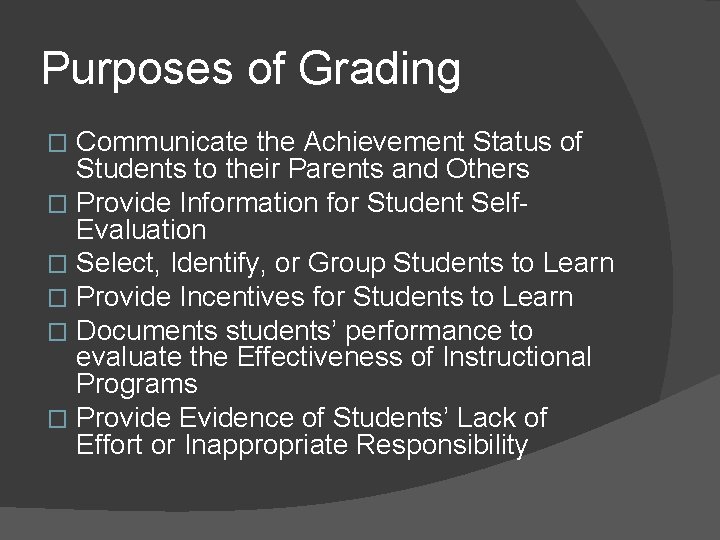
Purposes of Grading Communicate the Achievement Status of Students to their Parents and Others � Provide Information for Student Self. Evaluation � Select, Identify, or Group Students to Learn � Provide Incentives for Students to Learn � Documents students’ performance to evaluate the Effectiveness of Instructional Programs � Provide Evidence of Students’ Lack of Effort or Inappropriate Responsibility �
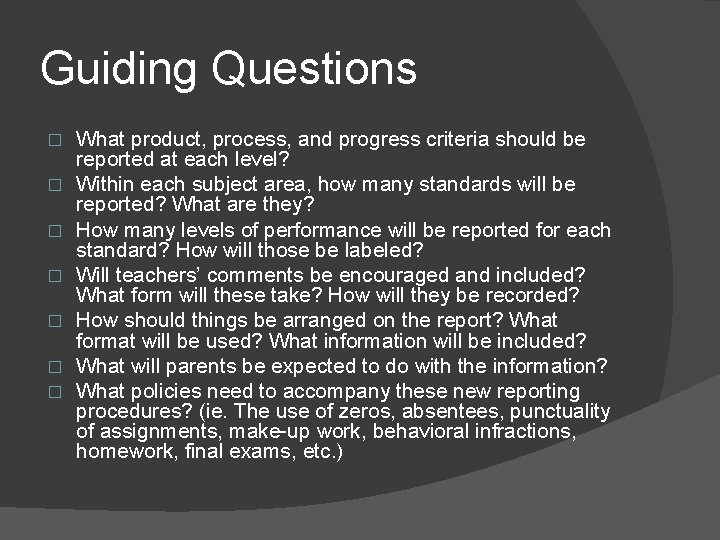
Guiding Questions � � � � What product, process, and progress criteria should be reported at each level? Within each subject area, how many standards will be reported? What are they? How many levels of performance will be reported for each standard? How will those be labeled? Will teachers’ comments be encouraged and included? What form will these take? How will they be recorded? How should things be arranged on the report? What format will be used? What information will be included? What will parents be expected to do with the information? What policies need to accompany these new reporting procedures? (ie. The use of zeros, absentees, punctuality of assignments, make-up work, behavioral infractions, homework, final exams, etc. )
Conclusions from the Research of Grading
#1 GRADING AND REPORTING ARE NOT ESSENTIAL TO THE INSTRUCTIONAL PROCESS
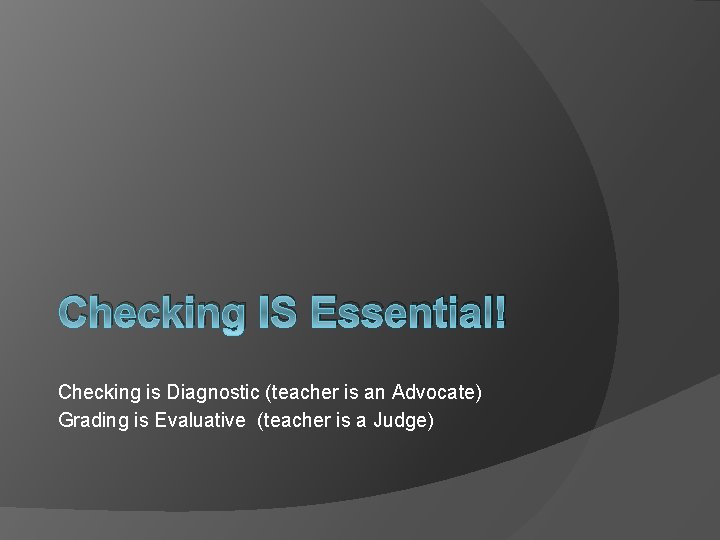
Checking IS Essential! Checking is Diagnostic (teacher is an Advocate) Grading is Evaluative (teacher is a Judge)
#2 NO ONE METHOD OF GRADING AND REPORTING SERVES ALL PURPOSES WELL!
Purposes of Grading Communicate the Achievement Status of Students to their Parents and Others � Provide Information for Student Self. Evaluation � Select, Identify, or Group Students to Learn � Provide Incentives for Students to Learn � Documents students’ performance to evaluate the Effectiveness of Instructional Programs � Provide Evidence of Students’ Lack of Effort or Inappropriate Responsibility �
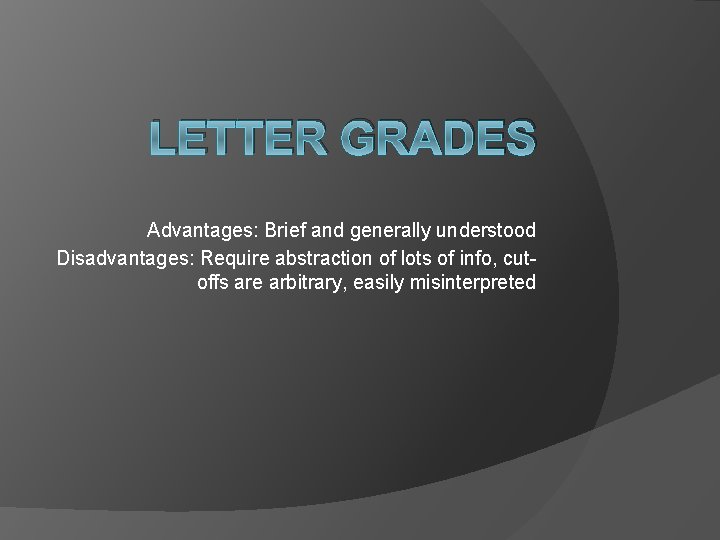
LETTER GRADES Advantages: Brief and generally understood Disadvantages: Require abstraction of lots of info, cutoffs are arbitrary, easily misinterpreted
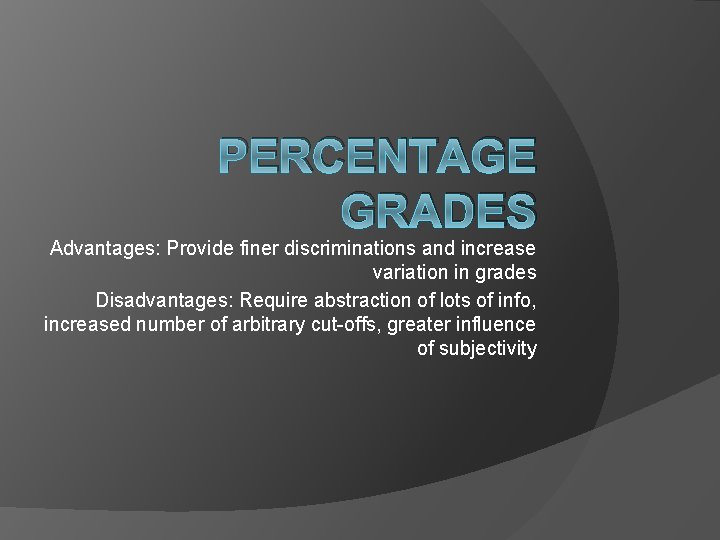
PERCENTAGE GRADES Advantages: Provide finer discriminations and increase variation in grades Disadvantages: Require abstraction of lots of info, increased number of arbitrary cut-offs, greater influence of subjectivity
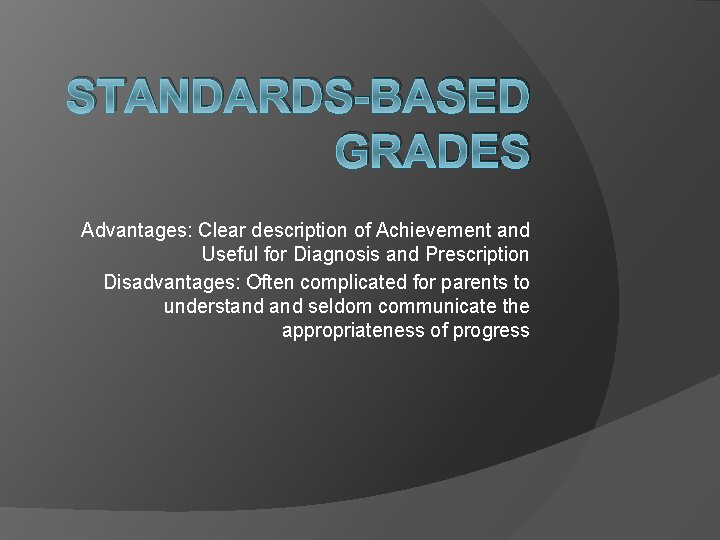
STANDARDS-BASED GRADES Advantages: Clear description of Achievement and Useful for Diagnosis and Prescription Disadvantages: Often complicated for parents to understand seldom communicate the appropriateness of progress
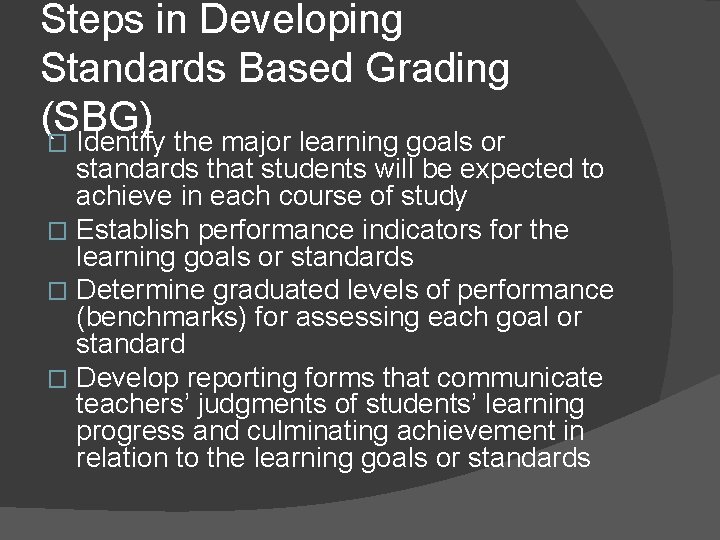
Steps in Developing Standards Based Grading (SBG) � Identify the major learning goals or standards that students will be expected to achieve in each course of study � Establish performance indicators for the learning goals or standards � Determine graduated levels of performance (benchmarks) for assessing each goal or standard � Develop reporting forms that communicate teachers’ judgments of students’ learning progress and culminating achievement in relation to the learning goals or standards
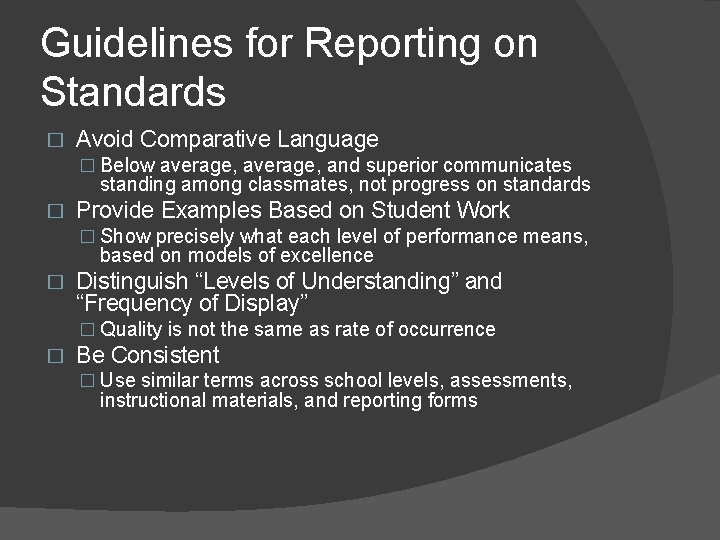
Guidelines for Reporting on Standards � Avoid Comparative Language � Below average, and superior communicates standing among classmates, not progress on standards � Provide Examples Based on Student Work � Show precisely what each level of performance means, based on models of excellence � Distinguish “Levels of Understanding” and “Frequency of Display” � Quality is not the same as rate of occurrence � Be Consistent � Use similar terms across school levels, assessments, instructional materials, and reporting forms
#3 GRADING AND REPORTING WILL ALWAYS INVOLVE SOME DEGREE OF SUBJECTIVITY
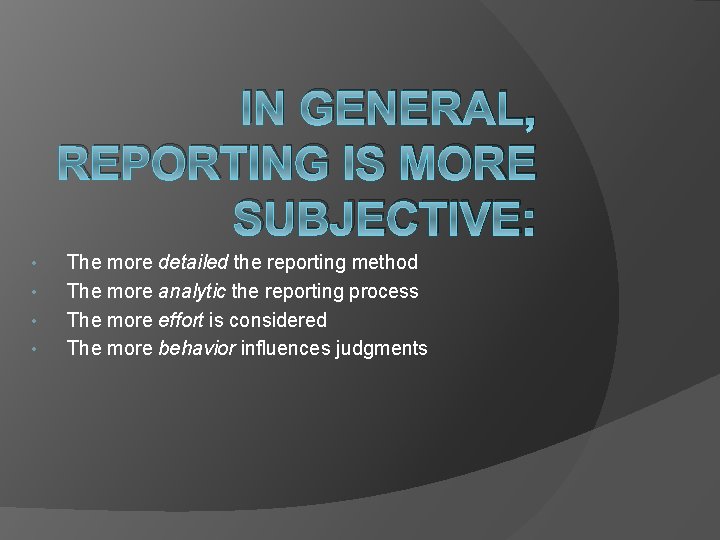
IN GENERAL, REPORTING IS MORE SUBJECTIVE: • • The more detailed the reporting method The more analytic the reporting process The more effort is considered The more behavior influences judgments
HOWEVER, MORE DETAILED ANALYTIC REPORTS ARE BETTER LEARNING TOOLS The Challenge: To balance Reporting Needs with Instructional Purposes
#4 MATHEMATIC PRECISION DOES NOT YIELD FAIRER OR MORE OBJECTIVE GRADING!
Questionable Practices � Averaging to Obtain a Course Grade � Giving Zeros for Work Missed or Work Turned in Late � Taking Credit Away from Students for Infractions
Alternatives to Averaging Inconsistent Evidence on Student Learning: � Give priority to the most recent evidence � Give priority to the most comprehensive evidence � Give priority to evidence related to the most important learning goals or standards
Alternatives to Giving Zeros: � Assign “I” or “incomplete” grades �Include specific and immediate consequences � Report behavioral aspects separately �Separate product from process and progress � Change grading scales �Use integers (A=4, B=3. . . ) instead of percentages
GRADING REQUIRES THOUGHTFUL AND INFORMED PROFESSIONAL JUDGMENT!
#5 GRADES HAVE SOME VALUE AS REWARDS, BUT NO VALUE AS PUNISHMENTS!
MESSAGE: DO NOT USE GRADES AS WEAPONS!
#6 GRADING AND REPORTING SHOULD ALWAYS BE DONE IN REFERENCE TO THE LEARNING CRITERIA, NEVER “ON THE CURVE”
#7 GRADE DISTRIBUTIONS REFLECT BOTH: 1. 2. Students’ level of performance The Quality of the Teaching
#8 REPORT CARDS ARE BUT ONE WAY OF COMMUNICATING WITH PARENTS! Report cards, notes home, progress reports, phone calls, open house, newsletters, homework, web pages, conferences
#9 HIGH PERCENTAGES ARE NOT THE SAME AS HIGH STANDARDS!
THINK ABOUT YOUR DAYS AS A STUDENT. THEN, DESCRIBE YOUR MOST MEMORABLE. . . • • Negative grading experience Positive grading experience
Goals for Reporting and Grading Begin with a Clear Statement of Purpose 2. Provide Accurate and Understandable Descriptions of Learning 3. Use Grading and Reporting to Enhance Teaching and Learning 1.