
CREDIT Credit another word for Borrowing 2 6
CREDIT “Credit”; another word for “Borrowing”
2. 6. 2. G 1 WHAT IS CREDIT? Credit is borrowing or taking a loan! If you buy something on “credit” you are receiving the goods or services today and will pay the bill later. Many goods and services are paid for with credit. Even simple things like your electric bill. Borrowing money to buy a car or home is the most significant example of credit. A credit card is borrowing as well as the bank pays off your vendors and you then owe them. © Take Charge Today – August 2013– Credit Basics – Slide 2 Funded by a grant from Take Charge America, Inc. to the Norton School of Family and Consumer Sciences Take Charge America Institute at the University of Arizona
2. 6. 2. G 1 ADVANTAGES OF CREDIT Advantages: Able to buy needed items now like education, homes, and cars. Don’t have to carry large amounts of cash to buy goods and services If managed wisely, it builds your credit rating allowing you to borrow money at lower interest rates! © Take Charge Today – August 2013– Credit Basics – Slide 3 teens Funded by a grant from Take Charge America, Inc. to the Norton School of Family and Consumer Sciences Take Charge America Institute at the University of Arizona – lesson 7 - slide 7 -A
2. 6. 2. G 1 DISADVANTAGES OF CREDIT Disadvantages: Paying Interest expense on loans means paying a higher total cost for items (education, cars, homes, etc. ) May incur additional fees beyond interest expense (loan processing costs) Financial difficulties and a poor credit rating will occur if one cannot pay off credit/debt. © Take Charge Today – August 2013– Credit Basics – Slide 4 Funded by a grant from Take Charge America, Inc. to the Norton School of Family and Consumer Sciences Take Charge America Institute at the University of Arizona
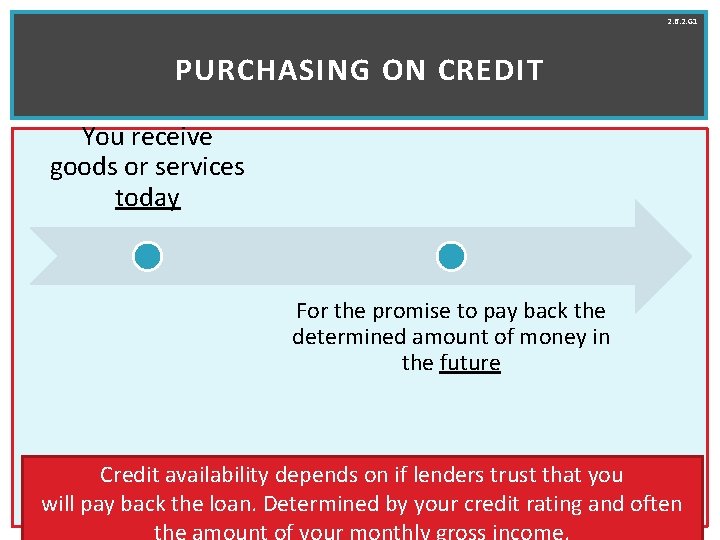
2. 6. 2. G 1 PURCHASING ON CREDIT You receive goods or services today For the promise to pay back the determined amount of money in the future Credit availability depends on if lenders trust that you will pay back the loan. Determined by your credit rating and often the amount of your monthly gross income. © Take Charge Today – August 2013– Credit Basics – Slide 5 Funded by a grant from Take Charge America, Inc. to the Norton School of Family and Consumer Sciences Take Charge America Institute at the University of Arizona
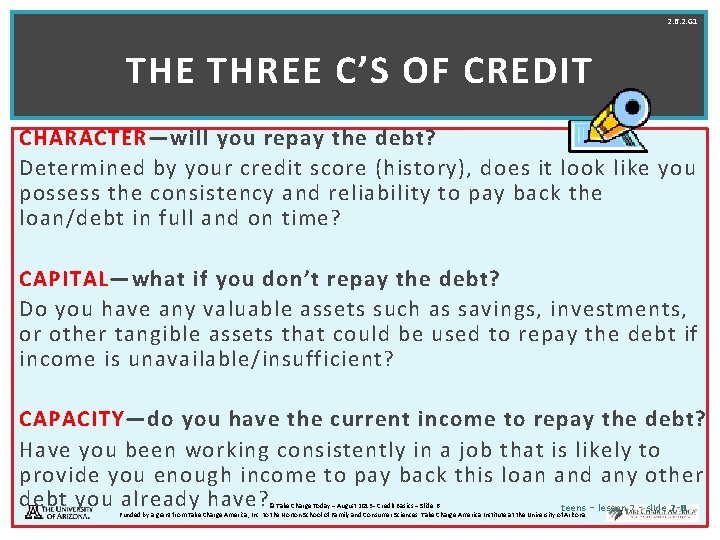
2. 6. 2. G 1 THE THREE C’S OF CREDIT CHARACTER—will you repay the debt? Determined by your credit score (history), does it look like you possess the consistency and reliability to pay back the loan/debt in full and on time? CAPITAL—what if you don’t repay the debt? Do you have any valuable assets such as savings, investments, or other tangible assets that could be used to repay the debt if income is unavailable/insufficient? CAPACITY—do you have the current income to repay the debt? Have you been working consistently in a job that is likely to provide you enough income to pay back this loan and any other debt you already have? © Take Charge Today – August 2013– Credit Basics – Slide 6 teens Funded by a grant from Take Charge America, Inc. to the Norton School of Family and Consumer Sciences Take Charge America Institute at the University of Arizona – lesson 7 - slide 7 -B
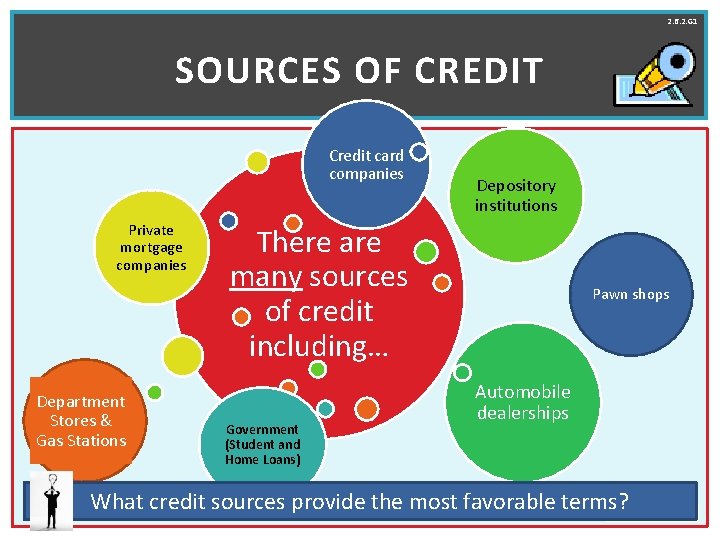
2. 6. 2. G 1 SOURCES OF CREDIT Credit card companies Private mortgage companies Department Stores & Gas Stations Depository institutions There are many sources of credit including… Government (Student and Home Loans) Pawn shops Automobile dealerships What credit sources provide the most favorable terms? © Take Charge Today – August 2013– Credit Basics – Slide 7 Funded by a grant from Take Charge America, Inc. to the Norton School of Family and Consumer Sciences Take Charge America Institute at the University of Arizona
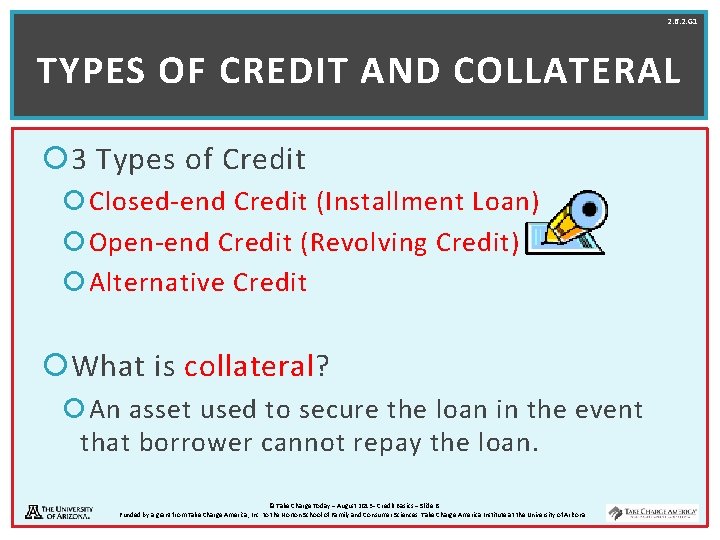
2. 6. 2. G 1 TYPES OF CREDIT AND COLLATERAL 3 Types of Credit Closed-end Credit (Installment Loan) Open-end Credit (Revolving Credit) Alternative Credit What is collateral? An asset used to secure the loan in the event that borrower cannot repay the loan. © Take Charge Today – August 2013– Credit Basics – Slide 8 Funded by a grant from Take Charge America, Inc. to the Norton School of Family and Consumer Sciences Take Charge America Institute at the University of Arizona
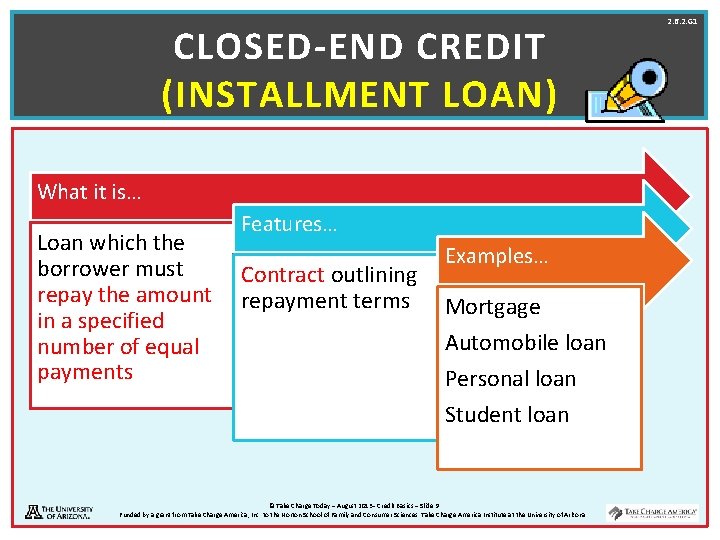
CLOSED-END CREDIT (INSTALLMENT LOAN) What it is… Features… Loan which the Examples… borrower must Contract outlining repay the amount repayment terms Mortgage in a specified Automobile loan number of equal payments Personal loan Student loan © Take Charge Today – August 2013– Credit Basics – Slide 9 Funded by a grant from Take Charge America, Inc. to the Norton School of Family and Consumer Sciences Take Charge America Institute at the University of Arizona 2. 6. 2. G 1
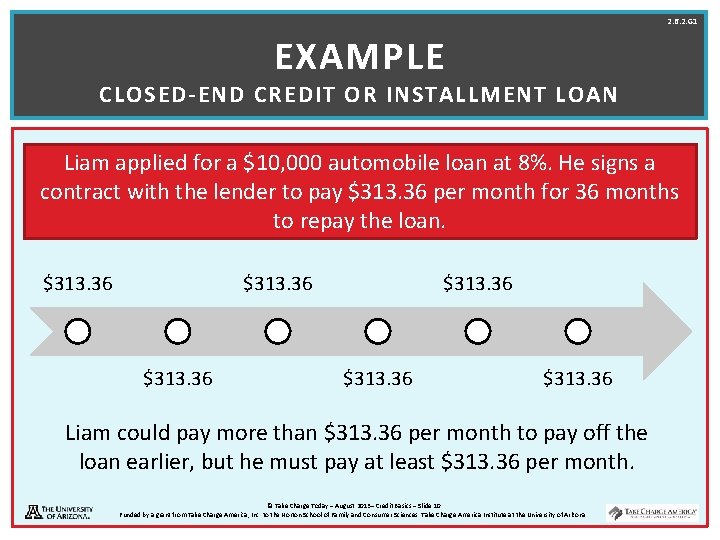
2. 6. 2. G 1 EXAMPLE CLOSED-END CREDIT OR INSTALLMENT LOAN Liam applied for a $10, 000 automobile loan at 8%. He signs a contract with the lender to pay $313. 36 per month for 36 months to repay the loan. $313. 36 Liam could pay more than $313. 36 per month to pay off the loan earlier, but he must pay at least $313. 36 per month. © Take Charge Today – August 2013– Credit Basics – Slide 10 Funded by a grant from Take Charge America, Inc. to the Norton School of Family and Consumer Sciences Take Charge America Institute at the University of Arizona

OPEN-END CREDIT (REVOLVING CREDIT) What it is… Extended line of credit established in advance Features… Loan may be paid (usually monthly) in a single payment or series of unequal payments Example… Credit Card (No Collateral) Home Equity Loan (Collateral is home) Bank Line of Credit (No Collateral) © Take Charge Today – August 2013– Credit Basics – Slide 11 Funded by a grant from Take Charge America, Inc. to the Norton School of Family and Consumer Sciences Take Charge America Institute at the University of Arizona 2. 6. 2. G 1
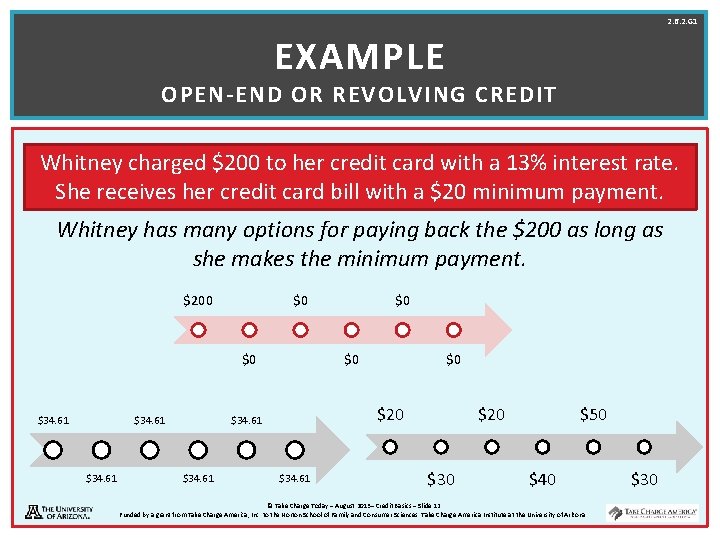
2. 6. 2. G 1 EXAMPLE OPEN-END OR REVOLVING CREDIT Whitney charged $200 to her credit card with a 13% interest rate. She receives her credit card bill with a $20 minimum payment. Whitney has many options for paying back the $200 as long as she makes the minimum payment. $200 $0 $0 $34. 61 $0 $0 $20 $34. 61 $0 $34. 61 $20 $30 $50 $40 © Take Charge Today – August 2013– Credit Basics – Slide 12 Funded by a grant from Take Charge America, Inc. to the Norton School of Family and Consumer Sciences Take Charge America Institute at the University of Arizona $30
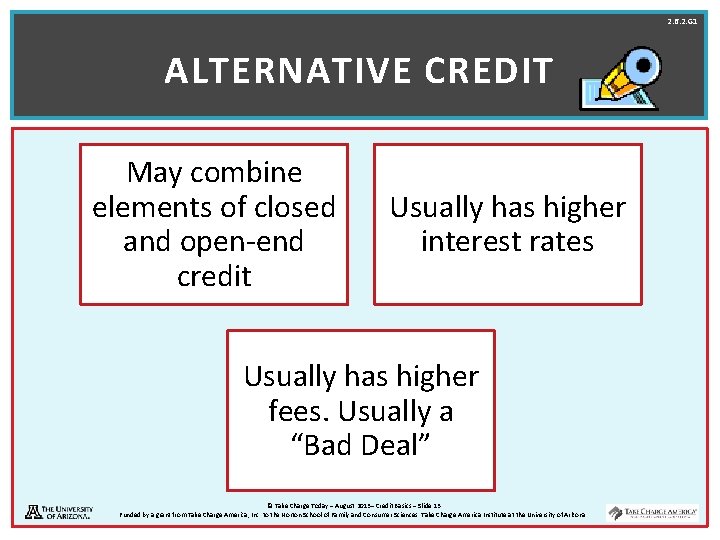
2. 6. 2. G 1 ALTERNATIVE CREDIT May combine elements of closed and open-end credit Usually has higher interest rates Usually has higher fees. Usually a “Bad Deal” © Take Charge Today – August 2013– Credit Basics – Slide 13 Funded by a grant from Take Charge America, Inc. to the Norton School of Family and Consumer Sciences Take Charge America Institute at the University of Arizona
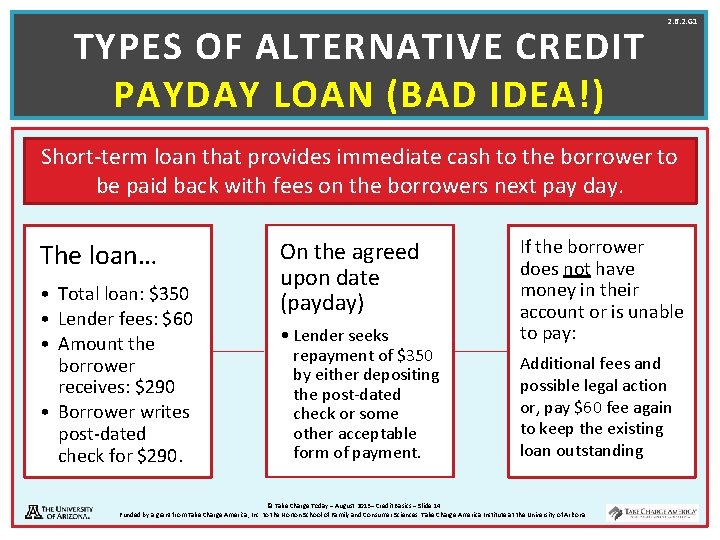
TYPES OF ALTERNATIVE CREDIT PAYDAY LOAN (BAD IDEA!) 2. 6. 2. G 1 Short-term loan that provides immediate cash to the borrower to be paid back with fees on the borrowers next pay day. The loan… • Total loan: $350 • Lender fees: $60 • Amount the borrower receives: $290 • Borrower writes post-dated check for $290. On the agreed upon date (payday) • Lender seeks repayment of $350 by either depositing the post-dated check or some other acceptable form of payment. If the borrower does not have money in their account or is unable to pay: Additional fees and possible legal action or, pay $60 fee again to keep the existing loan outstanding © Take Charge Today – August 2013– Credit Basics – Slide 14 Funded by a grant from Take Charge America, Inc. to the Norton School of Family and Consumer Sciences Take Charge America Institute at the University of Arizona
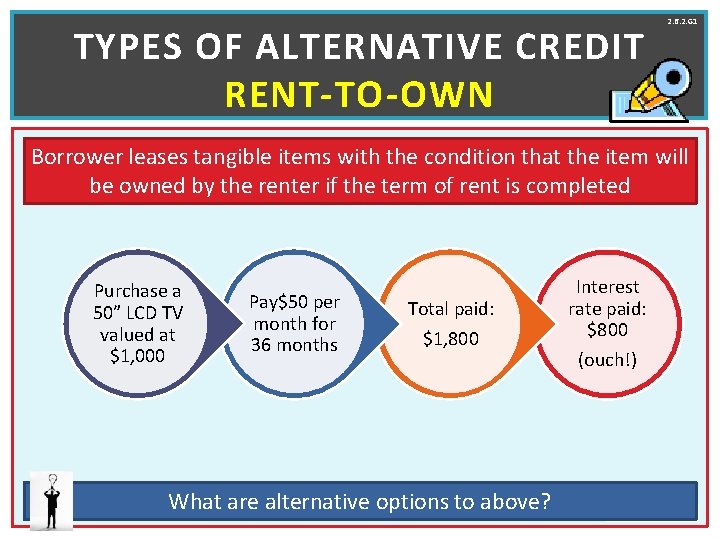
TYPES OF ALTERNATIVE CREDIT RENT-TO-OWN 2. 6. 2. G 1 Borrower leases tangible items with the condition that the item will be owned by the renter if the term of rent is completed Purchase a 50” LCD TV valued at $1, 000 Pay$50 per month for 36 months Total paid: $1, 800 What are alternative options to above? Interest rate paid: $800 (ouch!) © Take Charge Today – August 2013– Credit Basics – Slide 15 Funded by a grant from Take Charge America, Inc. to the Norton School of Family and Consumer Sciences Take Charge America Institute at the University of Arizona
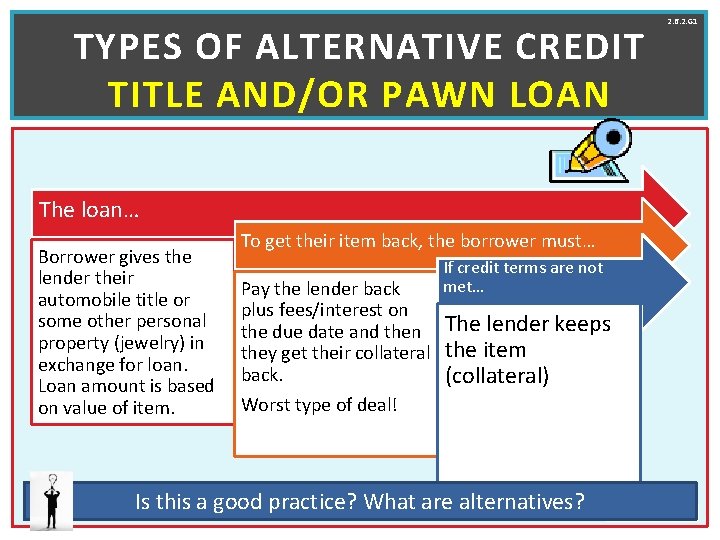
TYPES OF ALTERNATIVE CREDIT TITLE AND/OR PAWN LOAN The loan… Borrower gives the lender their automobile title or some other personal property (jewelry) in exchange for loan. Loan amount is based on value of item. To get their item back, the borrower must… Pay the lender back plus fees/interest on the due date and then they get their collateral back. Worst type of deal! If credit terms are not met… The lender keeps the item (collateral) Is this a good practice? What are alternatives? © Take Charge Today – August 2013– Credit Basics – Slide 16 Funded by a grant from Take Charge America, Inc. to the Norton School of Family and Consumer Sciences Take Charge America Institute at the University of Arizona 2. 6. 2. G 1
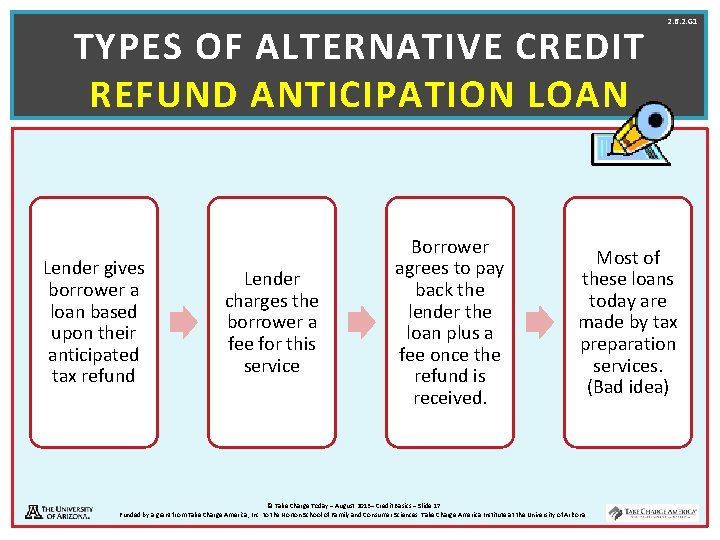
TYPES OF ALTERNATIVE CREDIT REFUND ANTICIPATION LOAN Lender gives borrower a loan based upon their anticipated tax refund Lender charges the borrower a fee for this service Borrower agrees to pay back the lender the loan plus a fee once the refund is received. 2. 6. 2. G 1 Most of these loans today are made by tax preparation services. (Bad idea) © Take Charge Today – August 2013– Credit Basics – Slide 17 Funded by a grant from Take Charge America, Inc. to the Norton School of Family and Consumer Sciences Take Charge America Institute at the University of Arizona
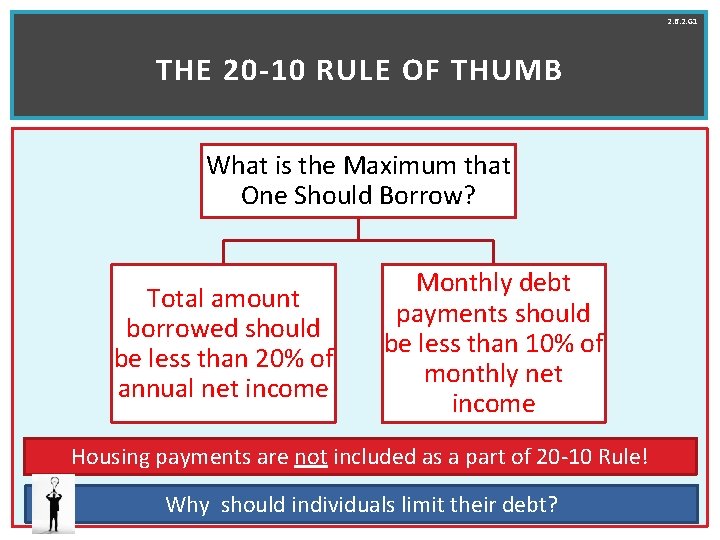
2. 6. 2. G 1 THE 20 -10 RULE OF THUMB What is the Maximum that One Should Borrow? Total amount borrowed should be less than 20% of annual net income Monthly debt payments should be less than 10% of monthly net income Housing payments are not included as a part of 20 -10 Rule! Why should individuals limit their debt? © Take Charge Today – August 2013– Credit Basics – Slide 18 Funded by a grant from Take Charge America, Inc. to the Norton School of Family and Consumer Sciences Take Charge America Institute at the University of Arizona
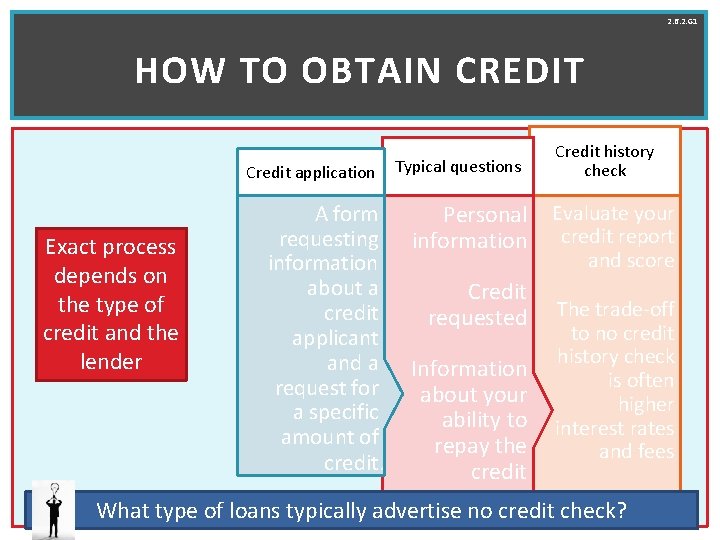
2. 6. 2. G 1 HOW TO OBTAIN CREDIT Credit application Exact process depends on the type of credit and the lender A form requesting information about a credit applicant and a request for a specific amount of credit. Typical questions Credit history check Personal Evaluate your information credit report and score Credit requested Information about your ability to repay the credit The trade-off to no credit history check is often higher interest rates and fees What type of loans typically advertise no credit check? © Take Charge Today – August 2013– Credit Basics – Slide 19 Funded by a grant from Take Charge America, Inc. to the Norton School of Family and Consumer Sciences Take Charge America Institute at the University of Arizona
2. 6. 2. G 1 CREDIT: YOUR RESPONSIBILITIES Borrow only what you can repay in full. Follow the 20 -10 rule of thumb. Read and understand the credit contract. Pay debts in full on or before the due date. Notify creditor if you cannot meet payments. Report lost or stolen credit cards promptly. Never give your credit card number over the phone unless you are certain of the caller’s identity. Maintain a credit rating over 760. Check your credit rating at least once per year. © Take Charge Today – August 2013– Credit Basics – Slide 20 teens – Funded by a grant from Take Charge America, Inc. to the Norton School of Family and Consumer Sciences Take Charge America Institute at the University of Arizona lesson 7 - slide 7 -C
2. 6. 2. G 1 YOUR RIGHTS Truth in Lending Act (1968) Ensures consumers are fully informed about interest rates, cost, and terms of credit (borrowing). Requires many disclosures by lenders! State Usury Laws Limits maximum interest to be charged on loans! © Take Charge Today – August 2013– Credit Basics – Slide 21 teens Funded by a grant from Take Charge America, Inc. to the Norton School of Family and Consumer Sciences Take Charge America Institute at the University of Arizona – lesson 7 - slide 7 -D
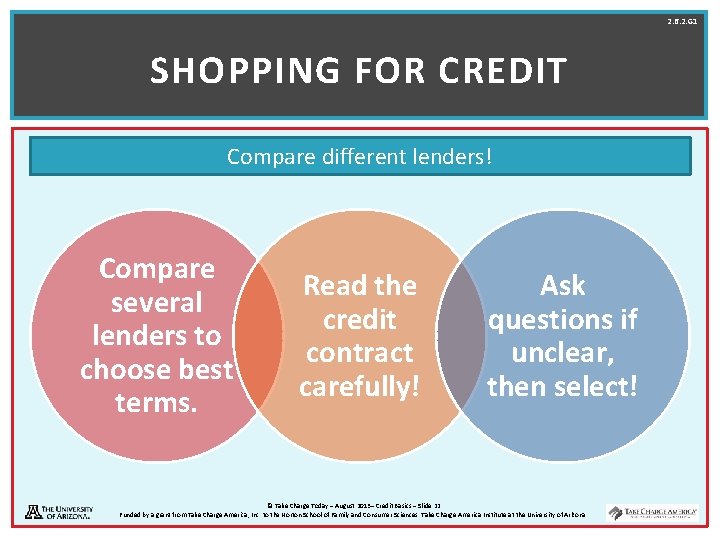
2. 6. 2. G 1 SHOPPING FOR CREDIT Compare different lenders! Compare several lenders to choose best terms. Read the credit contract carefully! Ask questions if unclear, then select! © Take Charge Today – August 2013– Credit Basics – Slide 22 Funded by a grant from Take Charge America, Inc. to the Norton School of Family and Consumer Sciences Take Charge America Institute at the University of Arizona
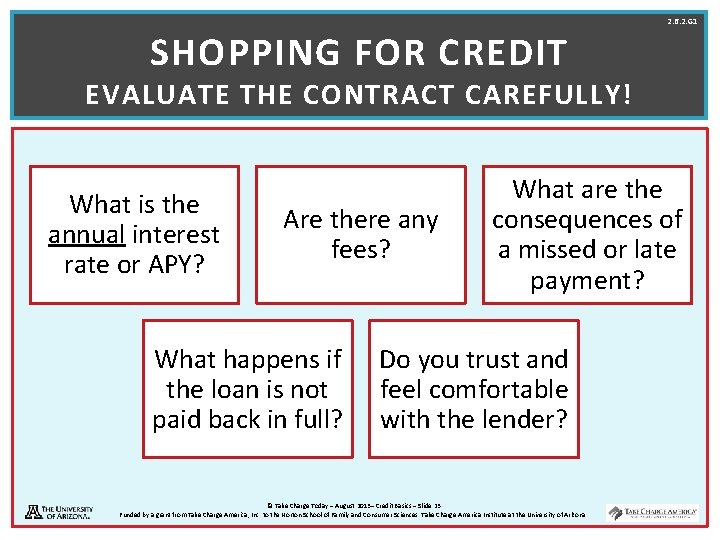
2. 6. 2. G 1 SHOPPING FOR CREDIT EVALUATE THE CONTRACT CAREFULLY! What is the annual interest rate or APY? Are there any fees? What happens if the loan is not paid back in full? What are the consequences of a missed or late payment? Do you trust and feel comfortable with the lender? © Take Charge Today – August 2013– Credit Basics – Slide 23 Funded by a grant from Take Charge America, Inc. to the Norton School of Family and Consumer Sciences Take Charge America Institute at the University of Arizona
CREDIT SCORES “Manage your credit score to 760 or higher (out of 850) to get the best interest rates on future loans” Steve Latter
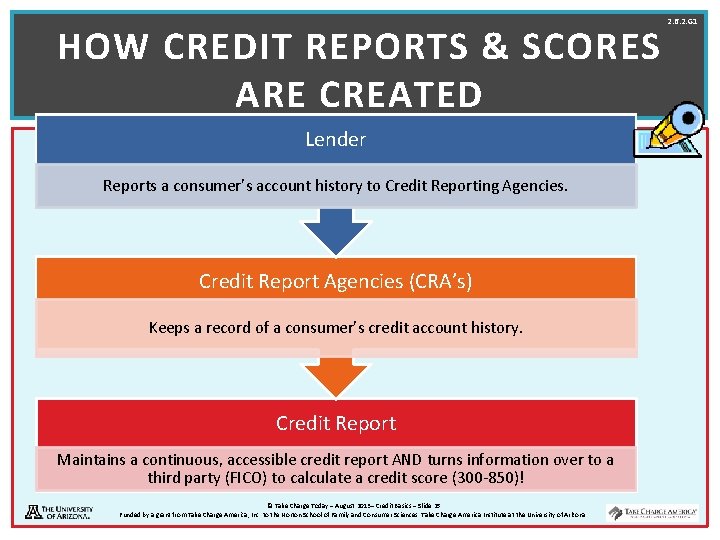
HOW CREDIT REPORTS & SCORES ARE CREATED Lender Reports a consumer’s account history to Credit Reporting Agencies. Credit Report Agencies (CRA’s) Keeps a record of a consumer’s credit account history. Credit Report Maintains a continuous, accessible credit report AND turns information over to a third party (FICO) to calculate a credit score (300 -850)! © Take Charge Today – August 2013– Credit Basics – Slide 25 Funded by a grant from Take Charge America, Inc. to the Norton School of Family and Consumer Sciences Take Charge America Institute at the University of Arizona 2. 6. 2. G 1
2. 6. 2. G 1 CREDIT REPORTING AGENCIES Three U. S. CRA’s: - Equifax - Experian - Trans. Union (Know for Test!) A person’s credit score, calculated by FICO, may vary slightly across the three CRA’s If credit has never been used (or reported) an individual will not have a credit report or score © Take Charge Today – August 2013– Credit Basics – Slide 26 Funded by a grant from Take Charge America, Inc. to the Norton School of Family and Consumer Sciences Take Charge America Institute at the University of Arizona
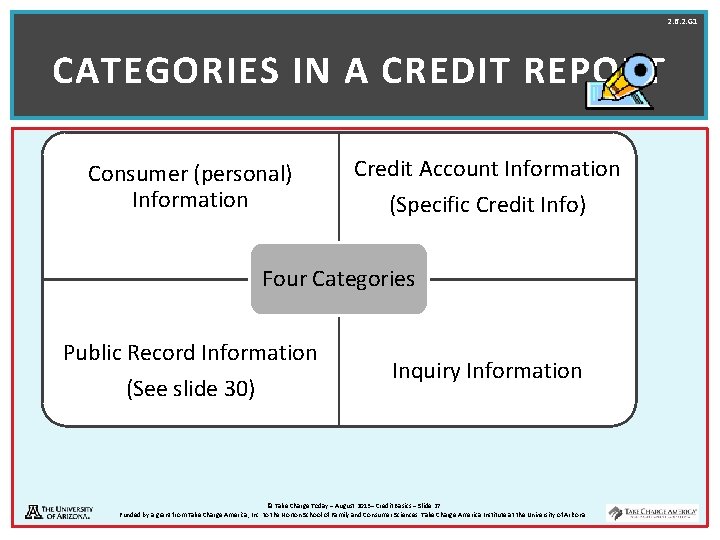
2. 6. 2. G 1 CATEGORIES IN A CREDIT REPORT Consumer (personal) Information Credit Account Information (Specific Credit Info) Four Categories Public Record Information (See slide 30) Inquiry Information © Take Charge Today – August 2013– Credit Basics – Slide 27 Funded by a grant from Take Charge America, Inc. to the Norton School of Family and Consumer Sciences Take Charge America Institute at the University of Arizona
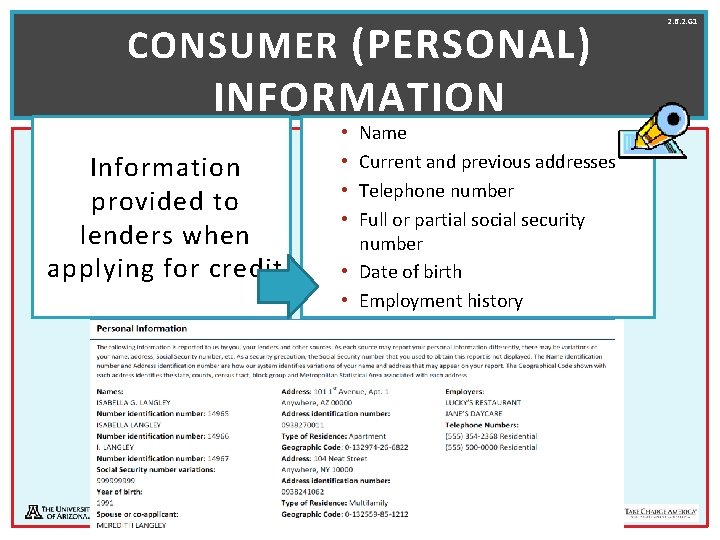
CONSUMER (PERSONAL) INFORMATION Information provided to lenders when applying for credit Name Current and previous addresses Telephone number Full or partial social security number • Date of birth • Employment history • • © Take Charge Today – August 2013– Credit Basics – Slide 28 Funded by a grant from Take Charge America, Inc. to the Norton School of Family and Consumer Sciences Take Charge America Institute at the University of Arizona 2. 6. 2. G 1
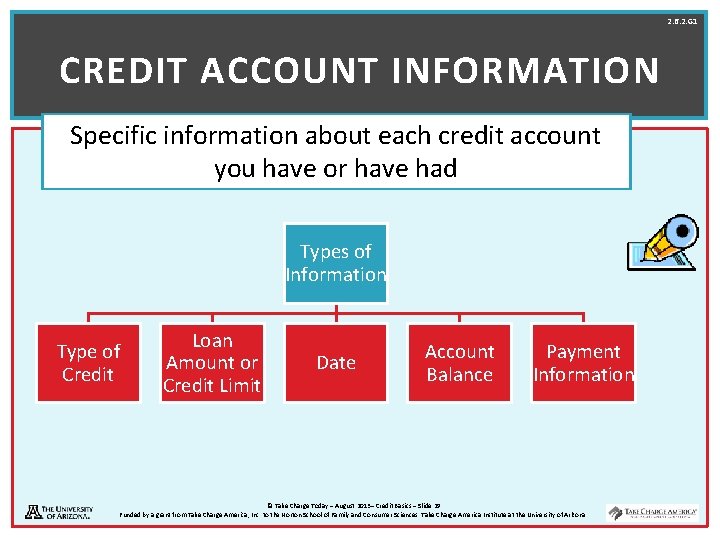
2. 6. 2. G 1 CREDIT ACCOUNT INFORMATION Specific information about each credit account you have or have had Types of Information Type of Credit Loan Amount or Credit Limit Date Account Balance Payment Information © Take Charge Today – August 2013– Credit Basics – Slide 29 Funded by a grant from Take Charge America, Inc. to the Norton School of Family and Consumer Sciences Take Charge America Institute at the University of Arizona
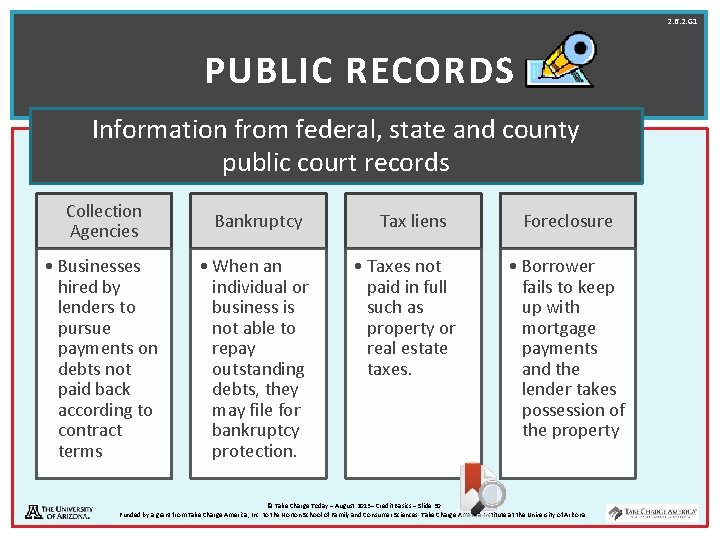
2. 6. 2. G 1 PUBLIC RECORDS Information from federal, state and county public court records Collection Agencies Bankruptcy • Businesses hired by lenders to pursue payments on debts not paid back according to contract terms • When an individual or business is not able to repay outstanding debts, they may file for bankruptcy protection. Tax liens • Taxes not paid in full such as property or real estate taxes. Foreclosure • Borrower fails to keep up with mortgage payments and the lender takes possession of the property © Take Charge Today – August 2013– Credit Basics – Slide 30 Funded by a grant from Take Charge America, Inc. to the Norton School of Family and Consumer Sciences Take Charge America Institute at the University of Arizona
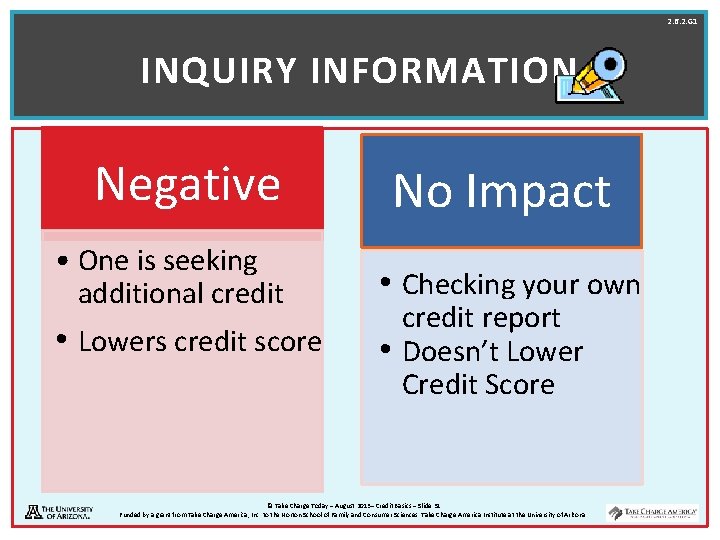
2. 6. 2. G 1 INQUIRY INFORMATION Negative • One is seeking additional credit • Lowers credit score No Impact • Checking your own credit report • Doesn’t Lower Credit Score © Take Charge Today – August 2013– Credit Basics – Slide 31 Funded by a grant from Take Charge America, Inc. to the Norton School of Family and Consumer Sciences Take Charge America Institute at the University of Arizona
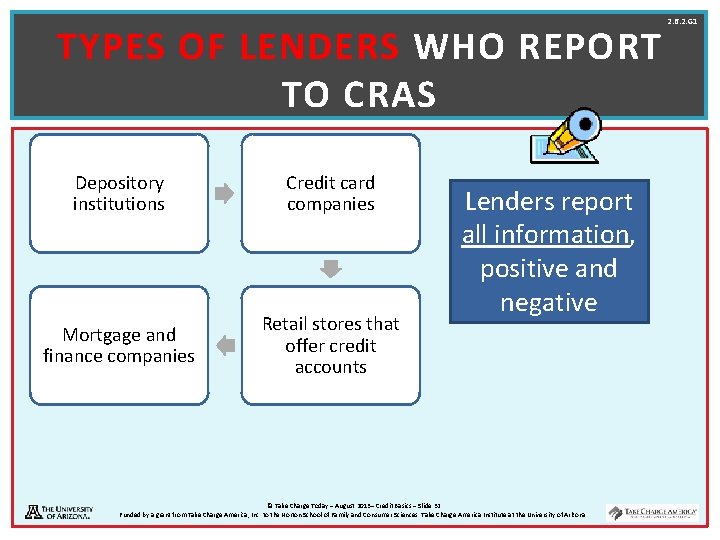
TYPES OF LENDERS WHO REPORT TO CRAS Depository institutions Credit card companies Mortgage and finance companies Retail stores that offer credit accounts Lenders report all information, positive and negative © Take Charge Today – August 2013– Credit Basics – Slide 32 Funded by a grant from Take Charge America, Inc. to the Norton School of Family and Consumer Sciences Take Charge America Institute at the University of Arizona 2. 6. 2. G 1
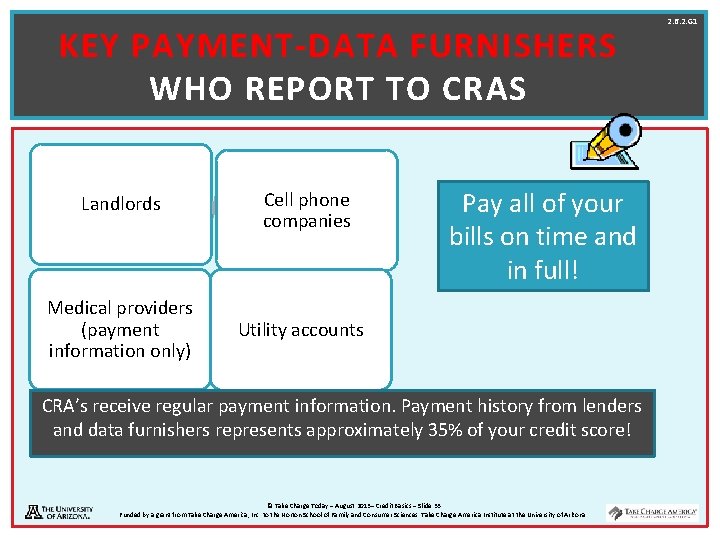
KEY PAYMENT-DATA FURNISHERS WHO REPORT TO CRAS Landlords Medical providers (payment information only) Cell phone companies Pay all of your bills on time and in full! Utility accounts CRA’s receive regular payment information. Payment history from lenders and data furnishers represents approximately 35% of your credit score! © Take Charge Today – August 2013– Credit Basics – Slide 33 Funded by a grant from Take Charge America, Inc. to the Norton School of Family and Consumer Sciences Take Charge America Institute at the University of Arizona 2. 6. 2. G 1
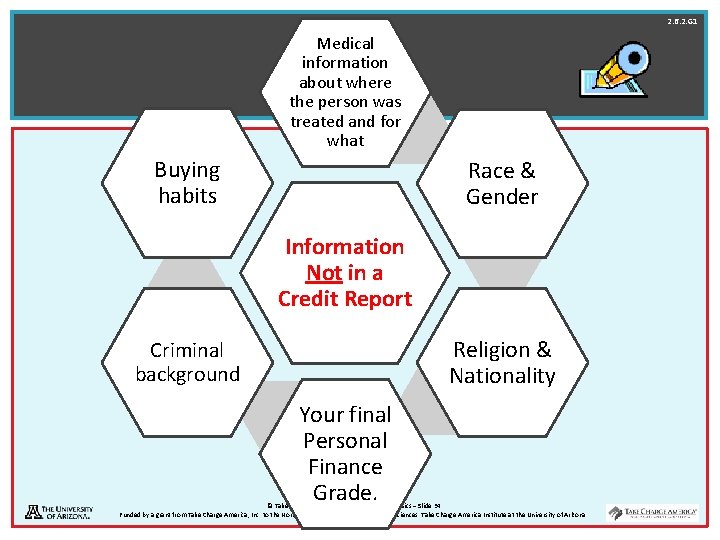
2. 6. 2. G 1 Medical information about where the person was treated and for what Buying habits Race & Gender Information Not in a Credit Report Religion & Nationality Criminal background Your final Personal Finance Grade. © Take Charge Today – August 2013– Credit Basics – Slide 34 Funded by a grant from Take Charge America, Inc. to the Norton School of Family and Consumer Sciences Take Charge America Institute at the University of Arizona
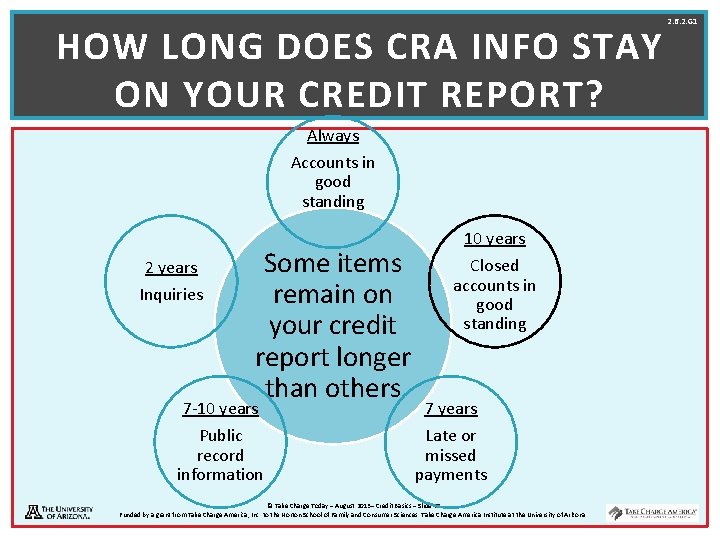
HOW LONG DOES CRA INFO STAY ON YOUR CREDIT REPORT? Always Accounts in good standing 2 years Inquiries Some items remain on your credit report longer than others 7 -10 years Public record information 10 years Closed accounts in good standing 7 years Late or missed payments © Take Charge Today – August 2013– Credit Basics – Slide 35 Funded by a grant from Take Charge America, Inc. to the Norton School of Family and Consumer Sciences Take Charge America Institute at the University of Arizona 2. 6. 2. G 1
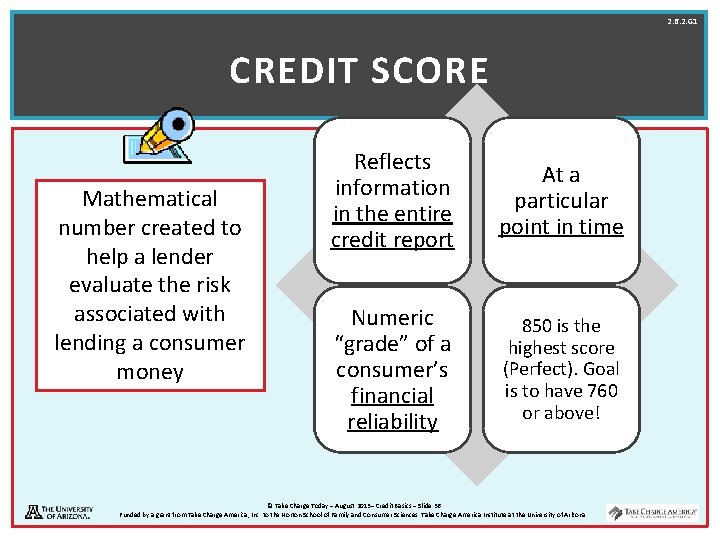
2. 6. 2. G 1 CREDIT SCORE Mathematical number created to help a lender evaluate the risk associated with lending a consumer money Reflects information in the entire credit report At a particular point in time Numeric “grade” of a consumer’s financial reliability 850 is the highest score (Perfect). Goal is to have 760 or above! © Take Charge Today – August 2013– Credit Basics – Slide 36 Funded by a grant from Take Charge America, Inc. to the Norton School of Family and Consumer Sciences Take Charge America Institute at the University of Arizona
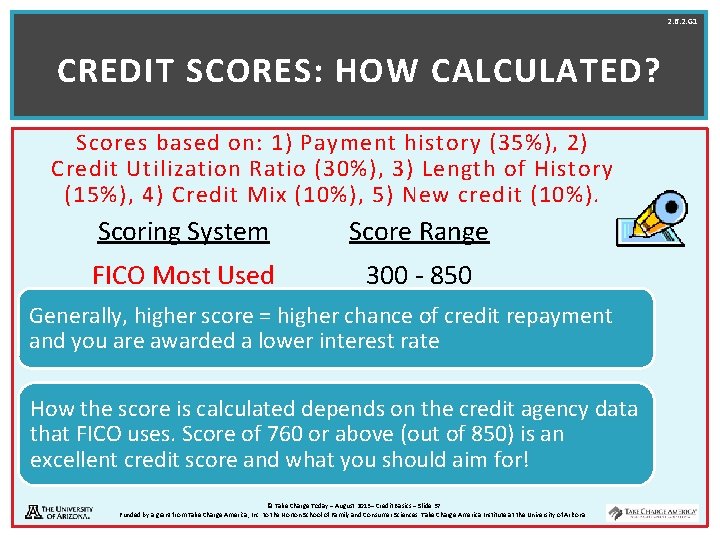
2. 6. 2. G 1 CREDIT SCORES: HOW CALCULATED? Scores based on: 1) Payment history (35%), 2) Credit Utilization Ratio (30%), 3) Length of History (15%), 4) Credit Mix (10%), 5) New credit (10%). Scoring System Score Range FICO Most Used 300 - 850 Generally, higher score = higher chance of credit repayment and you are awarded a lower interest rate How the score is calculated depends on the credit agency data that FICO uses. Score of 760 or above (out of 850) is an excellent credit score and what you should aim for! © Take Charge Today – August 2013– Credit Basics – Slide 37 Funded by a grant from Take Charge America, Inc. to the Norton School of Family and Consumer Sciences Take Charge America Institute at the University of Arizona
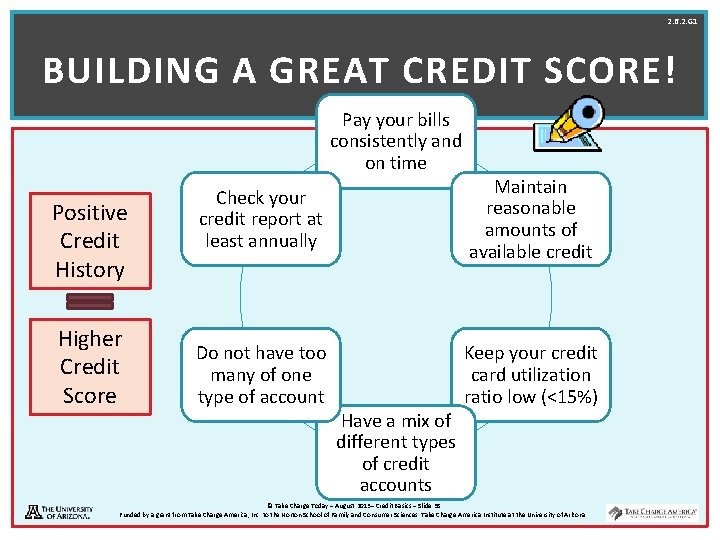
2. 6. 2. G 1 BUILDING A GREAT CREDIT SCORE! Pay your bills consistently and on time Positive Credit History Higher Credit Score Check your credit report at least annually Maintain reasonable amounts of available credit Do not have too many of one type of account Keep your credit card utilization ratio low (<15%) Have a mix of different types of credit accounts © Take Charge Today – August 2013– Credit Basics – Slide 38 Funded by a grant from Take Charge America, Inc. to the Norton School of Family and Consumer Sciences Take Charge America Institute at the University of Arizona
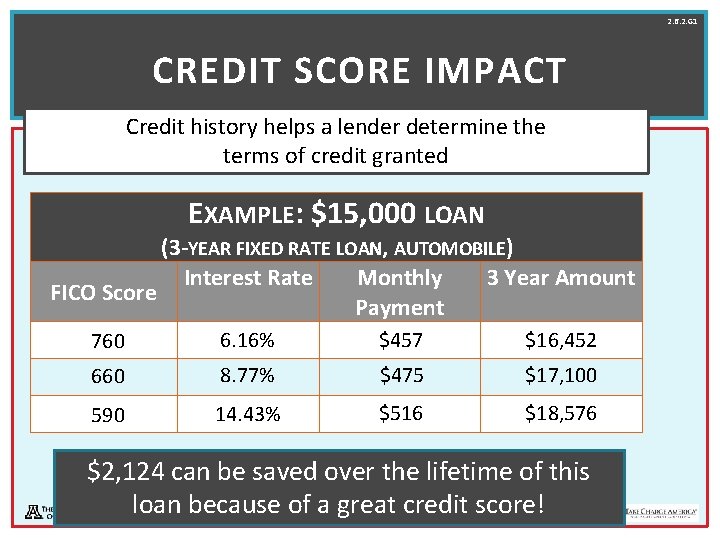
2. 6. 2. G 1 CREDIT SCORE IMPACT Credit history helps a lender determine the terms of credit granted EXAMPLE: $15, 000 LOAN (3 -YEAR FIXED RATE LOAN, AUTOMOBILE) Interest Rate Monthly 3 Year Amount FICO Score Payment 760 6. 16% $457 $16, 452 660 8. 77% $475 $17, 100 590 14. 43% $516 $18, 576 $2, 124 can be saved over the lifetime of this loan because of a great credit score! © Take Charge Today – August 2013– Credit Basics – Slide 39 Funded by a grant from Take Charge America, Inc. to the Norton School of Family and Consumer Sciences Take Charge America Institute at the University of Arizona
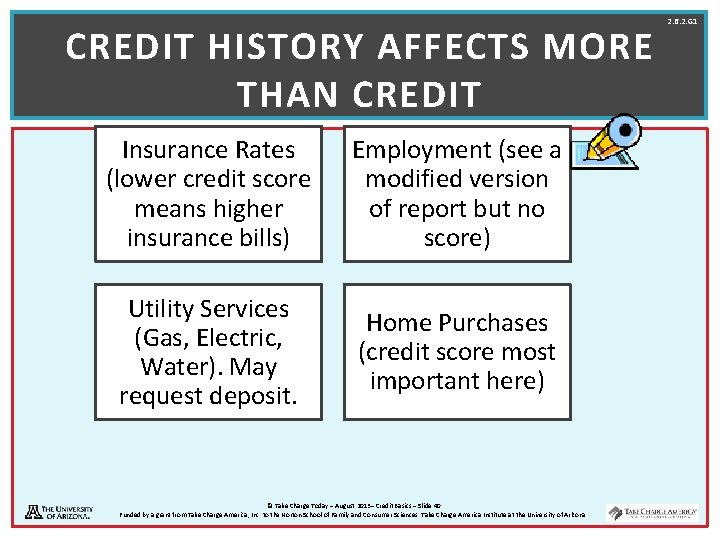
CREDIT HISTORY AFFECTS MORE THAN CREDIT Insurance Rates (lower credit score means higher insurance bills) Employment (see a modified version of report but no score) Utility Services (Gas, Electric, Water). May request deposit. Home Purchases (credit score most important here) © Take Charge Today – August 2013– Credit Basics – Slide 40 Funded by a grant from Take Charge America, Inc. to the Norton School of Family and Consumer Sciences Take Charge America Institute at the University of Arizona 2. 6. 2. G 1
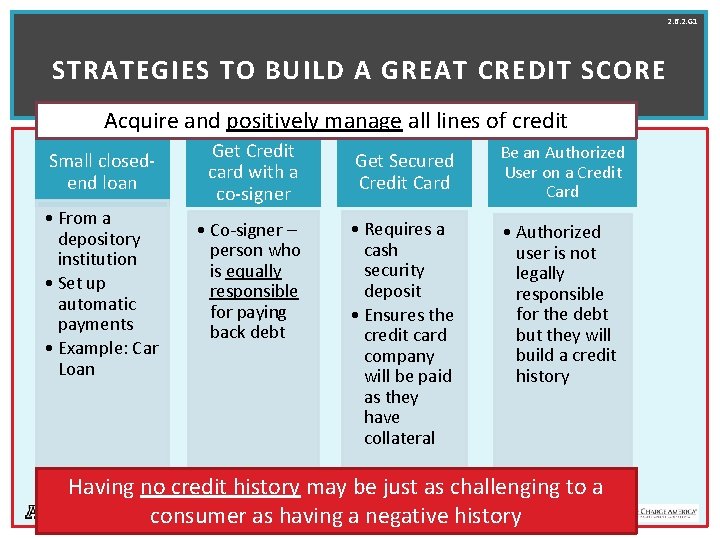
2. 6. 2. G 1 STRATEGIES TO BUILD A GREAT CREDIT SCORE Acquire and positively manage all lines of credit Small closedend loan • From a depository institution • Set up automatic payments • Example: Car Loan Get Credit card with a co-signer • Co-signer – person who is equally responsible for paying back debt Get Secured Credit Card Be an Authorized User on a Credit Card • Requires a cash security deposit • Ensures the credit card company will be paid as they have collateral • Authorized user is not legally responsible for the debt but they will build a credit history Having no credit history may be just as challenging to a consumer as having a negative history © Take Charge Today – August 2013– Credit Basics – Slide 41 Funded by a grant from Take Charge America, Inc. to the Norton School of Family and Consumer Sciences Take Charge America Institute at the University of Arizona
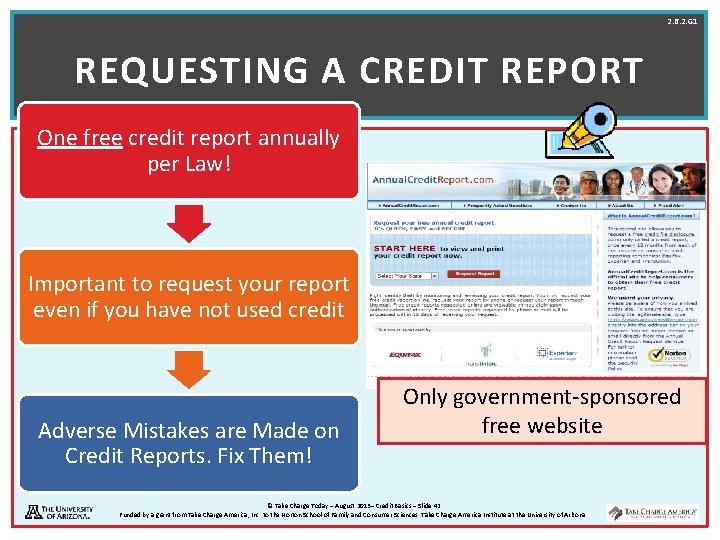
2. 6. 2. G 1 REQUESTING A CREDIT REPORT One free credit report annually per Law! Important to request your report even if you have not used credit Adverse Mistakes are Made on Credit Reports. Fix Them! Only government-sponsored free website © Take Charge Today – August 2013– Credit Basics – Slide 42 Funded by a grant from Take Charge America, Inc. to the Norton School of Family and Consumer Sciences Take Charge America Institute at the University of Arizona
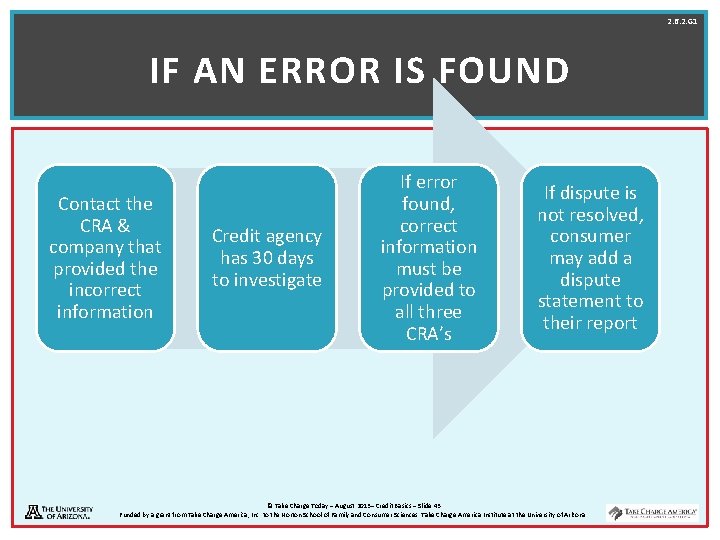
2. 6. 2. G 1 IF AN ERROR IS FOUND Contact the CRA & company that provided the incorrect information Credit agency has 30 days to investigate If error found, correct information must be provided to all three CRA’s If dispute is not resolved, consumer may add a dispute statement to their report © Take Charge Today – August 2013– Credit Basics – Slide 43 Funded by a grant from Take Charge America, Inc. to the Norton School of Family and Consumer Sciences Take Charge America Institute at the University of Arizona
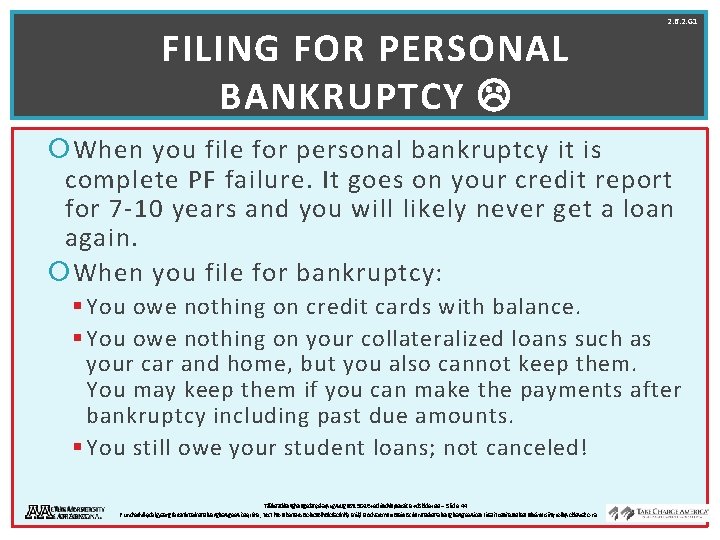
FILING FOR PERSONAL BANKRUPTCY 2. 6. 2. G 1 When you file for personal bankruptcy it is complete PF failure. It goes on your credit report for 7 -10 years and you will likely never get a loan again. When you file for bankruptcy: § You owe nothing on credit cards with balance. § You owe nothing on your collateralized loans such as your car and home, but you also cannot keep them. You may keep them if you can make the payments after bankruptcy including past due amounts. § You still owe your student loans; not canceled! Take Charge Today – August 2013 © Take Charge Today – August 2013– Credit Basics – Slide 44 – Credit Reports and Scores– Slide 44 Funded by a grant from Take Charge America, Inc. to the Norton School of Family and Consumer Sciences Take Charge America Institute at the University of Arizona
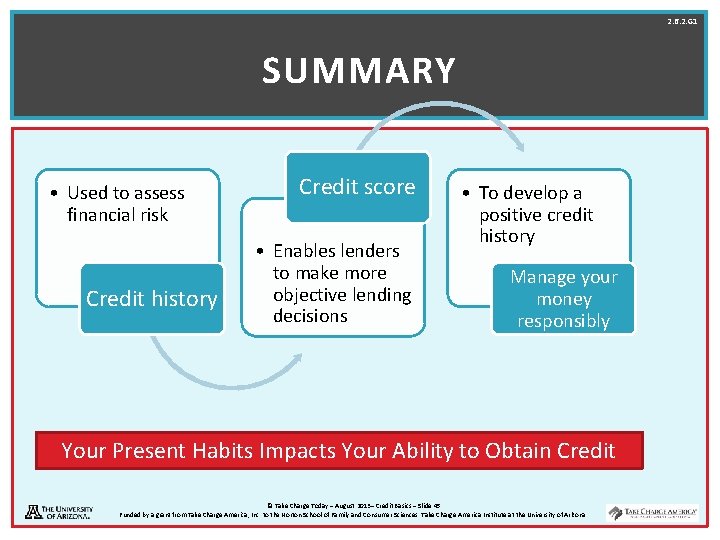
2. 6. 2. G 1 SUMMARY • Used to assess financial risk Credit history Credit score • Enables lenders to make more objective lending decisions • To develop a positive credit history Manage your money responsibly Your Present Habits Impacts Your Ability to Obtain Credit © Take Charge Today – August 2013– Credit Basics – Slide 45 Funded by a grant from Take Charge America, Inc. to the Norton School of Family and Consumer Sciences Take Charge America Institute at the University of Arizona
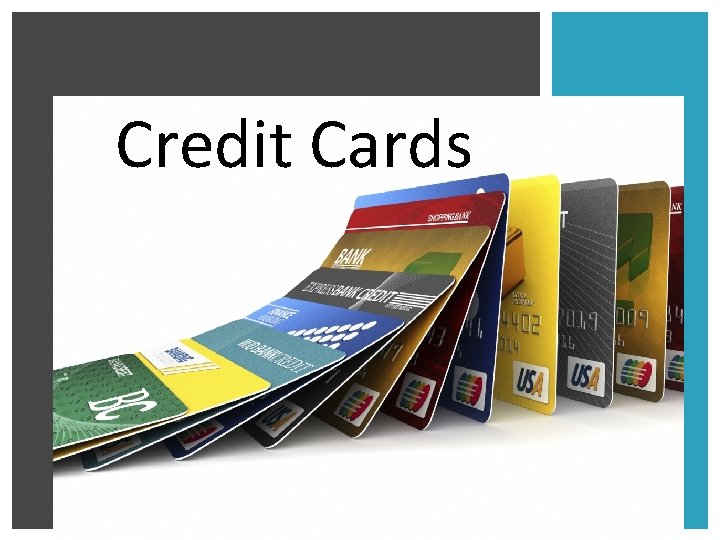
Credit Cards
2. 6. 2. G 1 CREDIT CARDS: A NECESSARY TOOL FOR BUILDING A SOLID CREDIT RATING! What is a credit card? Who can get a credit card and how? The key features of a credit card. What happens if you lose a credit card? How to read a credit card statement © Take Charge Today – August 2013– Credit Basics – Slide 47 Funded by a grant from Take Charge America, Inc. to the Norton School of Family and Consumer Sciences Take Charge America Institute at the University of Arizona
2. 6. 2. G 1 WHAT IS A CREDIT CARD? A credit card is a plastic card used to buy goods & services by accessing a line of credit with a limit that has been established in advance by the bank named on your credit card. The cost of a credit card is expressed as interest on unpaid balances and/or annual fees. § Interest rates on credit cards are very high if the balance is not paid in full by due date. § A typical interest rate charged on any balance not paid in full is 12%. You can buy a home with a loan at only 4. 5%! Pay your credit card balance off in full! © Take Charge Today – August 2013– Credit Basics – Slide 48 Funded by a grant from Take Charge America, Inc. to the Norton School of Family and Consumer Sciences Take Charge America Institute at the University of Arizona
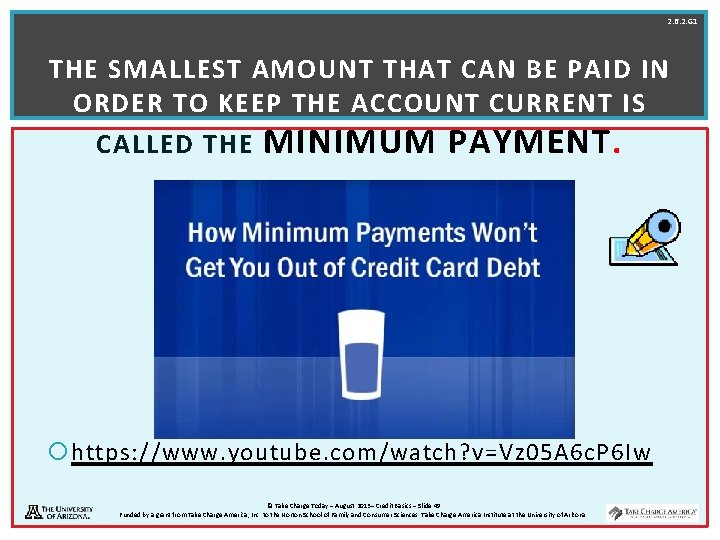
2. 6. 2. G 1 THE SMALLEST AMOUNT THAT CAN BE PAID IN ORDER TO KEEP THE ACCOUNT CURRENT IS CALLED THE MINIMUM PAYMENT. https: //www. youtube. com/watch? v=Vz 05 A 6 c. P 6 Iw © Take Charge Today – August 2013– Credit Basics – Slide 49 Funded by a grant from Take Charge America, Inc. to the Norton School of Family and Consumer Sciences Take Charge America Institute at the University of Arizona
WHO CAN GET A CREDIT CARD? Over 21 - credit history and proof of sufficient income to make payments Under 21 - by law, must have a co-signer and have proof of sufficient income to make payments A Pre-approved credit card application- means that a person has passed the initial credit check with a “soft” inquiry that does not hurt your credit score. . © Take Charge Today – August 2013– Credit Basics – Slide 50 Funded by a grant from Take Charge America, Inc. to the Norton School of Family and Consumer Sciences Take Charge America Institute at the University of Arizona 2. 6. 2. G 1
CREDIT CARD FEATURES 2. 6. 2. G 1 ) Annual Percentage Rate “APR” The cost of credit expressed as a yearly interest rate Pay your balance off in full by due date to escape interest charges! © Take Charge Today – August 2013– Credit Basics – Slide 51 Funded by a grant from Take Charge America, Inc. to the Norton School of Family and Consumer Sciences Take Charge America Institute at the University of Arizona
2. 6. 2. G 1 CREDIT CARD FEATURES Cash Advance (Credit Cards can be used at any ATM for Cash) But: Interest charged from day of advance (Don’t do it!) © Take Charge Today – August 2013– Credit Basics – Slide 52 Funded by a grant from Take Charge America, Inc. to the Norton School of Family and Consumer Sciences Take Charge America Institute at the University of Arizona
2. 6. 2. G 1 CREDIT CARD FEATURES Balance Transfer Rate (fee for transferring balance from a card; usually a % of balance) Happens when a person switches balance from one card to another © Take Charge Today – August 2013– Credit Basics – Slide 53 Funded by a grant from Take Charge America, Inc. to the Norton School of Family and Consumer Sciences Take Charge America Institute at the University of Arizona
2. 6. 2. G 1 CREDIT CARD FEATURES “Introductory Rate” A lower interest rate for a set period of time, afterward it increases to a predetermined rate © Take Charge Today – August 2013– Credit Basics – Slide 54 Funded by a grant from Take Charge America, Inc. to the Norton School of Family and Consumer Sciences Take Charge America Institute at the University of Arizona
2. 6. 2. G 1 CREDIT CARD FEATURES Annual Fee-yearly fee that may be charged for having a credit card. Aim to get a card with no annual fee ($75 -$100) unless the rewards on the card justify it. Discuss my AMEX Blue-Cash Card. Late Fee- charged when a cardholder does not make the minimum monthly payment by the due date. Over the Limit Fee- charged if the account balance goes over the set credit limit © Take Charge Today – August 2013– Credit Basics – Slide 55 Funded by a grant from Take Charge America, Inc. to the Norton School of Family and Consumer Sciences Take Charge America Institute at the University of Arizona
2. 6. 2. G 1 CREDIT CARD PENALTY APRS Penalty APRs (raising your interest rate from current APR) § Your interest rate (APR) may be raised if either of these occur: § You are 60 days past due in a payment. You are current if you make the minimum payment even though not a good idea. § You have made purchases that exceed your credit limit. © Take Charge Today – August 2013– Credit Basics – Slide 56 Funded by a grant from Take Charge America, Inc. to the Norton School of Family and Consumer Sciences Take Charge America Institute at the University of Arizona
2. 6. 2. G 1 CREDIT CARD FEATURES Grace Period-The credit-card issuer may allow a certain number of days to pay your balance in full past the due date before tacking on the interest charges. Many cards have no grace period. © Take Charge Today – August 2013– Credit Basics – Slide 57 Funded by a grant from Take Charge America, Inc. to the Norton School of Family and Consumer Sciences Take Charge America Institute at the University of Arizona
2. 6. 2. G 1 CREDIT CARD FEATURES Rewards (Make Money / Save Money) § Frequent flyer miles § Discounts on cars and other products § Warranties for items purchased § Travel insurance § Cash rebates (This is what I elect) Do the rewards outweigh the costs? Most always; yes! Rewards, safety, and building up your credit history are the benefits; mismanaging your money and hurting your credit rating are the risks!. © Take Charge Today – August 2013– Credit Basics – Slide 58 Funded by a grant from Take Charge America, Inc. to the Norton School of Family and Consumer Sciences Take Charge America Institute at the University of Arizona
LOST CARDS Report lost or stolen cards IMMEDIATELY! How much are you liable for? • $0 if reported before it is fraudulently used • $0 if just your card number is stolen • $50 if it is used without authorization but reported within 2 days • Higher amounts if not reported within 2 days
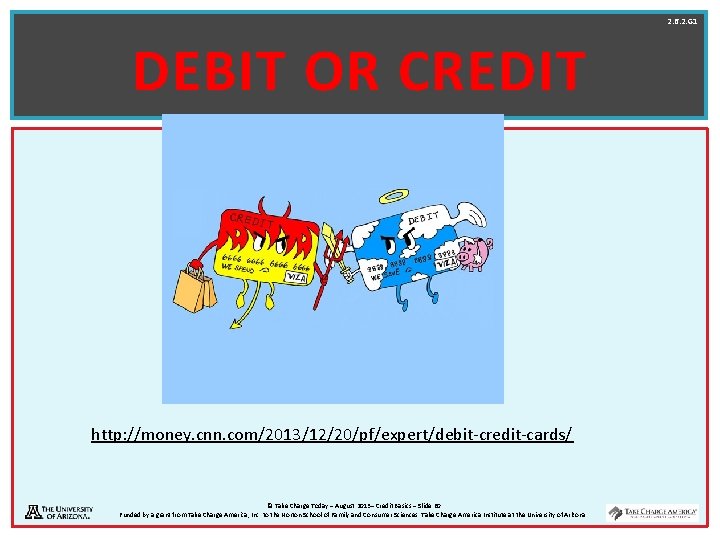
2. 6. 2. G 1 DEBIT OR CREDIT http: //money. cnn. com/2013/12/20/pf/expert/debit-credit-cards/ © Take Charge Today – August 2013– Credit Basics – Slide 60 Funded by a grant from Take Charge America, Inc. to the Norton School of Family and Consumer Sciences Take Charge America Institute at the University of Arizona
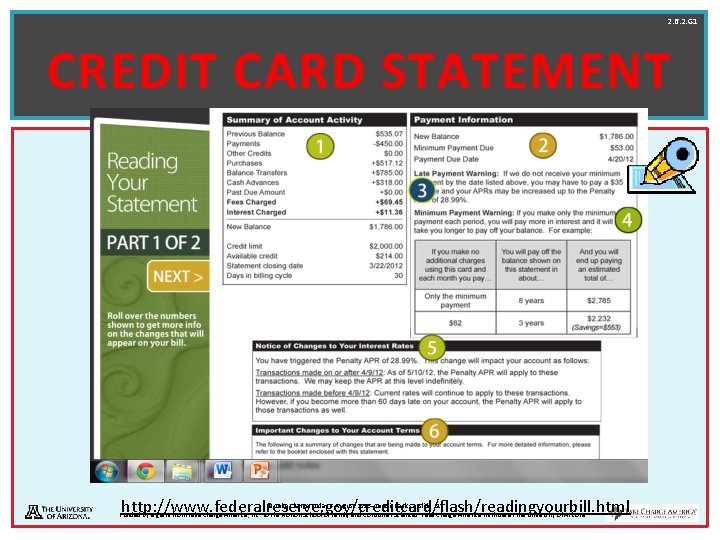
2. 6. 2. G 1 CREDIT CARD STATEMENT http: //www. federalreserve. gov/creditcard/flash/readingyourbill. html © Take Charge Today – August 2013– Credit Basics – Slide 61 Funded by a grant from Take Charge America, Inc. to the Norton School of Family and Consumer Sciences Take Charge America Institute at the University of Arizona
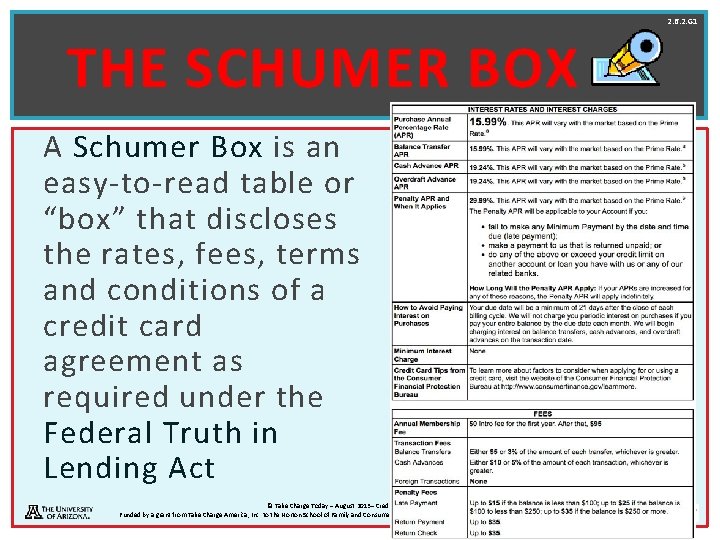
2. 6. 2. G 1 THE SCHUMER BOX A Schumer Box is an easy-to-read table or “box” that discloses the rates, fees, terms and conditions of a credit card agreement as required under the Federal Truth in Lending Act © Take Charge Today – August 2013– Credit Basics – Slide 62 Funded by a grant from Take Charge America, Inc. to the Norton School of Family and Consumer Sciences Take Charge America Institute at the University of Arizona
2. 6. 2. G 1 REAL LIFE STORY https: //www. youtube. com/watch? v=7 U 6 pmk. TC 8 i 0 © Take Charge Today – August 2013– Credit Basics – Slide 63 Funded by a grant from Take Charge America, Inc. to the Norton School of Family and Consumer Sciences Take Charge America Institute at the University of Arizona
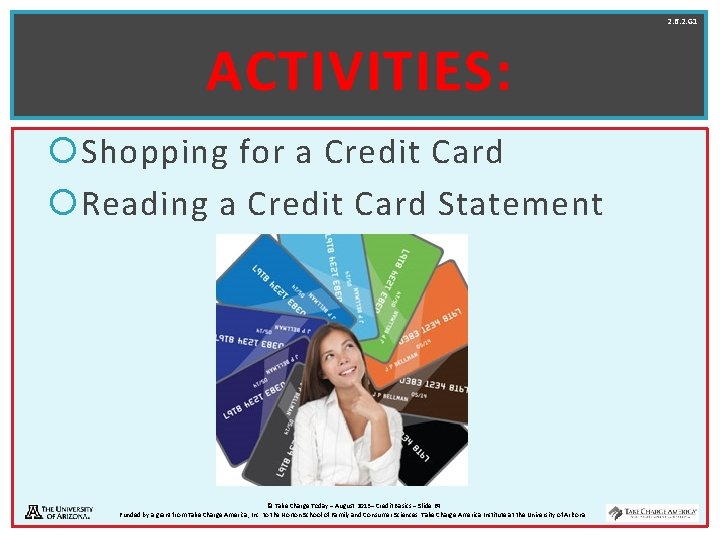
2. 6. 2. G 1 ACTIVITIES: Shopping for a Credit Card Reading a Credit Card Statement © Take Charge Today – August 2013– Credit Basics – Slide 64 Funded by a grant from Take Charge America, Inc. to the Norton School of Family and Consumer Sciences Take Charge America Institute at the University of Arizona
- Slides: 64