
Credit Basics Consumers Math Three Cs of Credit
Credit Basics Consumers Math
Three Cs of Credit • Character-the way you handle your money and have repaid debt in the past. • Capacity-your ability to pay the debt after monthly expense • Capital-the value of your assets
Things to Consider when Shopping for a Credit Card • • Annual Fee APR Grace Period Transaction Fees ATM access Credit Limit Credit Advance Penalties
Annual Fee • Flat dollar amount issuer charges each year for the use of the credit card • Do not want to have this fee but cards with no annual fee have higher interest rates • Not the same thing as APR
Finance Charge • Interest Rate your card issuer charges • Main cost of using credit • Bad credit or no credit results in higher interest rates because it reduces card issuers risk-higher the debt the faster it will grow and the harder it will be to pay it off
Minimum Payments • Minimum amount of money you have to pay each month • Credit card issuers make payments low, not as a favor to you, but to maximize profit • Usually it is 2% of the balance including interest
Minimum Payments Continued • $2500 debt (. 02) = $50 minimum payment. It will take you 28 years to pay off debt if you only pay the minimum each month • 18% finance charge/12 months=1. 5% $2500(. 015)=$37. 50 in interest each month *Pay $5896 in interest in 28 years so an item costing $2500 will item will actually cost $8396 • $50 -37. 50=$12. 50 only that much is going to pay off your debt each month
Grace Period • The time between the date you are billed and the date your payment is due • Usually 25 days • If you pay your entire balance within the grace period no interest charges • If you carry a balance and do not have a grace period, interest incurs right away
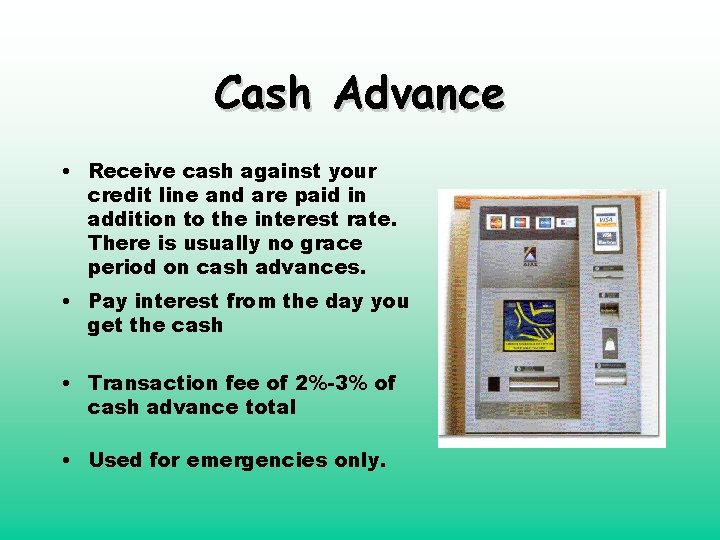
Cash Advance • Receive cash against your credit line and are paid in addition to the interest rate. There is usually no grace period on cash advances. • Pay interest from the day you get the cash • Transaction fee of 2%-3% of cash advance total • Used for emergencies only.
Late Fee • Penalty assessed if your monthly payment is made after the due date or Grace Period. • Depends on the credit issuer. • Usually between $20$40
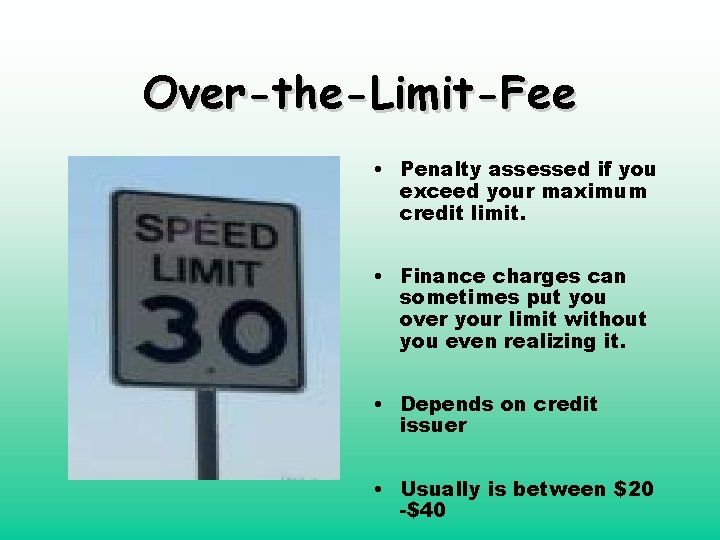
Over-the-Limit-Fee • Penalty assessed if you exceed your maximum credit limit. • Finance charges can sometimes put you over your limit without you even realizing it. • Depends on credit issuer • Usually is between $20 -$40
Types of Credit • Open – Retail – Service • Closed – Installment

Attributes of Revolving or Open Credit • Flexible payment • Minimum payment • APR can be adjusted by creditor • Credit limit • Finance charge • Transaction fees
Attributes of Installment or Closed Credit • • Contract Down payment Finance charge Fixed monthly payment • Acceleration clause • Balloon payment
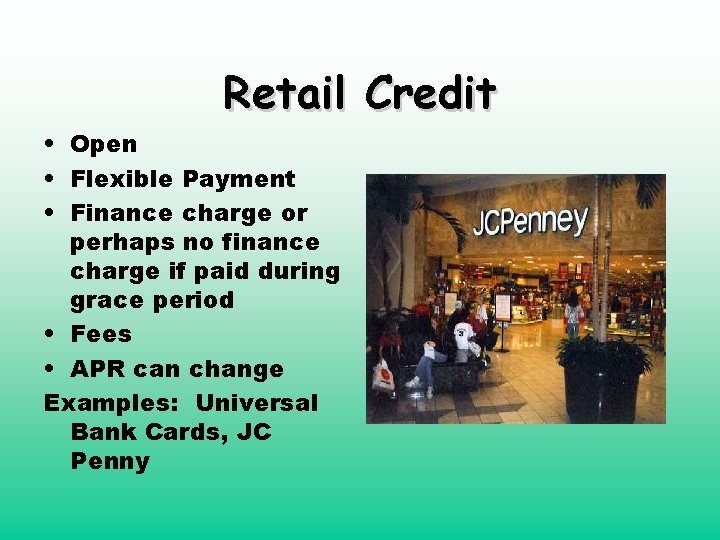
Retail Credit • Open • Flexible Payment • Finance charge or perhaps no finance charge if paid during grace period • Fees • APR can change Examples: Universal Bank Cards, JC Penny
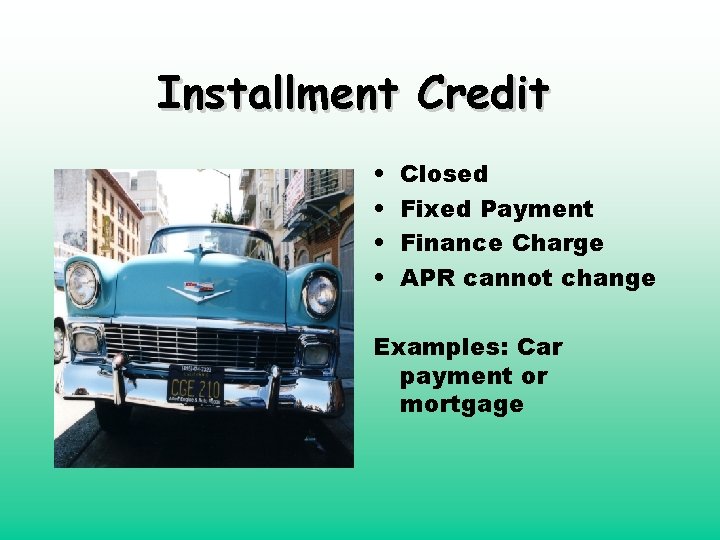
Installment Credit • • Closed Fixed Payment Finance Charge APR cannot change Examples: Car payment or mortgage
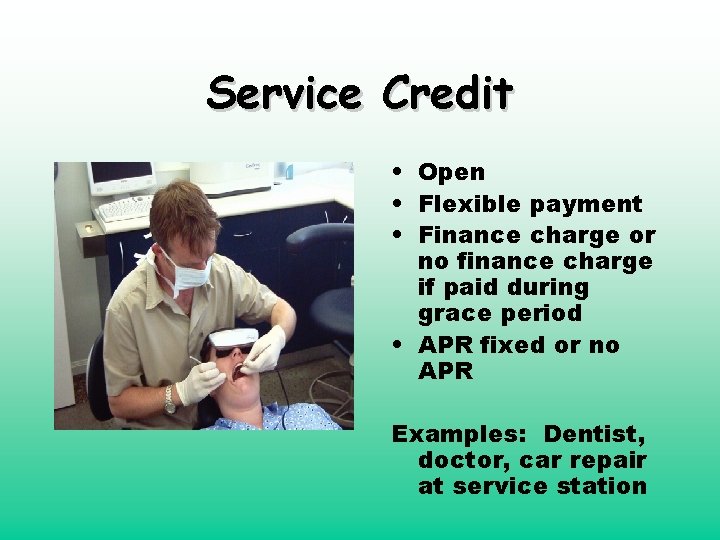
Service Credit • Open • Flexible payment • Finance charge or no finance charge if paid during grace period • APR fixed or no APR Examples: Dentist, doctor, car repair at service station
Advantages of Using Credit • Limited liability • Convenience • Rebates or special programs • Increased purchasing power • Free use of someone’s money for grace period • Emergencies
Disadvantages of Using Credit • Overspending • Finance charges = increased cost • Opportunity cost • Obligates future income
- Slides: 19