
Credibility of confidence intervals Dean Karlen Carleton University
Credibility of confidence intervals Dean Karlen / Carleton University Advanced Statistical Techniques in Particle Physics Durham, March 2002 Dean Karlen / Carleton University
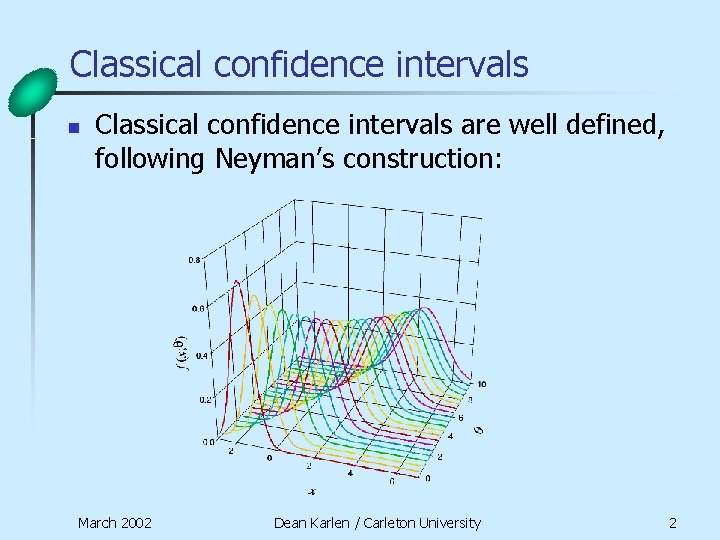
Classical confidence intervals n Classical confidence intervals are well defined, following Neyman’s construction: March 2002 Dean Karlen / Carleton University 2
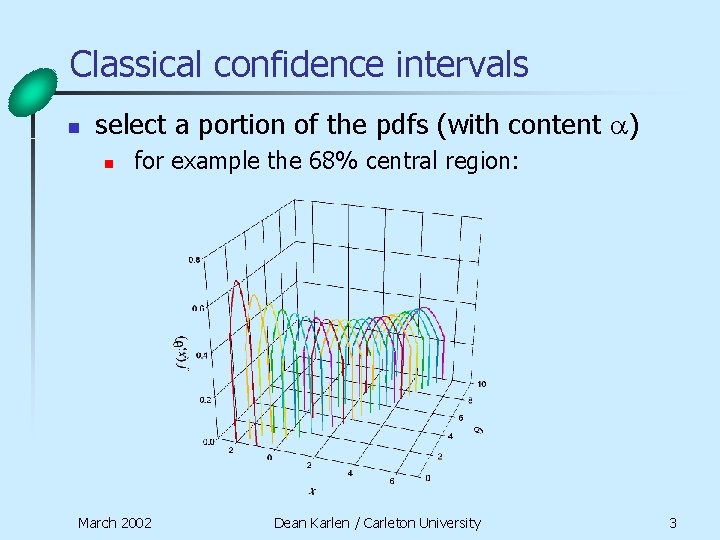
Classical confidence intervals n select a portion of the pdfs (with content a) n for example the 68% central region: March 2002 Dean Karlen / Carleton University 3
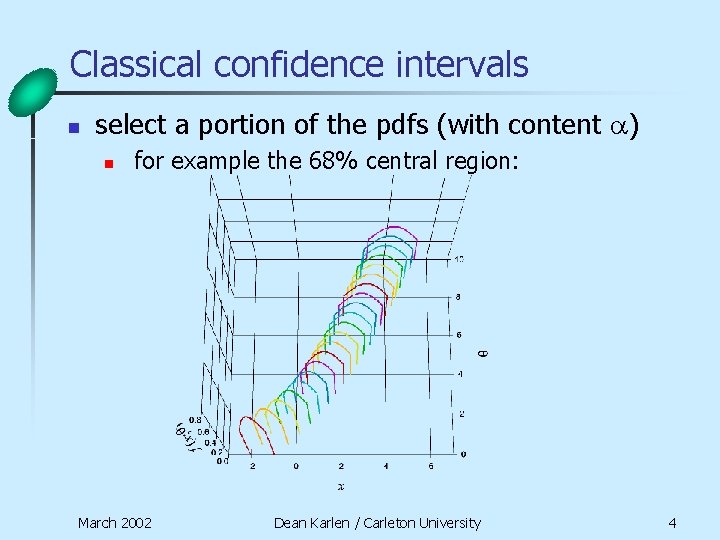
Classical confidence intervals n select a portion of the pdfs (with content a) n for example the 68% central region: March 2002 Dean Karlen / Carleton University 4
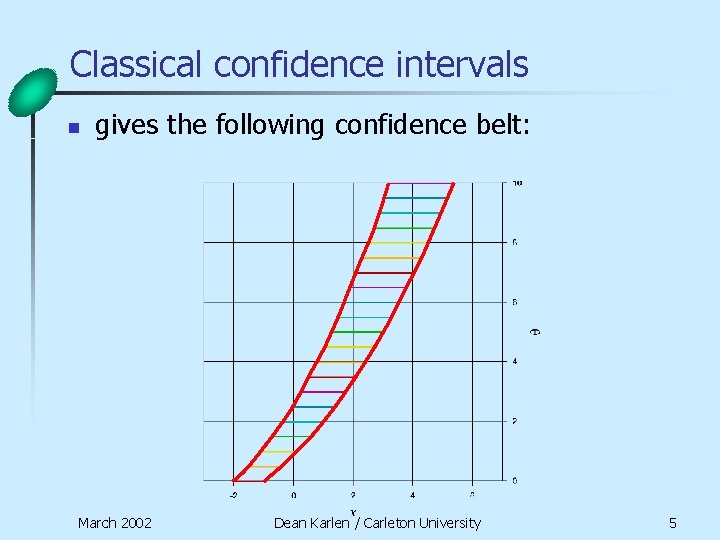
Classical confidence intervals n gives the following confidence belt: March 2002 Dean Karlen / Carleton University 5
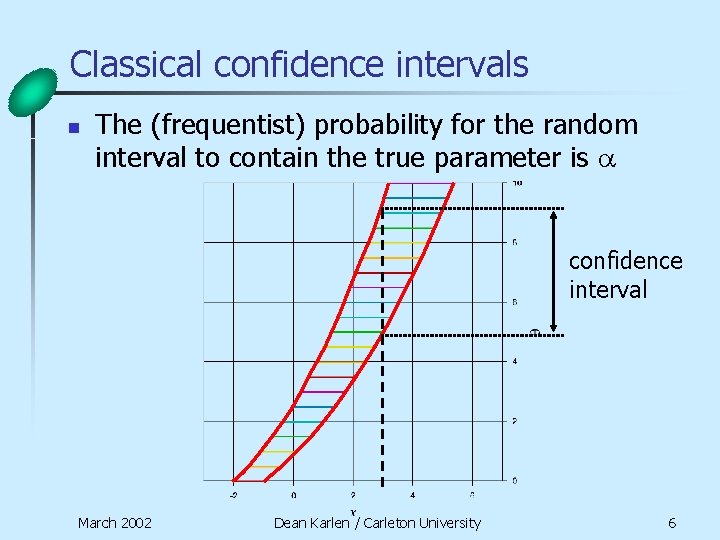
Classical confidence intervals n The (frequentist) probability for the random interval to contain the true parameter is a confidence interval March 2002 Dean Karlen / Carleton University 6
Problems with confidence intervals n Misinterpretation is common, by general public and scientists alike… n n n Incorrect: a states a “degree of belief” that the true value of the parameter is within the stated interval Correct: a states the “relative frequency” that the random interval contains the true parameter value Popular press gets it wrong more often than not n March 2002 “The probability that the Standard Model can explain the data is less than 1%. ” Dean Karlen / Carleton University 7
Problems with confidence intervals n People are justifiably concerned and confused when confidence intervals n n are empty; or reduce in size when background estimate increases (especially when n=0); or turn out to be smaller for the poorer of two experiments; or exclude parameters for which an experiment is insensitive “confidence interval pathologies” March 2002 Dean Karlen / Carleton University 8
Source of confusion n The two definitions of probability in common use go by the same n n n n Both definitions have merit Situation would be clearer if there were different names for the two concepts n n relative frequency: probability degree of belief: probability proposal to introduce new names is way too radical Instead, treat this as an education problem n make it better known that two definitions exist March 2002 Dean Karlen / Carleton University 9
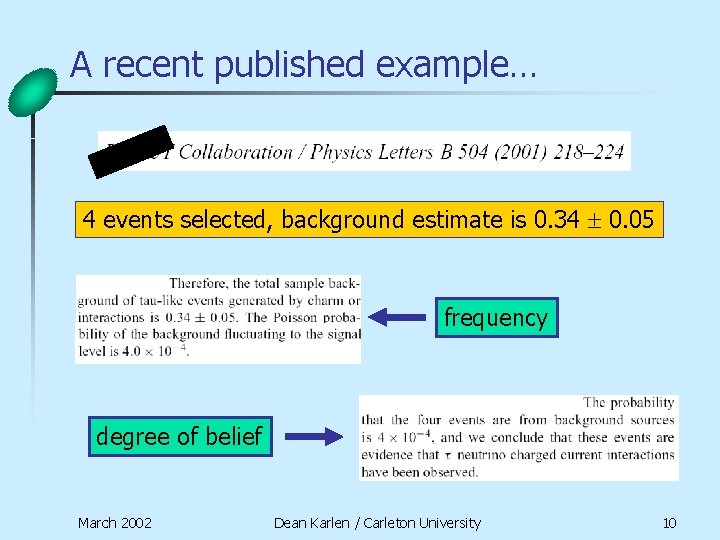
A recent published example… 4 events selected, background estimate is 0. 34 0. 05 frequency degree of belief March 2002 Dean Karlen / Carleton University 10
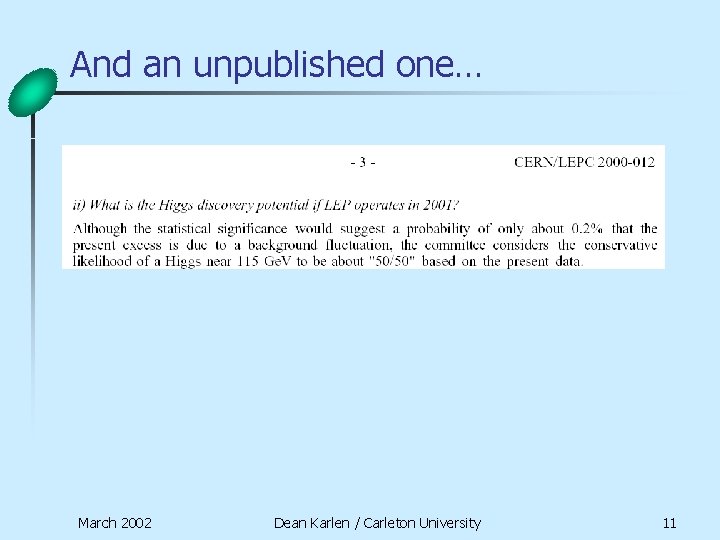
And an unpublished one… March 2002 Dean Karlen / Carleton University 11
Problems with confidence intervals n Even those who understand the distinction find the “confidence interval pathologies” unsettling n n Much effort devoted to define approaches that reduce the frequency of their occurrence These cases are unsettling for the same reason: The degree of belief that these particular intervals contain the true value of the parameter is significantly less than the confidence level n furthermore, there is no standard method for quantifying the pathology March 2002 Dean Karlen / Carleton University 12
Problems with confidence intervals n The confidence interval alone is not enough to n n n define an interval with stated coverage; and express a degree of belief that the parameter is contained in the interval F. – C. recommend that experiments provide a second quantity: sensitivity n n defined as the average limit for the experiment consumer’s degree of belief would be reduced if observed limit is far superior to average limit March 2002 Dean Karlen / Carleton University 13
Problems with sensitivity n Sensitivity is not enough – need more information to compare with observed limit n n variance of limit from ensemble of experiments? Use (Sensitivity – observed limit)/s ? n not a good indicator that interval is “pathological” March 2002 Dean Karlen / Carleton University 14
Problems with sensitivity n Example: mnt analysis n t 3 prong events contribute with different weight depending on: n n mass resolution for event nearness of event to mnt = 0 boundary ALEPH observes one clean event very near boundary Limit is much better than average Any reason to reduce degree of belief that the true mass is in the stated interval? NO! March 2002 Dean Karlen / Carleton University 15
Proposal n When quoting a confidence interval for a frontier experiment, also quote its credibility n Evaluate the degree of belief that the true parameter is contained in the stated interval n n n Use Bayes thereom with a reasonable prior n recommend: flat in physically allowed region call this the “credibility” report credibility (and prior) in journal paper n March 2002 if credibility is much less than confidence level, consumer would be warned that the interval may be “pathological” Dean Karlen / Carleton University 16
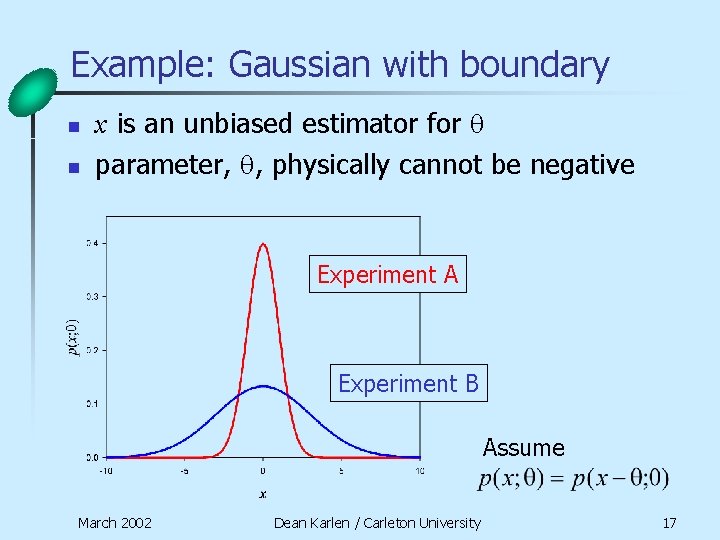
Example: Gaussian with boundary n n x is an unbiased estimator for q parameter, q, physically cannot be negative Experiment A Experiment B Assume March 2002 Dean Karlen / Carleton University 17
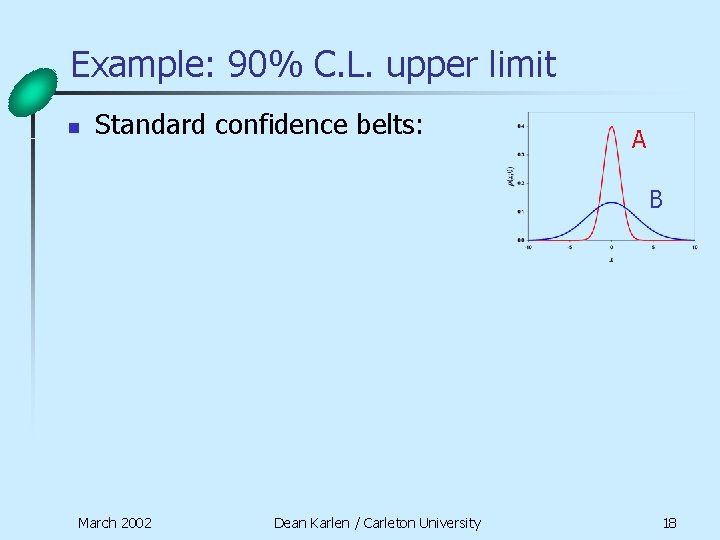
Example: 90% C. L. upper limit n Standard confidence belts: A B March 2002 Dean Karlen / Carleton University 18
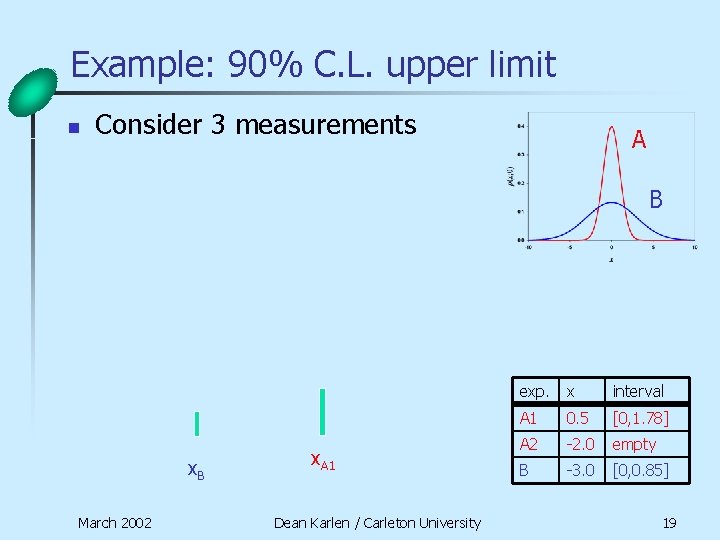
Example: 90% C. L. upper limit n Consider 3 measurements A B x. B March 2002 x. A 1 Dean Karlen / Carleton University exp. x interval A 1 0. 5 [0, 1. 78] A 2 -2. 0 empty B -3. 0 [0, 0. 85] 19
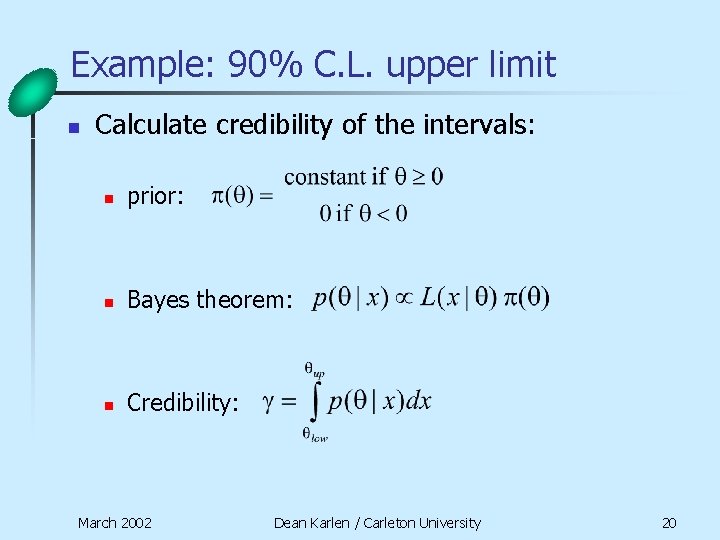
Example: 90% C. L. upper limit n Calculate credibility of the intervals: n prior: n Bayes theorem: n Credibility: March 2002 Dean Karlen / Carleton University 20
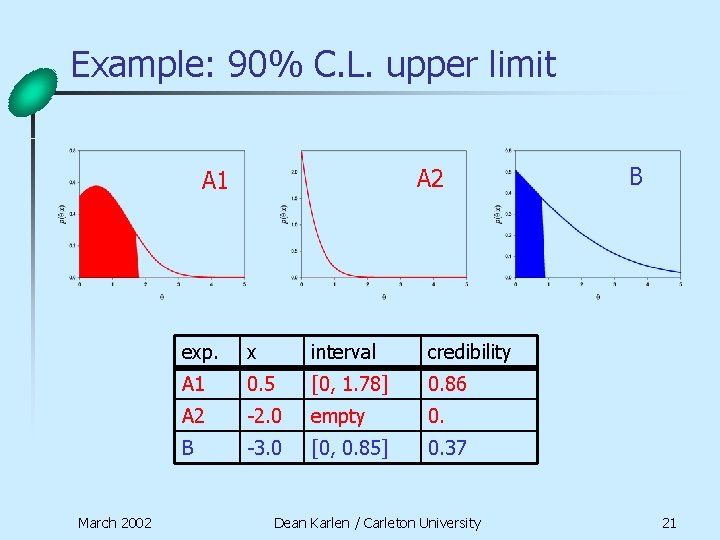
Example: 90% C. L. upper limit A 2 A 1 March 2002 exp. x interval credibility A 1 0. 5 [0, 1. 78] 0. 86 A 2 -2. 0 empty 0. B -3. 0 [0, 0. 85] 0. 37 Dean Karlen / Carleton University B 21
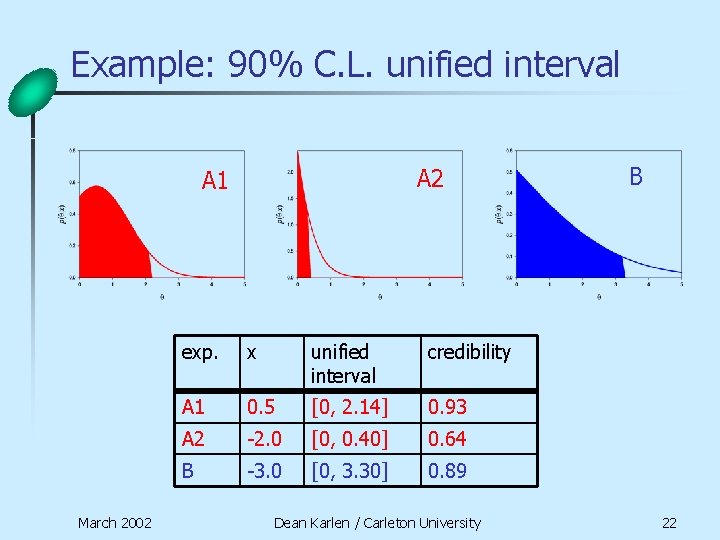
Example: 90% C. L. unified interval A 2 A 1 March 2002 exp. x unified interval credibility A 1 0. 5 [0, 2. 14] 0. 93 A 2 -2. 0 [0, 0. 40] 0. 64 B -3. 0 [0, 3. 30] 0. 89 Dean Karlen / Carleton University B 22
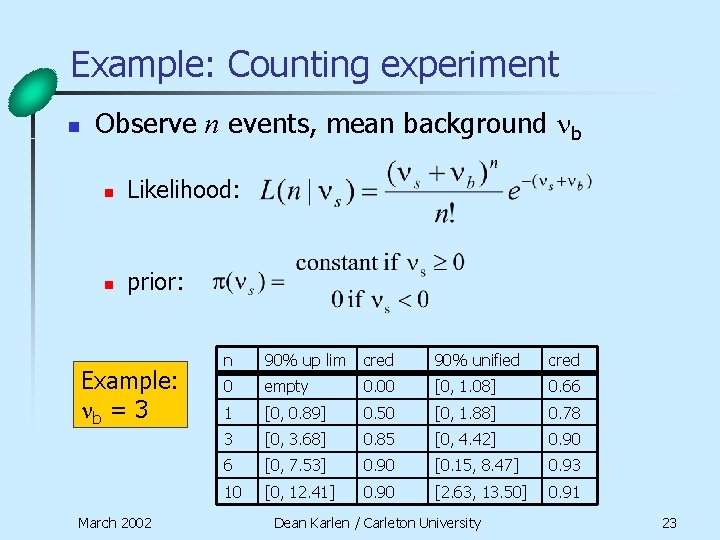
Example: Counting experiment n Observe n events, mean background nb n Likelihood: n prior: Example: nb = 3 March 2002 n 90% up lim cred 90% unified cred 0 empty 0. 00 [0, 1. 08] 0. 66 1 [0, 0. 89] 0. 50 [0, 1. 88] 0. 78 3 [0, 3. 68] 0. 85 [0, 4. 42] 0. 90 6 [0, 7. 53] 0. 90 [0. 15, 8. 47] 0. 93 10 [0, 12. 41] 0. 90 [2. 63, 13. 50] 0. 91 Dean Karlen / Carleton University 23
Key benefit of the proposal n n Without proposal: experiments can report an overly small (pathological) interval without informing the consumer of the potential problem. With proposal: Consumer can distinguish credible from incredible intervals. March 2002 Dean Karlen / Carleton University 24
Other benefits of the proposal n Education: n n n two different probabilities calculated – brings the distinction of coverage and credibility to the attention of physicists empty confidence intervals are assigned no credibility experiments with no observed events will be awarded for reducing their background (previously penalized) intervals “too small” (or exclusion of parameters beyond sensitivity) are assigned small credibility better than average limits not assigned small credibility if due to existence of rare, high precision events (mnt) March 2002 Dean Karlen / Carleton University 25
Other benefits of the proposal n Bayesian concept applied in a way that may be easy to accept even by devout frequentists: n n choice of uniform prior appears to work well does not “mix” Bayesian and frequentist methods does not modify coverage Experimenters will naturally choose frequentist methods that are less likely to result in a poor degree of belief. n “Do you want to risk getting an incredible limit? ” March 2002 Dean Karlen / Carleton University 26
Summary n Confidence intervals are well defined, but n n n are frequently misinterpreted can suffer from pathological problems when physical boundaries are present Propose that experiments quote credibility: n n n quantify possible pathology reminder of two definitions of probabilities encourages the use of methods for confidence interval construction that avoid pathologies March 2002 Dean Karlen / Carleton University 27
- Slides: 27