
Creativity Problem posing Observing nature Focused meditation Role
Creativity Ø Ø Ø Problem posing Observing nature Focused meditation Role playing Free writing Journal writing Whitmore/Stevenson: Strategies for Engineering Communication
Problem Posing Ø Observe how existing industrial, commercial, or consumer products and systems work. Ø Analyze the purpose of existing products or systems with an eye to finding inefficiencies or problems. Ø Analyze the nature of the problem by considering whether solving the problem is physically possible. Ø Determine how best to improve the product or how to resolve or restate the problem. Ø Consider how to develop and market the product. Whitmore/Stevenson: Strategies for Engineering Communication
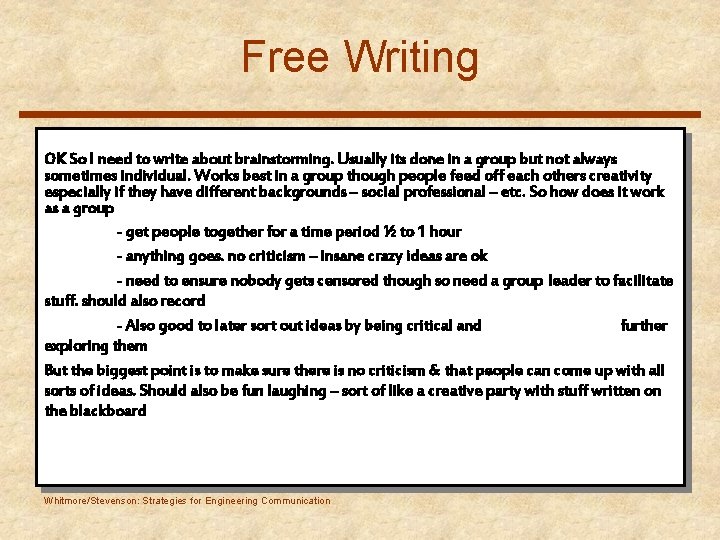
Free Writing OK So I need to write about brainstorming. Usually its done in a group but not always sometimes individual. Works best in a group though people feed off each others creativity especially if they have different backgrounds – social professional – etc. So how does it work as a group - get people together for a time period ½ to 1 hour - anything goes. no criticism – insane crazy ideas are ok - need to ensure nobody gets censored though so need a group leader to facilitate stuff. should also record - Also good to later sort out ideas by being critical and further exploring them But the biggest point is to make sure there is no criticism & that people can come up with all sorts of ideas. Should also be fun laughing – sort of like a creative party with stuff written on the blackboard Whitmore/Stevenson: Strategies for Engineering Communication
Informal Journals Whitmore/Stevenson: Strategies for Engineering Communication
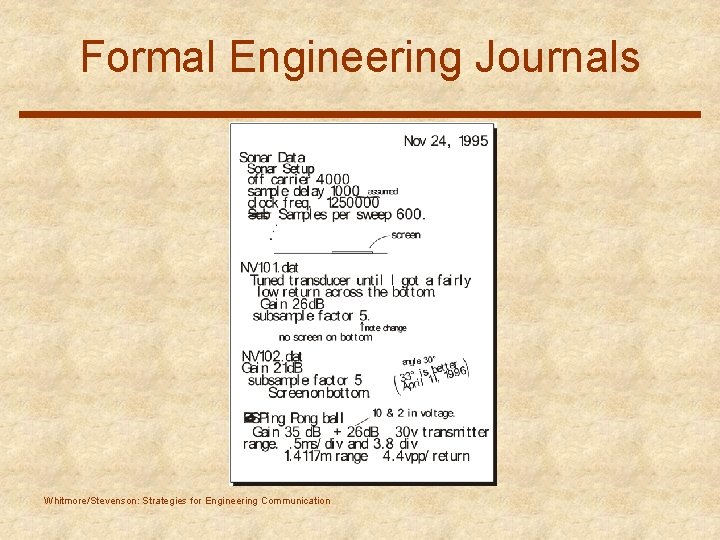
Formal Engineering Journals Whitmore/Stevenson: Strategies for Engineering Communication
Problem-Solving Heuristics Ø Ø Create analogies Generate contraries Synthesize ideas Ask questions Whitmore/Stevenson: Strategies for Engineering Communication
Create Analogies Ø Static (or particle) perspective Ø Dynamic (or wave) perspective Ø Relative (or field) perspective Whitmore/Stevenson: Strategies for Engineering Communication
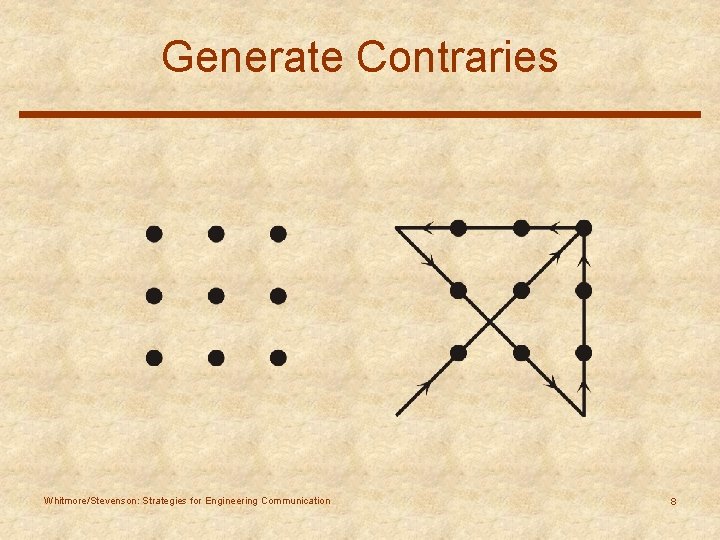
Generate Contraries Whitmore/Stevenson: Strategies for Engineering Communication 8
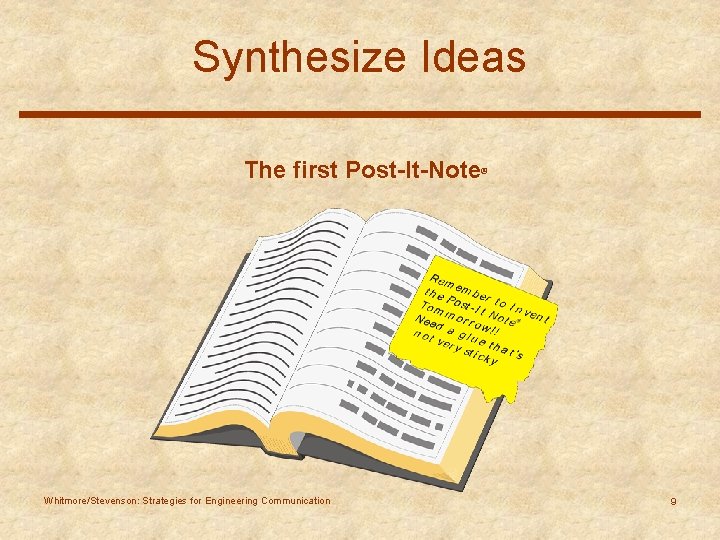
Synthesize Ideas The first Post-It-Note Whitmore/Stevenson: Strategies for Engineering Communication ® 9
Ask Questions Who Is My Audience? Ø Who will read this report? Technical experts? Administrators? Business people? Ø Why will they read it? What motivated them to request the report? What actions will they take on the basis of this report? Ø What information have they requested? Are their instructions clear or do they need clarification? Ø How well informed are they about the subject? How much background information is required? Are they familiar with technical terminology? Ø What information do they need? Do I have all the information needed to address their concerns? If not, what do I need to find out and how will I do so? Whitmore/Stevenson: Strategies for Engineering Communication
Ask Questions Ø Ø What Is My Purpose? What do I hope to accomplish by writing this report? Can I write a clear, concise statement of purpose? How do my goals relate to my reader’s expectations? Do they share my objectives? If not, what are the points of disagreement? How can I meet both my goals and my reader’s expectations? What do I know that they do not and how can I make them aware of it? What attitudes or values do they have that must be taken into account? Whitmore/Stevenson: Strategies for Engineering Communication
- Slides: 11