
Creativity Innovation Entrepreneurship What were they thinking If
- Slides: 54
Creativity Innovation Entrepreneurship What were they thinking? If opportunity doesn’t knock, build a door. – Milton Berle Think Outside Yourself
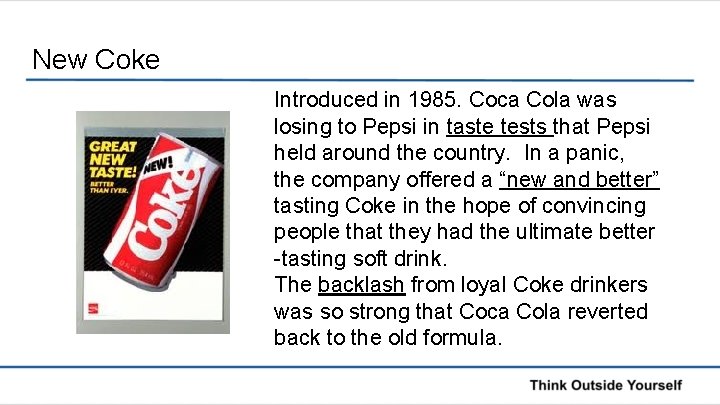
New Coke Introduced in 1985. Coca Cola was losing to Pepsi in taste tests that Pepsi held around the country. In a panic, the company offered a “new and better” tasting Coke in the hope of convincing people that they had the ultimate better -tasting soft drink. The backlash from loyal Coke drinkers was so strong that Coca Cola reverted back to the old formula.
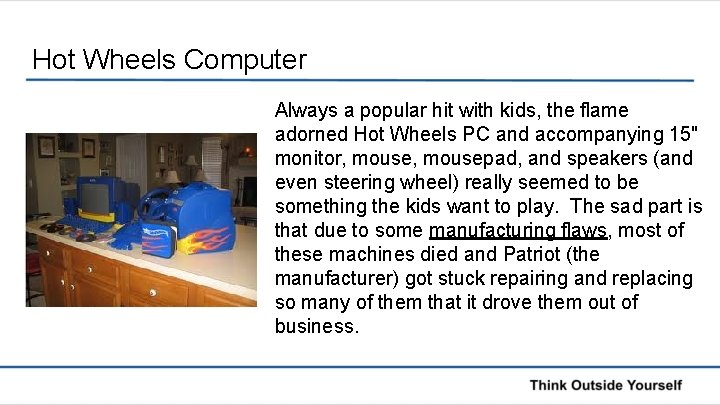
Hot Wheels Computer Always a popular hit with kids, the flame adorned Hot Wheels PC and accompanying 15" monitor, mousepad, and speakers (and even steering wheel) really seemed to be something the kids want to play. The sad part is that due to some manufacturing flaws, most of these machines died and Patriot (the manufacturer) got stuck repairing and replacing so many of them that it drove them out of business.
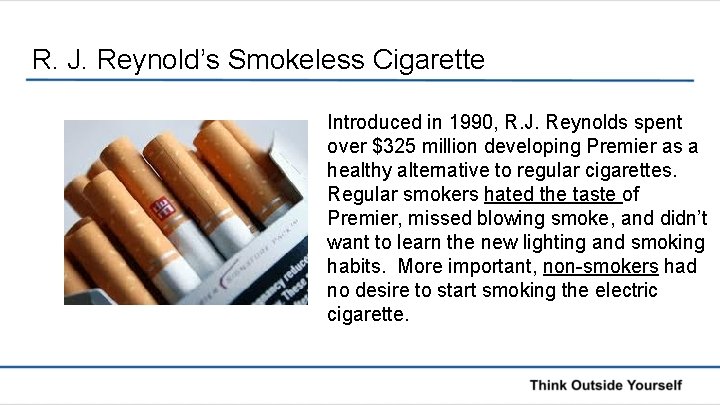
R. J. Reynold’s Smokeless Cigarette Introduced in 1990, R. J. Reynolds spent over $325 million developing Premier as a healthy alternative to regular cigarettes. Regular smokers hated the taste of Premier, missed blowing smoke, and didn’t want to learn the new lighting and smoking habits. More important, non-smokers had no desire to start smoking the electric cigarette.
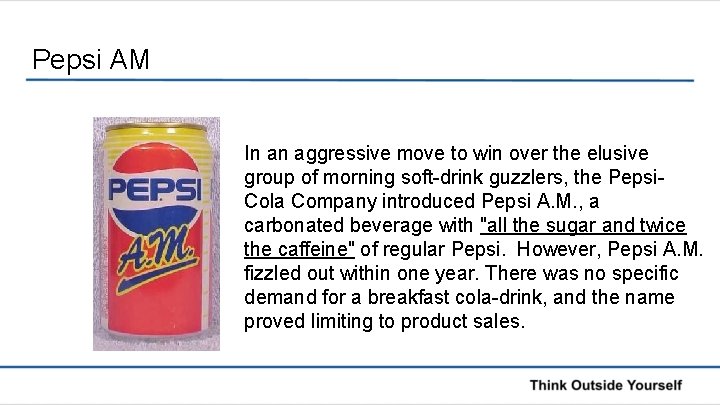
Pepsi AM In an aggressive move to win over the elusive group of morning soft-drink guzzlers, the Pepsi. Cola Company introduced Pepsi A. M. , a carbonated beverage with "all the sugar and twice the caffeine" of regular Pepsi. However, Pepsi A. M. fizzled out within one year. There was no specific demand for a breakfast cola-drink, and the name proved limiting to product sales.
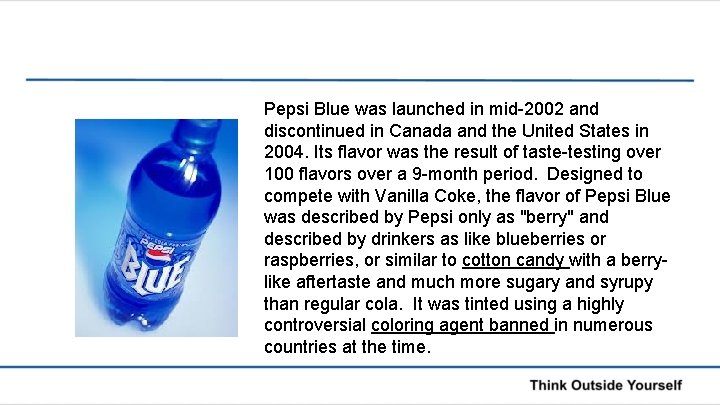
Pepsi Blue was launched in mid-2002 and discontinued in Canada and the United States in 2004. Its flavor was the result of taste-testing over 100 flavors over a 9 -month period. Designed to compete with Vanilla Coke, the flavor of Pepsi Blue was described by Pepsi only as "berry" and described by drinkers as like blueberries or raspberries, or similar to cotton candy with a berrylike aftertaste and much more sugary and syrupy than regular cola. It was tinted using a highly controversial coloring agent banned in numerous countries at the time.
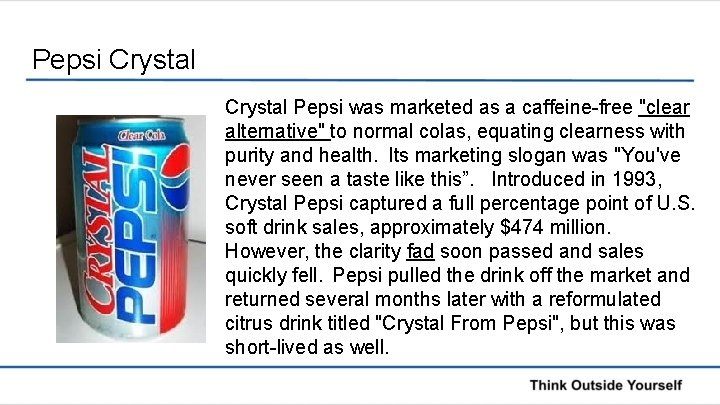
Pepsi Crystal Pepsi was marketed as a caffeine-free "clear alternative" to normal colas, equating clearness with purity and health. Its marketing slogan was "You've never seen a taste like this”. Introduced in 1993, Crystal Pepsi captured a full percentage point of U. S. soft drink sales, approximately $474 million. However, the clarity fad soon passed and sales quickly fell. Pepsi pulled the drink off the market and returned several months later with a reformulated citrus drink titled "Crystal From Pepsi", but this was short-lived as well.
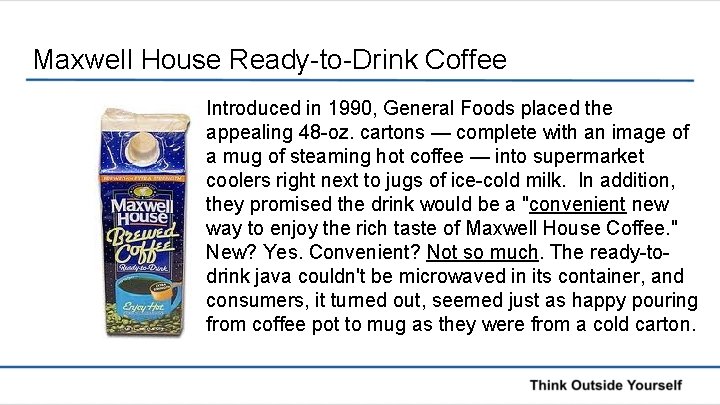
Maxwell House Ready-to-Drink Coffee Introduced in 1990, General Foods placed the appealing 48 -oz. cartons — complete with an image of a mug of steaming hot coffee — into supermarket coolers right next to jugs of ice-cold milk. In addition, they promised the drink would be a "convenient new way to enjoy the rich taste of Maxwell House Coffee. " New? Yes. Convenient? Not so much. The ready-todrink java couldn't be microwaved in its container, and consumers, it turned out, seemed just as happy pouring from coffee pot to mug as they were from a cold carton.
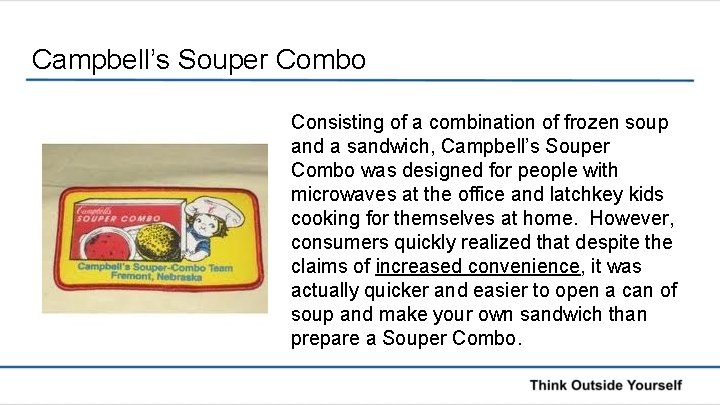
Campbell’s Souper Combo Consisting of a combination of frozen soup and a sandwich, Campbell’s Souper Combo was designed for people with microwaves at the office and latchkey kids cooking for themselves at home. However, consumers quickly realized that despite the claims of increased convenience, it was actually quicker and easier to open a can of soup and make your own sandwich than prepare a Souper Combo.
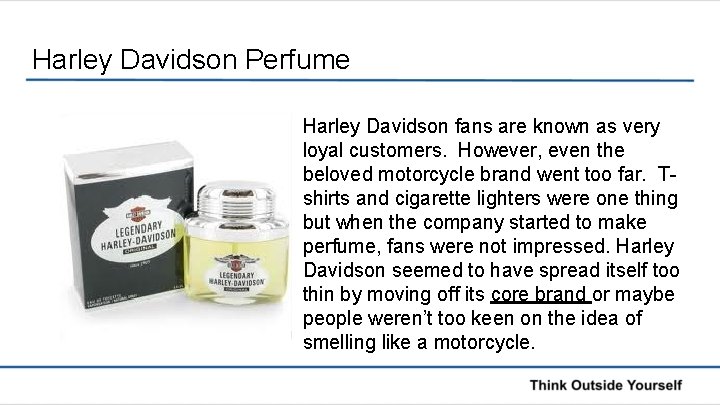
Harley Davidson Perfume Harley Davidson fans are known as very loyal customers. However, even the beloved motorcycle brand went too far. Tshirts and cigarette lighters were one thing but when the company started to make perfume, fans were not impressed. Harley Davidson seemed to have spread itself too thin by moving off its core brand or maybe people weren’t too keen on the idea of smelling like a motorcycle.
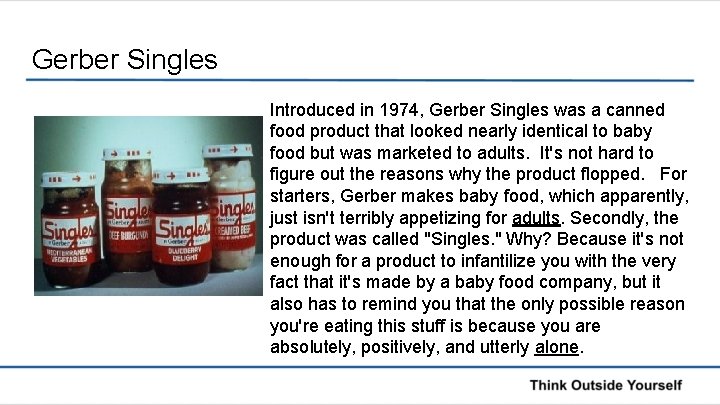
Gerber Singles Introduced in 1974, Gerber Singles was a canned food product that looked nearly identical to baby food but was marketed to adults. It's not hard to figure out the reasons why the product flopped. For starters, Gerber makes baby food, which apparently, just isn't terribly appetizing for adults. Secondly, the product was called "Singles. " Why? Because it's not enough for a product to infantilize you with the very fact that it's made by a baby food company, but it also has to remind you that the only possible reason you're eating this stuff is because you are absolutely, positively, and utterly alone.
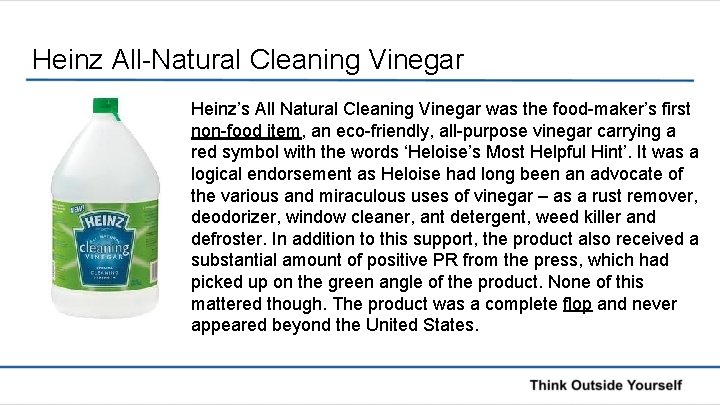
Heinz All-Natural Cleaning Vinegar Heinz’s All Natural Cleaning Vinegar was the food-maker’s first non-food item, an eco-friendly, all-purpose vinegar carrying a red symbol with the words ‘Heloise’s Most Helpful Hint’. It was a logical endorsement as Heloise had long been an advocate of the various and miraculous uses of vinegar – as a rust remover, deodorizer, window cleaner, ant detergent, weed killer and defroster. In addition to this support, the product also received a substantial amount of positive PR from the press, which had picked up on the green angle of the product. None of this mattered though. The product was a complete flop and never appeared beyond the United States.
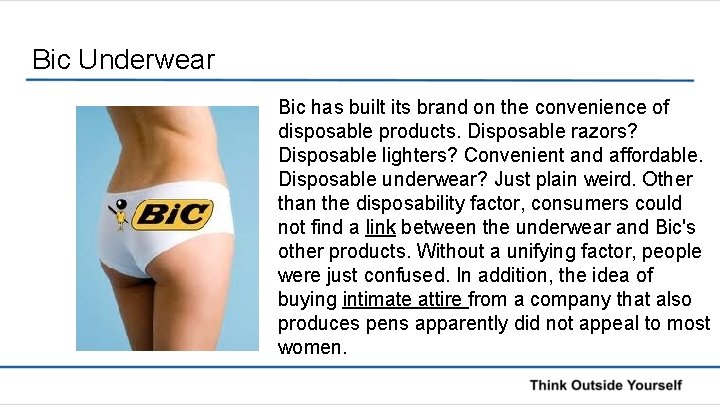
Bic Underwear Bic has built its brand on the convenience of disposable products. Disposable razors? Disposable lighters? Convenient and affordable. Disposable underwear? Just plain weird. Other than the disposability factor, consumers could not find a link between the underwear and Bic's other products. Without a unifying factor, people were just confused. In addition, the idea of buying intimate attire from a company that also produces pens apparently did not appeal to most women.
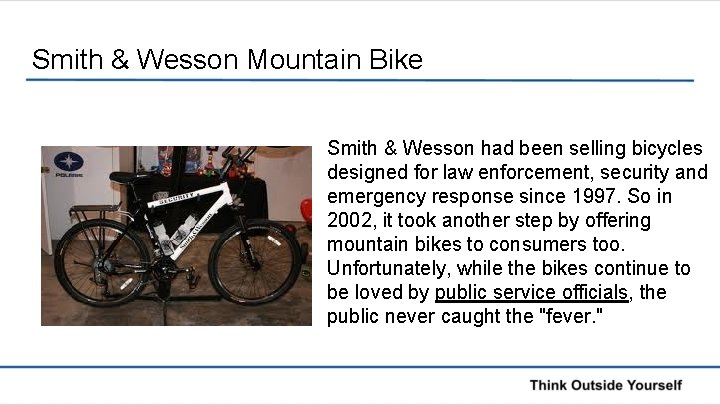
Smith & Wesson Mountain Bike Smith & Wesson had been selling bicycles designed for law enforcement, security and emergency response since 1997. So in 2002, it took another step by offering mountain bikes to consumers too. Unfortunately, while the bikes continue to be loved by public service officials, the public never caught the "fever. "
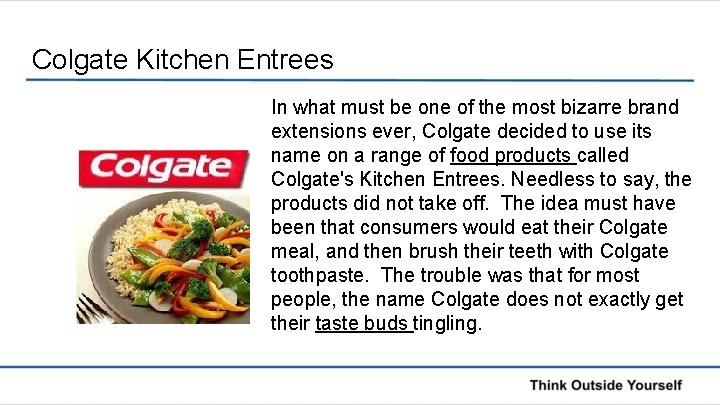
Colgate Kitchen Entrees In what must be one of the most bizarre brand extensions ever, Colgate decided to use its name on a range of food products called Colgate's Kitchen Entrees. Needless to say, the products did not take off. The idea must have been that consumers would eat their Colgate meal, and then brush their teeth with Colgate toothpaste. The trouble was that for most people, the name Colgate does not exactly get their taste buds tingling.
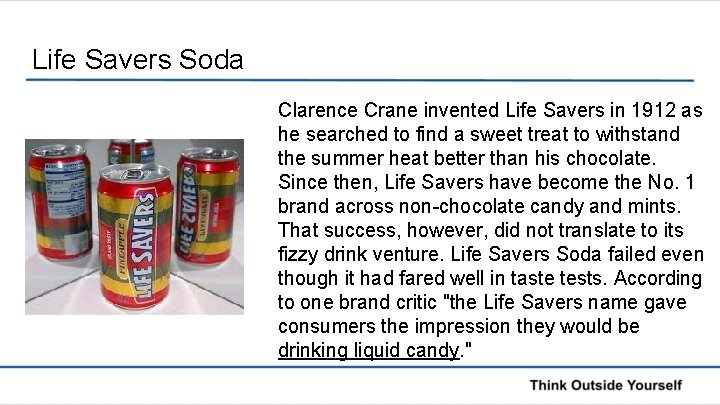
Life Savers Soda Clarence Crane invented Life Savers in 1912 as he searched to find a sweet treat to withstand the summer heat better than his chocolate. Since then, Life Savers have become the No. 1 brand across non-chocolate candy and mints. That success, however, did not translate to its fizzy drink venture. Life Savers Soda failed even though it had fared well in taste tests. According to one brand critic "the Life Savers name gave consumers the impression they would be drinking liquid candy. "
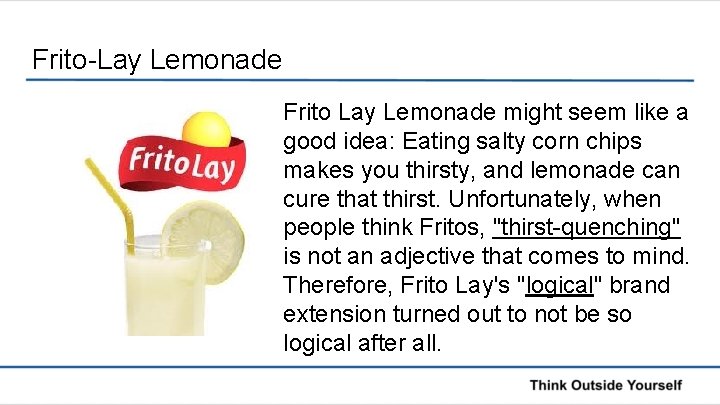
Frito-Lay Lemonade Frito Lay Lemonade might seem like a good idea: Eating salty corn chips makes you thirsty, and lemonade can cure that thirst. Unfortunately, when people think Fritos, "thirst-quenching" is not an adjective that comes to mind. Therefore, Frito Lay's "logical" brand extension turned out to not be so logical after all.
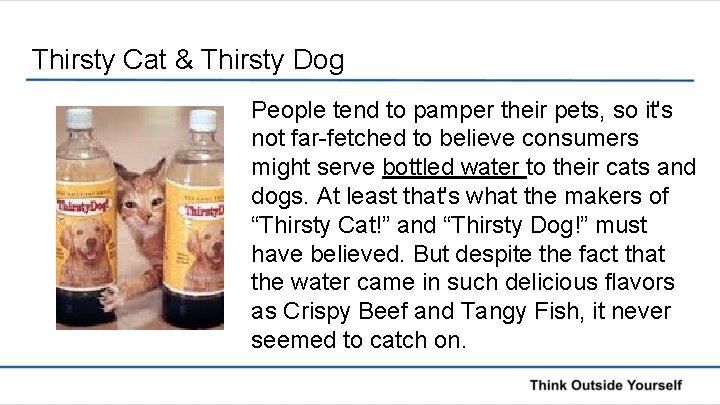
Thirsty Cat & Thirsty Dog People tend to pamper their pets, so it's not far-fetched to believe consumers might serve bottled water to their cats and dogs. At least that's what the makers of “Thirsty Cat!” and “Thirsty Dog!” must have believed. But despite the fact that the water came in such delicious flavors as Crispy Beef and Tangy Fish, it never seemed to catch on.
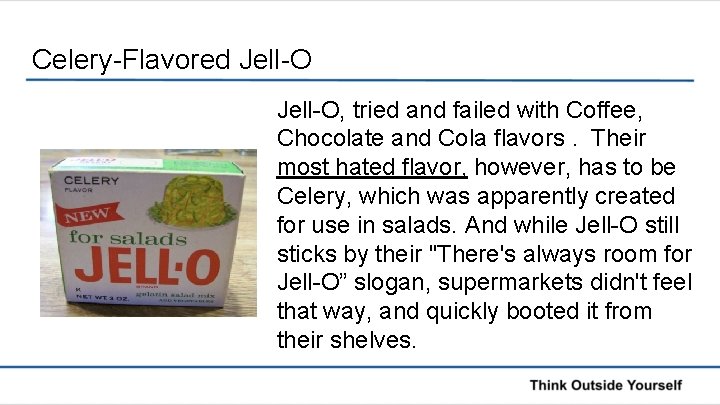
Celery-Flavored Jell-O, tried and failed with Coffee, Chocolate and Cola flavors. Their most hated flavor, however, has to be Celery, which was apparently created for use in salads. And while Jell-O still sticks by their "There's always room for Jell-O” slogan, supermarkets didn't feel that way, and quickly booted it from their shelves.
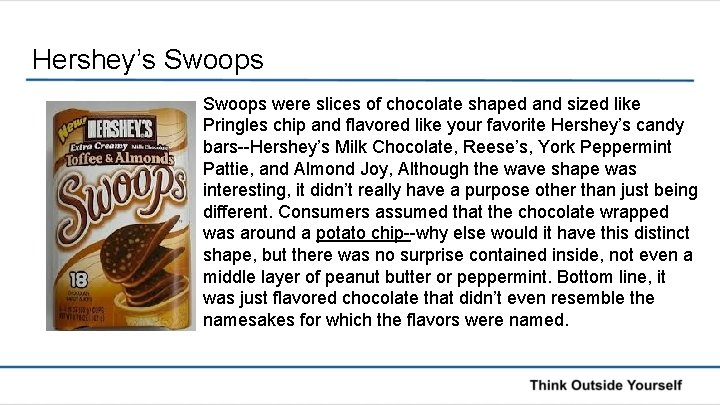
Hershey’s Swoops were slices of chocolate shaped and sized like Pringles chip and flavored like your favorite Hershey’s candy bars--Hershey’s Milk Chocolate, Reese’s, York Peppermint Pattie, and Almond Joy, Although the wave shape was interesting, it didn’t really have a purpose other than just being different. Consumers assumed that the chocolate wrapped was around a potato chip--why else would it have this distinct shape, but there was no surprise contained inside, not even a middle layer of peanut butter or peppermint. Bottom line, it was just flavored chocolate that didn’t even resemble the namesakes for which the flavors were named.
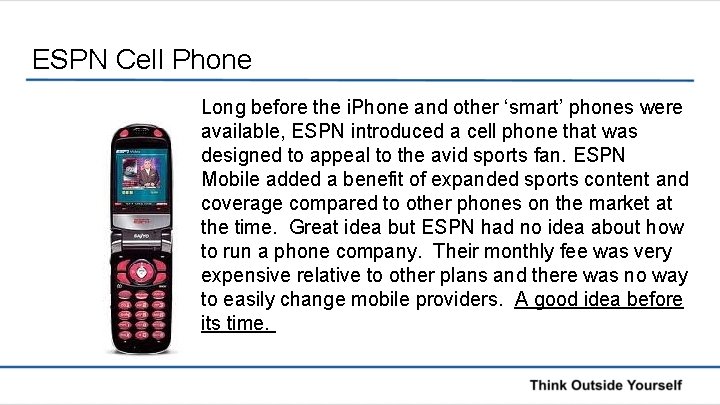
ESPN Cell Phone Long before the i. Phone and other ‘smart’ phones were available, ESPN introduced a cell phone that was designed to appeal to the avid sports fan. ESPN Mobile added a benefit of expanded sports content and coverage compared to other phones on the market at the time. Great idea but ESPN had no idea about how to run a phone company. Their monthly fee was very expensive relative to other plans and there was no way to easily change mobile providers. A good idea before its time.
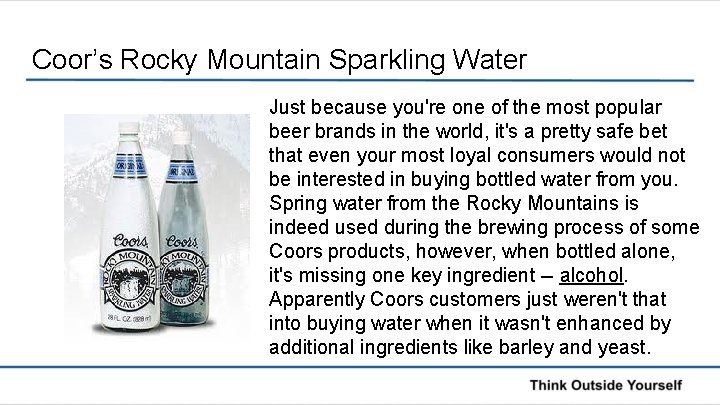
Coor’s Rocky Mountain Sparkling Water Just because you're one of the most popular beer brands in the world, it's a pretty safe bet that even your most loyal consumers would not be interested in buying bottled water from you. Spring water from the Rocky Mountains is indeed used during the brewing process of some Coors products, however, when bottled alone, it's missing one key ingredient -- alcohol. Apparently Coors customers just weren't that into buying water when it wasn't enhanced by additional ingredients like barley and yeast.
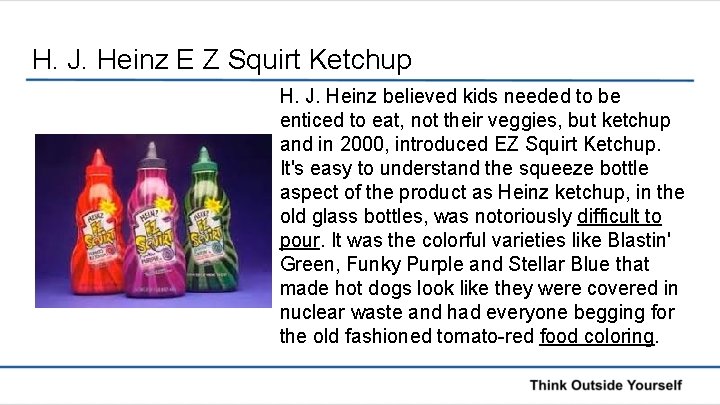
H. J. Heinz E Z Squirt Ketchup H. J. Heinz believed kids needed to be enticed to eat, not their veggies, but ketchup and in 2000, introduced EZ Squirt Ketchup. It's easy to understand the squeeze bottle aspect of the product as Heinz ketchup, in the old glass bottles, was notoriously difficult to pour. It was the colorful varieties like Blastin' Green, Funky Purple and Stellar Blue that made hot dogs look like they were covered in nuclear waste and had everyone begging for the old fashioned tomato-red food coloring.
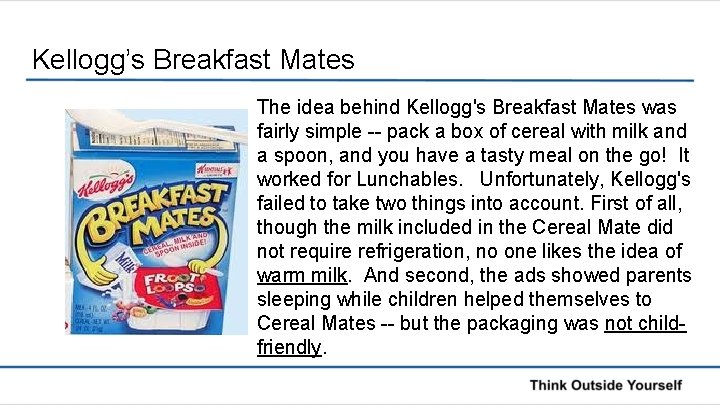
Kellogg’s Breakfast Mates The idea behind Kellogg's Breakfast Mates was fairly simple -- pack a box of cereal with milk and a spoon, and you have a tasty meal on the go! It worked for Lunchables. Unfortunately, Kellogg's failed to take two things into account. First of all, though the milk included in the Cereal Mate did not require refrigeration, no one likes the idea of warm milk. And second, the ads showed parents sleeping while children helped themselves to Cereal Mates -- but the packaging was not childfriendly.
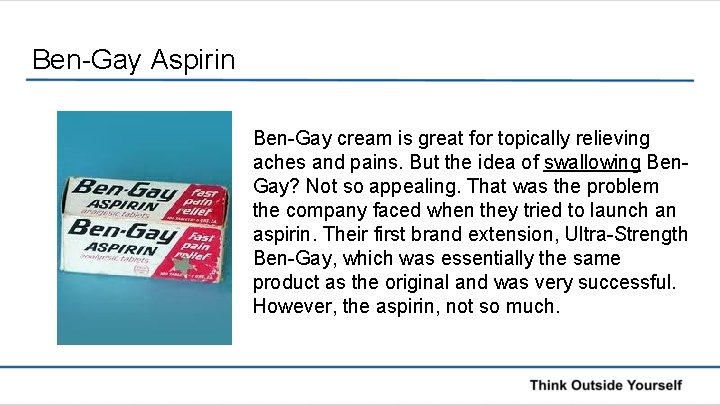
Ben-Gay Aspirin Ben-Gay cream is great for topically relieving aches and pains. But the idea of swallowing Ben. Gay? Not so appealing. That was the problem the company faced when they tried to launch an aspirin. Their first brand extension, Ultra-Strength Ben-Gay, which was essentially the same product as the original and was very successful. However, the aspirin, not so much.
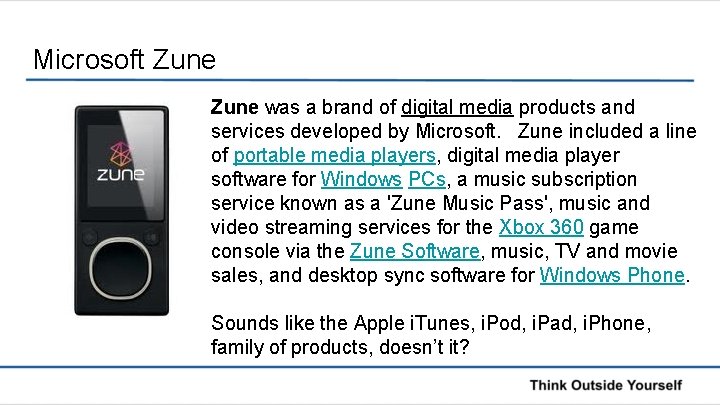
Microsoft Zune was a brand of digital media products and services developed by Microsoft. Zune included a line of portable media players, digital media player software for Windows PCs, a music subscription service known as a 'Zune Music Pass', music and video streaming services for the Xbox 360 game console via the Zune Software, music, TV and movie sales, and desktop sync software for Windows Phone. Sounds like the Apple i. Tunes, i. Pod, i. Pad, i. Phone, family of products, doesn’t it?
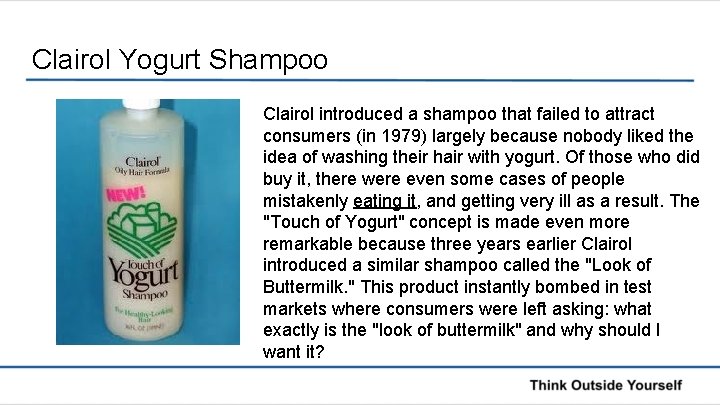
Clairol Yogurt Shampoo Clairol introduced a shampoo that failed to attract consumers (in 1979) largely because nobody liked the idea of washing their hair with yogurt. Of those who did buy it, there were even some cases of people mistakenly eating it, and getting very ill as a result. The "Touch of Yogurt" concept is made even more remarkable because three years earlier Clairol introduced a similar shampoo called the "Look of Buttermilk. " This product instantly bombed in test markets where consumers were left asking: what exactly is the "look of buttermilk" and why should I want it?
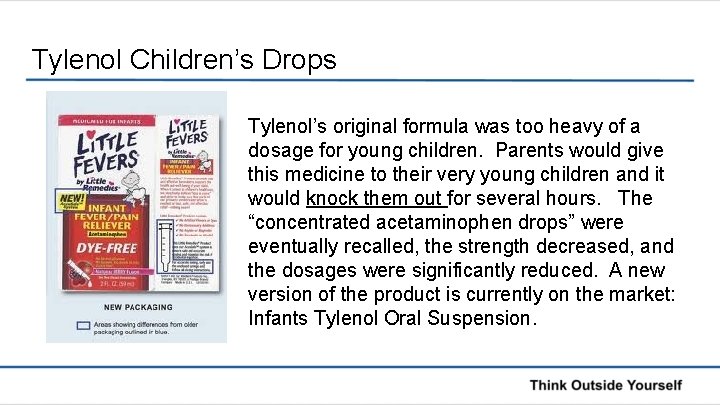
Tylenol Children’s Drops Tylenol’s original formula was too heavy of a dosage for young children. Parents would give this medicine to their very young children and it would knock them out for several hours. The “concentrated acetaminophen drops” were eventually recalled, the strength decreased, and the dosages were significantly reduced. A new version of the product is currently on the market: Infants Tylenol Oral Suspension.
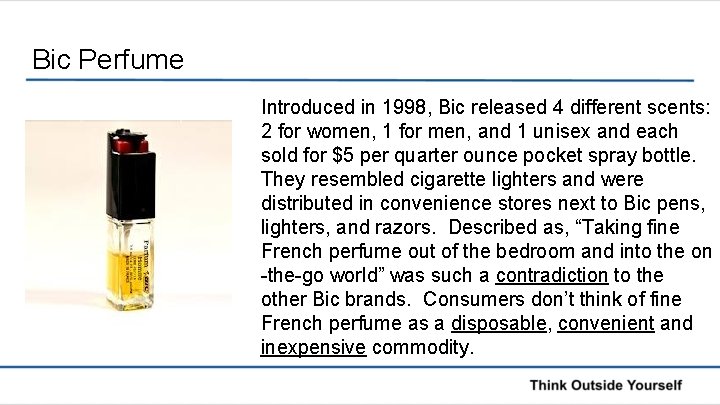
Bic Perfume Introduced in 1998, Bic released 4 different scents: 2 for women, 1 for men, and 1 unisex and each sold for $5 per quarter ounce pocket spray bottle. They resembled cigarette lighters and were distributed in convenience stores next to Bic pens, lighters, and razors. Described as, “Taking fine French perfume out of the bedroom and into the on -the-go world” was such a contradiction to the other Bic brands. Consumers don’t think of fine French perfume as a disposable, convenient and inexpensive commodity.
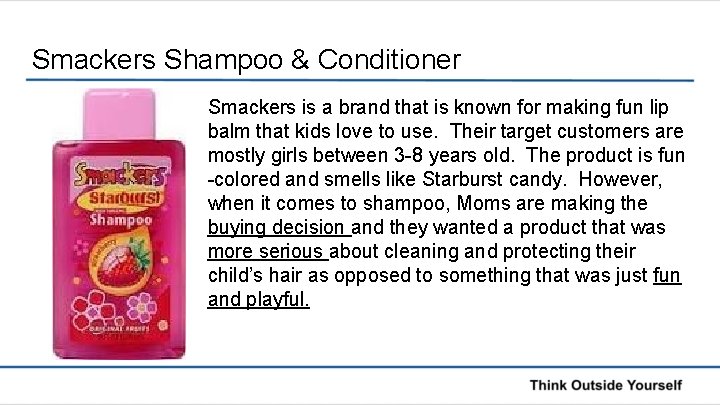
Smackers Shampoo & Conditioner Smackers is a brand that is known for making fun lip balm that kids love to use. Their target customers are mostly girls between 3 -8 years old. The product is fun -colored and smells like Starburst candy. However, when it comes to shampoo, Moms are making the buying decision and they wanted a product that was more serious about cleaning and protecting their child’s hair as opposed to something that was just fun and playful.
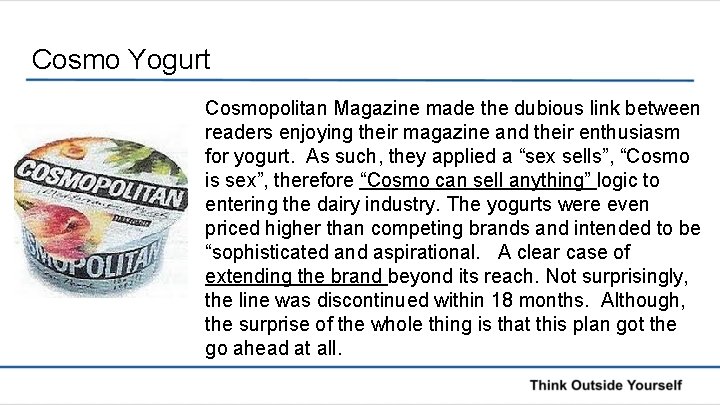
Cosmo Yogurt Cosmopolitan Magazine made the dubious link between readers enjoying their magazine and their enthusiasm for yogurt. As such, they applied a “sex sells”, “Cosmo is sex”, therefore “Cosmo can sell anything” logic to entering the dairy industry. The yogurts were even priced higher than competing brands and intended to be “sophisticated and aspirational. A clear case of extending the brand beyond its reach. Not surprisingly, the line was discontinued within 18 months. Although, the surprise of the whole thing is that this plan got the go ahead at all.
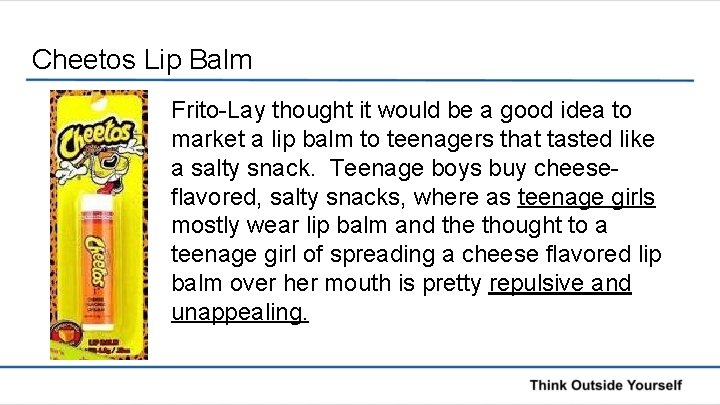
Cheetos Lip Balm Frito-Lay thought it would be a good idea to market a lip balm to teenagers that tasted like a salty snack. Teenage boys buy cheeseflavored, salty snacks, where as teenage girls mostly wear lip balm and the thought to a teenage girl of spreading a cheese flavored lip balm over her mouth is pretty repulsive and unappealing.
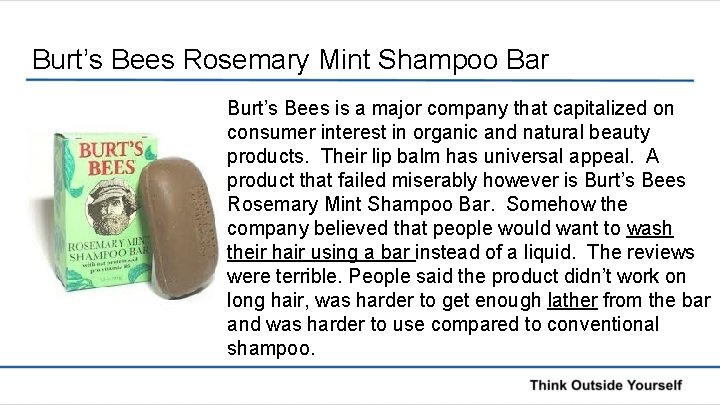
Burt’s Bees Rosemary Mint Shampoo Bar Burt’s Bees is a major company that capitalized on consumer interest in organic and natural beauty products. Their lip balm has universal appeal. A product that failed miserably however is Burt’s Bees Rosemary Mint Shampoo Bar. Somehow the company believed that people would want to wash their hair using a bar instead of a liquid. The reviews were terrible. People said the product didn’t work on long hair, was harder to get enough lather from the bar and was harder to use compared to conventional shampoo.
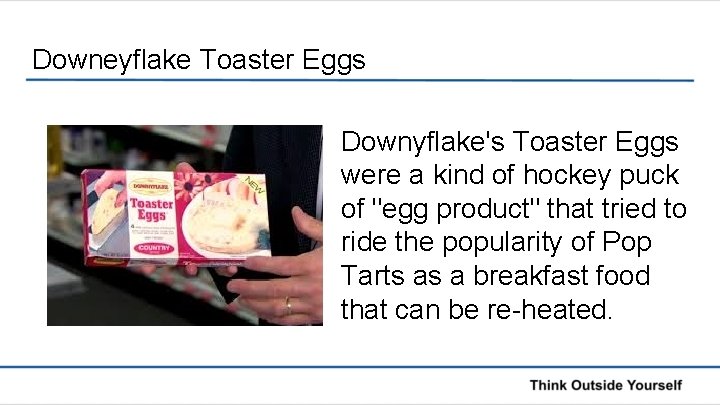
Downeyflake Toaster Eggs Downyflake's Toaster Eggs were a kind of hockey puck of "egg product" that tried to ride the popularity of Pop Tarts as a breakfast food that can be re-heated.
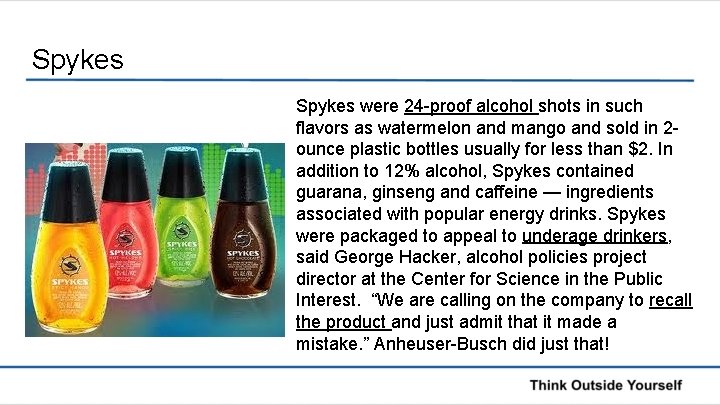
Spykes were 24 -proof alcohol shots in such flavors as watermelon and mango and sold in 2 ounce plastic bottles usually for less than $2. In addition to 12% alcohol, Spykes contained guarana, ginseng and caffeine — ingredients associated with popular energy drinks. Spykes were packaged to appeal to underage drinkers, said George Hacker, alcohol policies project director at the Center for Science in the Public Interest. “We are calling on the company to recall the product and just admit that it made a mistake. ” Anheuser-Busch did just that!
The Worst Apple Products of All Time Apple is known for the hit products it has released in the last decade: the i. Pod, the i. Phone, and most recently the i. Pad. But the company hasn't always been a synonym for success. Some of its products, particularly in the '80 s and '90 s, were huge flops.
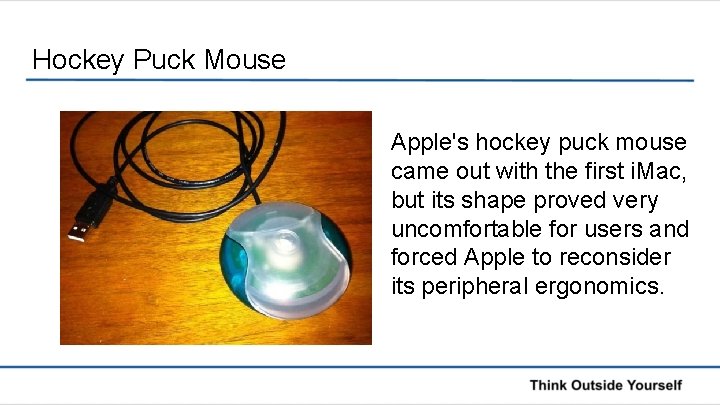
Hockey Puck Mouse Apple's hockey puck mouse came out with the first i. Mac, but its shape proved very uncomfortable for users and forced Apple to reconsider its peripheral ergonomics.
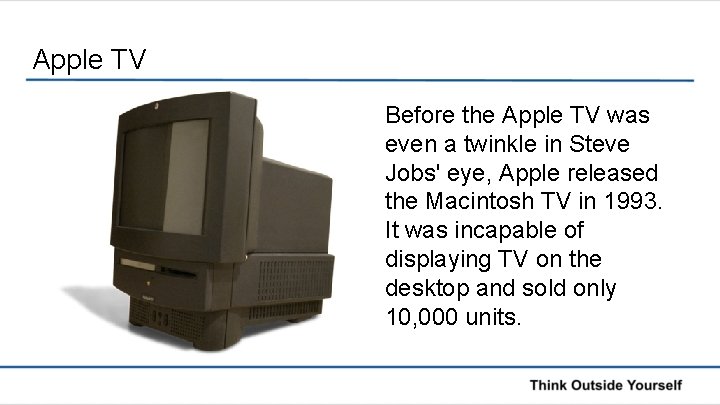
Apple TV Before the Apple TV was even a twinkle in Steve Jobs' eye, Apple released the Macintosh TV in 1993. It was incapable of displaying TV on the desktop and sold only 10, 000 units.
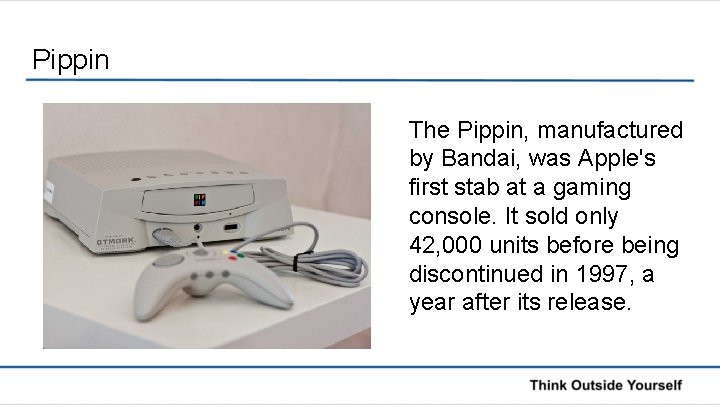
Pippin The Pippin, manufactured by Bandai, was Apple's first stab at a gaming console. It sold only 42, 000 units before being discontinued in 1997, a year after its release.
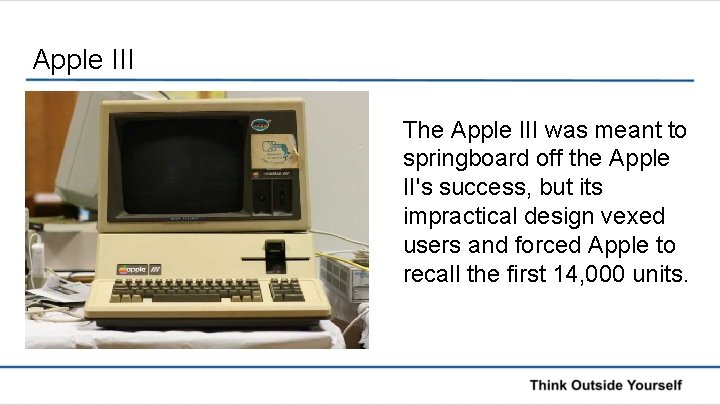
Apple III The Apple III was meant to springboard off the Apple II's success, but its impractical design vexed users and forced Apple to recall the first 14, 000 units.
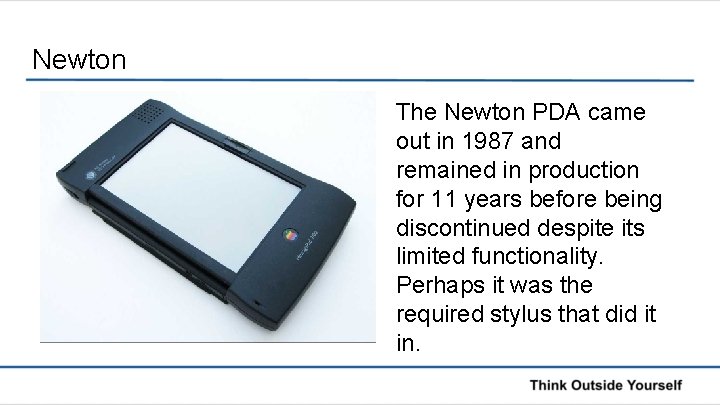
Newton The Newton PDA came out in 1987 and remained in production for 11 years before being discontinued despite its limited functionality. Perhaps it was the required stylus that did it in.
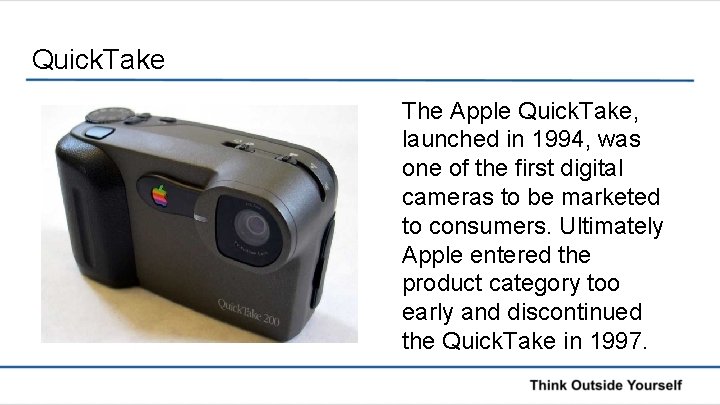
Quick. Take The Apple Quick. Take, launched in 1994, was one of the first digital cameras to be marketed to consumers. Ultimately Apple entered the product category too early and discontinued the Quick. Take in 1997.
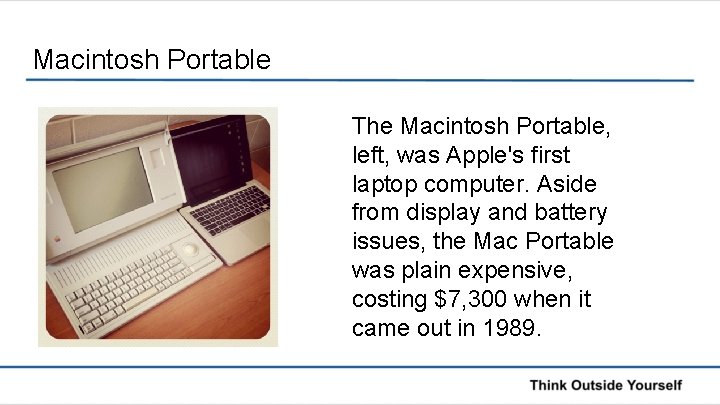
Macintosh Portable The Macintosh Portable, left, was Apple's first laptop computer. Aside from display and battery issues, the Mac Portable was plain expensive, costing $7, 300 when it came out in 1989.
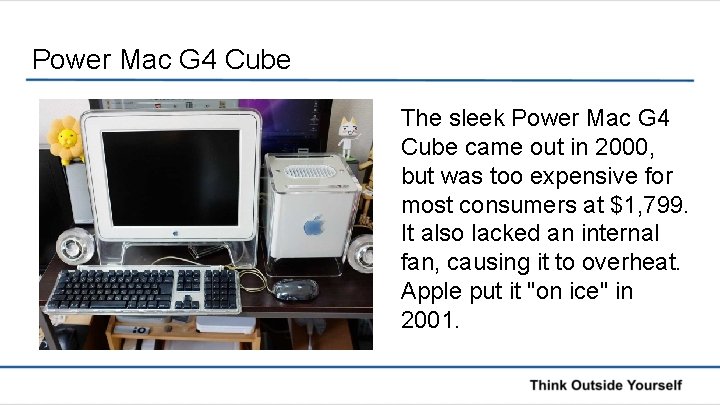
Power Mac G 4 Cube The sleek Power Mac G 4 Cube came out in 2000, but was too expensive for most consumers at $1, 799. It also lacked an internal fan, causing it to overheat. Apple put it "on ice" in 2001.
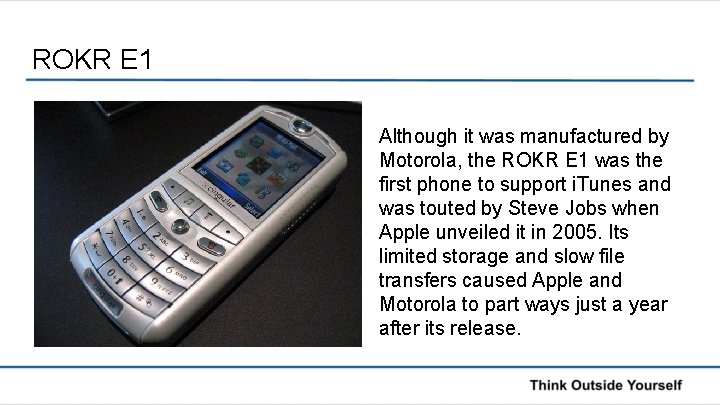
ROKR E 1 Although it was manufactured by Motorola, the ROKR E 1 was the first phone to support i. Tunes and was touted by Steve Jobs when Apple unveiled it in 2005. Its limited storage and slow file transfers caused Apple and Motorola to part ways just a year after its release.
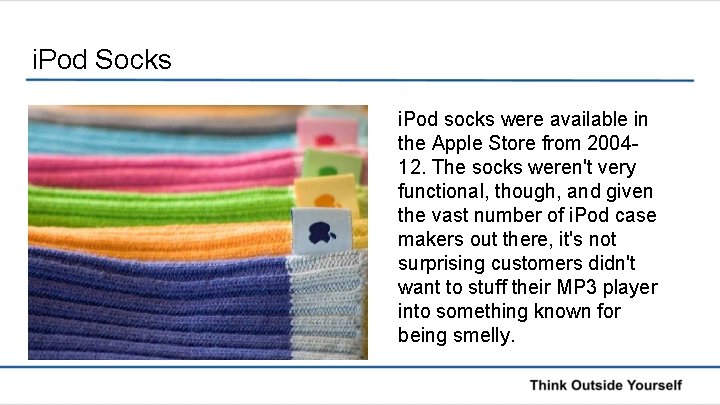
i. Pod Socks i. Pod socks were available in the Apple Store from 200412. The socks weren't very functional, though, and given the vast number of i. Pod case makers out there, it's not surprising customers didn't want to stuff their MP 3 player into something known for being smelly.
Top Failed Mc. Donald’s Products In an attempt to stay on top of the game, Mc. Donald’s occasionally tried out new menu items. Some of them become a great success while others are destined to fail before they even begin.
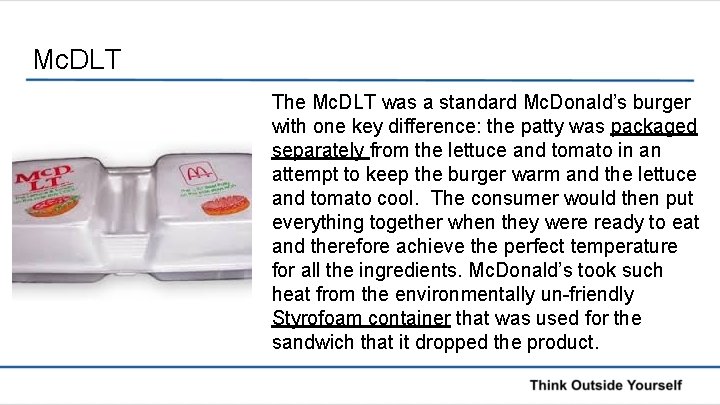
Mc. DLT The Mc. DLT was a standard Mc. Donald’s burger with one key difference: the patty was packaged separately from the lettuce and tomato in an attempt to keep the burger warm and the lettuce and tomato cool. The consumer would then put everything together when they were ready to eat and therefore achieve the perfect temperature for all the ingredients. Mc. Donald’s took such heat from the environmentally un-friendly Styrofoam container that was used for the sandwich that it dropped the product.
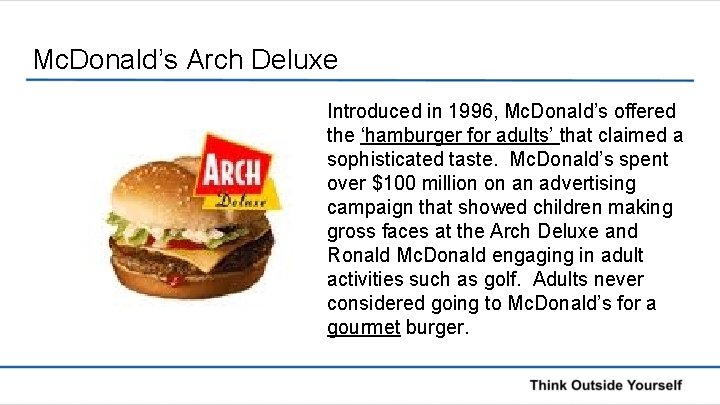
Mc. Donald’s Arch Deluxe Introduced in 1996, Mc. Donald’s offered the ‘hamburger for adults’ that claimed a sophisticated taste. Mc. Donald’s spent over $100 million on an advertising campaign that showed children making gross faces at the Arch Deluxe and Ronald Mc. Donald engaging in adult activities such as golf. Adults never considered going to Mc. Donald’s for a gourmet burger.
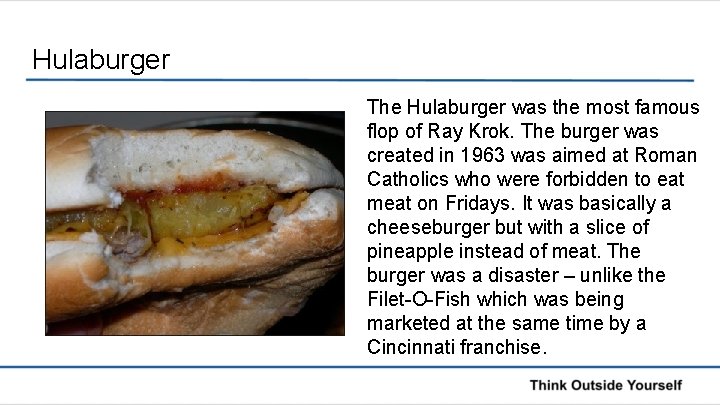
Hulaburger The Hulaburger was the most famous flop of Ray Krok. The burger was created in 1963 was aimed at Roman Catholics who were forbidden to eat meat on Fridays. It was basically a cheeseburger but with a slice of pineapple instead of meat. The burger was a disaster – unlike the Filet-O-Fish which was being marketed at the same time by a Cincinnati franchise.
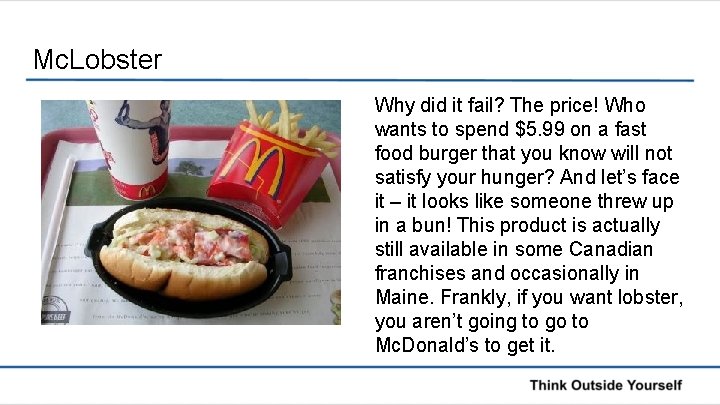
Mc. Lobster Why did it fail? The price! Who wants to spend $5. 99 on a fast food burger that you know will not satisfy your hunger? And let’s face it – it looks like someone threw up in a bun! This product is actually still available in some Canadian franchises and occasionally in Maine. Frankly, if you want lobster, you aren’t going to go to Mc. Donald’s to get it.
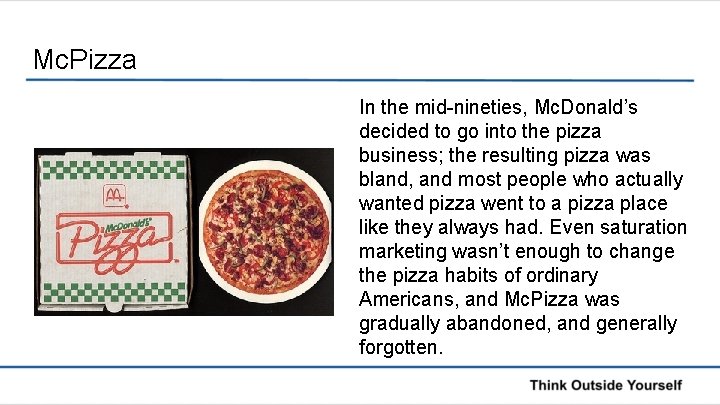
Mc. Pizza In the mid-nineties, Mc. Donald’s decided to go into the pizza business; the resulting pizza was bland, and most people who actually wanted pizza went to a pizza place like they always had. Even saturation marketing wasn’t enough to change the pizza habits of ordinary Americans, and Mc. Pizza was gradually abandoned, and generally forgotten.
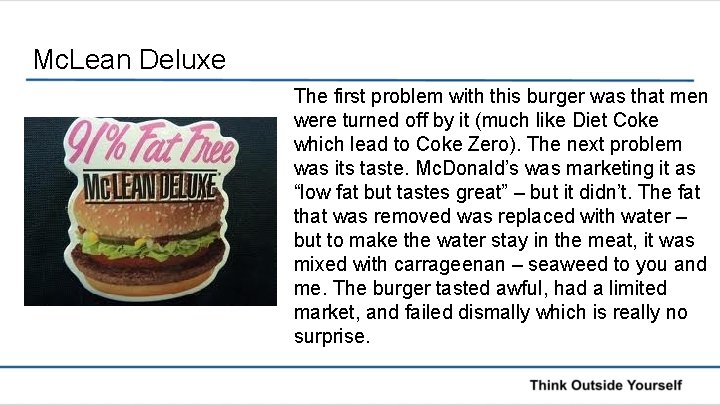
Mc. Lean Deluxe The first problem with this burger was that men were turned off by it (much like Diet Coke which lead to Coke Zero). The next problem was its taste. Mc. Donald’s was marketing it as “low fat but tastes great” – but it didn’t. The fat that was removed was replaced with water – but to make the water stay in the meat, it was mixed with carrageenan – seaweed to you and me. The burger tasted awful, had a limited market, and failed dismally which is really no surprise.
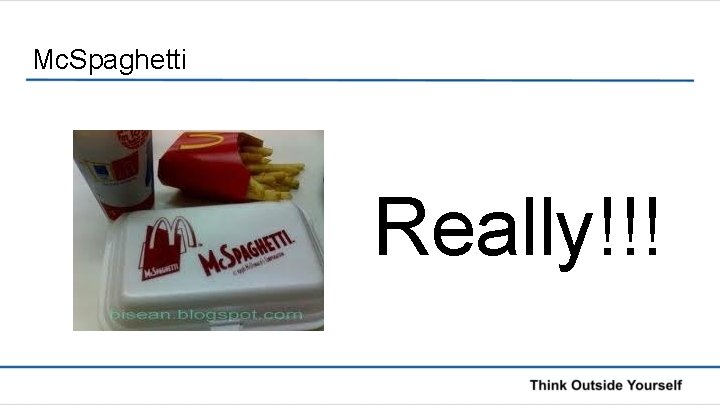
Mc. Spaghetti Really!!!