
Creativity Innovation Entrepreneurship Business Model Canvas A business
Creativity Innovation Entrepreneurship Business Model Canvas A business model describes the rationale of how an organization creates, delivers, and captures value. Think Outside Yourself

The 9 Building Blocks of a Business Model Cost Structure Value Proposition Key Activities Channels Customer Segments Revenue Streams Key Resources Customer Relationships Key Partnerships
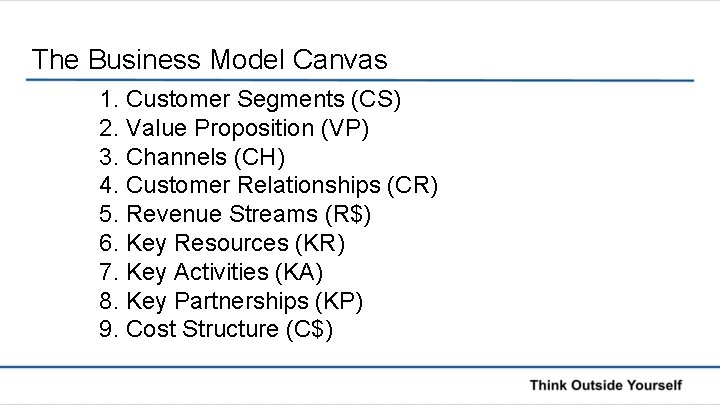
The Business Model Canvas 1. Customer Segments (CS) 2. Value Proposition (VP) 3. Channels (CH) 4. Customer Relationships (CR) 5. Revenue Streams (R$) 6. Key Resources (KR) 7. Key Activities (KA) 8. Key Partnerships (KP) 9. Cost Structure (C$)
Customer Segments (CS) Defines the different groups of people or organizations an enterprise aims to reach and serve: For whom are you creating value? Who are your most important customers?
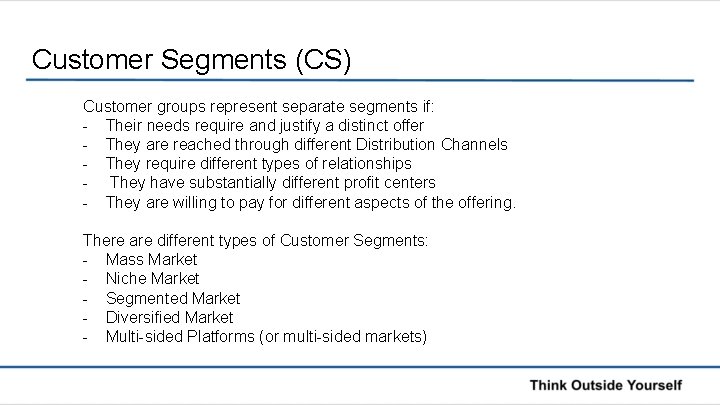
Customer Segments (CS) Customer groups represent separate segments if: - Their needs require and justify a distinct offer - They are reached through different Distribution Channels - They require different types of relationships - They have substantially different profit centers - They are willing to pay for different aspects of the offering. There are different types of Customer Segments: - Mass Market - Niche Market - Segmented Market - Diversified Market - Multi-sided Platforms (or multi-sided markets)
Value Proposition (VP) Describes the bundle of products and services that create value for a specific Customer Segment. What value do you deliver to the customer? Which customer’s problems are you helping to solve? Which customer needs are you satisfying? What bundle of products and services are you offering to each customer segment?
Value Proposition (VP) The Value Proposition is the reason why customers choose on company over another. A Value Proposition creates value for a Customer Segment through a distinct mix of products and services that cater to the needs of a specific Customer Segment. - Quantitative: - price, speed of service - Qualitative: - design, customer experience Elements that contribute to customer value creations: - Newness - Performance - Customization - Design - Brand/Status - Price - Cost and/or Risk Reduction - Accessibility and/or Convenience
Channels (CH) Describes how your company communicates with and reaches your Customer Segments to deliver a Value Proposition. Through which Channels do your customer segments want to be reached? Which Channels are the most cost efficient? How can you integrate your Channels with your customer’s routines?
Channels (CH) Communication, Distribution, and Sales comprise a company’s interface with customers. Channels are customer touch points that play an important role in the customer experience. Channels have 5 distinct phases: - Awareness - Evaluation - Purchase - Delivery - After Sales Channels can be direct or indirect and may include: - Direct Sales Force - Web Sales - Bricks & Mortar Stores - Partner Stores - Wholesale
Customer Relationships (CR) Describes the type of relationships a company establishes with specific Customer Segments What type of relationship do you expect to establish and maintain with each of your Customer Segments?
Customer Relationships (CR) Customer Relationships can range from personal to automated and are motivated from customer acquisition to customer retention. There are several categories of Customer Relationships including: - Personal Assistance - Self-service - Automated Services - Communities - Co-creation

Revenue Streams (R$) Represents the cash a company generates from each Customer Segment. (costs must be subtracted from revenues to create earnings. ) What value are your customers really willing to pay? What do they currently pay? How are they currently paying? How would they prefer to pay? How much does each Revenue Stream contribute to overall revenues?

Revenue Streams (R$) A business model can involve two different types of Revenue Streams: - Transactional revenues resulting from one-time customer payments. - Recurring revenues resulting from ongoing payments. Each Revenue Stream may have different pricing mechanisms: - Fixed Pricing --- predefined prices based on static variables - List Price - Product feature dependent pricing - Customer segment dependent pricing - Volume dependent pricing - Dynamic Pricing --- prices change based on market conditions - Negotiation - Yield Management - Real-time market - Auctions
Key Resources (KR) Describes the most important assets required to make a business model work. What Key Resources does your Value Proposition require? Your Distribution Channels? Your Customer Relationships? Your Revenue Streams?
Key Resources (KR) Key Resources can be physical, financial, intellectual, or human. Key Resources can be owned or leased by the company or acquired from key partners.

Key Activities (KA) Describes the most important things a company must do to make its business model work. What Key Activities does your Value Proposition require? Your Distribution Channel? Your Customer Relationships? Your Revenue Streams?
Key Activities (KA) Key Activities are the most important actions a company must take to operate successfully. Key Activities are required to create and offer a Value Proposition, reach markets, maintain Customer Relationships, and earn revenues.
Key Partnerships (KP) Describes the network of suppliers and partners that make the business model work. Who are your Key Partners? Who are your key suppliers? Which Key resources are you acquiring from partners? Which Key Activities do your partners perform?
Key Partnerships (KP) Companies create alliances to optimize their business models, reduce risk, or acquire resources. There are 4 different types of partnerships: - Strategic alliances between non-competitors - Cooperation: strategic partnerships between competitors - Joint ventures to develop new businesses - Buyer-supplier relationships to assure reliable supplies
Cost Structure (C$) Describes all the costs incurred to operate a business model. What are the most important costs inherent in your business model? Which Key Resources are the most expensive? Which Key Activities are the most expensive?
Cost Structure (C$) Creating and delivering value, maintaining Customer Relationships, and generating revenue all incur costs. Such costs are calculated after defining Key Resources, Key Activities, and Key Partnerships. Cost structures have the following characteristics: - Fixed costs - Variable costs - Economies of scale - Economies of scope
- Slides: 21