
Creativity in Practice An Ecological Phenomenon Norman Jackson
- Slides: 8
Creativity in Practice : An Ecological Phenomenon Norman Jackson ‘A properly ecological approach … is one that would take, as its point of departure, the whole-organism-in-its-environment. In other words, ‘organism plus environment’ should denote not a compound of two things, but one indivisible totality’ (Ingold 2000 : 16). My proposition: In the practice environment the motivator for creativity is the intrinsic desire to create value by solving domain specific problems, developing new situated knowledge and creating new cultural artefacts. The process involves ‘the emergence in action of a novel relational product growing out of the uniqueness of the individual on the one hand, and the materials, events, or circumstances of their life’ (Rogers 1961: 350). From Learning Ecologies to Ecologies for Creative Practice, Chapter 12 in R. Barnett & N J Jackson Ecologies for Learning and Practice: Emerging Ideas, Sightings and Possibilities http: //www. normanjackson. co. uk/crc. html
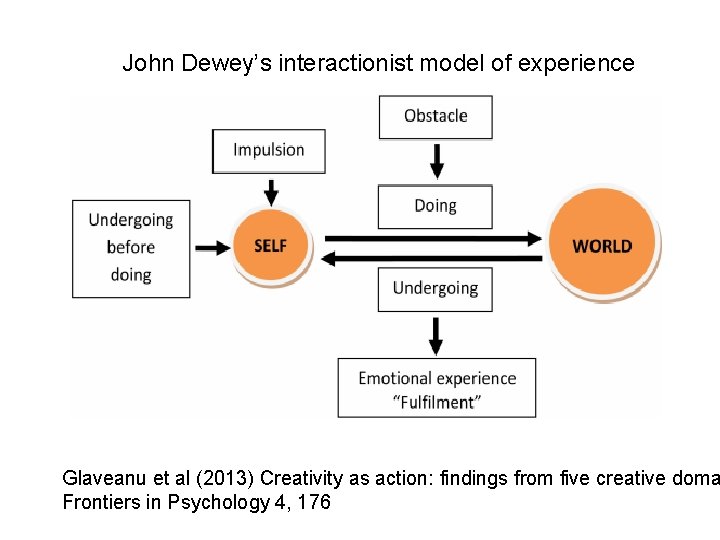
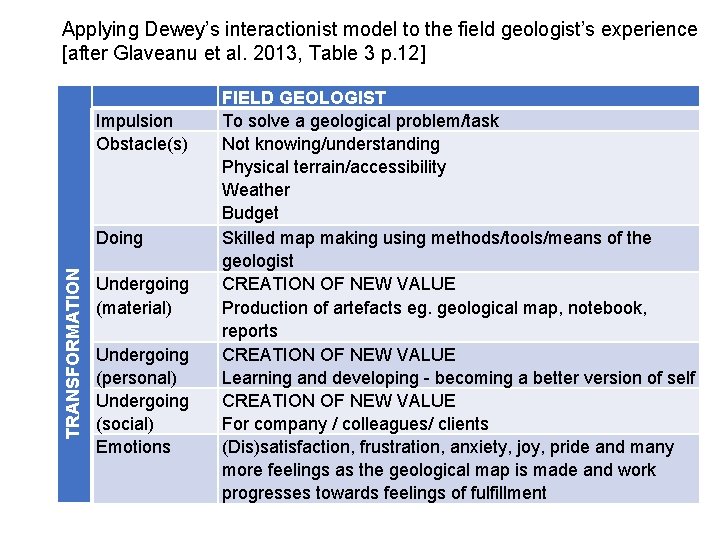
John Dewey’s interactionist model of experience Glaveanu et al (2013) Creativity as action: findings from five creative doma Frontiers in Psychology 4, 176
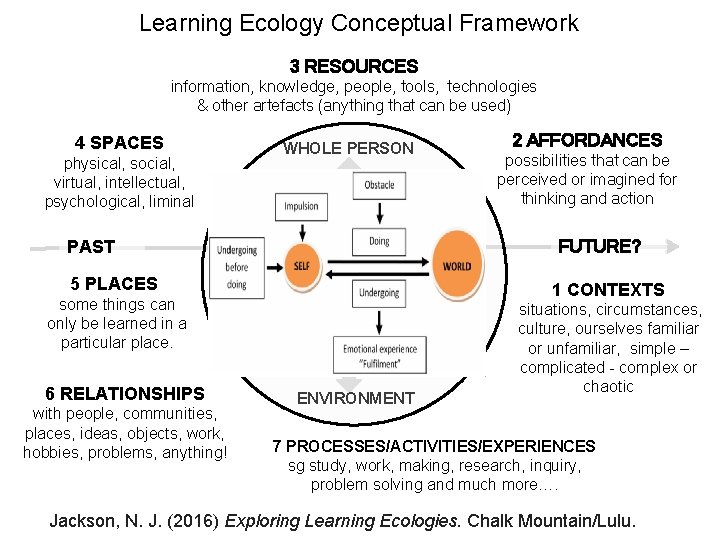
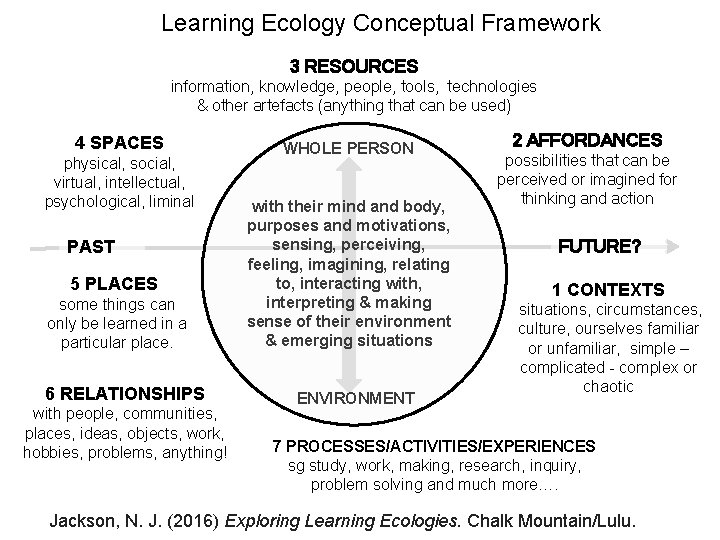
Learning Ecology Conceptual Framework 3 RESOURCES information, knowledge, people, tools, technologies & other artefacts (anything that can be used) 4 SPACES physical, social, virtual, intellectual, psychological, liminal PAST 5 PLACES some things can only be learned in a particular place. 6 RELATIONSHIPS with people, communities, places, ideas, objects, work, hobbies, problems, anything! WHOLE PERSON with their mind and body, purposes and motivations, sensing, perceiving, feeling, imagining, relating to, interacting with, interpreting & making sense of their environment & emerging situations ENVIRONMENT 2 AFFORDANCES possibilities that can be perceived or imagined for thinking and action FUTURE? 1 CONTEXTS situations, circumstances, culture, ourselves familiar or unfamiliar, simple – complicated - complex or chaotic 7 PROCESSES/ACTIVITIES/EXPERIENCES sg study, work, making, research, inquiry, problem solving and much more…. Jackson, N. J. (2016) Exploring Learning Ecologies. Chalk Mountain/Lulu.
Learning Ecology Conceptual Framework 3 RESOURCES information, knowledge, people, tools, technologies & other artefacts (anything that can be used) 4 SPACES physical, social, virtual, intellectual, psychological, liminal PAST 5 PLACES some things can only be learned in a particular place. 6 RELATIONSHIPS with people, communities, places, ideas, objects, work, hobbies, problems, anything! WHOLE PERSON with their mind and body, purposes and motivations, sensing, perceiving, feeling, imagining, relating to, interacting with, interpreting & making sense of their environment & emerging situations ENVIRONMENT 2 AFFORDANCES possibilities that can be perceived or imagined for thinking and action FUTURE? 1 CONTEXTS situations, circumstances, culture, ourselves familiar or unfamiliar, simple – complicated - complex or chaotic 7 PROCESSES/ACTIVITIES/EXPERIENCES sg study, work, making, research, inquiry, problem solving and much more…. Jackson, N. J. (2016) Exploring Learning Ecologies. Chalk Mountain/Lulu.
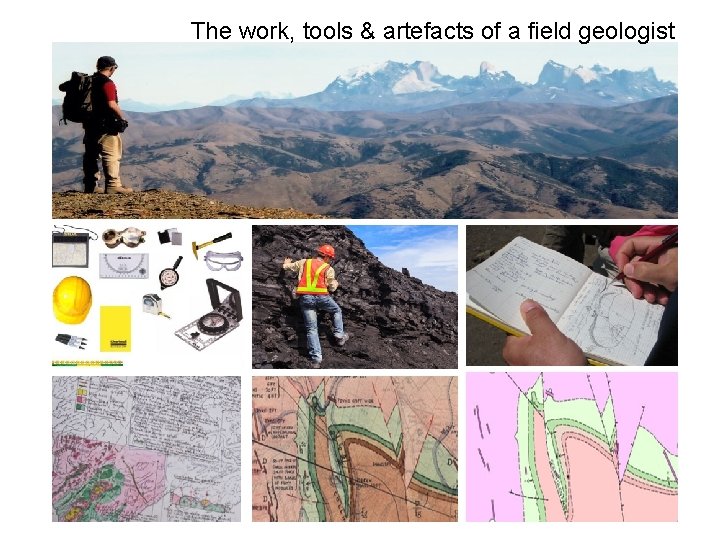
The work, tools & artefacts of a field geologist
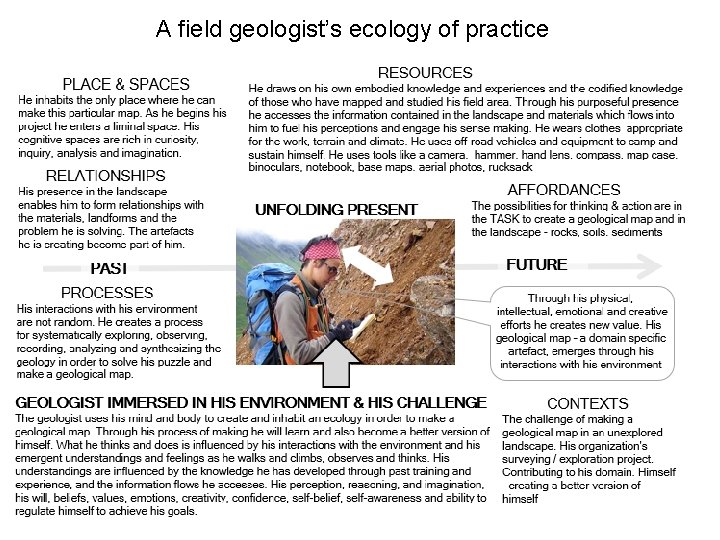
A field geologist’s ecology of practice
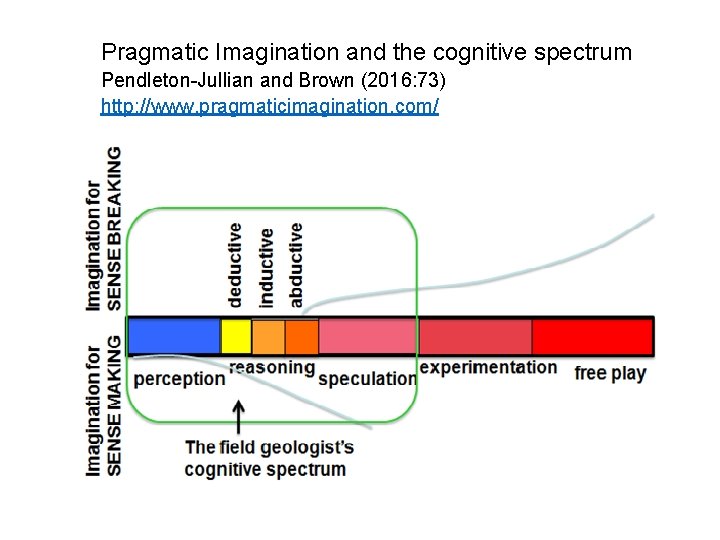
Pragmatic Imagination and the cognitive spectrum Pendleton-Jullian and Brown (2016: 73) http: //www. pragmaticimagination. com/
Applying Dewey’s interactionist model to the field geologist’s experience [after Glaveanu et al. 2013, Table 3 p. 12] Impulsion Obstacle(s) TRANSFORMATION Doing Undergoing (material) Undergoing (personal) Undergoing (social) Emotions FIELD GEOLOGIST To solve a geological problem/task Not knowing/understanding Physical terrain/accessibility Weather Budget Skilled map making using methods/tools/means of the geologist CREATION OF NEW VALUE Production of artefacts eg. geological map, notebook, reports CREATION OF NEW VALUE Learning and developing - becoming a better version of self CREATION OF NEW VALUE For company / colleagues/ clients (Dis)satisfaction, frustration, anxiety, joy, pride and many more feelings as the geological map is made and work progresses towards feelings of fulfillment