
CREATIVITY Group 2 Vinod Kumar Ignatius Pereira Prem
- Slides: 51
CREATIVITY Group 2 Vinod Kumar Ignatius Pereira Prem Kumar
Agenda Definition of Creativity Motivation Human Creativity Different models proposed Relevance to AI
Definition of Creativity Ability to come up with ideas that are new, surprising and valuable. Associated fields – artificial intelligence, cognitive psychology, philosophy, arts etc. . Not a special faculty but is an aspect of general intelligence. Eg. Escher's drawings, Einstein's works, inventions, discoveries etc. .
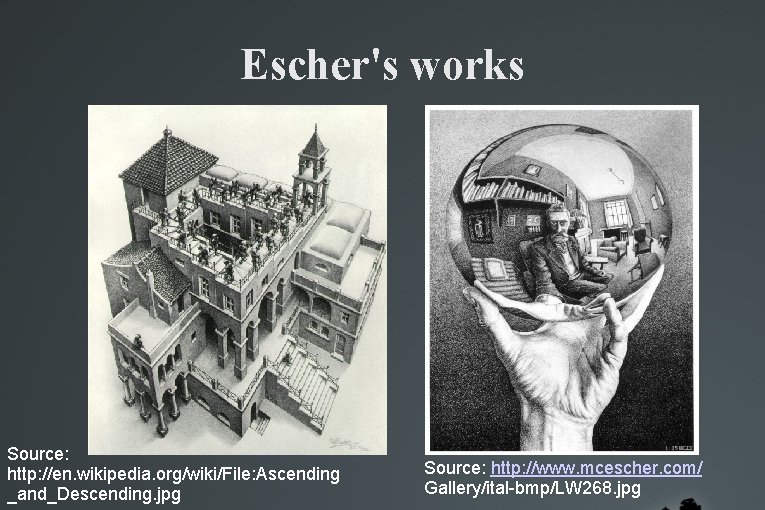
Escher's works Source: http: //en. wikipedia. org/wiki/File: Ascending _and_Descending. jpg Source: http: //www. mcescher. com/ Gallery/ital-bmp/LW 268. jpg
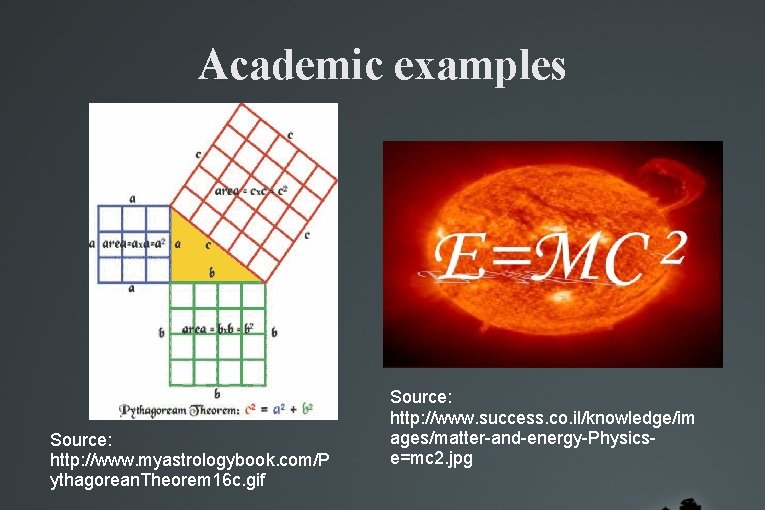
Academic examples Source: http: //www. myastrologybook. com/P ythagorean. Theorem 16 c. gif Source: http: //www. success. co. il/knowledge/im ages/matter-and-energy-Physicse=mc 2. jpg
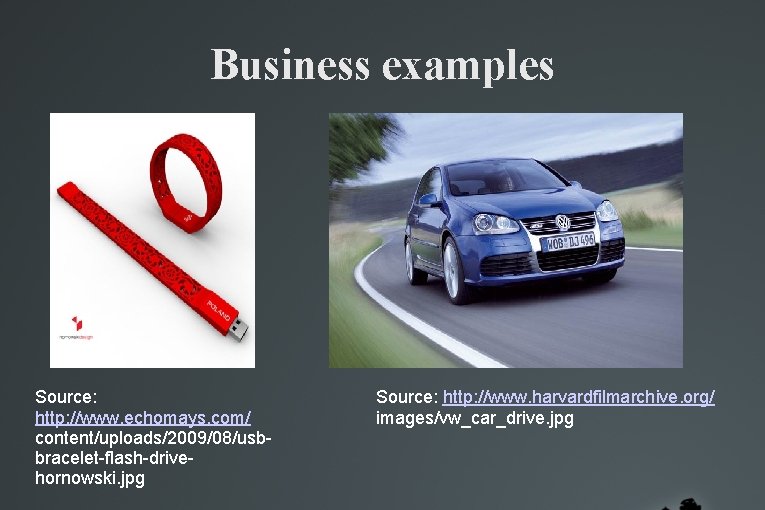
Business examples Source: http: //www. echomays. com/ content/uploads/2009/08/usbbracelet-flash-drivehornowski. jpg Source: http: //www. harvardfilmarchive. org/ images/vw_car_drive. jpg
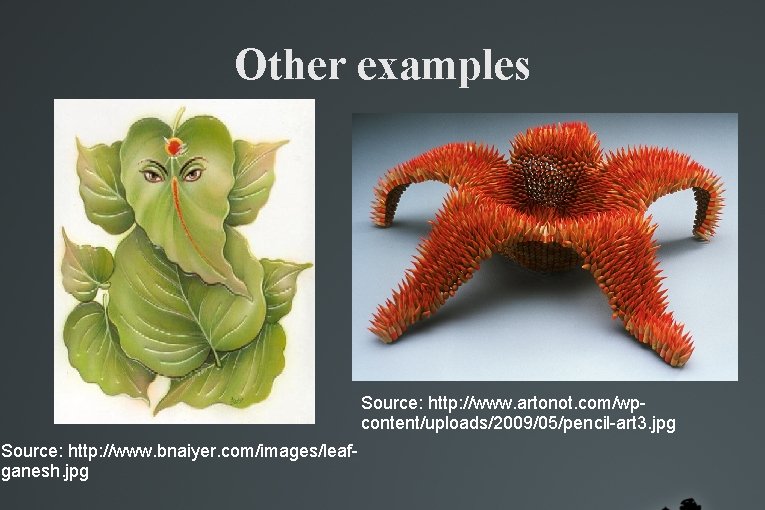
Other examples Source: http: //www. artonot. com/wpcontent/uploads/2009/05/pencil-art 3. jpg Source: http: //www. bnaiyer. com/images/leafganesh. jpg
Motivation Creativity is more of a MYSTERY. Examples above are human creativity skills. Understand the process behind human creativity. Understand by simulating with machines. Better creative systems can be built. That will also reflect how much we have understood.
How to be creative Come up with many ideas. Then discard useless ones. "Assumptions-breaking process" Discard the preconcieved assumptions. Attempt a new approach Element of chance
Distinguishing creativity and Innovation Creativity is referred to the act of producing new and novel ideas. While innovation is referred to the act of producing a new and novel idea and the idea is applied in some specific context. Creativity is starting point for innovation Former necessary but not sufficient for latter.
Human Creativity Margaret Boden categorizes creativity into P-creativity H-creativity P stands for psycological H stands historical Boden, M. (1991). The Creative Mind: Myths and Mechanisms.
P-creativity A novel idea that is new to person who comes up with it. Example – student coming up with an idea which is new to him even if it exists in literature This creativity interests to people like pyscologists, who wants to understand the process of creativity.
H-creativity A novel idea that is new to person who comes up with it and also new to everyone. Example – inventions, discoveries This creativity interests to people like general audience, historians, encyclopedia users etc. . H-creativity is an instance of P-creativity.
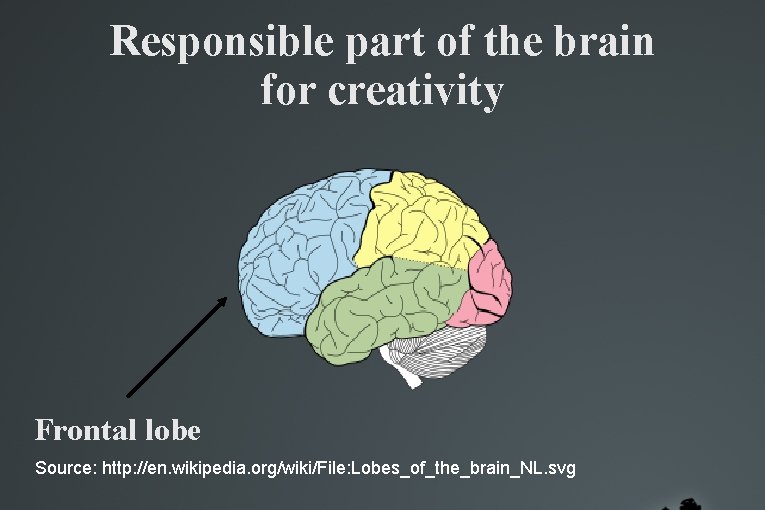
Responsible part of the brain for creativity Frontal lobe Source: http: //en. wikipedia. org/wiki/File: Lobes_of_the_brain_NL. svg
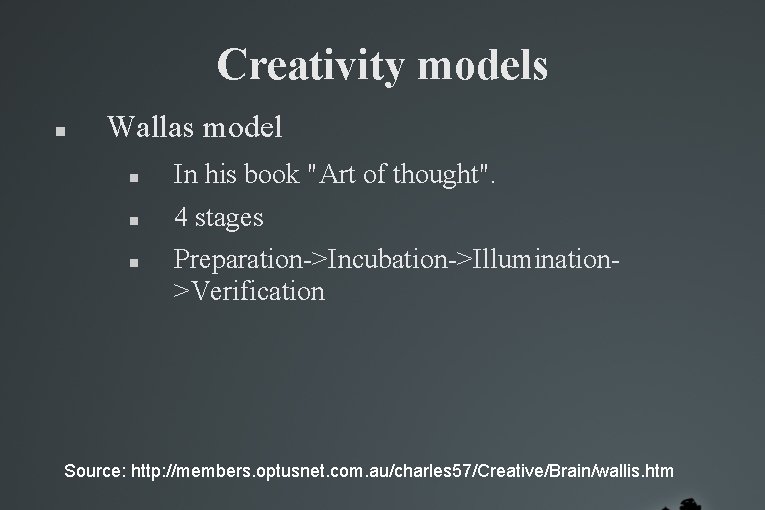
Creativity models Wallas model In his book "Art of thought". 4 stages Preparation->Incubation->Illumination>Verification Source: http: //members. optusnet. com. au/charles 57/Creative/Brain/wallis. htm
Creativity models Wallas model(contd. . ) Preparation : - we define the problem, need, or desire, and gather any information the solution or response needs to account for, and set up criteria for verifying the solution's acceptability.
Creativity models Wallas model(contd. . ) Incubation : - we step back from the problem and let our minds contemplate and work it through. Like preparation, incubation can last minutes, weeks, even years.
Creativity models Wallas model(contd. . ) Illumination : - ideas arise from the mind to provide the basis of a creative response. These ideas can be pieces of the whole or the whole itself, i. e, seeing the entire concept or entity all at once. Unlike the other stages, illumination is often very brief, involving a tremendous rush of insights within a few minutes or hours.
Creativity models Wallas model(contd. . ) Verification : - the final stage, one carries out activities to demonstrate whether or not what emerged in illumination satisfies the need and the criteria defined in the preparation stage.
Creativity models Geneplore model Two phases Generative phase : - one constructs mental representations called pre-inventive structures, having various properties that promote creative discovery. Exploratory phase : - These properties are then exploited during an exploratory phase in which one seeks to interpret the pre-inventive structures in meaningful ways. Source: Knowledge Transformers-a link between learning and creativity, SK Sim, AHB Duffy
Computational Creativity Goal Model Simulate Replicate human creativity
Computational Creativity To Achieve To construct a program or computer capable of human-level creativity To better understand human creativity and to formulate an algorithmic perspective on creative behavior in human to design programs that can enhance human creativity without necessarily being creative themselves Source: Wikipedia – Computational Creativity.
Defining creativity in computational terms 1. Novel and Useful important qualities of a creative product 2. Demands that we reject ideas we had previously accepted 3. Results from intense motivation and persistence 4. Comes from clarifying a problem that was originally vague 2 -4 characterize the attitude and actions of the producer of such a product Source: Wikipedia – Computational Creativity.
Three Forms of creativity Combinational Creativity Exploratory Creativity Transformational Creativity Source: Creativity and artificial intelligence -Margaret A. Boden
Combinational Creativity Unfamiliar combination of familiar ideas. -Eg. Journalist comparing a politician/terrorist with a deadly animal. -Requires rich store of knowledge. -Valued only if some link is found between them.
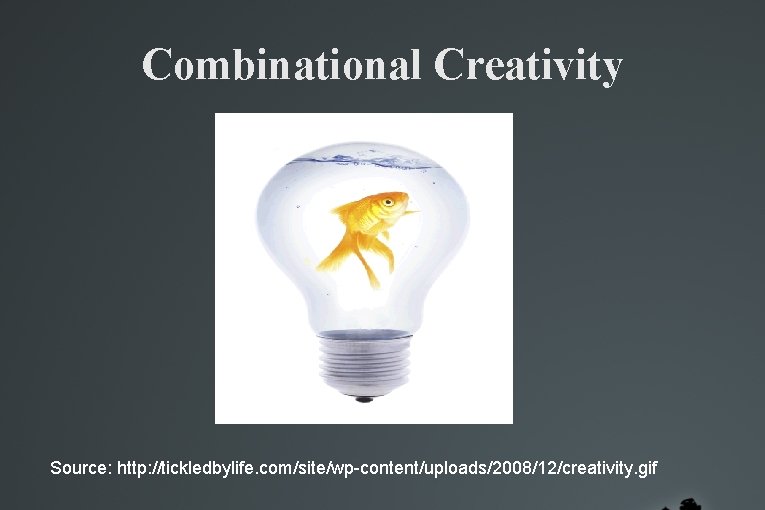
Combinational Creativity Source: http: //tickledbylife. com/site/wp-content/uploads/2008/12/creativity. gif
Exploratory Creativity Exploration within an established Conceptual space More likely to arise from a thorough and persistent search of a well-understood space (criterion 3 of Newell and Simon)
Transformational Creativity Arises from a deliberate transformation of the conceptual space Transformational creativity should involve the rejection of some of the constraints that define this space (criterion 2) Some of the assumptions that define the problem itself (criterion 4).
Artificial Creativity is concerned with producing behavior in machines, which if acted out by a human, would be deemed creative So, One of the ultimate goals of artificial creativity research is to replicate creativity as it appears in humans Source: http: //www. thinkartificial. org/artificial-creativity/
Artificial Creativity The complexity of human activities has led research to fragment into focus on specialized systems for particular activity, rarely encompassing systems integration to any significant extent. This divide & conquer approach to human creativity has arguably proven limited for explaining the origins and nature of creativity, and how its multifaceted processes are intertwined with intelligence
A fundamental problem in implementing creative systems Not only do we lack understanding of our own creative mechanisms, but the basics of computer programs seem to oppose the idea of achieving unbound originality Source: http: //www. thinkartificial. org/artificial-creativity/
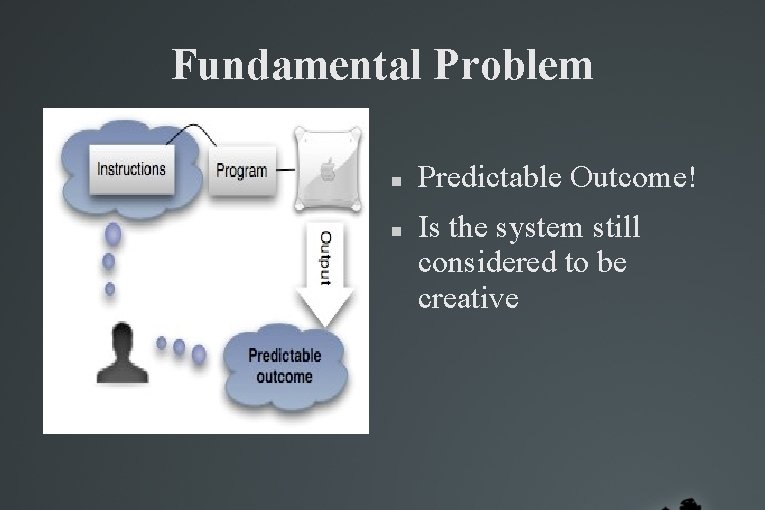
Fundamental Problem Computer programs are Instructions Programming require explicit designing of mechanisms that produce certain outcomes. By giving these explicit instructions the potential of a program acting in novel ways is decreased, since clearly it means that it’s known beforehand how the system will behave. The instructions that define programs (and make them work) are in turn the exact reason it’s hard to produce surprising, novel and interesting ideas
Fundamental Problem Predictable Outcome! Is the system still considered to be creative
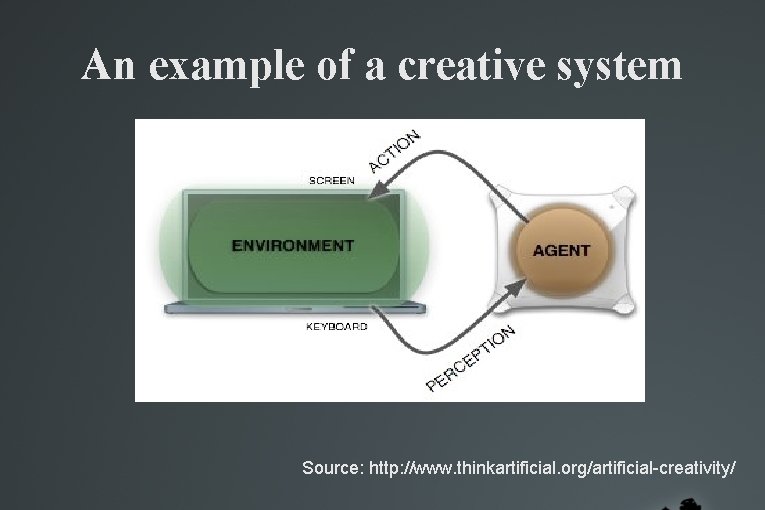
An example of a creative system Source: http: //www. thinkartificial. org/artificial-creativity/
An example of a creative system In between receiving input and presenting output is, of course, a program that maps the input to output In order to make our agent write something other than nonsense, He must have a dictionary of words He must know grammar He must also have common sense
Instructions are limitations When we gave our agent a dictionary, a goal, grammar knowledge and common sense, we effectively restricted him: He’s not a painter He’s not a musical composer He’s not a programmer
Instructions are limitations A goal limits the objectives of a system and thereby helps us organize how the system will behave But these restrictions are necessary for him to do anything at all
Solution But how about a self-organizing program that writes its own code on the fly to overcome its restrictions? This problem is also being slowly overcome with the use of neural networks, genetic algorithms and other complex systems and complex adaptive systems. Source: http: //www. thinkartificial. org/artificial-creativity/
Case Studies
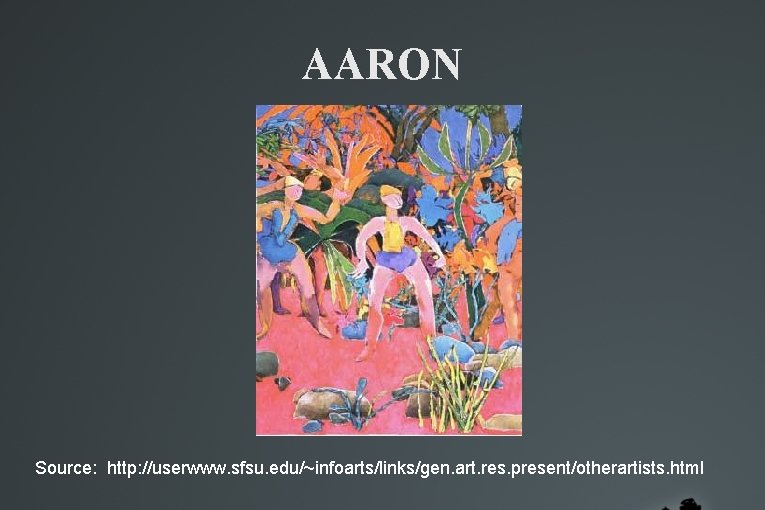
AARON By Harold Cohen A program that creates original artistic images Triggered by scribbling behaviour The next step depends on the pre-existing core figure Initially drew black and white Source: http: //en. wikipedia. org/wiki/AARON
AARON Development began in C, later in Lisp (which added color) Each new style has to be hand coded. Can draw infinite distinct images. If its not thinking, what exactly is it doing? - Cohen
AARON Source: http: //userwww. sfsu. edu/~infoarts/links/gen. art. res. present/otherartists. html
RACTER by William Chamberlain and Thomas Etter Generates English language prose at random plays active role in conversation jumps from topics in a wild manner. artificially insane (as Tom Etter calls it) The book The Policeman's Beard is Half Constructed was written by Racter
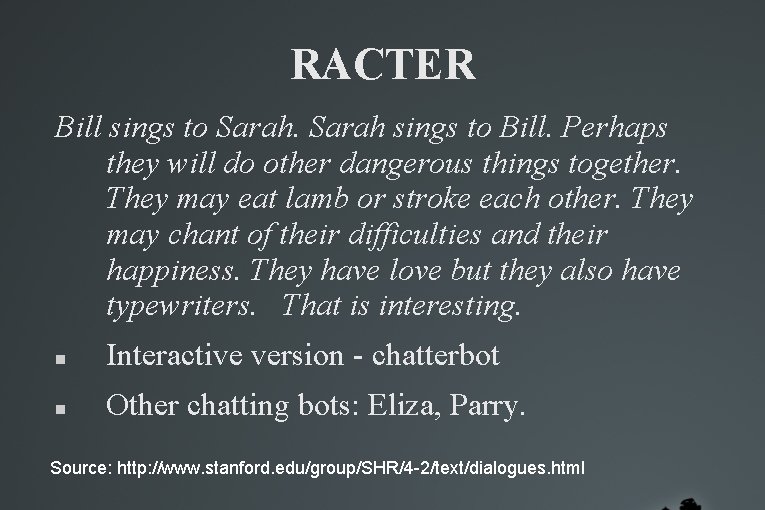
RACTER Bill sings to Sarah sings to Bill. Perhaps they will do other dangerous things together. They may eat lamb or stroke each other. They may chant of their difficulties and their happiness. They have love but they also have typewriters. That is interesting. Interactive version - chatterbot Other chatting bots: Eliza, Parry. Source: http: //www. stanford. edu/group/SHR/4 -2/text/dialogues. html
Story Generation : TALE-SPIN Author (program) generates stories in pursuit of her own goals or Each character tries to accomplish its goal Based on the model of : the storyworld, the characters in it, their goals, personalities, and interpersonal relations. Source: STORY GENERATION AFTER TALE-SPIN - Natalie Dehn, Yale University
Story Generation Three levels of simulation: Character intentionality if Tom was hungry, he will search for food Social constraints if John is Tom's friend, he will ask him a favour, if his best friend, he will return the favour Physical causality If a snake ate a frog, the frog would cease to exist.
BRUTUS can understand self-deception and betrayal through formal definitions of the rules. mathematizing through a series of algorithms and data structures Cleverly programmed to appear, to be in case literally creative. dimension responsible for wide variability: plot, characters, settings, literary themes, writing style, imagery, etc. Source: Inside the Mind of Brutus, a Storytelling Machine - Selmer Bringsjord and David Ferrucci, August 30, 1999
BRUTUS Brutus is designed to satisfy these seven characteristics: 1. Strong creativity - capable of raw imagination 2. Imagery generation 3. Defining the mental state of the characters 4. Mathematical formalization of themes 5. Genuinely interesting stories sex, money, death, betrayal, ruthless, etc. 6. Structured stories 7. Constrained prose
References http: //en. wikipedia. org/wiki/Creativity http: //en. wikipedia. org/wiki/Computational_creativity www. cad. strath. ac. uk/AID 02_workshop/knowledge. pdf Boden, M. (1991). The Creative Mind: Myths and Mechanisms. New York: Basic Books. Margaret A. Boden. Creativity and Artificial Intelligence, 103: 347– 356, 1998. Dehn, N. (1981) “Story Generation After TALE-SPIN, ” IJCAI 81 (San Mateo, CA: Morgan Kaufmann), 16– 18. Sim, S. K, Dufy, A. H. B. , (2002). Knowledge Transformers-a link between learning and creativity, AID 02 Workshop on Learning and Creativity.
Thank you
Questions