
Creative Thinking and ArtsBased Learning Preschool Through Fourth
Creative Thinking and Arts-Based Learning: Preschool Through Fourth Grade Chapter 2 Supporting Children’s Play, Games, and Creativity 1
Creative Thinking and Arts-Based Learning: Preschool Through Fourth Grade Chapter 2 Supporting Children’s Play, Games, and Creativity Prepared by Dr. J. Hodge 2
Learning Objectives 2. 1 Describe theoretical and research base of play. 2. 2 Explain how children learn through play. 2. 3 Identify the developmental sequence for different types of play. 2. 4 Consider teachers’ roles in supporting children’s play, games, and creativity. 2. 5 Differentiate instruction for diverse learners. Prepared by Dr. J. Hodge 3
Characteristics of Play page 41 Play is: • Voluntary and intrinsically motivated – Children freely choose what to play (content) and how to play (direction) with no external demands • Symbolic, meaningful, and transformational – Helps children connect experience with current world – Allows them to “transform” themselves into different roles in different situations – As others , they assume a “what if” or “as if” attitude Prepared by Dr. J. Hodge 4

Characteristics of Play page 41 Play is: • Active – Children experiment, explore, investigate, and inquire with people, objects and events • Rule-bound – Either explicit or implicit rules – Children both create and change rules – Older children accept predetermined rules • Pleasurable – Just for fun and not for a reward Prepared by Dr. J. Hodge 5
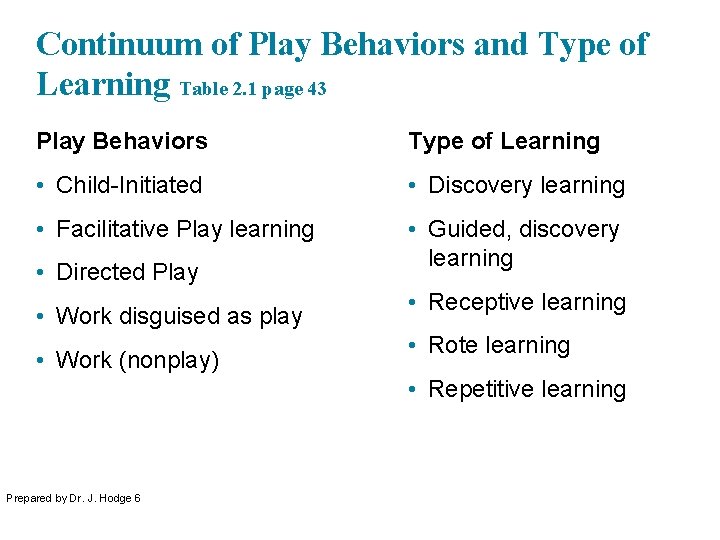
Continuum of Play Behaviors and Type of Learning Table 2. 1 page 43 Play Behaviors Type of Learning • Child-Initiated • Discovery learning • Facilitative Play learning • Guided, discovery learning • Directed Play • Work disguised as play • Work (nonplay) • Receptive learning • Rote learning • Repetitive learning Prepared by Dr. J. Hodge 6
Play Promotes Cognitive Development Table 2. 2 page 48 and pages 50 -51 Since the 1990 s, research in neuroscience (how the brain functions), inquiry learning (the process of asking and answering questions) as in Reggio Emilia, and the whole child, that all the domains of children’s development are fundamental to children’s well-being have contributed to supporting the value of play. When they play, children use: • Problem solving • Mental planning • Self-monitoring • Evaluation Prepared by Dr. J. Hodge 7
Theories of Why Children Play Table 2. 2 page 46 Modern Theories • Psychoanalytic theory - Freud and Erikson • Cognitive-developmental theory - Piaget and Bruner • Sociocultural theory - Vygotsky Prepared by Dr. J. Hodge 8
Modern Theories of Play Table 2. 2 page 46 • Psychoanalytic theory – emotional release and for developing self esteem; Freud and Erikson • Cognitive developmental theory – children create their own knowledge and flexible thinking and creative problemsolving; Piaget and Bruner • Sociocultural theory – Leads children’s development beyond or at regular ability; mental support like invented games; Vygotsky Prepared by Dr. J. Hodge 9

Theories of Why Children Play Classical Theories • Surplus-energy theory • Recreation / relaxation theory – alternate between quiet and active times • Practice theory – preparing for future roles and responsibilities • Recapitulation theory – instincts; learning to live in today’s world Prepared by Dr. J. Hodge 10
Play Helps Children Understand Literacy page 52 During play, children demonstrate: • Knowledge of story elements and story comprehension – Character, plot, setting, goal, and conflict – Can use play to “write and read” by making shopping list or environmental print • Understanding fantasy in books – Dramatic play – transform to be other characters or things • Use of symbols to represent their world – Inventing their own storyline is abstract thinking, which is necessary to become literate Prepared by Dr. J. Hodge 11
Play Supports Social Development page 52 During play, children: • Engage and practice verbal and nonverbal communication • Respond to peers’ feelings • Experiment with roles of home, community and school • Experience others’ points of view by working through conflicts about space, materials, rules, or responsibilities positively Prepared by Dr. J. Hodge 12
Play Helps Children Express Feelings and Support Emotional Development page 54 During play, children express their feelings by: • Simplifying events with imaginary characters, plots, and settings to match their own emotional states – For example, resolving being afraid of the dark • Compensating for situations by adding forbidden acts to pretend play – For example, eat cookies and ice cream for breakfast • Controlling emotions by reenacting frightening/unpleasant experiences to “play out” those experiences Prepared by Dr. J. Hodge 13
Play Promotes Physical Development During play, children use: • Fine and gross motor skills – – Fine motor skills - learning to use a writing tool – Gross motor skills – using movement like hopping, skipping, and other locomotor skills • Skills related to body awareness – movement influence self esteem and helps maintain health and weight • Children require at least 60 minutes throughout the day of regular age-appropriate physical activity including outside play when possible. Prepared by Dr. J. Hodge 14
Benefits of Physical Activity • Physical activity not only contributes to children’s health and well-being but also stimulates brain activity that contributes to children’s learning and readiness to learn. Providing children with multiple opportunities for physical activity throughout the day has benefits. Physical activity supports: • Brain activity, improved cognitive and academic performance, and behavior • Increases fundamental movement abilities that improves self-concept, self-discipline, psychological well-being and problem-solving skills. Prepared by Dr. J. Hodge 15
Play Encourages Creativity During play, children’s creativity is developed as they: • Problem solve • Develop the abilities to be successful in new situations • Locomotion skills are walking, running, hopping, jumping, galloping, leaping, side-sliding, and skipping. Prepared by Dr. J. Hodge 16
Development of Cognitive Play Table 2. 3 page 59 • Functional play - repeated movements with objects, people, and language • Symbolic play - pretense and make-believe • Sociodramatic play - 2 or more children who communicate about the play • Constructive play - create something or engage in problem-solving, based on plan • Games with rules - prearranged rules, with reciprocity and turn-taking Prepared by Dr. J. Hodge 17
Levels of Social Play Table 2. 5 page 65 Levels of Social Play • Unoccupied behavior • Onlooker behavior • Solitary play • Parallel play • Associative play • Cooperative play Prepared by Dr. J. Hodge 18
Teachers’ Roles in Children’s Play • Teacher should support children’s play through a scaffolding process but in no way control or dominate the direction of children’s play • Observer - note children’s roles, preferred themes, when help is needed, when (or not) to intervene – See when to intervene page 66 • Collaborator – sometimes children get stuck a teacher can extend children’s play with new toys, ideas, questions • Planner - plan environment with plenty of space to promote different types of play and skills of individual children (but not wide open spaces) Prepared by Dr. J. Hodge 19
Teachers’ Roles in Children’s Play (2 of 2) • Responder - provide feedback about children’s actions and words using their own words and actions • Model - demonstrate behavior or role in ongoing play theme • Mediator – serve as a bridge between children’s level of initial understanding to help children develop deeper understanding Prepared by Dr. J. Hodge 20
Supporting Play in an Inclusive Classroom • Provide ample opportunities for indoor and outdoor play • Model specific skills to peer group that will support the diverse abilities of all members of the classroom – Visual cues for children with sight impairments – Repeating game instructions – Modeling game behaviors Prepared by Dr. J. Hodge 21
Integrating the Curriculum Using Games and Technology • Why use Games? • Differentiating instruction for diverse learners through games • Play and Technology – Digital Interactives (dynamic web content housed on a website to encourage interaction) – Figure 2. 1 on page 71 – Figure 2. 2 on page 72 – Figure 2. 3 on page 73 Prepared by Dr. J. Hodge 22
Concluding Key Points • Play is a children’s natural resource for developing the knowledge, skills and dispositions that affect their present and future. • Best practices in each area of the curriculum, such as hands on science, math manipulatives, music laboratories, and writers workshops, it is easy to see that all of these approaches are play-oriented and support children’s curiosity, motivation, attention, and thinking. • Early childhood teachers must understand that play offers all children a way to express themselves, test their knowledge, and supports their learning. Prepared by Dr. J. Hodge 23
- Slides: 23