
Creative Thinking and ArtsBased Learning Preschool Through Fourth
Creative Thinking and Arts-Based Learning: Preschool Through Fourth Grade Seventh Edition Chapter 5 Exploring Drama Prepared by Dr. J. Hodge Chapter 05 Exploring Drama 2019 1
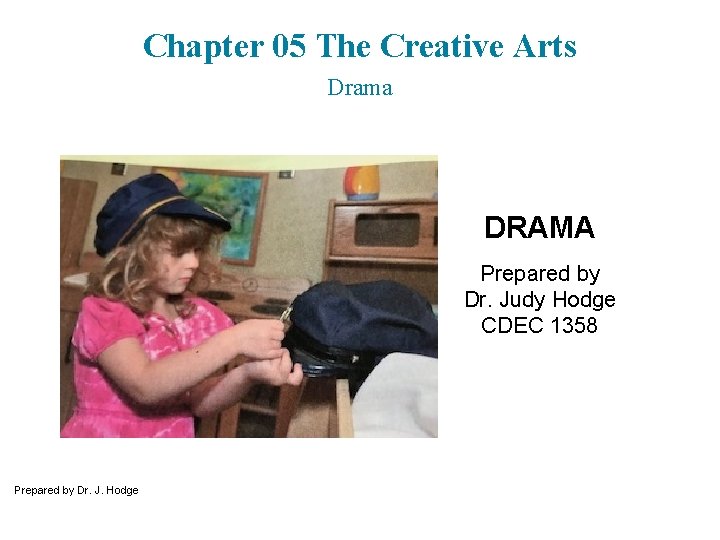
2 Chapter 05 The Creative Arts Drama DRAMA Prepared by Dr. Judy Hodge CDEC 1358 Prepared by Dr. J. Hodge

Learning Objectives 5. 1 Describe theoretical and research base of drama. 5. 2 Discuss how children learn through drama. 5. 3 Use a variety of strategies to teach drama. 5. 4 Identify teachers’ roles in supporting drama. 5. 5 Differentiate drama instruction for diverse learners. Prepared by Dr. J. Hodge 3
Multiple Intelligences Used in the Dramatic Arts – Page 173 Table 5. 1 • Bodily / Kinesthetic – Use body to express feelings, thoughts, and solve problems • Interpersonal – Distinguish moods, intentions, feelings of others, and respond sensitively • Intrapersonal – Detecting own moods, needs, desires • Verbal / Linguistic – Using words and language to understand others Prepared by Dr. J. Hodge 4
Enactment as a Kind of Learning • Drama occurs when children adopt the actions, feelings, thoughts, and behaviors of people in particular situation. • Enactment allows children to: – Use roles, create dialogue, feel emotions, use bodies, make decisions – Use personal experiences to solve problems – Develop knowledge of roles, actions, behaviors – See others’ points of view – Try out skills – Explore forms and functions of language Prepared by Dr. J. Hodge 5
Forms of Enactment or Drama Table 5. 2 page 176 • Informal drama - includes dramatic and sociodramatic play – Spontaneous and child-centered – Dramatic play, improvisation, pantomime • Story or interpretive drama – Interpreting someone else’s ideas and words • Formal or scripted drama – Production before an audience – Not appropriate before 4 th grade Prepared by Dr. J. Hodge 6
Importance of Dramatic Arts q. Stimulates imagination and respect individuality q. Requires cooperation and teamwork q. Provides opportunities to be actors and audiences q. Offers meaningful opportunities for children to practice content area and skills q. Contributes to empathy, tolerance and self-regulation q. Can be useful with behavior management q. Makes teaching and learning more socially and culturally responsive, more relevant to students’ lives, and more collaborative while promoting deep understanding that goes beyond test preparation Prepared by Dr. J. Hodge 7
Benefits of Drama Activities • Drama experiences help children: – Develop reading, listening, speaking, writing, comprehension, and acting skills – Build skills in thinking analytically and acting decisively and responsibly – Strengthen ability to concentrate, follow directions, cooperate, and negotiate – Deepen understanding of subject area – Show knowledge in different forms Prepared by Dr. J. Hodge 8
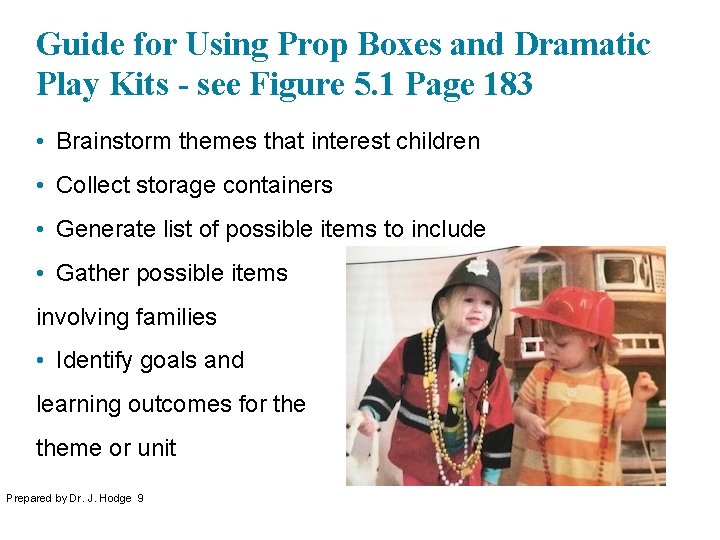
Guide for Using Prop Boxes and Dramatic Play Kits - see Figure 5. 1 Page 183 • Brainstorm themes that interest children • Collect storage containers • Generate list of possible items to include • Gather possible items involving families • Identify goals and learning outcomes for theme or unit Prepared by Dr. J. Hodge 9
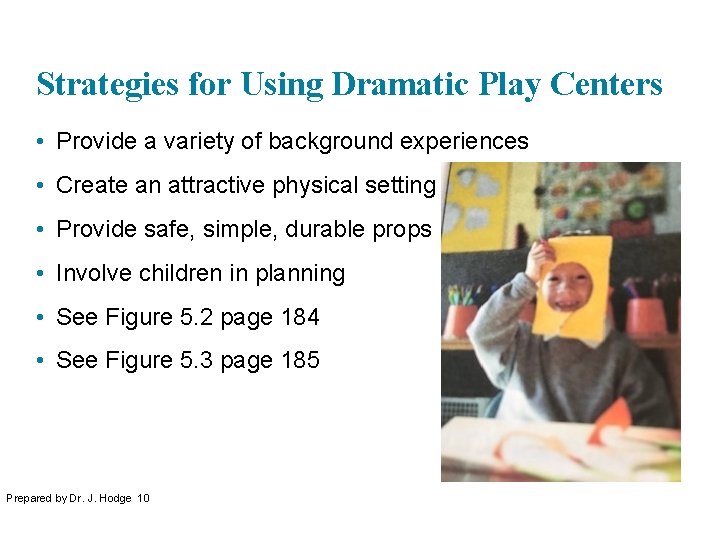
Strategies for Using Dramatic Play Centers • Provide a variety of background experiences • Create an attractive physical setting • Provide safe, simple, durable props • Involve children in planning • See Figure 5. 2 page 184 • See Figure 5. 3 page 185 Prepared by Dr. J. Hodge 10
Benefits of Pantomime • Pantomime is the starting point for drama • Pantomime helps children: – Develop confidence and tools for later story dramatization – Communicate nonverbally – Convey understanding of characters and events – Develop skills in acting, concentrating, listening, language, and audience awareness Prepared by Dr. J. Hodge 11
Strategies for Using Puppets Pages 190 -191 Figure 5. 5 • Provide opportunities for children to experiment with different puppets • Create a puppet center • Puppets is a perfect props for all drama • Use puppets to help children express feelings with their voices • Teach children some basic puppet actions • Create puppets that illustrate what children are learning • Provide guidelines for safety and management Prepared by Dr. J. Hodge 12
Strategies for Using Story Drama • Begin with familiar stories like poems, fables, or original stories - Involve children in selection of story • Discuss story structure: Choose stories with immediate action, simple plot, few characters, and appealing dialogue • Be a facilitator: Prepare thought-provoking questions that help children focus on both story and drama elements, like “How do these feelings ”act” like in body and voice? ” • Provide time and space for children to plan dramatization, decide which parts to read or enact, and explore their characters • Reflect on the enactment with open-ended questions Prepared by Dr. J. Hodge 13
Strategies for Using Readers’ Theater • Select material that is action-based and can be interpreted in a dramatic fashion • Provide several group read alouds, then choose or assign parts • Have readers sit or stand, with books in front of them, while they read and act • Props are not necessary; focus is on facial and vocal expressions, gestures and imagination to interpret story • Choose narrator or director: either teacher-led with child narrator or child directed with child narrator Prepared by Dr. J. Hodge 14
Teachers’ Roles and Responsibilities • Teach both drama skills and content area skills • Define the space to be used • Model a behavior or attribute • Ask questions that provoke imagination and thinking • Address roles of participants and audience • Allow adequate time • Reflect with children Prepared by Dr. J. Hodge 15
Drama in the Inclusive Classroom • Use props to make learning concrete • Begin with simple activities • Adopt a buddy system • Keep activity levels high and short • Invite children to take leadership roles • Maintain safe and supportive environment • Provide long-term projects to increase interest in dramatic arts Prepared by Dr. J. Hodge 16
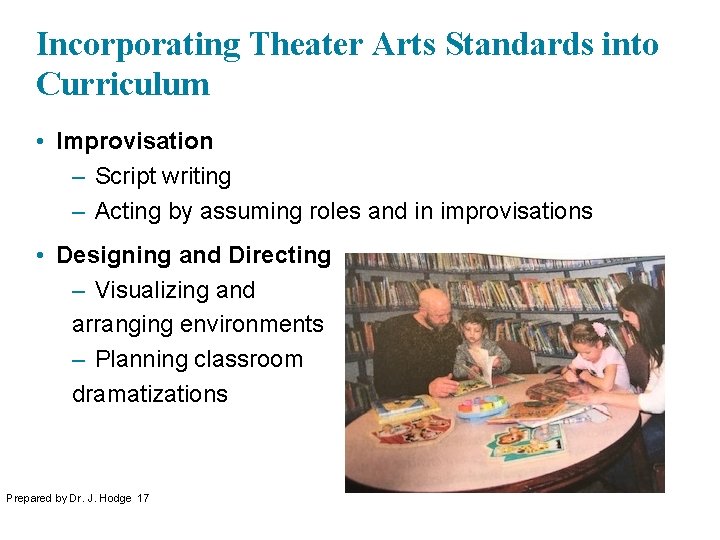
Incorporating Theater Arts Standards into Curriculum • Improvisation – Script writing – Acting by assuming roles and in improvisations • Designing and Directing – Visualizing and arranging environments – Planning classroom dramatizations Prepared by Dr. J. Hodge 17
Incorporating Theater Arts Standards into Curriculum • Researching, Comparing, and Analyzing Art Forms – Find information to support classroom dramatizations – Compare and connect art forms of theater, dramatic media, and other performing arts • Analyzing and Utilizing Forms of Media – Explain personal preferences and meanings from classroom dramatizations and media productions Prepared by Dr. J. Hodge 18
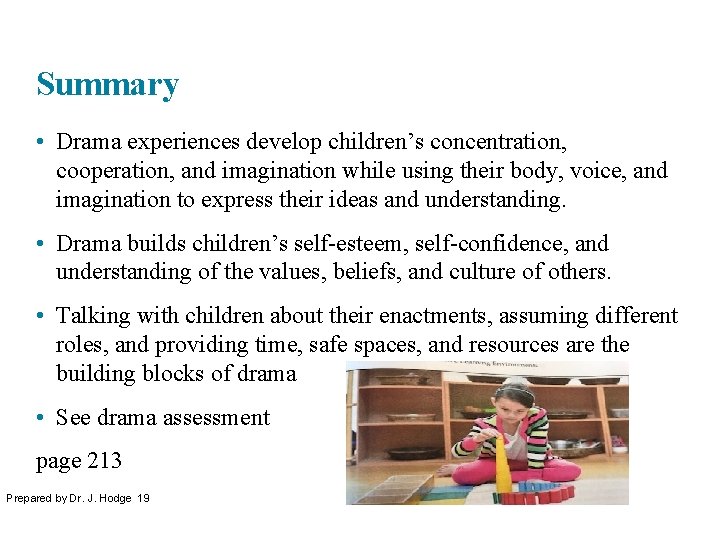
Summary • Drama experiences develop children’s concentration, cooperation, and imagination while using their body, voice, and imagination to express their ideas and understanding. • Drama builds children’s self-esteem, self-confidence, and understanding of the values, beliefs, and culture of others. • Talking with children about their enactments, assuming different roles, and providing time, safe spaces, and resources are the building blocks of drama • See drama assessment page 213 Prepared by Dr. J. Hodge 19
- Slides: 19