
Creative Thinking and ArtsBased Learning Preschool Through Fourth
Creative Thinking and Arts-Based Learning: Preschool Through Fourth Grade Seventh Edition Chapter 7 Assessing the Creative Processes and Products of Children Prepared by Dr. J. Hodge 1

Define performance assessment as it pertains to children’s creativity and the arts. Learning Objective s Describe theoretical perspectives on identifying talent and giftedness in children. Explain why, what, and how to conduct assessments of children’s creative processes and products. List and describe key assessment roles and responsibilities of teachers. Prepared by Dr. J. Hodge 2
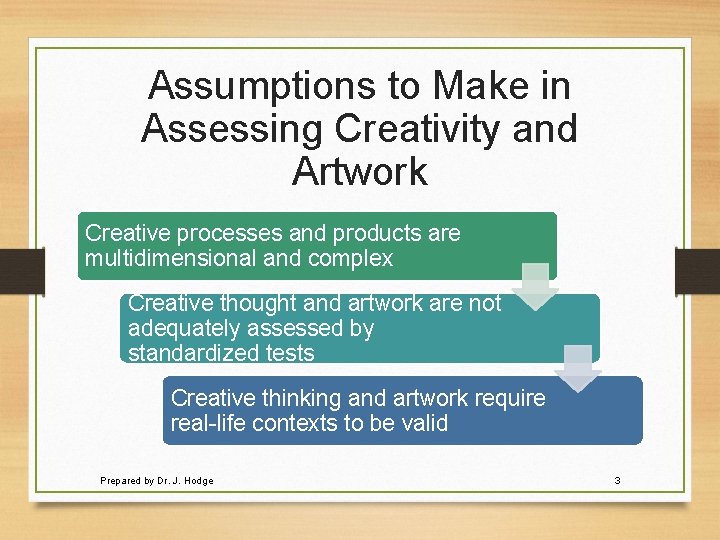
Assumptions to Make in Assessing Creativity and Artwork Creative processes and products are multidimensional and complex Creative thought and artwork are not adequately assessed by standardized tests Creative thinking and artwork require real-life contexts to be valid Prepared by Dr. J. Hodge 3
Assessment of Creative Work Figure 7. 2 page 258 • Gives students equal • Provides opportunity to participate and adapted to special needs • Considers not only the products but also the processes. Prepared by Dr. J. Hodge opportunities for students to revisit the work, refine, and revise. • Is supportive of collaborative and cooperative learning. 4
Consider real purposes of assessment The “Why” of Assessme nt Prepared by Dr. J. Hodge Assessment should help teachers to: • Identify and respond appropriately to individual children • Make instructional decisions to benefit the child • Evaluate program effectiveness 5
Find a focus The “What” of Assessme nt Figure 7. 5 page 265 Prepared by Dr. J. Hodge Clarify what should be assessed: • Content knowledge • Children’s understanding of processes and procedures • Evidence of effort • Other 6
Formative Assessment – occurs while work is being developed • Allows teachers to recognize the need for changes in the • physical environment: materials, equipment, room arrangement • and pedagogical approaches: ways of giving instruction, or demonstrations, or content, or grouping Prepared by Dr. J. Hodge Examples of formative assessment: • Class discussion • Small group interaction • Journal entries • Skills inventories • Homework assignments 7
The “How” of Assessme nt Prepared by Dr. J. Hodge Formative assessment assess along the way in order to adjust to learners’ needs Various assessment methods • Prepared by the teacher • Produced and assessed by the child • Assessed by the family/community 8
Assessments Prepared by the Teacher Guideline: provide a more holistic view of what children know and can do • • • Anecdotal records Checklists / developmental profiles / logs Conference notes Interviews Documentation panels Prepared by Dr. J. Hodge 9
Assessmen ts Prepared by the Student Prepared by Dr. J. Hodge Guideline: children bear responsibility for identifying best work and explaining why they have included it • Self-selected work samples • Rating scales or checklists • Child-led conferences 10
Assessmen ts Prepared by the Family and/or Community Prepared by Dr. J. Hodge Guideline: parents, families, and community members are involved in assessing children’s growth • Conferences with parents and families • Review of live or taped individual or group performances • Responses to portfolios 11
Summative Assessment pages 259 -260 • Summative assessment happens after the task or project is finished • Example: Culminating event – evaluate the effectiveness of the Prepared by Dr. J. Hodge instruction through culminating event. • Examples: musical performances, discussions of an event, exhibit, art display of work, demonstration of mastery, story writing, technologybased presentation of skills 12
Teachers’ Roles and Responsibilities Observe r Prepared by Dr. J. Hodge Interacto r Evaluato r 13
Observer Role Use direct observational data Accurately record verbal and nonverbal data Describe context in which behavior occurred Observations become the basis for planning curriculum Prepared by Dr. J. Hodge 14
Performance Assessment • Performance Assessment – is the process of discovering children’s knowledge, abilities, and interests. • It emphasizes not only what they know but also what they Prepared by Dr. J. Hodge understand can do • Performance Assessment Example: Writing a letter • See Figure 7. 1 page 256 for characteristics and other examples 15
Tasks performed by children are relevant and interesting Evaluator Role: Characteristic s of Performance Assessment Prepared by Dr. J. Hodge Products and processes used to achieve them are evaluated Students develop skills in self-evaluation as they select their best work 16
Students’ attitudes and feelings are considered Evaluator Role: Characteristic s of Performance Assessment Prepared by Dr. J. Hodge Results used to optimize learning Data used to improve classroom practice and inform instruction Results produce holistic picture of student performance 17
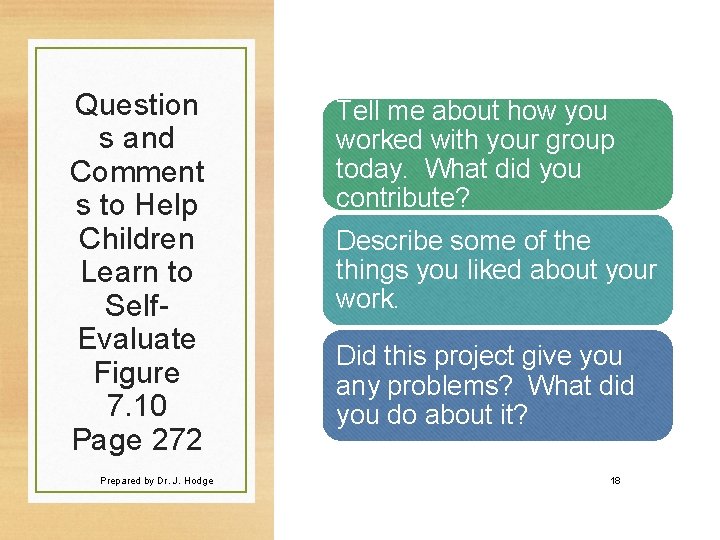
Question s and Comment s to Help Children Learn to Self. Evaluate Figure 7. 10 Page 272 Prepared by Dr. J. Hodge Tell me about how you worked with your group today. What did you contribute? Describe some of the things you liked about your work. Did this project give you any problems? What did you do about it? 18
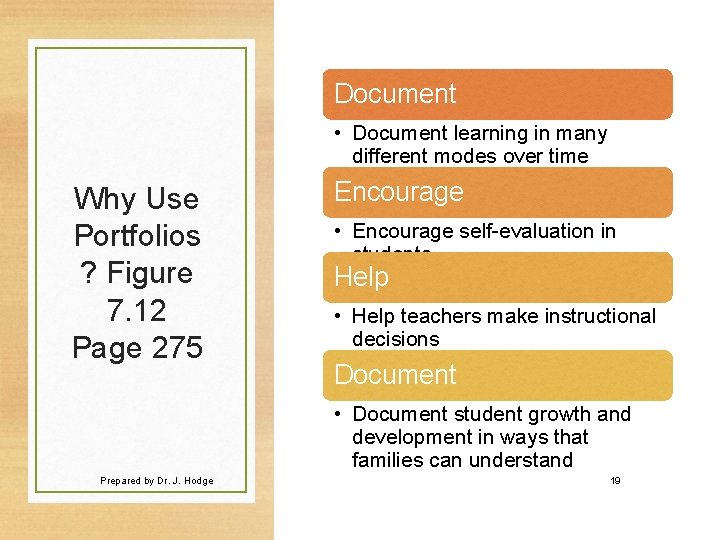
Document • Document learning in many different modes over time Why Use Portfolios ? Figure 7. 12 Page 275 Encourage • Encourage self-evaluation in students Help • Help teachers make instructional decisions Document • Document student growth and development in ways that families can understand Prepared by Dr. J. Hodge 19
- Slides: 19