
Creative Europe Culture Investing into identity inclusiveness tolerance
- Slides: 27
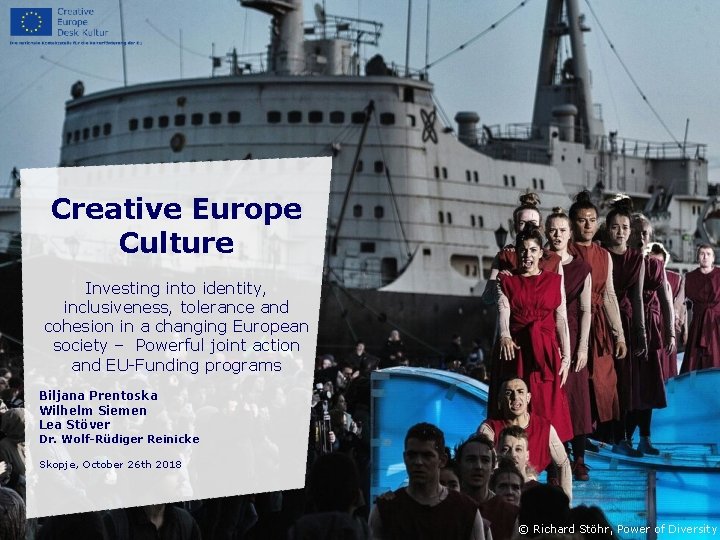
Creative Europe Culture Investing into identity, inclusiveness, tolerance and cohesion in a changing European society – Powerful joint action and EU-Funding programs Biljana Prentoska Wilhelm Siemen Lea Stöver Dr. Wolf-Rüdiger Reinicke Skopje, October 26 th 2018 © Richard Stöhr, Power of Diversity
Agenda 1. Introduction to EU cultural policy 2. What is Creative Europe Culture? 3. LIONS and Creative Europe Culture 4. Interreg A – Cooperation between Member States 5. Other EU-Programmes
Introduction to EU cultural policy https: //www. youtube. com/watch? v=Fz 7 c 0 ASWf. Qo&feature=youtu. be
Introduction to EU cultural policy Council Work Plan for Culture 2015 -2018 Treaty of Lisbon 4 priorities: Articel 167 • • Principle of Subsidiarity: protection of cultural independence of EU Member States Cultural compatibility clause: Culture as „cross cutting task“ • Cultural promotion within the EU • • • accessible and inclusive cultural heritage creative economy and innovation the promotion of cultural diversity
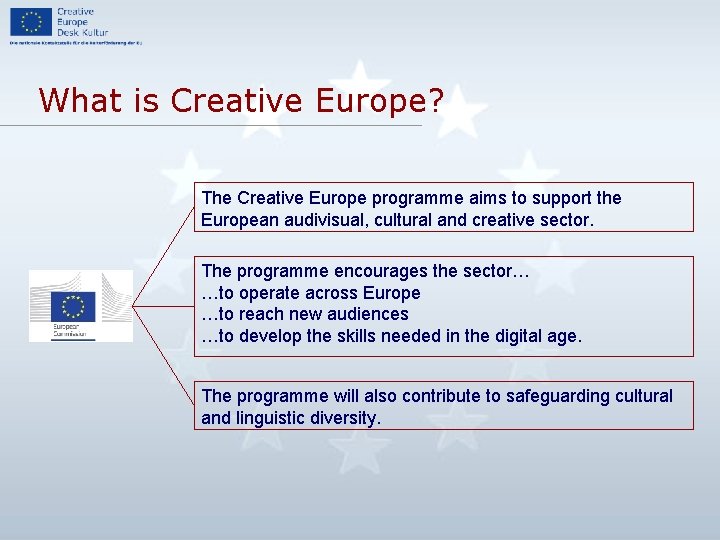
What is Creative Europe? The Creative Europe programme aims to support the European audivisual, cultural and creative sector. The programme encourages the sector… …to operate across Europe …to reach new audiences …to develop the skills needed in the digital age. The programme will also contribute to safeguarding cultural and linguistic diversity.
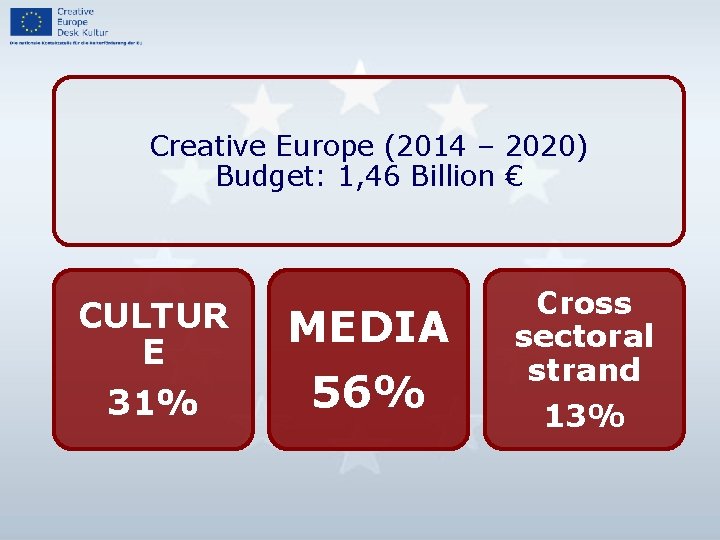
Creative Europe (2014 – 2020) Budget: 1, 46 Billion € CULTUR E 31% MEDIA 56% Cross sectoral strand 13%
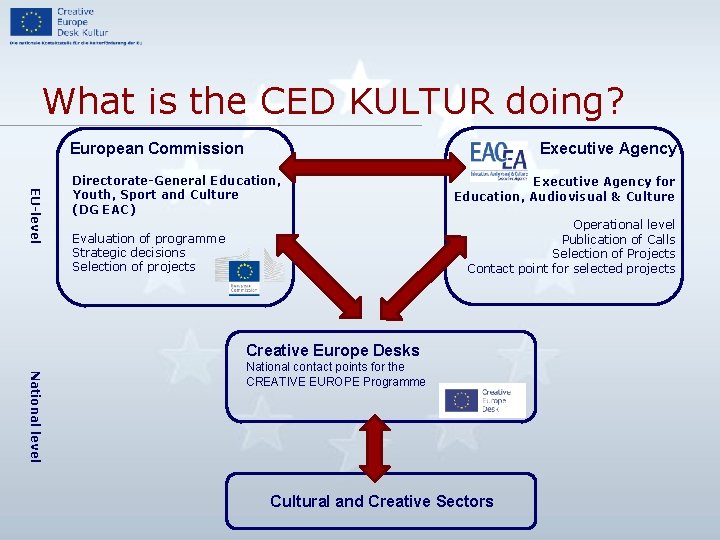
What is the CED KULTUR doing? European Commission Executive Agency EU-level Directorate-General Education, Youth, Sport and Culture (DG EAC) Executive Agency for Education, Audiovisual & Culture Operational level Publication of Calls Selection of Projects Contact point for selected projects Evaluation of programme Strategic decisions Selection of projects Creative Europe Desks National level National contact points for the CREATIVE EUROPE Programme Cultural and Creative Sectors
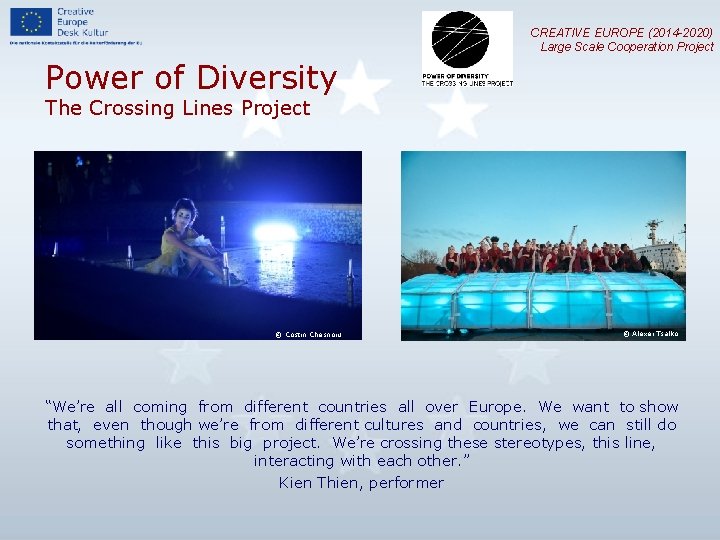
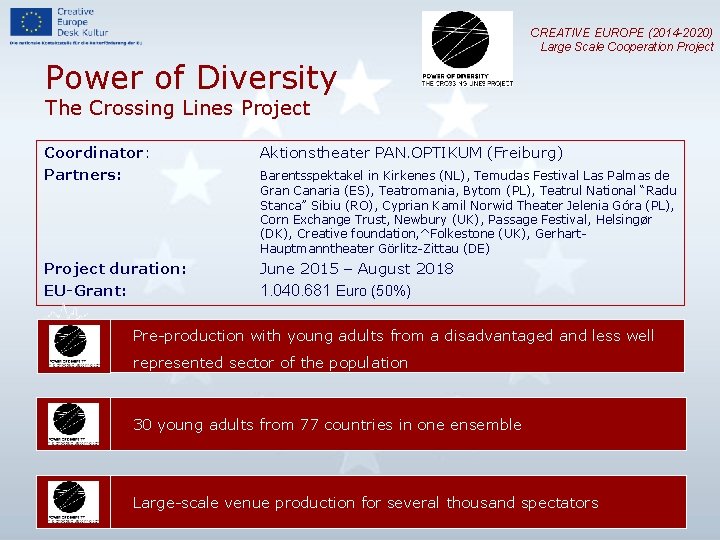
CREATIVE EUROPE (2014 -2020) Large Scale Cooperation Project Power of Diversity The Crossing Lines Project © Costin Chesnoiu © Alexei Tsalko “We’re all coming from different countries all over Europe. We want to show that, even though we’re from different cultures and countries, we can still do something like this big project. We’re crossing these stereotypes, this line, interacting with each other. ” Kien Thien, performer
CREATIVE EUROPE (2014 -2020) Large Scale Cooperation Project Power of Diversity The Crossing Lines Project Coordinator: Partners: Aktionstheater PAN. OPTIKUM (Freiburg) Project duration: June 2015 – August 2018 EU-Grant: 1. 040. 681 Euro (50%) Barentsspektakel in Kirkenes (NL), Temudas Festival Las Palmas de Gran Canaria (ES), Teatromania, Bytom (PL), Teatrul National “Radu Stanca” Sibiu (RO), Cyprian Kamil Norwid Theater Jelenia Góra (PL), Corn Exchange Trust, Newbury (UK), Passage Festival, Helsingør (DK), Creative foundation, ^Folkestone (UK), Gerhart. Hauptmanntheater Görlitz-Zittau (DE) Pre-production with young adults from a disadvantaged and less well represented sector of the population 30 young adults from 77 countries in one ensemble Large-scale venue production for several thousand spectators
Agenda 1. Introduction to EU cultural policy 2. What is Creative Europe Culture? 3. LIONS and Creative Europe Culture 4. Interreg A – Cooperation between Member States 5. Other EU-Programmes
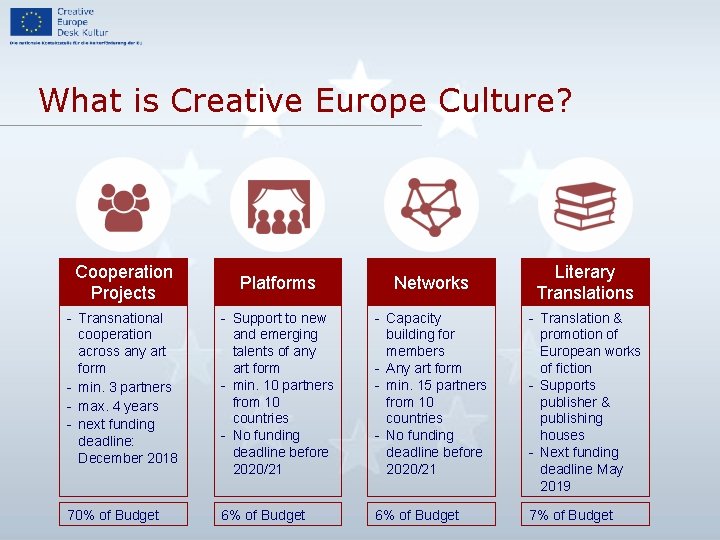
What is Creative Europe Culture? Cooperation Projects Platforms Networks - Transnational cooperation across any art form - min. 3 partners - max. 4 years - next funding deadline: December 2018 - Support to new and emerging talents of any art form - min. 10 partners from 10 countries - No funding deadline before 2020/21 - Capacity building for members - Any art form - min. 15 partners from 10 countries - No funding deadline before 2020/21 - Translation & promotion of European works of fiction - Supports publisher & publishing houses - Next funding deadline May 2019 70% of Budget 6% of Budget 7% of Budget Literary Translations
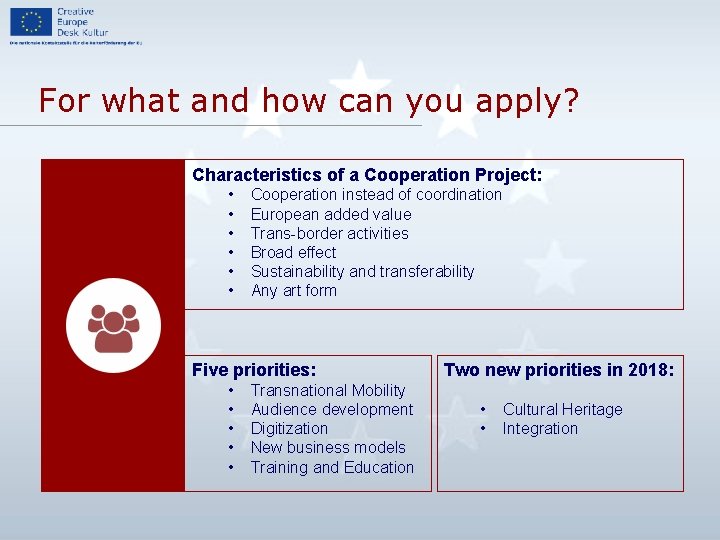
For what and how can you apply? Characteristics of a Cooperation Project: • • • Cooperation instead of coordination European added value Trans-border activities Broad effect Sustainability and transferability Any art form Five priorities: • • • Transnational Mobility Audience development Digitization New business models Training and Education Two new priorities in 2018: • • Cultural Heritage Integration
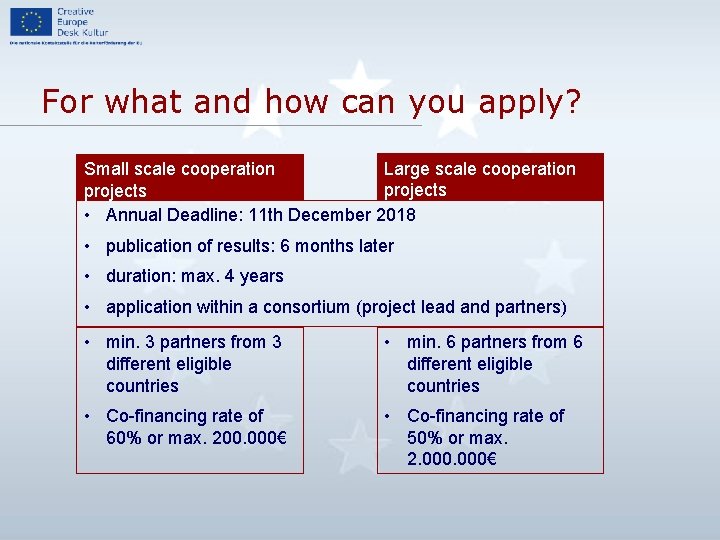
For what and how can you apply? Large scale cooperation Small scale cooperation projects • Annual Deadline: 11 th December 2018 • publication of results: 6 months later • duration: max. 4 years • application within a consortium (project lead and partners) • min. 3 partners from 3 different eligible countries • min. 6 partners from 6 different eligible countries • Co-financing rate of 60% or max. 200. 000€ • Co-financing rate of 50% or max. 2. 000€
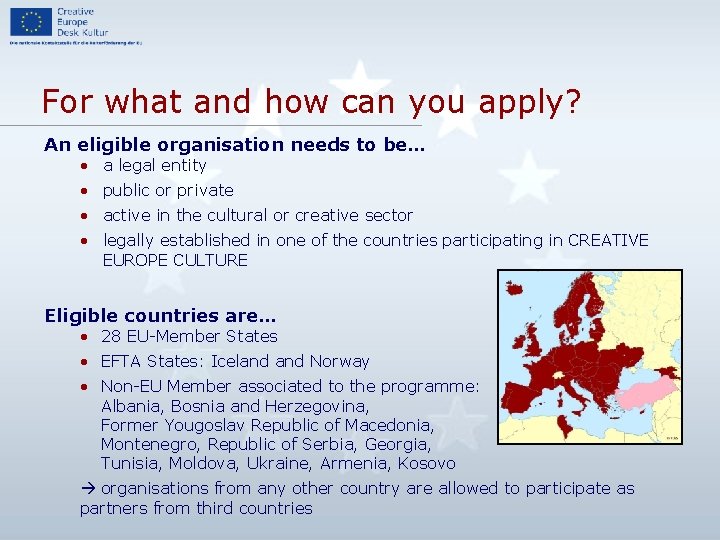
For what and how can you apply? An eligible organisation needs to be… • a legal entity • public or private • active in the cultural or creative sector • legally established in one of the countries participating in CREATIVE EUROPE CULTURE Eligible countries are… • 28 EU-Member States • EFTA States: Iceland Norway • Non-EU Member associated to the programme: Albania, Bosnia and Herzegovina, Former Yougoslav Republic of Macedonia, Montenegro, Republic of Serbia, Georgia, Tunisia, Moldova, Ukraine, Armenia, Kosovo organisations from any other country are allowed to participate as partners from third countries
CREATIVE EUROPE (2014 -2020) Small Scale Cooperation Project from Macedonia
Agenda 1. Introduction to EU cultural policy 2. What is Creative Europe Culture? 3. LIONS and Creative Europe Culture 4. Interreg A – Cooperation between Member States 5. Other EU-Programmes
Lions and CREATIVE EUROPE CULTURE
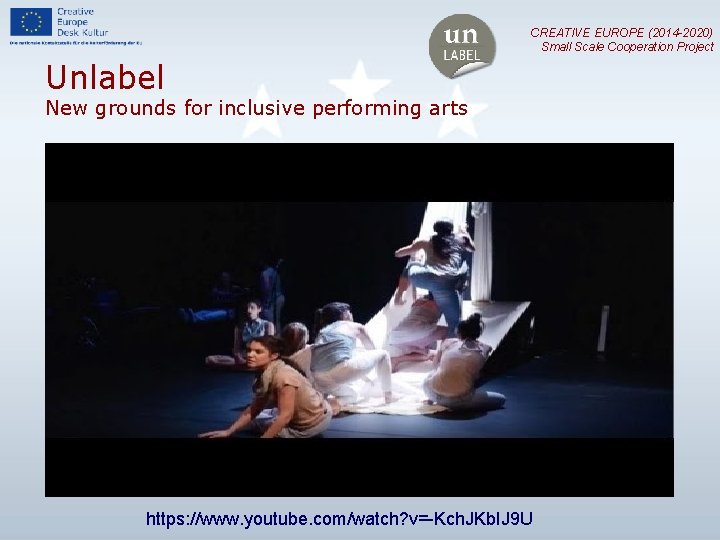
CREATIVE EUROPE (2014 -2020) Small Scale Cooperation Project Unlabel New grounds for inclusive performing arts https: //www. youtube. com/watch? v=-Kch. JKb. IJ 9 U
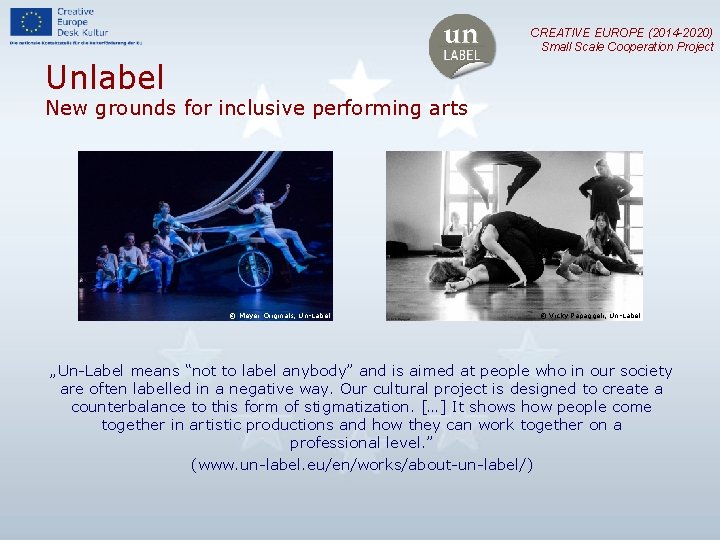
CREATIVE EUROPE (2014 -2020) Small Scale Cooperation Project Unlabel New grounds for inclusive performing arts © Meyer Originals, Un-Label © Vicky Papaggeli, Un-Label „Un-Label means “not to label anybody” and is aimed at people who in our society are often labelled in a negative way. Our cultural project is designed to create a counterbalance to this form of stigmatization. […] It shows how people come together in artistic productions and how they can work together on a professional level. ” (www. un-label. eu/en/works/about-un-label/)
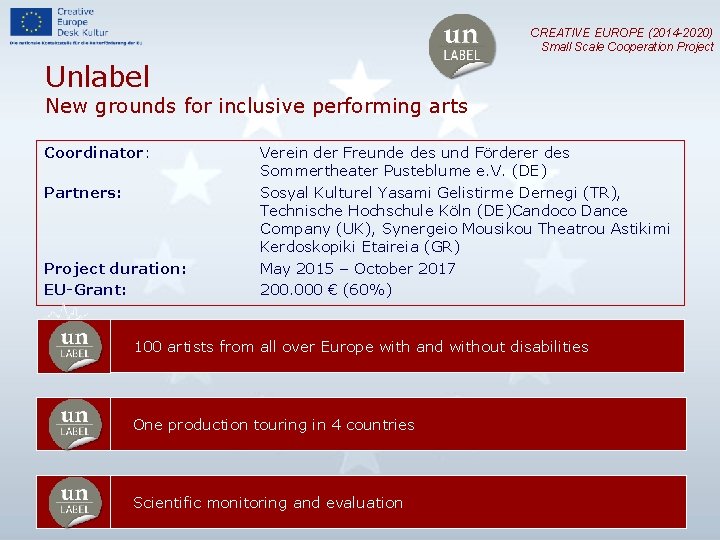
CREATIVE EUROPE (2014 -2020) Small Scale Cooperation Project Unlabel New grounds for inclusive performing arts Coordinator: Partners: Project duration: EU-Grant: Verein der Freunde des und Förderer des Sommertheater Pusteblume e. V. (DE) Sosyal Kulturel Yasami Gelistirme Dernegi (TR), Technische Hochschule Köln (DE)Candoco Dance Company (UK), Synergeio Mousikou Theatrou Astikimi Kerdoskopiki Etaireia (GR) May 2015 – October 2017 200. 000 € (60%) 100 artists from all over Europe with and without disabilities One production touring in 4 countries Scientific monitoring and evaluation
Agenda 1. Introduction to EU cultural policy 2. What is Creative Europe Culture? 3. LIONS and Creative Europe Culture 4. Interreg A – Cooperation between Member States 5. Other EU-Programmes
Interreg A
Agenda 1. Introduction to EU cultural policy 2. What is Creative Europe Culture? 3. LIONS and Creative Europe Culture 4. Interreg A – Cooperation between Member States 5. Other EU-Programmes
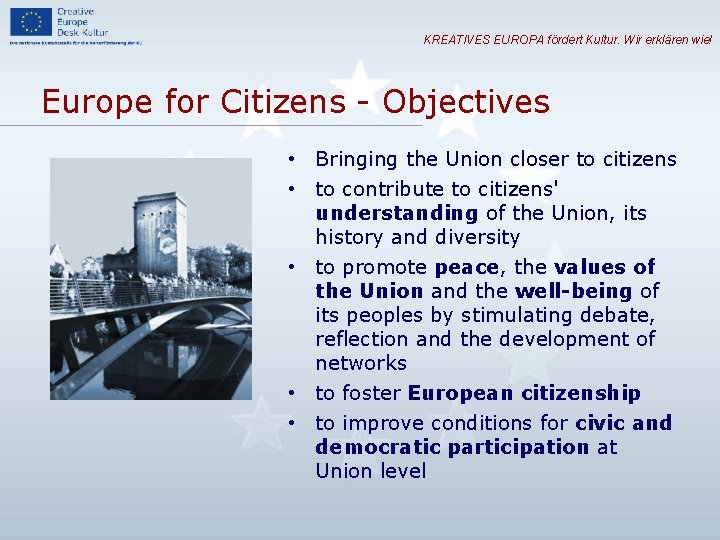
KREATIVES EUROPA fördert Kultur. Wir erklären wie! Europe for Citizens - Objectives • Bringing the Union closer to citizens • to contribute to citizens' understanding of the Union, its history and diversity • to promote peace, the values of the Union and the well-being of its peoples by stimulating debate, reflection and the development of networks • to foster European citizenship • to improve conditions for civic and democratic participation at Union level
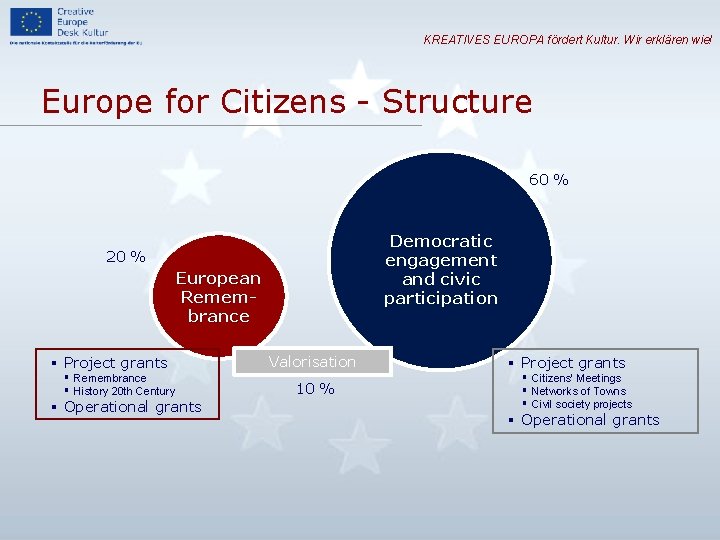
KREATIVES EUROPA fördert Kultur. Wir erklären wie! Europe for Citizens - Structure 60 % Democratic engagement and civic participation 20 % European Remembrance § Project grants § Remembrance § History 20 th Century § Operational grants Valorisation 10 % § Project grants § Citizens‘ Meetings § Networks of Towns § Civil society projects § Operational grants
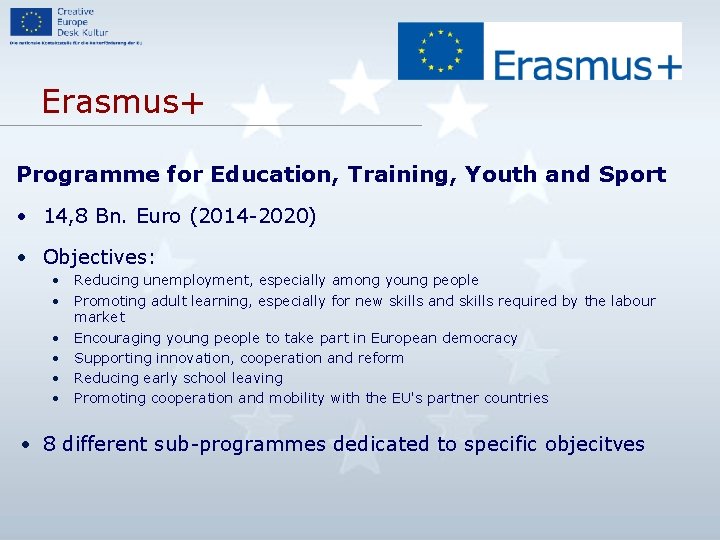
Erasmus+ Programme for Education, Training, Youth and Sport • 14, 8 Bn. Euro (2014 -2020) • Objectives: • • • Reducing unemployment, especially among young people Promoting adult learning, especially for new skills and skills required by the labour market Encouraging young people to take part in European democracy Supporting innovation, cooperation and reform Reducing early school leaving Promoting cooperation and mobility with the EU's partner countries • 8 different sub-programmes dedicated to specific objecitves
Questions? www. creative-europe-desk. de info@ced-kultur. eu Follow us on facebook: Creative Europe Desk Deutschland - Kultur