
Creative Commons Copyright and Fair Use Why do
- Slides: 28
Creative Commons, Copyright, and Fair Use - Why do we need OER? Rachel Arteaga, Librarian, Butte College arteagara@butte. edu CC BY Rachel Arteaga
Overview ● Define copyright, fair use, free, and open ● What can you do with an open resource? ● Introduction to Creative Commons licences
What Is Copyright? ● Exclusive set of rights for creators ● Copy, distribute, perform, adapt or use the work ● Incentivises creation of new works ● Someone controls the copyright creator, organization, employer ● Copyright holder grants permission to use work Adapted by Rachel Arteaga from Creative Commons Certificate for Librarians, Module 2. 1: Copyright Basics CC BY
What Does Copyright Protect? Copyright protects original and unique works in a tangible medium. For example: ● Literary and artistic works ● Translations, adaptations, arrangements ● Collections of literary and artistic works ● Applied art and industrial designs and models ● Computer software Adapted by Rachel Arteaga from Creative Commons Certificate for Librarians, Module 2. 1: Copyright Basics CC BY
How Long Does Copyright Last? Laws vary by country but for works copyrighted in the United States, the law is the length of the author’s life plus 70 years.
Copyright law is complicated in ways that cannot be quickly covered.
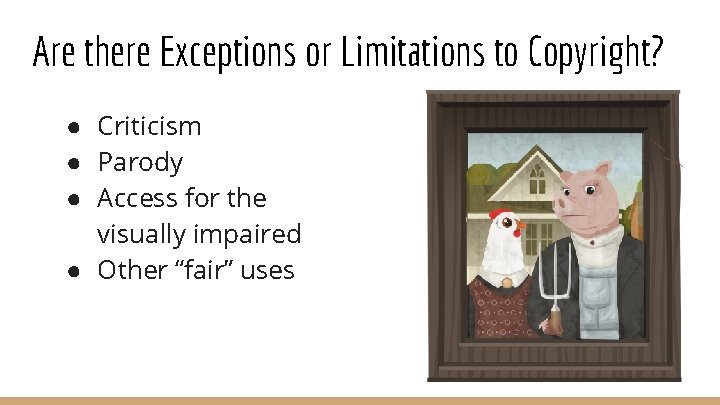
Are there Exceptions or Limitations to Copyright? ● Criticism ● Parody ● Access for the visually impaired ● Other “fair” uses
What is Fair Use? “Fair use is a legal doctrine that promotes freedom of expression by permitting the unlicensed use of copyright -protected works in certain circumstances. Section 107 of the Copyright Act provides the statutory framework for determining whether something is a fair use and identifies certain types of uses—such as criticism, comment, news reporting, teaching, scholarship, and research—as examples of activities that may qualify as fair use. ” More Information on Fair Use, Copyright. gov
Fair Use: It’s Magical? No.
Four Factors 1. Purpose and character of the use 2. Nature of the original work 3. Amount and substantiality of the portion used 4. Effect of the use on the potential market for or value of the source work
Is Your Use Transformative? Does the use of the original work create a new work or use the work in a new, “transformative way? ● Parody or satire ● New technologies ● Remixes in a new medium
Remember. . . Fair Use is a “framework” that must be looked at for each use. The four factors must be considered in totality and do not offer a definitive or legal answer. A good tool to use for guidance is UMN’s “Thinking Through Fair Use. ”
Problems with Fair Use ● Legally complicated ● Citing or acknowledging the source does not make your use fair ● Case by case basis ● Guidelines, not rules ● Don’t rely on it to legally protect you ● If you think your use is fair use a resource to help you decide
Fair Use Resources ● Thinking Through Fair Use ● Copyright and Fair Use: The Stanford University Libraries ● Fair Use Checklist ● See if your college has a policy
What about “Free” Resources ● Freely accessible ● Maybe copyrighted or restricted ● Most likely you cannot change, modify, or distribute the resource without permission ● If you are unsure of how you can use the resource supply a link for students
Is there a way to avoid all of these complications? Use Open Educational Resources!
What are Open Educational Resources? “OER are teaching, learning, and research resources that reside in the public domain or are released under an intellectual property license that permits their free use and repurposing by others” -- Hewlett Foundation
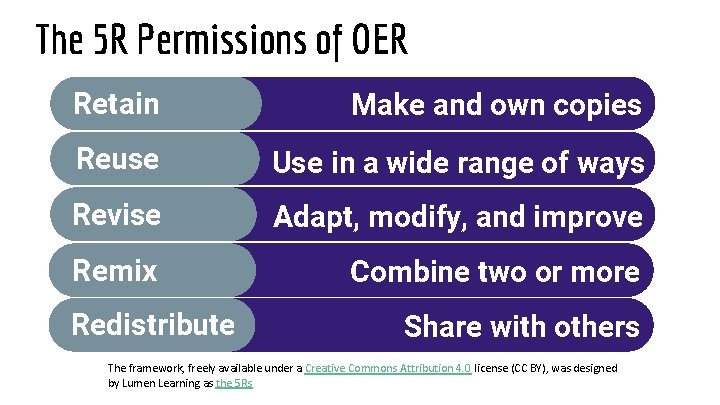
The 5 R Permissions of OER Retain Make and own copies Reuse Use in a wide range of ways Revise Adapt, modify, and improve Remix Combine two or more Redistribute Share with others The framework, freely available under a Creative Commons Attribution 4. 0 license (CC BY), was designed by Lumen Learning as the 5 Rs
Creative Commons ● Nonprofit “dedicated to building a globallyaccessible public commons of knowledge and culture” ● Supplies copyright licenses, including legal framework that allows creators to share work more openly ● Licenses work within existing copyright law ● Licenses variations of the 5 permissions
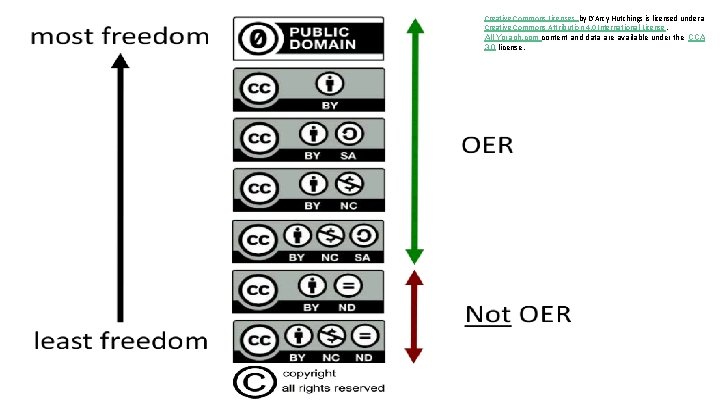
Creative Commons Licenses by D'Arcy Hutchings is licensed under a Creative Commons Attribution 4. 0 International License. All Ygraph. com content and data are available under the CCA 3. 0 license.
CC BY - Attribution ● Distribute, remix, tweak, build upon work ● Commercial use permitted ● Credit creator ● Most accommodating CC license ● Recommended for maximum dissemination and use of licensed View License Deed | View Legal Code materials Adapted from About the Licenses, by Creative Commons, Creative Commons Attribution 4. 0 International license
CC BY SA - Attribution-Share. Alike ● Distribute, remix, tweak, build upon work ● Commercial use permitted ● Credit creator ● Must license new creations under the identical terms ● New works will carry the same license, so any derivatives will also allow commercial use View License Deed | View Legal Code Adapted from About the Licenses, by Creative Commons, Creative Commons Attribution 4. 0 International license
CC BY-ND - Attribution-No. Derivs Allows redistribution, commercial and noncommercial use, as long as original is passed along unchanged and in whole, with credit to creator. View License Deed | View Legal Code Adapted from About the Licenses, Creative Commons Attribution 4. 0 International license
CC BY-NC-SA - Attribution-Non. Commercial-Share. Alike ● Remix, tweak, and build upon a work noncommercially ● Credit creator and license new creations under the identical terms View License Deed | View Legal Code Adapted from About the Licenses, by Creative Commons, Creative Commons Attribution 4. 0 International license
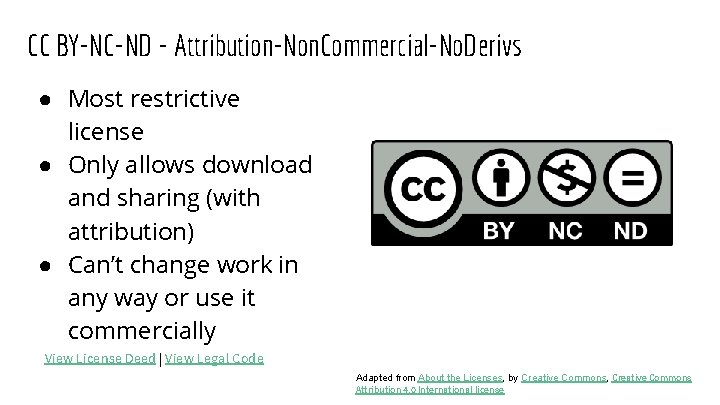
CC BY-NC-ND - Attribution-Non. Commercial-No. Derivs ● Most restrictive license ● Only allows download and sharing (with attribution) ● Can’t change work in any way or use it commercially View License Deed | View Legal Code Adapted from About the Licenses, by Creative Commons, Creative Commons Attribution 4. 0 International license
Creative Commons ● About the licenses ● Frequently Asked Questions ● License and share your own work ● Downloads - logos, cheatsheets, etc.
Questions?
Credits: All images supplied by Pixabay unless otherwise noted. Pixabay License Free for commercial use; No attribution required