
Creation groans For the creation waits with eager

- Slides: 20
Creation groans… For the creation waits with eager longing for the revealing of the children of God; that the creation itself will be set free from its bondage to decay and will obtain the freedom of the glory of the children of God. We know that the whole creation has been groaning in labor pains until now; and not only the creation, but we ourselves, who have the first fruits of the Spirit, groan inwardly while we wait for adoption Romans 8: 19, 21 -23
Christians and Climate Change – Usually do not want to take sides on political issues. – Don’t see the connection between Christian faith and care of creation: either “dominion over” as a gift of God: or stewardship as secondary. – Don’t see this as a justice issue with clear moral imperatives. – Often focus on other-worldly theological frameworks. – Often do not see the Divine within humanity or within creation.
Intergenerational Justice (Fairness) “How and to what extent can the present generation harm future generations? ” “In what ways should the interests of subsequent generations guide present decisions? ”
The Seventh Generation Principle – Based on an ancient Iroquois philosophy that the decisions we make today should result in a sustainable world seven generations into the future. – First recorded The Great Law of Iroquois Confederacy between 1142 and 1500 A. D. – Credited as being a contributing influence on the American Constitution, due to Benjamin Franklin’s great respect for the Iroquois system of government. – Generally used in regards to decisions being made about our energy, water, and natural resources, and ensuring those decisions are sustainable for seven generations in the future. – It can also be applied to relationships - every decision should result in sustainable relationships seven generations in the future.
Creating a Vision – – I have a dream! vs I have a nightmare! Understanding God’s vision for this world. Understanding God within humanity and within all of creation. Understanding the sacredness of 1 st world and 3 rd world, of ecosystems, geospheres, and all of life. – Realizing that this is our time to step up for the sake of the world and for future generations. – Creating a vision of hope for our future that is energized and grounded in faith and God’s love for all creation.
Why are we here today? – We believe that the earth is the Lord’s and all that is in it. – We believe this is holy ground. – We believe we are made of this earth and it is part of who we are. – We believe that we are to guard the earth – it feeds us, gives us air to breath and water to drink. – We believe that our children and grandchildren deserve a world to live in that is clean and healthy. – We believe the earth and the firmament are speaking to us and we aren’t listening to what they are telling us. – We believe that we can do something about it.
Two Theological Worldviews – Process Theology: God is in and of the world: All of the creation is in God, and God doesn’t exist without creation (panenthiesm). God is still engaged in the world within creation, but not controlling it. Human actions are part of the process: we are the created co-creators. – Deep Ecology: We cannot separate ourselves from the rest of creation. In an ecological system if one entity separates itself, it dies. We are intimately connected to, dependent on, and part of all of the creation. Our fate, wellness, prosperity, health, sustainability is ultimately the same as the rest of the creation.
We are dependent on the earth – We cannot live without air, water or food – Food – about 30 -40 days – Water – about 3 days – Air – about 2 minutes – Why do we continue to pollute the very things that we need to live? – How can we regain our connection to the earth through the sacred writings?
Creation stories An example of how we can shift our emphasis from dominion theology: – Creation epics - The Enuma Elis and The Epic of Gilgamesh – 1800 BCE – Dakota/Lakota tradition of Wakan Tanka (a Lakota word for Creator) – Hebrew scripture – 3 creation stories – written 1200 BCE – 500 BCE – Genesis 1. 1 -2. 4 a – Genesis 2. 4 b-25 – Psalm 104
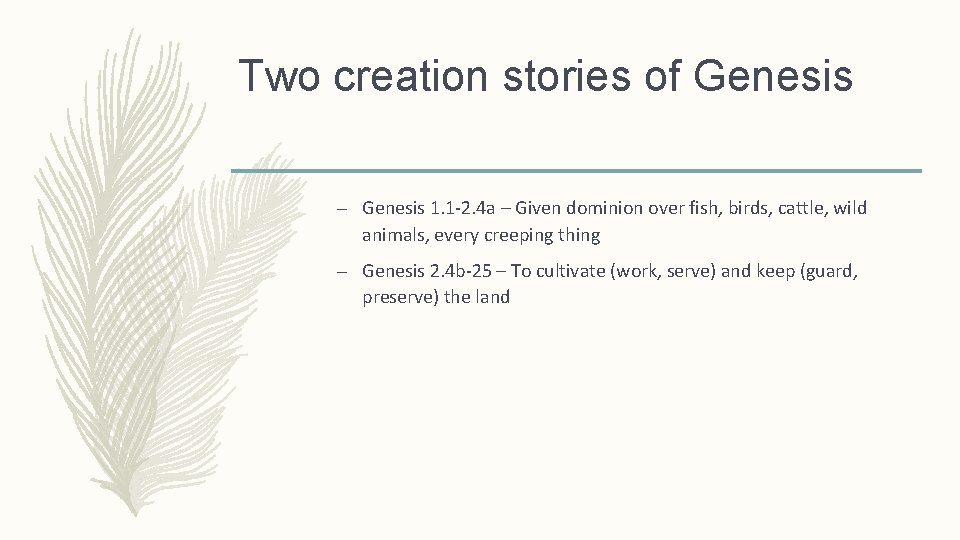
Two creation stories of Genesis – Genesis 1. 1 -2. 4 a – Given dominion over fish, birds, cattle, wild animals, every creeping thing – Genesis 2. 4 b-25 – To cultivate (work, serve) and keep (guard, preserve) the land
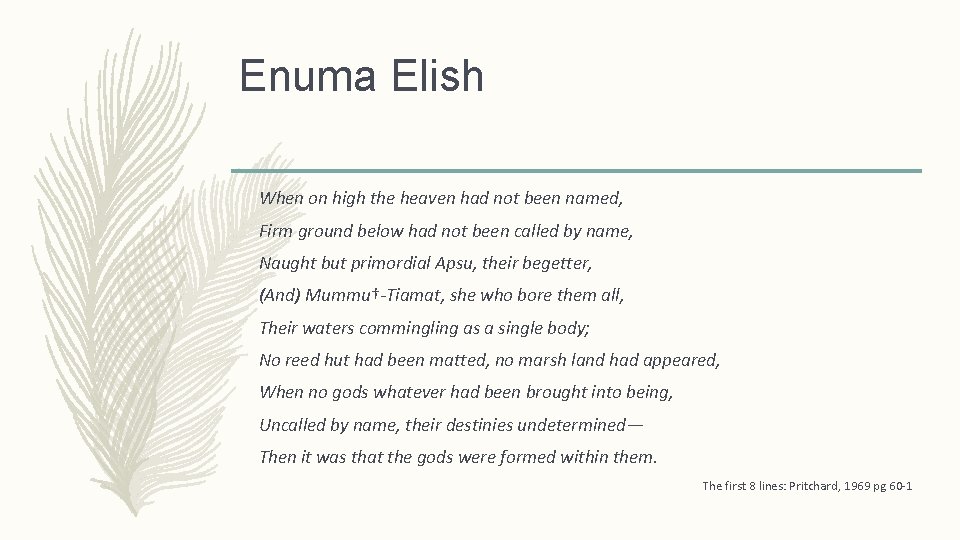
Enuma Elish When on high the heaven had not been named, Firm ground below had not been called by name, Naught but primordial Apsu, their begetter, (And) Mummu†-Tiamat, she who bore them all, Their waters commingling as a single body; No reed hut had been matted, no marsh land had appeared, When no gods whatever had been brought into being, Uncalled by name, their destinies undetermined— Then it was that the gods were formed within them. The first 8 lines: Pritchard, 1969 pg 60 -1
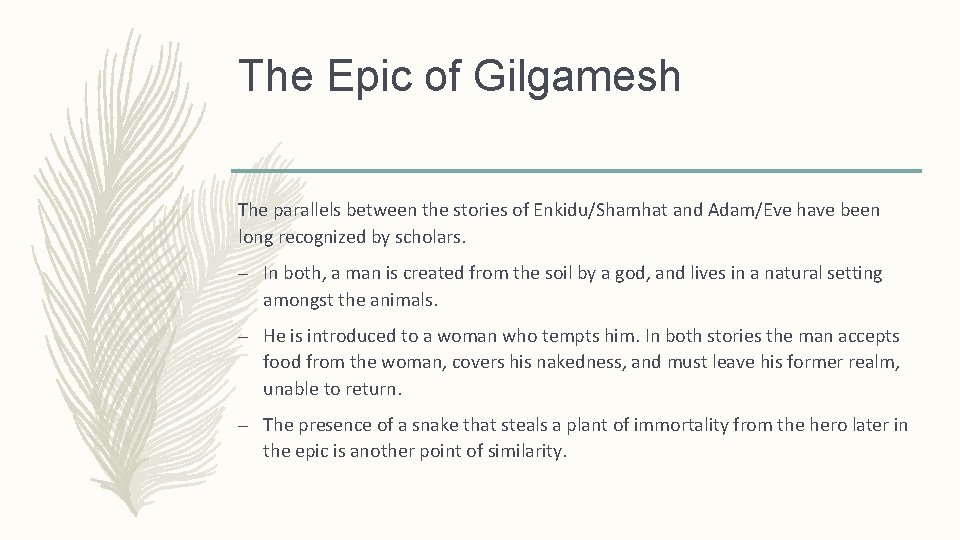
The Epic of Gilgamesh The parallels between the stories of Enkidu/Shamhat and Adam/Eve have been long recognized by scholars. – In both, a man is created from the soil by a god, and lives in a natural setting amongst the animals. – He is introduced to a woman who tempts him. In both stories the man accepts food from the woman, covers his nakedness, and must leave his former realm, unable to return. – The presence of a snake that steals a plant of immortality from the hero later in the epic is another point of similarity.
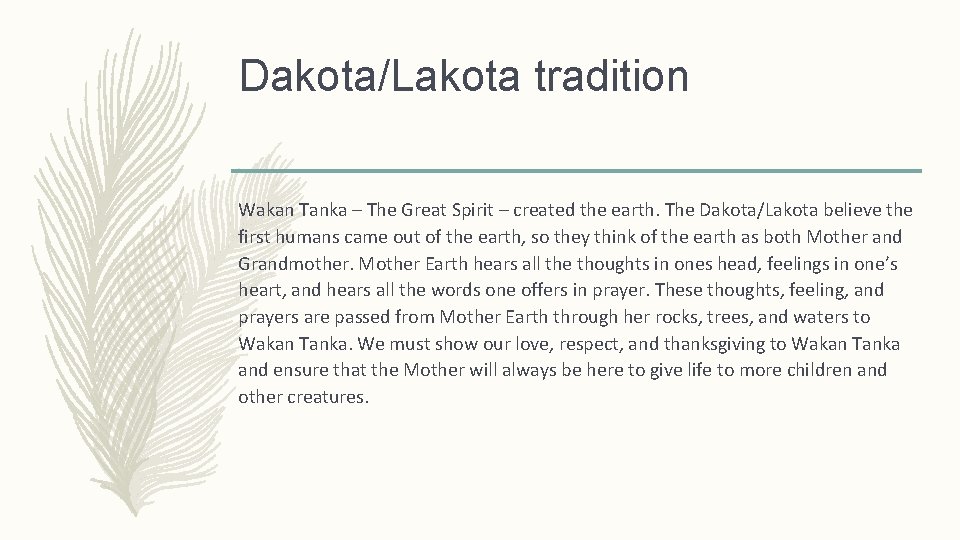
Dakota/Lakota tradition Wakan Tanka – The Great Spirit – created the earth. The Dakota/Lakota believe the first humans came out of the earth, so they think of the earth as both Mother and Grandmother. Mother Earth hears all the thoughts in ones head, feelings in one’s heart, and hears all the words one offers in prayer. These thoughts, feeling, and prayers are passed from Mother Earth through her rocks, trees, and waters to Wakan Tanka. We must show our love, respect, and thanksgiving to Wakan Tanka and ensure that the Mother will always be here to give life to more children and other creatures.
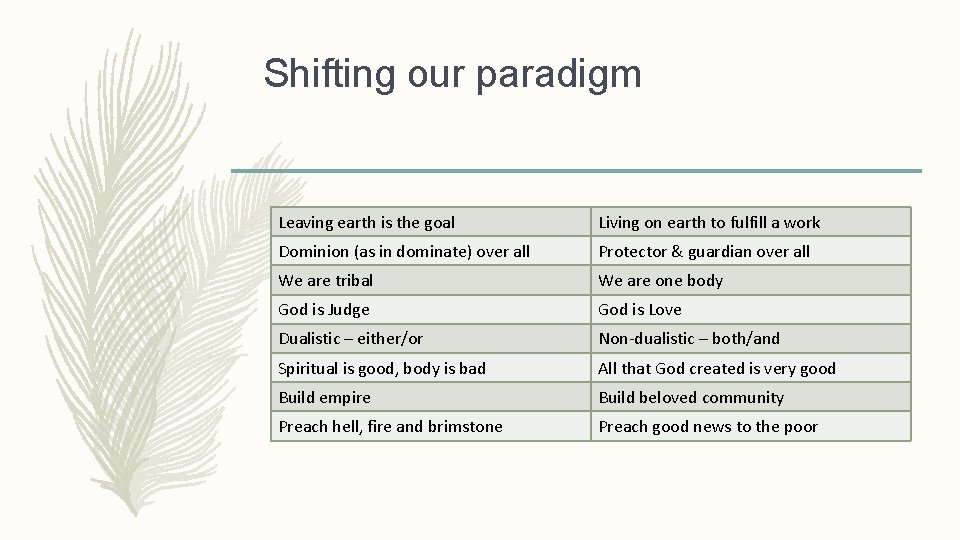
Shifting our paradigm Leaving earth is the goal Living on earth to fulfill a work Dominion (as in dominate) over all Protector & guardian over all We are tribal We are one body God is Judge God is Love Dualistic – either/or Non-dualistic – both/and Spiritual is good, body is bad All that God created is very good Build empire Build beloved community Preach hell, fire and brimstone Preach good news to the poor
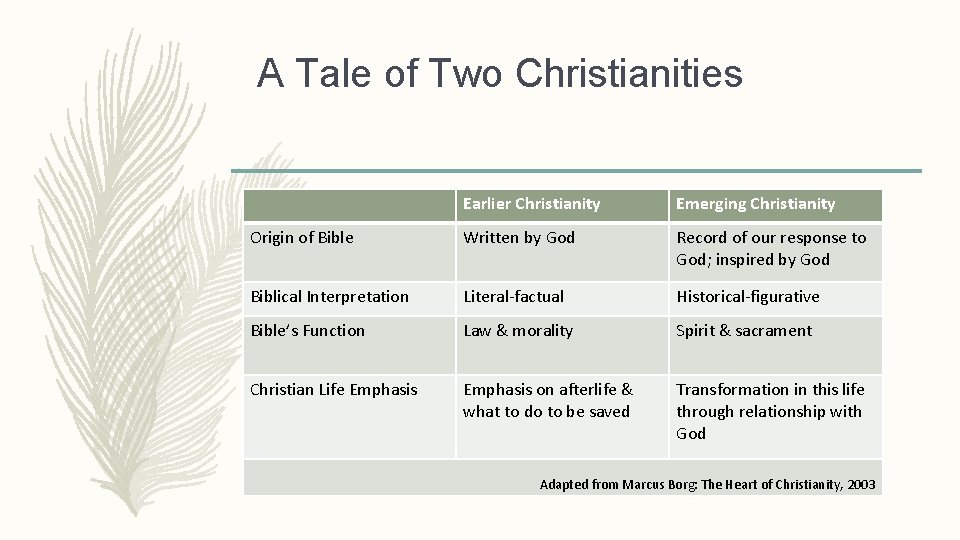
A Tale of Two Christianities Earlier Christianity Emerging Christianity Origin of Bible Written by God Record of our response to God; inspired by God Biblical Interpretation Literal-factual Historical-figurative Bible’s Function Law & morality Spirit & sacrament Christian Life Emphasis on afterlife & what to do to be saved Transformation in this life through relationship with God Adapted from Marcus Borg: The Heart of Christianity, 2003
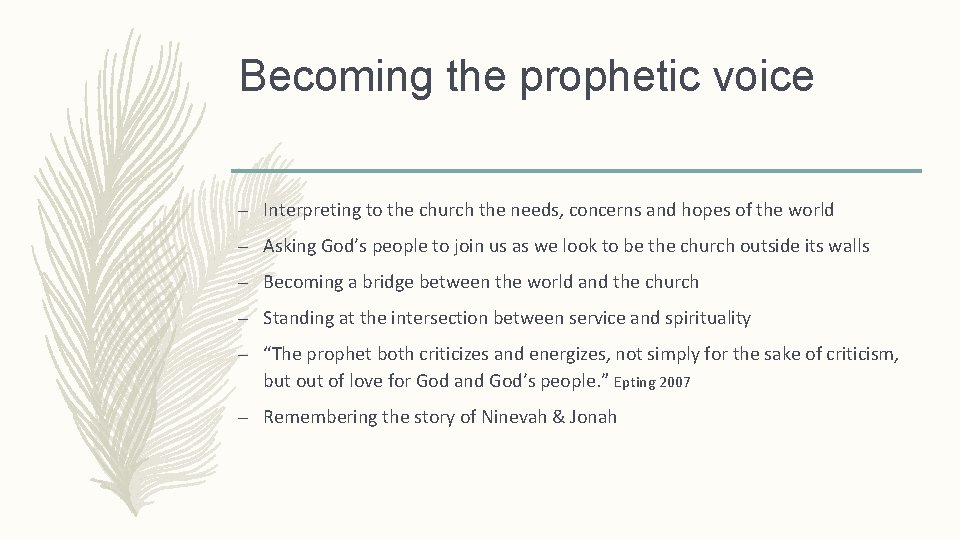
Becoming the prophetic voice – Interpreting to the church the needs, concerns and hopes of the world – Asking God’s people to join us as we look to be the church outside its walls – Becoming a bridge between the world and the church – Standing at the intersection between service and spirituality – “The prophet both criticizes and energizes, not simply for the sake of criticism, but of love for God and God’s people. ” Epting 2007 – Remembering the story of Ninevah & Jonah
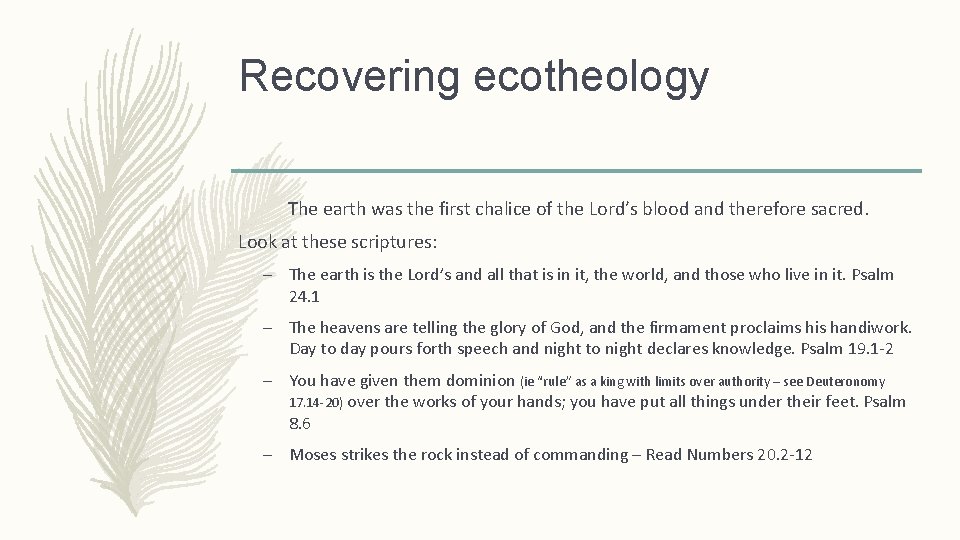
Recovering ecotheology The earth was the first chalice of the Lord’s blood and therefore sacred. Look at these scriptures: – The earth is the Lord’s and all that is in it, the world, and those who live in it. Psalm 24. 1 – The heavens are telling the glory of God, and the firmament proclaims his handiwork. Day to day pours forth speech and night to night declares knowledge. Psalm 19. 1 -2 – You have given them dominion (ie “rule” as a king with limits over authority – see Deuteronomy 17. 14 -20) over the works of your hands; you have put all things under their feet. Psalm 8. 6 – Moses strikes the rock instead of commanding – Read Numbers 20. 2 -12
Jesus’ words – “God is able from these stones to raise up Sons of Abraham. ” Matthew 3. 9 – ”I tell you, if these were silent (the disciples), the stones would shout out. ” Luke 19. 40 – “You know how to interpret the appearance of the sky, but you cannot interpret the signs of the times. ” Matthew 16. 3 b
Jesus incarnate – Now God is in the world with us. (shifting from distant to present) – In His teachings He shows who God is. (shifting from purity to compassion) – He shows us a vision of community. (shifting from individual to corporate) – All the Law is now summed up in Loving God & Neighbor. (shifting from rule to relationship)
An emerging worldview: – As Christians we are compelled to be the prophetic voice of resistance to the powers of domination, healing of the world, preserving life and creation, lifting up the poor and oppressed and vulnerable agents within creation, and bringing a vision of hope, promise and new life. – Easter is not the promise of our escaping from this world, but rather the promise that Gods vision and work for healing and transformation will never die, even when the powers of dominion seem to have won. This is our path of faith and hope, that God will be with us and empower us to be agents of healing and change. – Our time has come to step up and be the church: ARE WE READY?