
CREATING STUDY SCHEDULES schedule created by students that

“ CREATING STUDY SCHEDULES” schedule created by students that outlines study times and learning goals.
A- Strategies for Creating Your Weekly Schedule 1. Spread things out- Try to spread activities without fixed times across the week so that they are not all concentrated on already busy days. Considering Your Schedule and Personality
Reserve time for reading. Reserve time for reviewing your notes. Reserve time to create exam study guides, if you'll need them
Prioritize your List Put a number, starting with one, next to all of your subjects or exams. If you need the most time for math, give it a one. If you need the least time for history (and you have five subjects to study for), give it a five. Take into account difficulty of the subject or exam. Take into account the amount of reading you will need to do. Take into account the amount of reviewing you will need to do

Divide your available time during the week into study blocks. Before you go on, you need to divide up your available time during the week into study blocks. After you do this, you can go and assign your blocks to a subject.
The trick to creating a study schedule is to plan to study the same time every day so you actually have a schedule you can memorize without constantly checking. By creating a routine, you’ll build a positive study habit. Check if there are times or days of the week you can always study during. For example, you may be free 3 -4 p. m. every Tuesday and Thursday. If possible, try to schedule your studying then, because a regular, set routine can help you get into a studying mindset and into one more quickly. Schedule study sessions in 30 to 45 minute blocks. Shorter time blocks are easier to find and to schedule than longer blocks. Create blocks for all of your available time. If you have a certain amount of time before an exam, create a reverse calendar instead of a weekly schedule.
Assess your current schedule. Your first step in creating a study schedule is to assess your current schedule and the way you currently spend time. Assessing your current schedule will enable you to take a good look at how you use time and to help identify where you can be more efficient and what activities you might be able to cut. Determine how many hours a week you currently study. Determine how many hours a week you currently devote to entertainment. Determine how many hours a week you currently spend with friends and family. Do some quick math to see what you could cut. People tend to find they spend a lot of time on entertainment, start there. Make sure to create your study schedule around your work schedule, if you work.
2. Plan time for fun- Leave time in your schedule for the things that make life worthwhile, such as hobbies or time with friends.
3. Don’t spread yourself too thin. Try to avoid cluttering your schedule with activities and tasks. Don’t over commit.

4. Give yourself enough time. Budget at least One hour of homework for every hour of class time.

5. Plan for real life- Make sure you have some gaps between activities to allow for down time, eating, and travel.
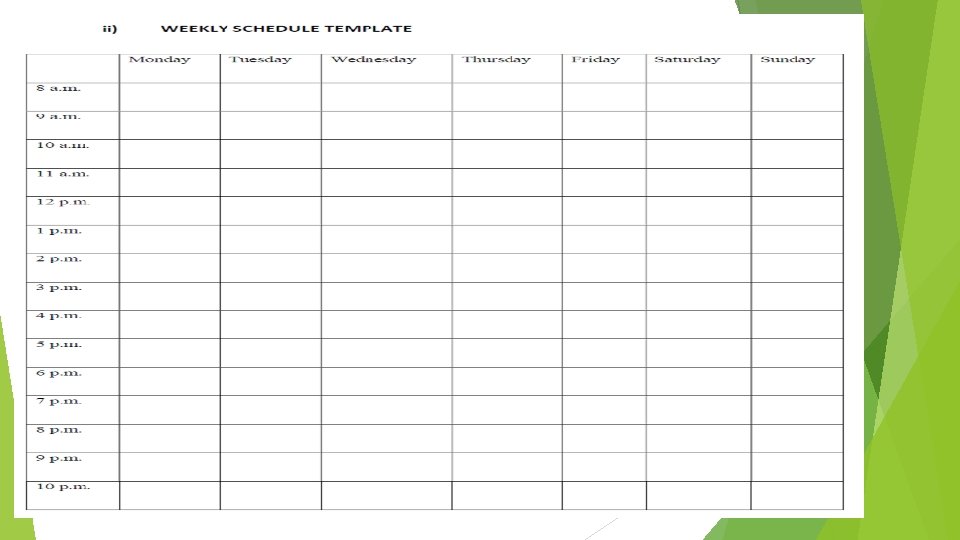
STEPS TO CREATE A WEEKLY SCHEDULE 1. Find a weekly schedule template that works for you. You can use the template below, or use calendars on programs such as Blackboard, Outlook or Google Calendar. 2. Add items that are already scheduled for the week, including classes, appointments, and work. 3. Add activities that need to be done that week but don’t have a set time. Try to spread these activities across the week so that they are not all concentrated on already busy days. 4. Add the activities that make life worthwhile, such as spending time with friends, or going to the gym. 5. Highlight the most important things so you can find them at a glance. Colour code item by type, e. g. classes are purple, work is blue.

Importance of Keeping a Weekly Schedule
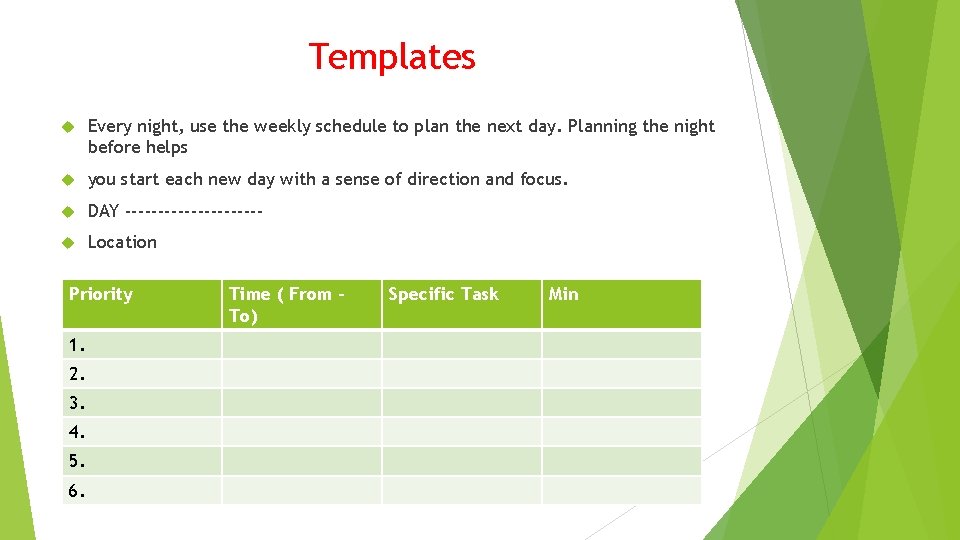
Templates Every night, use the weekly schedule to plan the next day. Planning the night before helps you start each new day with a sense of direction and focus. DAY ----------- Location Priority 1. 2. 3. 4. 5. 6. Time ( From – To) Specific Task Min
B. Strategies for Creating Term Schedule A term plan is a master schedule of everything that you need to get done over the 15 weeks of your term. Your teachers provide you with your due dates for the term through the academic session. A term plan displays your due dates in one place and helps your remember when you have a due date coming up. This module will show you how to use all of the due dates for each subject to create a term plan.

Highlight the big ones Highlight the biggest item for each subject so that these key dates stand out.

Highlight busy weeks Highlight the weeks that are going to be your biggest weeks of the term.
Update your plan Add any new deadlines to your Semester Plan that pop up over the term.
Display your plan Put your Term Plan somewhere you will look at it frequently.
Don’t erase completed assignments Cross items of the plan as they are completed and keep them as visual reminders of the things that you are getting done.
- Slides: 21