
Creating soft shadows Computer Graphics methods Submitted by
Creating soft shadows Computer Graphics methods Submitted by: Zusman Dimitry
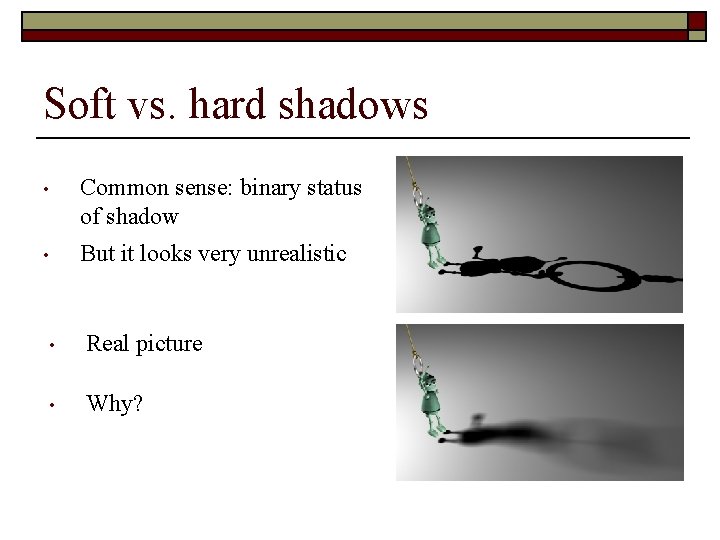
Soft vs. hard shadows • Common sense: binary status of shadow • But it looks very unrealistic • Real picture • Why?
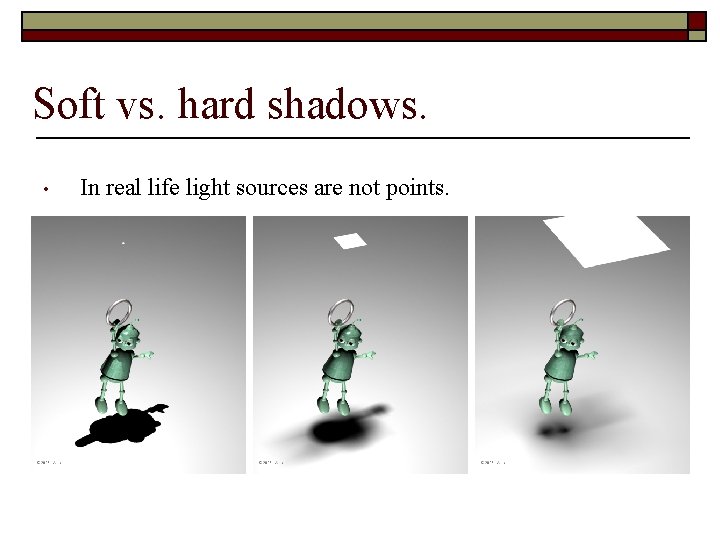
Soft vs. hard shadows. • In real life light sources are not points.
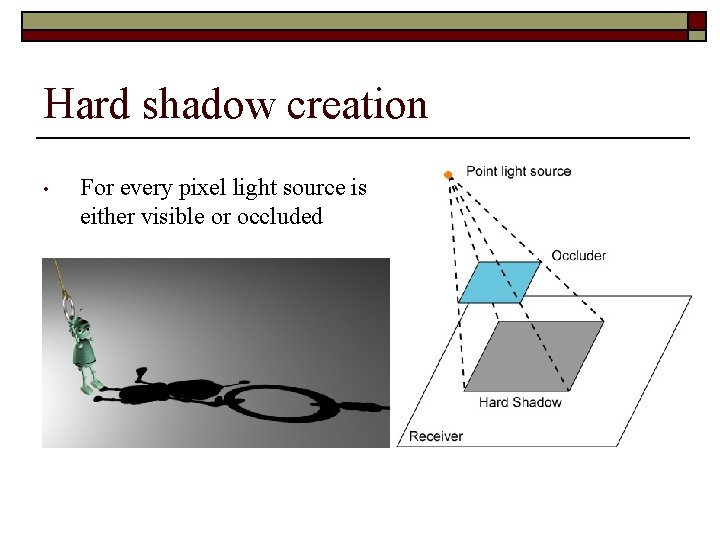
Hard shadow creation • For every pixel light source is either visible or occluded
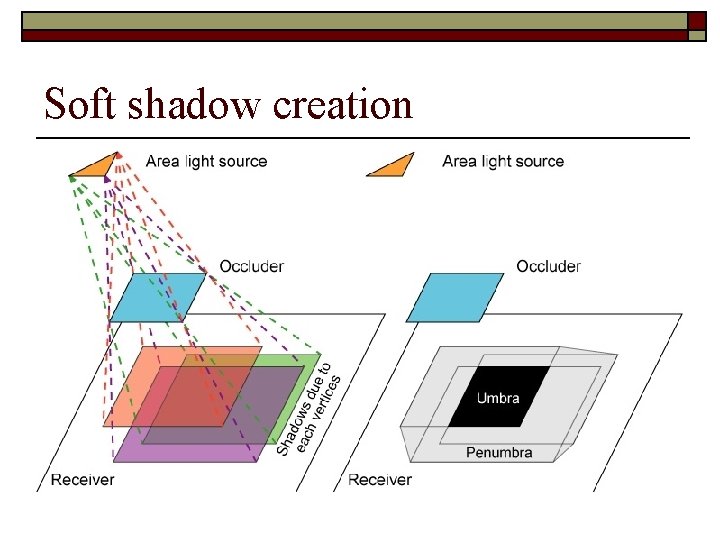
Soft shadow creation

Some assumptions • • One light source Monochromatic light source No special objects (clouds, hair) Many occluder shadows
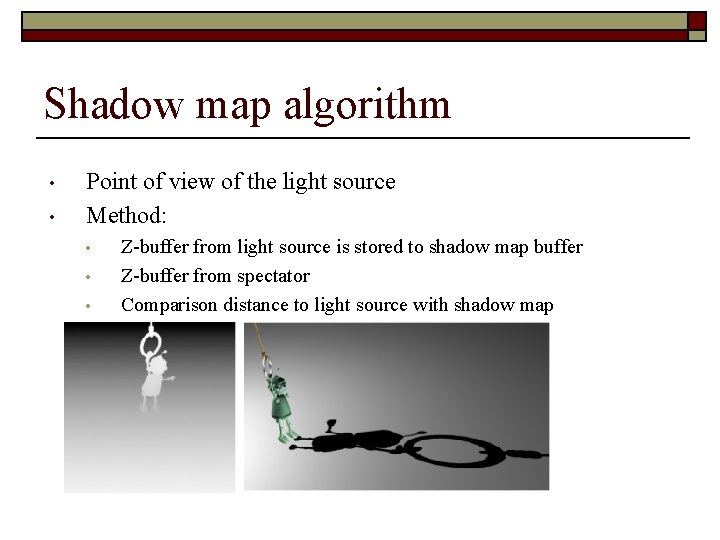
Shadow map algorithm • • Point of view of the light source Method: • • • Z-buffer from light source is stored to shadow map buffer Z-buffer from spectator Comparison distance to light source with shadow map
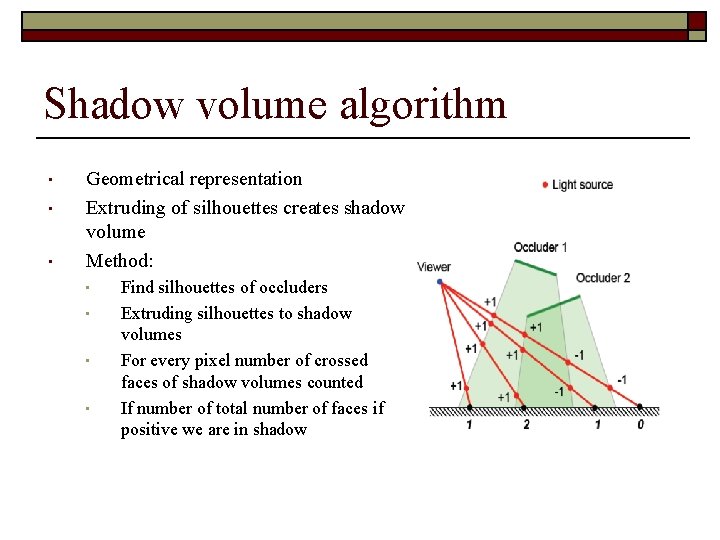
Shadow volume algorithm • • • Geometrical representation Extruding of silhouettes creates shadow volume Method: • • Find silhouettes of occluders Extruding silhouettes to shadow volumes For every pixel number of crossed faces of shadow volumes counted If number of total number of faces if positive we are in shadow
Soft shadow algorithms • • Image-based approach (based on shadow map algorithm) Object-based approach (based on shadow volume algorithms
Image-based approach • Combining some shadow maps from point samples • Layered shadow maps instead of shadow map • Some shadow maps take from point samples and computing percentage of light source visibility Using standard shadow map with techniques to compute soft shadow •
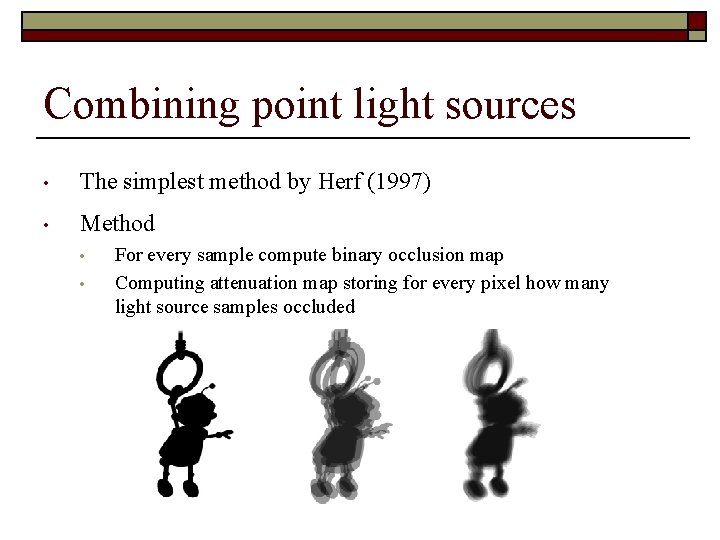
Combining point light sources • The simplest method by Herf (1997) • Method • • For every sample compute binary occlusion map Computing attenuation map storing for every pixel how many light source samples occluded
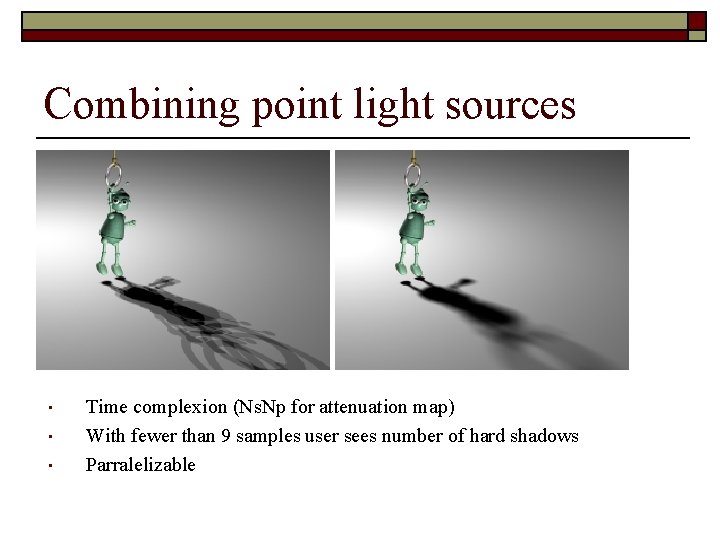
Combining point light sources • • • Time complexion (Ns. Np for attenuation map) With fewer than 9 samples user sees number of hard shadows Parralelizable
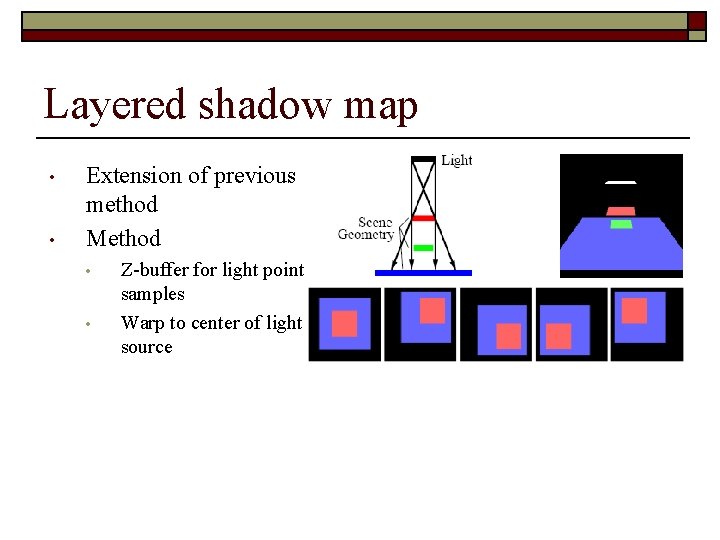
Layered shadow map • • Extension of previous method Method • • Z-buffer for light point samples Warp to center of light source
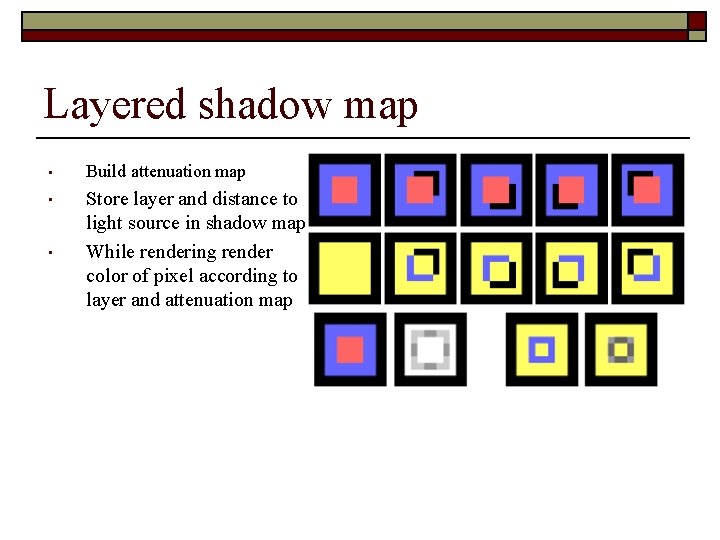
Layered shadow map • Build attenuation map • Store layer and distance to light source in shadow map While rendering render color of pixel according to layer and attenuation map •
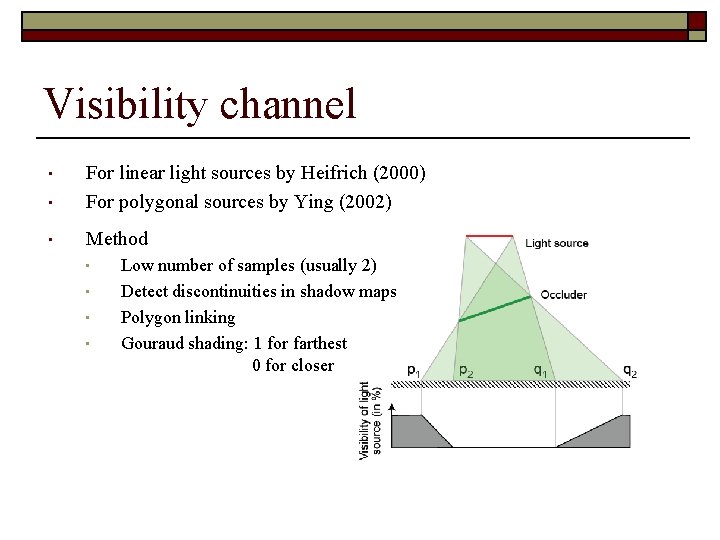
Visibility channel • For linear light sources by Heifrich (2000) For polygonal sources by Ying (2002) • Method • • • Low number of samples (usually 2) Detect discontinuities in shadow maps Polygon linking Gouraud shading: 1 for farthest 0 for closer
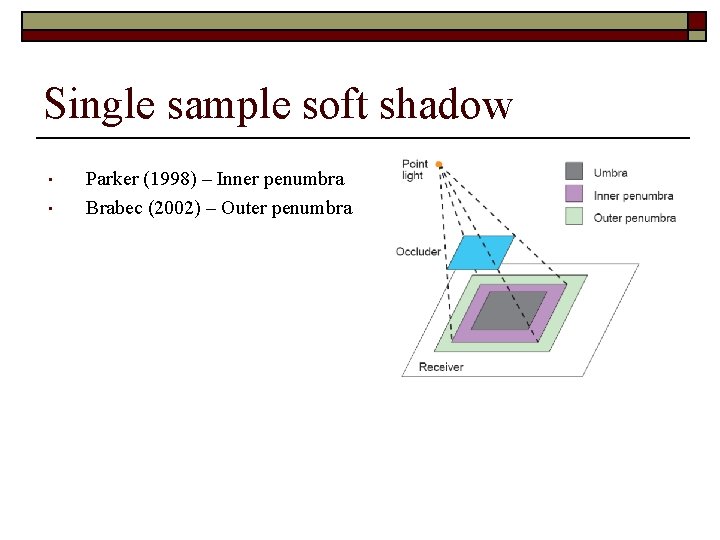
Single sample soft shadow • • Parker (1998) – Inner penumbra Brabec (2002) – Outer penumbra
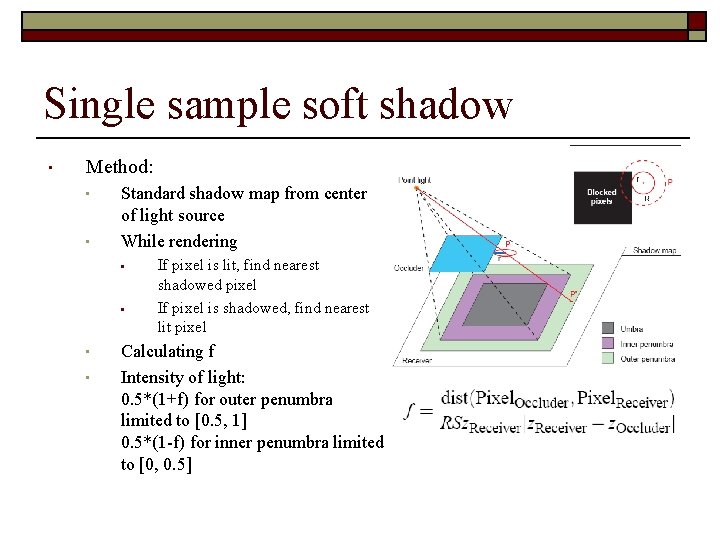
Single sample soft shadow • Method: • • Standard shadow map from center of light source While rendering • • If pixel is lit, find nearest shadowed pixel If pixel is shadowed, find nearest lit pixel Calculating f Intensity of light: 0. 5*(1+f) for outer penumbra limited to [0. 5, 1] 0. 5*(1 -f) for inner penumbra limited to [0, 0. 5]
Single sample soft shadow • Disadvantages: • • Bottleneck: to find nearest lit/shadowed pixel Doesn’t depend on size of light source, only from distances
Object based approach • • • Combining some hard shadows Extending shadow volume by heuristic Computing penumbra volume for each edge
Combining hard shadows • • The simplest method to produce soft shadow Method: • • • Several light source samples Build shadow volumes for each sample Average received pictures
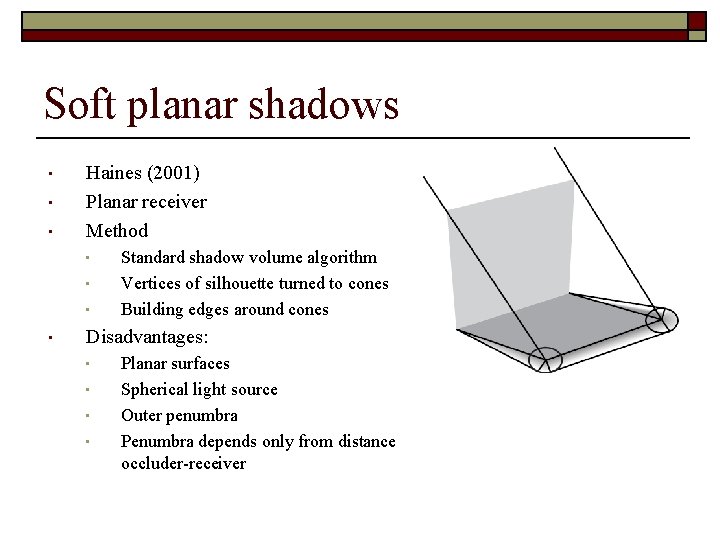
Soft planar shadows • • • Haines (2001) Planar receiver Method • • Standard shadow volume algorithm Vertices of silhouette turned to cones Building edges around cones Disadvantages: • • Planar surfaces Spherical light source Outer penumbra Penumbra depends only from distance occluder-receiver
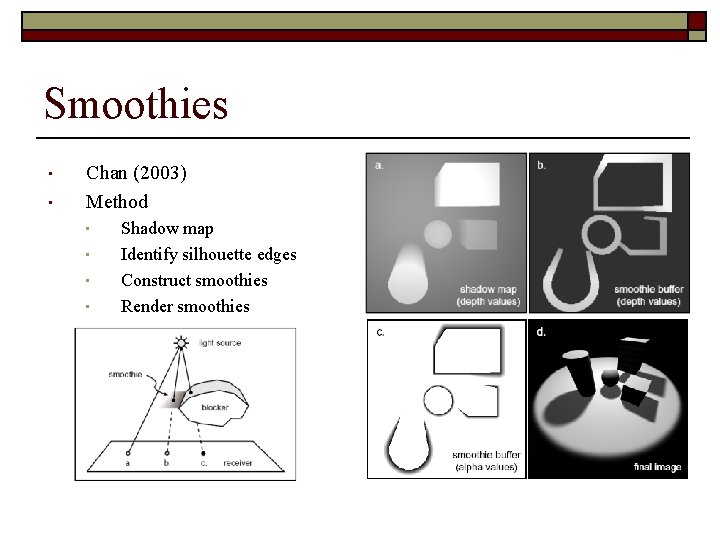
Smoothies • • Chan (2003) Method • • Shadow map Identify silhouette edges Construct smoothies Render smoothies
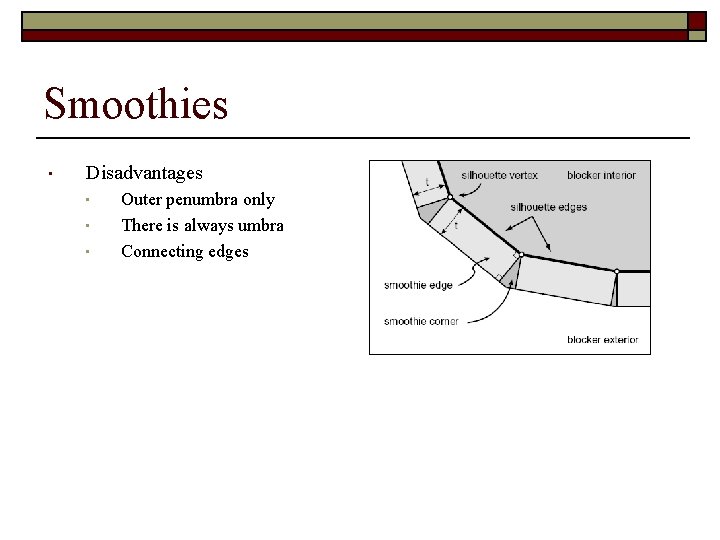
Smoothies • Disadvantages • • • Outer penumbra only There is always umbra Connecting edges
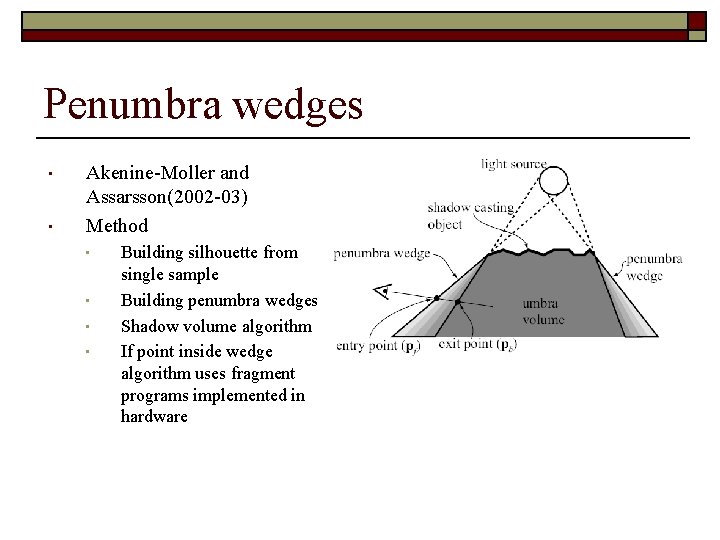
Penumbra wedges • • Akenine-Moller and Assarsson(2002 -03) Method • • Building silhouette from single sample Building penumbra wedges Shadow volume algorithm If point inside wedge algorithm uses fragment programs implemented in hardware
Summary • • • Hard vs. soft shadows Existing algorithms for soft shadow creation Advantages and disadvantages of each algorthms
Bibliography • • Maneesh Agrawala, Ravi Ramamoorthi, Alan Heirich and Laurent Moll. Efficient image-based methods for rendering soft shadows. Tomas Akenine-Möller and Ulf Assarsson. Approximate soft shadows on arbitrary surfaces using penumbra wedges. Eric Chan and Fredo Durand. Rendering fake soft shadows with smoothies. J. -M. Hasenfratz, M. Lapierre, N. Holzschuch and F. X. Sillion A Survey of Real-time Soft Shadows Algorithms
- Slides: 26