
Creating proper positive social models makes favourable conditions
Creating proper, positive social models makes favourable conditions which serve to prevent aggressive behaviour. It requires showing positive models of social demeanor. It is important to teach children how to control their emotions, aggressive impulses and how to make contacts with their peers and other people. It can be said that interaction games play a very significant role in the teaching process. Games against agression make it possible: Ø To notice aggressive behaviour and express it Ø To recognise the reasons of angry behaviour Ø To learn how to understand ourselves and others better, Ø To learn how to control oneself and cope with agression, Ø To learn how to build self-esteem and strong personality, Ø To learn how to make contacts with others in a non-aggressive way, Ø To learn how to solve problems without agression,
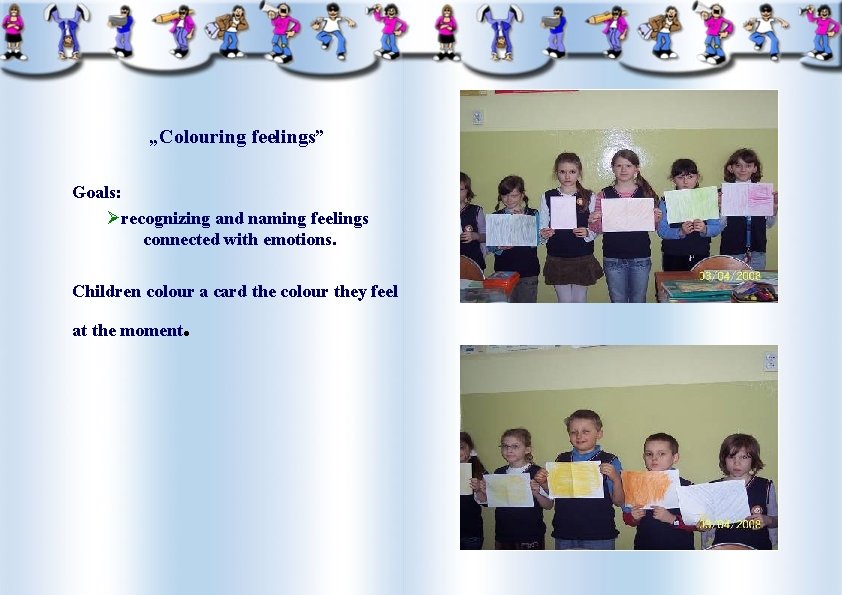
„Colouring feelings” Goals: Ørecognizing and naming feelings connected with emotions. Children colour a card the colour they feel at the moment .
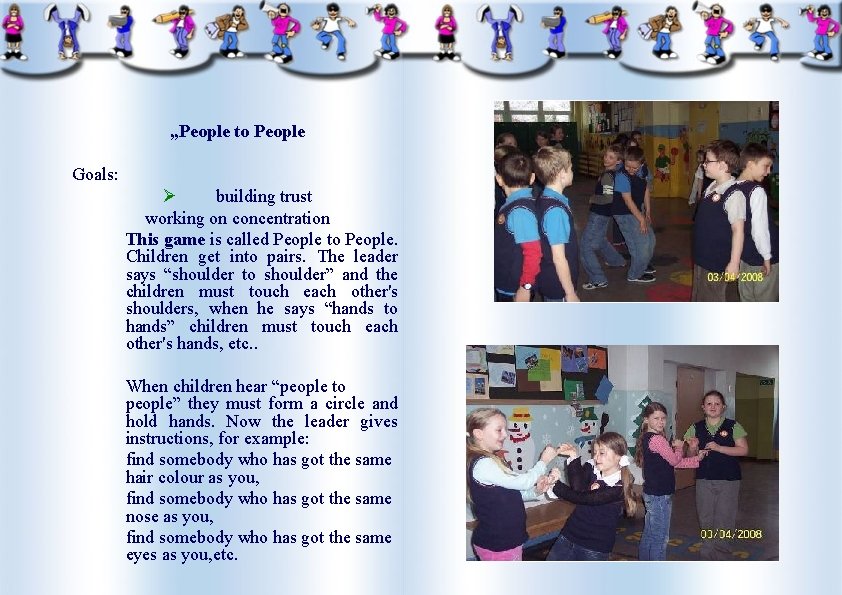
„People to People Goals: Ø building trust working on concentration This game is called People to People. Children get into pairs. The leader says “shoulder to shoulder” and the children must touch each other's shoulders, when he says “hands to hands” children must touch each other's hands, etc. . When children hear “people to people” they must form a circle and hold hands. Now the leader gives instructions, for example: find somebody who has got the same hair colour as you, find somebody who has got the same nose as you, find somebody who has got the same eyes as you, etc.
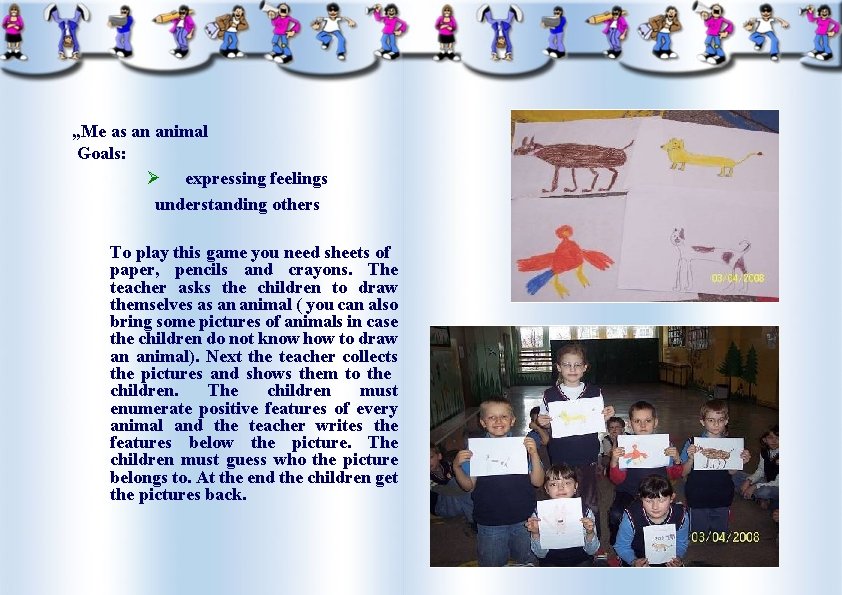
„Me as an animal Goals: Ø expressing feelings understanding others To play this game you need sheets of paper, pencils and crayons. The teacher asks the children to draw themselves as an animal ( you can also bring some pictures of animals in case the children do not know how to draw an animal). Next the teacher collects the pictures and shows them to the children. The children must enumerate positive features of every animal and the teacher writes the features below the picture. The children must guess who the picture belongs to. At the end the children get the pictures back.
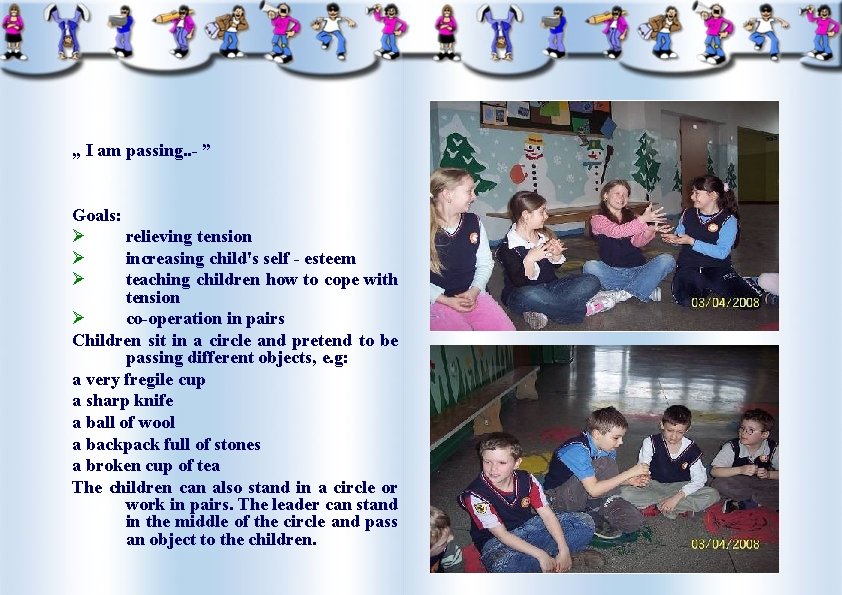
„ I am passing. . - ” Goals: Ø relieving tension Ø increasing child's self - esteem Ø teaching children how to cope with tension Ø co-operation in pairs Children sit in a circle and pretend to be passing different objects, e. g: a very fregile cup a sharp knife a ball of wool a backpack full of stones a broken cup of tea The children can also stand in a circle or work in pairs. The leader can stand in the middle of the circle and pass an object to the children.
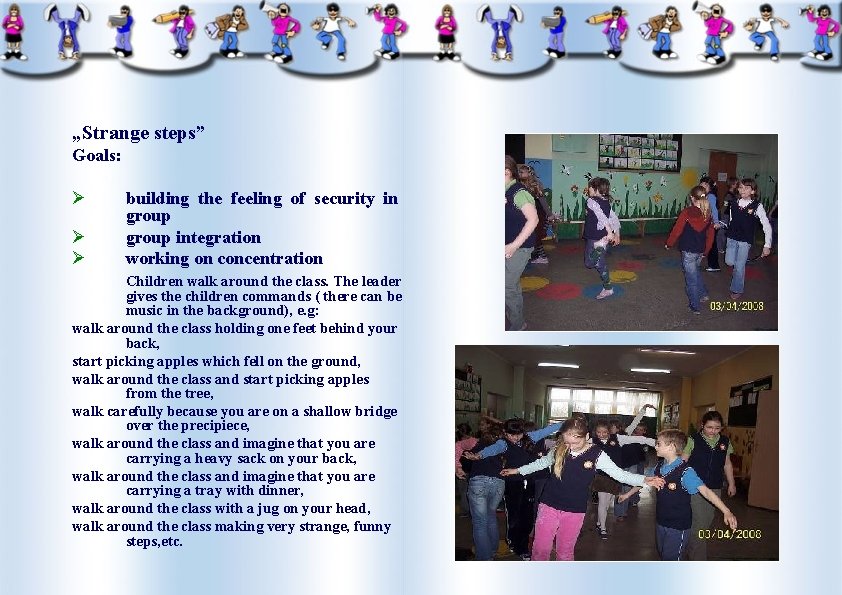
„Strange steps” Goals: Ø Ø Ø building the feeling of security in group integration working on concentration Children walk around the class. The leader gives the children commands ( there can be music in the background), e. g: walk around the class holding one feet behind your back, start picking apples which fell on the ground, walk around the class and start picking apples from the tree, walk carefully because you are on a shallow bridge over the precipiece, walk around the class and imagine that you are carrying a heavy sack on your back, walk around the class and imagine that you are carrying a tray with dinner, walk around the class with a jug on your head, walk around the class making very strange, funny steps, etc.
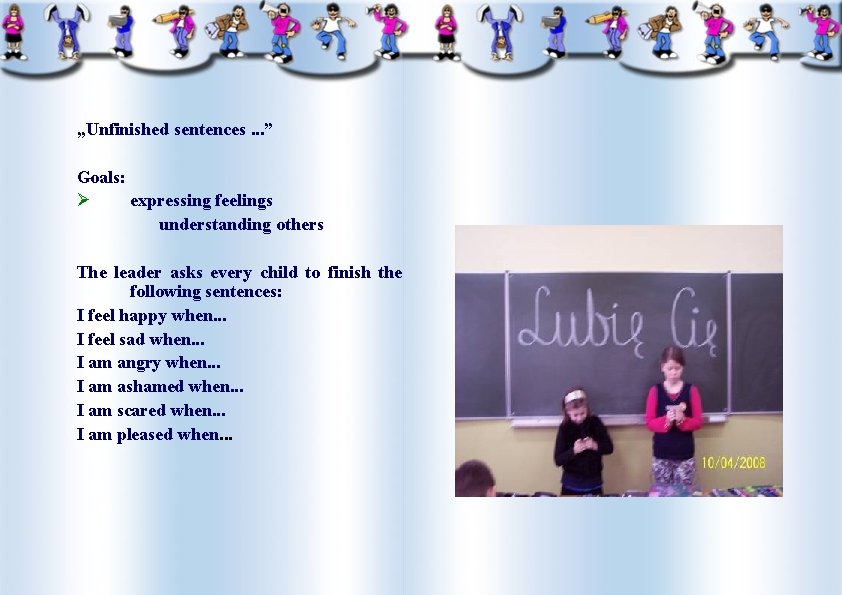
„Unfinished sentences. . . ” Goals: Ø expressing feelings understanding others The leader asks every child to finish the following sentences: I feel happy when. . . I feel sad when. . . I am angry when. . . I am ashamed when. . . I am scared when. . . I am pleased when. . .
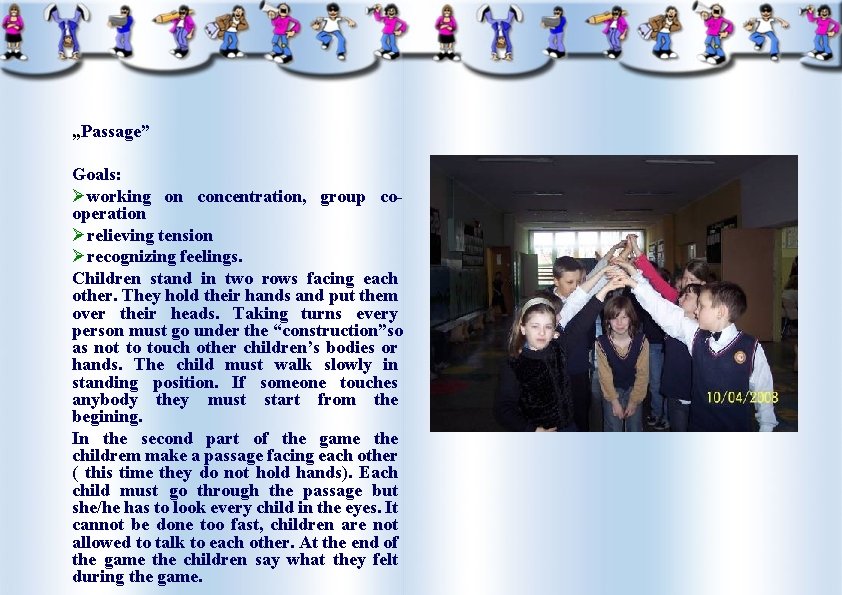
„Passage” Goals: Øworking on concentration, group cooperation Ørelieving tension Ørecognizing feelings. Children stand in two rows facing each other. They hold their hands and put them over their heads. Taking turns every person must go under the “construction”so as not to touch other children’s bodies or hands. The child must walk slowly in standing position. If someone touches anybody they must start from the begining. In the second part of the game the childrem make a passage facing each other ( this time they do not hold hands). Each child must go through the passage but she/he has to look every child in the eyes. It cannot be done too fast, children are not allowed to talk to each other. At the end of the game the children say what they felt during the game.
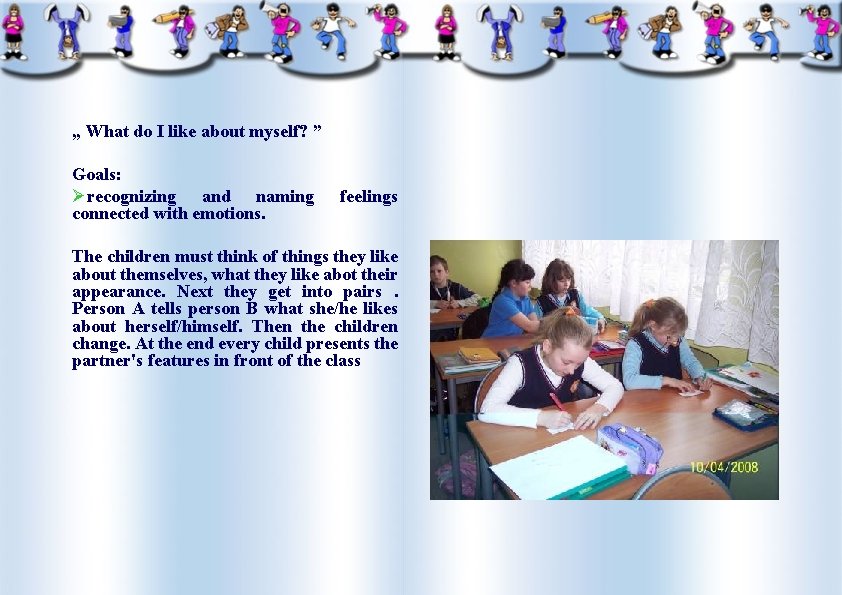
„ What do I like about myself? ” Goals: Ørecognizing and naming connected with emotions. feelings The children must think of things they like about themselves, what they like abot their appearance. Next they get into pairs. Person A tells person B what she/he likes about herself/himself. Then the children change. At the end every child presents the partner's features in front of the class
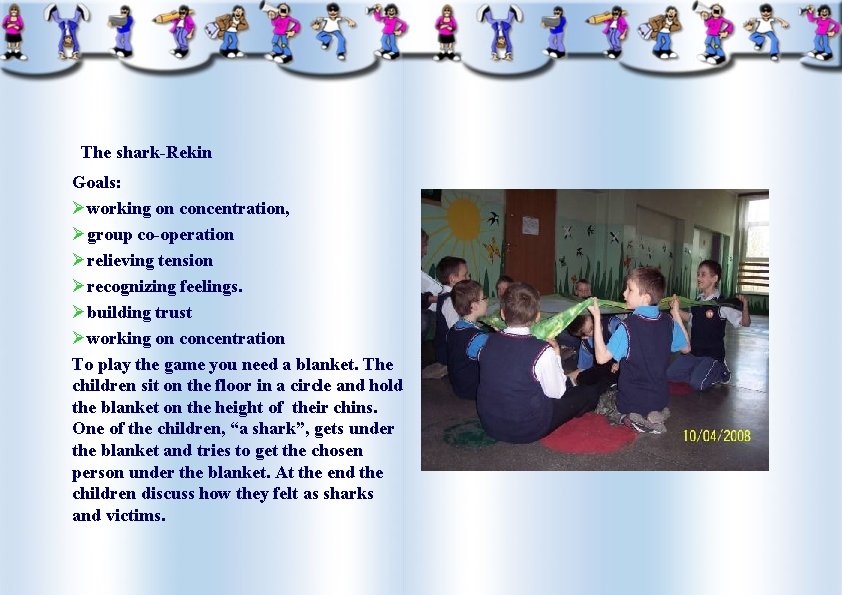
The shark-Rekin Goals: Øworking on concentration, Øgroup co-operation Ørelieving tension Ørecognizing feelings. Øbuilding trust Øworking on concentration To play the game you need a blanket. The children sit on the floor in a circle and hold the blanket on the height of their chins. One of the children, “a shark”, gets under the blanket and tries to get the chosen person under the blanket. At the end the children discuss how they felt as sharks and victims.
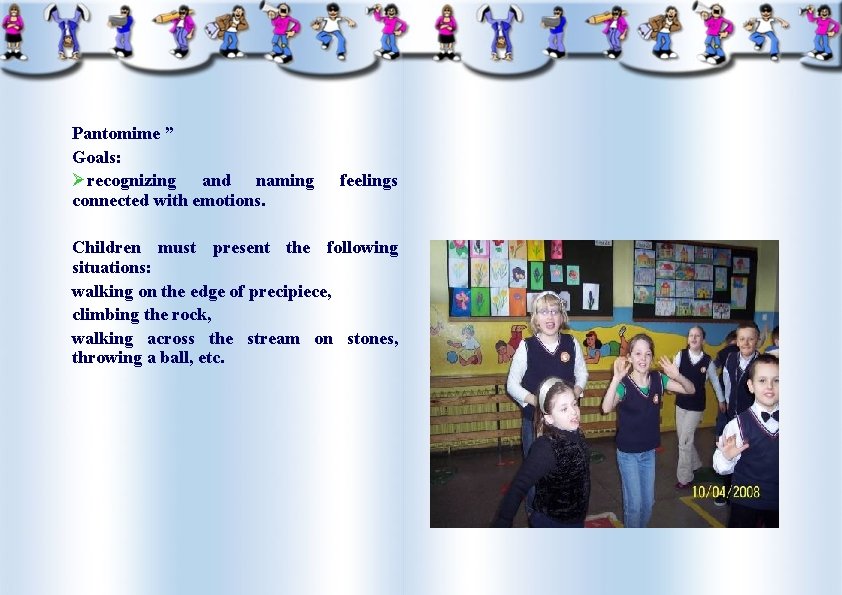
Pantomime ” Goals: Ørecognizing and naming connected with emotions. feelings Children must present the following situations: walking on the edge of precipiece, climbing the rock, walking across the stream on stones, throwing a ball, etc.
Chosen syllabuses dealing with agression and violence.
There are 20 pupils in class 1 A integrated - 10 girls and 10 boys. Five students have specific health problems. We have 1 autistic child, 1 is hearing – impaired, 1 with asthma and two children with underdevelopment of the alimentary canal. Lessons are taught by an integrated teaching teacher with the accompany of a second teacher - a specialist. INTEGRATED TEACHING A PHYSICAL EDUCATION LESSON Teachers: Iwona Piszczatowska, Jolanta Zacharko Class: I A integrated Topic of the day: Games with “a rainbow - coloured shawl” General aim: Various games integrating the group, practicing cooperation, reflex and powers of observation with the use of “a rainbow-coloured shawl” and other sports objects. Specific aims: Student: can use various untypical objects during games can play safely knows and obeys rules of a safe behaviour on lessons distinguishes colours can make a movement at a signal concentrates on a given sign develops precision of movements develops speed and stamina reaches a common aim in a group develops self – esteem is in a good physical and mental state
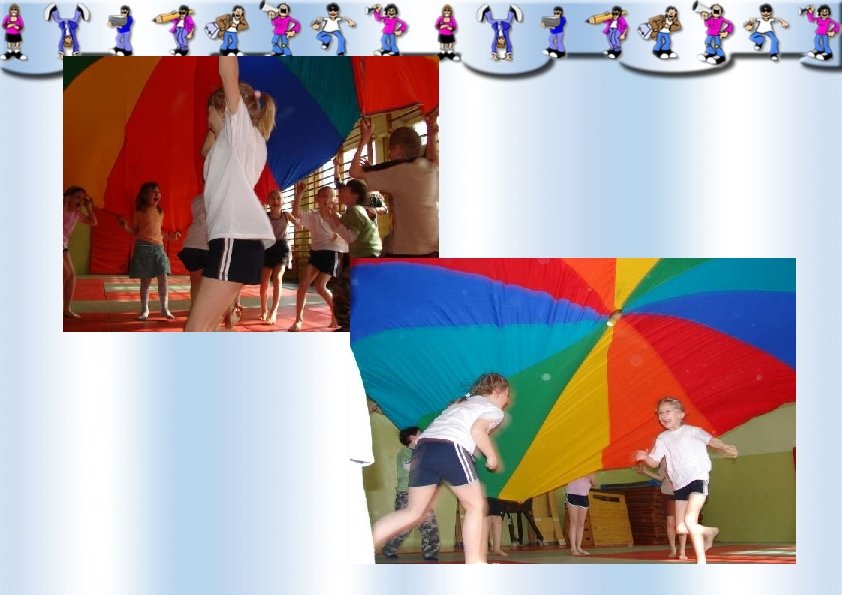
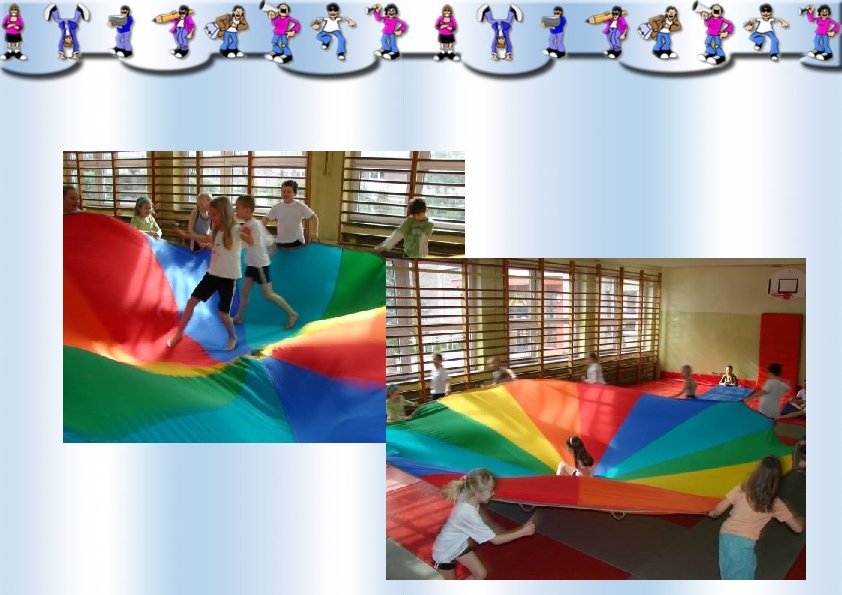
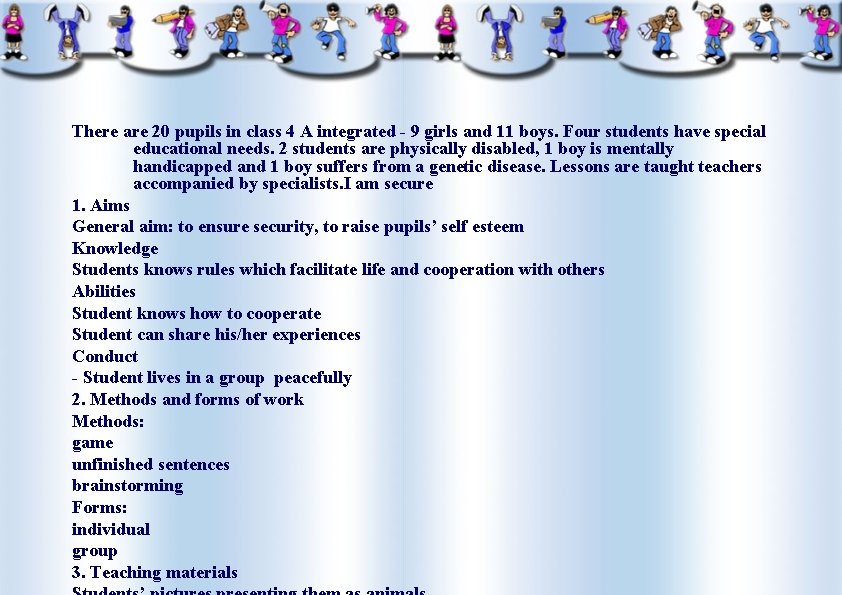
Methods: Game (imitating and classic) Creative expression Show Practical action Motivating to common action Forms of work: Individual Group work Teaching materials: “A rainbow – coloured shawl”, sacks, a rubber ball PROCEDURE INTRODUCTION Students sit in a circle. The teacher explains what they will do during the lesson. The teacher says: ” We are going to play with a rainbow – coloured shawl today. The tasks which you have to do must be done carefully, our common effort will help us to do it correctly and gain the highest number of points. ” Warm up Games “I am a cat”, “Plane – flood – fire”, “A jumping jack”. REALIZATION Game “WAVES ON THE SEA” Participants hold the shawl and perform the teacher’s instructions: “ Children came on the beach an look at the sea. The sea is quiet (children tighten the shawl). A slight wind and small waves appeared (children start moving the shawl). The wind blows harder, waves are bigger (children move the shawl stronger). A storm appeared. The sun doesn’t like it and calms the storm down (children stop moving the shawl). Children can swim in the sea ( 3 students lie on the shawl and pretend swimming). A MERRY – GO - ROUND One person sits in the middle of the shawl. The rest holds it. They start running in one direction at a signal. The sitting child tries to keep balance. BALL UP Students hold the shawl. There is a ball on it. The shawl is lifted slowly and then lowered very quickly.
RUNNING UNDER THE SHAWL The shawl is lifted and lowered 3 times. When the children hear “their” colour they run under the shawl. (The teacher says all colours from the shawl). PICKING SACKS Children hold the shawl. There is a sack behind each child. At a signal they start to pull the shawl in order to grab the sack. SUMMING UP A COLOURFUL STAR Everybody lie on the shawl with their legs directed to the middle. They perform the teacher’s orders: roll right twice, roll left twice, hold your hands, raise them and lower, sit down, stand up and sit again. FEEDBACK The teacher asks questions connected with the lesson: Did you like the activities? Which game was the best? Children answer.

There are 20 pupils in class 4 A integrated - 9 girls and 11 boys. Four students have special educational needs. 2 students are physically disabled, 1 boy is mentally handicapped and 1 boy suffers from a genetic disease. Lessons are taught teachers accompanied by specialists. I am secure 1. Aims General aim: to ensure security, to raise pupils’ self esteem Knowledge Students knows rules which facilitate life and cooperation with others Abilities Student knows how to cooperate Student can share his/her experiences Conduct - Student lives in a group peacefully 2. Methods and forms of work Methods: game unfinished sentences brainstorming Forms: individual group 3. Teaching materials
4. Procedure Warm up A lap. Students answer the following question: “What nice happened to you last week? ” Realization 1. A game “People to people”. Students find somebody who has the same colour hair, eyes, the same nose, etc. 2. Students sit in a circle and pretend to pass different objects. Teacher says: Pass a very fragile cup a soft wool ball a sharp knife a backpack full of stones, etc. 3. “Me as an animal”. Children choose pictures with animals (they were previously drawn by them). Their task is to write 5 positive features connected with the animal. Students read their words aloud and try to guess the author of the picture. Teacher sums up the
Class characteristic-VI There are 29 pupils in class 6 b. Sociological therapy research concerning interpersonal communication, done by the pedagogue, has shown that students need activities integrating a group, releasing stress and tension, increasing self-esteem. Presented lesson plan is a part of educational lessons course that is realized in the class during the school year. Anger – how to deal with it Aims of the lesson: general aim: way of dealing with anger Student knows: what anger is others feelings that he’s got the right to feelings and he knows how to express them Student can: describe the situation when they feel basic emotions recognize the feelings and express them talk about his feelings stop the anger cooperate with others 2. Methods and forms of working Methods: game unfinished sentences discussion Forms: Individual group 3. Materials:
Children are standing in a circle together with the teacher, who starts the sparkle by squeezing next child’s hand. The child is to give it to the next person. The sparkle should come back to the teacher. Realization Knot We ask children to hold their hands and make a chain. First child is to go between the children to make a big knot. If they are „tied” the last person should go that way to untie them and make a chain back. They are not allowed to break the chain – and hold their hands the whole time. Pulling faces Teacher names some feelings and children should express them by making faces like: grief, anger, happiness, surprise, pride, confusion, etc. When. . . I feel. . ! Children get sheets of paper with unfinished sentences about feelings: When somebody offends me I feel ……… When somebody pushes me and hurts me I feel ……… When teacher praises me I feel ……… When a friend tells me nice words I feel ……… When my mum kisses me goodnight I feel ……… When somebody catches me lying I feel ……… When I don’t see somebody I like very much I feel ……… Summing up - evaluation:
What have I learnt – What can I take with me? – a discussion what children have learnt during the lesson Launch the rocket Children can release their anger through e. g. clapping their hands, stamping their feet starting very slowly and quietly and getting faster and loudly and finally they are getting quiet. Saying goodbye – Sparkle Enclosure: When somebody offends me I feel ……… When somebody pushes me and hurts me I feel ……… When teacher praises me I feel ……… When a friend tells me nice words I feel ……… When my mum kisses me goodnight I feel ……… When somebody catches me lying I feel ……… When I don’t see somebody I like very much I feel ………
Games against agression.
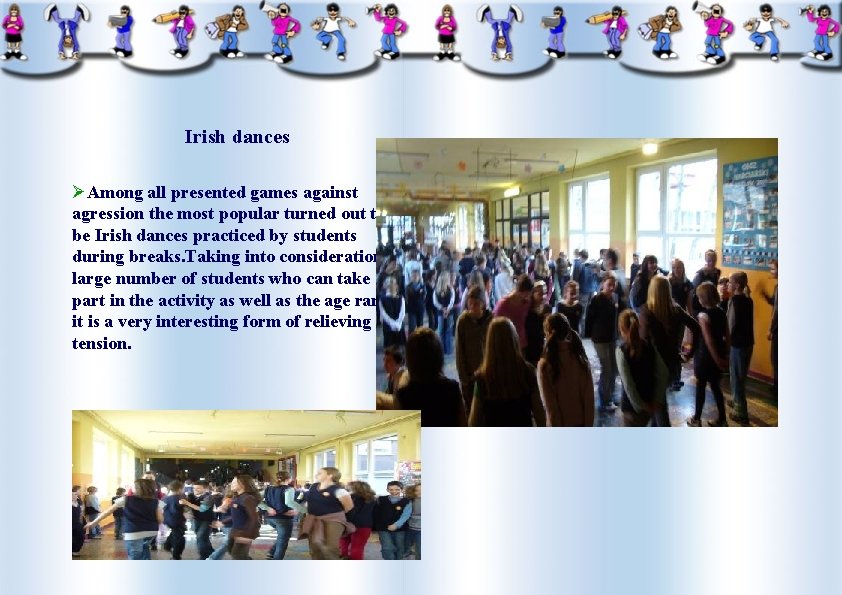
Irish dances ØAmong all presented games against agression the most popular turned out to be Irish dances practiced by students during breaks. Taking into consideration large number of students who can take part in the activity as well as the age range, it is a very interesting form of relieving tension.


Financed from the European Union grants within Comenius Project: ”Conflict management” Partners: Germany, Ireland, Great Britain, Poland.
- Slides: 36