
Creating Positive Learning Environments Through Differentiated Instruction Joseph

- Slides: 12
Creating Positive Learning Environments Through Differentiated Instruction Joseph Kwiatek
“A differentiated classroom provides different avenues to acquiring content, to processing or making sense of ideas, and to developing products so that each student can learn effectively” (Carol Ann Tomlinson, p. 1). “All students benefit when they are challenged with essential skills, questions processes, and ideas to learn within their personal levels of understanding” (Chapman and King, p. xxx).
Differentiated Instruction What is it? What isn’t it? ● Supporting student ● Individualized instruction. learning through a variety of methods. ● Helping each student achieve the same goals through whatever method they require. ● Encouraging growth no matter where the student’s abilities may be. ● More support given to certain groups of students over others. ● Individual lesson plans for each student.
Why is positivity important? ● Positivity, when displayed by an educator, has the effect of influencing the students to have the same outlook. ● Chapman and King: “Think about the learning climate in which most assessments are administered. Did positive testing envirnoment come to mind? . . . negativity must be eliminated”(p. 18). ● Chapman and King state that many of the expectations students have about their learning experiences come directly from how they observed their teacher to act. ● Voice tone, high expectations, energy, and genuine interest are among the ways positivity can be used to influence student learning (p. 18). ● “Brain research and common sense tells us that the brain functions best when in a relaxed, nonthreatened state” (Chapman and King, p. 171). ● Tomlinson suggests that “the students prior understandings, interests, beliefs, how the student learns best, and the student’s attitudes about self and school” are big factors in promoting differentiated classrooms (p. 8). ● If these experiences promote positive expectations of school, they will last much longer than the instances when they are shown.
Why is positivity important? cont. ● Remaining positive as an educator sends the message that hard work can be handled with optimism. ● Tomlinson suggests “teachers who differentiate instruction have to manage and monitor many activities simultaneously” (p. 2). ● Just as we model learning behaviors in the classroom, so too must we model a positive outlook regarding our efforts in differentiated instruction.
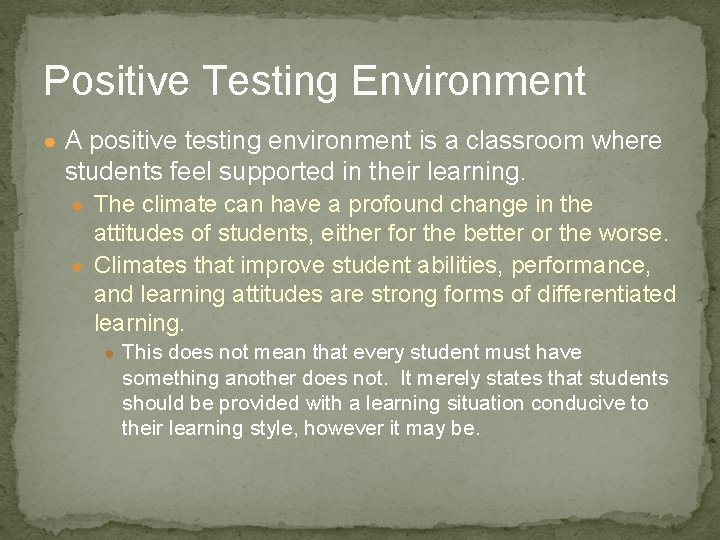
Positive Testing Environment ● A positive testing environment is a classroom where students feel supported in their learning. ● The climate can have a profound change in the attitudes of students, either for the better or the worse. ● Climates that improve student abilities, performance, and learning attitudes are strong forms of differentiated learning. ● This does not mean that every student must have something another does not. It merely states that students should be provided with a learning situation conducive to their learning style, however it may be.
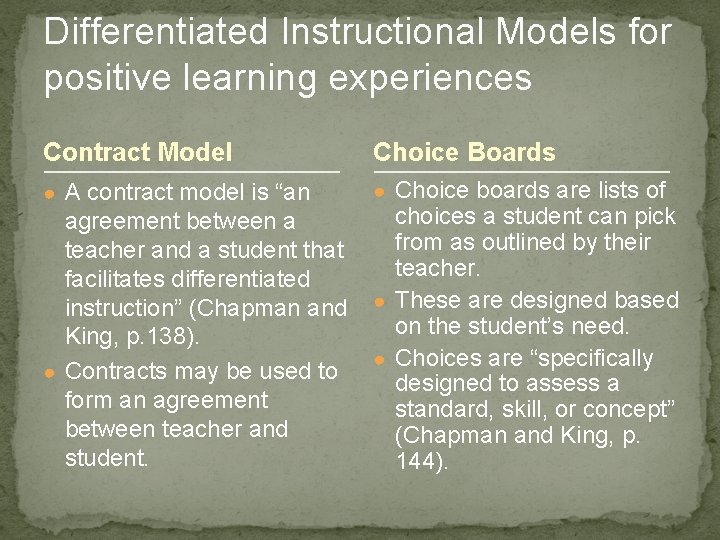
Differentiated Instructional Models for positive learning experiences Contract Model Choice Boards ● A contract model is “an ● Choice boards are lists of agreement between a teacher and a student that facilitates differentiated instruction” (Chapman and King, p. 138). ● Contracts may be used to form an agreement between teacher and student. choices a student can pick from as outlined by their teacher. ● These are designed based on the student’s need. ● Choices are “specifically designed to assess a standard, skill, or concept” (Chapman and King, p. 144).
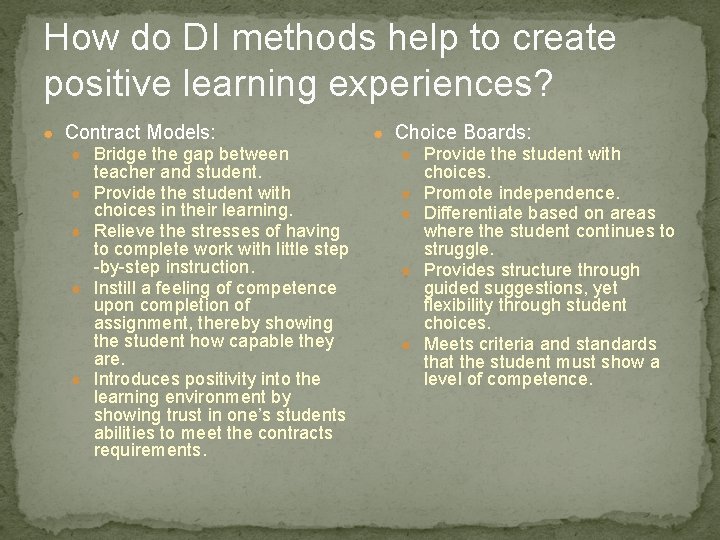
How do DI methods help to create positive learning experiences? ● Contract Models: ● Choice Boards: ● Bridge the gap between ● Provide the student with ● ● ● teacher and student. Provide the student with choices in their learning. Relieve the stresses of having to complete work with little step -by-step instruction. Instill a feeling of competence upon completion of assignment, thereby showing the student how capable they are. Introduces positivity into the learning environment by showing trust in one’s students abilities to meet the contracts requirements. ● ● choices. Promote independence. Differentiate based on areas where the student continues to struggle. Provides structure through guided suggestions, yet flexibility through student choices. Meets criteria and standards that the student must show a level of competence.
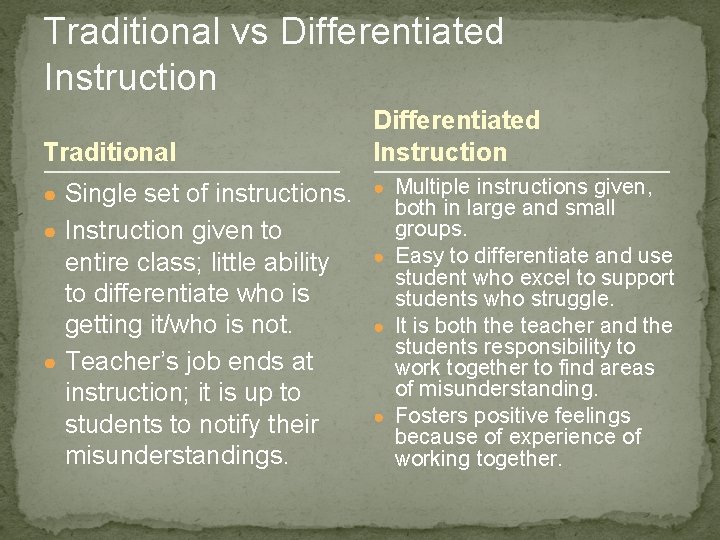
Traditional vs Differentiated Instruction Traditional Differentiated Instruction ● Single set of instructions. ● Multiple instructions given, both in large and small groups. ● Instruction given to ● Easy to differentiate and use entire class; little ability student who excel to support to differentiate who is students who struggle. ● It is both the teacher and the getting it/who is not. students responsibility to ● Teacher’s job ends at work together to find areas of misunderstanding. instruction; it is up to ● Fosters positive feelings students to notify their because of experience of misunderstandings. working together.
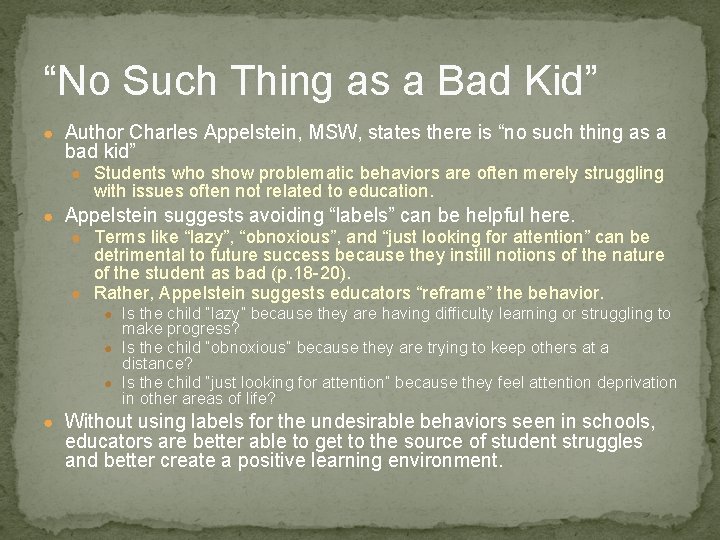
“No Such Thing as a Bad Kid” ● Author Charles Appelstein, MSW, states there is “no such thing as a bad kid” ● Students who show problematic behaviors are often merely struggling with issues often not related to education. ● Appelstein suggests avoiding “labels” can be helpful here. ● Terms like “lazy”, “obnoxious”, and “just looking for attention” can be detrimental to future success because they instill notions of the nature of the student as bad (p. 18 -20). ● Rather, Appelstein suggests educators “reframe” the behavior. ● Is the child “lazy” because they are having difficulty learning or struggling to make progress? ● Is the child “obnoxious” because they are trying to keep others at a distance? ● Is the child “just looking for attention” because they feel attention deprivation in other areas of life? ● Without using labels for the undesirable behaviors seen in schools, educators are better able to get to the source of student struggles and better create a positive learning environment.
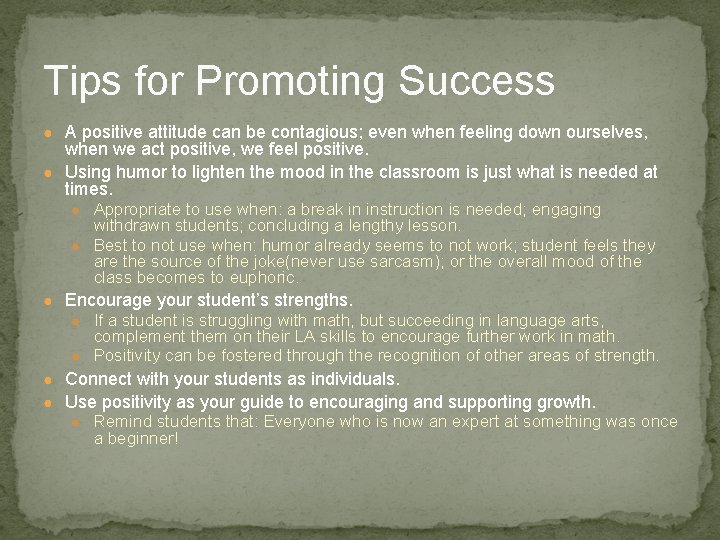
Tips for Promoting Success ● A positive attitude can be contagious; even when feeling down ourselves, when we act positive, we feel positive. ● Using humor to lighten the mood in the classroom is just what is needed at times. ● Appropriate to use when: a break in instruction is needed; engaging withdrawn students; concluding a lengthy lesson. ● Best to not use when: humor already seems to not work; student feels they are the source of the joke(never use sarcasm); or the overall mood of the class becomes to euphoric. ● Encourage your student’s strengths. ● If a student is struggling with math, but succeeding in language arts, complement them on their LA skills to encourage further work in math. ● Positivity can be fostered through the recognition of other areas of strength. ● Connect with your students as individuals. ● Use positivity as your guide to encouraging and supporting growth. ● Remind students that: Everyone who is now an expert at something was once a beginner!
References ● Appelstein, Charles D. No Such Thing as a Bad Kid: Understanding and Responding to the Challenging Behavior of Troubled Children and Youth. The Gifford School. Weston, MA. 1998. ● Chapman, C. , & King, R. (2012). Differentiated assessment strategies one tool doesn't fit all. Thousand Oaks, California: Corwin. 2005. ● Tomlinson, C. A. (2001). How to Differentiate Instruction in Mixed-Ability Classrooms (2 nd ed. ) Alexandria, Va. : Association for Supervision and Curriculum Development. 2001.