
CREATING MORE EFFECTIVE AUTOMATED FEEDBACK TO IMPROVE WEB
CREATING MORE EFFECTIVE AUTOMATED FEEDBACK TO IMPROVE WEB BASED LEARNING FOR LOW-INCOME SCHOOLS Addison Oliver Biology Major, Chemistry and Education Minor SURF Sommer 2019 Faculty Advisor: Dr. Kihyun “Kelly” Ryoo, School of Education This material is based upon work supported by the National Science Foundation under Grant #1552114 and the UNC SURF program.
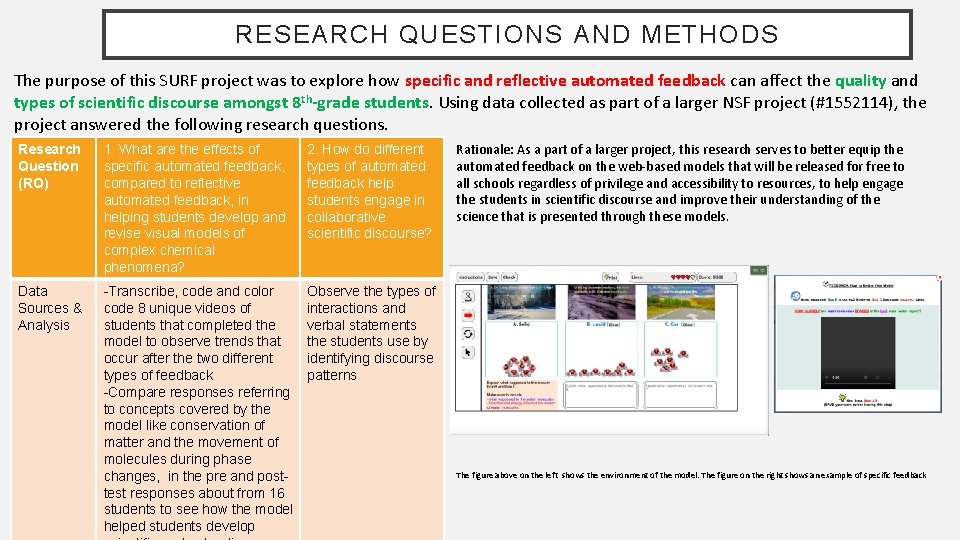
RESEARCH QUESTIONS AND METHODS The purpose of this SURF project was to explore how specific and reflective automated feedback can affect the quality and types of scientific discourse amongst 8 th-grade students. Using data collected as part of a larger NSF project (#1552114), the project answered the following research questions. Research Question (RQ) 1. What are the effects of specific automated feedback, compared to reflective automated feedback, in helping students develop and revise visual models of complex chemical phenomena? 2. How do different types of automated feedback help students engage in collaborative scientific discourse? Data Sources & Analysis -Transcribe, code and color code 8 unique videos of students that completed the model to observe trends that occur after the two different types of feedback -Compare responses referring to concepts covered by the model like conservation of matter and the movement of molecules during phase changes, in the pre and posttest responses about from 16 students to see how the model helped students develop Observe the types of interactions and verbal statements the students use by identifying discourse patterns Rationale: As a part of a larger project, this research serves to better equip the automated feedback on the web-based models that will be released for free to all schools regardless of privilege and accessibility to resources, to help engage the students in scientific discourse and improve their understanding of the science that is presented through these models. The figure above on the left shows the environment of the model. The figure on the right shows an example of specific feedback
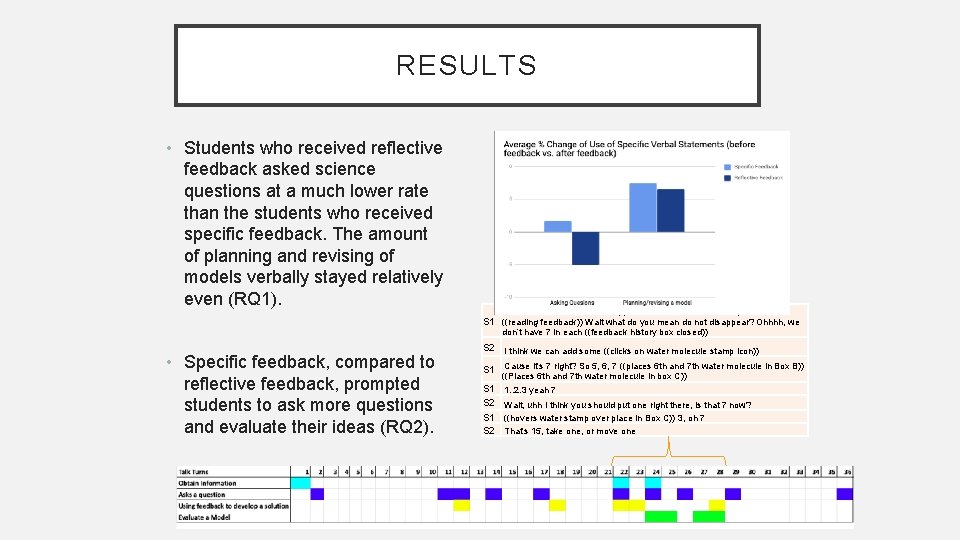
RESULTS • Students who received reflective feedback asked science questions at a much lower rate than the students who received specific feedback. The amount of planning and revising of models verbally stayed relatively even (RQ 1). Water molecules do not disappear when snow becomes liquid water S 1 ((reading feedback)) Wait what do you mean do not disappear? Ohhhh, we don’t have 7 in each ((feedback history box closed)) • Specific feedback, compared to reflective feedback, prompted students to ask more questions and evaluate their ideas (RQ 2). S 2 I think we can add some ((clicks on water molecule stamp icon)) S 1 Cause it’s 7 right? So 5, 6, 7 ((places 6 th and 7 th water molecule in Box B)) ((Places 6 th and 7 th water molecule in box C)) S 1 1. . 2. 3 yeah 7 S 2 Wait, uhh I think you should put one right there, is that 7 now? S 1 ((hovers water stamp over place in Box C)) 3, oh 7 S 2 That’s 15, take one, or move one
- Slides: 3