
Creating Math Steps Algebra Formulas and Math Operations
Creating Math Steps Algebra, Formulas and Math Operations
Writing Steps must use simple Language • Avoid steps like “use the formula”, “plug in the numbers”, “solve” This doesn’t tell the students how to do anything, it would be like being told “work this calculus problem”, but you haven’t taken calculus. What you need to do is tell them where to get the numbers from, how to write them down, which math operations to do first, second, …, how and where to put the answers. The following slides show simple wording that can be used as math steps to tell the students how to do various mathematical operations.
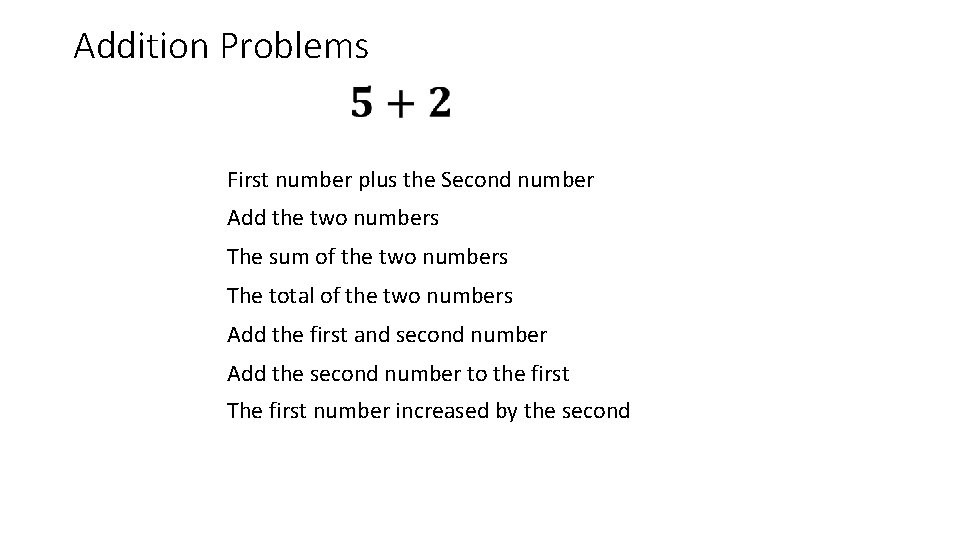
Addition Problems First number plus the Second number Add the two numbers The sum of the two numbers The total of the two numbers Add the first and second number Add the second number to the first The first number increased by the second
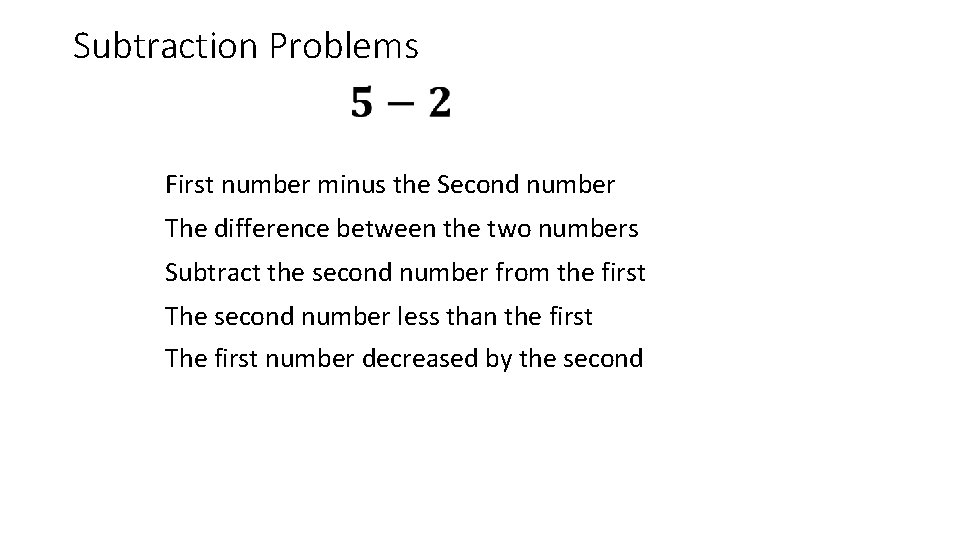
Subtraction Problems First number minus the Second number The difference between the two numbers Subtract the second number from the first The second number less than the first The first number decreased by the second
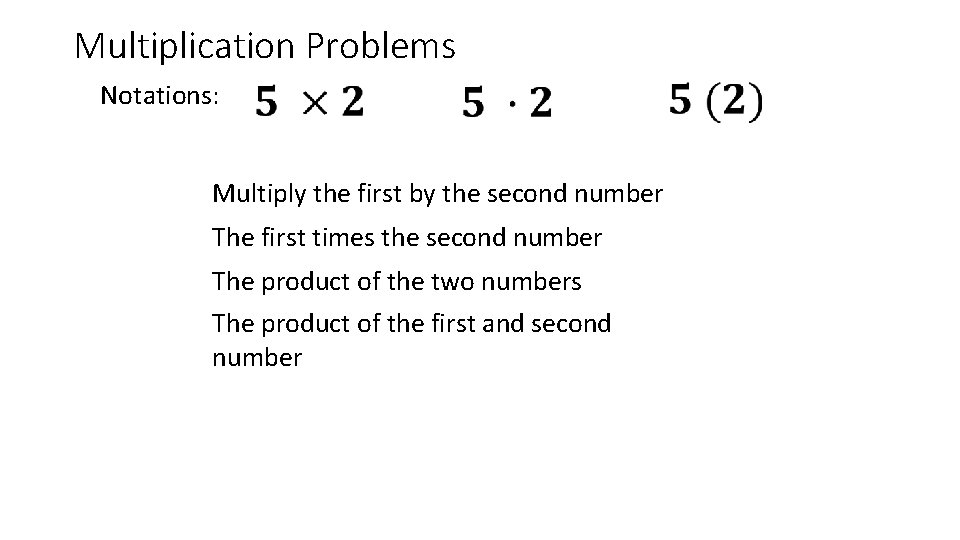
Multiplication Problems Notations: Multiply the first by the second number The first times the second number The product of the two numbers The product of the first and second number
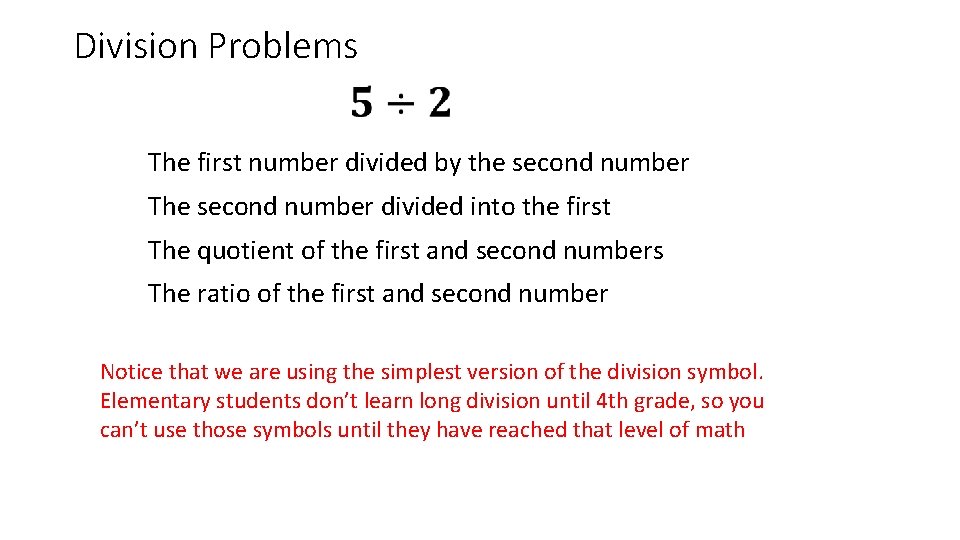
Division Problems The first number divided by the second number The second number divided into the first The quotient of the first and second numbers The ratio of the first and second number Notice that we are using the simplest version of the division symbol. Elementary students don’t learn long division until 4 th grade, so you can’t use those symbols until they have reached that level of math
Formulas Remember that little kids can’t use formulas, use powers or fractions and they do not know how to do order of operations. When writing math steps formulas, think about the order of operations. Which part of the equation will be calculated first, Where do they look in the problem or the question to find those numbers? Which part of the equation will be calculated next, etc. Each new operation should be a separate step.
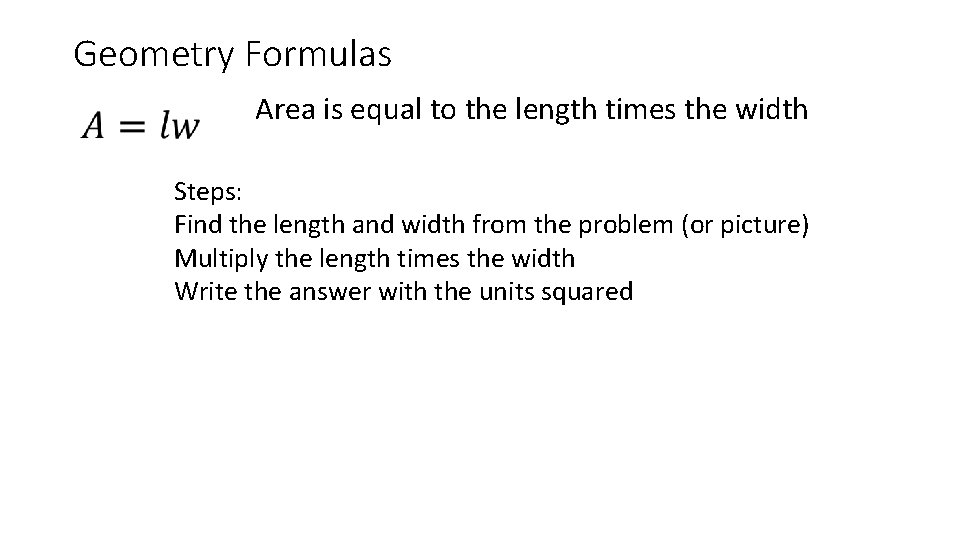
Geometry Formulas Area is equal to the length times the width Steps: Find the length and width from the problem (or picture) Multiply the length times the width Write the answer with the units squared
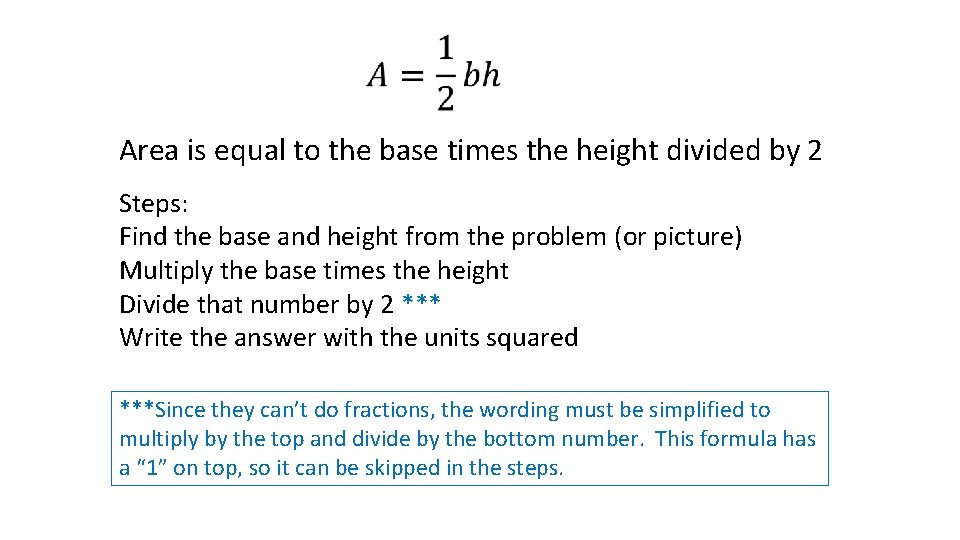
Area is equal to the base times the height divided by 2 Steps: Find the base and height from the problem (or picture) Multiply the base times the height Divide that number by 2 *** Write the answer with the units squared ***Since they can’t do fractions, the wording must be simplified to multiply by the top and divide by the bottom number. This formula has a “ 1” on top, so it can be skipped in the steps.
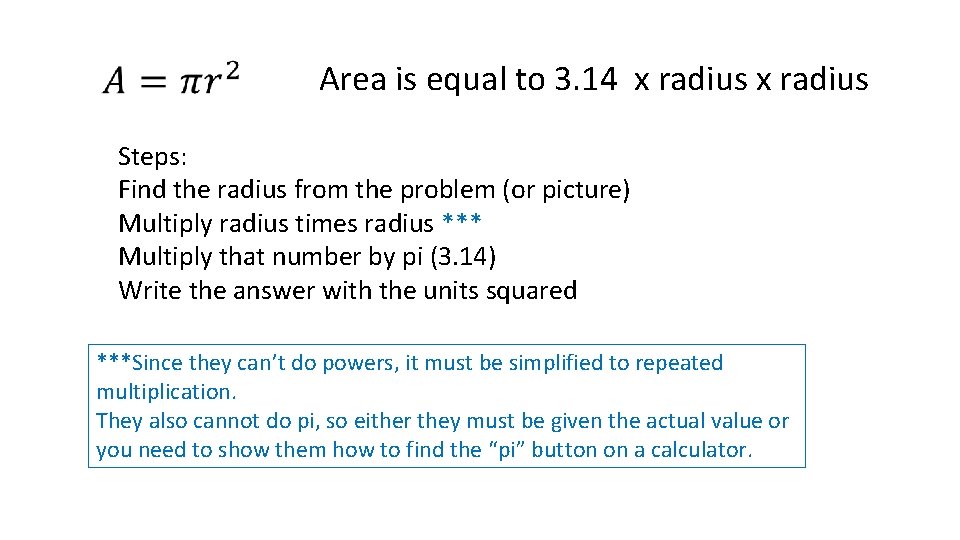
Area is equal to 3. 14 x radius Steps: Find the radius from the problem (or picture) Multiply radius times radius *** Multiply that number by pi (3. 14) Write the answer with the units squared ***Since they can’t do powers, it must be simplified to repeated multiplication. They also cannot do pi, so either they must be given the actual value or you need to show them how to find the “pi” button on a calculator.
Algebra Expressions Little kids also can’t do Algebra (i. e. anything with a variable (a letter) in it, like “x”). For algebra problems, you have to call the variable by an everyday name.
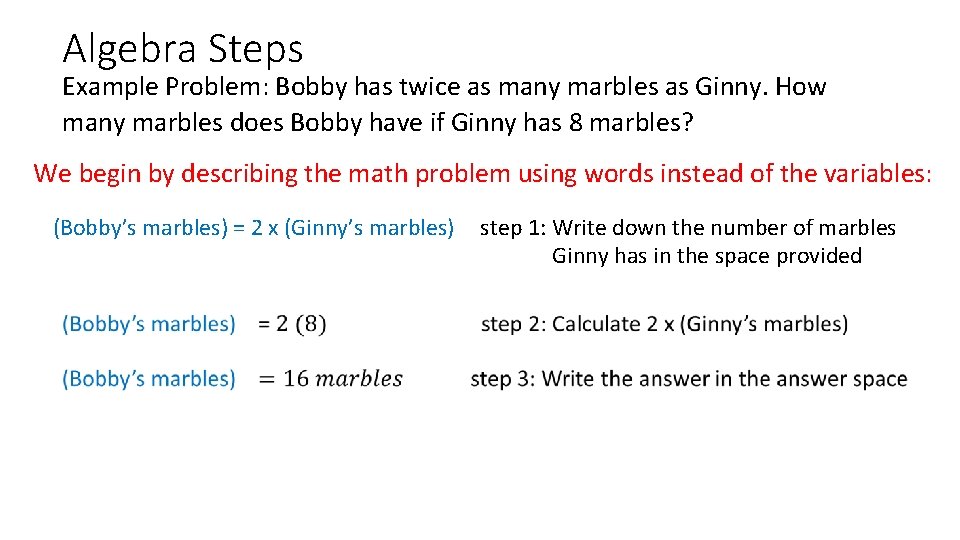
Algebra Steps Example Problem: Bobby has twice as many marbles as Ginny. How many marbles does Bobby have if Ginny has 8 marbles? We begin by describing the math problem using words instead of the variables: (Bobby’s marbles) = 2 x (Ginny’s marbles) step 1: Write down the number of marbles Ginny has in the space provided
Teaching an alternate method It is a hard enough task to teach well-known methods, but when the method you have to teach is new to you also, then it has to be broken down, defined, outlined and explained in even more detail than usual. See the following example of a shortcut method for multiplying numbers by 11 to see how much extra detail is required.
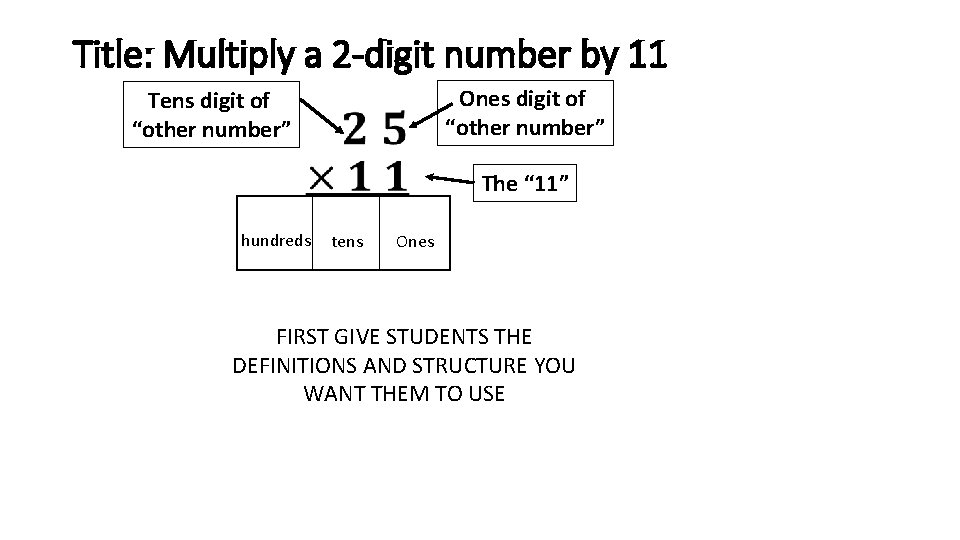
Title: Multiply a 2 -digit number by 11 Ones digit of “other number” Tens digit of “other number” The “ 11” hundreds tens Ones FIRST GIVE STUDENTS THE DEFINITIONS AND STRUCTURE YOU WANT THEM TO USE
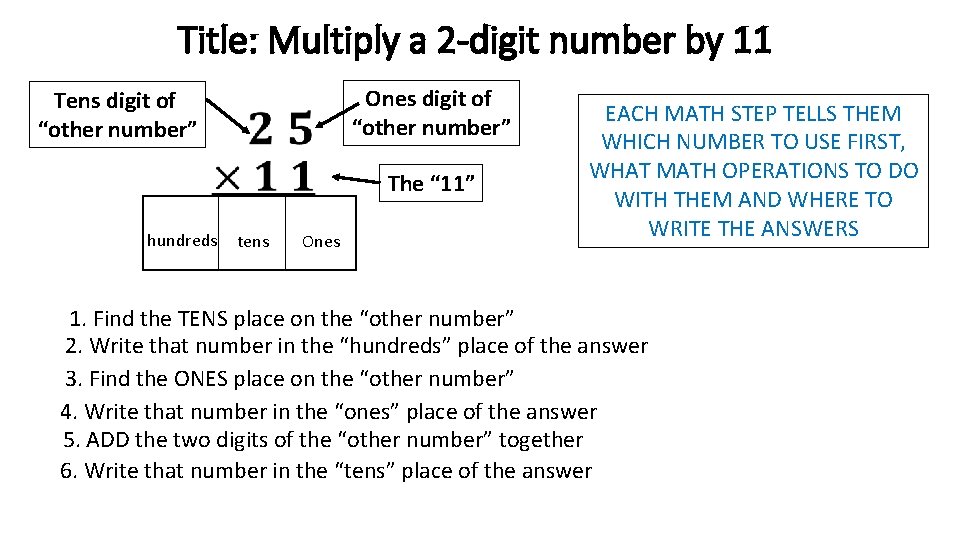
Title: Multiply a 2 -digit number by 11 Ones digit of “other number” Tens digit of “other number” The “ 11” hundreds tens Ones EACH MATH STEP TELLS THEM WHICH NUMBER TO USE FIRST, WHAT MATH OPERATIONS TO DO WITH THEM AND WHERE TO WRITE THE ANSWERS 1. Find the TENS place on the “other number” 2. Write that number in the “hundreds” place of the answer 3. Find the ONES place on the “other number” 4. Write that number in the “ones” place of the answer 5. ADD the two digits of the “other number” together 6. Write that number in the “tens” place of the answer
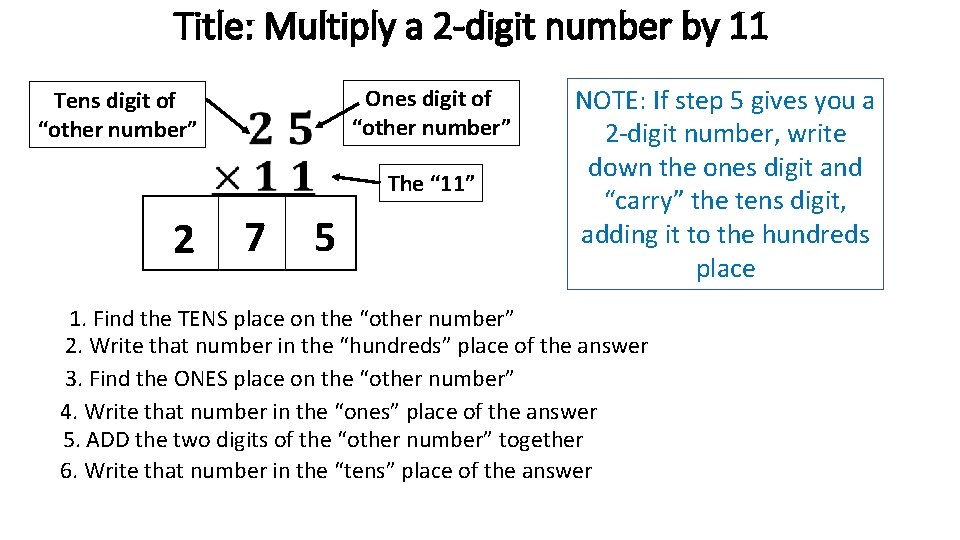
Title: Multiply a 2 -digit number by 11 Ones digit of “other number” Tens digit of “other number” The “ 11” 2 7 5 NOTE: If step 5 gives you a 2 -digit number, write down the ones digit and “carry” the tens digit, adding it to the hundreds place 1. Find the TENS place on the “other number” 2. Write that number in the “hundreds” place of the answer 3. Find the ONES place on the “other number” 4. Write that number in the “ones” place of the answer 5. ADD the two digits of the “other number” together 6. Write that number in the “tens” place of the answer
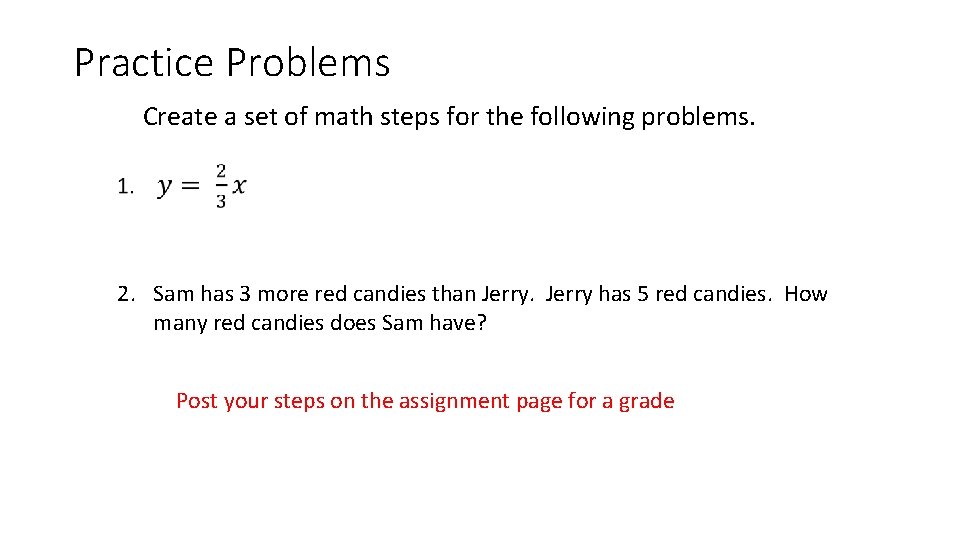
Practice Problems Create a set of math steps for the following problems. 2. Sam has 3 more red candies than Jerry has 5 red candies. How many red candies does Sam have? Post your steps on the assignment page for a grade
- Slides: 17