
Creating Mastery Objectives EDU 7701 Research Development in
Creating Mastery Objectives EDU 7701 Research Development in Instructional Strategies Dr. Dennis O’Hara March 4, 2015 Sharon Hayes and Mia Truesdale
“To begin with the end in mind means to start with a clear understanding of your destination. It means to know where you’re going so that you better understand where you are now, so that the steps you take are Steven Covey always in the right The Seven Habits of Highly Effective People direction. ”

Creating Mastery Objectives By the end of this presentation teachers will be able to: ØDescribe what mastery learning is ØExplain why mastery learning is beneficial to their students ØDescribe why mastery objectives are an essential step in mastery learning ØCreate their own mastery objectives ØCreate formative assessments on others’ mastery objectives
Use the text marking strategy to read the handout. üGot it. ! This is important. (I could explain it to someone else. ) (This is a key point. ) ? What? ? ? (I don’t understand it yet. ) How do I frame lesson objectives so they guide my planning and focus on student achievement?

Mastery Learning Creating Mastery Objectives ØWhat is mastery learning? ØWhere did mastery learning come from? ØWhy do I care?

Mastery Learning Creating Mastery Objectives The goal of mastery learning is to ensure all students master the content of the material being taught. This is achieved through breaking down the material being taught into smaller segments. Providing the students with mastery objectives and utilizing formative assessments throughout the learning process ensures mastery of the objectives. Utilizing a summative assessment only after mastery is achieved
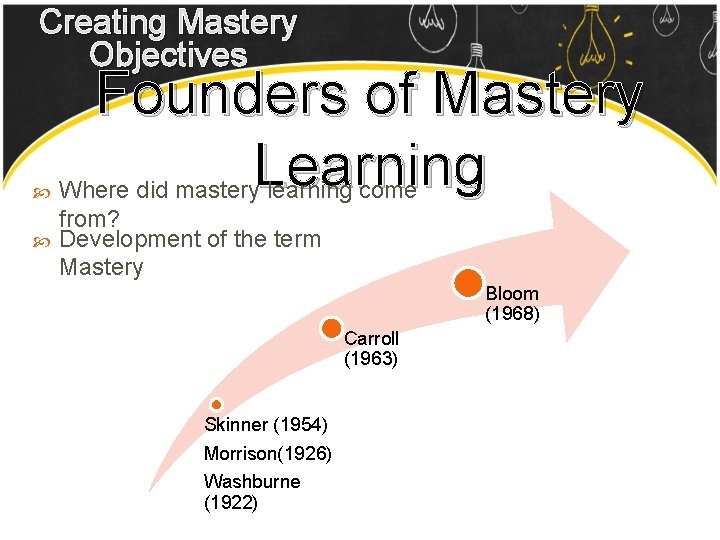
Creating Mastery Objectives Founders of Mastery Learning Where did mastery learning come from? Development of the term Mastery Bloom (1968) Carroll (1963) Skinner (1954) Morrison(1926) Washburne (1922)
Creating Mastery Objectives Mastery Learning Why should I care? Ø Research demonstrates that mastery learning techniques increases learning. • In one meta-analysis (Kulik, Kulik & Bangert-Drowns, 1990), the mean effect size (Cohen's d) of 103 studies was 0. 52, which is considered a moderately large effect size. http: //en. wikipedia. org/wiki/Mastery_learning Ø Students need to have a mastery of topics before moving on Ø A strong base increases the ability to learn the next topic

One teacher’s example of Mastery Learning…
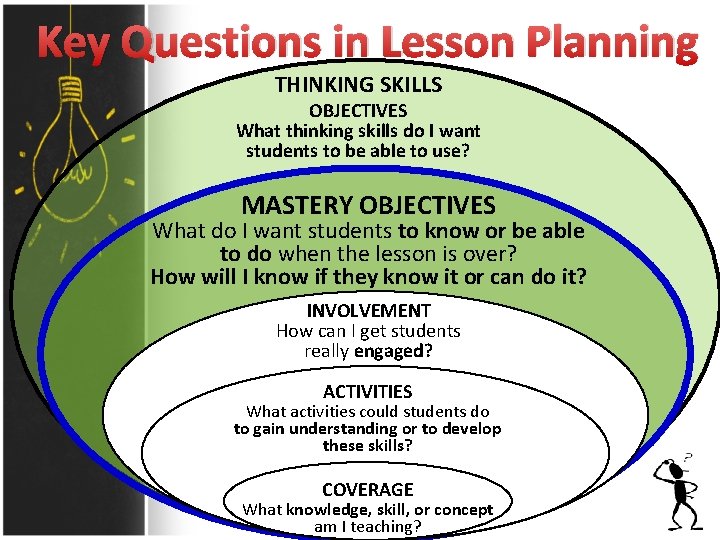
Key Questions in Lesson Planning THINKING SKILLS OBJECTIVES What thinking skills do I want students to be able to use? MASTERY OBJECTIVES What do I want students to know or be able to do when the lesson is over? How will I know if they know it or can do it? INVOLVEMENT How can I get students really engaged? ACTIVITIES What activities could students do to gain understanding or to develop these skills? COVERAGE What knowledge, skill, or concept am I teaching?
Criteria for Mastery Objectives • “What exactly do I want students to know and be able to do when this lesson is over? ” • “How will I know they have learned it, that is, What will I take as evidence that the objective has been met? ” • Are learning objectives clear to both teacher and students? • Are the objectives appropriate? – – aligned with district and curriculum standards matched to the students; challenging and attainable worth knowing able to be assessed • Identify the criteria for success

Mastery Objectives Mastery objectives for the teachers Ø provide the teacher with clear goals of their teaching, Ø ensures teachers are giving appropriate feedback for the objectives Mastery objectives for the students Ø gives the students a clear understanding of what is expected of them Ø Increases their responsibility for their own learning Ø Encourages the students to state when they don’t understand something.
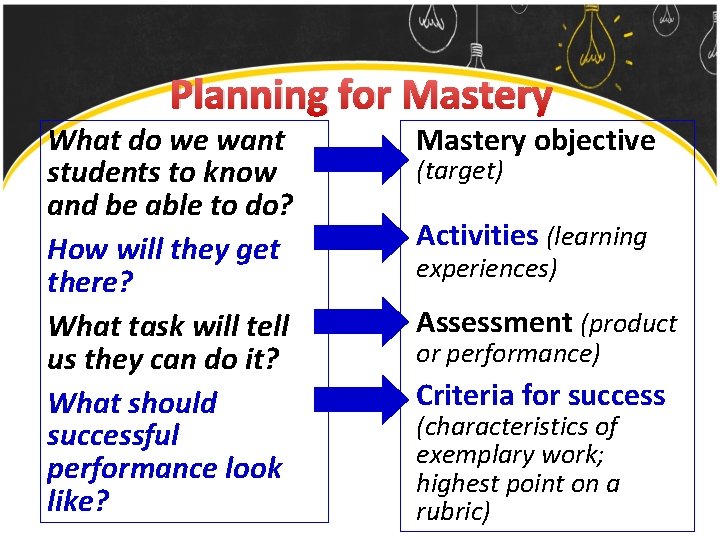
Planning for Mastery What do we want students to know and be able to do? How will they get there? What task will tell us they can do it? What should successful performance look like? Mastery objective (target) Activities (learning experiences) Assessment (product or performance) Criteria for success (characteristics of exemplary work; highest point on a rubric)
Mastery Objective Thinking Major considerations: Ø Is objective precisely worded so that the learning targets are clear for both teacher and student? Ø Are the objectives appropriate, that is, aligned with the district or grade level curriculum standards? Retrieved from: http: //www. slideshare. net/gnonewleaders/mastery-objectives-2

Mastery Objectives. Example of mastery objectives from an indicator: Examples Indicator Mastery Objectives Use nonstandard units to estimate and measure weight and capacity * identify some examples of nonstandard units * demonstrate how nonstandard units are used to weigh objects * demonstrate how to use a scale * estimate measurements * use the vocabulary of measurement Write formal or business letters that: * explain the reason for writing * get the attention of the reader * use formal language * include the heading, salutation, body, closing, and signature * identify the differences between the heading, salutation, body, closing and signature in a friendly vs. business letter format * etc.
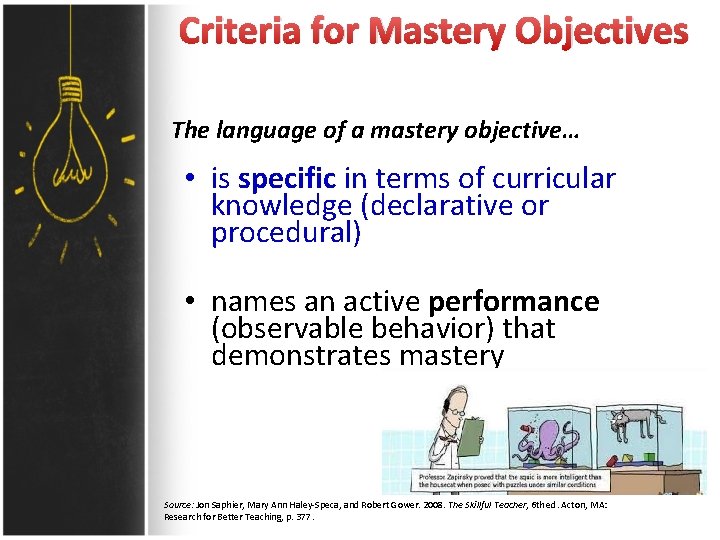
Criteria for Mastery Objectives The language of a mastery objective… • is specific in terms of curricular knowledge (declarative or procedural) • names an active performance (observable behavior) that demonstrates mastery Source: Jon Saphier, Mary Ann Haley-Speca, and Robert Gower. 2008. The Skillful Teacher, 6 th ed. Acton, MA: Research for Better Teaching, p. 377.
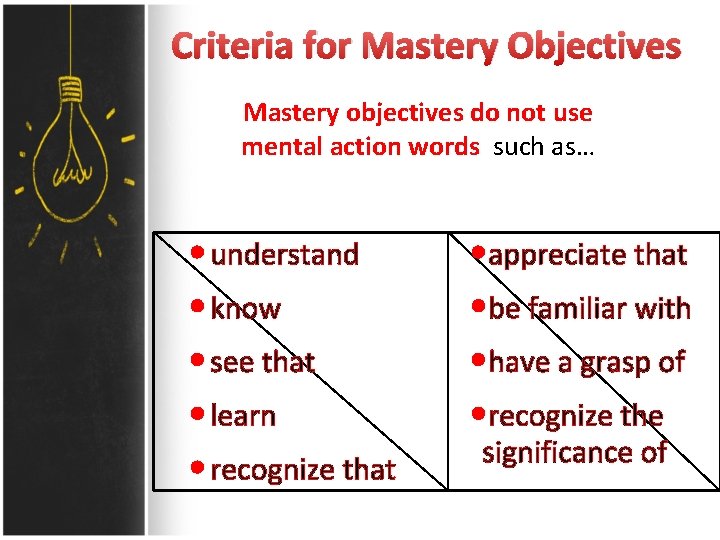
Criteria for Mastery Objectives Mastery objectives do not use mental action words such as… • understand • know • see that • learn • recognize that • appreciate that • be familiar with • have a grasp of • recognize the significance of
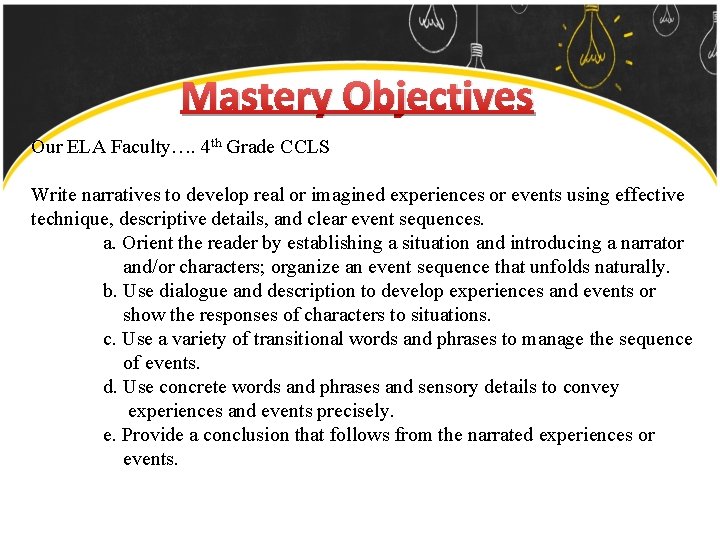
Mastery Objectives Our ELA Faculty…. 4 th Grade CCLS Write narratives to develop real or imagined experiences or events using effective technique, descriptive details, and clear event sequences. a. Orient the reader by establishing a situation and introducing a narrator and/or characters; organize an event sequence that unfolds naturally. b. Use dialogue and description to develop experiences and events or show the responses of characters to situations. c. Use a variety of transitional words and phrases to manage the sequence of events. d. Use concrete words and phrases and sensory details to convey experiences and events precisely. e. Provide a conclusion that follows from the narrated experiences or events.
Creating Mastery Now it’s your turn! Objectives You will receive 3 handouts o 1 - 4 th Grade CCLS o 2 - Verbs for Writing Mastery Objectives o 3 - Chapter 2 from the book Never Work Harder Than Your Students & Other Principles of Great Teaching by Robyn R. Jackson Spend 5 minutes reviewing the indicators on handout 4 th Grade CCLS Create Mastery objectives for a category you choose, utilizing handout Verbs for Writing Mastery Objectives Share with your group and provide constructive feedback to others in your group (formative assessment) Finally we will share with the class as a whole
- Slides: 19