
Creating Healthy Communities What works well when it

- Slides: 18
Creating Healthy Communities What works well when it comes to creating healthy communities?
Table of Contents 01 04 07 Key issues Rural local gov challenges to healthy policy implementation. Step Two Preparation. Action Plan and Examples Action plan template and real Australian program examples. 02 05 What makes programs work? What makes a healthy communities program successful; 4 steps. Step Three Planning and implementation. 03 06 Step One Setting the foundation. Step Four Reflect, adapt and embed.
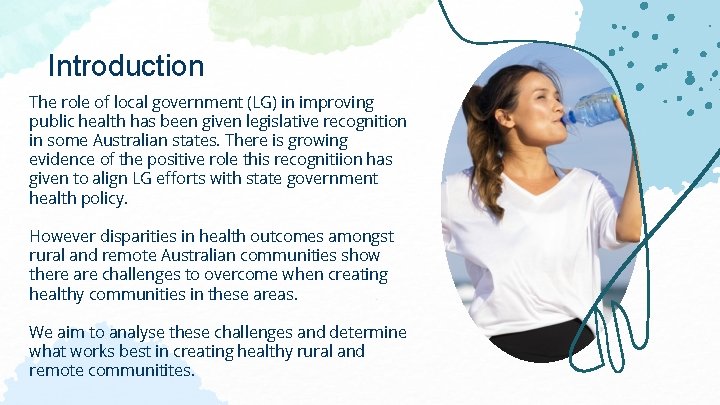
Introduction The role of local government (LG) in improving public health has been given legislative recognition in some Australian states. There is growing evidence of the positive role this recognitiion has given to align LG efforts with state government health policy. However disparities in health outcomes amongst rural and remote Australian communities show there are challenges to overcome when creating healthy communities in these areas. We aim to analyse these challenges and determine what works best in creating healthy rural and remote communitites.
Key Issues in implementing public healthy policies Rural and regional local governments face a few more issues when it comes to public healthy policy implementation than urban governments. These issues include but are not limited to: § Role of leadership and related political strategies o Expecting non-health focus departments to incorporate health issues into policies could be seen as a departure and distraction from core business Diminished funding § Changes in staff or management structures § Changes in political priorities § Lack of access to public health experts with whom to collaborate § Current staff don’t have the capacity to take on extra responsibilities § Constraints on infrastructure and resources § Growth and changes in characteristics of local populations §
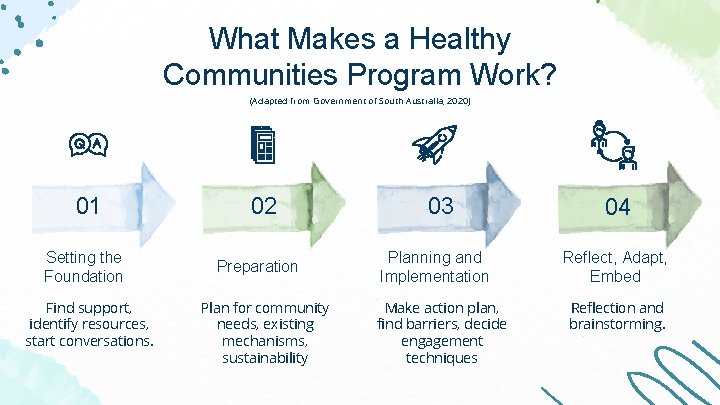
What Makes a Healthy Communities Program Work? (Adapted from Government of South Australia, 2020) 01 Setting the Foundation Find support, identify resources, start conversations. 02 Preparation Plan for community needs, existing mechanisms, sustainability 03 Planning and Implementation Make action plan, find barriers, decide engagement techniques 04 Reflect, Adapt, Embed Reflection and brainstorming.
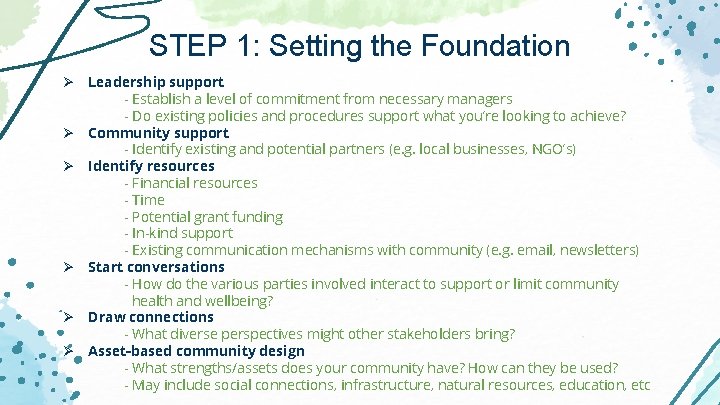
STEP 1: Setting the Foundation Ø Leadership support - Establish a level of commitment from necessary managers - Do existing policies and procedures support what you’re looking to achieve? Ø Community support - Identify existing and potential partners (e. g. local businesses, NGO’s) Ø Identify resources - Financial resources - Time - Potential grant funding - In-kind support - Existing communication mechanisms with community (e. g. email, newsletters) Ø Start conversations - How do the various parties involved interact to support or limit community health and wellbeing? Ø Draw connections - What diverse perspectives might other stakeholders bring? Ø Asset-based community design - What strengths/assets does your community have? How can they be used? - May include social connections, infrastructure, natural resources, education, etc
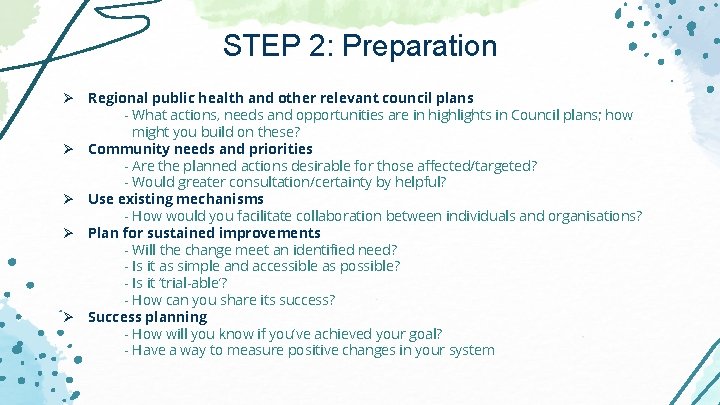
STEP 2: Preparation Ø Regional public health and other relevant council plans - What actions, needs and opportunities are in highlights in Council plans; how might you build on these? Ø Community needs and priorities - Are the planned actions desirable for those affected/targeted? - Would greater consultation/certainty by helpful? Ø Use existing mechanisms - How would you facilitate collaboration between individuals and organisations? Ø Plan for sustained improvements - Will the change meet an identified need? - Is it as simple and accessible as possible? - Is it ‘trial-able’? - How can you share its success? Ø Success planning - How will you know if you’ve achieved your goal? - Have a way to measure positive changes in your system
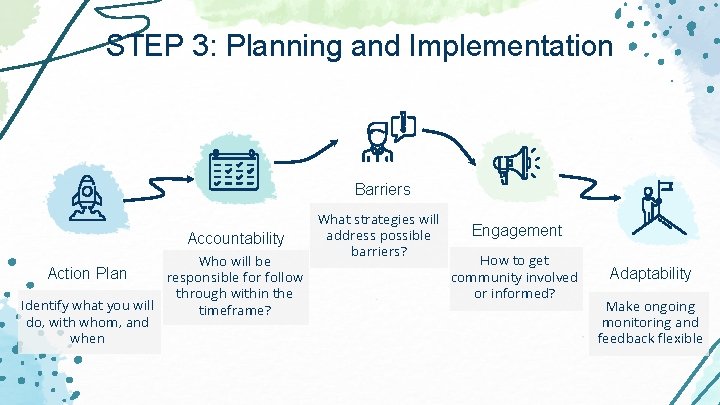
STEP 3: Planning and Implementation Barriers Accountability Who will be responsible for follow through within the Identify what you will timeframe? do, with whom, and when Action Plan What strategies will address possible barriers? Engagement How to get community involved or informed? Adaptability Make ongoing monitoring and feedback flexible
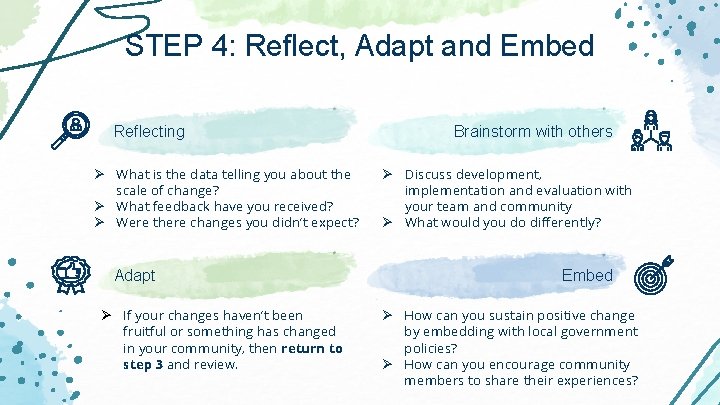
STEP 4: Reflect, Adapt and Embed Reflecting Ø What is the data telling you about the scale of change? Ø What feedback have you received? Ø Were there changes you didn’t expect? Adapt Ø If your changes haven’t been fruitful or something has changed in your community, then return to step 3 and review. Brainstorm with others Ø Discuss development, implementation and evaluation with your team and community Ø What would you do differently? Embed Ø How can you sustain positive change by embedding with local government policies? Ø How can you encourage community members to share their experiences?
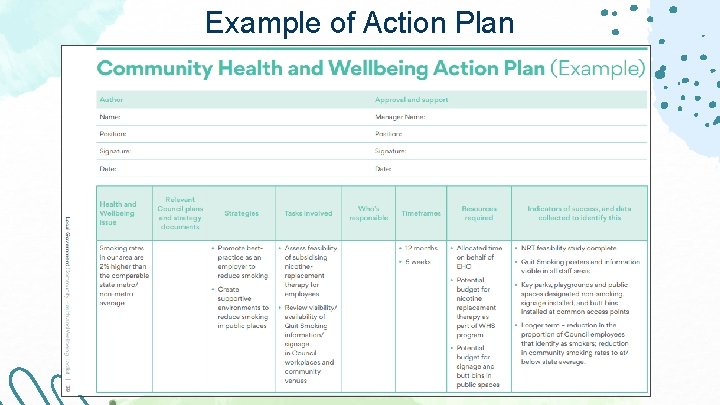
Example of Action Plan
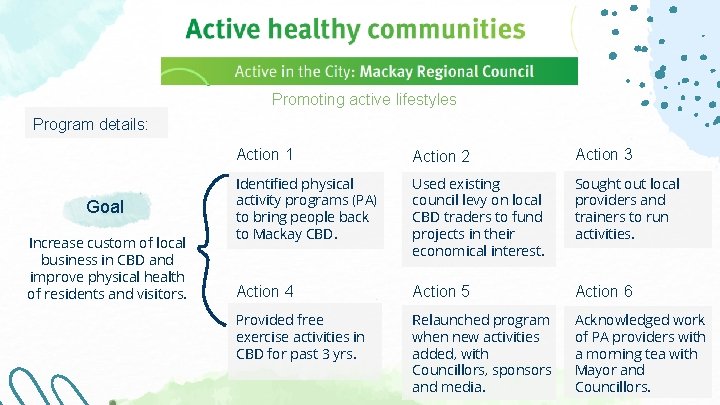
Australian Healthy Communities Programs: Example 1 Promoting active lifestyles Link: http: //www. activehealthycommunities. com. au/wpcontent/uploads/2014/07/QH 37_AHC_Mackay. pdf
Promoting active lifestyles What it demonstrates: Benefits of interdepartmental partnerships within councils. The program seeks to accommodate working habits of the local community. Links a range of council objectives and goals to improve access to resources. Links programs that are driven by different goals to increase better outcomes (e. g. improved physical health and economic development).
Promoting active lifestyles Program details: Goal Increase custom of local business in CBD and improve physical health of residents and visitors. Action 1 Action 2 Action 3 Identified physical activity programs (PA) to bring people back to Mackay CBD. Used existing council levy on local CBD traders to fund projects in their economical interest. Sought out local providers and trainers to run activities. Action 4 Action 5 Action 6 Provided free exercise activities in CBD for past 3 yrs. Relaunched program when new activities added, with Councillors, sponsors and media. Acknowledged work of PA providers with a morning tea with Mayor and Councillors.
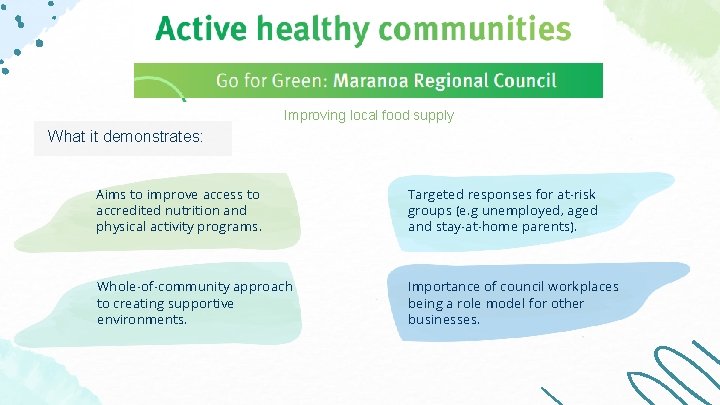
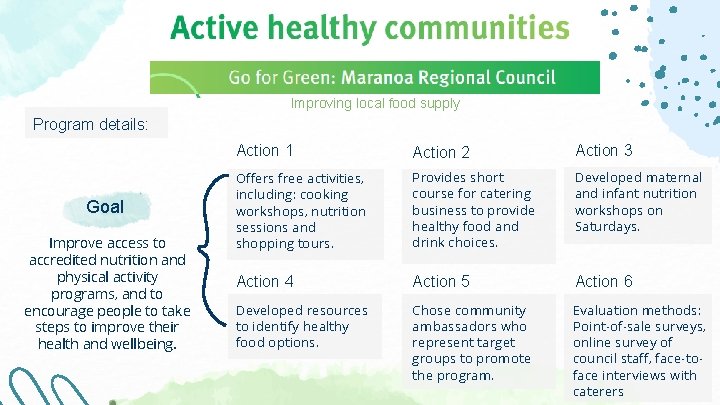
Australian Healthy Communities Programs: Example 2 Improving local food supply Link: http: //www. activehealthycommunities. com. au/wpcontent/uploads/2014/07/QH 37_AHC_Maranoa. pdf
Improving local food supply What it demonstrates: Aims to improve access to accredited nutrition and physical activity programs. Targeted responses for at-risk groups (e. g unemployed, aged and stay-at-home parents). Whole-of-community approach to creating supportive environments. Importance of council workplaces being a role model for other businesses.
Improving local food supply Program details: Goal Improve access to accredited nutrition and physical activity programs, and to encourage people to take steps to improve their health and wellbeing. Action 1 Action 2 Action 3 Offers free activities, including: cooking workshops, nutrition sessions and shopping tours. Provides short course for catering business to provide healthy food and drink choices. Developed maternal and infant nutrition workshops on Saturdays. Action 4 Action 5 Action 6 Developed resources to identify healthy food options. Chose community ambassadors who represent target groups to promote the program. Evaluation methods: Point-of-sale surveys, online survey of council staff, face-toface interviews with caterers
Australian Healthy Communities Programs: Example 3 Link: https: //queenslandwalks. org. au
76 f 5 4 -e 67 265 -c