
Creating Communication Environments An Overview Learner Outcomes Understand


- Slides: 64
Creating Communication Environments An Overview
Learner Outcomes Understand the foundations of functional and interactive communication Identify target activities and strategies for eliciting active participation by student(s) Select communication opportunities that are natural and appropriate Arrange the environment to promote communication Identify the steps in a “least to most” prompt hierarchy
Agenda • Background of “Creating Communication Environments” (CCE) • Purposes of Communication • The Three Main Ingredients of Creating a Communication Environment • • • Activity Environment Partner • The Prompt Hierarchy • How Can This Be Useful for YOU?
Background Information CCE is based on ECT (Environmental Communication Teaching) - developed by Dr. George Karlan at Purdue University Developed for a classroom TEAM Emphasis on eliciting communication within natural environments Originally developed as a 5 -day training program for school-age children who use or need AAC Replicated throughout the country for children and students of all ages & disabilities (CCE in Wisconsin since 1999)
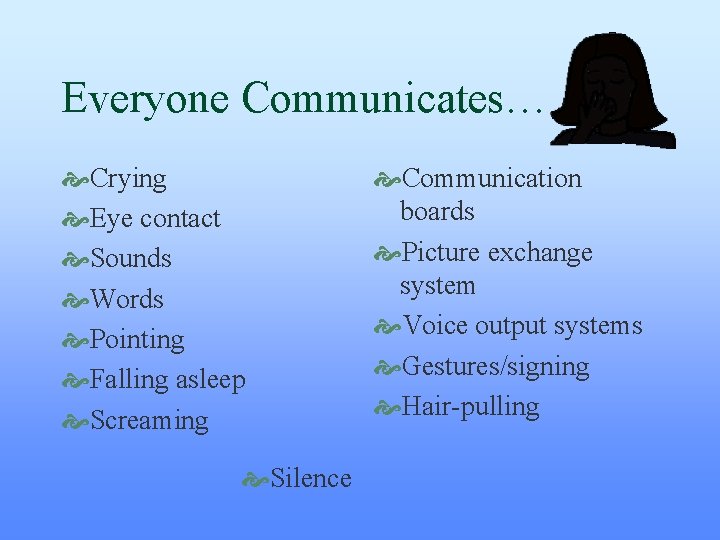
Everyone Communicates… Crying Eye contact Sounds Words Pointing Falling asleep Screaming Silence Communication boards Picture exchange system Voice output systems Gestures/signing Hair-pulling
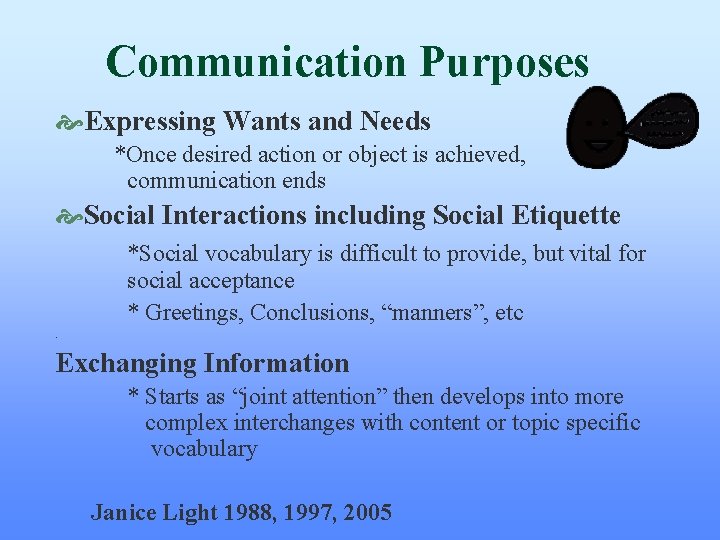
Communication Purposes Expressing Wants and Needs *Once desired action or object is achieved, communication ends Social Interactions including Social Etiquette *Social vocabulary is difficult to provide, but vital for social acceptance * Greetings, Conclusions, “manners”, etc. Exchanging Information * Starts as “joint attention” then develops into more complex interchanges with content or topic specific vocabulary Janice Light 1988, 1997, 2005
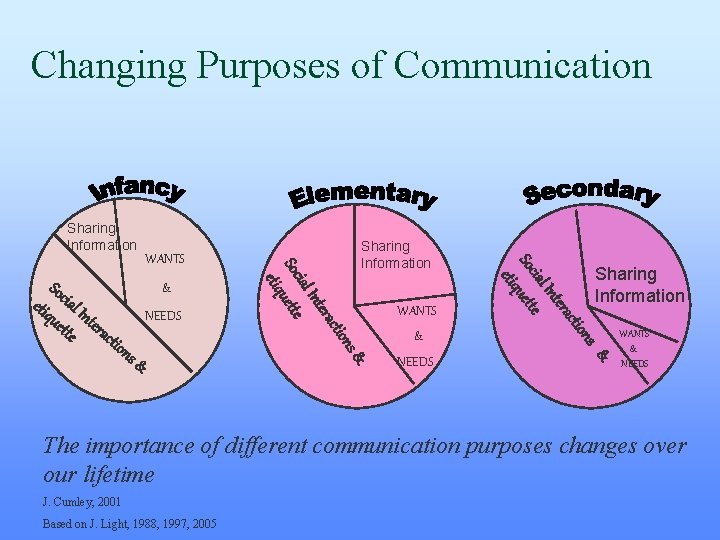
Changing Purposes of Communication Sharing Information & & NEEDS ns s& s& tion on WANTS Sharing Information ctio NEEDS Sharing Information era Int ial e Soc uett etiq & c era Int ial Soc uette etiq Soc etiq ial I uet nter te act i WANTS & NEEDS The importance of different communication purposes changes over our lifetime J. Cumley, 2001 Based on J. Light, 1988, 1997, 2005
If we only have to think about encouraging our students to communicate for three different purposes, why is it so HARD…. . what can make it easier?
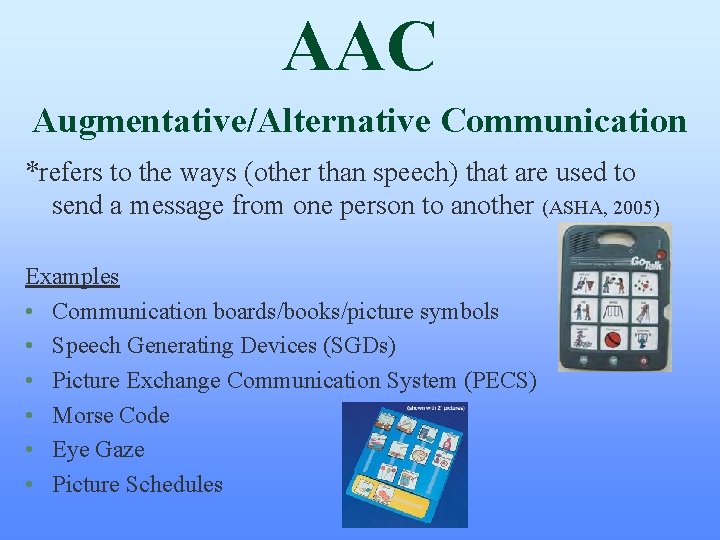
AAC Augmentative/Alternative Communication *refers to the ways (other than speech) that are used to send a message from one person to another (ASHA, 2005) Examples • Communication boards/books/picture symbols • Speech Generating Devices (SGDs) • Picture Exchange Communication System (PECS) • Morse Code • Eye Gaze • Picture Schedules
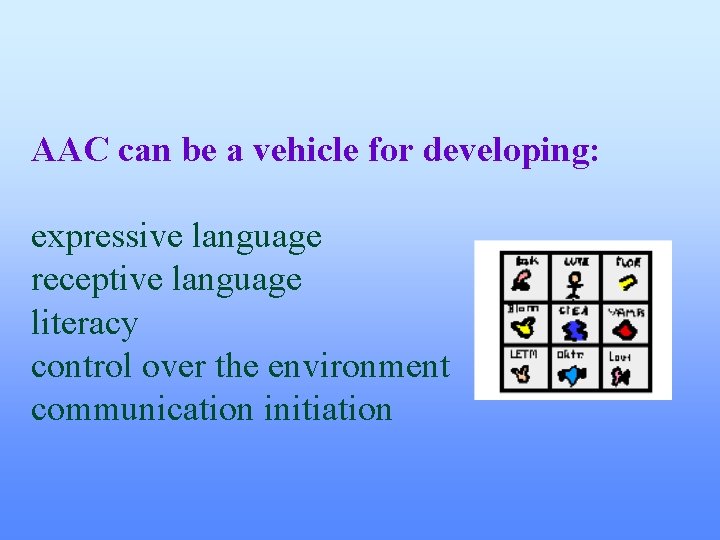
AAC can be a vehicle for developing: expressive language receptive language literacy control over the environment communication initiation
AAC is not…. A last resort “Giving up” on speech Only for those of a certain IQ or Age Only the job of the speech-language pathologist
Myths and Misconceptions: Young Children with CCN (Complex Communication Needs) Myth and Misconceptions AAC hinders or stops further speech development The Evidence AAC approaches (signs, picture symbols, VOCAs*) do NOT hinder speech development. In fact, speech often increases during AAC treatment approaches *VOCA= Voice Output Communication Aid From: Augmentative Communication News, Volume 18, Number 2, June, 2006
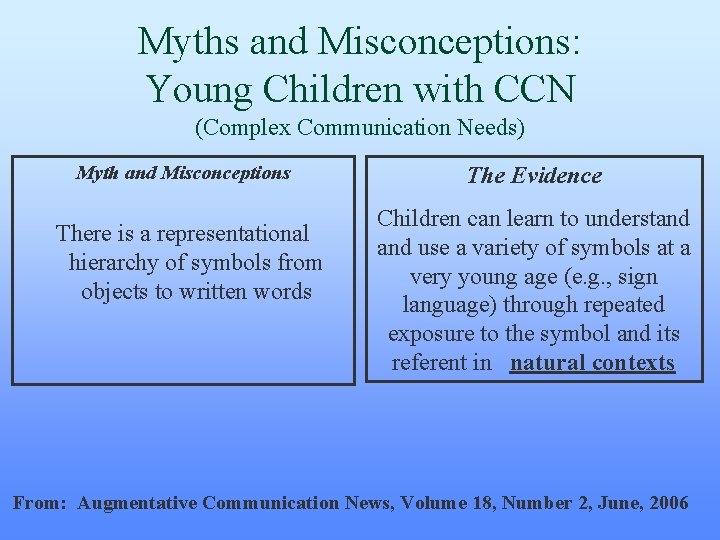
Myths and Misconceptions: Young Children with CCN (Complex Communication Needs) Myth and Misconceptions There is a representational hierarchy of symbols from objects to written words The Evidence Children can learn to understand use a variety of symbols at a very young age (e. g. , sign language) through repeated exposure to the symbol and its referent in natural contexts From: Augmentative Communication News, Volume 18, Number 2, June, 2006
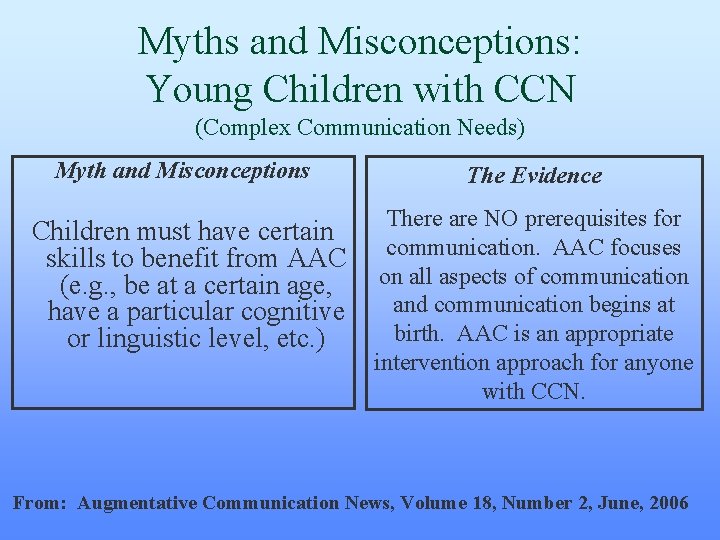
Myths and Misconceptions: Young Children with CCN (Complex Communication Needs) Myth and Misconceptions The Evidence Children must have certain skills to benefit from AAC (e. g. , be at a certain age, have a particular cognitive or linguistic level, etc. ) There are NO prerequisites for communication. AAC focuses on all aspects of communication and communication begins at birth. AAC is an appropriate intervention approach for anyone with CCN. From: Augmentative Communication News, Volume 18, Number 2, June, 2006
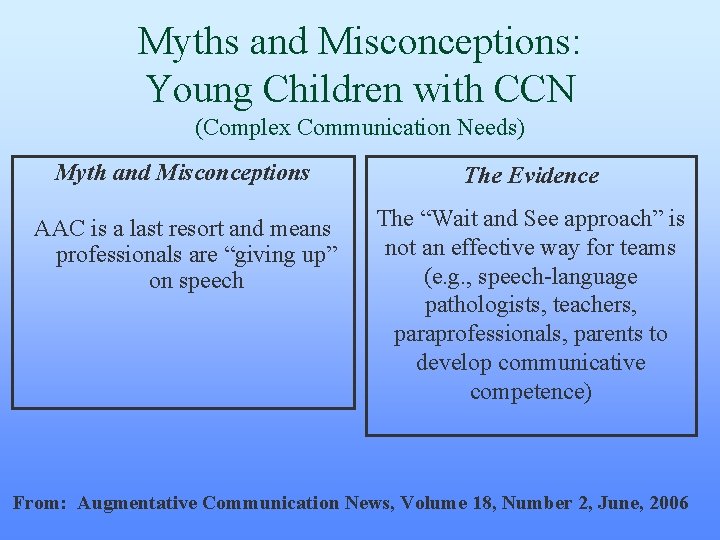
Myths and Misconceptions: Young Children with CCN (Complex Communication Needs) Myth and Misconceptions The Evidence AAC is a last resort and means professionals are “giving up” on speech The “Wait and See approach” is not an effective way for teams (e. g. , speech-language pathologists, teachers, paraprofessionals, parents to develop communicative competence) From: Augmentative Communication News, Volume 18, Number 2, June, 2006
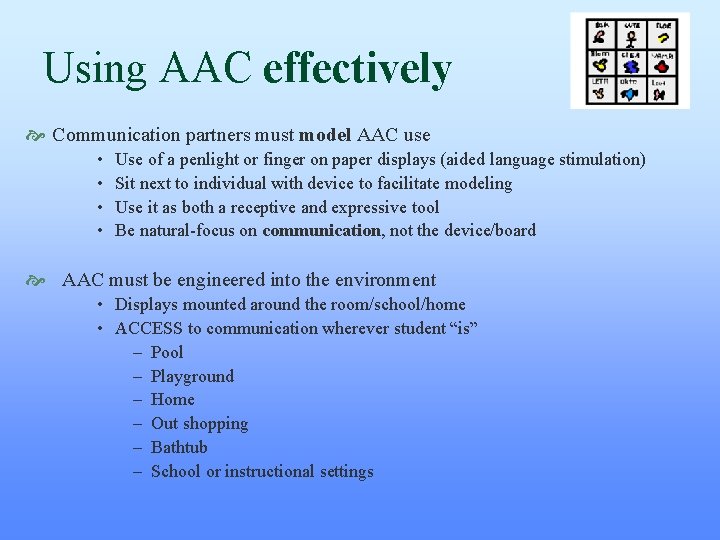
Using AAC effectively Communication partners must model AAC use • • Use of a penlight or finger on paper displays (aided language stimulation) Sit next to individual with device to facilitate modeling Use it as both a receptive and expressive tool Be natural-focus on communication, not the device/board AAC must be engineered into the environment • Displays mounted around the room/school/home • ACCESS to communication wherever student “is” – Pool – Playground – Home – Out shopping – Bathtub – School or instructional settings
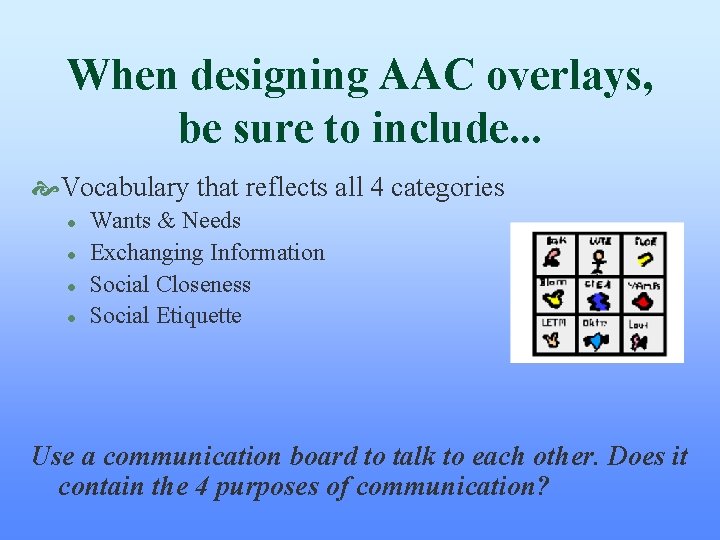
When designing AAC overlays, be sure to include. . . Vocabulary that reflects all 4 categories l l Wants & Needs Exchanging Information Social Closeness Social Etiquette Use a communication board to talk to each other. Does it contain the 4 purposes of communication?
AAC: Establishes a means of communication Provides opportunity for social interaction Promotes receptive communication Encourages expressive communication Decreases frustration Provides opportunity for initiation
Think about YOUR students who are struggling to communicate effectively… What are some characteristics of their communication?
Common Characteristics of Students Using AAC Rarely initiate interactions Usual form of communication is NOT using a communication device Gestural responses (head nods) to yes/no questions main form of communicating May use “challenging” behaviors to communicate
Common Characteristics of Students Using AAC Most vocalizations are unintelligible Rarely interact with peers Communication system may not be available when needed Necessary vocabulary is not programmed or correct symbol is not available
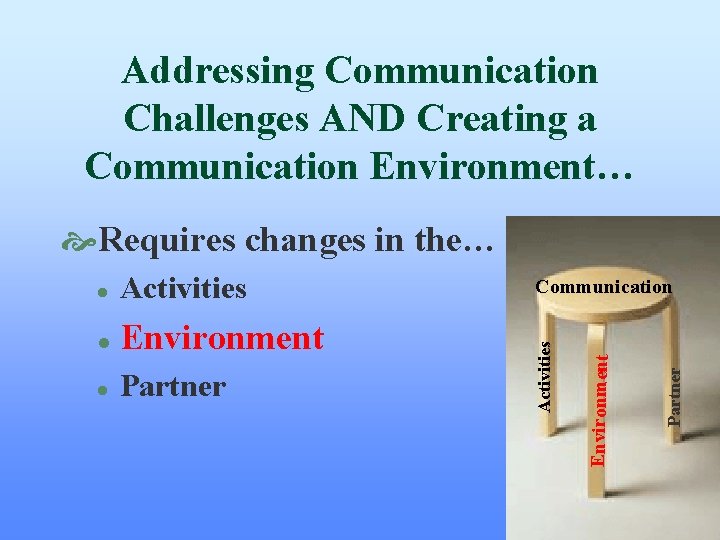
Supporting AAC users…. Create a Communication Environment Expect all students to communicate Recognize and respond to the student’s communication initiations Arrange the environment to increase the likelihood for communication Identify communication opportunities within natural routines and activities
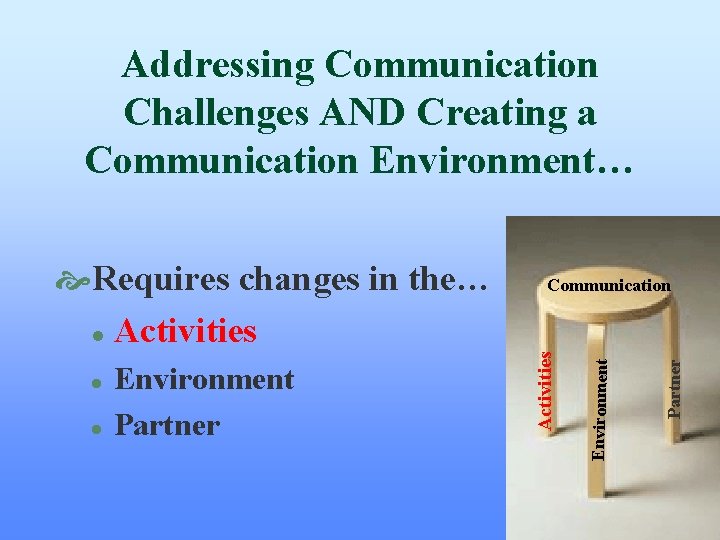
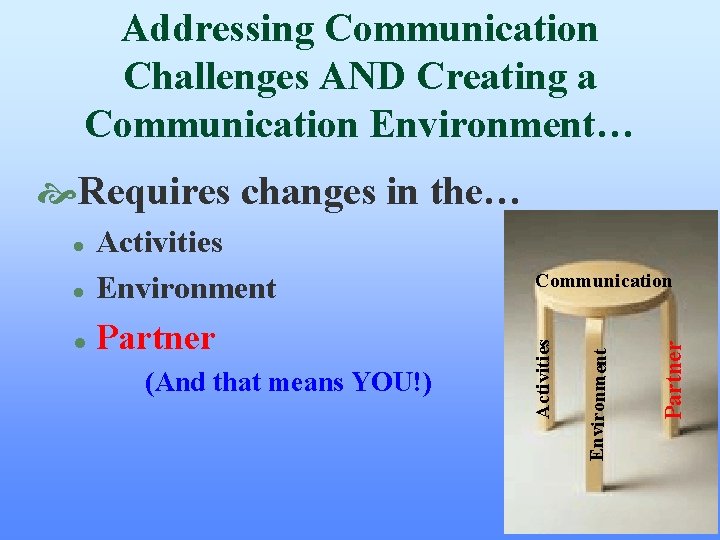
Addressing Communication Challenges AND Creating a Communication Environment… l Partner Environment l Communication Activities Requires changes in the… l Activities
“Incidental teaching episodes are brief, positive, and oriented toward communication rather than language teaching. ” Dr. George Karlan
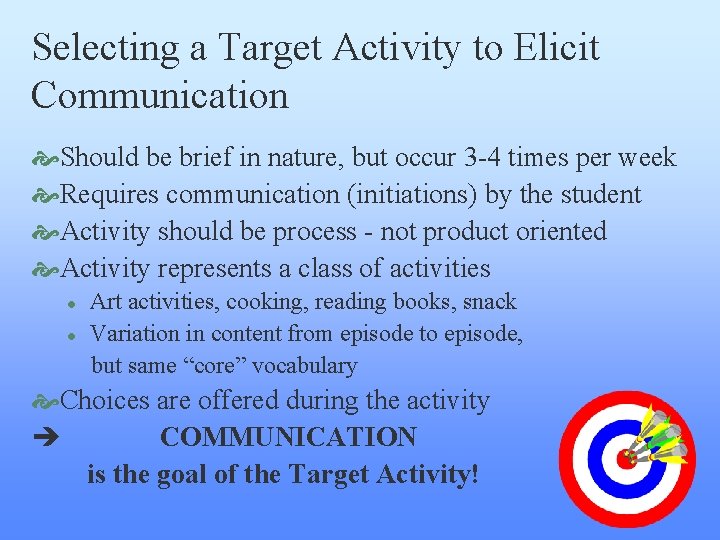
Selecting a Target Activity to Elicit Communication Should be brief in nature, but occur 3 -4 times per week Requires communication (initiations) by the student Activity should be process - not product oriented Activity represents a class of activities l l Art activities, cooking, reading books, snack Variation in content from episode to episode, but same “core” vocabulary Choices are offered during the activity è COMMUNICATION is the goal of the Target Activity!
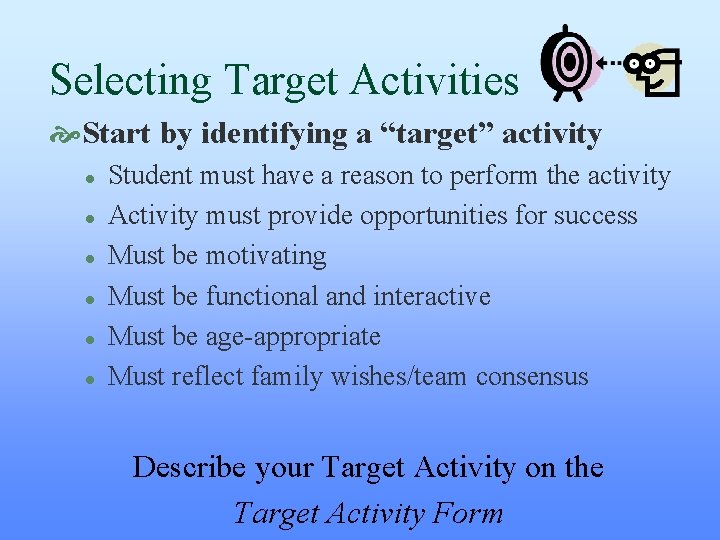
Selecting Target Activities Start by identifying a “target” activity l l l Student must have a reason to perform the activity Activity must provide opportunities for success Must be motivating Must be functional and interactive Must be age-appropriate Must reflect family wishes/team consensus Describe your Target Activity on the Target Activity Form
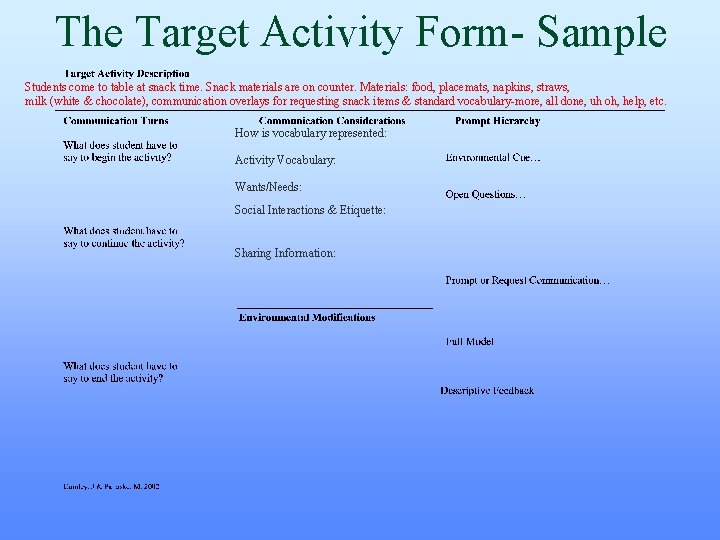
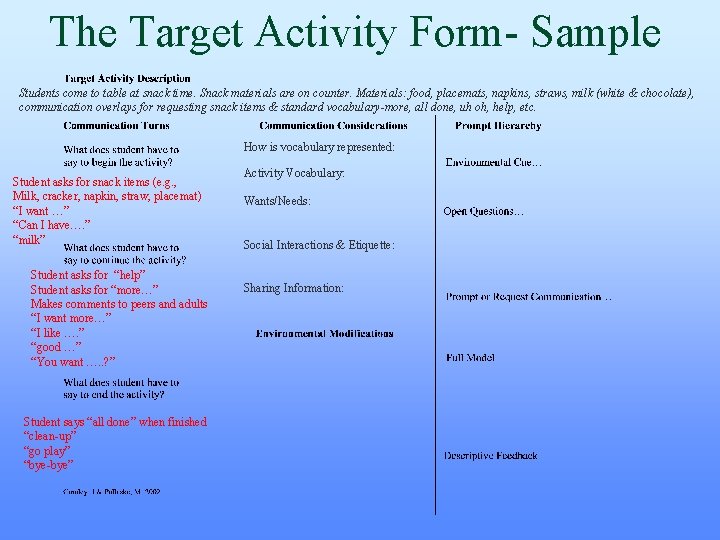
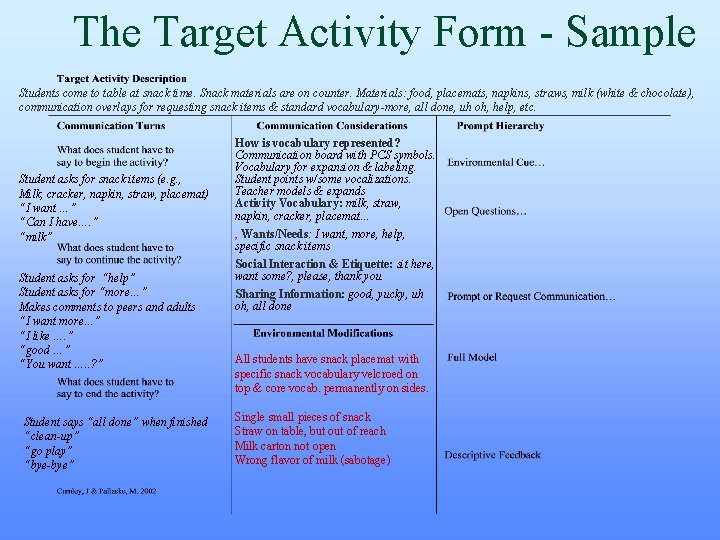
The Target Activity Form- Sample Students come to table at snack time. Snack materials are on counter. Materials: food, placemats, napkins, straws, milk (white & chocolate), communication overlays for requesting snack items & standard vocabulary-more, all done, uh oh, help, etc. How is vocabulary represented: Activity Vocabulary: Wants/Needs: Social Interactions & Etiquette: Sharing Information:
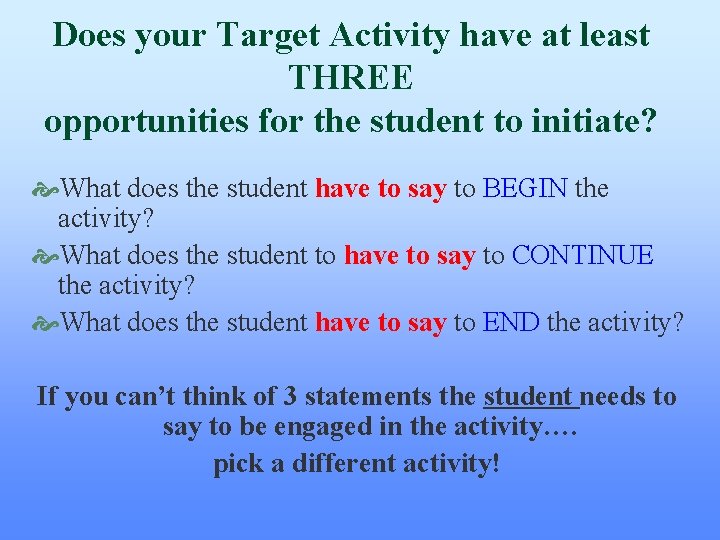
Does your Target Activity have at least THREE opportunities for the student to initiate? What does the student have to say to BEGIN the activity? What does the student to have to say to CONTINUE the activity? What does the student have to say to END the activity? If you can’t think of 3 statements the student needs to say to be engaged in the activity…. pick a different activity!
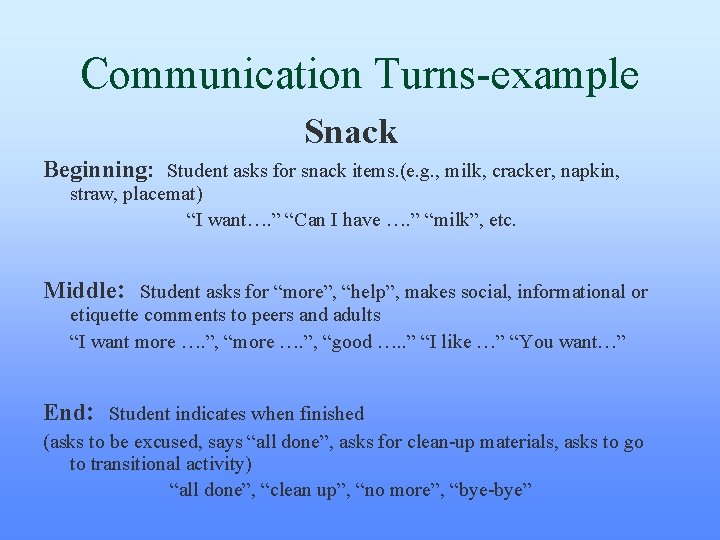
Communication Turns-example Snack Beginning: Student asks for snack items. (e. g. , milk, cracker, napkin, straw, placemat) “I want…. ” “Can I have …. ” “milk”, etc. Middle: Student asks for “more”, “help”, makes social, informational or etiquette comments to peers and adults “I want more …. ”, “good …. . ” “I like …” “You want…” End: Student indicates when finished (asks to be excused, says “all done”, asks for clean-up materials, asks to go to transitional activity) “all done”, “clean up”, “no more”, “bye-bye”
The Target Activity Form- Sample Students come to table at snack time. Snack materials are on counter. Materials: food, placemats, napkins, straws, milk (white & chocolate), communication overlays for requesting snack items & standard vocabulary-more, all done, uh oh, help, etc. How is vocabulary represented: Student asks for snack items (e. g. , Milk, cracker, napkin, straw, placemat) “I want …” “Can I have…. ” “milk” Student asks for “help” Student asks for “more…” Makes comments to peers and adults “I want more…” “I like …. ” “good …” “You want …. . ? ” Student says “all done” when finished “clean-up” “go play” “bye-bye” Activity Vocabulary: Wants/Needs: Social Interactions & Etiquette: Sharing Information:
Communication Considerations How will the vocabulary be represented (e. g. , objects, tangible symbols, photos, symbols, etc. ) List the vocabulary that must be available. Try to have vocabulary that represents • Wants/Needs • Social Interactions & Social Etiquette • Sharing Information
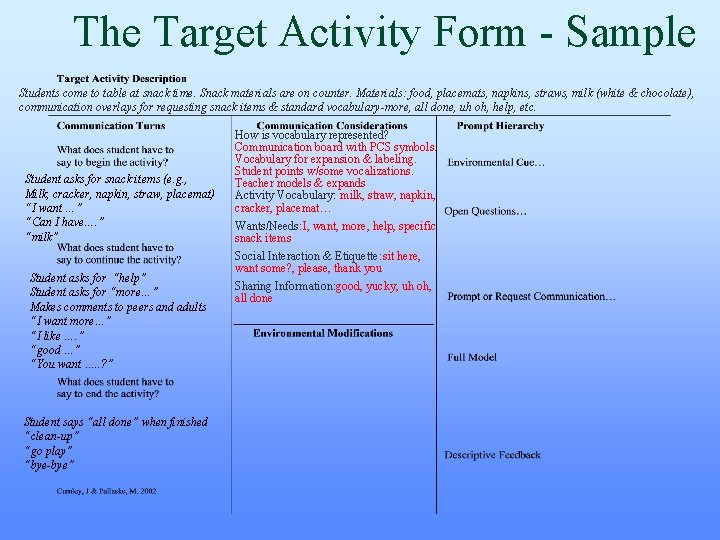
The Target Activity Form - Sample Students come to table at snack time. Snack materials are on counter. Materials: food, placemats, napkins, straws, milk (white & chocolate), communication overlays for requesting snack items & standard vocabulary-more, all done, uh oh, help, etc. Student asks for snack items (e. g. , Milk, cracker, napkin, straw, placemat) “I want …” “Can I have…. ” “milk” Student asks for “help” Student asks for “more…” Makes comments to peers and adults “I want more…” “I like …. ” “good …” “You want …. . ? ” Student says “all done” when finished “clean-up” “go play” “bye-bye” How is vocabulary represented? Communication board with PCS symbols. Vocabulary for expansion & labeling. Student points w/some vocalizations. Teacher models & expands Activity Vocabulary: milk, straw, napkin, cracker, placemat… Wants/Needs: I, want, more, help, specific snack items Social Interaction & Etiquette: sit here, want some? , please, thank you Sharing Information: good, yucky, uh oh, all done
Video…. .
Addressing Communication Challenges AND Creating a Communication Environment… Requires changes in the… Environment l Partner l Communication Environment Activities l
Arrange the Environment to Increase the Likelihood of Communication Common Strategies…. l l l l Use motivating materials and activities Materials should be in view but not accessible Student should need assistance with some materials Provide small or inadequate amounts of materials Sabotage Provide something the student doesn’t like/want Use communication boards/devices & visual tools
Your Environment Are there any environmental changes you could make to increase communication? l Activity-based environmental changes • Material location, amount, type l Communication-based environmental changes • Picture symbols, communication boards, device placement
Video. Note Environmental Arrangements
The Target Activity Form - Sample Students come to table at snack time. Snack materials are on counter. Materials: food, placemats, napkins, straws, milk (white & chocolate), communication overlays for requesting snack items & standard vocabulary-more, all done, uh oh, help, etc. Student asks for snack items (e. g. , Milk, cracker, napkin, straw, placemat) “I want …” “Can I have…. ” “milk” Student asks for “help” Student asks for “more…” Makes comments to peers and adults “I want more…” “I like …. ” “good …” “You want …. . ? ” Student says “all done” when finished “clean-up” “go play” “bye-bye” How is vocabulary represented? Communication board with PCS symbols. Vocabulary for expansion & labeling. Student points w/some vocalizations. Teacher models & expands Activity Vocabulary: milk, straw, napkin, cracker, placemat… , Wants/Needs: I want, more, help, specific snack items Social Interaction & Etiquette: sit here, want some? , please, thank you Sharing Information: good, yucky, uh oh, all done All students have snack placemat with specific snack vocabulary velcroed on top & core vocab. permanently on sides. Single small pieces of snack Straw on table, but of reach Milk carton not open Wrong flavor of milk (sabotage)
Addressing Communication Challenges AND Creating a Communication Environment… Requires changes in the… (And that means YOU!) Partner Environment l Communication Activities l Activities Environment l
What are some common characteristics of communication partners?
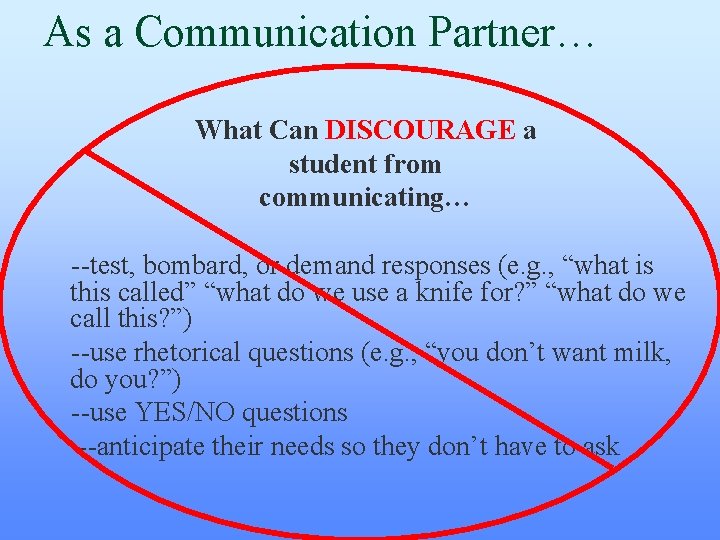
As a Communication Partner… What Can DISCOURAGE a student from communicating… --test, bombard, or demand responses (e. g. , “what is this called” “what do we use a knife for? ” “what do we call this? ”) --use rhetorical questions (e. g. , “you don’t want milk, do you? ”) --use YES/NO questions --anticipate their needs so they don’t have to ask
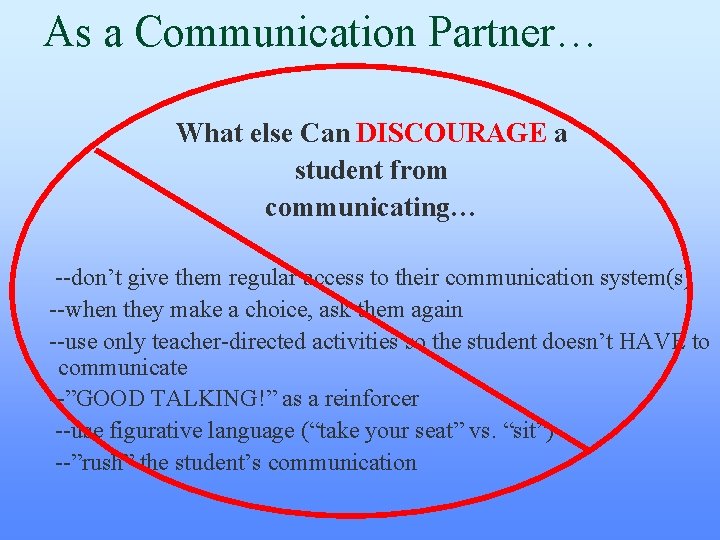
As a Communication Partner… What else Can DISCOURAGE a student from communicating… --don’t give them regular access to their communication system(s) --when they make a choice, ask them again --use only teacher-directed activities so the student doesn’t HAVE to communicate --”GOOD TALKING!” as a reinforcer --use figurative language (“take your seat” vs. “sit”) --”rush” the student’s communication
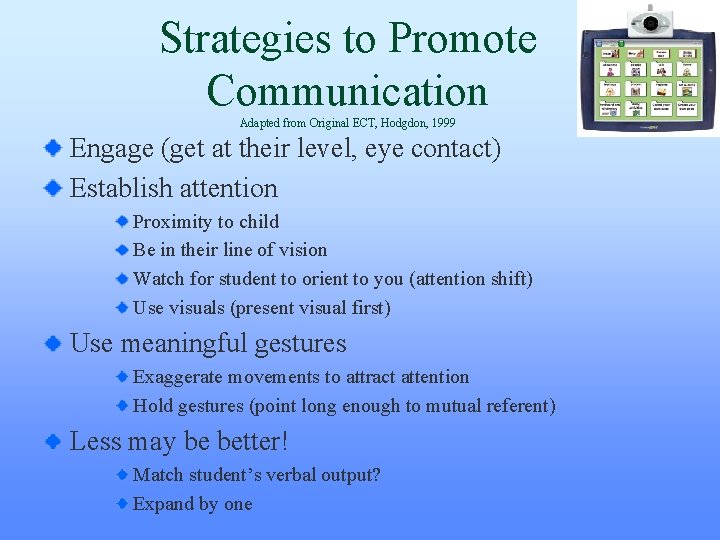
Strategies to Promote Communication Adapted from Original ECT, Hodgdon, 1999 Engage (get at their level, eye contact) Establish attention Proximity to child Be in their line of vision Watch for student to orient to you (attention shift) Use visuals (present visual first) Use meaningful gestures Exaggerate movements to attract attention Hold gestures (point long enough to mutual referent) Less may be better! Match student’s verbal output? Expand by one
Strategies to Promote Communication Adapted from Original ECT, Hodgdon, 1999 Wait for responses Count to 5, 10 after a command/question Stay engaged Increase opportunities for initiation Be consistent with labels (why? ) Modify the environment to create active participation, communication Make sure the student has access to communication at ALL TIMES!
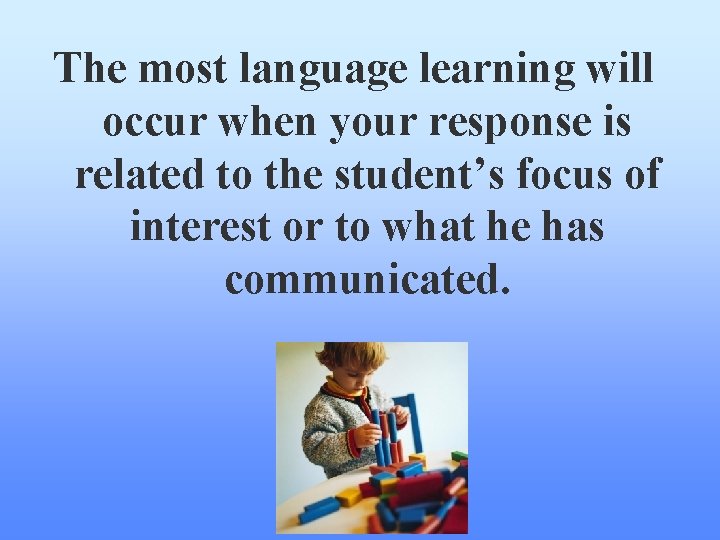
The most language learning will occur when your response is related to the student’s focus of interest or to what he has communicated.
YOU are part of the environment … When you use a prompt hierarchy you can: Provide consistency across partners because of framework Give students processing time Be individualized Provide only as much prompting as is needed
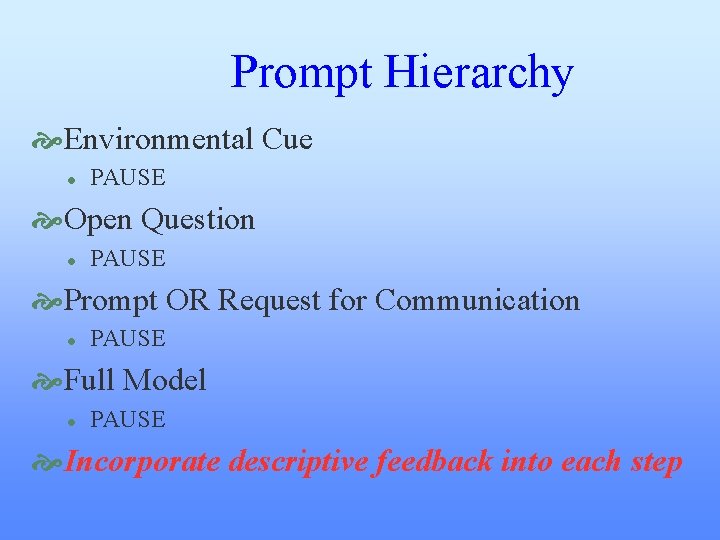
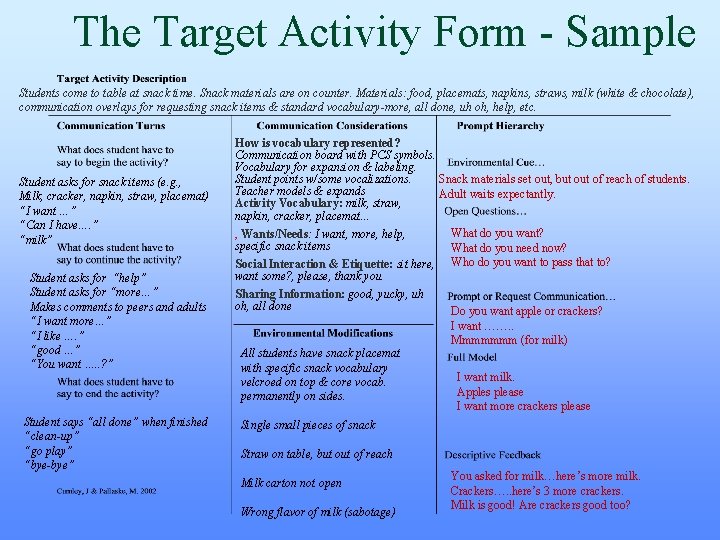
Prompt Hierarchy Environmental Cue l PAUSE Open Question l PAUSE Prompt OR Request for Communication l PAUSE Full Model l PAUSE Incorporate descriptive feedback into each step
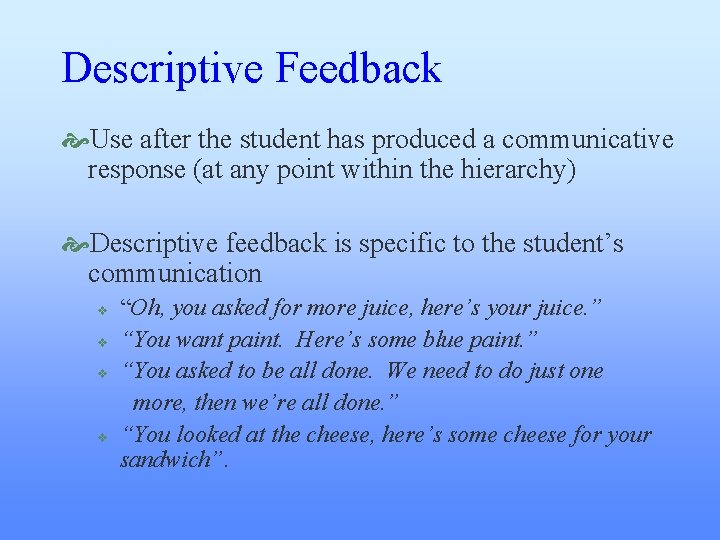
Descriptive Feedback Use after the student has produced a communicative response (at any point within the hierarchy) Descriptive feedback is specific to the student’s communication v v “Oh, you asked for more juice, here’s your juice. ” “You want paint. Here’s some blue paint. ” “You asked to be all done. We need to do just one more, then we’re all done. ” “You looked at the cheese, here’s some cheese for your sandwich”.
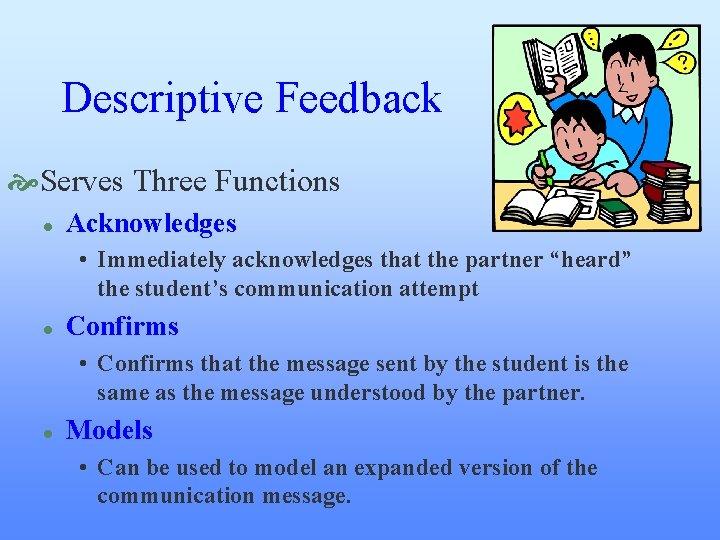
Descriptive Feedback Serves Three Functions l Acknowledges • Immediately acknowledges that the partner “heard” the student’s communication attempt l Confirms • Confirms that the message sent by the student is the same as the message understood by the partner. l Models • Can be used to model an expanded version of the communication message.
Prompt Hierarchy Step #1 Environmental Cue Set up the environment to signal to the student that an activity is about to begin. l l l Lining up at the door Getting everything ready for an activity & then waiting……. . Art materials prepared but of reach Desired items visible but inaccessible Cutting the pizza up and waiting If student responds, provide. . . Descriptive Feedback
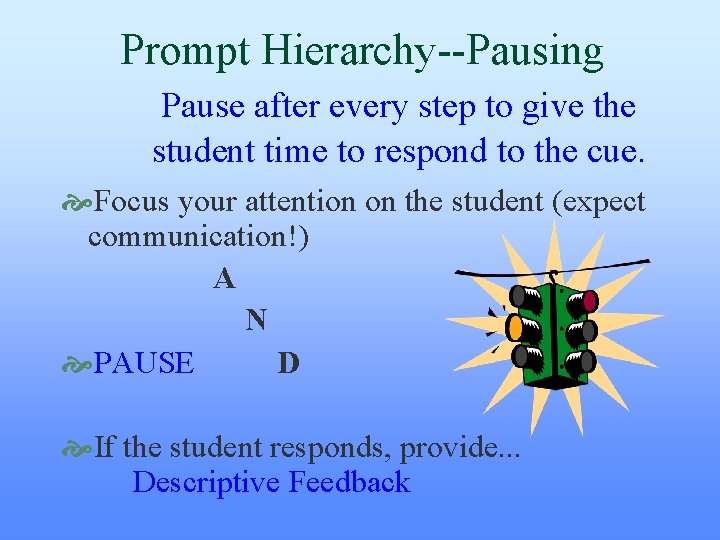
Prompt Hierarchy--Pausing Pause after every step to give the student time to respond to the cue. Focus your attention on the student (expect communication!) A N PAUSE D If the student responds, provide. . . Descriptive Feedback
Prompt Hierarchy Step #2 Open Question If the student does not respond to the pause by making a response: l Ask a WHAT, WHY, WHO, WHEN, WHERE, OR HOW Question ONE time • “What do you want? ” • “Whose turn is it? ” • “Where does that go? ” AND then…. . . PAUSE If student responds now, provide. . . Descriptive Feedback
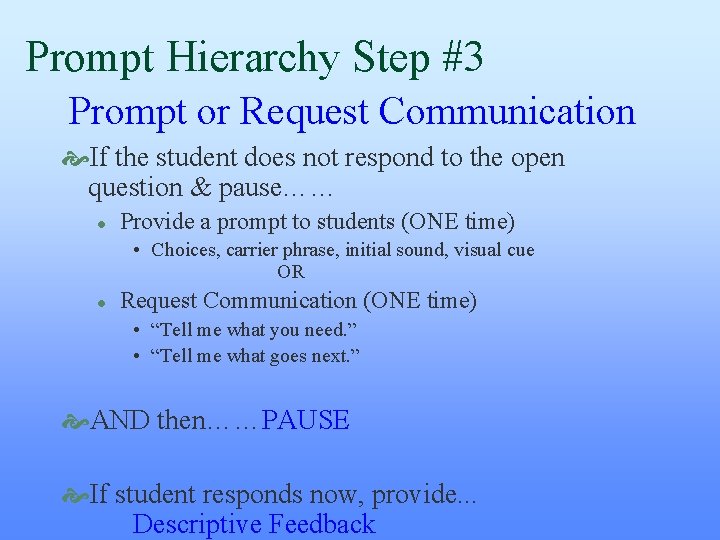
Prompt Hierarchy Step #3 Prompt or Request Communication If the student does not respond to the open question & pause…… l Provide a prompt to students (ONE time) • Choices, carrier phrase, initial sound, visual cue OR l Request Communication (ONE time) • “Tell me what you need. ” • “Tell me what goes next. ” AND then……PAUSE If student responds now, provide. . . Descriptive Feedback
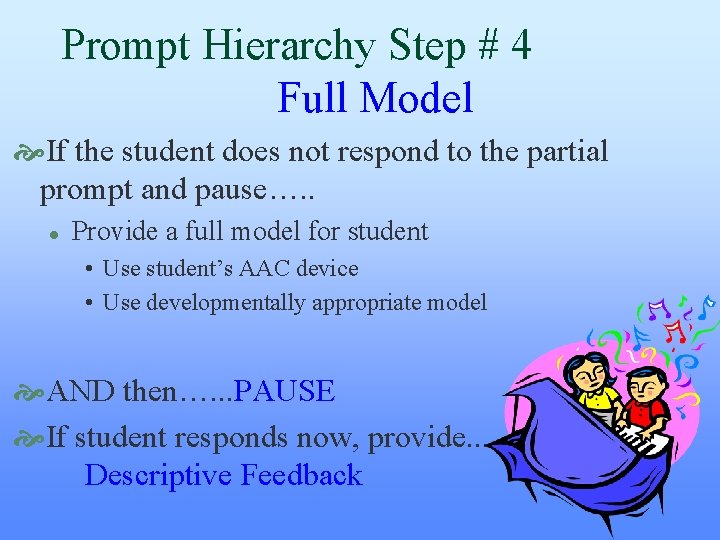
Prompt Hierarchy Step # 4 Full Model If the student does not respond to the partial prompt and pause…. . l Provide a full model for student • Use student’s AAC device • Use developmentally appropriate model AND then…. . . PAUSE If student responds now, provide. . . Descriptive Feedback
PAUSE Pause Pause Pause Pause Pause Pause Pause Pause Pause! Pause In other words…PAUSE!
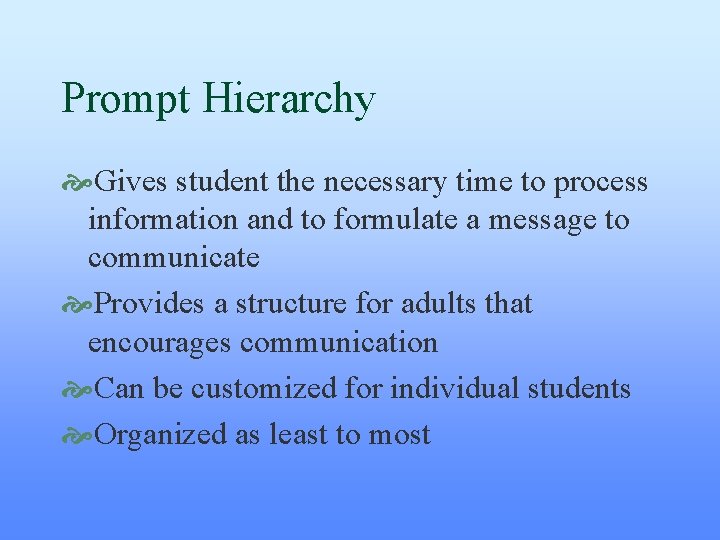
Prompt Hierarchy Gives student the necessary time to process information and to formulate a message to communicate Provides a structure for adults that encourages communication Can be customized for individual students Organized as least to most
Prompt Hierarchy
The Target Activity Form - Sample Students come to table at snack time. Snack materials are on counter. Materials: food, placemats, napkins, straws, milk (white & chocolate), communication overlays for requesting snack items & standard vocabulary-more, all done, uh oh, help, etc. Student asks for snack items (e. g. , Milk, cracker, napkin, straw, placemat) “I want …” “Can I have…. ” “milk” Student asks for “help” Student asks for “more…” Makes comments to peers and adults “I want more…” “I like …. ” “good …” “You want …. . ? ” Student says “all done” when finished “clean-up” “go play” “bye-bye” How is vocabulary represented? Communication board with PCS symbols. Vocabulary for expansion & labeling. Student points w/some vocalizations. Snack materials set out, but of reach of students. Teacher models & expands Adult waits expectantly. Activity Vocabulary: milk, straw, napkin, cracker, placemat… What do you want? , Wants/Needs: I want, more, help, specific snack items What do you need now? Social Interaction & Etiquette: sit here, Who do you want to pass that to? want some? , please, thank you Sharing Information: good, yucky, uh oh, all done Do you want apple or crackers? I want ……. . Mmmmmmm (for milk) All students have snack placemat with specific snack vocabulary I want milk. velcroed on top & core vocab. Apples please permanently on sides. I want more crackers please Single small pieces of snack Straw on table, but of reach Milk carton not open Wrong flavor of milk (sabotage) You asked for milk…here’s more milk. Crackers…. . here’s 3 more crackers. Milk is good! Are crackers good too?
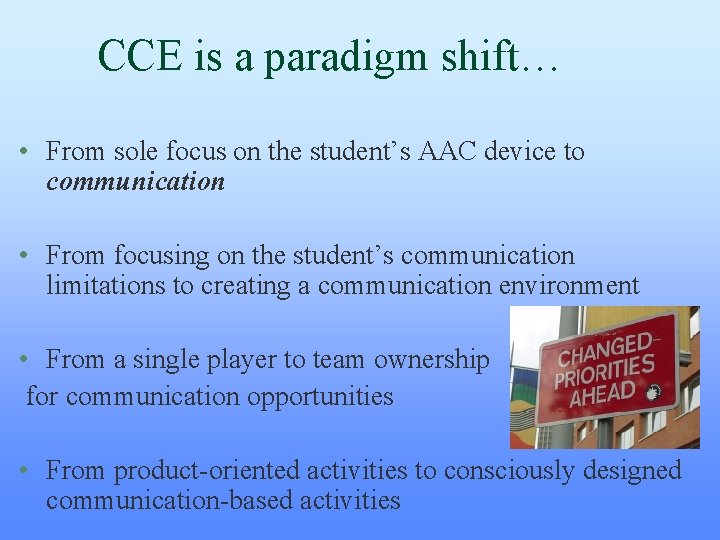
CCE is a paradigm shift… • From sole focus on the student’s AAC device to communication • From focusing on the student’s communication limitations to creating a communication environment • From a single player to team ownership for communication opportunities • From product-oriented activities to consciously designed communication-based activities
Where do I go from here?
Some Possibilities… Identify one specific student (do not select your most “challenging” student!) Encourage other teams in the district to join you & form a “study group” where you…. Use videotaping to help you analyze your activities, partner behaviors & environment Critically analyze the activities for student communication opportunities (minimum of 3) Set up your environment to maximize communication (one activity a day) Post prompt hierarchy & start to use Provide feedback to team members & ask for same Others?
References American Speech-Language-Hearing Association website: www. asha. org Burkhart, L. 1993, Total Augmentative Communication in the Early Childhood Classroom, p. 38 Binger, C. & Kent-Walsh, J. (2005). Evidence-Based Language Supports for Children Using AAC: Increasing Expressive Communication. Closing the Gap conference, Oct. 2005, Minneapolis, MN. Blackstone, S. (2006). Young children. False beliefs, widely held. ACN: Augmentative Communication News, June 2006, 18 (2). Casey, K. & Kornfeld S. (2004). Developing language-rich light tech AAC systems for young children. Closing the Gap, October/November 2004, 23 (4). Hodgdon, L. A. (1999). Solving behavior problems in Autism: improving communication with visual strategies. Troy, Michigan: Quirk. Roberts Publishing.
Karlan, George. Environmental Communication Teaching Training. Field-Initiated Research Grant Award No. H 023 C 9005 from the Office of Special Education, U. S. Department of Education. Lafayette, Indiana: Purdue University. Light, J. (1996) Communication is the essence of human life: Reflections on communicative competence. AAC Augmentative and Alternative Communication, June 1997 (13), 61 -70. Light, J. C. (2005, May). AAC interventions to maximize language development for young children. State College, PA: AAC-RERC. Retrieved June 10, 2008 from http: //aacrerc. psu. edu/index-16147. php. html Skotko, B. , Koppenhaver, D. , & Erickson, K. (2004). Parent Reading Behaviors and Communication Outcomes in Girls with Rett Syndrome. Exceptional Children, 70 (2), 145 -166. Quill, K. (2000) Do-Watch-Listen-Say: Social and communication intervention for children with autism. Baltimore: Brookes Publishing. WATI (2009). Assessing student’s Needs for assistive technology. www. wati. org
Thank you for coming….