
Creating Child Safe Environments After a Disaster Session

- Slides: 18
Creating Child Safe Environments After a Disaster Session I: Dr. Beverly J. Buckles, DSW Dean, School of Behavioral Health Chair and Professor, Department of Social Work and Social Ecology Co-Chair, International Behavioral Health Trauma Team Loma Linda University Dr. Kimberly R. Freeman, Ph. D Associate Executive Chair and Associate Professor, Department of Social Work and Social Ecology Member, International Behavioral Health Trauma Team Loma Linda University
Overview: Creating Child Safe Environment Following a Disaster �In the aftermath of a disaster all children need a safe place away from danger and other frightening experiences �Parents and caregivers need a place for children to stay while they work find safe housing, secure food, water, work, etc. �Creating Child Safe Environments requires planning and consideration of the needs of children following disasters.
Overview: Creating Child Safe Environment After a Disaster �Establishing child safe environments requires that we: • -Protect-establish a shelter/safe zone • -Direct-away from destruction/disaster site • -Connect-to parents, relatives on regular intervals • -Support-by providing emotionally safe environment (Addressed in Session II) • -Triage-general assessment of physical and emotional needs and triaging to advanced professionals as appropriate • (Addressed in Session II)
Protect: Establishing a Safe Zone � Preparation is Key: • -Know your community • -Establish how many sites will be need, i. e. , enough to care for the children in your community • -Work with other churches and community groups to establish a plan to create and make ready multiple shelters � � � Multiple shelters provide better access for neighborhoods (i. e. , walking distance within neighborhoods as transportation may be limited) Multiple sites allow for smaller groups of neighborhood children to be together Provides more familiarity than a site where all of the children are strangers.
Finding the best sites/locations for the Child Safe Zones �Identify alternative locations and sites • Alternatives provide better preparation as no one knows where a disaster will strike • Identify different community-oriented facilities (churches, schools, community centers) • Identify open land areas where temporary shelters can be erected
Finding the best sites/locations for the Child Safe Zones � Visit each alternative site • -Scan sites for safety issues • -Avoid locations where there are possible dangers (e. g. , construction hazards, toxins, deep water, places where children could fall, animals, other harmful elements, etc. • -All selected sites must be able to be secured (i. e. , protection from intruders, predatory individuals who seek to abuse or exploit children) • -All sites should be accessible (i. e. , nearest proximity to medical and other resources, access to transportation routes) � Develop agreements in advance that these locations will be free to use in the event of a mass disaster
Equipping the Shelter: Supplies �Identify and secure supplies in advance • -Identify a place to store all supplies (ideally can be stored in the site that will be the shelter/safe zone Emergency supplies (e. g. , Water, First Aid, flashlight, batteries, radio, etc) � Food/snacks (7 -10 days) � Eating and serving utensils, plates, paper towels, etc � Blankets � Diapers � Personal hygiene items for adolescents (bath soap, toothbrushes, tooth paste, deodorant and feminine hygiene products) � Magnifying glasses or hand-held magnifying lens for children with vision problems � Extra clothing (multiple sizes) �
Supplies cont. General school supplies (paper, pencils, pens, chalk, crayons, etc) � Assorted toys (consider giving each child their own toy when they enter the shelter—a toy they can take with them when they leave) � Assorted board games (games for varying age groups, including adolescents) � Assorted art supplies (paper, water-based paints, brushes, children’s scissors, glue, etc) � Assorted books (books for varying age groups, including adolescents) � Cleaning supplies (dish soap and laundry detergent) � Camera (need ability to create and post instant pictures of children and their family) � Telephone (consider other emergency communication devices in the event that there are extended electrical power outages) �
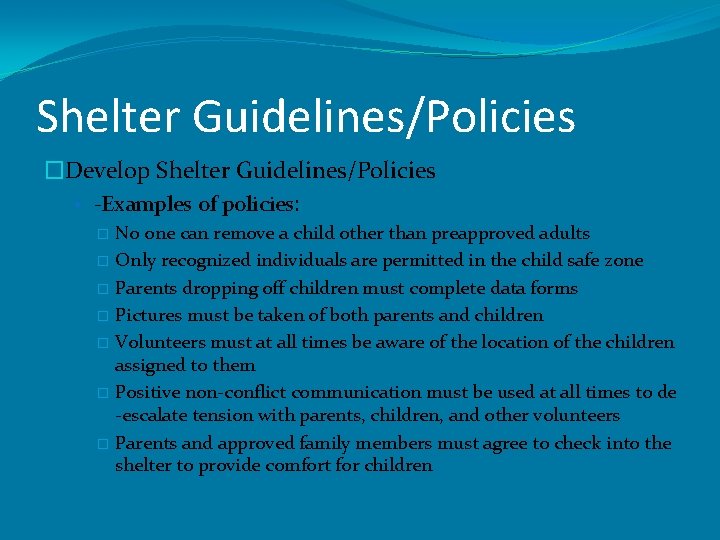
Shelter Guidelines/Policies �Develop Shelter Guidelines/Policies • -Examples of policies: � No one can remove a child other than preapproved adults � Only recognized individuals are permitted in the child safe zone � Parents dropping off children must complete data forms � Pictures must be taken of both parents and children � Volunteers must at all times be aware of the location of the children assigned to them � Positive non-conflict communication must be used at all times to de -escalate tension with parents, children, and other volunteers � Parents and approved family members must agree to check into the shelter to provide comfort for children
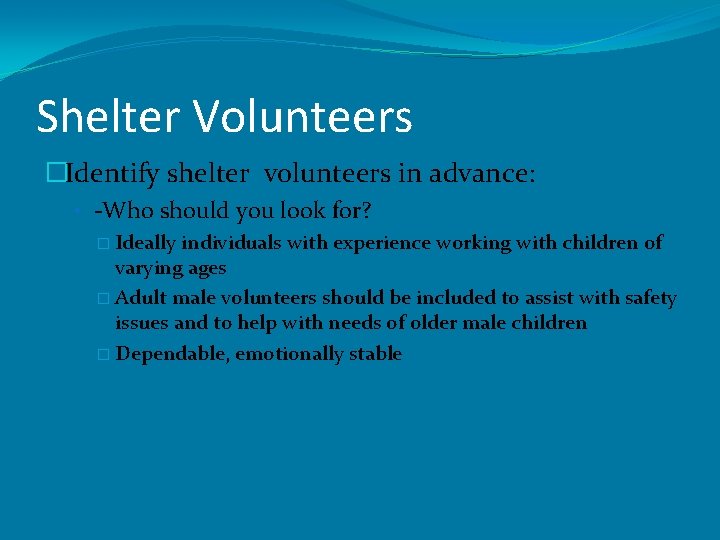
Shelter Volunteers �Identify shelter volunteers in advance: • -Who should you look for? � Ideally individuals with experience working with children of varying ages � Adult male volunteers should be included to assist with safety issues and to help with needs of older male children � Dependable, emotionally stable
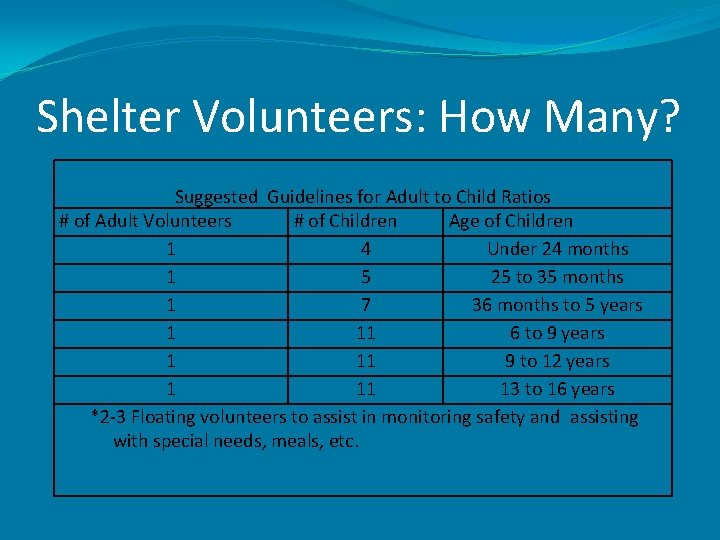
Shelter Volunteers: How Many? Suggested Guidelines for Adult to Child Ratios # of Adult Volunteers # of Children Age of Children 1 4 Under 24 months 1 5 25 to 35 months 1 7 36 months to 5 years 1 11 6 to 9 years 1 11 9 to 12 years 1 11 13 to 16 years *2 -3 Floating volunteers to assist in monitoring safety and assisting with special needs, meals, etc.
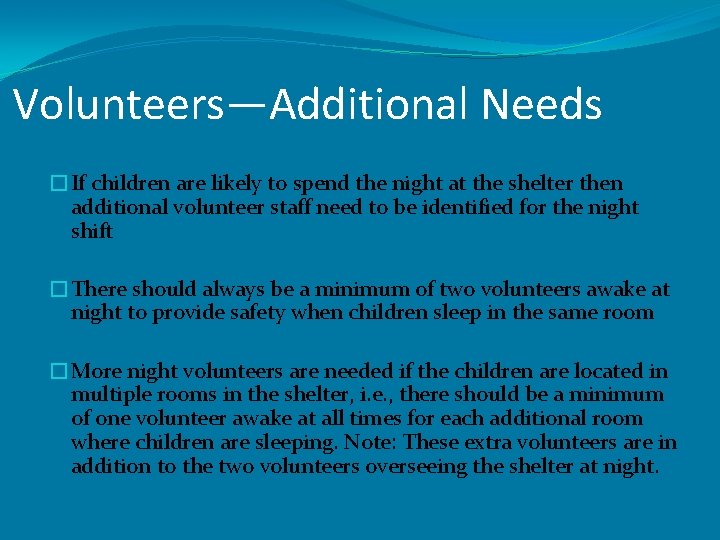
Volunteers—Additional Needs �If children are likely to spend the night at the shelter then additional volunteer staff need to be identified for the night shift �There should always be a minimum of two volunteers awake at night to provide safety when children sleep in the same room �More night volunteers are needed if the children are located in multiple rooms in the shelter, i. e. , there should be a minimum of one volunteer awake at all times for each additional room where children are sleeping. Note: These extra volunteers are in addition to the two volunteers overseeing the shelter at night.
Preparing Volunteers �Provide orientation of shelter guidelines and safety issues �Develop a general plan of tasks assignments that need to be done in the event of a disaster �Review/train individuals to be aware of volunteer functions �Emphasize safety and child protection needs
Preparing Volunteers �Review/train volunteers to understand how to identify and support basic physical and emotional needs of children �Review/train volunteers how to interview parents to collect contact information and basic information of each child �Review/train volunteers how to address distress and disruptive behaviors of parents and/or children
Operating the Shelter �Registering Children • -Completing Data Forms(See attached) • -Parent contact and emergency information • -Take pictures (child, parents, extended family) • -Create family board (when possible for each child) � Know who can visit and pick up each child � Post in visible location for children as a source of comfort and for ease of access to all volunteer
Working with the Children �General guidelines for working with children • -May be stunned, in shock or experiencing some degree of dissociation that can be made worse if not protect from reoccurring traumatic stimuli � Where possible, direct ambulatory children away from destruction stimuli, including injured survivors � Use kind but give firm direction when needed
Working with the Children—cont. • -Connect to familiar people � Connect to identified parents and/or family at regular intervals � Provide accurate information about at regular intervals if a child has questions about their parents or others • -Support � Be supportive, compassionate, gentle � Learn and use the names of the children when communicating with them � Use nonjudgmental verbal and nonverbal communication with child � However temporary use of positive relationship tools help to reconnect children and reduce sense acute loss • -Triage � Observe physical and emotional needs (see assessment materials provided in Session II) � Triage with advanced medical and behavioral health professionals � Arrangements should be made in advance as to the location and protocol for advance professionals to see children (e. g. , at local hospital or emergency medical facility)
Questions