
Creating Characters One Step in Developing Fiction Stories
- Slides: 16
Creating Characters: One Step in Developing Fiction Stories Presented by: Cindy Abbott Mc. Whirter Elementary School Clear Creek ISD GHAWP 2005
7 Reasons Why Children Should Write Stories 1. 2. 3. 4. 5. 6. 7. To entertain To foster artistic expression To explore the functions and values of writing To stimulate imagination To clarify thinking To search for identity To learn to read and write Gail Tompkins. (1982). “Seven Reasons Why Children Should Write Stories, ”
How do you get them interested? The teacher must emphasize children’s personal involvement and investment in their writing. Carla Resenbrink, “Writing as Play” By creating their own characters: Students take ownership of their story creations and have pride in their final product.
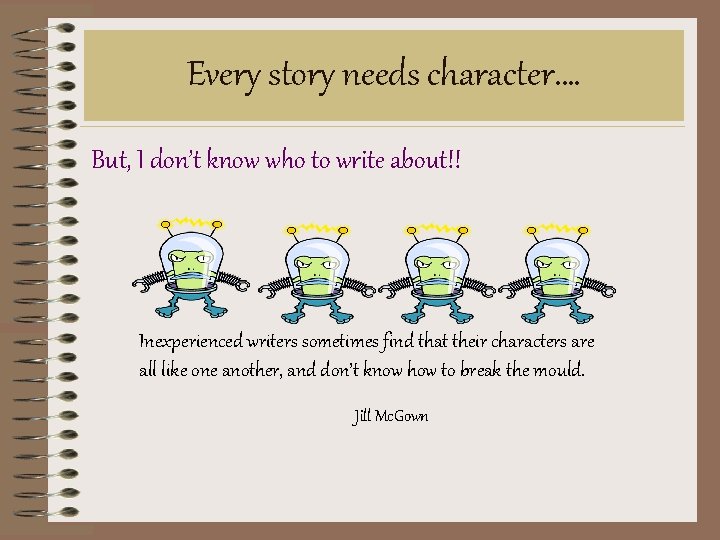
Every story needs character…. But, I don’t know who to write about!! Inexperienced writers sometimes find that their characters are all like one another, and don’t know how to break the mould. Jill Mc. Gown
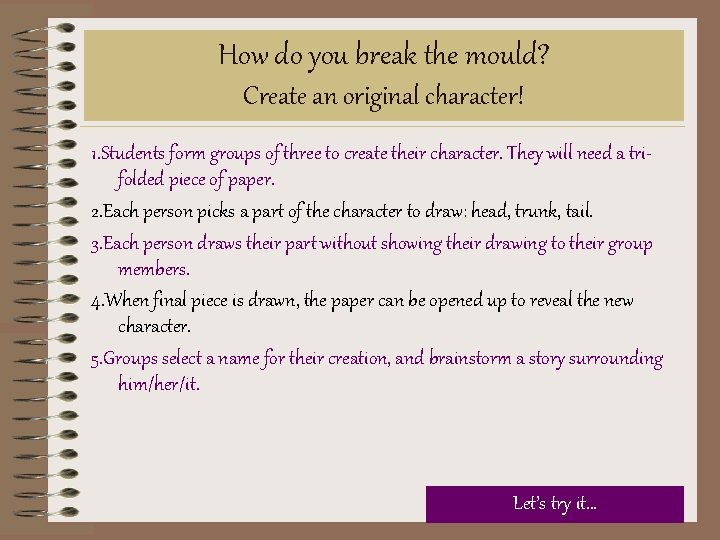
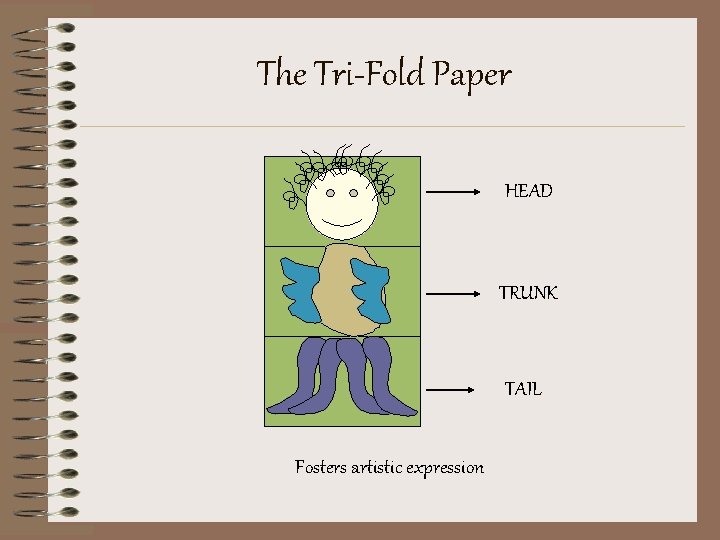
How do you break the mould? Create an original character! 1. Students form groups of three to create their character. They will need a trifolded piece of paper. 2. Each person picks a part of the character to draw: head, trunk, tail. 3. Each person draws their part without showing their drawing to their group members. 4. When final piece is drawn, the paper can be opened up to reveal the new character. 5. Groups select a name for their creation, and brainstorm a story surrounding him/her/it. Let’s try it…
The Tri-Fold Paper HEAD TRUNK TAIL Fosters artistic expression
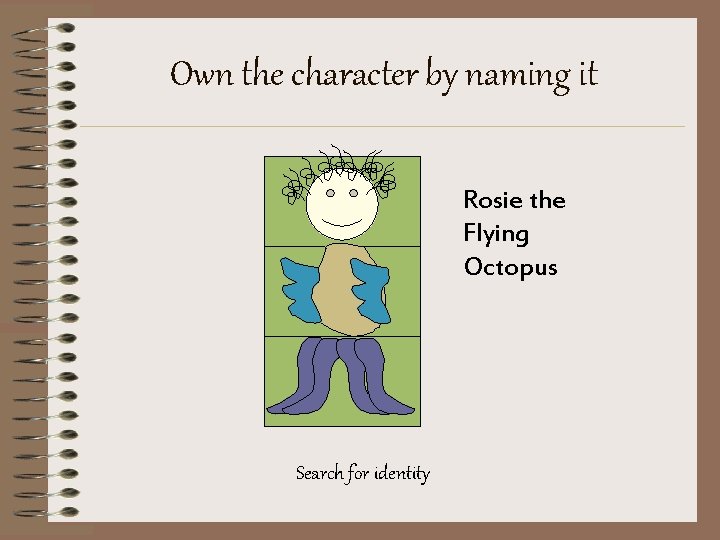
Own the character by naming it Rosie the Flying Octopus Search for identity
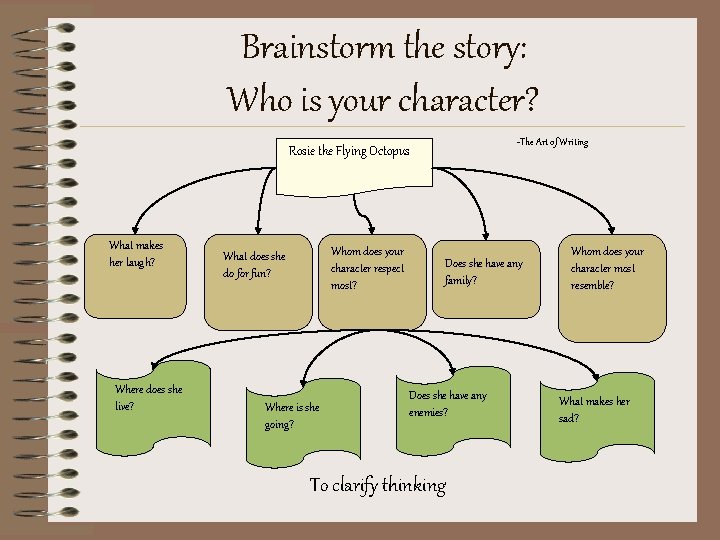
Brainstorm the story: Who is your character? -The Art of Writing Rosie the Flying Octopus What makes her laugh? Where does she live? Whom does your character respect most? What does she do for fun? Where is she going? Does she have any family? Does she have any enemies? To clarify thinking Whom does your character most resemble? What makes her sad?
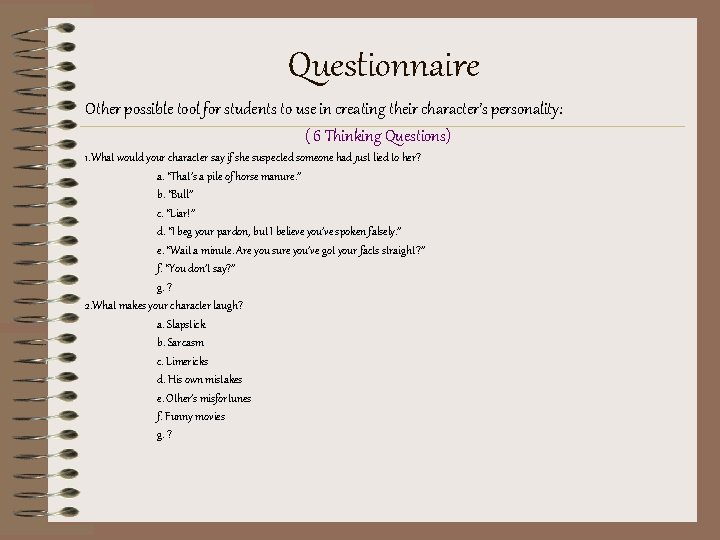
Questionnaire Other possible tool for students to use in creating their character’s personality: ( 6 Thinking Questions) 1. What would your character say if she suspected someone had just lied to her? a. “That’s a pile of horse manure. ” b. “Bull” c. “Liar!” d. “I beg your pardon, but I believe you’ve spoken falsely. ” e. “Wait a minute. Are you sure you’ve got your facts straight? ” f. “You don’t say? ” g. ? 2. What makes your character laugh? a. Slapstick b. Sarcasm c. Limericks d. His own mistakes e. Other’s misfortunes f. Funny movies g. ?
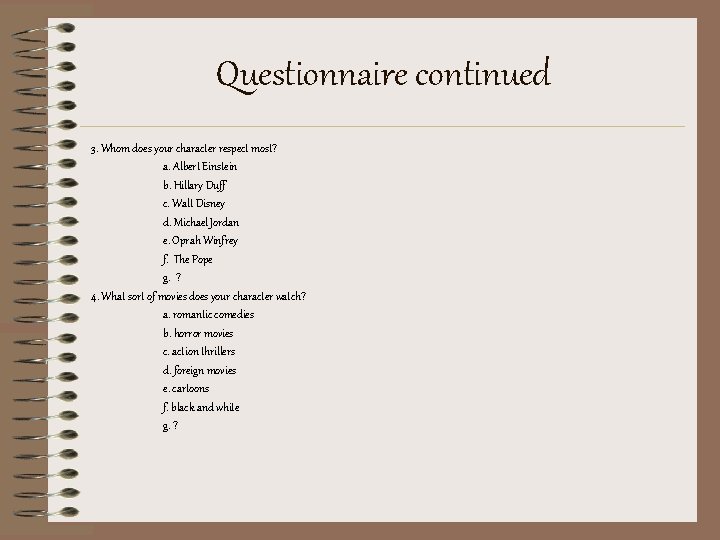
Questionnaire continued 3. Whom does your character respect most? a. Albert Einstein b. Hillary Duff c. Walt Disney d. Michael Jordan e. Oprah Winfrey f. The Pope g. ? 4. What sort of movies does your character watch? a. romantic comedies b. horror movies c. action thrillers d. foreign movies e. cartoons f. black and white g. ?
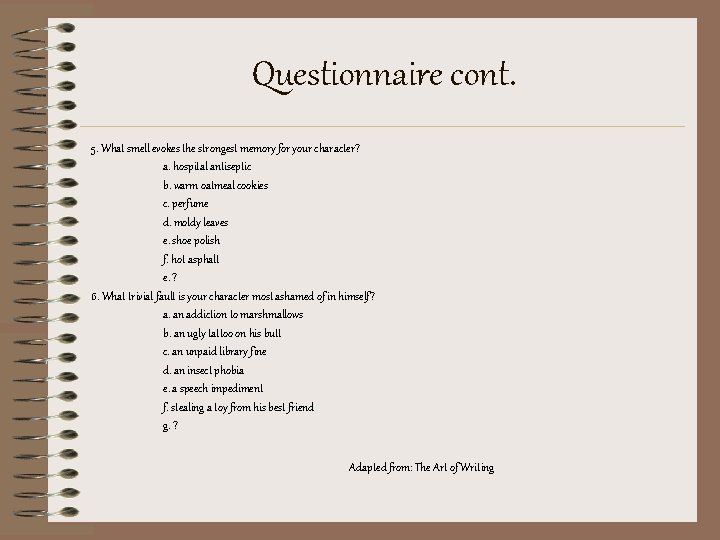
Questionnaire cont. 5. What smell evokes the strongest memory for your character? a. hospital antiseptic b. warm oatmeal cookies c. perfume d. moldy leaves e. shoe polish f. hot asphalt e. ? 6. What trivial fault is your character most ashamed of in himself? a. an addiction to marshmallows b. an ugly tattoo on his butt c. an unpaid library fine d. an insect phobia e. a speech impediment f. stealing a toy from his best friend g. ? Adapted from: The Art of Writing
Regulating the Activity Use any or both tools to get the conversation started. Working in groups takes the pressure off! Rules: Have fun, be creative, think outside your comfort zone!
Write a paragraph about your new character Now that you have background information about your character, write a paragraph with your group introducing him/her to the class. Rosie The Flying Octopus Rosie is no ordinary sea creature with fins and gills. Though she lives in the ocean, she spends many hours stretching her wings across the sky… To stimulate imagination
And now… Students can continue with their groups to develop a story around their character. Once a final draft has been created, it can be illustrated and published. The groups can read their book to the class, and the book can be kept in the classroom library.
Modifications • Once an identity has been established, each person in the group can create their own story. The students will be creating a series around the same character. • Students can write stories about or including other characters from the class. • Illustrating/Storyboarding the adventures of the character will allow every student to express themselves in their most effective manner.
Bibliography • • • Essex, Christopher (1996) “Teaching Creative Writing. ” www. ericdigests. org/1996 -3/writing. html Mc. Gown, Jill. “Creating characters. ” www. jillmcgown. com/pages/writing_advice/creating_characters. html The Art of Writing. “How well do you know your character? ” www. webcom. com/wordings/artofwrite/feature. html Tompkins, Gail E. (1982). “Seven Reasons Why Children Should Write Stories. ” Language Arts, 59(7), 718 -21. Resenbrink, Carla (1987). “Writing as Play. ” Language Arts, 64(6), 59 -60.