
Creating and Adapting Elder Abuse MDTS in the
Creating and Adapting Elder Abuse MDTS in the Current Environment Talitha Guinn-Shaver, MDT Technical Advisor MDT TAC
AGENDA Maintaining a multidisciplinary team is complex work. Every community will encounter unique challenges; however, some challenges are more common that others. Today we will discuss: ‣ Elder Justice Initiative and the MDT TAC Background ‣ MDT 101 ‣ What we know about strong MDTs ‣ What teams are doing to adapt to working during an epidemic ‣ Tips and resources to bolster your team MDT TAC 2
ELDER JUSTICE INITIATIVE The mission is to support and coordinate the Department of Justice’s enforcement and programmatic efforts to combat elder abuse, neglect, and financial fraud and scams that target older adults. The Initiative does so by— ‣ Promoting justice for older adults. ‣ Helping older victims and their families. ‣ Enhancing state and local efforts through training and resources. ‣ Supporting research to improve elder abuse policy and practice. MDT TAC 3
ABOUT THE MDT TAC Our mission is to provide tools, resources, and individualized consultations to facilitate the expansion of elder abuse case review multidisciplinary teams across the nation. 4 MDT TAC
SERVICES • Responding to requests for materials (e. g. , toolkits or research) • Phone consultations to discuss problem solving (e. g. , confidentiality issues) • In-person consultations for communities needing a more hands-on approach • Educational opportunities such as webinars • MDT Guide and Toolkit • Elder Abuse Network Map MDT TAC 5

WHAT ARE MDTS? MDT TAC 6
DEFINING A MDT Rooted in the biopsychosocial model, MDTs are defined as representatives from three or more disciplines who work collaboratively, bound by a common purpose. MDTs have a shared goal and shared definition of the problem they are addressing. MDT TAC 7
Adult Protective Services (APS) Aging services network personnel COMMON CORE MEMBERS Geriatricians/physicians Law enforcement Prosecutors (District Attorneys) Psychologists/neuropsychologists Victim-witness advocates/victim service providers MDT TAC 8
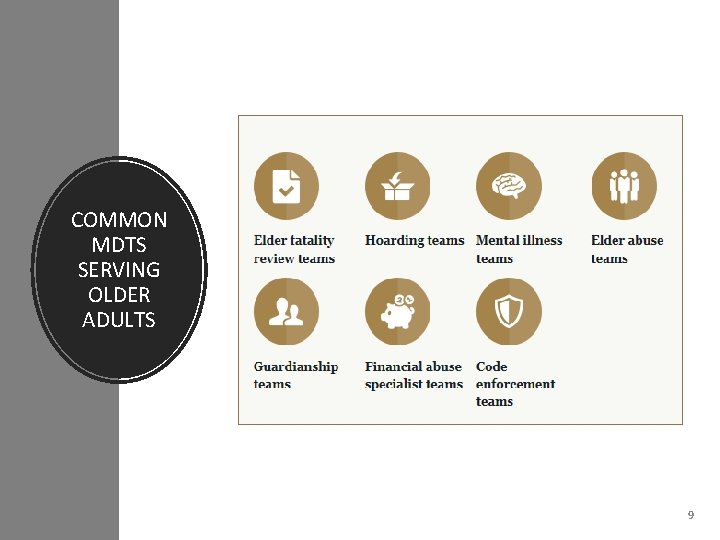
COMMON MDTS SERVING OLDER ADULTS MDT TAC 9
CHOSE A STRUCTURE What type of team will work best for your community? What agencies and organizations should be involved in starting your team? https: //www. justice. gov/elderjustice/2 -meeting-needs-your-community (See Organizational Structure paragraph) MDT TAC 10
RECRUIT PARTICIPANTS ‣ Be as collaborative and open to a wide variety of participants as possible. Think about who is needed to resolve elder abuse cases effectively and efficiently. ‣ Understand the needs of your community. Understand local systems issues and politics. Propose solutions to problems. ‣ Clearly communicate the benefits of collaboration – “What’s in it for me? ” ‣ Identify influencers and leaders within organizations and build relationships. ‣ Empower others. https: //www. justice. gov/elderjustice/selecting-team-members MDT TAC 11
WHAT WE KNOW ABOUT STRONG MDTS: FUNDAMENTALS 12
Shared Decision-Making The entire team participates in the decision making process, sharing information, and sharing successes. SETTING THE STAGE FOR SUCCESS Partnership MDTs are characterized by a formal Memorandum of Understanding (MOU) or an Interagency Agreement (IAA). Interdependency Group and individual outcomes are influenced by the team. Balanced Power All members of the MDT have equal input and prohibit a single member from dominating the group. Process The development and use of protocols to introduce predictability and accountability into the case review process, including protocols for conflict resolution. 13
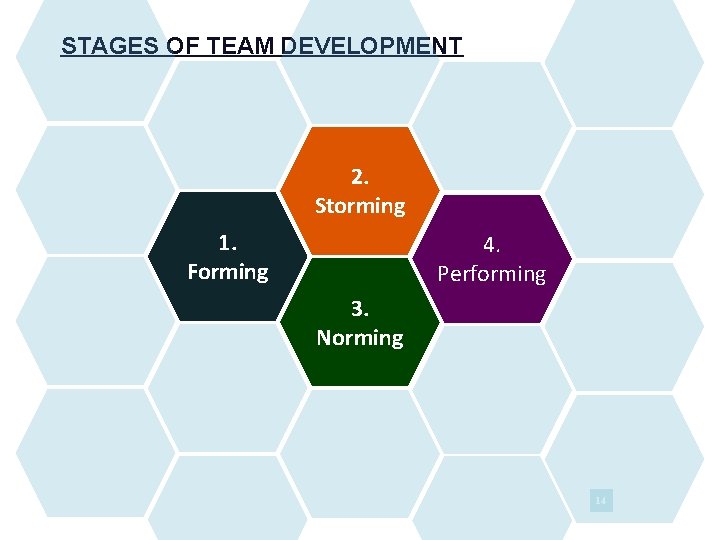
STAGES OF TEAM DEVELOPMENT 2. Storming 1. Forming 4. Performing 3. Norming 14
DEFINE MISSION, VISION, & GOALS What is the purpose of your team? What do you hope to accomplish together? Having a clear mission and agreed upon goals early on in the process of developing your team will help to keep everyone on track, working toward the same outcomes and clear about how to measure success. https: //www. justice. gov/elderjustice/4 building-strong-foundation 15 MDT TAC
DEVELOP CLEAR ORGANIZATIONAL RULES ‣ Clearly understand agree upon interpretations of your state laws and statues https: //www. justice. gov/elderjustice/file/960791/download ‣ Identify someone to serve as the coordinator https: //www. justice. gov/elderjustice/6 -mdt-coordinator ‣ Create MOUs for participating agencies https: //www. justice. gov/elderjustice/5 -ethical-legal-considerations ‣ Write protocols https: //www. justice. gov/archives/elderjustice/file/938806/download ‣ Learn more about building a strong foundation here https: //www. justice. gov/elderjustice/4 -building-strong-foundation MDT TAC 16
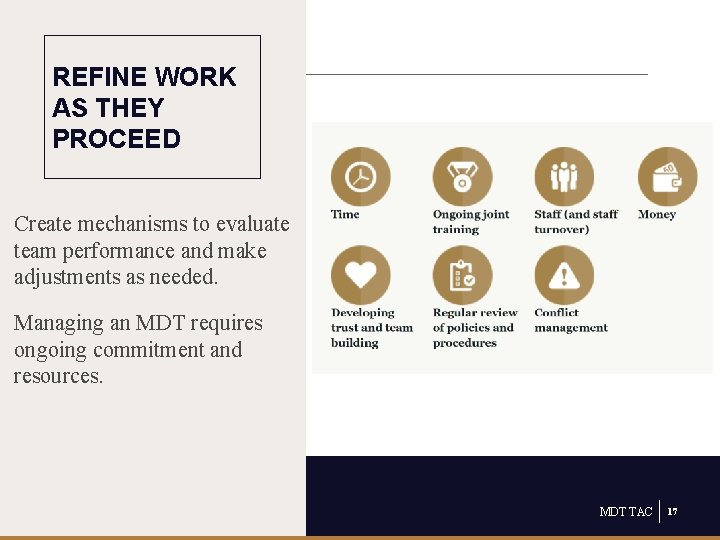
REFINE WORK AS THEY PROCEED Create mechanisms to evaluate team performance and make adjustments as needed. Managing an MDT requires ongoing commitment and resources. MDT TAC 17
KEEP TEAM MEMBERS INFORMED • Build into the MDT protocols periodic and ongoing training, both formal and informal, particularly as new members arrive and protocols and policies change, and the political landscape shifts. • Attend to your team’s cross-training needs https: //www. justice. gov/elderjustice/7 professional-development • EJI has many educational resources and webinars that may help your team https: //www. justice. gov/elderjustice/webinars MDT TAC 18
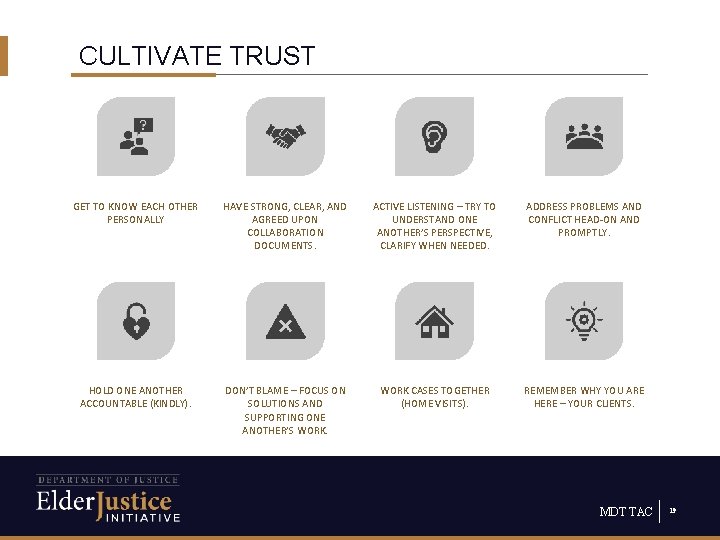
CULTIVATE TRUST GET TO KNOW EACH OTHER PERSONALLY HAVE STRONG, CLEAR, AND AGREED UPON COLLABORATION DOCUMENTS. ACTIVE LISTENING – TRY TO UNDERSTAND ONE ANOTHER’S PERSPECTIVE, CLARIFY WHEN NEEDED. ADDRESS PROBLEMS AND CONFLICT HEAD-ON AND PROMPTLY. HOLD ONE ANOTHER ACCOUNTABLE (KINDLY). DON’T BLAME – FOCUS ON SOLUTIONS AND SUPPORTING ONE ANOTHER’S WORK CASES TOGETHER (HOME VISITS). REMEMBER WHY YOU ARE HERE – YOUR CLIENTS. MDT TAC 19

Adapting to a New Environment What now? MDT TAC
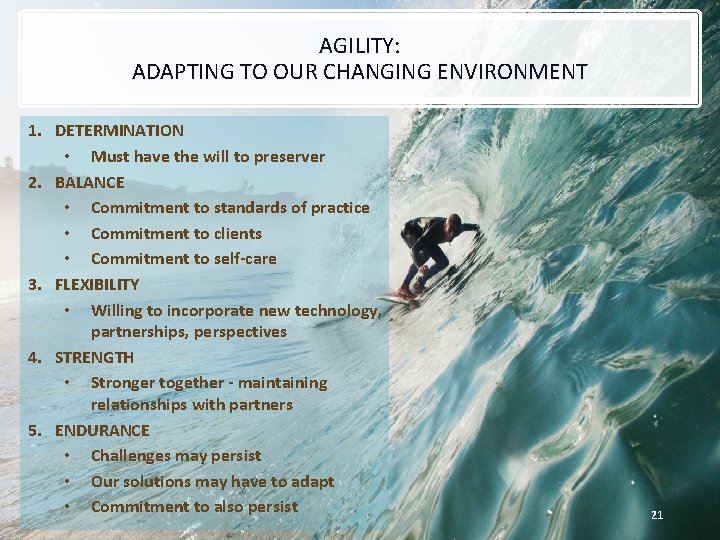
AGILITY: ADAPTING TO OUR CHANGING ENVIRONMENT 1. DETERMINATION • Must have the will to preserver 2. BALANCE • Commitment to standards of practice • Commitment to clients • Commitment to self-care 3. FLEXIBILITY • Willing to incorporate new technology, partnerships, perspectives 4. STRENGTH • Stronger together - maintaining relationships with partners 5. ENDURANCE • Challenges may persist • Our solutions may have to adapt • Commitment to also persist MDT TAC 21
HOW ARE TEAMS RESPONDING? Some teams have decided to shift their focus to challenges that have emerged or become more pronounced by the current crisis. Focus areas include, but are not limited to. ‣ Countering Agism ‣ Gaps in safety net – policy or protocols between agencies ‣ Standards of care in long-term care facilities ‣ Developing safety and action plans for similar future emergencies MDT TAC 22
HOW ARE TEAMS RESPONDING? Some teams have decided to continue case review or similar client driven work while making appropriate adaptations. This next section contains things to consider and tips to continue your MDT related work. MDT TAC 23
SOCIAL DISTANCING Interacting with older adult clients ‣ Reduce the number of professionals who have face-to-face contact – team coordination ‣ Stay connected with phone calls between necessary visits ‣ Triaging cases so that in-person contact only occurs in emergencies ‣ Defining emergency needs and conditions for contact ‣ Practice safe contact using safe distances, gloves and masks (See CDC for additional information) MDT TAC 24
WORKING REMOTELY Teleconferencing Considerations ‣ Choosing a platform – collaborate with partners regarding licensing teleconferencing software • Sharing cost • Using established platforms to enhance user familiarity • Lead agency – In-kind contribution MDT TAC 25
WORKING REMOTELY Teleconferencing Considerations ‣ Confidentiality • Most video conferencing platforms have HIPAA compliant for-pay tiers • MUST COMPLY WITH SECURITY PROTOCOL TO BE EFFECTIVE • Consider adding language to confidentiality agreements to cover remote communication (have attorneys for partner agencies review and approve) MDT TAC 26
WORKING REMOTELY Teleconferencing Considerations ‣ Enhancing Security • Use ‘waiting rooms’ to accept participants into meetings • Display confidentiality agreement language in waiting room • Utilize group chats to confirm participants have read, understood and agree to confidentiality statement • Kick participants for non-compliance • Maintain chat record of confidentiality agreement MDT TAC 27
WORKING REMOTELY Teleconferencing Considerations ‣ Enhancing Security • • Don’t use open Wi-Fi Don’t hold calls in public spaces Do keep software updated Do stay current with protocols and professional guidelines MDT TAC 28
WORKING REMOTELY Teleconferencing Considerations ‣ Etiquette • Test audio/video ahead of meeting • Ensure your face is lit and visible (no light sources behind you) • Don’t take your devise with you to the bathroom • Mute your line when you aren’t speaking • Unmute your line when you are speaking • Come prepared • Don’t multitask • Be respectful of time MDT TAC 29
WORKING REMOTELY Training! ‣ Ensure your members understand how to use new tools and resources. Other collaborative tools ‣ Shared calendars ‣ Listservs ‣ Instant messaging ‣ Cloud computing/sharing working documents MDT TAC 30
WORKING REMOTELY Telehealth Considerations ‣ Virtual communication with clients is more complicated than internal communication. ‣ Previous tips apply, but are not all-inclusive. ‣ https: //www. techsafety. org/ ‣ http: //reachingvictims. org/resource/nationalstrategy-session-on-sustaining-servicessession-1/ MDT TAC 31
FACILITATION TIPS Develop a meeting structure Be mindful of everyone’s time and organizational limitations Keep in mind “cultural differences” between professions Communicate outside of the meeting Spread the kudos Comply with agreed upon protocols Cultivate respectful communication Share technical responsibilities Provide opportunities for members to get to know each other MDT TAC 32
AVAILABLE RESOURCES ‣ https: //www. justice. gov/coronavirus ‣ www. elderjustice. gov ‣ https: //www. cdc. gov/coronavirus/2019 -ncov/communication/guidance -list. html? Sort=Date%3 A%3 Adesc ‣ https: //www. techsafety. org/ ‣ http: //reachingvictims. org/resource/national-strategy-session-onsustaining-services-session-1/ ‣ https: //www. justice. gov/elderjustice/mdt MDT TAC 33
REACH OUT FOR HELP WHEN YOU NEED IT For consultation referrals or to collaborate, contact: Talitha Guinn-Shaver 202. 598. 0292 Talitha. j. guinn-shaver@usdoj. gov MDT TAC 34
MDT TAC
- Slides: 35