
Creating an Aligned Assessment System to Promote Work

- Slides: 32
Creating an Aligned Assessment System to Promote Work Training Readiness and Career Success Steve Robbins Vice President, Research ACT, Inc. Though designed to meet a wide array of needs, all ACT programs and services have one guiding purpose: Helping people achieve education and workplace success. © 2010 by ACT, Inc. All rights reserved. 1
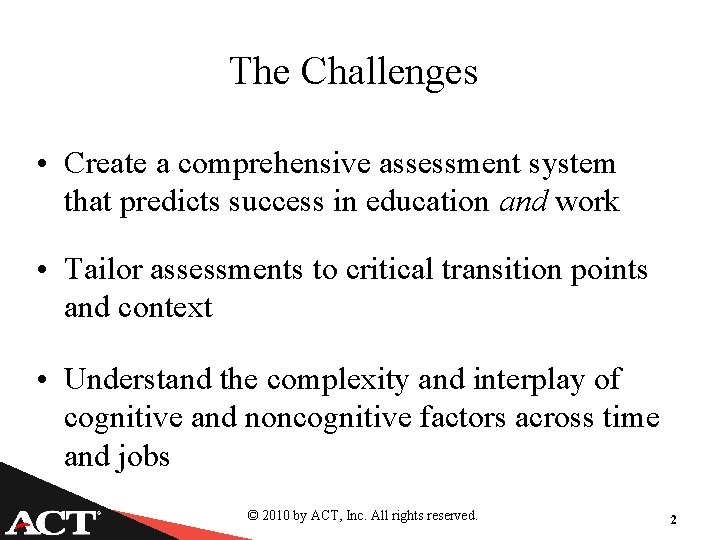
The Challenges • Create a comprehensive assessment system that predicts success in education and work • Tailor assessments to critical transition points and context • Understand the complexity and interplay of cognitive and noncognitive factors across time and jobs © 2010 by ACT, Inc. All rights reserved. 2
Do noncognitive factors matter? • What we know from the world of work: – Project A from the military – Training and work outcomes © 2010 by ACT, Inc. All rights reserved. 3
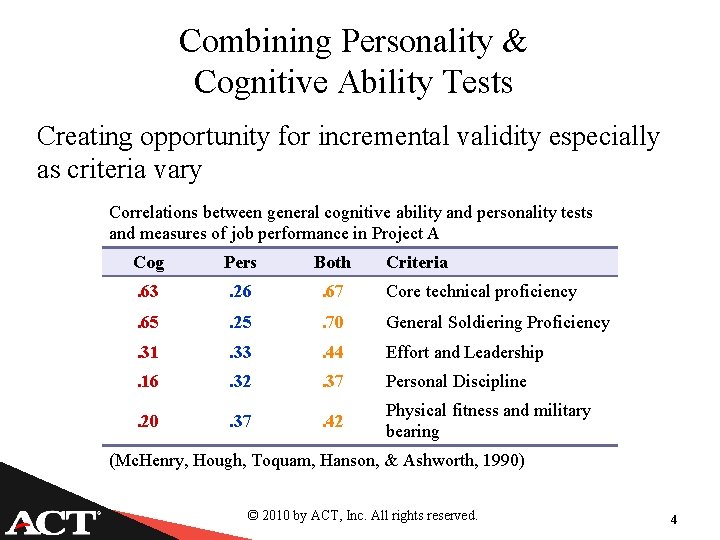
Combining Personality & Cognitive Ability Tests Creating opportunity for incremental validity especially as criteria vary Correlations between general cognitive ability and personality tests and measures of job performance in Project A Cog Pers Both Criteria . 63 . 26 . 67 Core technical proficiency . 65 . 25 . 70 General Soldiering Proficiency . 31 . 33 . 44 Effort and Leadership . 16 . 32 . 37 Personal Discipline . 20 . 37 . 42 Physical fitness and military bearing (Mc. Henry, Hough, Toquam, Hanson, & Ashworth, 1990) © 2010 by ACT, Inc. All rights reserved. 4
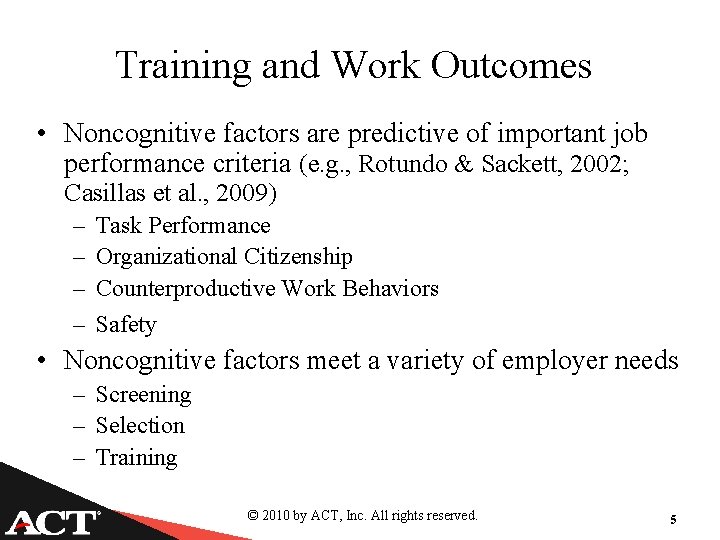
Training and Work Outcomes • Noncognitive factors are predictive of important job performance criteria (e. g. , Rotundo & Sackett, 2002; Casillas et al. , 2009) – – Task Performance Organizational Citizenship Counterproductive Work Behaviors Safety • Noncognitive factors meet a variety of employer needs – Screening – Selection – Training © 2010 by ACT, Inc. All rights reserved. 5
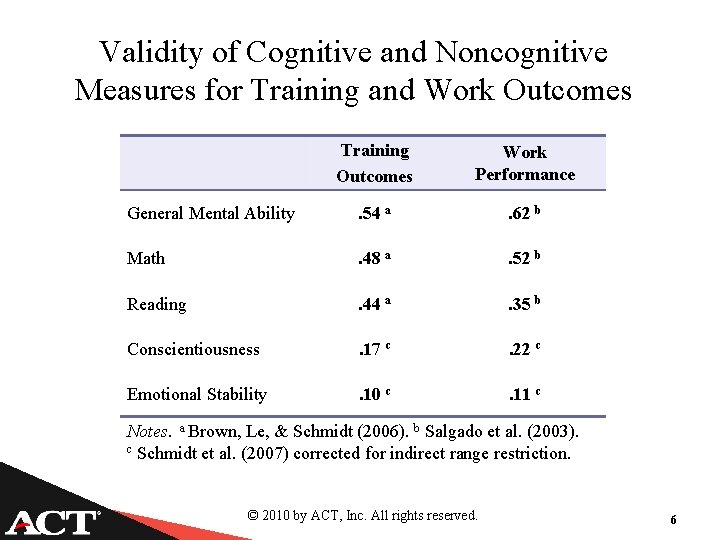
Validity of Cognitive and Noncognitive Measures for Training and Work Outcomes Training Outcomes Work Performance General Mental Ability . 54 a . 62 b Math . 48 a . 52 b Reading . 44 a . 35 b Conscientiousness . 17 c . 22 c Emotional Stability . 10 c . 11 c Notes. a Brown, Le, & Schmidt (2006). b Salgado et al. (2003). c Schmidt et al. (2007) corrected for indirect range restriction. © 2010 by ACT, Inc. All rights reserved. 6
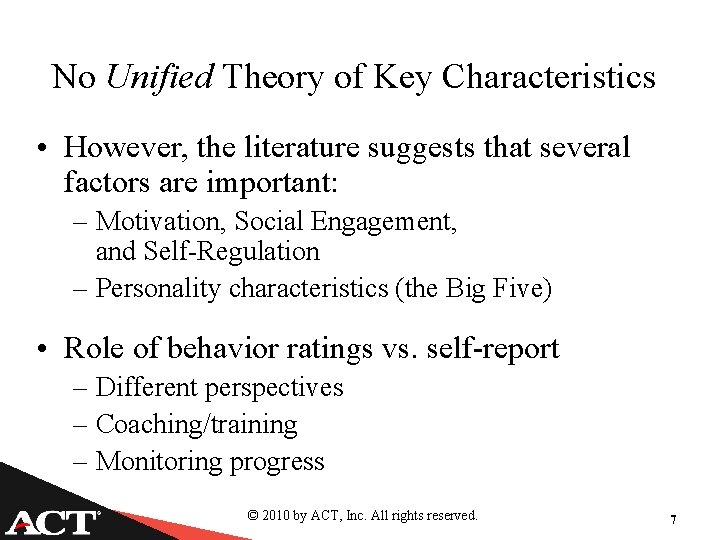
No Unified Theory of Key Characteristics • However, the literature suggests that several factors are important: – Motivation, Social Engagement, and Self-Regulation – Personality characteristics (the Big Five) • Role of behavior ratings vs. self-report – Different perspectives – Coaching/training – Monitoring progress © 2010 by ACT, Inc. All rights reserved. 7
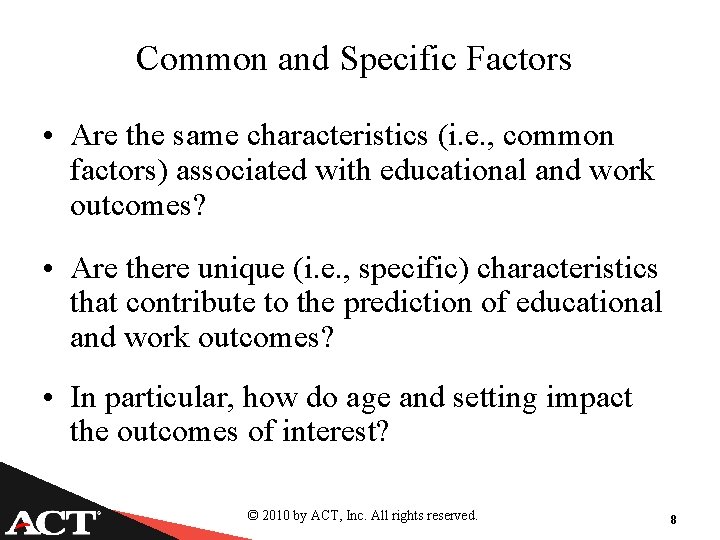
Common and Specific Factors • Are the same characteristics (i. e. , common factors) associated with educational and work outcomes? • Are there unique (i. e. , specific) characteristics that contribute to the prediction of educational and work outcomes? • In particular, how do age and setting impact the outcomes of interest? © 2010 by ACT, Inc. All rights reserved. 8
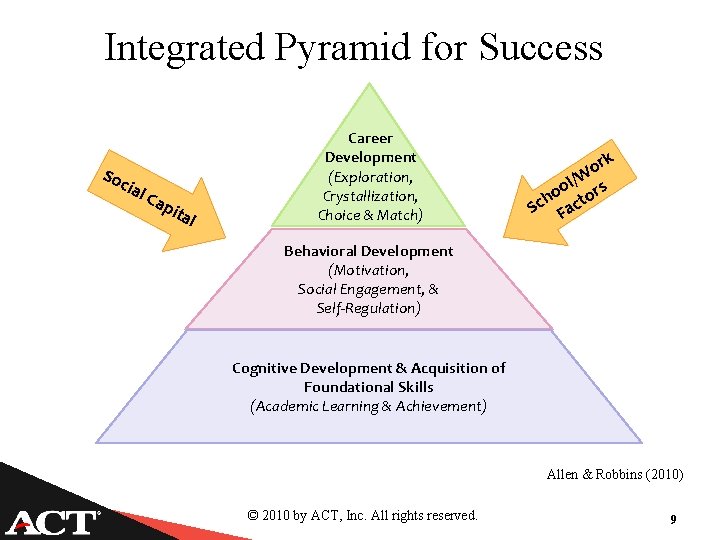
Integrated Pyramid for Success So cia l Ca pit al Career Development (Exploration, Crystallization, Choice & Match) rk o l/W s o ho ctor c S Fa Behavioral Development (Motivation, Social Engagement, & Self-Regulation) Cognitive Development & Acquisition of Foundational Skills (Academic Learning & Achievement) Allen & Robbins (2010) © 2010 by ACT, Inc. All rights reserved. 9
The human side of the pyramid © 2010 by ACT, Inc. All rights reserved. 10
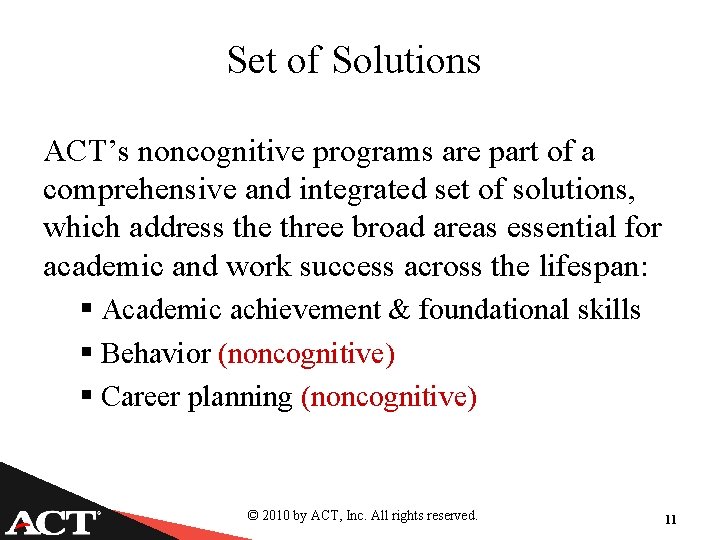
Set of Solutions ACT’s noncognitive programs are part of a comprehensive and integrated set of solutions, which address the three broad areas essential for academic and work success across the lifespan: § Academic achievement & foundational skills § Behavior (noncognitive) § Career planning (noncognitive) © 2010 by ACT, Inc. All rights reserved. 11
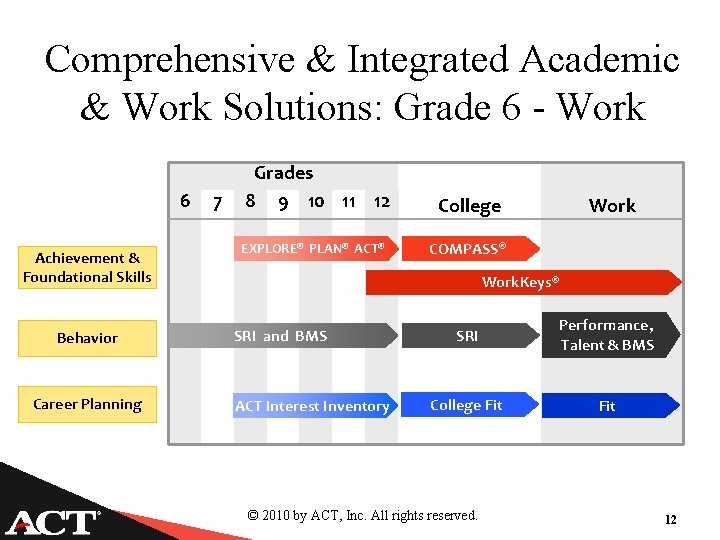
Comprehensive & Integrated Academic & Work Solutions: Grade 6 - Work 6 Achievement & Foundational Skills Behavior Career Planning 7 Grades 8 9 10 11 12 EXPLORE® PLAN® ACT® College Work COMPASS® Work. Keys® SRI and BMS ACT Interest Inventory SRI Performance, Talent & BMS College Fit © 2010 by ACT, Inc. All rights reserved. 12
Creating a Comprehensive Set of Behavior (Self & Other Report) Assessments • Role of meta-analysis and validity generalization – Robbins et al. (2004). Do psychosocial and study skill factors predict college outcomes? A meta-analysis. Psychological Bulletin, 130, 261 -288. – Robbins et al. (2009). Intervention effects on college performance and retention as mediated by motivational, emotional, and social control factors: Integrated metaanalytic path analyses. Journal of Applied Psychology, 94, 1163 -1184. © 2010 by ACT, Inc. All rights reserved. 13
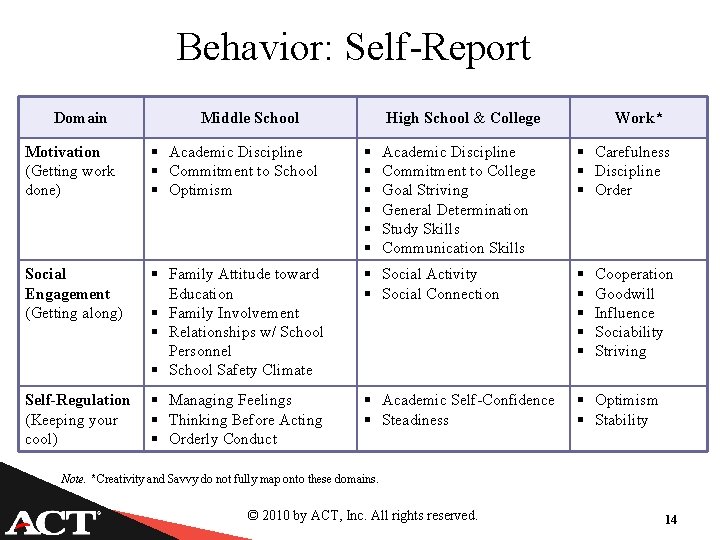
Behavior: Self-Report Domain Middle School High School & College Work* Motivation (Getting work done) § Academic Discipline § Commitment to School § Optimism § § § Social Engagement (Getting along) § Family Attitude toward Education § Family Involvement § Relationships w/ School Personnel § School Safety Climate § Social Activity § Social Connection § § § Self-Regulation (Keeping your cool) § Managing Feelings § Thinking Before Acting § Orderly Conduct § Academic Self-Confidence § Steadiness § Optimism § Stability Academic Discipline Commitment to College Goal Striving General Determination Study Skills Communication Skills § Carefulness § Discipline § Order Cooperation Goodwill Influence Sociability Striving Note. *Creativity and Savvy do not fully map onto these domains. © 2010 by ACT, Inc. All rights reserved. 14
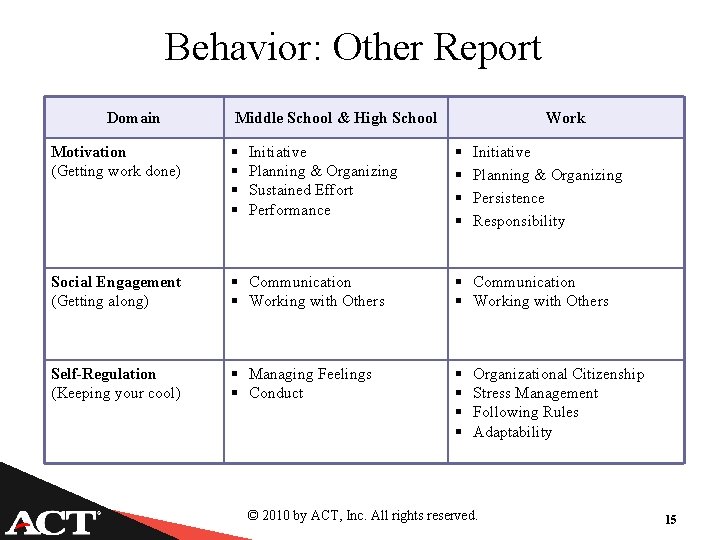
Behavior: Other Report Domain Middle School & High School Work Motivation (Getting work done) § § Social Engagement (Getting along) § Communication § Working with Others Self-Regulation (Keeping your cool) § Managing Feelings § Conduct § § Initiative Planning & Organizing Sustained Effort Performance § § Initiative Planning & Organizing Persistence Responsibility Organizational Citizenship Stress Management Following Rules Adaptability © 2010 by ACT, Inc. All rights reserved. 15
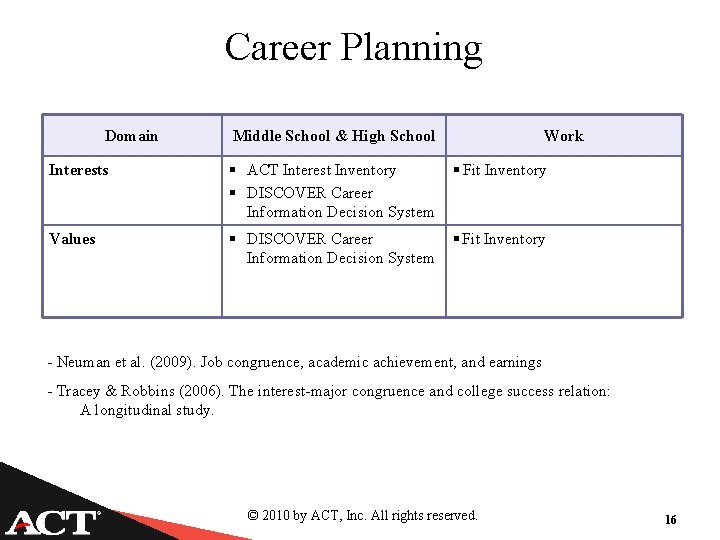
Career Planning Domain Middle School & High School Work Interests § ACT Interest Inventory § DISCOVER Career Information Decision System § Fit Inventory Values § DISCOVER Career Information Decision System § Fit Inventory - Neuman et al. (2009). Job congruence, academic achievement, and earnings - Tracey & Robbins (2006). The interest-major congruence and college success relation: A longitudinal study. © 2010 by ACT, Inc. All rights reserved. 16
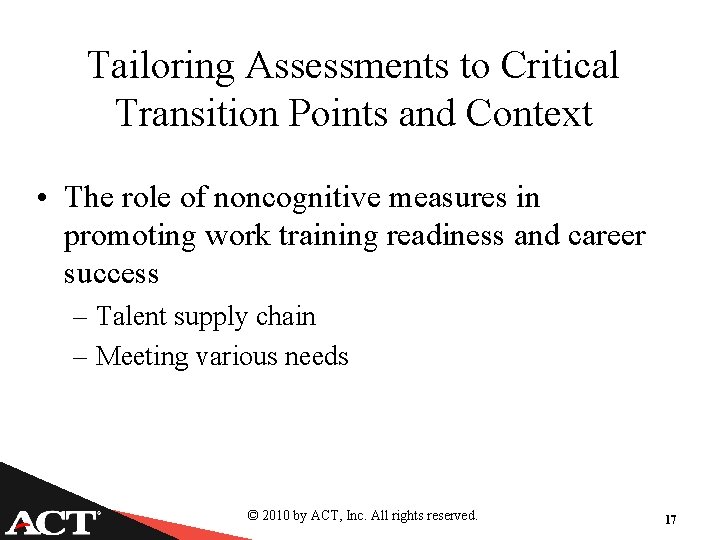
Tailoring Assessments to Critical Transition Points and Context • The role of noncognitive measures in promoting work training readiness and career success – Talent supply chain – Meeting various needs © 2010 by ACT, Inc. All rights reserved. 17
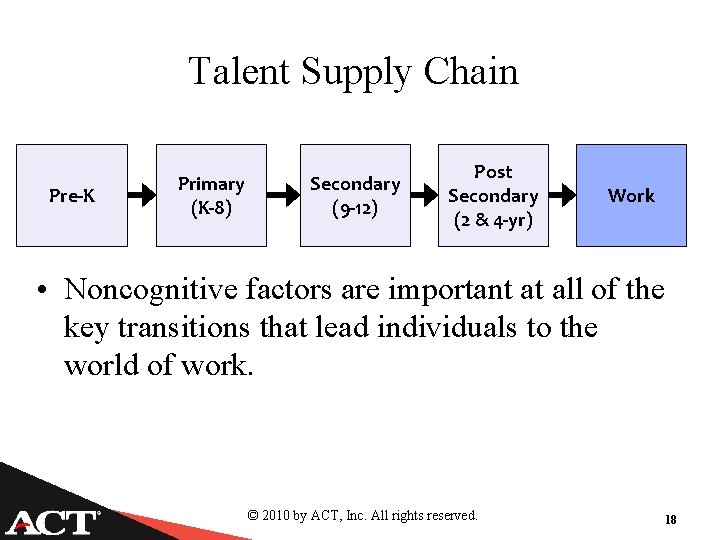
Talent Supply Chain Pre-K Primary (K-8) Secondary (9 -12) Post Secondary (2 & 4 -yr) Work • Noncognitive factors are important at all of the key transitions that lead individuals to the world of work. © 2010 by ACT, Inc. All rights reserved. 18
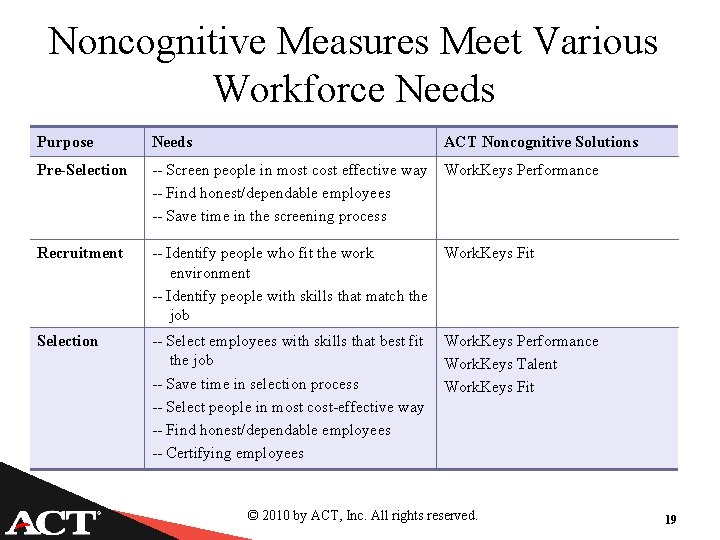
Noncognitive Measures Meet Various Workforce Needs Purpose Needs ACT Noncognitive Solutions Pre-Selection -- Screen people in most cost effective way Work. Keys Performance -- Find honest/dependable employees -- Save time in the screening process Recruitment -- Identify people who fit the work Work. Keys Fit environment -- Identify people with skills that match the job Selection -- Select employees with skills that best fit the job -- Save time in selection process -- Select people in most cost-effective way -- Find honest/dependable employees -- Certifying employees Work. Keys Performance Work. Keys Talent Work. Keys Fit © 2010 by ACT, Inc. All rights reserved. 19
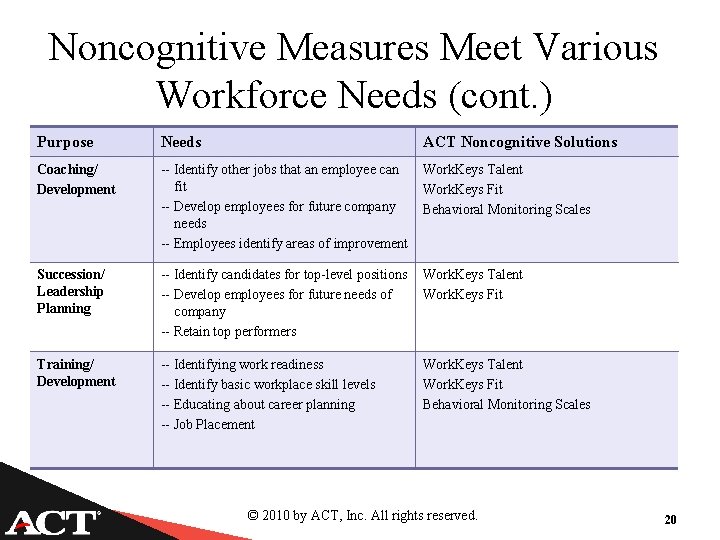
Noncognitive Measures Meet Various Workforce Needs (cont. ) Purpose Needs ACT Noncognitive Solutions Coaching/ Development -- Identify other jobs that an employee can fit -- Develop employees for future company needs -- Employees identify areas of improvement Work. Keys Talent Work. Keys Fit Behavioral Monitoring Scales Succession/ Leadership Planning -- Identify candidates for top-level positions -- Develop employees for future needs of company -- Retain top performers Work. Keys Talent Work. Keys Fit Training/ Development -- Identifying work readiness -- Identify basic workplace skill levels -- Educating about career planning -- Job Placement Work. Keys Talent Work. Keys Fit Behavioral Monitoring Scales © 2010 by ACT, Inc. All rights reserved. 20
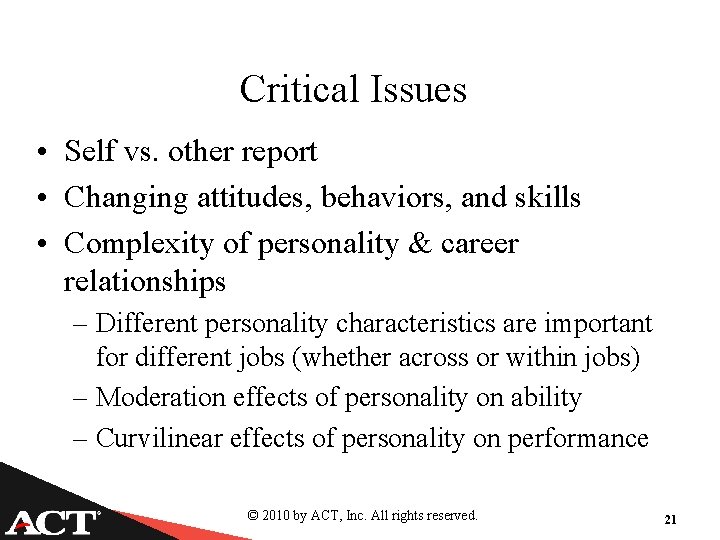
Critical Issues • Self vs. other report • Changing attitudes, behaviors, and skills • Complexity of personality & career relationships – Different personality characteristics are important for different jobs (whether across or within jobs) – Moderation effects of personality on ability – Curvilinear effects of personality on performance © 2010 by ACT, Inc. All rights reserved. 21
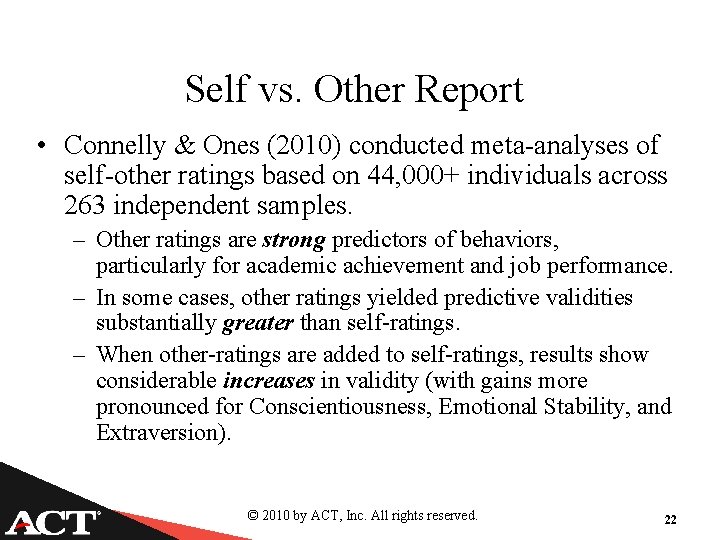
Self vs. Other Report • Connelly & Ones (2010) conducted meta-analyses of self-other ratings based on 44, 000+ individuals across 263 independent samples. – Other ratings are strong predictors of behaviors, particularly for academic achievement and job performance. – In some cases, other ratings yielded predictive validities substantially greater than self-ratings. – When other-ratings are added to self-ratings, results show considerable increases in validity (with gains more pronounced for Conscientiousness, Emotional Stability, and Extraversion). © 2010 by ACT, Inc. All rights reserved. 22
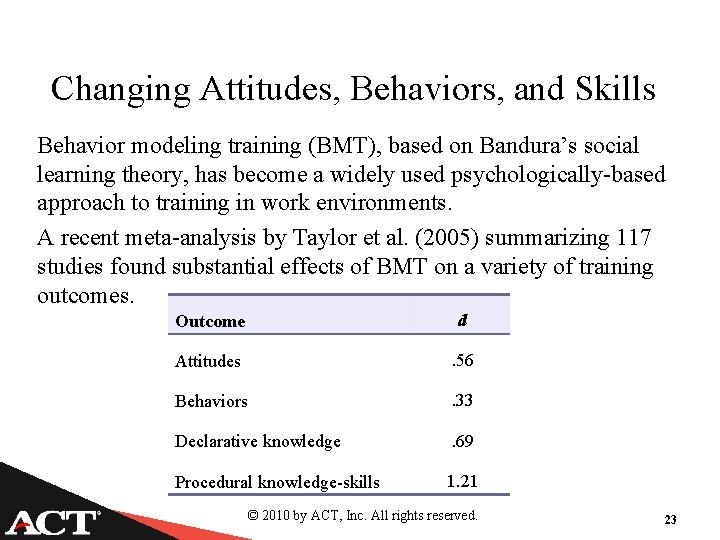
Changing Attitudes, Behaviors, and Skills Behavior modeling training (BMT), based on Bandura’s social learning theory, has become a widely used psychologically-based approach to training in work environments. A recent meta-analysis by Taylor et al. (2005) summarizing 117 studies found substantial effects of BMT on a variety of training outcomes. Outcome d Attitudes . 56 Behaviors . 33 Declarative knowledge . 69 Procedural knowledge-skills 1. 21 © 2010 by ACT, Inc. All rights reserved. 23
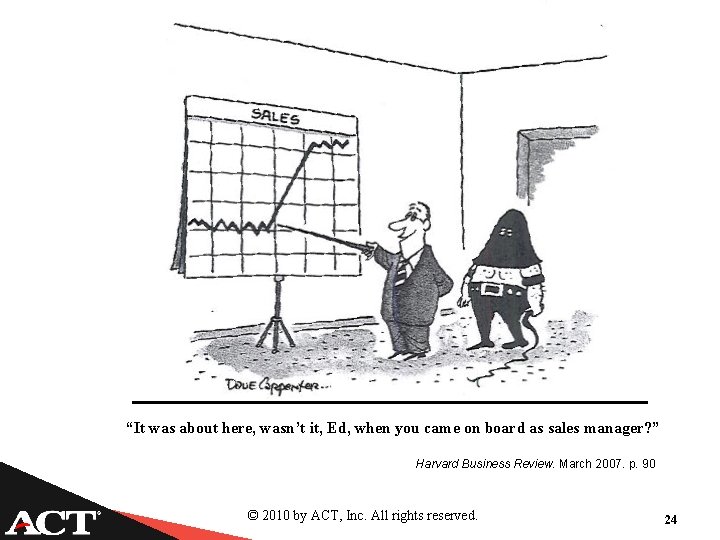
“It was about here, wasn’t it, Ed, when you came on board as sales manager? ” Harvard Business Review. March 2007. p. 90 © 2010 by ACT, Inc. All rights reserved. 24
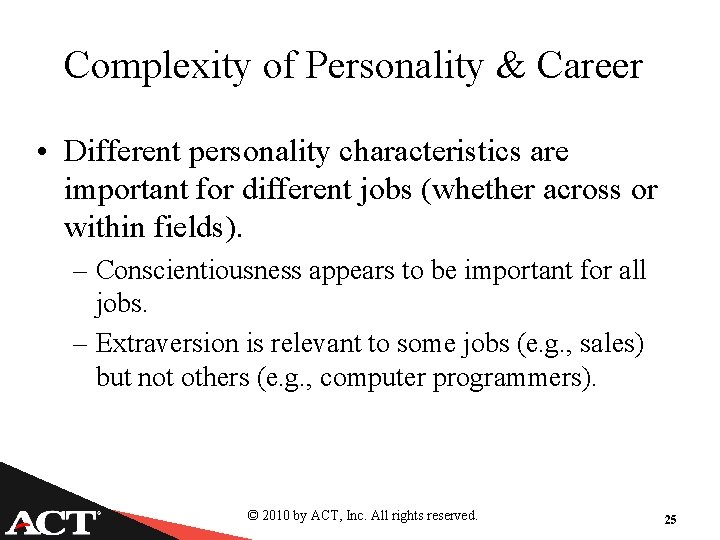
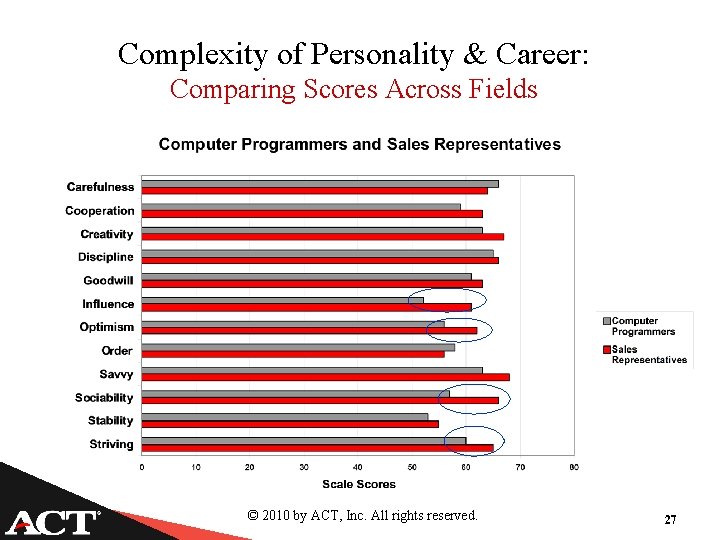
Complexity of Personality & Career • Different personality characteristics are important for different jobs (whether across or within fields). – Conscientiousness appears to be important for all jobs. – Extraversion is relevant to some jobs (e. g. , sales) but not others (e. g. , computer programmers). © 2010 by ACT, Inc. All rights reserved. 25
Complexity of Personality & Career Across Fields • Position Computer Programmers • O-NET Job Zone Four: Considerable Preparation Needed • Education Most occupations in this zone require a four-year bachelor's degree, but some do not. http: //online. onetcenter. org/link/summary/15 -1021. 00 • Position Sales Representatives • O-NET Job Zone Four: Considerable Preparation Needed • Education Most occupations in this zone require a four-year bachelor's degree, but some do not. http: //online. onetcenter. org/link/summary/41 -4011. 00 © 2010 by ACT, Inc. All rights reserved. 26
Complexity of Personality & Career: Comparing Scores Across Fields © 2010 by ACT, Inc. All rights reserved. 27
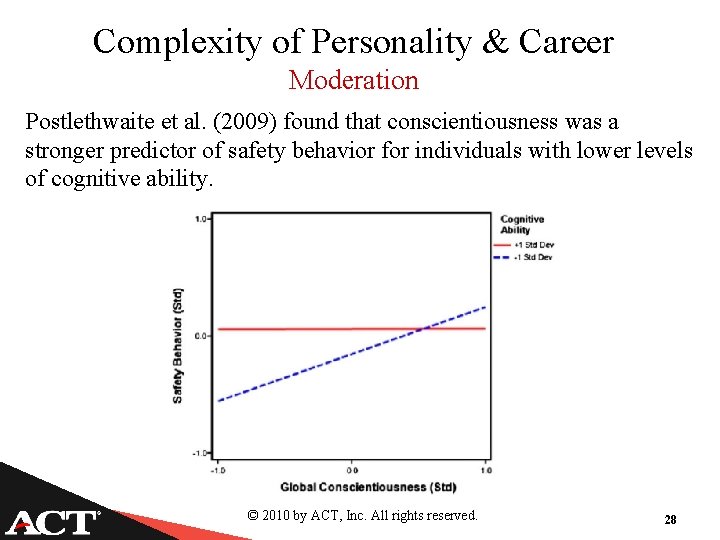
Complexity of Personality & Career Moderation Postlethwaite et al. (2009) found that conscientiousness was a stronger predictor of safety behavior for individuals with lower levels of cognitive ability. © 2010 by ACT, Inc. All rights reserved. 28
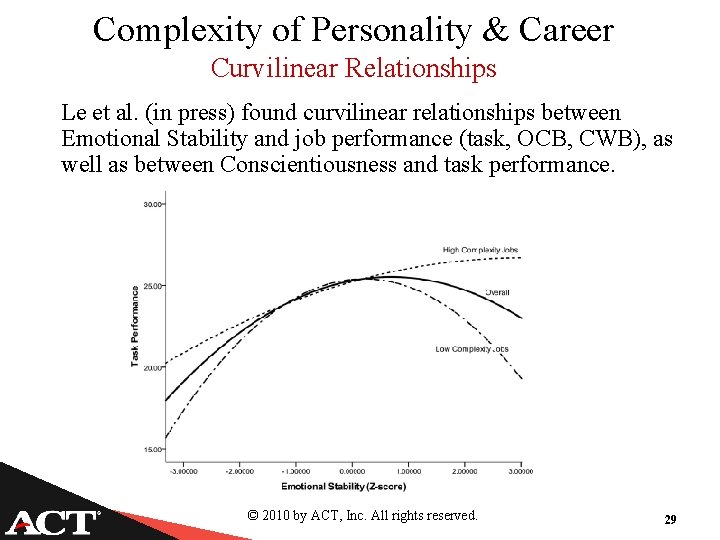
Complexity of Personality & Career Curvilinear Relationships Le et al. (in press) found curvilinear relationships between Emotional Stability and job performance (task, OCB, CWB), as well as between Conscientiousness and task performance. © 2010 by ACT, Inc. All rights reserved. 29
Questions? Correspondence regarding this presentation should be addressed to: Steve Robbins Vice President, Research ACT, Inc. steve. robbins@act. org © 2010 by ACT, Inc. All rights reserved. 30
References Allen, J. & Robbins, S. (2010). Effects of interest–major congruence, motivation, and academic performance on timely degree attainment. Journal of Counseling Psychology, 57, 23– 35. Brown, K. G. , Le, H. , & Schmidt, F. L. (2006). Specific aptitude theory revisited: Is there incremental validity for training performance? International Journal of Selection and Assessment, 14, 87 -100. Casillas, A. , Robbins, S. B. , Mc. Kinniss, T. , Postlethwaite, B. , & Oh, I. S. (2009). Using narrow facets of integrity to predict safety: A test validation study. International Journal of Selection and Assessment, 17, 119 -125. Connelly, B. S. & Ones, D. S. (2010). An Other Perspective on Personality: Meta-Analytic Integration of Observers’ Accuracy and Predictive Validity. Psychological Bulletin, 136, 1092– 1122. Le, H. , Oh, I. -S. , Robbins, S. B. , Ilies, R. , Holland, E. , & Westrick, P. (in press). Too Much of a Good Thing: Curvilinear Relationships Between Personality Traits and Job Performance. Journal of Applied Psychology. Mc. Henry, J. J. , Hough, L. M. , Toquam, J. L. , Hanson, M. A. , & Ashworth, S. (1990). Project A validity results: The relationship between predictor and criterion domains. Personnel Psychology, 43, 335 -354. Neumann, G. , Olitsky, N. , & Robbins, S. (2009). Job congruence, academic achievement, and earnings. Labour Economics, 16, 503 -509. Postlethwaite, B. , Robbins, S. , Rickerson, J. , & Mc. Kinniss, T. (2009). The moderation of conscientiousness by cognitive ability when predicting workplace safety behavior. Personality and Individual Differences, 47, 711 -716. © 2010 by ACT, Inc. All rights reserved. 31
References (cont. ) Robbins, S. B. , Lauver, K. , Le, H. , David, D. , Langley, R. , & Carlstrom, A. (2004). Do psychosocial and study skill factors predict college outcomes? A meta-analysis. Psychological Bulletin, 130, 261 -288. Robbins, S. B. , Oh, I. , Le, H. , & Button, C. (2009). Intervention effects on college performance and retention as mediated by motivational, emotional, and social control factors: Integrated meta-analytic path analyses. Journal of Applied Psychology, 94, 1163 -1184. Rotundo, M. & Sackett, P. R. (2002). The relative importance of task, citizenship, and counterproductive performance to global ratings of job performance: A policycapturing approach. Journal of Applied Psychology, 87, 66– 80. Salgado, J. F. , Anderson, N. , Moscoso, S. , Bertua, C. , & de Fruyt, F. (2003). International validity generalization of GMA and cognitive abilities: A European community meta-analysis. Personnel Psychology, 56, 573 -605. Schmidt, F. L. , Shaffer, J. , & Oh. I. (2007). Reassessing the Relative Importance of Cognitive Ability and Personality in Job Performance and Training Performance: Some Surprising New Research Findings. Paper presented at the 2007 ATP conference, Palm Springs, CA. Feb. 6. Taylor, Paul J. , Russ-Eft, D. F. , & Chan, D. W. L. (2005). A Meta-Analytic Review of Behavior Modeling Training. Journal of Applied Psychology, 90, 692 -709. Tracey, T. J. G. , & Robbins, S. B. (2006). The interest-major congruence and college success relation: A longitudinal study. Journal of Vocational Behavior, 69, 64 -89. © 2010 by ACT, Inc. All rights reserved. 32