
Creating a WinWin Rotational Program Produce Knowledgeable Systems
Creating a Win-Win Rotational Program Produce Knowledgeable Systems Engineers and Aid in Knowledge Sharing Across a Company 4/4/2014 Janine Brown Systems Engineer
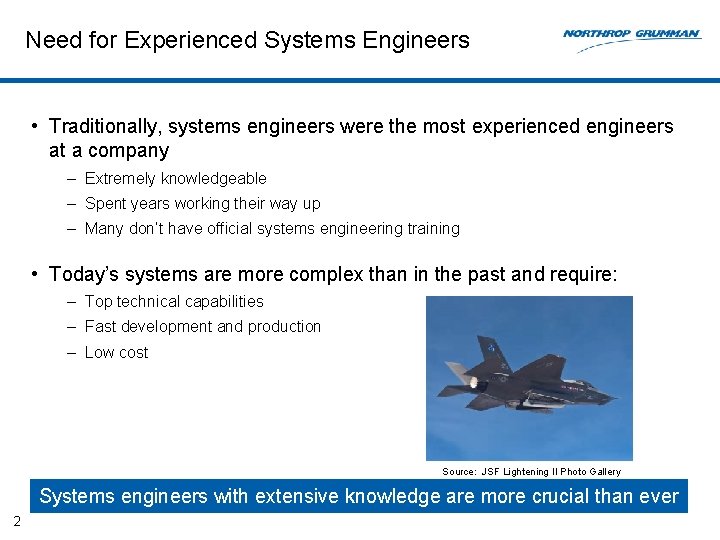
Need for Experienced Systems Engineers • Traditionally, systems engineers were the most experienced engineers at a company – Extremely knowledgeable – Spent years working their way up – Many don’t have official systems engineering training • Today’s systems are more complex than in the past and require: – Top technical capabilities – Fast development and production – Low cost Source: JSF Lightening II Photo Gallery Systems engineers with extensive knowledge are more crucial than ever 2
Traditional Education Helps • Universities are helping with the education of systems engineers – Degrees at the undergraduate, masters, and doctorate levels – Curriculums often include projects to simulate real system challenges – Many professors have worked as systems engineers for large companies and bring real world experiences to their courses 3
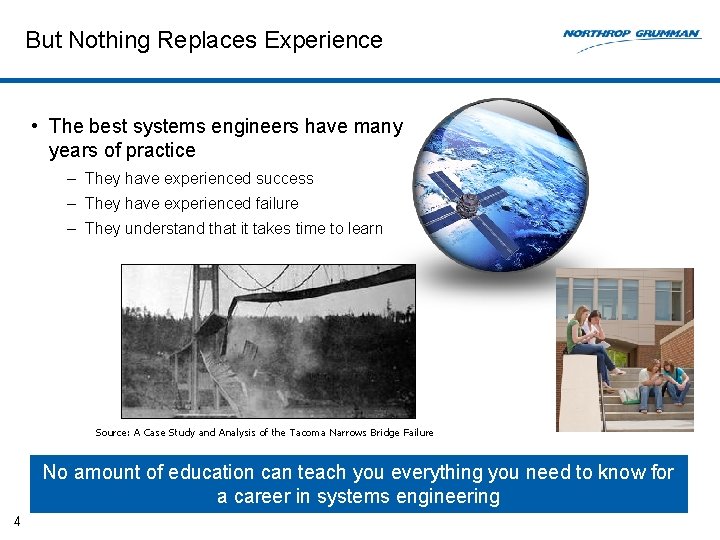
But Nothing Replaces Experience • The best systems engineers have many years of practice – They have experienced success – They have experienced failure – They understand that it takes time to learn Source: A Case Study and Analysis of the Tacoma Narrows Bridge Failure No amount of education can teach you everything you need to know for a career in systems engineering 4
So How Can a Rotational Program Help Fill the Void? • Expands systems engineering skills through various projects • Develops the ability to learn and understand new systems quickly • Intensifies an understanding of different areas of the systems engineering life cycle • Encourages learning in a variety of domain areas Rotational programs speed up the SE learning process 5
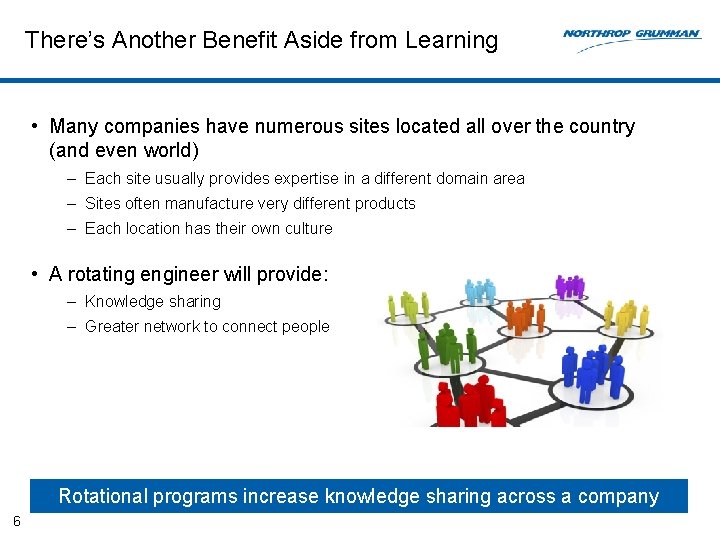
There’s Another Benefit Aside from Learning • Many companies have numerous sites located all over the country (and even world) – Each site usually provides expertise in a different domain area – Sites often manufacture very different products – Each location has their own culture • A rotating engineer will provide: – Knowledge sharing – Greater network to connect people Rotational programs increase knowledge sharing across a company 6
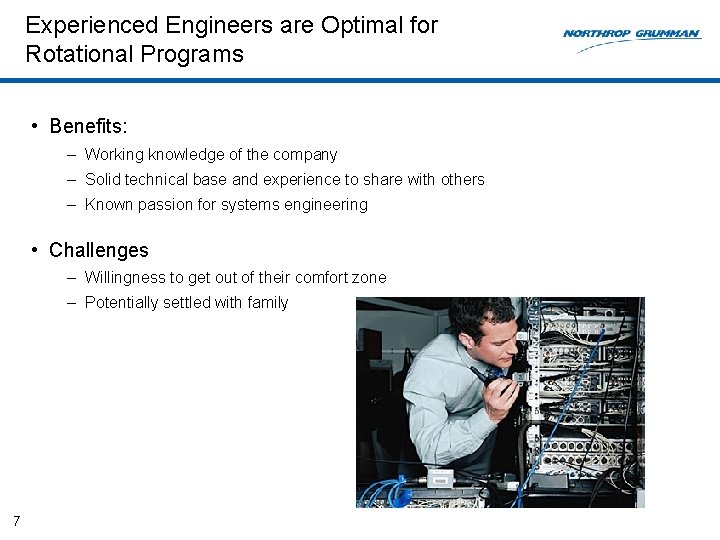
Experienced Engineers are Optimal for Rotational Programs • Benefits: – Working knowledge of the company – Solid technical base and experience to share with others – Known passion for systems engineering • Challenges – Willingness to get out of their comfort zone – Potentially settled with family 7
Implementation Challenges
Program Logistics • Outline how the rotational program will work – Duration of the overall program – Length of each rotation – Types of rotations – all technical or a mix of technical and business – Commitment required by each participant both during and after the program – Relocation policy 9
Find Qualified Candidates • Define the selection process and criteria that works for the company – Nomination by management vs self nomination – Required years of experience – Required education – Proof of technical expertise and leadership ability through letters of recommendation – Demonstrated interest in systems engineering Look for candidates with the potential to become high caliber systems engineers who continually to challenge themselves 10
Identify Challenging Rotations • Provide challenging work assignments – Achieve buy-in from managers that the engineer can provide value in a short amount of time – Ensure the rotation increases the engineer’s awareness and exposure to systems engineering and the company – Work with the employee to determine the experiences they need to broaden their knowledge base • Requirements Analysis • Systems Architecting • Integration and Test • Risk management Increase the individual’s exposure to different disciplines, program sizes, lifecycle phases, job assignments, leadership styles, cultures, and customers 11
Provide Relocation Support • To gain the most out of rotating, the engineer will need to physically move around the company – Determine if there are policies in place to support this • Ship/rent vehicle • Lodging assistance if individual has a mortgage – Define how this will work for single, married, and employees with children • Decide if there is support for spouses and children to move around too – Consider if trips home can be funded 12
Obtain Upper Management Backing • Encourage management to be supportive of taking on rotating engineers – Reassure teams that the engineer will also be sharing their knowledge from another site – Recommend managers utilize the engineer for challenging short term tasks • Provide financial support for relocation – Projects providing the rotational experience are not likely to also pay for the relocation – Host organization may need to pay for employee’s relocation (housing, car, etc. ) if they are already paying a mortgage Upper management needs to support the rotational program in both technical and financial areas 13
Conclusion • Rotational programs can help fill the need for experienced systems engineers – Quickly increase the technical development and systems engineering proficiency of employees – Strengthen the knowledge sharing network around the company. • Management support is required to keep the program effective and feasible for employees 14

Backup
About the Author • B. S. Electrical Engineering • M. S. Systems Engineering • Northrop Grumman Systems Engineer – Started rotational program with 6 years of experience as an integration and test engineer – Participated in 4 rotations over 2 years • New technology development and customer demonstration • Requirements development • Modeling and simulation • System architecting • Program audits 16
Photo Credit • F-35 LIGHTNING II PROGRAM Photo Gallery – www. jsf. mil/gallery/gal_photo_sdd_f 35 atest. htm • A Case Study and Analysis of the Tacoma Narrows Bridge Failure – Smith, Doug, 99. 497 Engineering Project, Department of Mechanical Engineering, Carleton University, Ottawa, Canada, March 29, 1974, Supervised by Professor G. Kardos. 17
- Slides: 18