
CREATING A THESIS STATEMENT AND ESSAY OUTLINE FIRST

- Slides: 34
CREATING A THESIS STATEMENT AND ESSAY OUTLINE
FIRST STEPS • Keep your research question in mind • Look over your work on the “Argumentative Article Questions” • Think about the main ideas in those articles and the evidence presented • Start to think about your own perspective on the issue
CREATING A WORKING THESIS • Again, keep your research question in mind • Come up with a thesis—this is the main idea of your paper—the main argument you’re trying to make • Try to avoid the following: • • Simply stating a fact Being too simple Being too broad/vague Saying “you” or “I think”
MAKE AN ARGUMENT, NOT JUST STATE A FACT • This is simply a statement of fact—there is no opinion to it • It doesn’t work as a thesis because you aren’t really arguing anything, just explaining a fact • For example: standardized testing is a way for school districts to track students’ progress • Correction: standardized testing doesn’t track student progress as well as legislators and lawmakers state due to test inaccuracies, delays in scoring, and other outside -of-school variables that affect learning
BE COMPLEX/NUANCED, NOT TOO SIMPLE • Simply stating one side without giving it the detail it deserves • Doesn’t fully capture your thinking • Example: Schools should not have school uniforms • Correction: School uniforms can hinder students’ ability to express their personality and be creative, which are rights protected by law and values schools should try to cultivate in their students
BE SPECIFIC, NOT BROAD/VAGUE • Your idea is not specific enough, or the language makes it so it isn’t very understandable • Broad/Vague example: We need to do everything we can to eliminate climate change • Correction: The average citizen can assist in alleviating climate change through their everyday actions including recycling, buying products from green companies, and voting
CHECK WITH PARTNERS • Try to avoid the following: • • Simply stating a fact Being too simple Being too broad/vague Saying “you” or “I think” • AKA do the following: • Make an argument • Make your thesis nuanced • Make is specific enough for your essay • State it authoritatively (like it’s a fact)
SUBCLAIMS • Subclaims are smaller claims that support your thesis • They are like a “mini thesis” for each body paragraph • Write down some subclaims that go along with your thesis • In your thesis, work on previewing the subclaims you’ll use later in the essay • Example: • Thesis: Common sense gun control measures such as stricter access to assault rifles, mental health background checks, and bans on automatic weapons would reduce the number of mass shooting deaths in the United States • Subclaims: • Countries such as Australia have virtually eliminated mass shootings through gun control and countries with strict gun laws like Japan have virtually no mass shootings • Many mass shooters have mental health issues, and having a mental health background check system might reduce the number of guns in the hands of mentally ill people • A ban on bump stocks and other products that allow people to fire bullets at a faster rate would reduce the unmber of deaths in a shooting would it to occur
• Example: • Thesis: Common sense gun control measures such as stricter access to assault rifles, mental health background checks, and bans on automatic weapons would reduce the number of mass shooting deaths in the United States • Subclaims: • Countries such as Australia have virtually eliminated mass shootings through gun control and countries with strict gun laws like Japan have virtually no mass shootings • Many mass shooters have mental health issues, and having a mental health background check system might reduce the number of guns in the hands of mentally ill people • A ban on bump stocks and other products that allow people to fire bullets at a
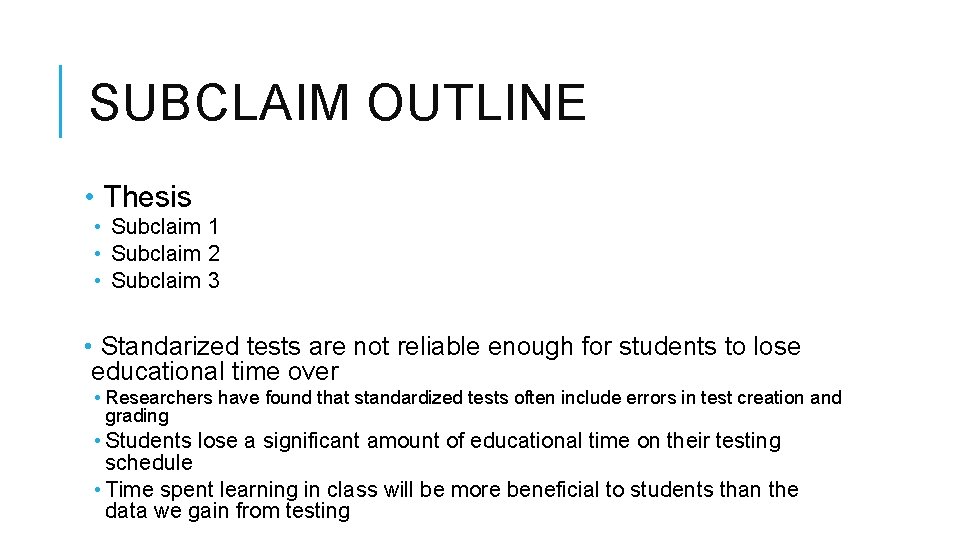
SUBCLAIM OUTLINE • Thesis • Subclaim 1 • Subclaim 2 • Subclaim 3 • Standarized tests are not reliable enough for students to lose educational time over • Researchers have found that standardized tests often include errors in test creation and grading • Students lose a significant amount of educational time on their testing schedule • Time spent learning in class will be more beneficial to students than the data we gain from testing
COUNTERCLAIM • A counterclaim is a claim that goes against your claim • You want to address the counterclaim because it shows you understand both sides of the issue • This builds ethos in your paper
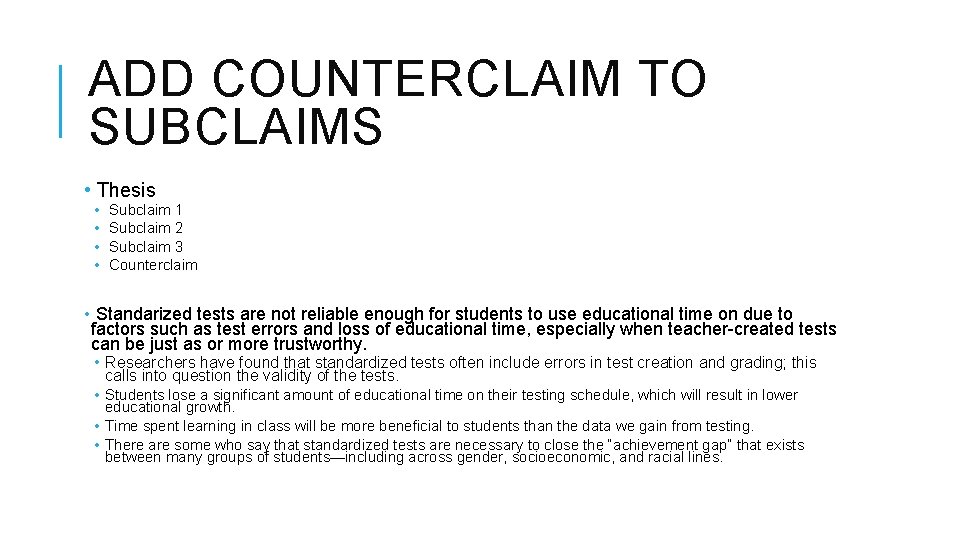
ADD COUNTERCLAIM TO SUBCLAIMS • Thesis • • Subclaim 1 Subclaim 2 Subclaim 3 Counterclaim • Standarized tests are not reliable enough for students to use educational time on due to factors such as test errors and loss of educational time, especially when teacher-created tests can be just as or more trustworthy. • Researchers have found that standardized tests often include errors in test creation and grading; this calls into question the validity of the tests. • Students lose a significant amount of educational time on their testing schedule, which will result in lower educational growth. • Time spent learning in class will be more beneficial to students than the data we gain from testing. • There are some who say that standardized tests are necessary to close the “achievement gap” that exists between many groups of students—including across gender, socioeconomic, and racial lines.
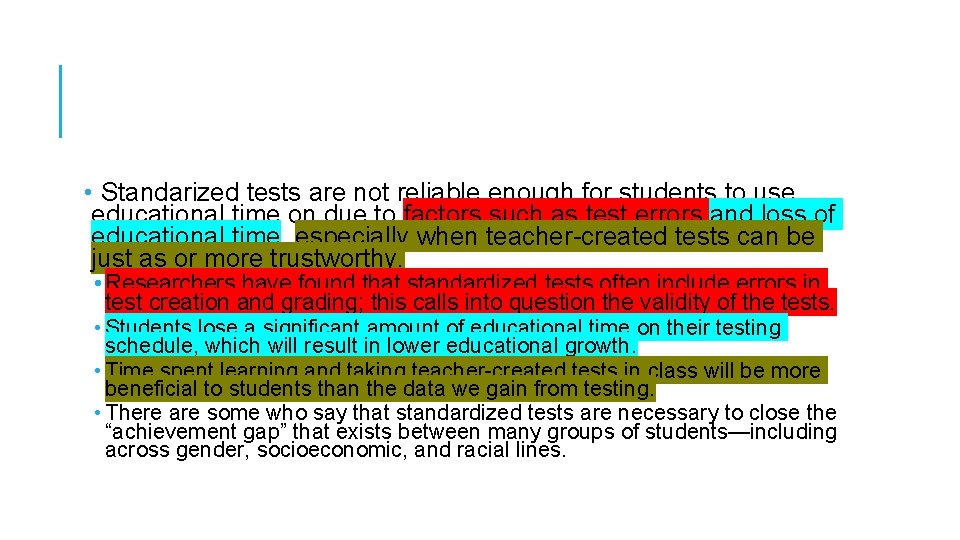
• Standarized tests are not reliable enough for students to use educational time on due to factors such as test errors and loss of educational time, especially when teacher-created tests can be just as or more trustworthy. • Researchers have found that standardized tests often include errors in test creation and grading; this calls into question the validity of the tests. • Students lose a significant amount of educational time on their testing schedule, which will result in lower educational growth. • Time spent learning and taking teacher-created tests in class will be more beneficial to students than the data we gain from testing. • There are some who say that standardized tests are necessary to close the “achievement gap” that exists between many groups of students—including across gender, socioeconomic, and racial lines.
REBUTTAL • A rebuttal is a way to address a counterclaim • There are two ways you can do this: • You can concede a point by admitting the counterclaim is correct, but then use evidence and reasoning to show why your claim is still stronger • You can refute a point by using evidence and reasoning to show the counterclaim is incorrect
EXAMPLE: BEGINNING A REBUTTAL PARAGRAPH - Claim: Standardized tests are not reliable enough to spend important educational time on. - Counterclaim with evidence: There are some who say that standardized tests are necessary to close the “achievement gap” that exists between many groups of students—including across gender, socioeconomic, and racial lines. For example, Paul Pastorek, chairman of Partnership for Assessment of Readiness for College and Career (PARCC) and the former superintendent of the Louisiana school system, says that “standardized tests are necessary for measuring student progress, especially for struggling students and schools” (Rothstein).
EXAMPLE: CONCEDE THE COUNTERCLAIM While Mr. Pastorek is absolutely correct that we need to measure the yearly progress of students and schools, the standardized tests we have now are not always a reliable measure of progress. As Charles Murray, educational researcher for Texas A&M points out, “the STAAR Test in Texas in 2016 only reliably measured standards on 68% of questions” (Gale Encyclopedia). This means that almost a third of test questions on Texas’ standardized test are unreliable. Using these unreliable tests to make decisions about our youth is irresponsible. In order to ensure reliable progress tracking, we need more reliable measurements before we start putting the data to use.
EXAMPLE: REFUTE THE COUNTERCLAIM Mr. Pastorek is incorrect that standardized testing is “necessary” because teachers can create more reliable tests themselves. As Mark Hellman, Professor of Curriculum and Instruction at UCLA, states, “teachers know exactly which standards they have taught in class, and experienced teachers create tests which reliably measure those skills” (Berryman). Since teachers know their students best, they are best equipped to create tests that will accurately measure their knowledge, and then use those results to modify instruction. The standardized tests cannot help with this because teachers don’t see the results until almost a year later.
ETHOS AND EVIDENCE • Think about the concept of ethos… as a middle school student, you likely don’t have a ton of ethos in society yet • However, there are ways to build ethos in your paper, and one is by appealing to the authority of a speaker or organization • Example: According to Paul Pastorek, senior advisor for the Partnership for Assessment of Readiness for College and Careers (PARCC) and former Louisiana state superintendent, “if we want to hold people accountable, we have to measure what they’re doing. ”
SELECTING EVIDENCE • Read your subclaim very carefully and make sure you understand exactly what it’s saying • Go to your annotated bibliography and see if you can find evidence that supports your subclaim • If the evidence isn’t directly listed, go to the article that best supports your subclaim and find good pieces of text evidence within the article • If you cannot locate evidence in your articles, you will need to find a new article (you have to do the CRAAP test but you don’t have to turn in an “Arugmentative Article Questions” form)
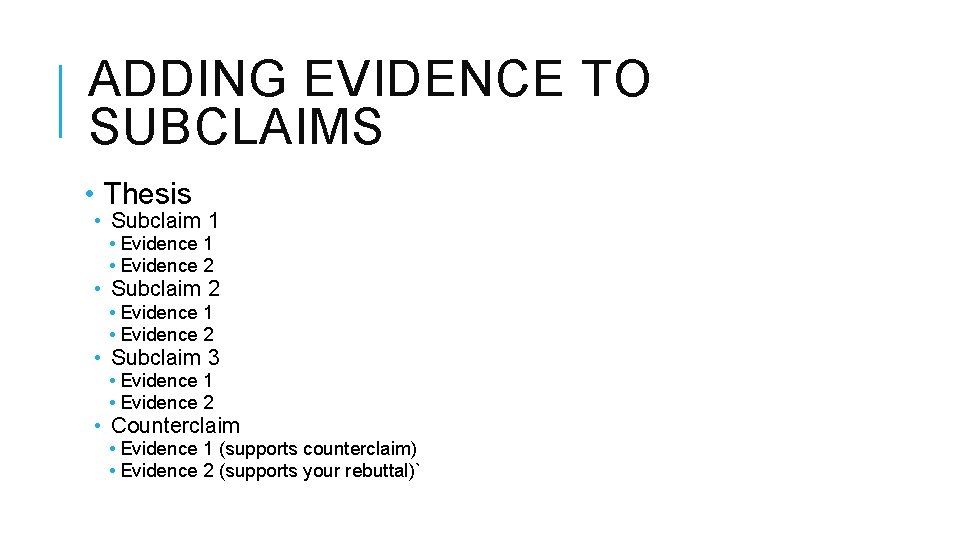
ADDING EVIDENCE TO SUBCLAIMS • Thesis • Subclaim 1 • Evidence 2 • Subclaim 2 • Evidence 1 • Evidence 2 • Subclaim 3 • Evidence 1 • Evidence 2 • Counterclaim • Evidence 1 (supports counterclaim) • Evidence 2 (supports your rebuttal)`
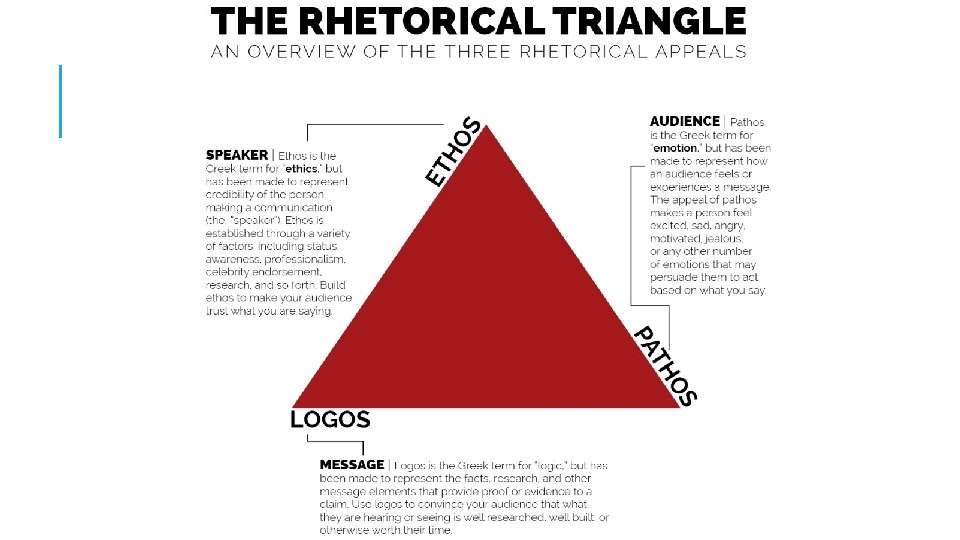
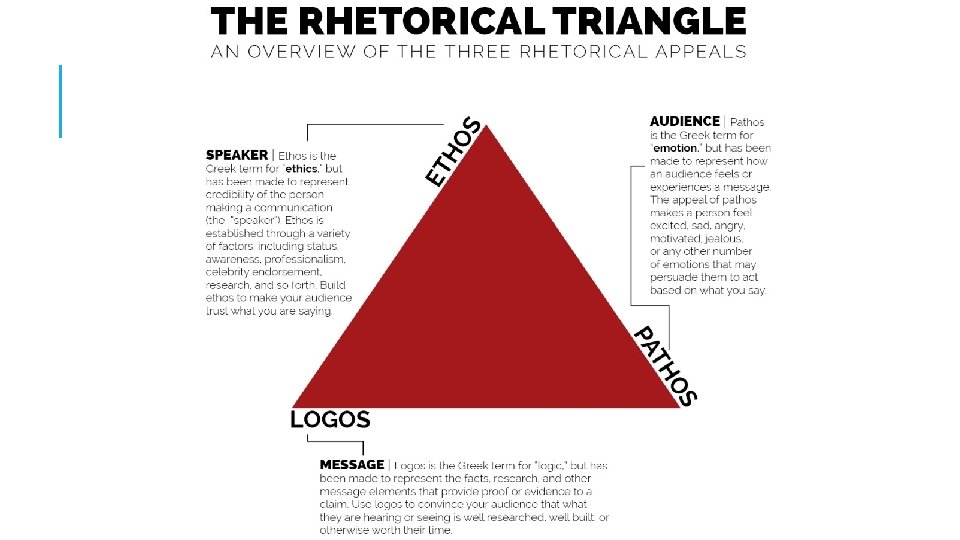
RHETORICAL APPEALS: ETHOS • You establish ethos through appealing to the authority of your information sources and the people/organizations you’re citing • You can establish ethos by showing you understand the topic thoroughly, including arguments you disagree with • You can also establish ethos by writing with good structure and flow, by writing with proper spelling, grammar, punctuation, by citing evidence properly, by having a proper bibliography, etc. • If you have personal experience on the topic, you can also establish some level of ethos by speaking about that
RHETORICAL APPEALS: LOGOS • You establish logos through logic and reasoning • Using facts and evidence to come to logical conclusions • Selecting evidence that clearly supports thesis and subclaims • Explaining clearly how the facts and evidence supports the subclaim in a logical way
RHETORICAL APPEALS: PATHOS • You establish pathos through appealing to human emotions and values: • Stories or examples that have a human aspect to them • Writing with a personal voice • Tapping into the audience’s sense of empathy or justice • The audience should feel something important
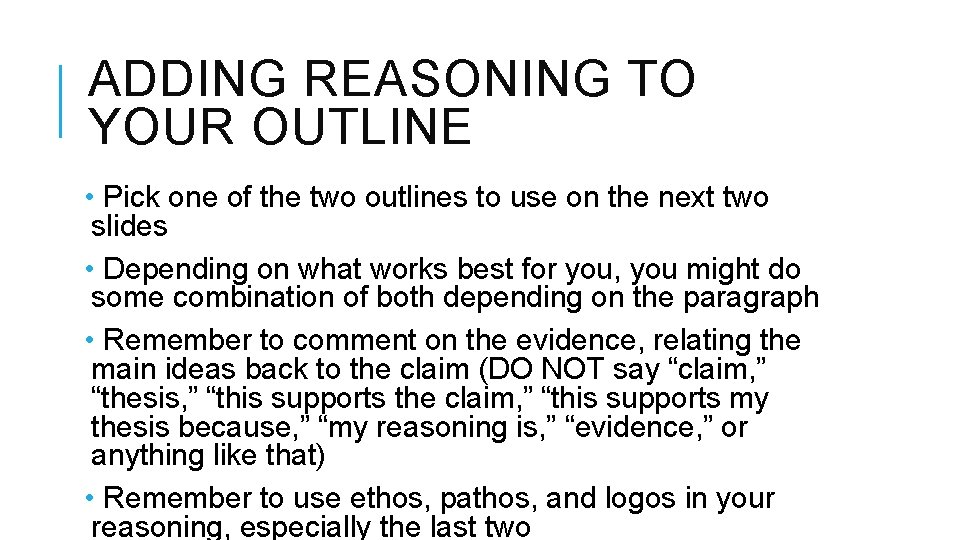
ADDING REASONING TO YOUR OUTLINE • Pick one of the two outlines to use on the next two slides • Depending on what works best for you, you might do some combination of both depending on the paragraph • Remember to comment on the evidence, relating the main ideas back to the claim (DO NOT say “claim, ” “thesis, ” “this supports the claim, ” “this supports my thesis because, ” “my reasoning is, ” “evidence, ” or anything like that) • Remember to use ethos, pathos, and logos in your reasoning, especially the last two
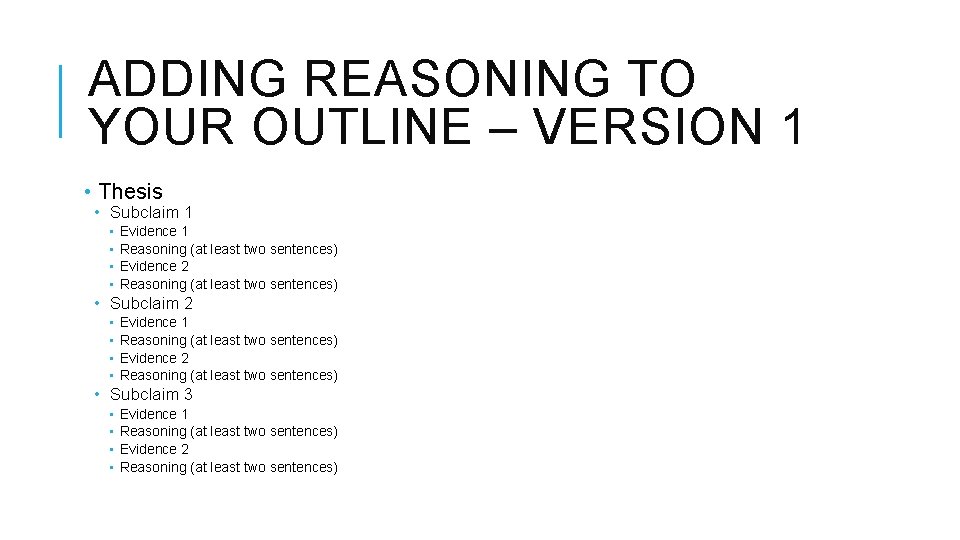
ADDING REASONING TO YOUR OUTLINE – VERSION 1 • Thesis • Subclaim 1 • • Evidence 1 Reasoning (at least two sentences) Evidence 2 Reasoning (at least two sentences) • Subclaim 2 • • Evidence 1 Reasoning (at least two sentences) Evidence 2 Reasoning (at least two sentences) • Subclaim 3 • • Evidence 1 Reasoning (at least two sentences) Evidence 2 Reasoning (at least two sentences)
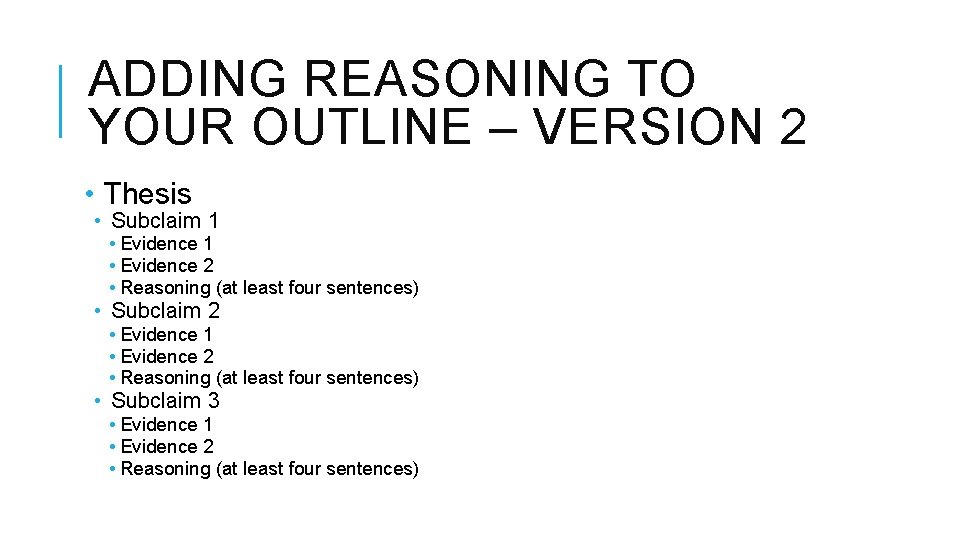
ADDING REASONING TO YOUR OUTLINE – VERSION 2 • Thesis • Subclaim 1 • Evidence 2 • Reasoning (at least four sentences) • Subclaim 2 • Evidence 1 • Evidence 2 • Reasoning (at least four sentences) • Subclaim 3 • Evidence 1 • Evidence 2 • Reasoning (at least four sentences)
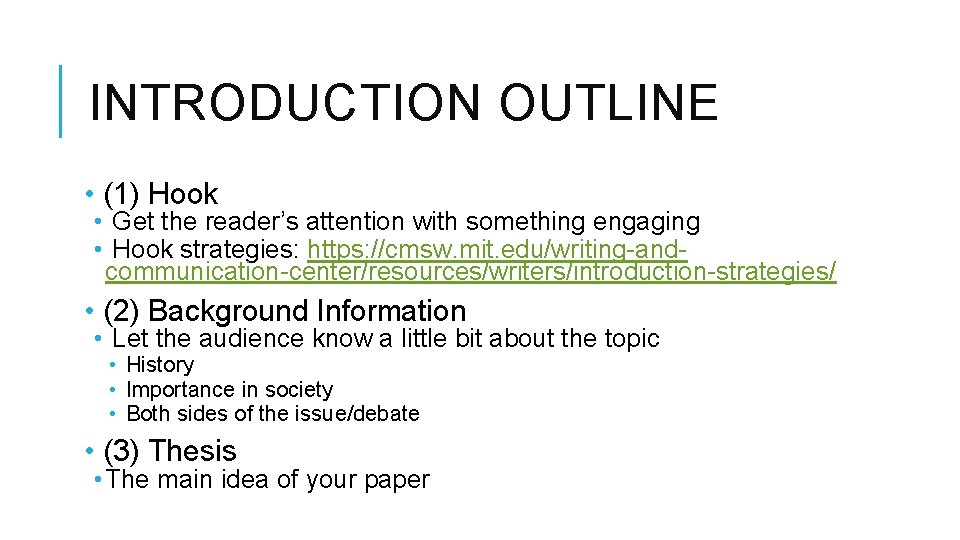
INTRODUCTION OUTLINE • (1) Hook • Get the reader’s attention with something engaging • Hook strategies: https: //cmsw. mit. edu/writing-andcommunication-center/resources/writers/introduction-strategies/ • (2) Background Information • Let the audience know a little bit about the topic • History • Importance in society • Both sides of the issue/debate • (3) Thesis • The main idea of your paper
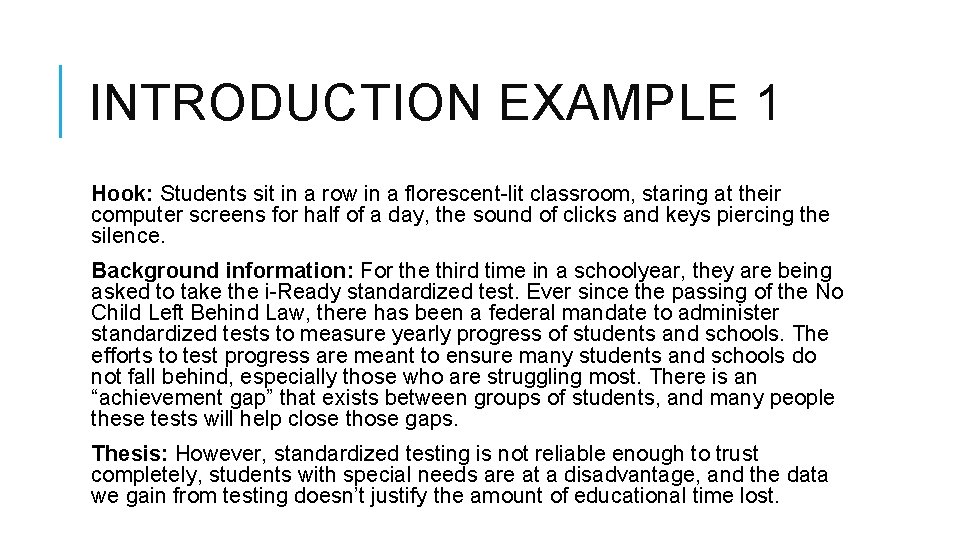
INTRODUCTION EXAMPLE 1 Hook: Students sit in a row in a florescent-lit classroom, staring at their computer screens for half of a day, the sound of clicks and keys piercing the silence. Background information: For the third time in a schoolyear, they are being asked to take the i-Ready standardized test. Ever since the passing of the No Child Left Behind Law, there has been a federal mandate to administer standardized tests to measure yearly progress of students and schools. The efforts to test progress are meant to ensure many students and schools do not fall behind, especially those who are struggling most. There is an “achievement gap” that exists between groups of students, and many people these tests will help close those gaps. Thesis: However, standardized testing is not reliable enough to trust completely, students with special needs are at a disadvantage, and the data we gain from testing doesn’t justify the amount of educational time lost.
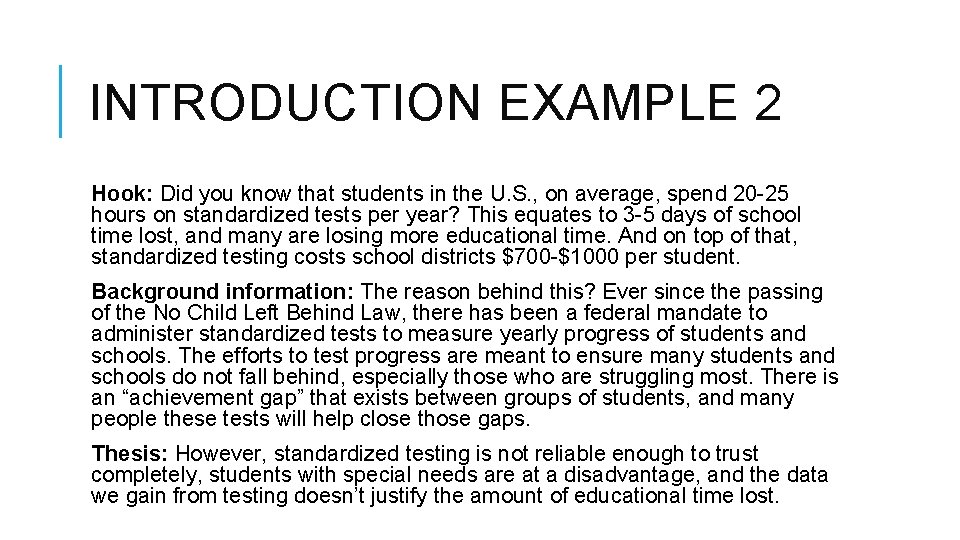
INTRODUCTION EXAMPLE 2 Hook: Did you know that students in the U. S. , on average, spend 20 -25 hours on standardized tests per year? This equates to 3 -5 days of school time lost, and many are losing more educational time. And on top of that, standardized testing costs school districts $700 -$1000 per student. Background information: The reason behind this? Ever since the passing of the No Child Left Behind Law, there has been a federal mandate to administer standardized tests to measure yearly progress of students and schools. The efforts to test progress are meant to ensure many students and schools do not fall behind, especially those who are struggling most. There is an “achievement gap” that exists between groups of students, and many people these tests will help close those gaps. Thesis: However, standardized testing is not reliable enough to trust completely, students with special needs are at a disadvantage, and the data we gain from testing doesn’t justify the amount of educational time lost.
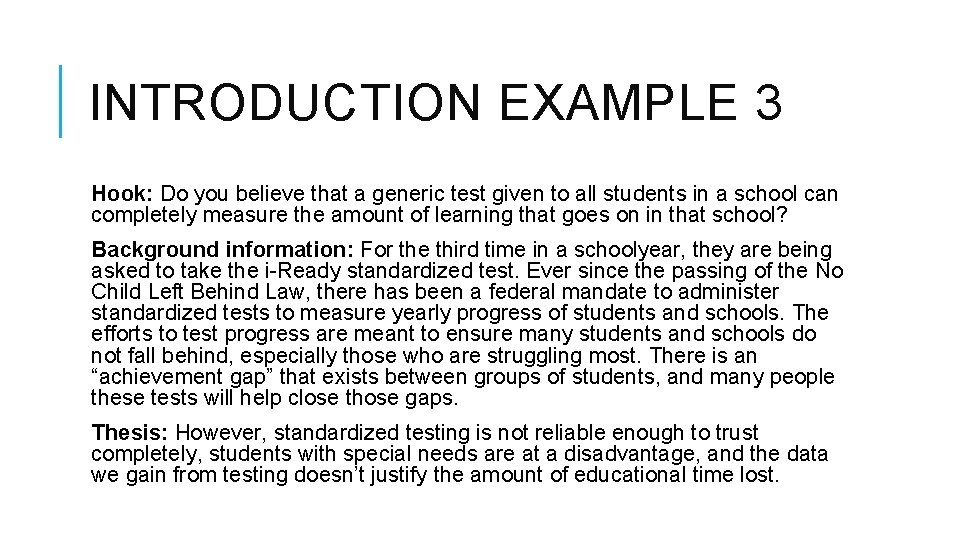
INTRODUCTION EXAMPLE 3 Hook: Do you believe that a generic test given to all students in a school can completely measure the amount of learning that goes on in that school? Background information: For the third time in a schoolyear, they are being asked to take the i-Ready standardized test. Ever since the passing of the No Child Left Behind Law, there has been a federal mandate to administer standardized tests to measure yearly progress of students and schools. The efforts to test progress are meant to ensure many students and schools do not fall behind, especially those who are struggling most. There is an “achievement gap” that exists between groups of students, and many people these tests will help close those gaps. Thesis: However, standardized testing is not reliable enough to trust completely, students with special needs are at a disadvantage, and the data we gain from testing doesn’t justify the amount of educational time lost.
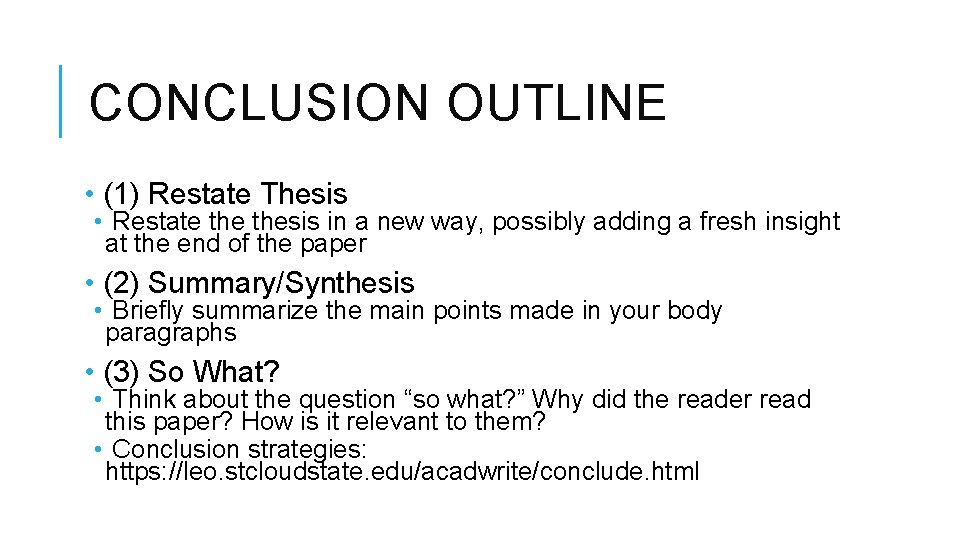
CONCLUSION OUTLINE • (1) Restate Thesis • Restate thesis in a new way, possibly adding a fresh insight at the end of the paper • (2) Summary/Synthesis • Briefly summarize the main points made in your body paragraphs • (3) So What? • Think about the question “so what? ” Why did the reader read this paper? How is it relevant to them? • Conclusion strategies: https: //leo. stcloudstate. edu/acadwrite/conclude. html
CONCLUSION EXAMPLE Restate Thesis: Not only are standardized tests unreliable and waste important educational time, they do not give teachers any timely feedback about their students’ progress and may harm students with special needs. Summary/Synthesis: These tests have found to be unreliable in many states including Texas, Missouri, Florida, New York. Educational researchers have found these tests to be of little benefit to closing the achievement gap, and may harm lowincome students most because they lose more testing time than other students. So What? : Many parents, due to the unreliability and unfair nature of the tests, are beginning to wonder if they should “opt-out” of testing, essentially giving their child permission to not take the test. If your child is in a state with an unreliable test, if your child has special needs, or if your child is in a lower-performing school, you should consider looking into the movement, or at least contacting your local representatives about your thoughts and feelings about testing. Parents and students, if they make their voices heard, can make a positive impact on the state of standardized testing.