
Creating a Therapeutic Milieu in an Acute Psychiatric

- Slides: 24
Creating a Therapeutic Milieu in an Acute Psychiatric Setting Presented by: Dr Laura Dannahy
“The creation of the atmosphere of a therapeutic (milieu) is in itself, one of the most important types of treatment which the hospital can provide” World Health Organisation (1953)
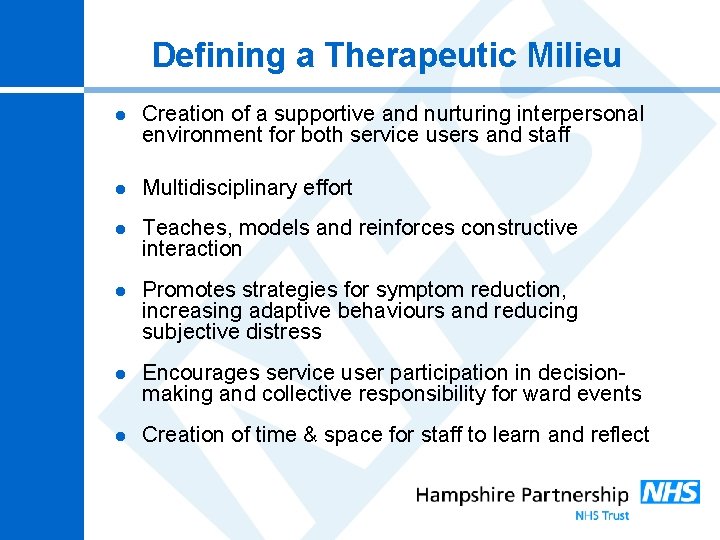
Defining a Therapeutic Milieu l Creation of a supportive and nurturing interpersonal environment for both service users and staff l Multidisciplinary effort l Teaches, models and reinforces constructive interaction l Promotes strategies for symptom reduction, increasing adaptive behaviours and reducing subjective distress l Encourages service user participation in decisionmaking and collective responsibility for ward events l Creation of time & space for staff to learn and reflect
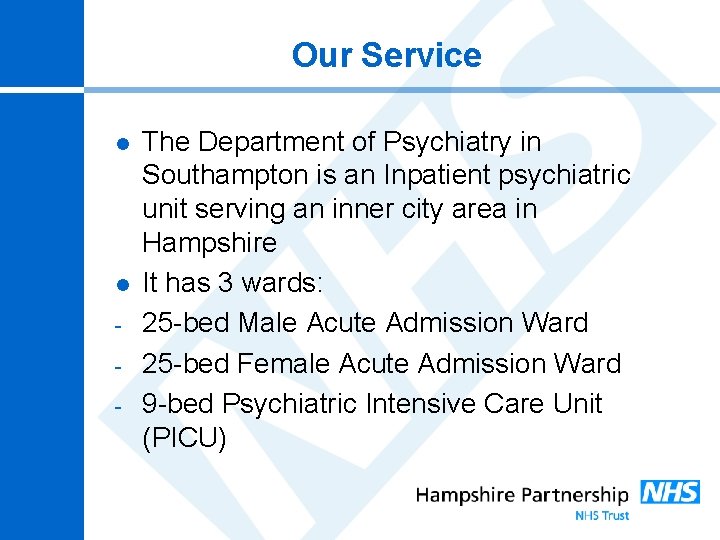
Our Service l l - The Department of Psychiatry in Southampton is an Inpatient psychiatric unit serving an inner city area in Hampshire It has 3 wards: 25 -bed Male Acute Admission Ward 25 -bed Female Acute Admission Ward 9 -bed Psychiatric Intensive Care Unit (PICU)
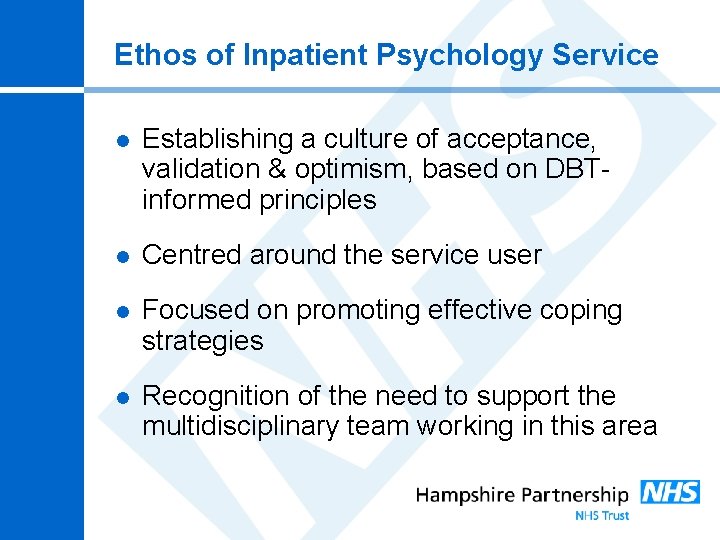
Ethos of Inpatient Psychology Service l Establishing a culture of acceptance, validation & optimism, based on DBTinformed principles l Centred around the service user l Focused on promoting effective coping strategies l Recognition of the need to support the multidisciplinary team working in this area
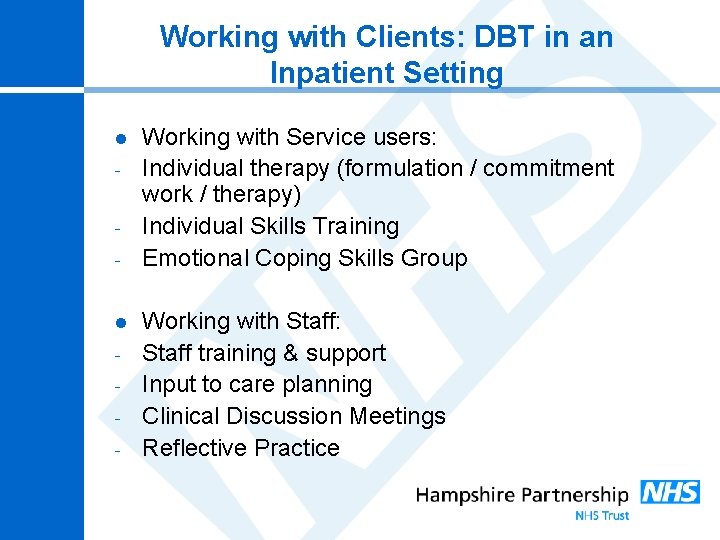
Working with Clients: DBT in an Inpatient Setting l - Working with Service users: Individual therapy (formulation / commitment work / therapy) Individual Skills Training Emotional Coping Skills Group Working with Staff: Staff training & support Input to care planning Clinical Discussion Meetings Reflective Practice
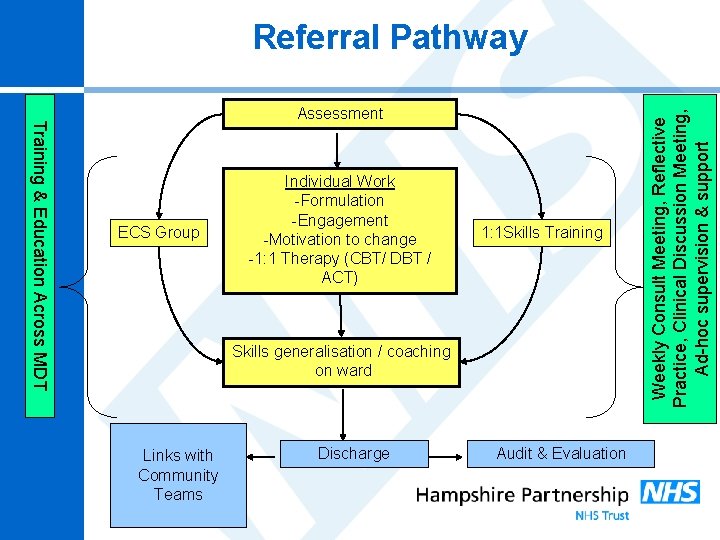
Training & Education Across MDT Assessment ECS Group Individual Work -Formulation -Engagement -Motivation to change -1: 1 Therapy (CBT/ DBT / ACT) 1: 1 Skills Training Skills generalisation / coaching on ward Links with Community Teams Discharge Audit & Evaluation Weekly Consult Meeting, Reflective Practice, Clinical Discussion Meeting, Ad-hoc supervision & support Referral Pathway
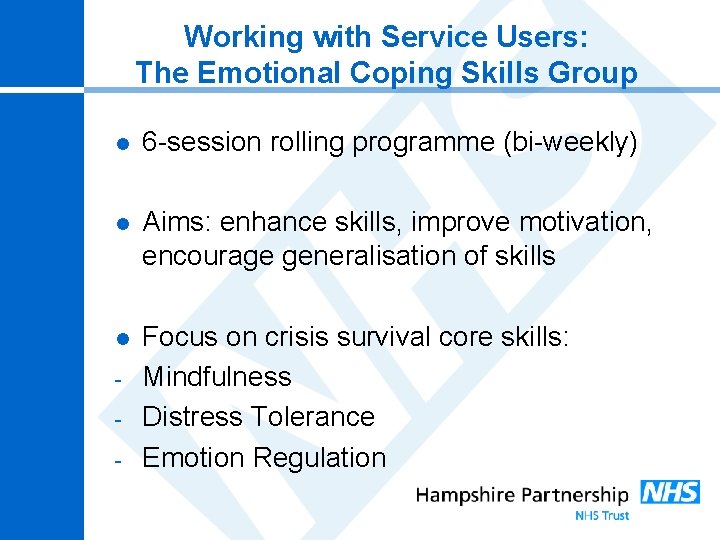
Working with Service Users: The Emotional Coping Skills Group l 6 -session rolling programme (bi-weekly) l Aims: enhance skills, improve motivation, encourage generalisation of skills l Focus on crisis survival core skills: Mindfulness Distress Tolerance Emotion Regulation -
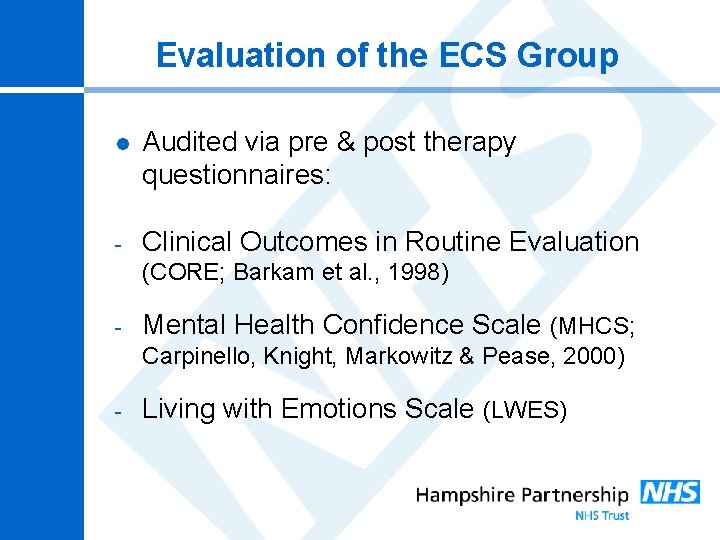
Evaluation of the ECS Group l Audited via pre & post therapy questionnaires: - Clinical Outcomes in Routine Evaluation (CORE; Barkam et al. , 1998) - Mental Health Confidence Scale (MHCS; Carpinello, Knight, Markowitz & Pease, 2000) - Living with Emotions Scale (LWES)
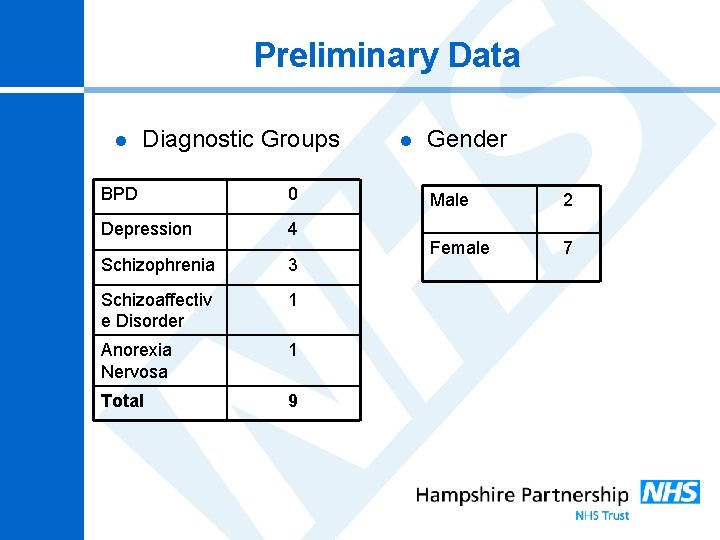
Preliminary Data l Diagnostic Groups BPD 0 Depression 4 Schizophrenia 3 Schizoaffectiv e Disorder 1 Anorexia Nervosa 1 Total 9 l Gender Male 2 Female 7
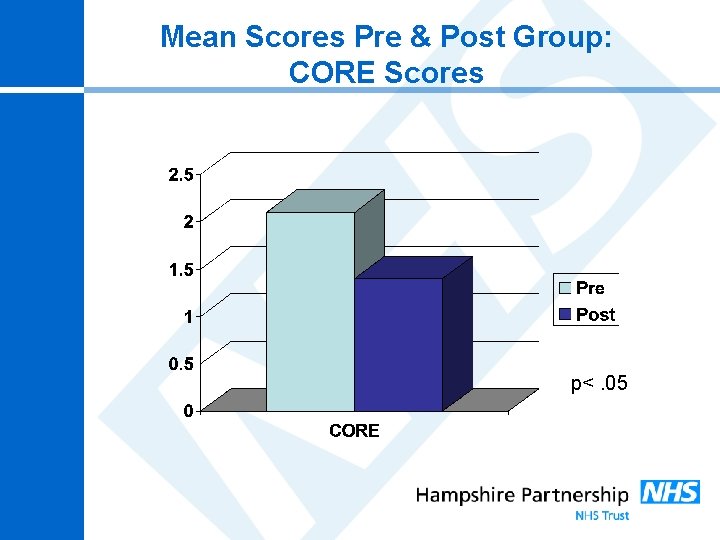
Mean Scores Pre & Post Group: CORE Scores p<. 05
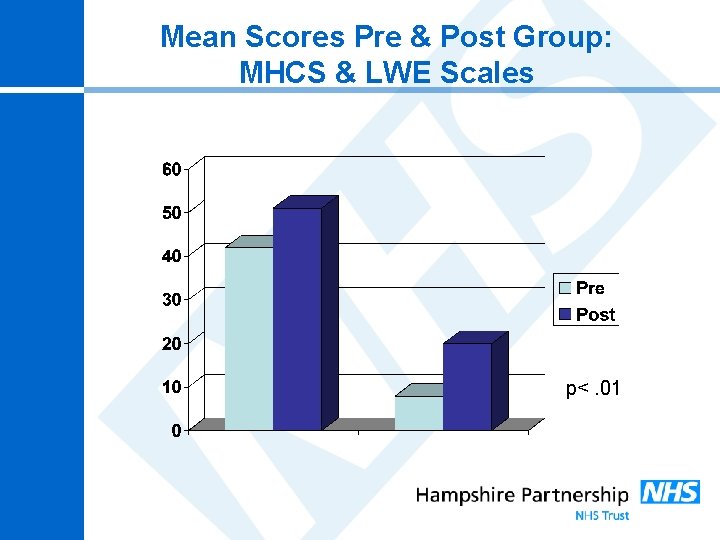
Mean Scores Pre & Post Group: MHCS & LWE Scales p<. 01
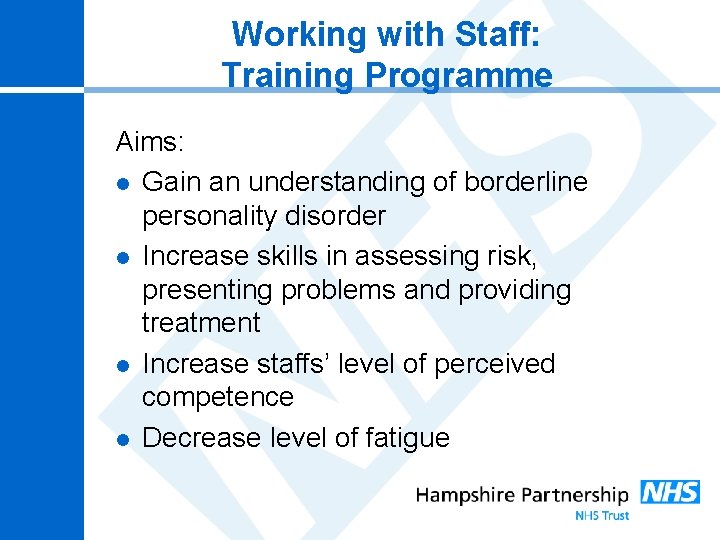
Working with Staff: Training Programme Aims: l Gain an understanding of borderline personality disorder l Increase skills in assessing risk, presenting problems and providing treatment l Increase staffs’ level of perceived competence l Decrease level of fatigue
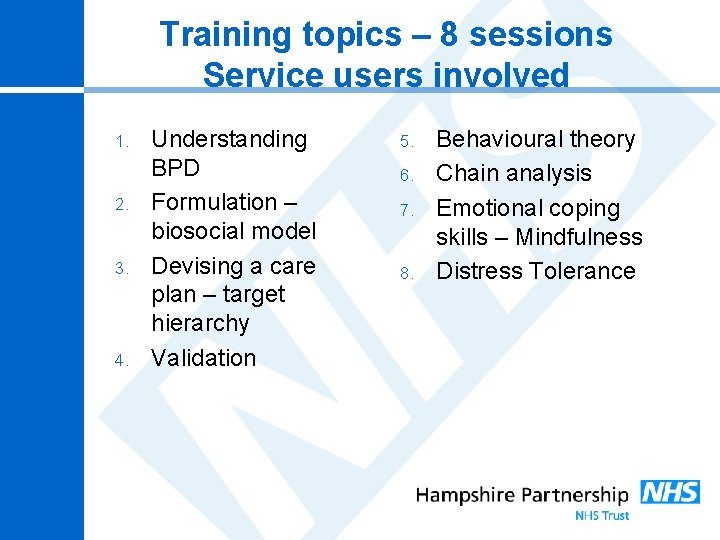
Training topics – 8 sessions Service users involved 1. 2. 3. 4. Understanding BPD Formulation – biosocial model Devising a care plan – target hierarchy Validation 5. 6. 7. 8. Behavioural theory Chain analysis Emotional coping skills – Mindfulness Distress Tolerance
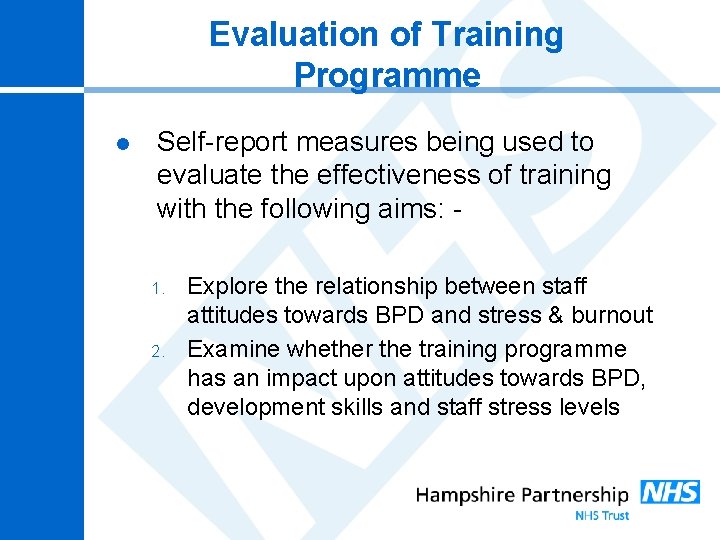
Evaluation of Training Programme l Self-report measures being used to evaluate the effectiveness of training with the following aims: 1. 2. Explore the relationship between staff attitudes towards BPD and stress & burnout Examine whether the training programme has an impact upon attitudes towards BPD, development skills and staff stress levels
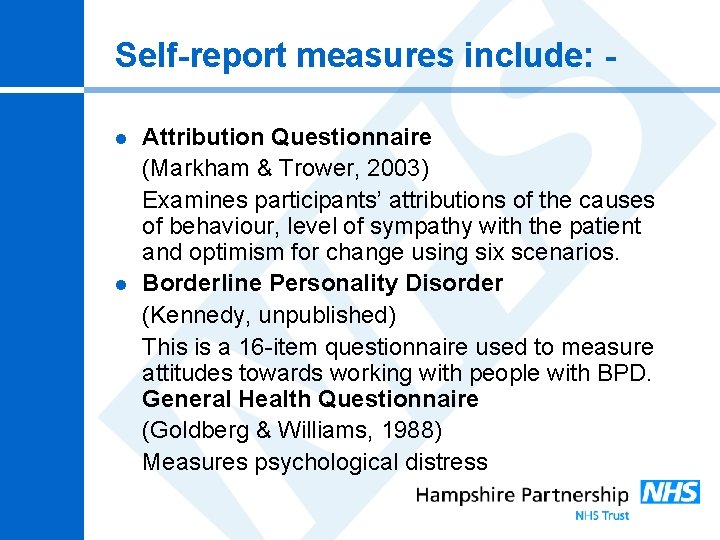
Self-report measures include: l l Attribution Questionnaire (Markham & Trower, 2003) Examines participants’ attributions of the causes of behaviour, level of sympathy with the patient and optimism for change using six scenarios. Borderline Personality Disorder (Kennedy, unpublished) This is a 16 -item questionnaire used to measure attitudes towards working with people with BPD. General Health Questionnaire (Goldberg & Williams, 1988) Measures psychological distress
Self-report measures cont. l The Mental Health Professionals Stress Scale (Cushway, Tyler & Nolan, 1996) This is a 42 item measure grouped into seven subscales of sources of stress at work: workload; client related difficulties; organisational structure and processes; relationships and conflicts with other professionals; lack of resources; professional self-doubt and home/work conflict
Results l Preliminary results available in November 2007
Working with Staff: Reflective Practice involves: “ the critical analysis of everyday working practices to improve competence, promote professional development, develop practice-generated theory, and help professionals make sense of complex and ambiguous practice situations” Cowdrill & Dannahy, 2007
Topics For Reflection l One hour weekly sessions for all staff l Direct Clinical Practice: working with Clients l Functional Aspects of work l Self-Reflection
Challenges & Solutions l l l Support from hospital management (e. g. Modern Matron) Support from ward managers: to ensure involvement of staff members Terms of Reference, describing aims, requirements & expectations. Promoted & viewed as integral part of working life of the ward Timing of sessions negotiated: handover periods
Ongoing Challenge l l Cognitive Behaviour Therapy has a great deal to offer in-patient services It provides theoretical background, pragmatic clinical tools and philosophy for developing therapeutic milieu Need to be creative and adaptive for the ever changing environment of the psychiatric hospital Involve service users in order to provide a high quality mental health service that meets individual needs.
Contact details and references l Dr Laura Dannahy Laura. dannahy@hantspt-sw. nhs. uk l Dr Vivia Cowdrill viv. cowdrill@hantspt-sw. nhs. uk Forthcoming book chapter Reflective Practice, by Vivia Cowdrill& Laura Dannahy in Cognitive Behaviour Therapy for Acute Inpatient Mental Health Units: working with clients, staff and the milieu. Edited by Isabel Clarke & Hannah Wilson. Routledge
References cont. l l Bohus, M. , Haff, B. , Simms, T. , Limberger, Schmakl, C. , Unckel, C. , et al (2004) Effectiveness of inpatient dialectical behavioral therapy for borderline personality disorder: a controlled trial Behaviour Research and Therapy 42, 467 -499. Swenson, C. R. , Sanderson, C. , Dulit, R. A. , & Linehan, M. M. (2001) The application of dialectical behavior therapy for patients with borderline personality disorder on inpatient units Psychiatric Quarterly, 72, 307 -324