
Creating a System to Test Single Photon Avalanche
- Slides: 1
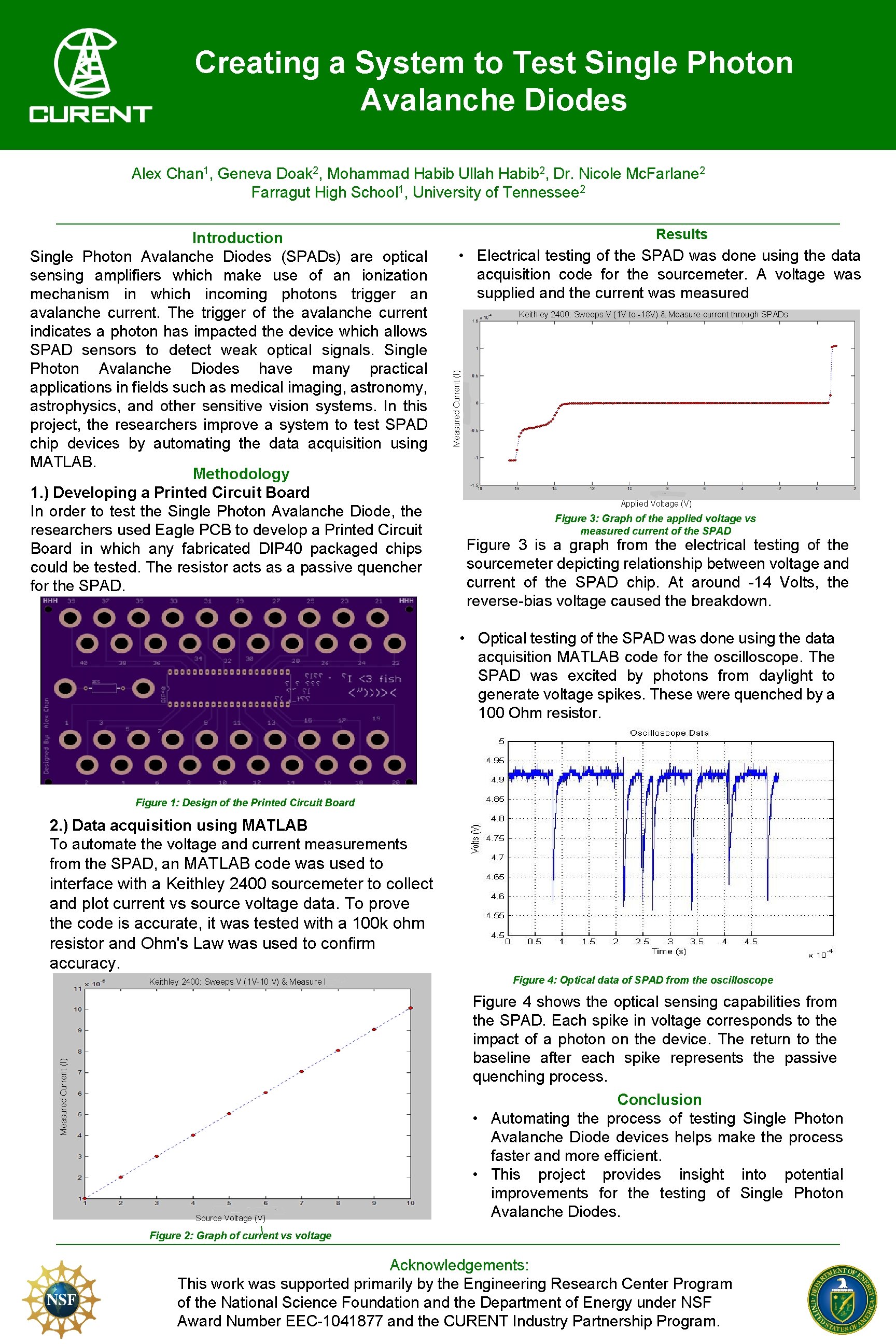
Creating a System to Test Single Photon Avalanche Diodes Alex Chan 1, Geneva Doak 2, Mohammad Habib Ullah Habib 2, Dr. Nicole Mc. Farlane 2 Farragut High School 1, University of Tennessee 2 Results • Electrical testing of the SPAD was done using the data acquisition code for the sourcemeter. A voltage was supplied and the current was measured Keithley 2400: Sweeps V (1 V to -18 V) & Measure current through SPADs Measured Current (I) Introduction Single Photon Avalanche Diodes (SPADs) are optical sensing amplifiers which make use of an ionization mechanism in which incoming photons trigger an avalanche current. The trigger of the avalanche current indicates a photon has impacted the device which allows SPAD sensors to detect weak optical signals. Single Photon Avalanche Diodes have many practical applications in fields such as medical imaging, astronomy, astrophysics, and other sensitive vision systems. In this project, the researchers improve a system to test SPAD chip devices by automating the data acquisition using MATLAB. Methodology 1. ) Developing a Printed Circuit Board In order to test the Single Photon Avalanche Diode, the researchers used Eagle PCB to develop a Printed Circuit Board in which any fabricated DIP 40 packaged chips could be tested. The resistor acts as a passive quencher for the SPAD. Applied Voltage (V) Figure 3: Graph of the applied voltage vs measured current of the SPAD Figure 3 is a graph from the electrical testing of the sourcemeter depicting relationship between voltage and current of the SPAD chip. At around -14 Volts, the reverse-bias voltage caused the breakdown. • Optical testing of the SPAD was done using the data acquisition MATLAB code for the oscilloscope. The SPAD was excited by photons from daylight to generate voltage spikes. These were quenched by a 100 Ohm resistor. Figure 1: Design of the Printed Circuit Board 2. ) Data acquisition using MATLAB To automate the voltage and current measurements from the SPAD, an MATLAB code was used to interface with a Keithley 2400 sourcemeter to collect and plot current vs source voltage data. To prove the code is accurate, it was tested with a 100 k ohm resistor and Ohm's Law was used to confirm accuracy. Keithley 2400: Sweeps V (1 V-10 V) & Measure I Figure 4: Optical data of SPAD from the oscilloscope Measured Current (I) Figure 4 shows the optical sensing capabilities from the SPAD. Each spike in voltage corresponds to the impact of a photon on the device. The return to the baseline after each spike represents the passive quenching process. Source Voltage (V) Conclusion • Automating the process of testing Single Photon Avalanche Diode devices helps make the process faster and more efficient. • This project provides insight into potential improvements for the testing of Single Photon Avalanche Diodes. Figure 2: Graph of current vs voltage Acknowledgements: This work was supported primarily by the Engineering Research Center Program of the National Science Foundation and the Department of Energy under NSF Award Number EEC-1041877 and the CURENT Industry Partnership Program.