
Creating a system of support designed around children
- Slides: 5
Creating a system of support designed around children and families’ needs APPG FOR STRENGTHENING COUPLE RELATIONSHIPS AND REDUCING PARENTAL CONFLICT Teresa Williams, Director of Strategy at Cafcass
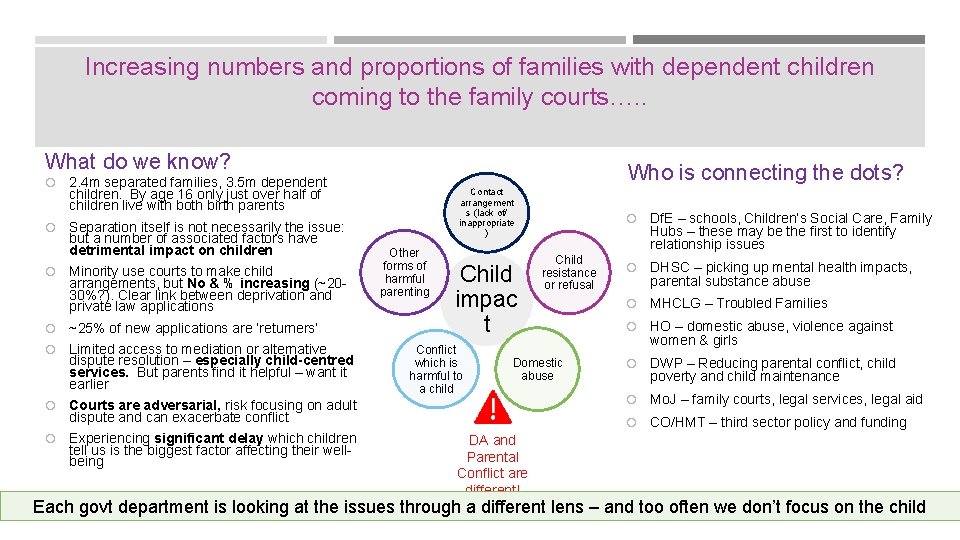
Increasing numbers and proportions of families with dependent children coming to the family courts…. . What do we know? Who is connecting the dots? 2. 4 m separated families, 3. 5 m dependent children. By age 16 only just over half of children live with both birth parents Separation itself is not necessarily the issue: but a number of associated factors have detrimental impact on children Minority use courts to make child arrangements, but No & % increasing (~2030%? ). Clear link between deprivation and private law applications ~25% of new applications are ‘returners’ Limited access to mediation or alternative dispute resolution – especially child-centred services. But parents find it helpful – want it earlier Contact arrangement s (lack of/ inappropriate ) Other forms of harmful parenting Child impac t Conflict which is harmful to a child Child resistance or refusal Domestic abuse Courts are adversarial, risk focusing on adult dispute and can exacerbate conflict Experiencing significant delay which children tell us is the biggest factor affecting their wellbeing Df. E – schools, Children’s Social Care, Family Hubs – these may be the first to identify relationship issues DHSC – picking up mental health impacts, parental substance abuse MHCLG – Troubled Families HO – domestic abuse, violence against women & girls DWP – Reducing parental conflict, child poverty and child maintenance Mo. J – family courts, legal services, legal aid CO/HMT – third sector policy and funding DA and Parental Conflict are different! Each govt department is looking at the issues through a different lens – and too often we don’t focus on the child
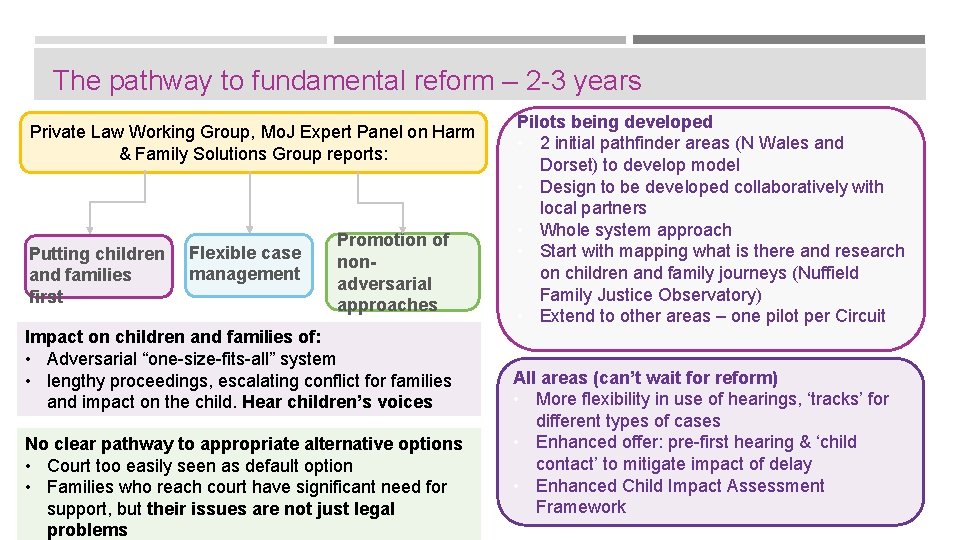
The pathway to fundamental reform – 2 -3 years Private Law Working Group, Mo. J Expert Panel on Harm & Family Solutions Group reports: Putting children and families first Flexible case management Promotion of nonadversarial approaches Impact on children and families of: • Adversarial “one-size-fits-all” system • lengthy proceedings, escalating conflict for families and impact on the child. Hear children’s voices No clear pathway to appropriate alternative options • Court too easily seen as default option • Families who reach court have significant need for support, but their issues are not just legal problems Pilots being developed • 2 initial pathfinder areas (N Wales and Dorset) to develop model • Design to be developed collaboratively with local partners • Whole system approach • Start with mapping what is there and research on children and family journeys (Nuffield Family Justice Observatory) • Extend to other areas – one pilot per Circuit All areas (can’t wait for reform) • More flexibility in use of hearings, ‘tracks’ for different types of cases • Enhanced offer: pre-first hearing & ‘child contact’ to mitigate impact of delay • Enhanced Child Impact Assessment Framework
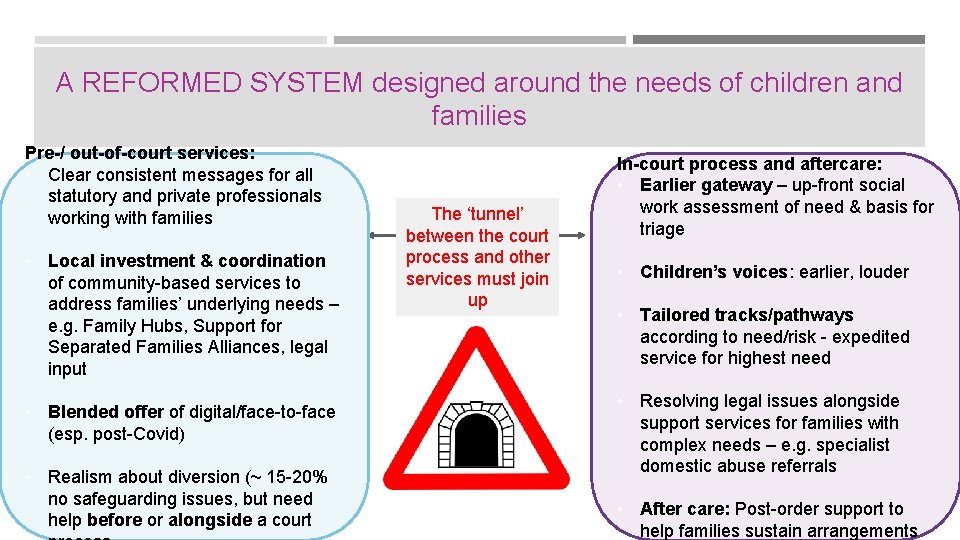
A REFORMED SYSTEM designed around the needs of children and families Pre-/ out-of-court services: • Clear consistent messages for all statutory and private professionals working with families • Local investment & coordination of community-based services to address families’ underlying needs – e. g. Family Hubs, Support for Separated Families Alliances, legal input • Blended offer of digital/face-to-face (esp. post-Covid) • Realism about diversion (~ 15 -20% no safeguarding issues, but need help before or alongside a court The ‘tunnel’ between the court process and other services must join up In-court process and aftercare: • Earlier gateway – up-front social work assessment of need & basis for triage • Children’s voices: earlier, louder • Tailored tracks/pathways according to need/risk - expedited service for highest need • Resolving legal issues alongside support services for families with complex needs – e. g. specialist domestic abuse referrals • After care: Post-order support to help families sustain arrangements
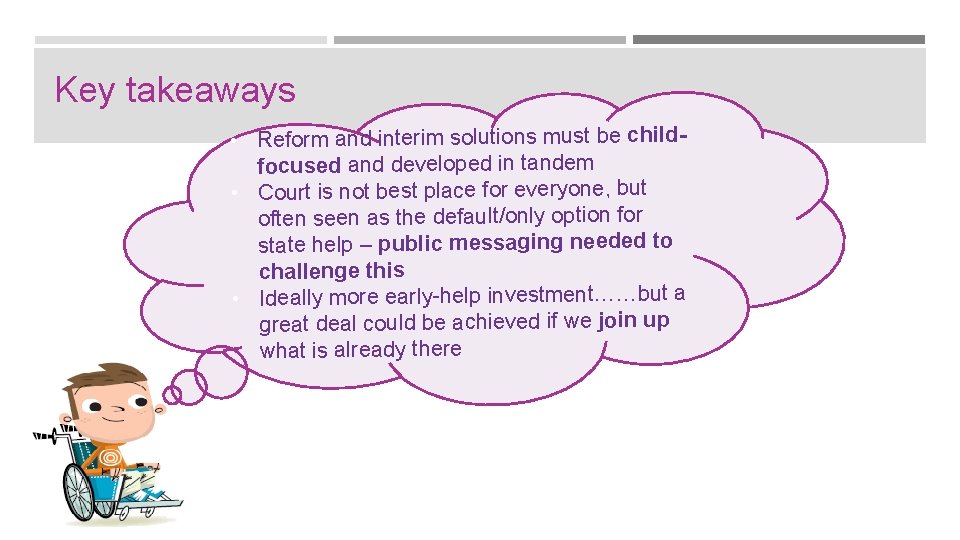
Key takeaways • Reform and interim solutions must be childfocused and developed in tandem • Court is not best place for everyone, but often seen as the default/only option for state help – public messaging needed to challenge this • Ideally more early-help investment……but a great deal could be achieved if we join up what is already there