
Creating a Solid Financial Plan Chapter 7 Solid


- Slides: 36
Creating a Solid Financial Plan Chapter 7 Solid Financial Plan Copyright © 2009 Pearson Education, Inc. Publishing as Prentice Hall 1
Financial Planning n Research: Ø Significant numbers of entrepreneurs run their companies without any kind of financial plan! Ø A significant positive relationship exists between formal planning in small companies and their financial performances Chapter 7 Solid Financial Plan Copyright © 2009 Pearson Education, Inc. Publishing as Prentice Hall 2
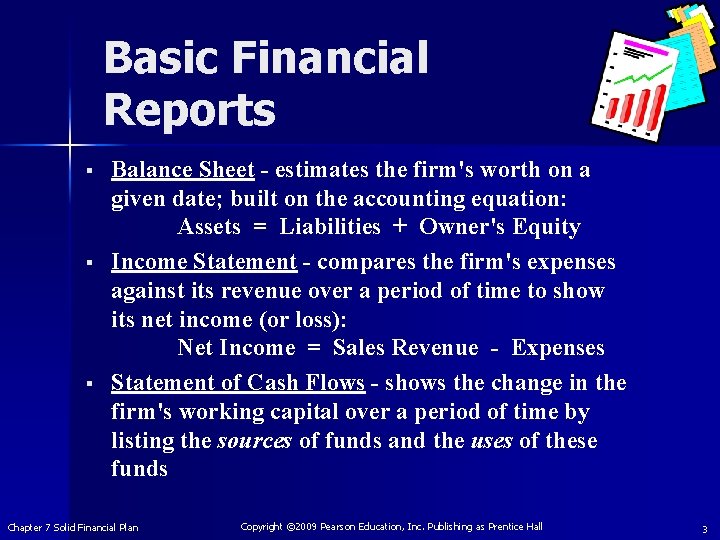
Basic Financial Reports § § § Balance Sheet - estimates the firm's worth on a given date; built on the accounting equation: Assets = Liabilities + Owner's Equity Income Statement - compares the firm's expenses against its revenue over a period of time to show its net income (or loss): Net Income = Sales Revenue - Expenses Statement of Cash Flows - shows the change in the firm's working capital over a period of time by listing the sources of funds and the uses of these funds Chapter 7 Solid Financial Plan Copyright © 2009 Pearson Education, Inc. Publishing as Prentice Hall 3
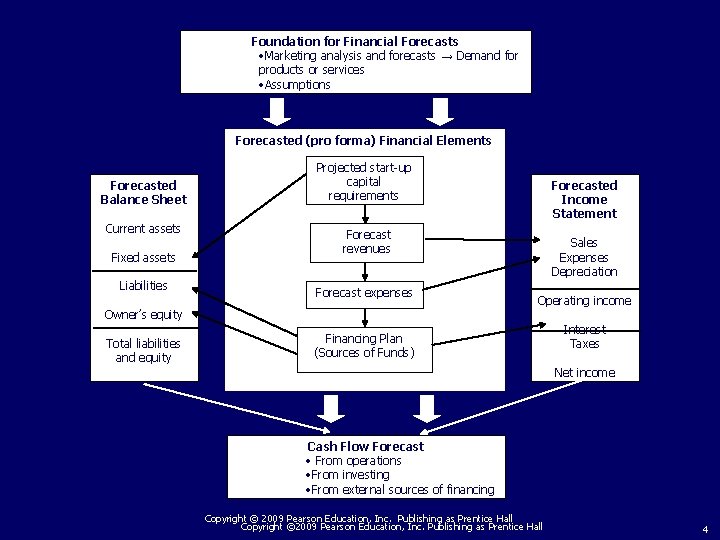
Foundation for Financial Forecasts • Marketing analysis and forecasts → Demand for products or services • Assumptions Forecasted (pro forma) Financial Elements Forecasted Balance Sheet Current assets Fixed assets Liabilities Projected start-up capital requirements Forecast revenues Forecast expenses Owner’s equity Total liabilities and equity Forecasted Income Statement Sales Expenses Depreciation Operating income Financing Plan (Sources of Funds) Interest Taxes Net income Cash Flow Forecast • From operations • From investing • From external sources of financing Copyright © 2009 Pearson Education, Inc. Publishing as Prentice Hall 4
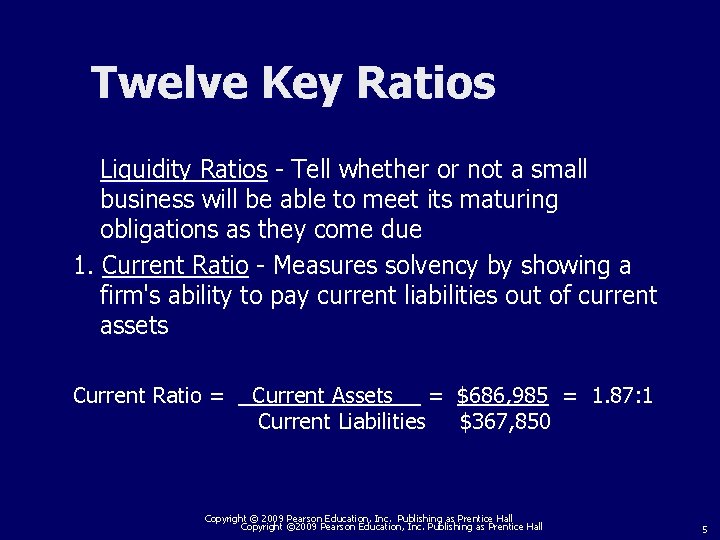
Twelve Key Ratios Liquidity Ratios - Tell whether or not a small business will be able to meet its maturing obligations as they come due 1. Current Ratio - Measures solvency by showing a firm's ability to pay current liabilities out of current assets Current Ratio = Current Assets = $686, 985 = 1. 87: 1 Current Liabilities $367, 850 Copyright © 2009 Pearson Education, Inc. Publishing as Prentice Hall 5
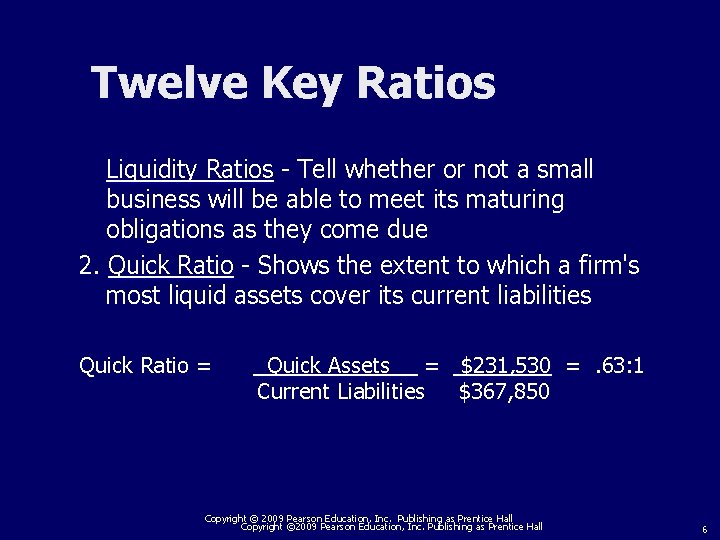
Twelve Key Ratios Liquidity Ratios - Tell whether or not a small business will be able to meet its maturing obligations as they come due 2. Quick Ratio - Shows the extent to which a firm's most liquid assets cover its current liabilities Quick Ratio = Quick Assets = $231, 530 =. 63: 1 Current Liabilities $367, 850 Copyright © 2009 Pearson Education, Inc. Publishing as Prentice Hall 6
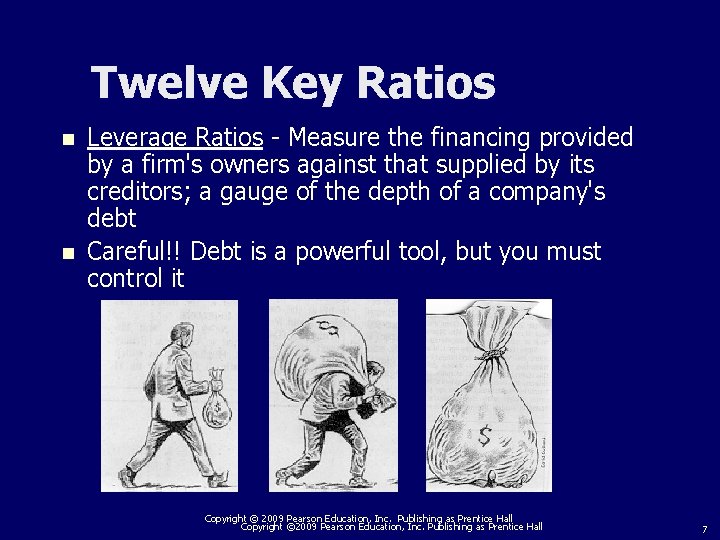
Twelve Key Ratios n n Leverage Ratios - Measure the financing provided by a firm's owners against that supplied by its creditors; a gauge of the depth of a company's debt Careful!! Debt is a powerful tool, but you must control it Copyright © 2009 Pearson Education, Inc. Publishing as Prentice Hall 7
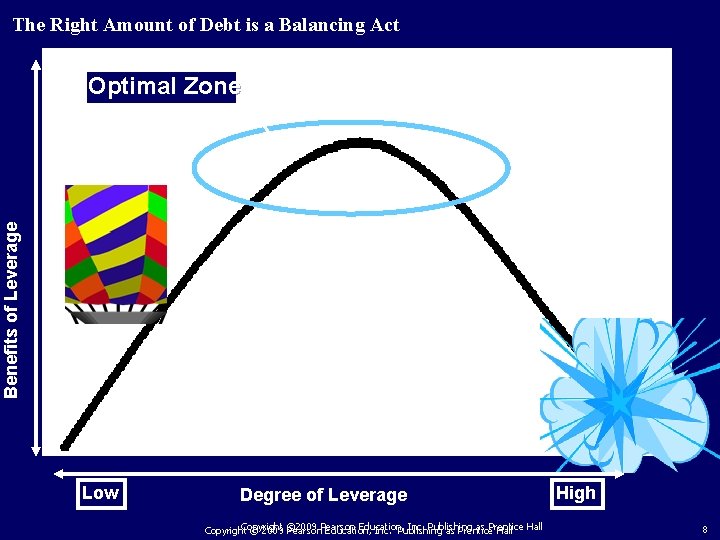
The Right Amount of Debt is a Balancing Act Benefits of Leverage Optimal Zone Low Degree of Leverage Copyright 2009 Pearson Education, Inc. Publishing as Prentice Copyright © 2009 © Pearson Education, Inc. Publishing as Prentice Hall High 8
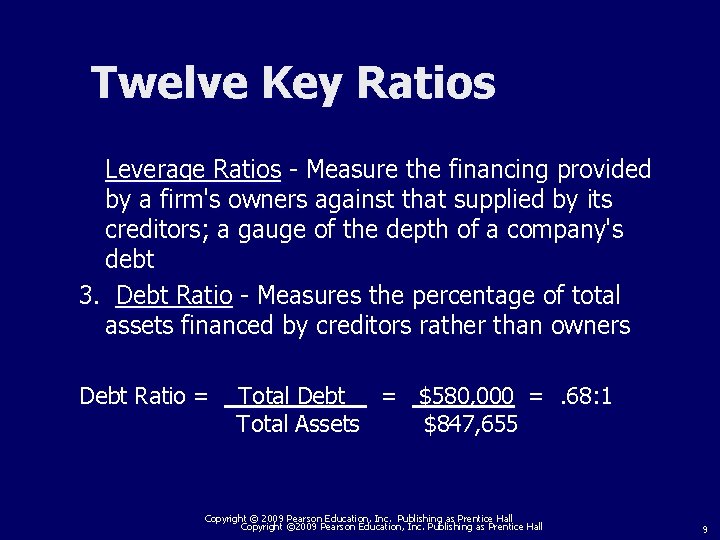
Twelve Key Ratios Leverage Ratios - Measure the financing provided by a firm's owners against that supplied by its creditors; a gauge of the depth of a company's debt 3. Debt Ratio - Measures the percentage of total assets financed by creditors rather than owners Debt Ratio = Total Debt = $580, 000 =. 68: 1 Total Assets $847, 655 Copyright © 2009 Pearson Education, Inc. Publishing as Prentice Hall 9
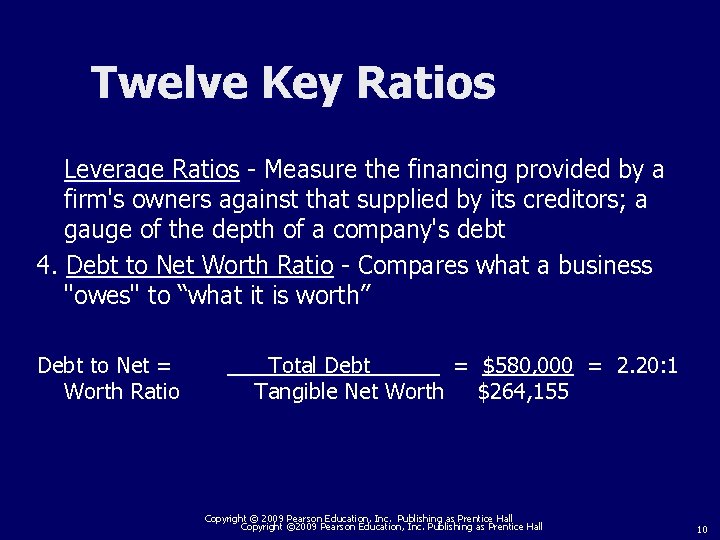
Twelve Key Ratios Leverage Ratios - Measure the financing provided by a firm's owners against that supplied by its creditors; a gauge of the depth of a company's debt 4. Debt to Net Worth Ratio - Compares what a business "owes" to “what it is worth” Debt to Net = Worth Ratio Total Debt = $580, 000 = 2. 20: 1 Tangible Net Worth $264, 155 Copyright © 2009 Pearson Education, Inc. Publishing as Prentice Hall 10
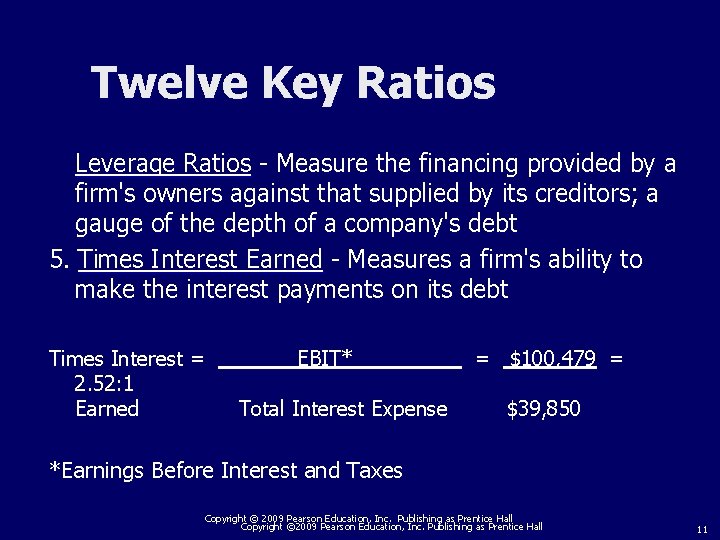
Twelve Key Ratios Leverage Ratios - Measure the financing provided by a firm's owners against that supplied by its creditors; a gauge of the depth of a company's debt 5. Times Interest Earned - Measures a firm's ability to make the interest payments on its debt Times Interest = 2. 52: 1 Earned EBIT* Total Interest Expense = $100, 479 = $39, 850 *Earnings Before Interest and Taxes Copyright © 2009 Pearson Education, Inc. Publishing as Prentice Hall 11
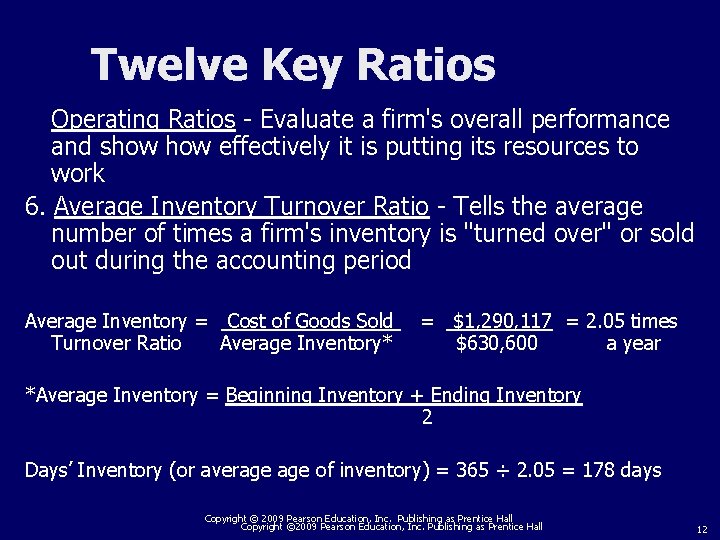
Twelve Key Ratios Operating Ratios - Evaluate a firm's overall performance and show effectively it is putting its resources to work 6. Average Inventory Turnover Ratio - Tells the average number of times a firm's inventory is "turned over" or sold out during the accounting period Average Inventory = Cost of Goods Sold Turnover Ratio Average Inventory* = $1, 290, 117 = 2. 05 times $630, 600 a year *Average Inventory = Beginning Inventory + Ending Inventory 2 Days’ Inventory (or average of inventory) = 365 ÷ 2. 05 = 178 days Copyright © 2009 Pearson Education, Inc. Publishing as Prentice Hall 12
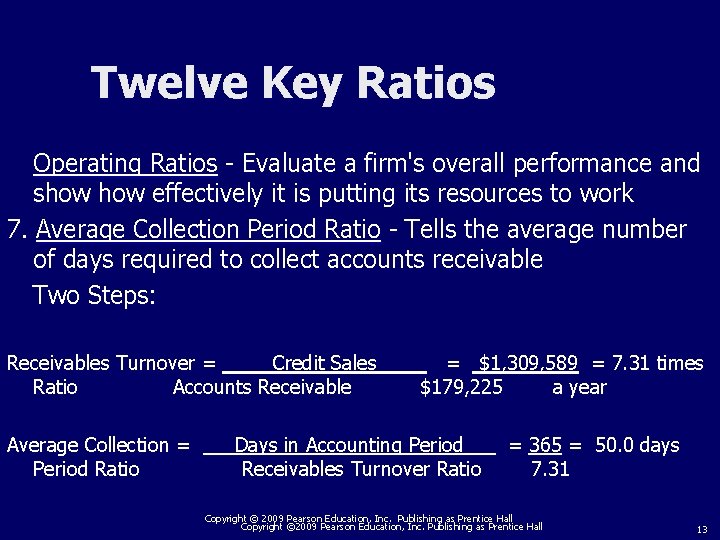
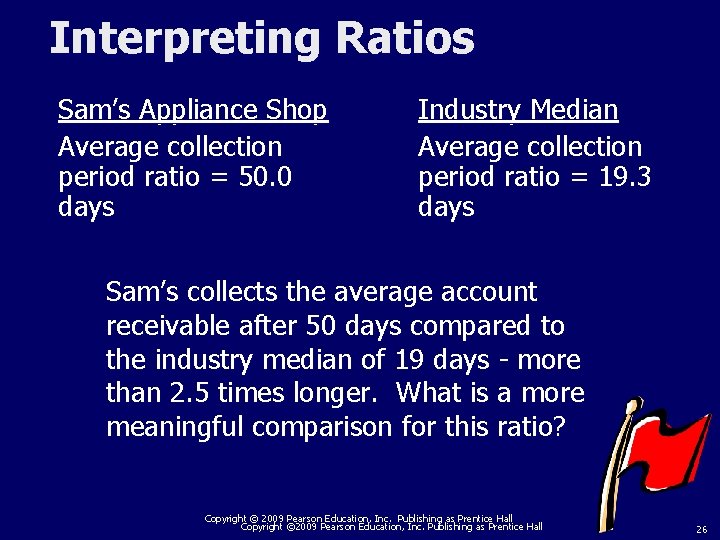
Twelve Key Ratios Operating Ratios - Evaluate a firm's overall performance and show effectively it is putting its resources to work 7. Average Collection Period Ratio - Tells the average number of days required to collect accounts receivable Two Steps: Receivables Turnover = Credit Sales Ratio Accounts Receivable Average Collection = Period Ratio = $1, 309, 589 = 7. 31 times $179, 225 a year Days in Accounting Period Receivables Turnover Ratio = 365 = 50. 0 days 7. 31 Copyright © 2009 Pearson Education, Inc. Publishing as Prentice Hall 13
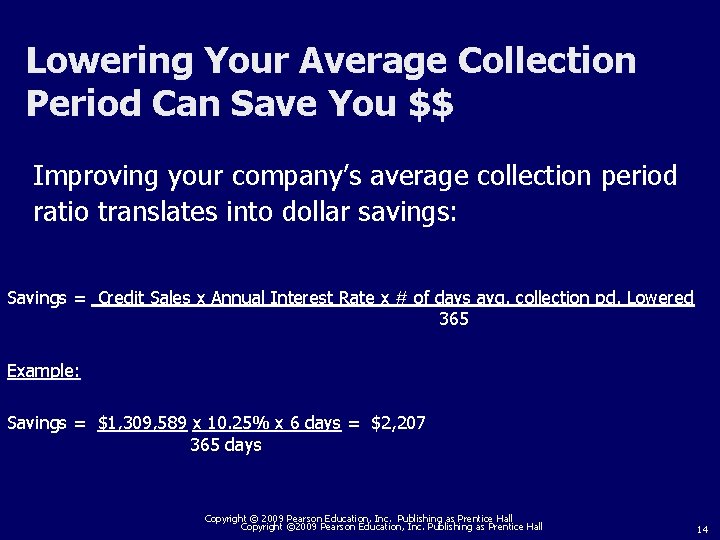
Lowering Your Average Collection Period Can Save You $$ Improving your company’s average collection period ratio translates into dollar savings: Savings = Credit Sales x Annual Interest Rate x # of days avg. collection pd. Lowered 365 Example: Savings = $1, 309, 589 x 10. 25% x 6 days = $2, 207 365 days Copyright © 2009 Pearson Education, Inc. Publishing as Prentice Hall 14
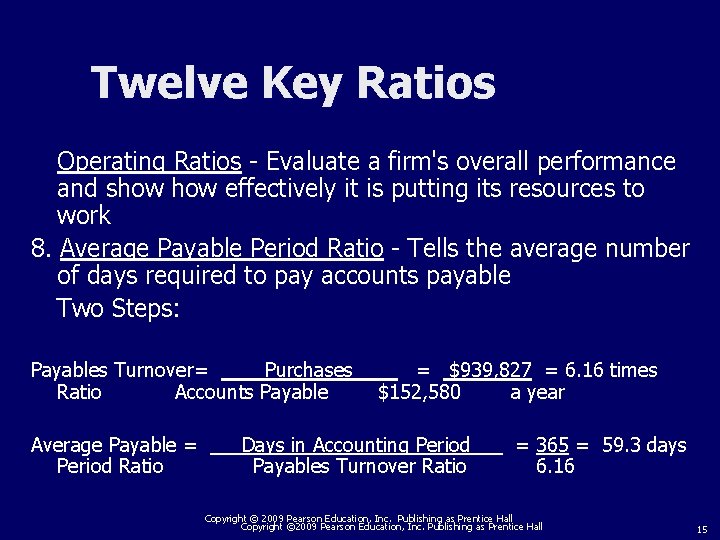
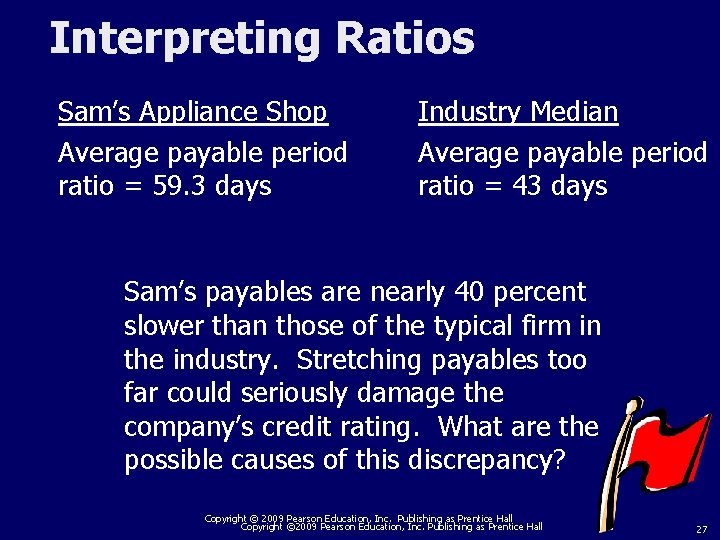
Twelve Key Ratios Operating Ratios - Evaluate a firm's overall performance and show effectively it is putting its resources to work 8. Average Payable Period Ratio - Tells the average number of days required to pay accounts payable Two Steps: Payables Turnover= Purchases Ratio Accounts Payable Average Payable = Period Ratio = $939, 827 = 6. 16 times $152, 580 a year Days in Accounting Period Payables Turnover Ratio = 365 = 59. 3 days 6. 16 Copyright © 2009 Pearson Education, Inc. Publishing as Prentice Hall 15
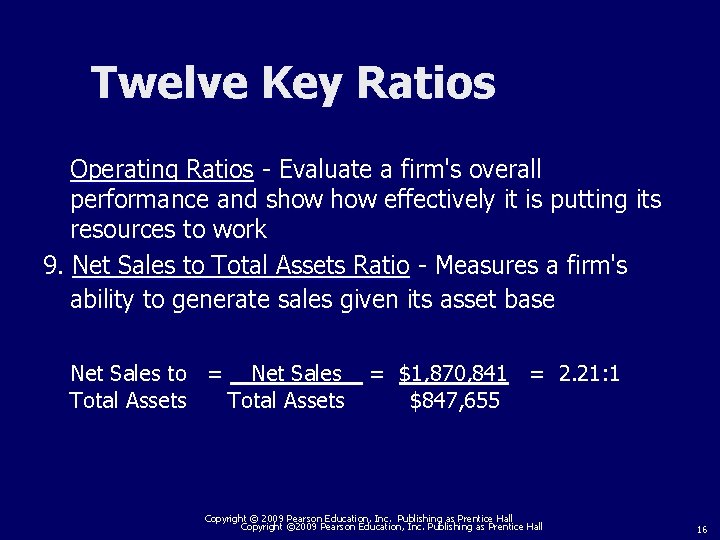
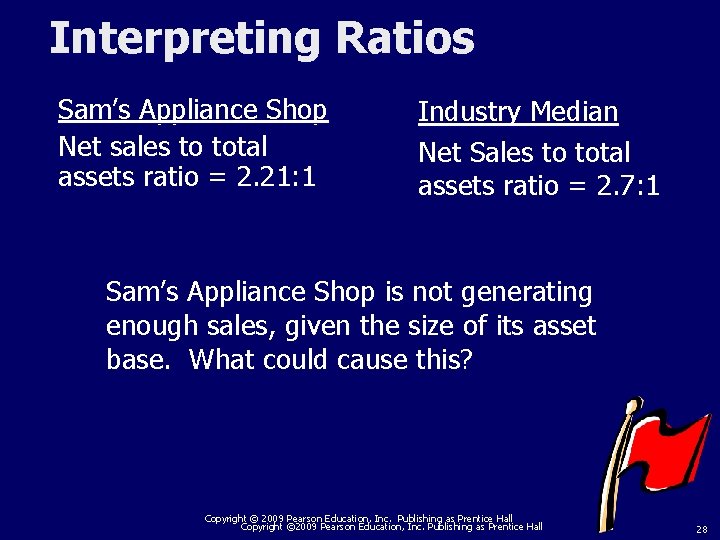
Twelve Key Ratios Operating Ratios - Evaluate a firm's overall performance and show effectively it is putting its resources to work 9. Net Sales to Total Assets Ratio - Measures a firm's ability to generate sales given its asset base Net Sales to = Net Sales Total Assets = $1, 870, 841 = 2. 21: 1 $847, 655 Copyright © 2009 Pearson Education, Inc. Publishing as Prentice Hall 16
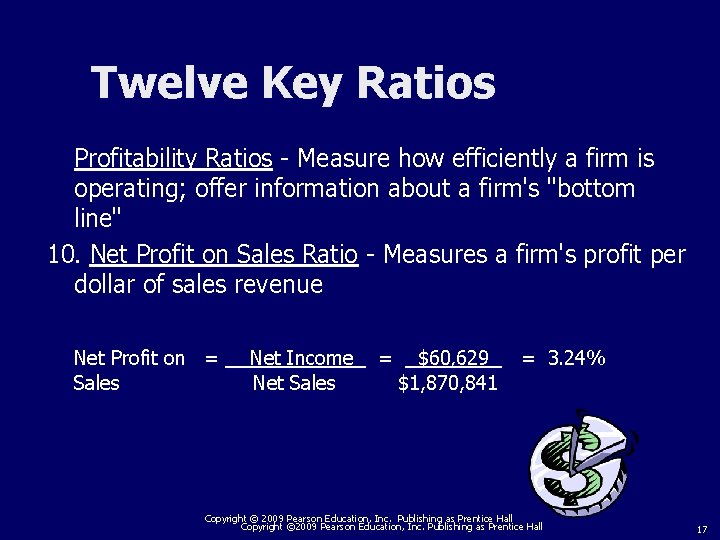
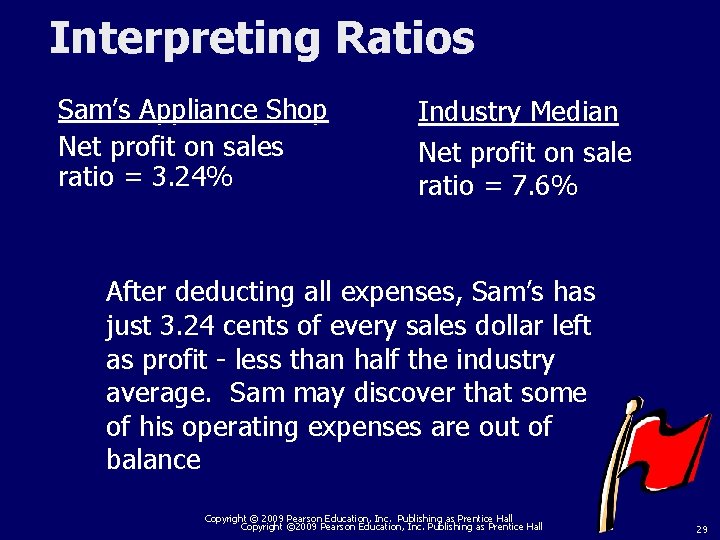
Twelve Key Ratios Profitability Ratios - Measure how efficiently a firm is operating; offer information about a firm's "bottom line" 10. Net Profit on Sales Ratio - Measures a firm's profit per dollar of sales revenue Net Profit on = Sales Net Income Net Sales = $60, 629 $1, 870, 841 = 3. 24% Copyright © 2009 Pearson Education, Inc. Publishing as Prentice Hall 17
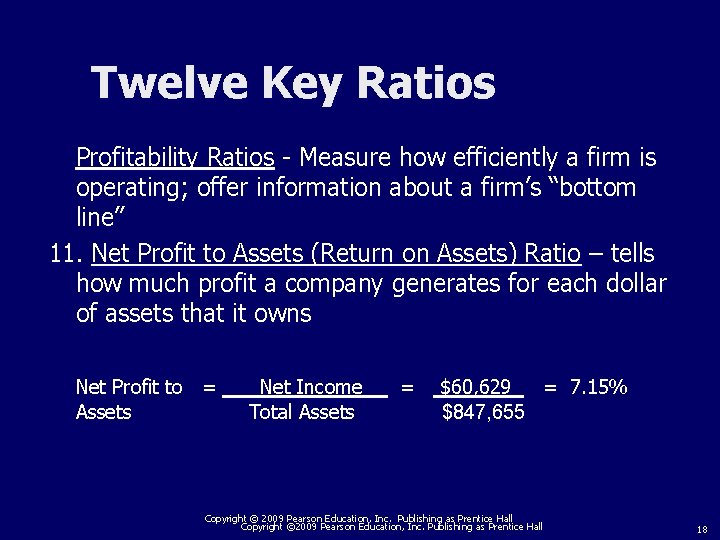
Twelve Key Ratios Profitability Ratios - Measure how efficiently a firm is operating; offer information about a firm’s “bottom line” 11. Net Profit to Assets (Return on Assets) Ratio – tells how much profit a company generates for each dollar of assets that it owns Net Profit to = Assets Net Income Total Assets = $60, 629 = 7. 15% $847, 655 Copyright © 2009 Pearson Education, Inc. Publishing as Prentice Hall 18
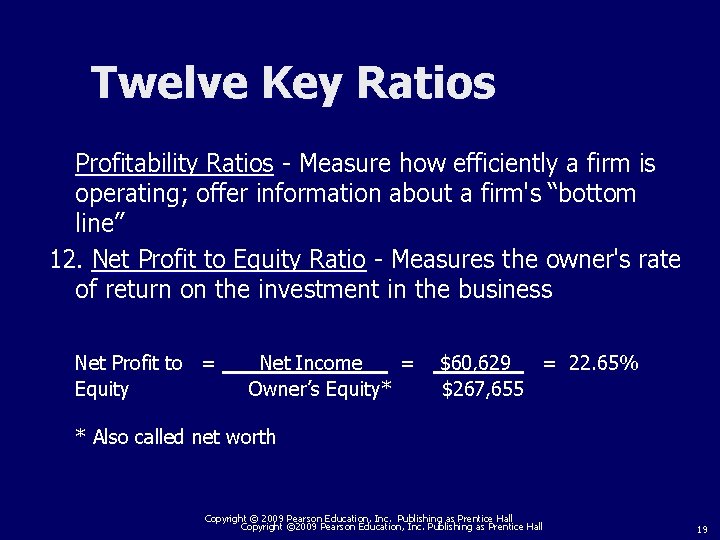
Twelve Key Ratios Profitability Ratios - Measure how efficiently a firm is operating; offer information about a firm's “bottom line” 12. Net Profit to Equity Ratio - Measures the owner's rate of return on the investment in the business Net Profit to = Equity Net Income = Owner’s Equity* $60, 629 = 22. 65% $267, 655 * Also called net worth Copyright © 2009 Pearson Education, Inc. Publishing as Prentice Hall 19
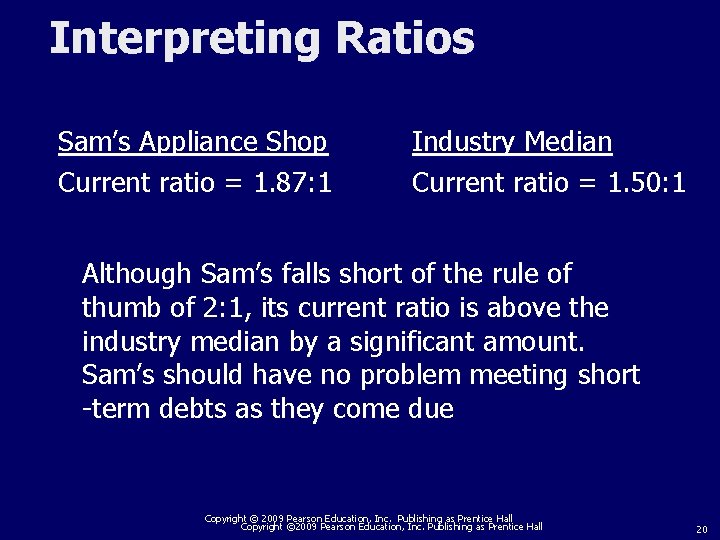
Interpreting Ratios Sam’s Appliance Shop Current ratio = 1. 87: 1 Industry Median Current ratio = 1. 50: 1 Although Sam’s falls short of the rule of thumb of 2: 1, its current ratio is above the industry median by a significant amount. Sam’s should have no problem meeting short -term debts as they come due Copyright © 2009 Pearson Education, Inc. Publishing as Prentice Hall 20
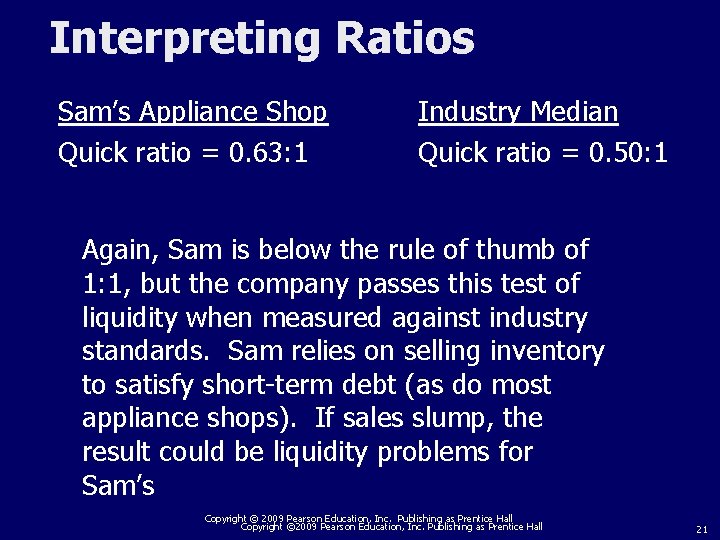
Interpreting Ratios Sam’s Appliance Shop Quick ratio = 0. 63: 1 Industry Median Quick ratio = 0. 50: 1 Again, Sam is below the rule of thumb of 1: 1, but the company passes this test of liquidity when measured against industry standards. Sam relies on selling inventory to satisfy short-term debt (as do most appliance shops). If sales slump, the result could be liquidity problems for Sam’s Copyright © 2009 Pearson Education, Inc. Publishing as Prentice Hall 21
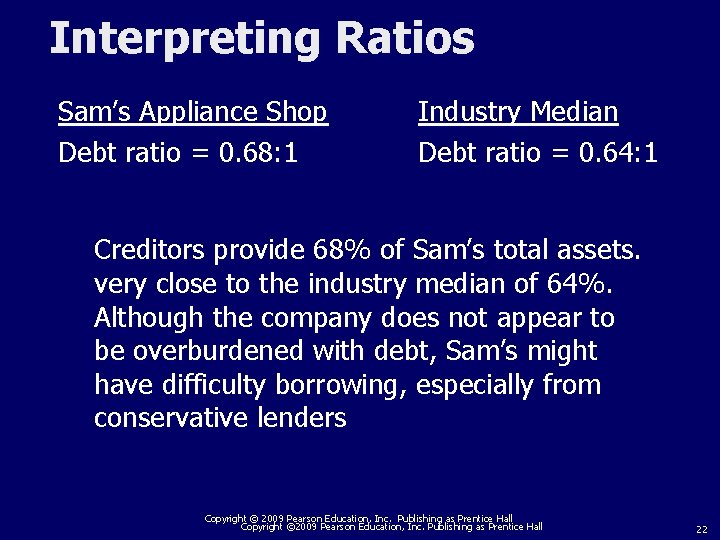
Interpreting Ratios Sam’s Appliance Shop Debt ratio = 0. 68: 1 Industry Median Debt ratio = 0. 64: 1 Creditors provide 68% of Sam’s total assets. very close to the industry median of 64%. Although the company does not appear to be overburdened with debt, Sam’s might have difficulty borrowing, especially from conservative lenders Copyright © 2009 Pearson Education, Inc. Publishing as Prentice Hall 22
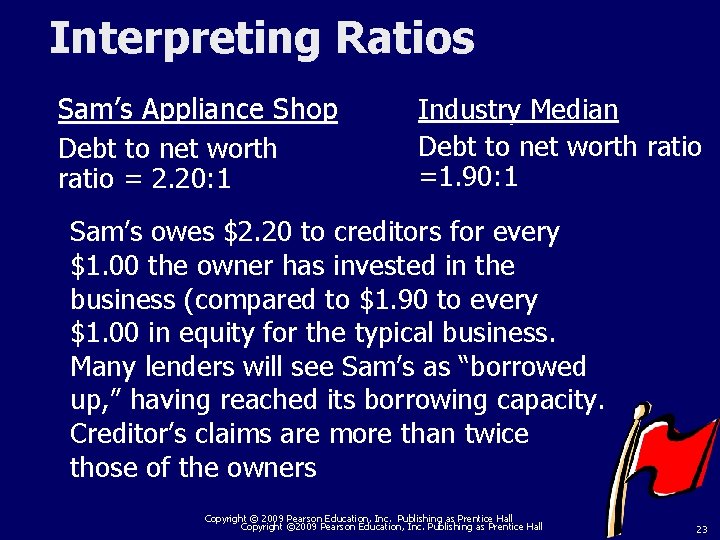
Interpreting Ratios Sam’s Appliance Shop Debt to net worth ratio = 2. 20: 1 Industry Median Debt to net worth ratio =1. 90: 1 Sam’s owes $2. 20 to creditors for every $1. 00 the owner has invested in the business (compared to $1. 90 to every $1. 00 in equity for the typical business. Many lenders will see Sam’s as “borrowed up, ” having reached its borrowing capacity. Creditor’s claims are more than twice those of the owners Copyright © 2009 Pearson Education, Inc. Publishing as Prentice Hall 23
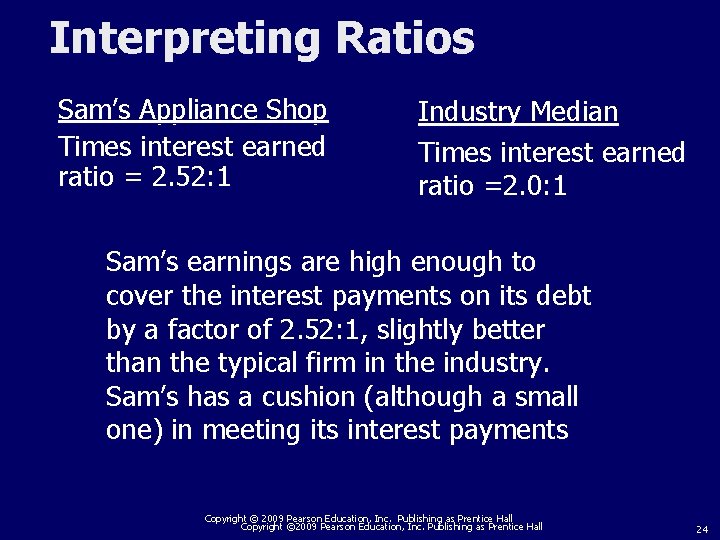
Interpreting Ratios Sam’s Appliance Shop Times interest earned ratio = 2. 52: 1 Industry Median Times interest earned ratio =2. 0: 1 Sam’s earnings are high enough to cover the interest payments on its debt by a factor of 2. 52: 1, slightly better than the typical firm in the industry. Sam’s has a cushion (although a small one) in meeting its interest payments Copyright © 2009 Pearson Education, Inc. Publishing as Prentice Hall 24
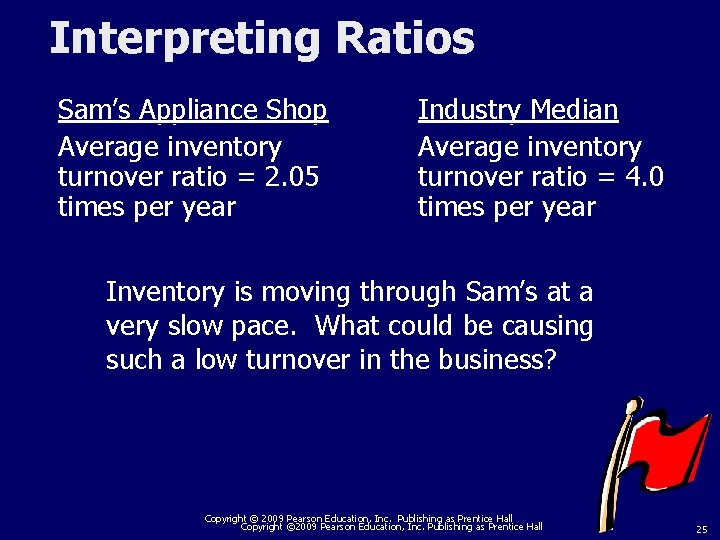
Interpreting Ratios Sam’s Appliance Shop Average inventory turnover ratio = 2. 05 times per year Industry Median Average inventory turnover ratio = 4. 0 times per year Inventory is moving through Sam’s at a very slow pace. What could be causing such a low turnover in the business? Copyright © 2009 Pearson Education, Inc. Publishing as Prentice Hall 25
Interpreting Ratios Sam’s Appliance Shop Average collection period ratio = 50. 0 days Industry Median Average collection period ratio = 19. 3 days Sam’s collects the average account receivable after 50 days compared to the industry median of 19 days - more than 2. 5 times longer. What is a more meaningful comparison for this ratio? Copyright © 2009 Pearson Education, Inc. Publishing as Prentice Hall 26
Interpreting Ratios Sam’s Appliance Shop Average payable period ratio = 59. 3 days Industry Median Average payable period ratio = 43 days Sam’s payables are nearly 40 percent slower than those of the typical firm in the industry. Stretching payables too far could seriously damage the company’s credit rating. What are the possible causes of this discrepancy? Copyright © 2009 Pearson Education, Inc. Publishing as Prentice Hall 27
Interpreting Ratios Sam’s Appliance Shop Net sales to total assets ratio = 2. 21: 1 Industry Median Net Sales to total assets ratio = 2. 7: 1 Sam’s Appliance Shop is not generating enough sales, given the size of its asset base. What could cause this? Copyright © 2009 Pearson Education, Inc. Publishing as Prentice Hall 28
Interpreting Ratios Sam’s Appliance Shop Net profit on sales ratio = 3. 24% Industry Median Net profit on sale ratio = 7. 6% After deducting all expenses, Sam’s has just 3. 24 cents of every sales dollar left as profit - less than half the industry average. Sam may discover that some of his operating expenses are out of balance Copyright © 2009 Pearson Education, Inc. Publishing as Prentice Hall 29
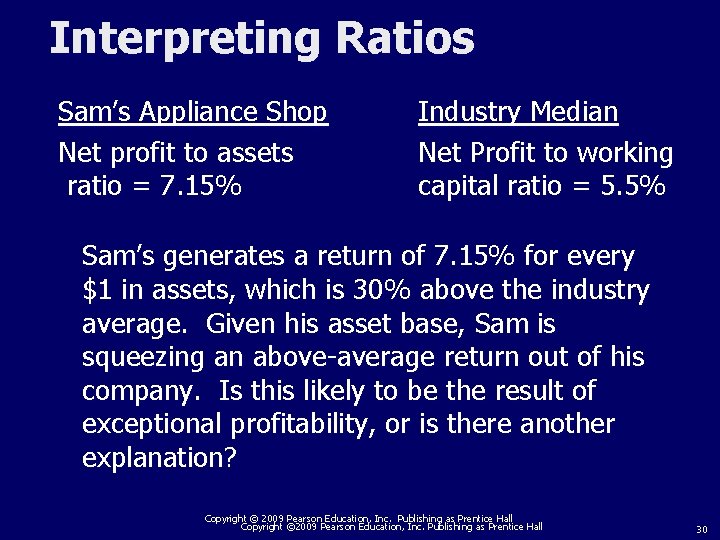
Interpreting Ratios Sam’s Appliance Shop Net profit to assets ratio = 7. 15% Industry Median Net Profit to working capital ratio = 5. 5% Sam’s generates a return of 7. 15% for every $1 in assets, which is 30% above the industry average. Given his asset base, Sam is squeezing an above-average return out of his company. Is this likely to be the result of exceptional profitability, or is there another explanation? Copyright © 2009 Pearson Education, Inc. Publishing as Prentice Hall 30
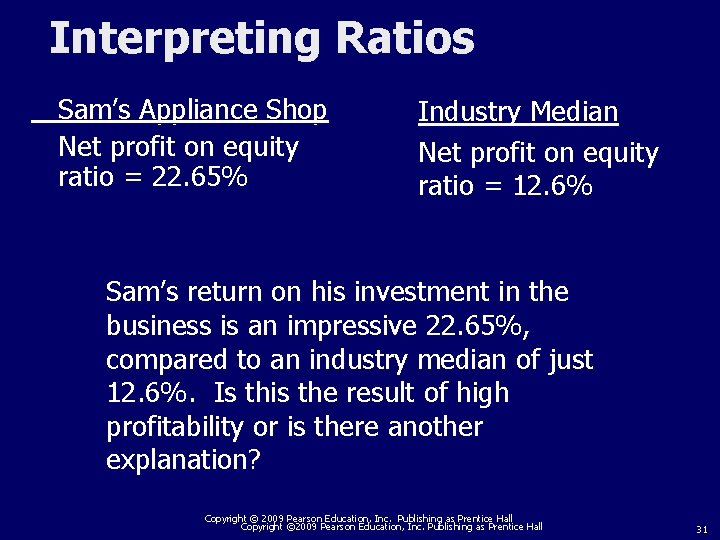
Interpreting Ratios Sam’s Appliance Shop Net profit on equity ratio = 22. 65% Industry Median Net profit on equity ratio = 12. 6% Sam’s return on his investment in the business is an impressive 22. 65%, compared to an industry median of just 12. 6%. Is this the result of high profitability or is there another explanation? Copyright © 2009 Pearson Education, Inc. Publishing as Prentice Hall 31
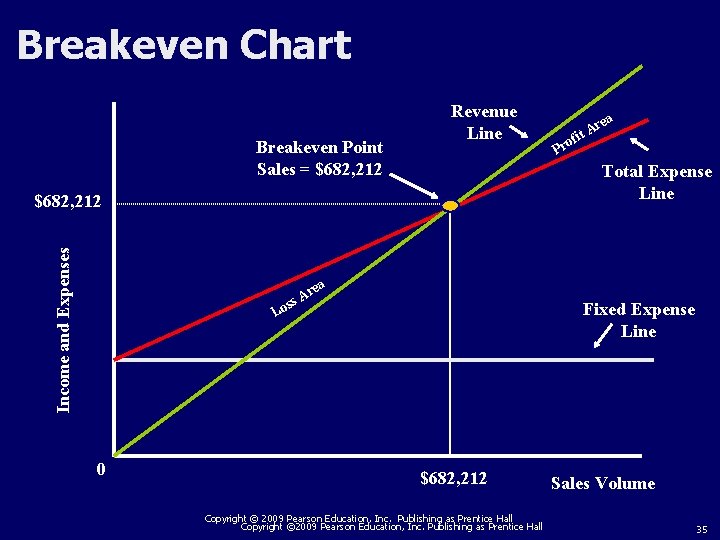
Breakeven Analysis n n n The breakeven point is the level of operation at which a business neither earns a profit nor incurs a loss It is a useful planning tool because it shows entrepreneurs minimum level of activity required to stay in business With one change in the breakeven calculation, an entrepreneur can also determine the sales volume required to reach a particular profit target Chapter 7 Solid Financial Plan Copyright © 2009 Pearson Education, Inc. Publishing as Prentice Hall 32
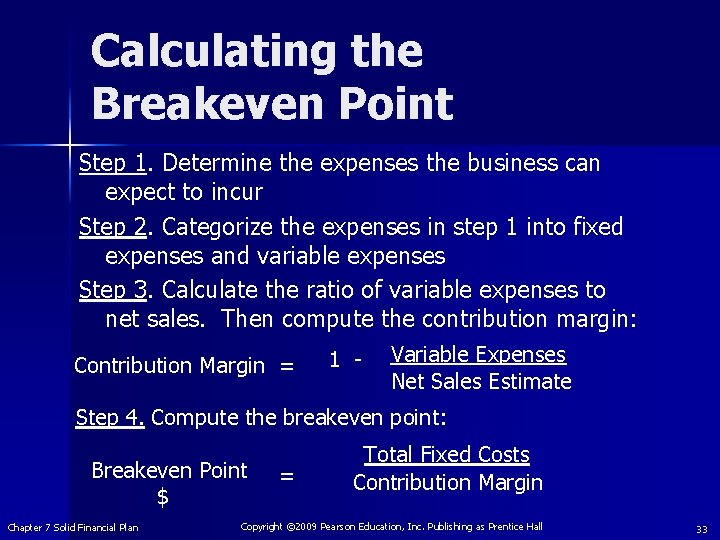
Calculating the Breakeven Point Step 1. Determine the expenses the business can expect to incur Step 2. Categorize the expenses in step 1 into fixed expenses and variable expenses Step 3. Calculate the ratio of variable expenses to net sales. Then compute the contribution margin: Contribution Margin = 1 - Variable Expenses Net Sales Estimate Step 4. Compute the breakeven point: Breakeven Point $ Chapter 7 Solid Financial Plan = Total Fixed Costs Contribution Margin Copyright © 2009 Pearson Education, Inc. Publishing as Prentice Hall 33
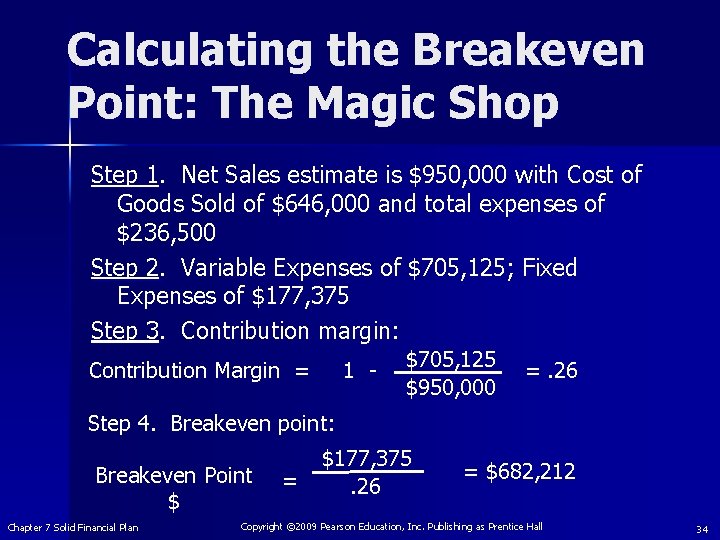
Calculating the Breakeven Point: The Magic Shop Step 1. Net Sales estimate is $950, 000 with Cost of Goods Sold of $646, 000 and total expenses of $236, 500 Step 2. Variable Expenses of $705, 125; Fixed Expenses of $177, 375 Step 3. Contribution margin: Contribution Margin = 1 - $705, 125 $950, 000 =. 26 Step 4. Breakeven point: Breakeven Point $ Chapter 7 Solid Financial Plan = $177, 375. 26 = $682, 212 Copyright © 2009 Pearson Education, Inc. Publishing as Prentice Hall 34
Breakeven Chart Breakeven Point Sales = $682, 212 Revenue Line Total Expense Line Income and Expenses $682, 212 rea A ss Lo 0 rea A t ofi r P Fixed Expense Line $682, 212 Copyright © 2009 Pearson Education, Inc. Publishing as Prentice Hall Sales Volume 35
All rights reserved. No part of this publication may be reproduced, stored in a retrieval system, or transmitted, in any form or by any means, electronic, mechanical, photocopying, recording, or otherwise, without the prior written permission of the publisher. Printed in the United States of America. Copyright © 2009 Pearson Education, Inc. Publishing as Prentice Hall Chapter 7 Solid Financial Plan Copyright © 2009 Pearson Education, Inc. Publishing as Prentice Hall 36