
Creating a pedagogical systems theory for early childhood
- Slides: 20
Creating a pedagogical systems theory for early childhood and preschool education Docent Ulla Härkönen Ph. D. , Lecturer in Early Childhood Education University of Joensuu Savonlinna Department of Teacher Education 25. 11. 2005 Tallinn University
Introduction This presentation gives a short overview about the key results of my studies made during thirty years And it shows the deepening understanding of the systemic, holistic, semiotic thoughts and the principles of gender equality and sustainability of early childhood education.
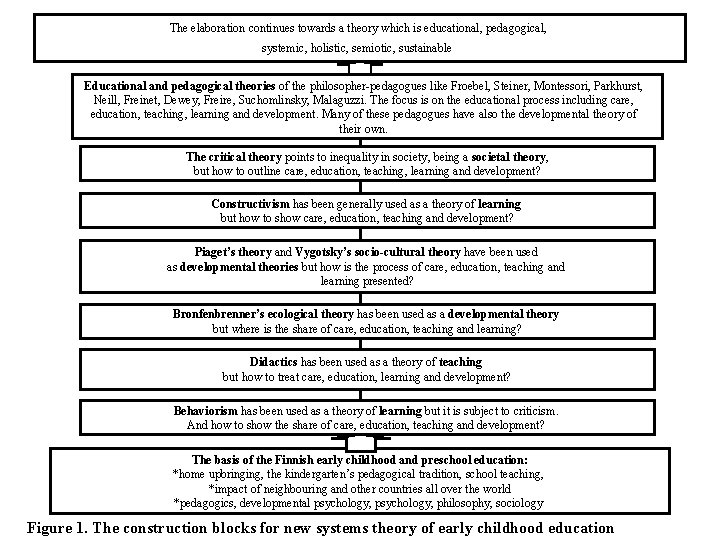
The figure 1. in the next slide shows 1. the basis and 2. the central theoretical approaches that have been influenced in the Finnish early childhood and pre-school education. The basis and 7 blocks of theoretical approaches form the main construction blocks in my elaboration of the new systems theory.
The elaboration continues towards a theory which is educational, pedagogical, systemic, holistic, semiotic, sustainable Educational and pedagogical theories of the philosopher-pedagogues like Froebel, Steiner, Montessori, Parkhurst, Neill, Freinet, Dewey, Freire, Suchomlinsky, Malaguzzi. The focus is on the educational process including care, education, teaching, learning and development. Many of these pedagogues have also the developmental theory of their own. The critical theory points to inequality in society, being a societal theory, but how to outline care, education, teaching, learning and development? Constructivism has been generally used as a theory of learning but how to show care, education, teaching and development? Piaget’s theory and Vygotsky’s socio-cultural theory have been used as developmental theories but how is the process of care, education, teaching and learning presented? Bronfenbrenner’s ecological theory has been used as a developmental theory but where is the share of care, education, teaching and learning? Didactics has been used as a theory of teaching but how to treat care, education, learning and development? Behaviorism has been used as a theory of learning but it is subject to criticism. And how to show the share of care, education, teaching and development? The basis of the Finnish early childhood and preschool education: *home upbringing, the kindergarten’s pedagogical tradition, school teaching, *impact of neighbouring and other countries all over the world *pedagogics, developmental psychology, philosophy, sociology Figure 1. The construction blocks for new systems theory of early childhood education
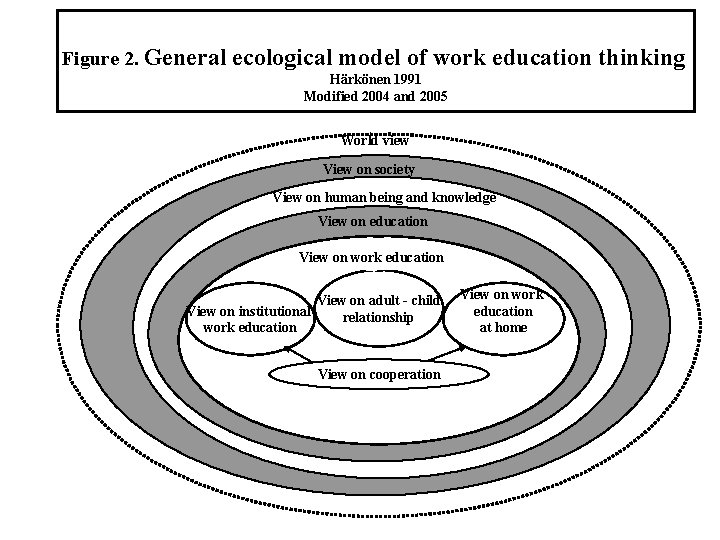
The Figure 2 in the next slide shows the general ecological model of one part of the whole educational systems, namely that of work education thinking. The author has studied small children’s work education and especially that of history’s great philosopher-pedagogues’ theories. It has ment that work education has been shown in the light of the whole pedagogical thinking and theories.
Figure 2. General ecological model of work education thinking Härkönen 1991 Modified 2004 and 2005 World view View on society View on human being and knowledge View on education View on work education View on adult - child View on institutional relationship work education View on cooperation View on work education at home
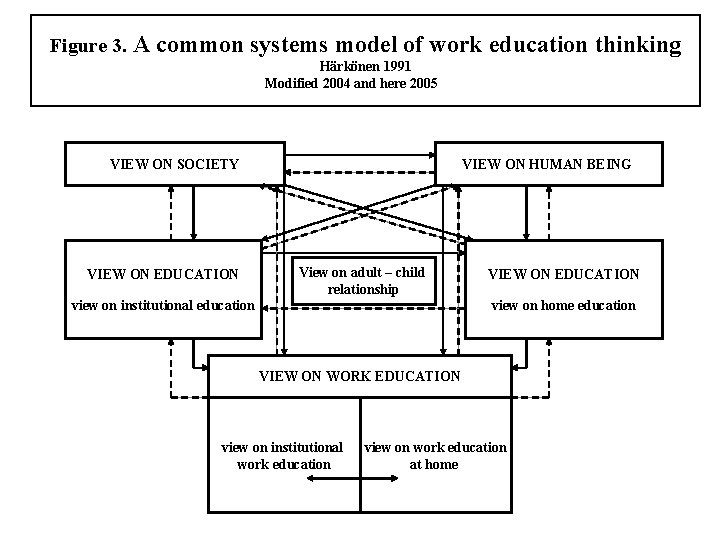
The figure 3 in the next slide shows the general systems model of work education thinking. This model is free from the bounds of the ecological approach thus being a general systems model.
Figure 3. A common systems model of work education thinking Härkönen 1991 Modified 2004 and here 2005 VIEW ON SOCIETY VIEW ON EDUCATION VIEW ON HUMAN BEING View on adult – child relationship view on institutional education VIEW ON EDUCATION view on home education VIEW ON WORK EDUCATION view on institutional work education view on work education at home
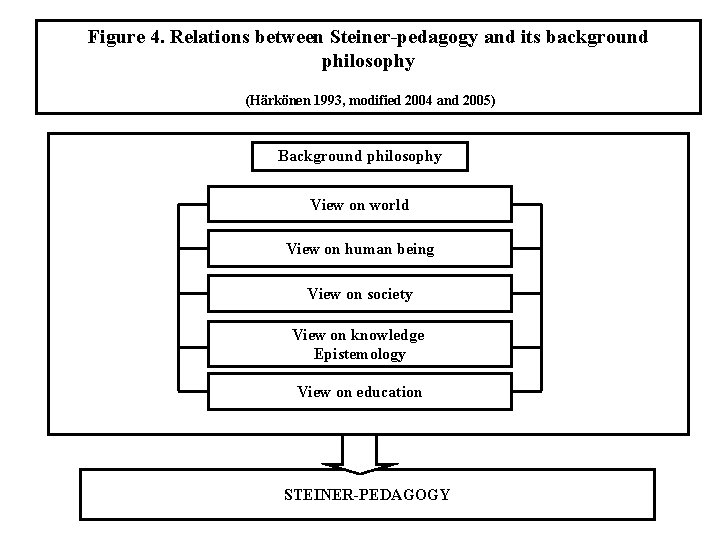
The figure 4 in the next slide shows the realtionships between background philosophy and pedagogy. The example is that of Rudolf Steiner, one of possible choices of numerous philosopherpedagogues, like Fröbel, Montessori, Parkhurst, Dewey, Neill, Malaguzzi and others.
Figure 4. Relations between Steiner-pedagogy and its background philosophy (Härkönen 1993, modified 2004 and 2005) Background philosophy View on world View on human being View on society View on knowledge Epistemology View on education STEINER-PEDAGOGY
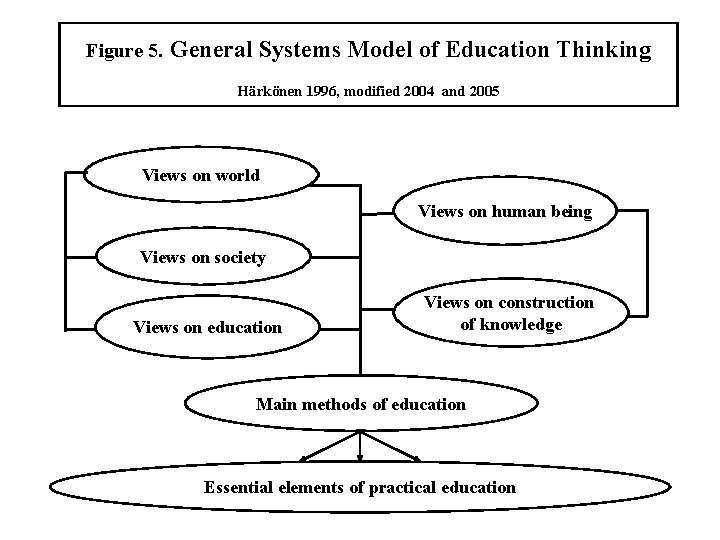
The figure 5 in the next slide shows the general systems model of educational thinking. It is a generalisation of Steiner’s, Montessori’s and other philosopher-pedagogues’ thinking. Here and after this I concentrate on educational thinking and different views on educational thinking. This means a hermeneutic and qualitative approach on education.
Figure 5. General Systems Model of Education Thinking Härkönen 1996, modified 2004 and 2005 Views on world Views on human being Views on society Views on education Views on construction of knowledge Main methods of education Essential elements of practical education
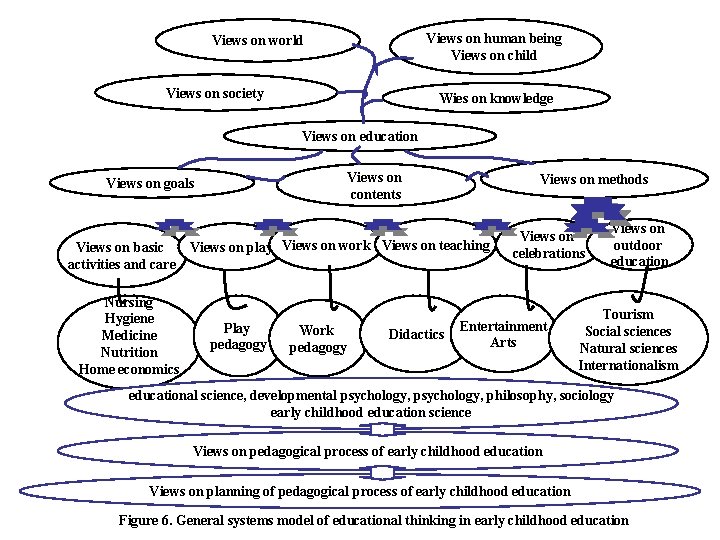
The figure 2. in the next slide is a general systems model of educational thinking in early childhood and preschool education. The figure consists of different parts of the whole systems: 1. the philosophical background and 2. the educational elements that are goals, contents and methods.
In the figure 2 • methods are shown in details because these methods are essential in early childhood education and preschool education. • The figure also points out the main early childhood education science, related sciences, fields on knowledge and refers to the processes and planning of early childhood education and preschool education.
Views on human being Views on child Views on world Views on society Wies on knowledge Views on education Views on contents Views on goals Views on methods Views on play Views on work Views on teaching Views on basic activities and care Nursing Hygiene Medicine Nutrition Home economics Play pedagogy Work pedagogy Didactics Views on celebrations Entertainment Arts Views on outdoor education Tourism Social sciences Natural sciences Internationalism educational science, developmental psychology, philosophy, sociology early childhood education science Views on pedagogical process of early childhood education Views on planning of pedagogical process of early childhood education Figure 6. General systems model of educational thinking in early childhood education
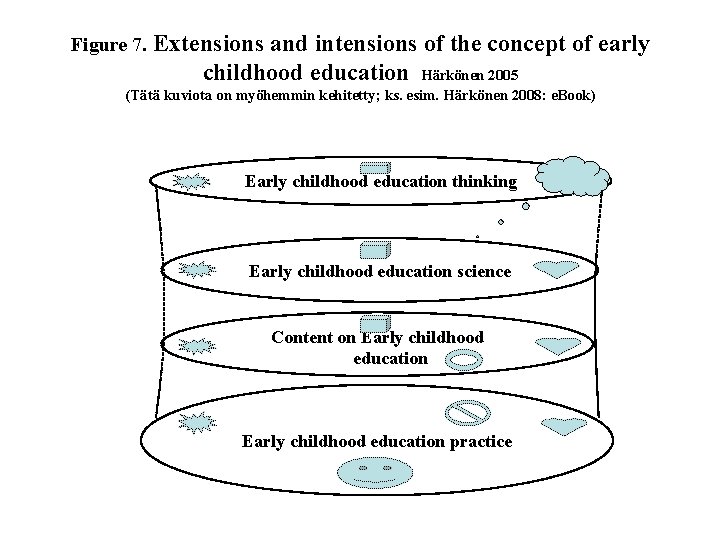
The figure 3 in the next slide shows extensions and intensions of the concept of early childhood education. This is a semiotic approach to these concepts. The figure shows that this concepts has four extensions: 1. practice, 2. content, 3. science and 4. thinking.
The figure 3 in the next slide • Also these extensions together form the systems that can be analyzed. • All extensions should include the same intensions if we speak about early childhood education at the area of these extensions.
Figure 7. Extensions and intensions of the concept of early childhood education Härkönen 2005 (Tätä kuviota on myöhemmin kehitetty; ks. esim. Härkönen 2008: e. Book) Early childhood education thinking Early childhood education science Content on Early childhood education practice
My dear audience: • How to continue the elaboration of the new systems theory? • There are much to do but what and how and why? • The theory must be systemic, holistic, semiotic, creating gender equality and sustainability!
References: http: //savonlinna. joensuu. fi/harkonen Thank you for your attention!