
Creating a Pathway to a Teaching Career 1


- Slides: 23
“Creating a Pathway to a Teaching Career” 1
Presentation Purpose Summary of Project TEACH Establish Initial Contact with Advisors Collect Required Forms Answer Specific Questions 2
Introductions What is your name? What do you want to teach? Where are you in your college education? How many credits do you currently have? Do you know which 4 -year school you want to go to? 3
Teacher Education The Need – National Nearly 40% of current public school teachers will retire or leave the profession by the 2003 -04 school year. (DOE, 1999) In the next ten years, America needs to hire 2. 5 million new teachers to replace retiring teachers and meet the needs of rising enrollments. 4
Teacher Education The Need - National Up to 32% of students who complete their teacher certification at universities never enter the profession. (Carnegie Foundation, 1987) While 40%-49% of future teachers begin their careers at a community college, opportunities for them to connect to the teaching profession are minimal or nonexistent. ( NWREL, 1996; Curry, 1985) 5
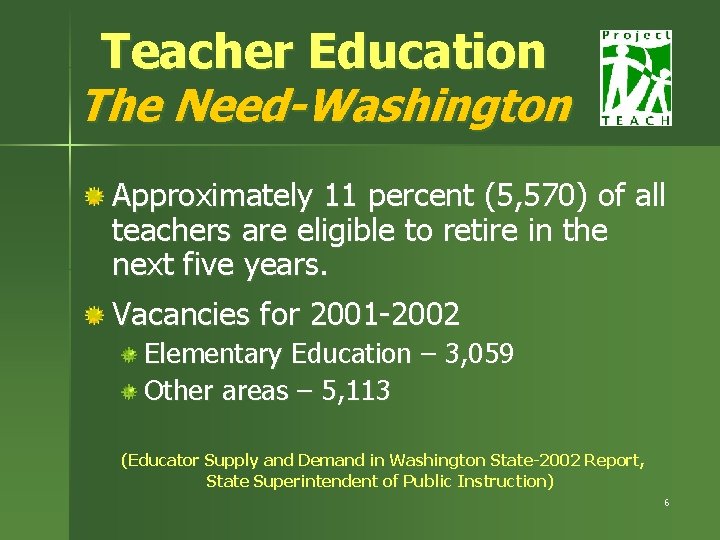
Teacher Education The Need-Washington Approximately 11 percent (5, 570) of all teachers are eligible to retire in the next five years. Vacancies for 2001 -2002 Elementary Education – 3, 059 Other areas – 5, 113 (Educator Supply and Demand in Washington State-2002 Report, State Superintendent of Public Instruction) 6
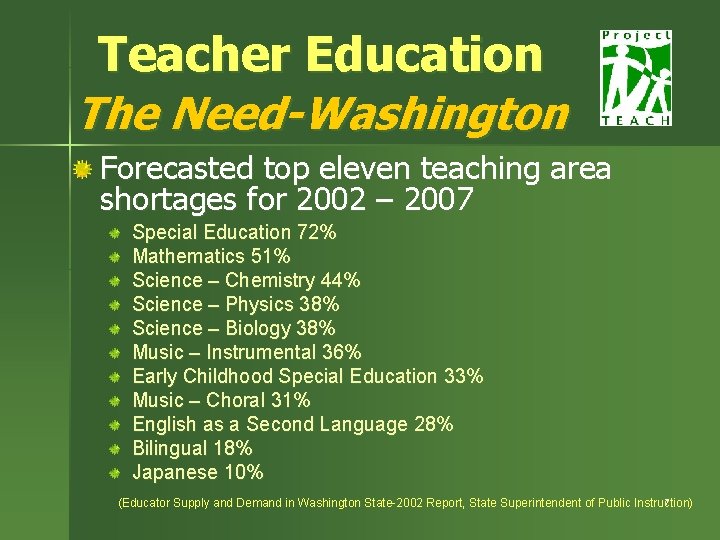
Teacher Education The Need-Washington Forecasted top eleven teaching area shortages for 2002 – 2007 Special Education 72% Mathematics 51% Science – Chemistry 44% Science – Physics 38% Science – Biology 38% Music – Instrumental 36% Early Childhood Special Education 33% Music – Choral 31% English as a Second Language 28% Bilingual 18% Japanese 10% 7 (Educator Supply and Demand in Washington State-2002 Report, State Superintendent of Public Instruction)
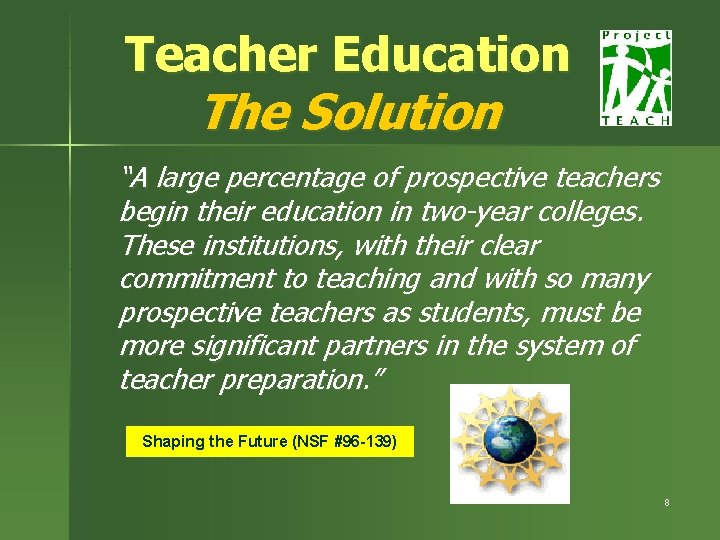
Teacher Education The Solution “A large percentage of prospective teachers begin their education in two-year colleges. These institutions, with their clear commitment to teaching and with so many prospective teachers as students, must be more significant partners in the system of teacher preparation. ” Shaping the Future (NSF #96 -139) 8
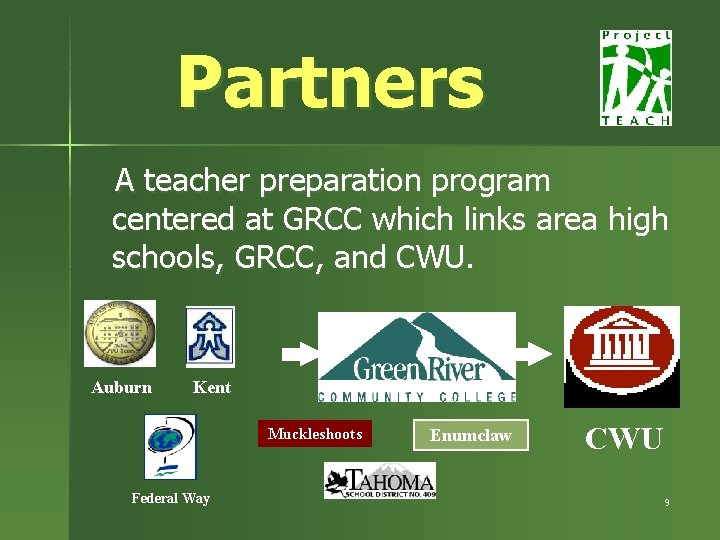
Partners A teacher preparation program centered at GRCC which links area high schools, GRCC, and CWU. Auburn Kent Muckleshoots Federal Way Enumclaw CWU 9
Funding Initial funding of $434, 000 from National Science Foundation Continued funding of $307, 000 from the National Science Foundation Funding of $500, 000 from the US Department of Education Funding of $141, 000 from the Washington HEC Board 10
Strategies STRATEGY 1: To recruit a diverse group of talented students into the teaching profession. – High School students – Those with commitments to math/science – Those wishing to change careers – Underrepresented populations 11
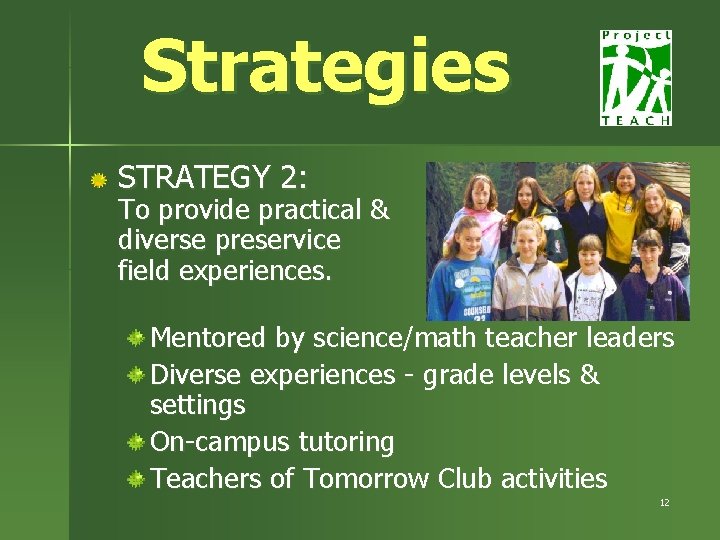
Strategies STRATEGY 2: To provide practical & diverse preservice field experiences. Mentored by science/math teacher leaders Diverse experiences - grade levels & settings On-campus tutoring Teachers of Tomorrow Club activities 12
Strategies STRATEGY 3: To strengthen math & science for elementary schools. Mathematics for elementary teachers course sequence 3 -qtr. , interdisciplinary science course Courses model interactive teaching and active learning 13
Strategies STRATEGY 4: To improve the preparation & retention of prospective teachers. A new para-educator certificate A new Associate Pre-Professional degree for Elementary Teachers A supportive career pathway from HS to CC to University Advising/support along the career pathway 14
What is my first step? Introduction to Education Course (EDUC 170) & Lab (172. 1/172. 2) Hands-on experience in a local school Begin your portfolio Gain more specific information about teaching Explore options for teacher certification programs at 4 -year schools 15
What courses should a future elementary teacher take? Elementary Education majors (with a few exceptions) should follow the new APP degree. Use your reference binder to select courses. Begin researching the requirements of the 4 -year schools now. There may be some in addition to the APP. (ex. Foreign Lang. ) Start with EDUC 170, with 172. 1 or 172. 2 Complete the Basic Skills requirements in English and Math ASAP! 16
What courses should a future secondary teacher take? Secondary teachers need to pursue the “regular” AA degree. However, you must still plan carefully. If you identify now where you want to transfer and which endorsement(s) you will pursue, you may be able to meet some requirements at GRCC. You will find specific advice for secondary teachers in your Student Reference Guide. 17
Who will advise me? Early Childhood Education Diana Holz and Leslie Kessler Elementary and Secondary Education Keith Clay, Christie Gilliland, Joyce Hammer, Steve Kinholt, David Nelson and Pam Reising General Advising Erin Weller Hitzemann Mouy-Ly Ie 18
Project TEACH Center An information resource for Project TEACH students, faculty and staff is in RLC 106. –Leslie Heizer - Center Director Marilou Christiansen, Program Support Supervisor 19
What other opportunities are there? America COUNTS & America READS Konnie Pitts - Student Employment, x 2453 Summer TEACH & Math Maniacs Project TEACH Student Workers / Tutors Scholarships Financial Aid Office, x 2440 Teachers of Tomorrow Club & The Future Teachers Conference. 20
Creating A Pathway to a Teaching Career Discussion & Questions 21
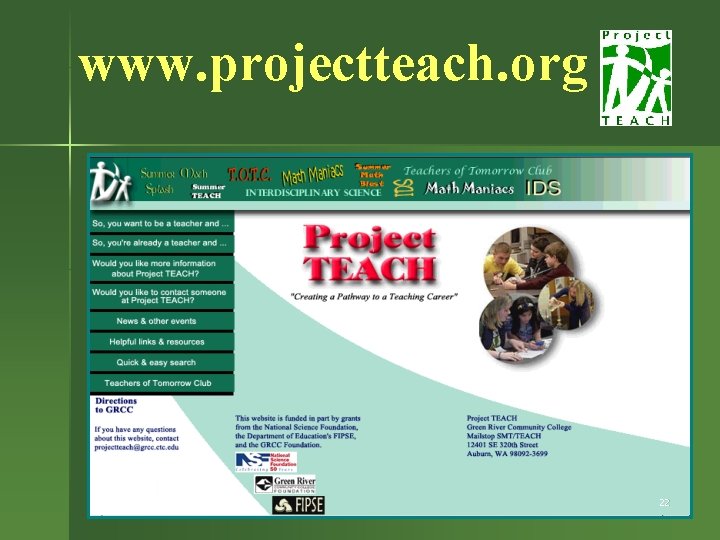
www. projectteach. org 22
Creating A Pathway to a Teaching Career Thank You for attending this presentation 23