
Creating A New Instruction Programmerdefined Method Alice Overview
- Slides: 13
Creating A New Instruction (Programmer-defined Method) Alice
Overview Creating our own (programmer-defined) methods Demo Why we want to write our own methods Abstraction Re-using code Comments
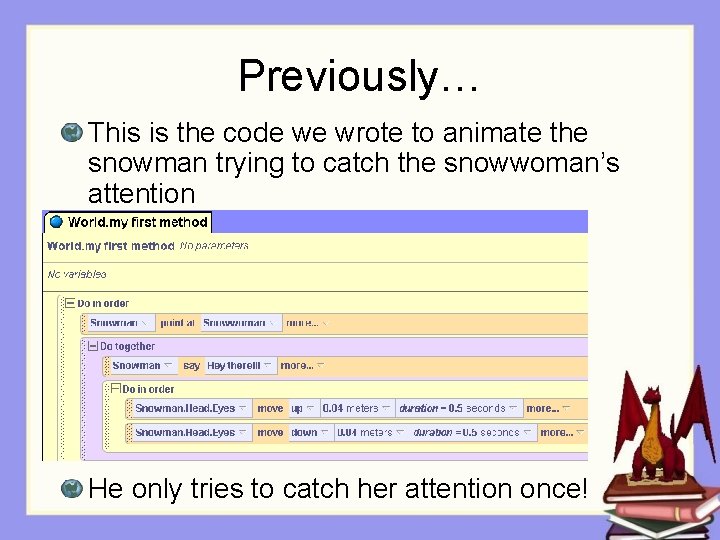
Previously… This is the code we wrote to animate the snowman trying to catch the snowwoman’s attention He only tries to catch her attention once!
A Problem To make the problem more realistic, we would probably want the snowman to try to get the snowwoman’s attention several times. How can we do this? We would need to: drag-and-drop each instruction multiple times into the edit box, or use the clipboard to copy-and-paste
A Quicker Solution A quicker and easier solution to this problem is to define our own instruction (method) name the new method catch. Attention Then, we can drag-and-drop the catch. Attention instruction into the edit box just like the built-in instructions (move, turn, roll, …)
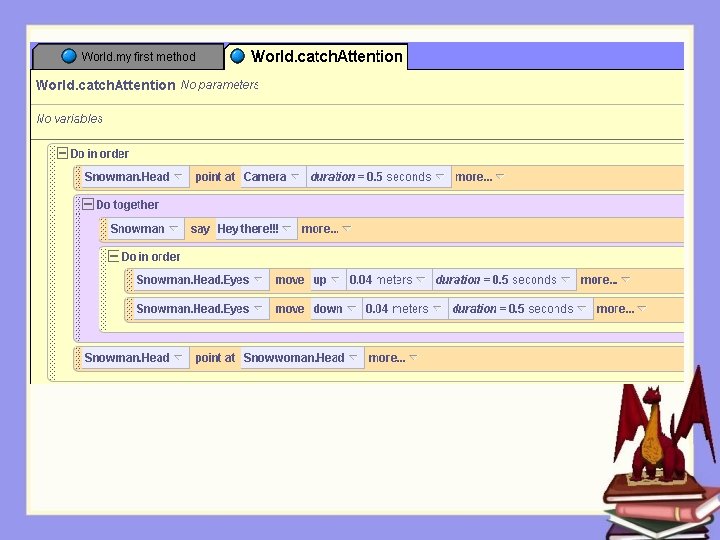
Demo A demonstration of creating the catch. Attention method in the world
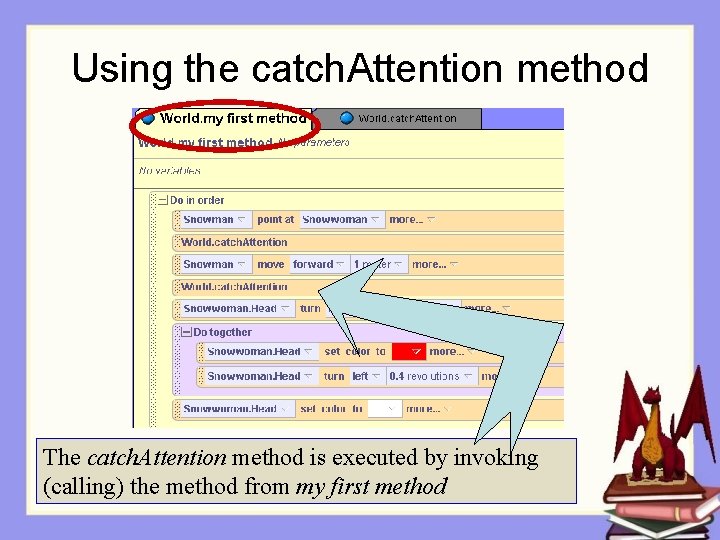
Using the catch. Attention method The catch. Attention method is executed by invoking (calling) the method from my first method
Why? Why do we want to write our own (programmerdefined) methods? saves time -- we can call the method again and again without reconstructing code allows us to "think at a higher level" can think “catch. Attention" instead of “point head at camera, then say ‘hey there’ while moving eyes up and down" the technical term for "think at a higher level" is "abstraction"
Comments While Alice instructions are easy to understand, it is often desirable to be able to explain (in English) what is going on in a program We use comments to explain to the human reader what a particular section of code does
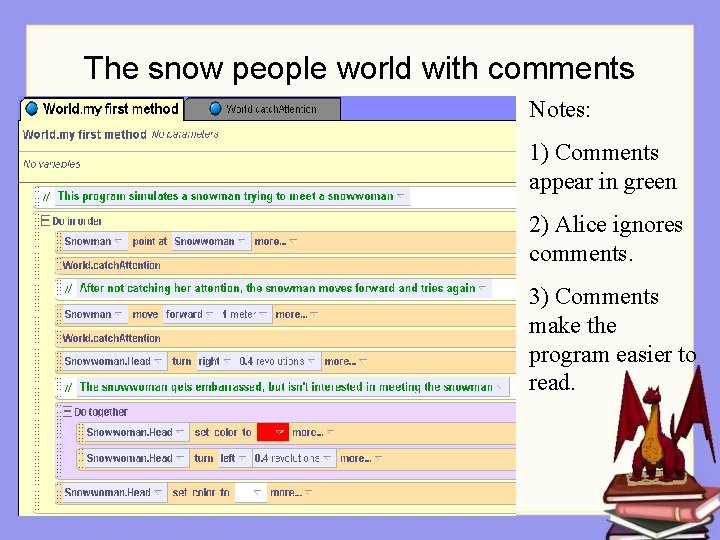
The snow people world with comments Notes: 1) Comments appear in green 2) Alice ignores comments. 3) Comments make the program easier to read.
Assignment Read Chapter 3 section 1 Methods How to create them How to invoke them When is it appropriate to use them Comments
Lab chapter 3 section 1