
Creating a Local Theory of Change Implementing the
- Slides: 43
Creating a Local Theory of Change Implementing the ROMA Cycle in the “Next Generation” Performance Management Framework ROMA NEXT GENERATION TRAINING SERIES
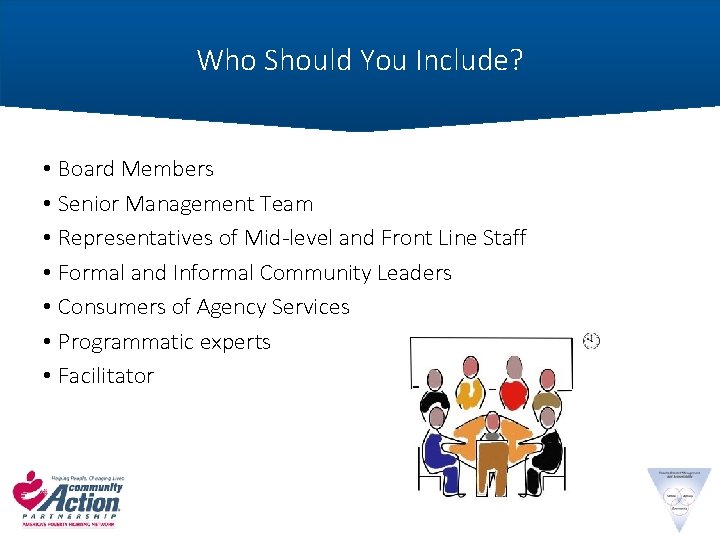
Who Should You Include? • Board Members • Senior Management Team • Representatives of Mid-level and Front Line Staff • Formal and Informal Community Leaders • Consumers of Agency Services • Programmatic experts • Facilitator
What Should You Have on Hand? • Your most recent Community Needs Assessment • Your most recent Strategic Plan • Agency Reports that capture impact of current services
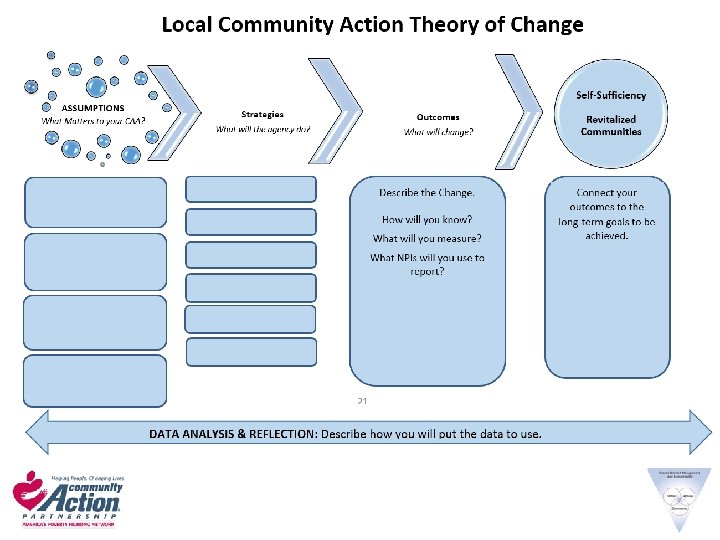
Guide to Creating a Local Theory of Change
WHILE WE GET SETTLED WHITE: What do you believe are the causes of poverty? BLUE: What do you believe are the impacts of poverty on your community? (in other words, what conditions do you see that you attribute to the state of “poverty” in the community) PINK: What do you think people need to get out of poverty?
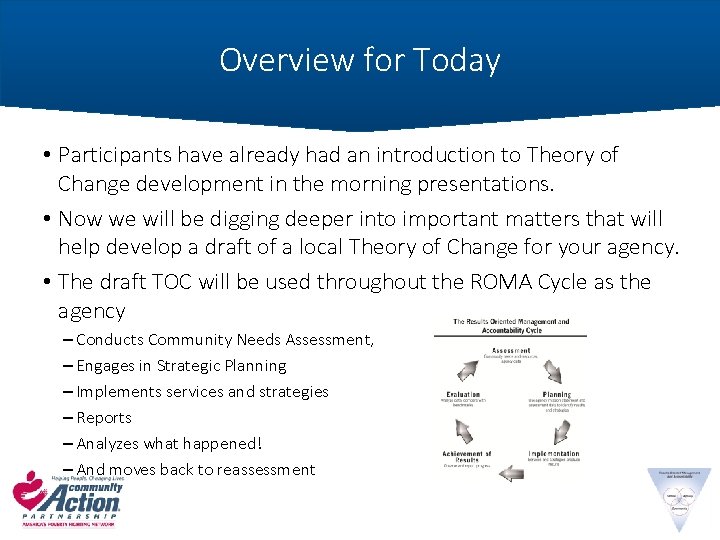
Overview for Today • Participants have already had an introduction to Theory of Change development in the morning presentations. • Now we will be digging deeper into important matters that will help develop a draft of a local Theory of Change for your agency. • The draft TOC will be used throughout the ROMA Cycle as the agency – Conducts Community Needs Assessment, – Engages in Strategic Planning – Implements services and strategies – Reports – Analyzes what happened! – And moves back to reassessment
Learning Objectives for this Workshop Participants will: - Define “Theory of Change” - Identify key elements of the National Community Action Theory of Change - Recognize the assumptions about causes and conditions of poverty which are communicated in agency mission statements - Recognize the assumptions about how to address poverty which are communicated in the strategies and services an agency chooses - Describe the benefits of creating a local Theory of Change - Identify steps to creating a local Theory of Change
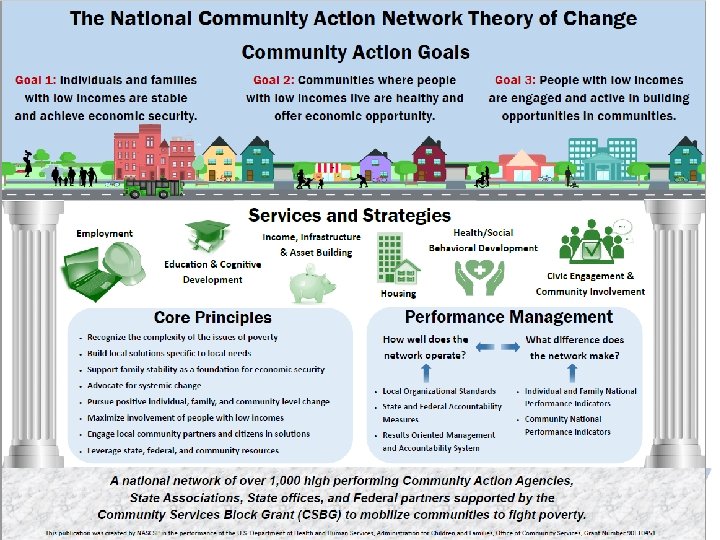
National Theory of Change
National Theory of Change • What do you see that reflects your local CAA? • What do you see that does not reflect your local CAA? • What is missing from this CAA that is an important part of your agency?
Considerations for building TOC • Agreements • Differences/Unresolved Issues • Questions we need answered
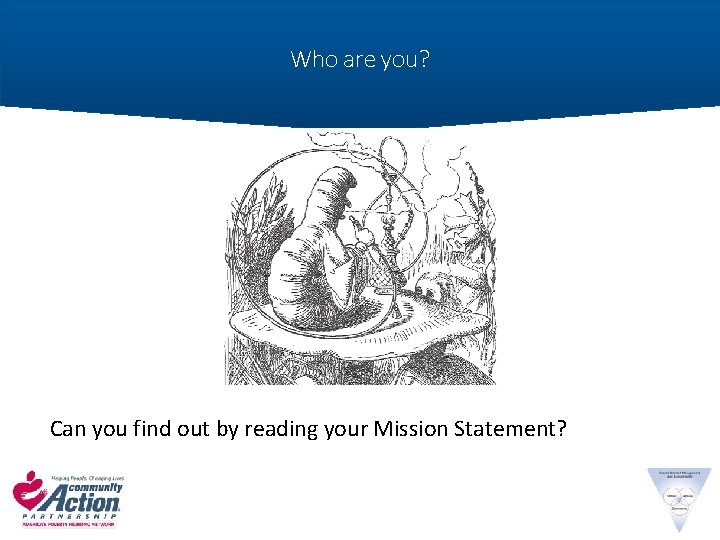
Who are you? Can you find out by reading your Mission Statement?
Assumptions behind Mission statements To improve the quality of life for people in need by empowering them to become more self-sufficient and by providing essential services in collaboration and cooperation with partners. - People in need must be empowered to become more self-sufficient - We can empower them - Becoming empowered to be more self-sufficient will improve their quality of life - People who are not already self sufficient are in need of essential services - We can’t provide these services alone - We have partner who will collaborate with us to provide these services
Our Agency’s Mission Statement is…
Causes and Conditions of Poverty WHITE: What do you believe are the causes of poverty? BLUE: What do you believe are the impacts of poverty on your community? (in other words, what conditions do you see that you attribute to the state of “poverty” in the community)
Community Needs Assessment • My community needs the following opportunities (resources? ) to help families reach economic security ………. • Families in my community need the following support if they are to reach economic security…….
How well did your Community Needs Assessment identify the needs? • In order to know what YOU are going to do, you really must understand all that you know about your community and the people with low incomes that live there. • What’s happening? What’s missing? What is beyond your control?
Identified Needs Find the top three to five needs identified in your agency’s community assessment: • Of the needs above, which are integral to your agency mission? • Are you already addressing these? (In the column to the right, indicate yes or no) • Identify if these are family, agency or community level needs. – Enter “f, ” “a, ” or “c” in the column to the right.
Big Thinking Which needs require community level strategies and/or partnerships? What can you do to contribute to impacting those needs that are not the immediate mission of your agency?
Identifying outcomes: • Identify your agency Overall Outcomes • These are the outcomes that are based on the community needs and resources, the agency’s priorities and the agency planning process.
Identifying outcomes: • Next identify the Program Outcomes • These may be identified by program funding source or by the specific focus of the individual program. • How do these Program Outcomes contribute to the Overall Outcomes of the agency.
Do you see these outcomes identified in the • Agency Wide Strategic Plan? • Community Action Plan? (CSBG funding request) • Other proposals for funding for specific programs • Agency Annual Report • Other agency outreach brochures • Anywhere ? ? ?
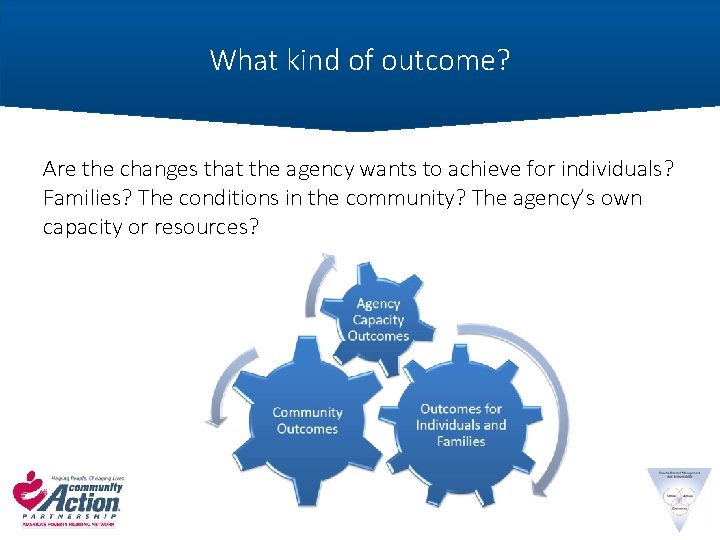
What kind of outcome? Are the changes that the agency wants to achieve for individuals? Families? The conditions in the community? The agency’s own capacity or resources?
Identify the Connections • Identify how family level outcomes will improve the community conditions • Identify how community outcomes will support family outcomes • Identify how agency involvement in community planning and community projects is "value added"
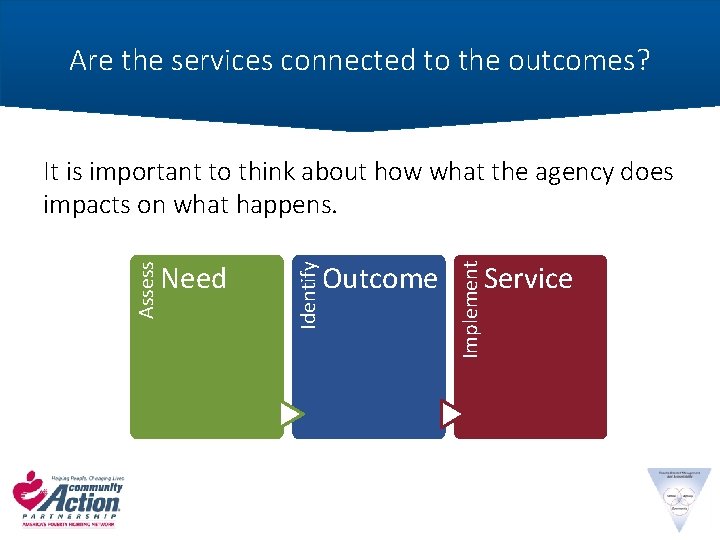
Are the services connected to the outcomes? Outcome Implement Need Identify Assess It is important to think about how what the agency does impacts on what happens. Service
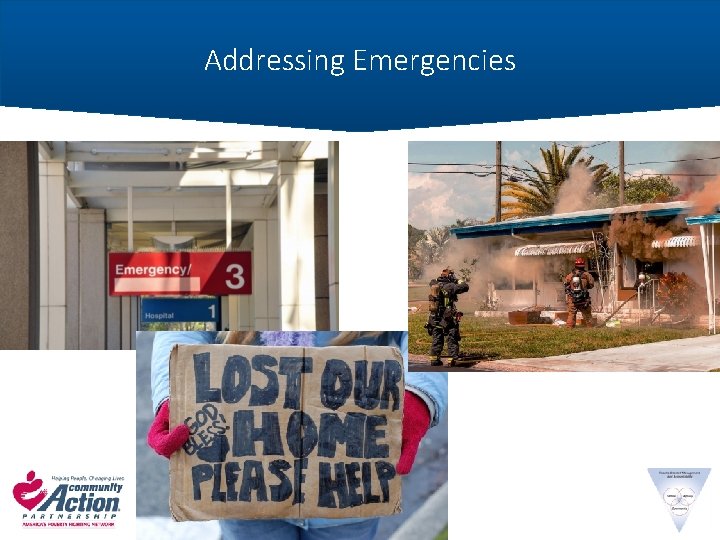
Addressing Emergencies
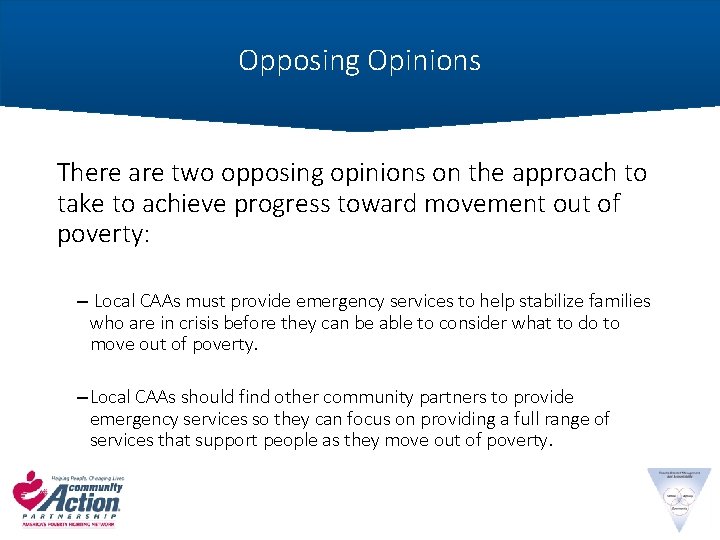
Opposing Opinions There are two opposing opinions on the approach to take to achieve progress toward movement out of poverty: – Local CAAs must provide emergency services to help stabilize families who are in crisis before they can be able to consider what to do to move out of poverty. – Local CAAs should find other community partners to provide emergency services so they can focus on providing a full range of services that support people as they move out of poverty.
What are we accountable for? • Moving people out of poverty? – How many have moved? # • Improving conditions in low income communities? – How many communities have been revitalized?
Consider the individuals and families • Are they coming to the agency because of an emergency? Because they are facing a crisis of some kind? • Do you provide immediate tangible assistance? • What kind of “result” do you see? – Does the assistance help the family move out of the crisis state? – Is there a change in status? – Is the situation temporarily addressed, but the crisis persists?
Before you decide about the service • Know exactly what the customer needs, and understand what result the service will produce. –Do these match? • Know how the individual and family needs relate to the community opportunities and challenges –These two levels are inter-related
Assumptions behind services • Prevention services – we believe that the tangible assistance given to the customer will prevent a crisis. – Rent payment will avoid an eviction and keep families in their home. • Stabilization services – we believe that the tangible assistance will enable the family to maintain all their basic needs – Monthly food distribution allows the family to stretch other resources to enable all basic needs to be met • Gateway services – we believe that the tangible assistance will enable us to establish a relationship with the family, and they will return to the agency for other services. – Food pantry recipient will ask about training opportunities or other tangible assistance needed.
Other One Time Services • Participants identify…….
Identifying what the agency will do • What we’ve always done • What we have funding to do • What is most important to our board • What is most important to our Executive Director
Think about your organizational culture and apply it to the local TOC • Think about how “we have always done” the work of the agency • What is real, what is true, what is good, what is done? • Think about the outcomes (changes) that you have achieved in the past. • Think about WHAT ELSE your agency could achieve if you were not “problem” focused The ideas that are generated by this kind of thinking will influence your creation of your local Theory of Change
Assumptions Behind Strategies Can you identify what is behind these strategies? 1. Our agency will provide credit counseling to low income people who are deeply in debt. 2. We provide an emergency food distribution each month. 3. We are a part of a community coalition that works with existing and potential employers who are not giving jobs to local residents
What would you do? Your agency has just received a modest sum of money to address problems relating to food insecurity. Which of the following approaches do you believe your agency would adopt? 1. Conduct a food donation drive and distribute the food to low-income people 2. Buy a new truck for the agency’s food bank to increase ability to gather food. 3. Establish a skills development program so individuals with low income can learn how to purchase economical food and use them to produce nutritious meals for the family 4. Help community residents organize and operate a farmer's market where lowincome people (and others) can buy and sell produce 5. Assist a local group in advocating for expansion of federal and state food programs so more families are eligible for this benefit.
What do you do to achieve the outcomes? • Services for individuals and families – Direct services – Referrals to partners or other agencies • Strategies for community and agency level work – include other agencies, community members, agency customers, businesses, faith-based groups, government and policy making bodies
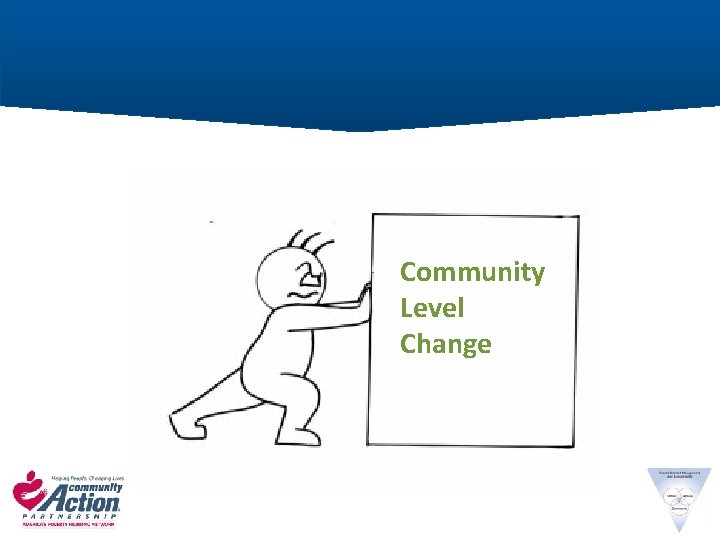
Community Level Change
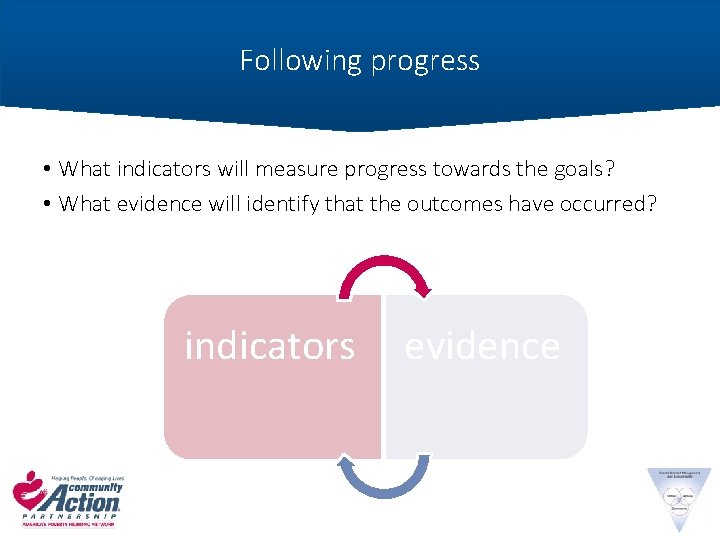
Following progress • What indicators will measure progress towards the goals? • What evidence will identify that the outcomes have occurred? indicators evidence
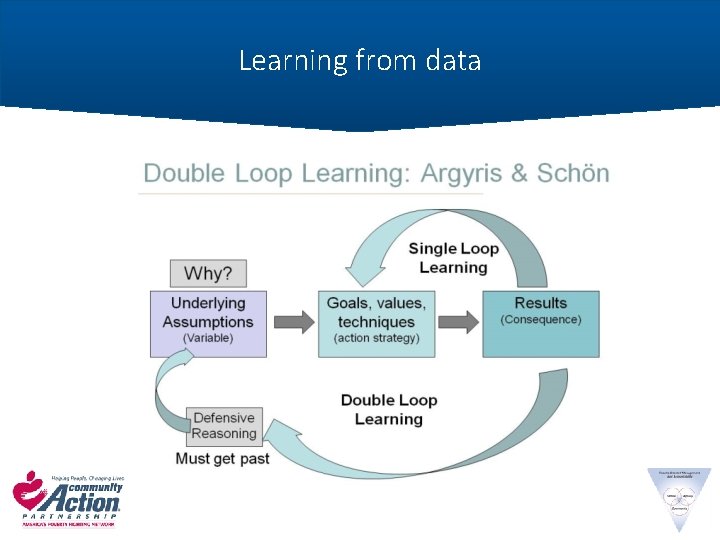
Learning from data
Now that you have a local TOC… • How will you use it?
Modified from CAP Presentation by Barbara Mooney, Director Association of Nationally Certified ROMA Trainers barbaramooney@windstream. net Myka Piatt, Training & Curriculum Development Temple University Myka. piatt@temple. edu Courtney Kohler, Senior Associate Community Action Partnership ckohler@communityactionpartnership. com Jarle Crocker, Director T/TA Community Action Partnership jcrocker@communityactionpartnership. com