
Creating a Contour Plot from Spatial Data A
- Slides: 12
Creating a Contour Plot from Spatial Data A Comp. Hydro example
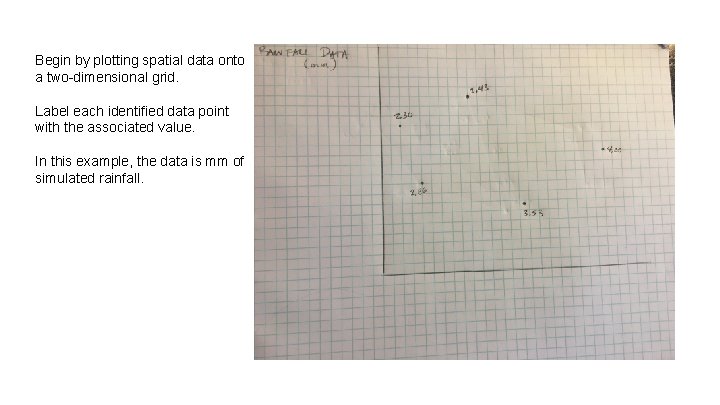
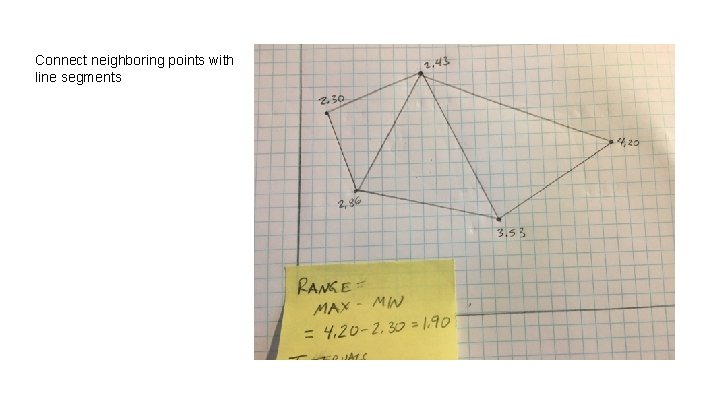
Begin by plotting spatial data onto a two-dimensional grid. Label each identified data point with the associated value. In this example, the data is mm of simulated rainfall.
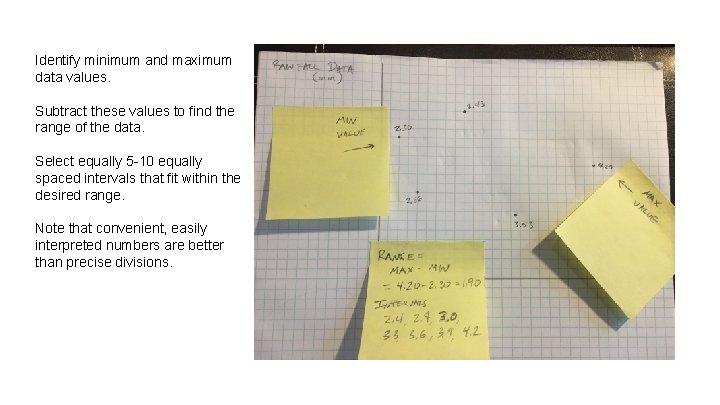
Identify minimum and maximum data values. Subtract these values to find the range of the data. Select equally 5 -10 equally spaced intervals that fit within the desired range. Note that convenient, easily interpreted numbers are better than precise divisions.
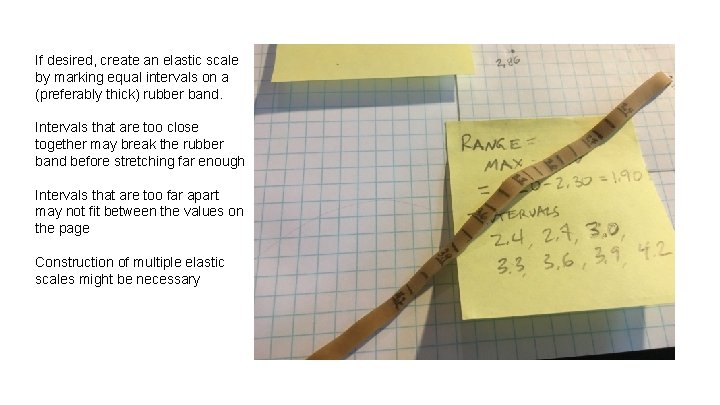
If desired, create an elastic scale by marking equal intervals on a (preferably thick) rubber band. Intervals that are too close together may break the rubber band before stretching far enough Intervals that are too far apart may not fit between the values on the page Construction of multiple elastic scales might be necessary
Connect neighboring points with line segments
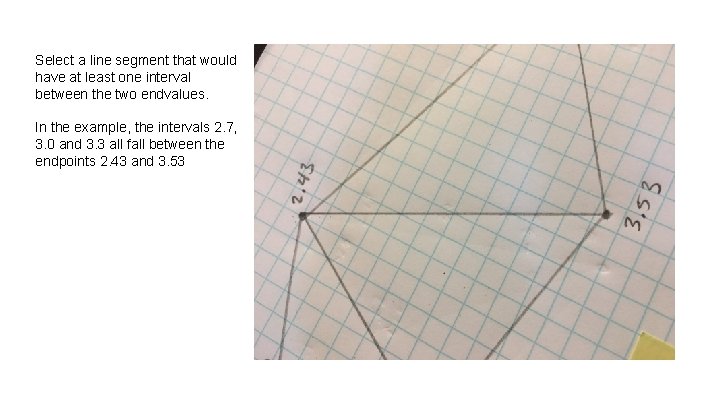
Select a line segment that would have at least one interval between the two endvalues. In the example, the intervals 2. 7, 3. 0 and 3. 3 all fall between the endpoints 2. 43 and 3. 53
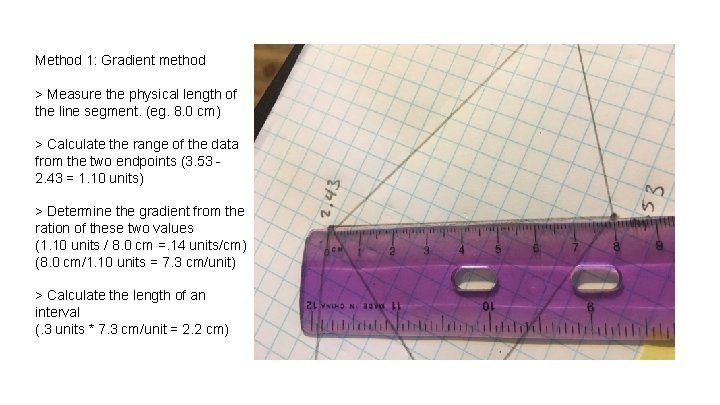
Method 1: Gradient method > Measure the physical length of the line segment. (eg. 8. 0 cm) > Calculate the range of the data from the two endpoints (3. 53 2. 43 = 1. 10 units) > Determine the gradient from the ration of these two values (1. 10 units / 8. 0 cm =. 14 units/cm) (8. 0 cm/1. 10 units = 7. 3 cm/unit) > Calculate the length of an interval (. 3 units * 7. 3 cm/unit = 2. 2 cm)
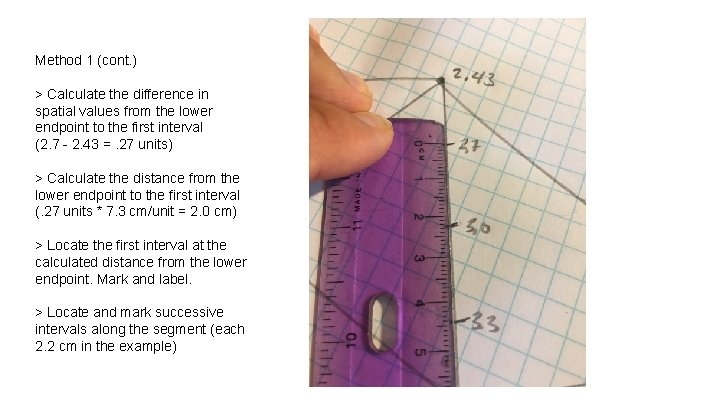
Method 1 (cont. ) > Calculate the difference in spatial values from the lower endpoint to the first interval (2. 7 - 2. 43 =. 27 units) > Calculate the distance from the lower endpoint to the first interval (. 27 units * 7. 3 cm/unit = 2. 0 cm) > Locate the first interval at the calculated distance from the lower endpoint. Mark and label. > Locate and mark successive intervals along the segment (each 2. 2 cm in the example)
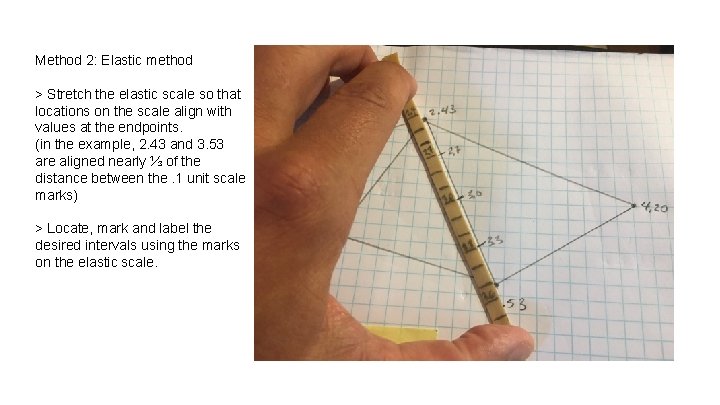
Method 2: Elastic method > Stretch the elastic scale so that locations on the scale align with values at the endpoints. (in the example, 2. 43 and 3. 53 are aligned nearly ⅓ of the distance between the. 1 unit scale marks) > Locate, mark and label the desired intervals using the marks on the elastic scale.
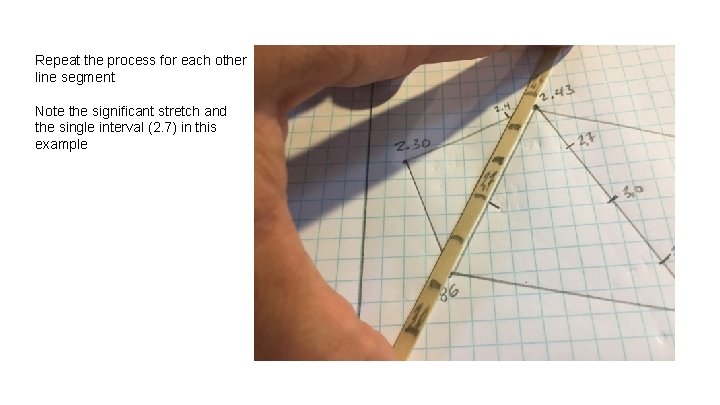
Repeat the process for each other line segment Note the significant stretch and the single interval (2. 7) in this example
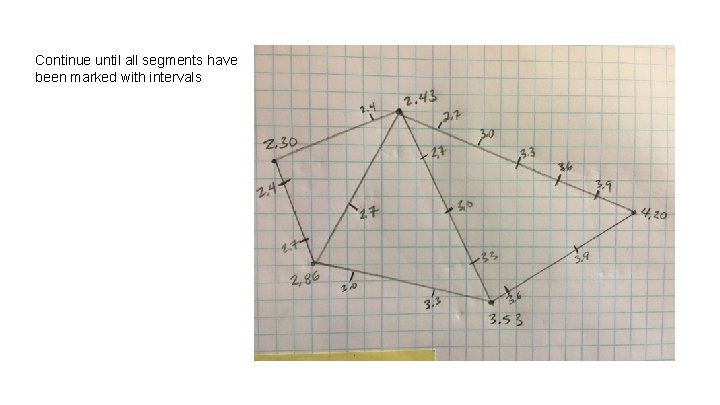
Continue until all segments have been marked with intervals
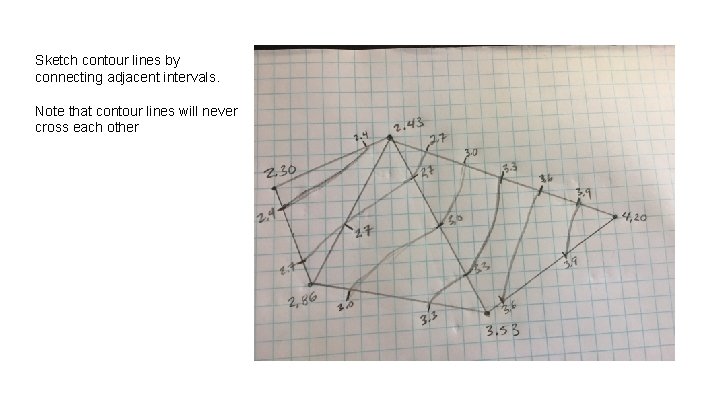
Sketch contour lines by connecting adjacent intervals. Note that contour lines will never cross each other