
Creating a Constitution Vocabulary Executive Economic Depression Judicial
Creating a Constitution
Vocabulary • Executive • Economic Depression • Judicial Branch • Ratify • Constitution • Northwest Ordinance of 1787
Governing a New Nation • What are the jobs of a executive branch and legislature branch? • Who was the first state to have a bill of rights?
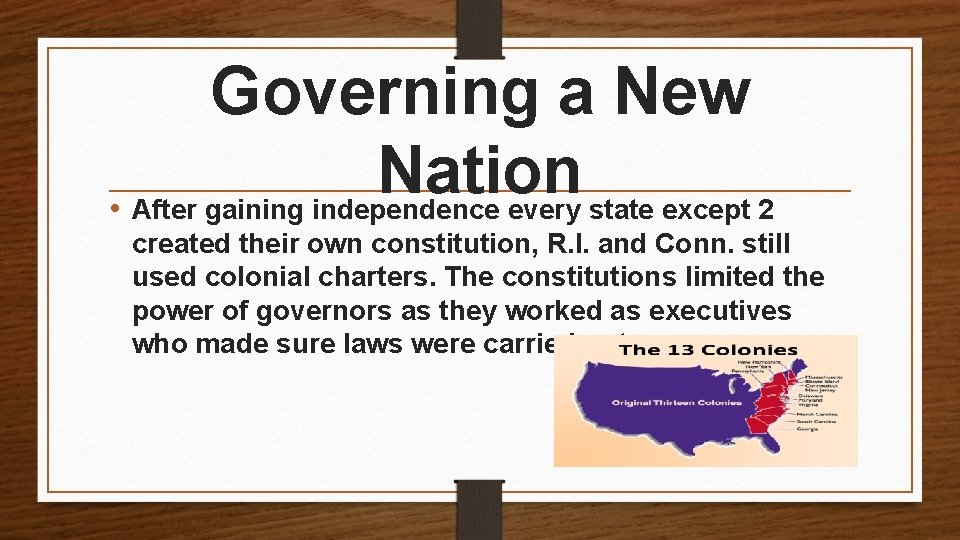
Governing a New Nation • After gaining independence every state except 2 created their own constitution, R. I. and Conn. still used colonial charters. The constitutions limited the power of governors as they worked as executives who made sure laws were carried out.
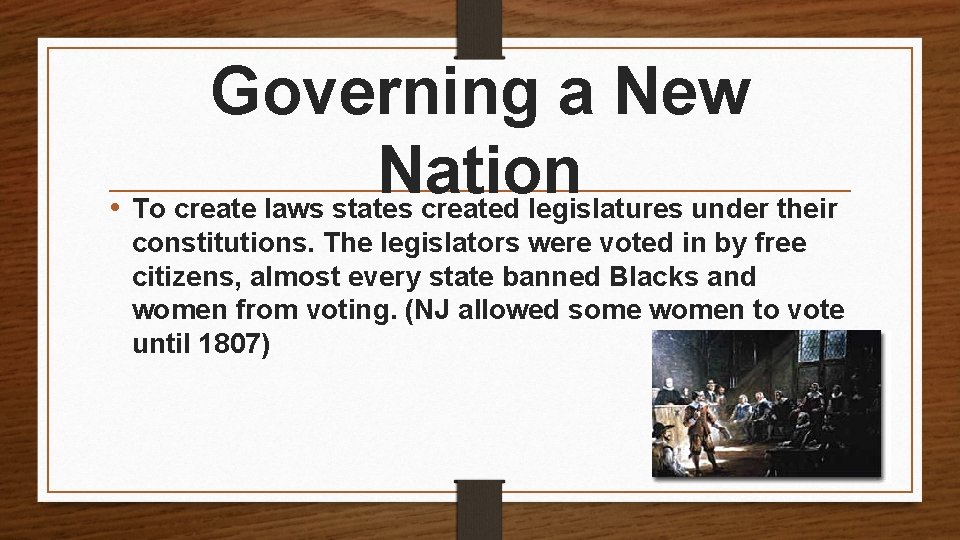
Governing a New Nation • To create laws states created legislatures under their constitutions. The legislators were voted in by free citizens, almost every state banned Blacks and women from voting. (NJ allowed some women to vote until 1807)
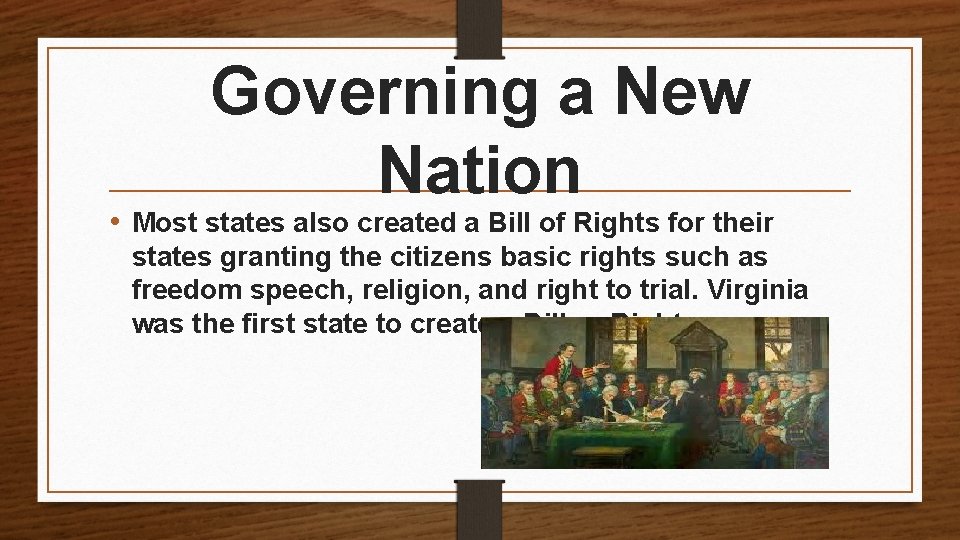
Governing a New Nation • Most states also created a Bill of Rights for their states granting the citizens basic rights such as freedom speech, religion, and right to trial. Virginia was the first state to create a Bill or Rights.
Governing a New Nation • What was the form of National Government called? • What were the powers of Congress?
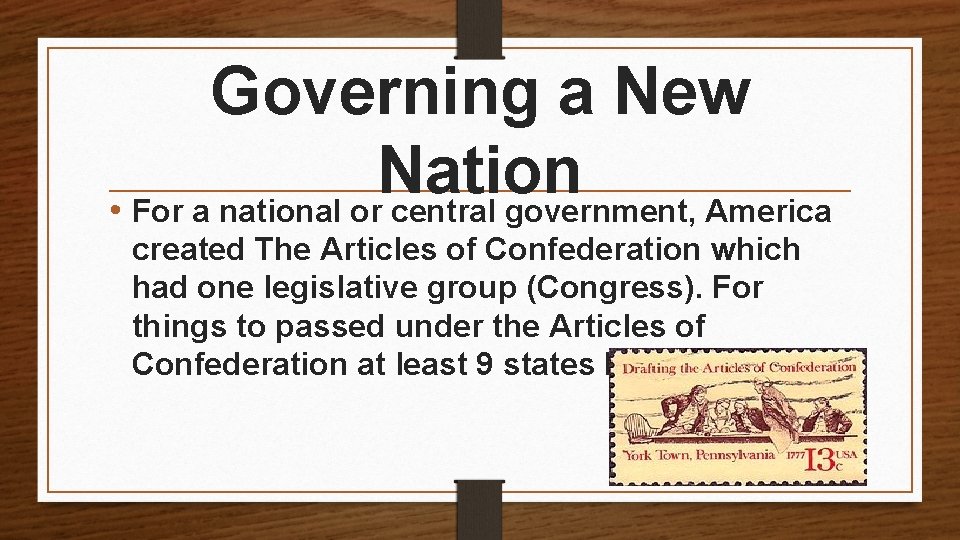
Governing a New Nation • For a national or central government, America created The Articles of Confederation which had one legislative group (Congress). For things to passed under the Articles of Confederation at least 9 states had to approve.
Governing a New Nation • The Articles of Confederation (congress) dealt with foreign affairs, create laws, declare war, borrow and coin money, and ran a postal service. Most power still belong to states as they controlled trade, taxes, and enforcing laws.
Governing a New Nation • When was the Articles of Confederation approved? • What were the requirements for the Northwest Ordinance of 1787?
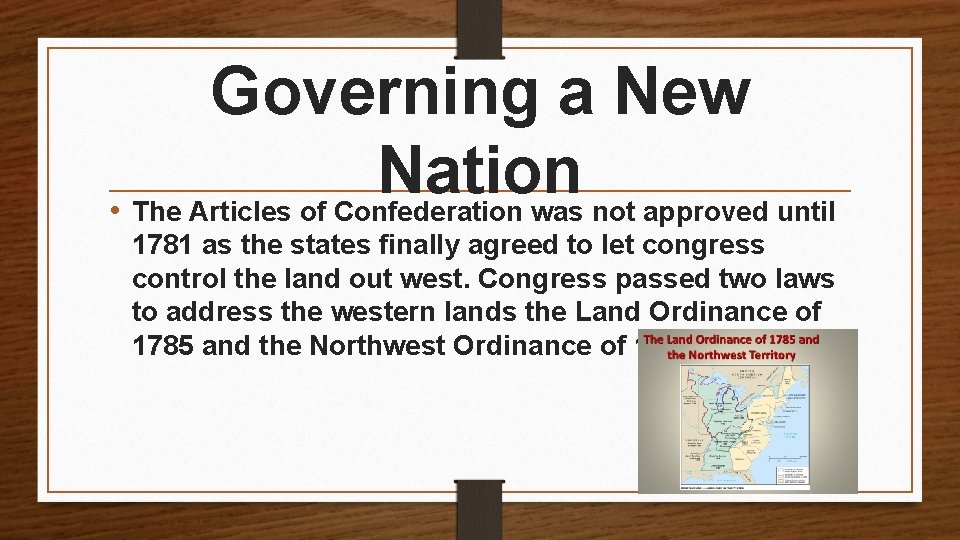
Governing a New Nation • The Articles of Confederation was not approved until 1781 as the states finally agreed to let congress control the land out west. Congress passed two laws to address the western lands the Land Ordinance of 1785 and the Northwest Ordinance of 1787.
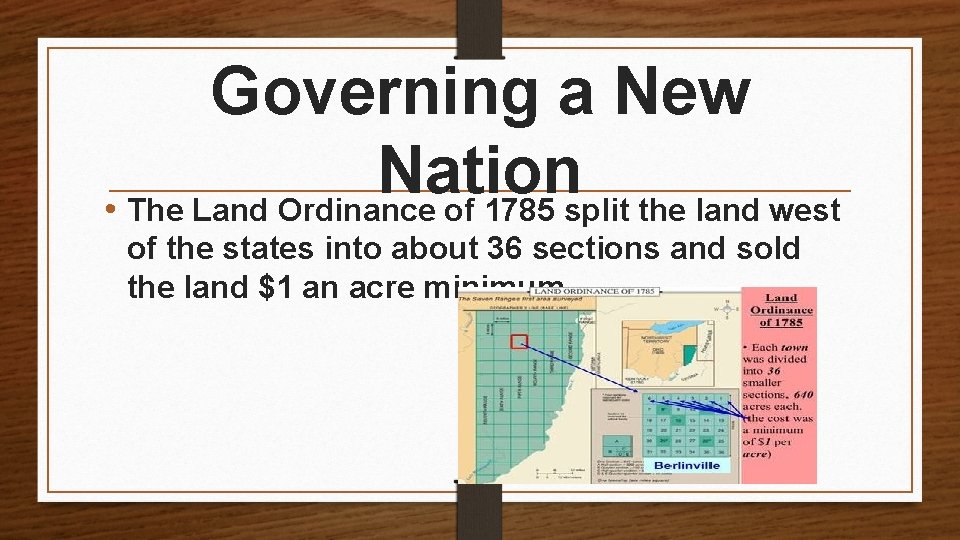
Governing a New Nation • The Land Ordinance of 1785 split the land west of the states into about 36 sections and sold the land $1 an acre minimum.
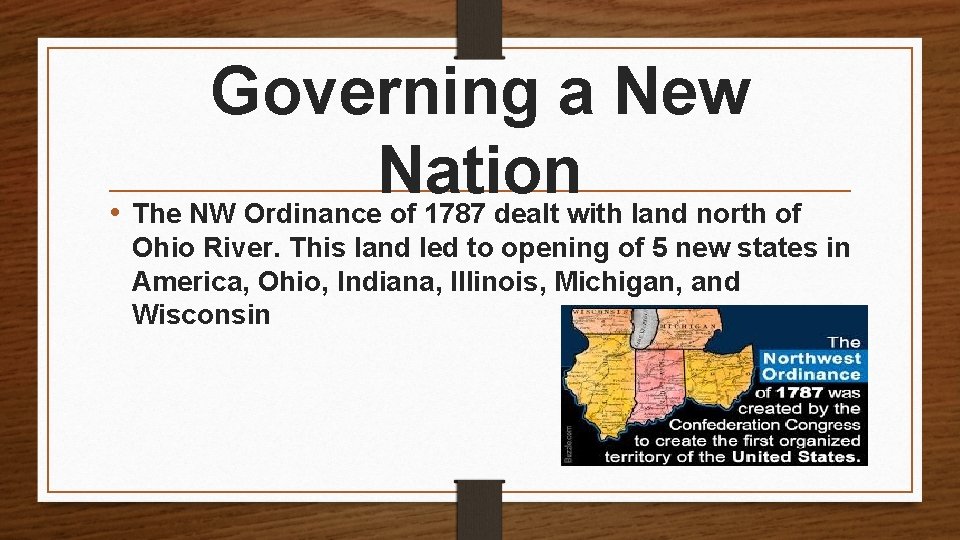
Governing a New Nation • The NW Ordinance of 1787 dealt with land north of Ohio River. This land led to opening of 5 new states in America, Ohio, Indiana, Illinois, Michigan, and Wisconsin
Governing a New Nation • Requirements of the NW Ordinance include: • No Slavery • Congress appointed gov. , secretary, and judges • Could elect legislature if population reached 5000 free males • Population reaches 60, 000 territory could become a state
Governing a New Nation • Why was trade difficult in America? • What were some foreign affair problems Americans faced? • Who is Daniel Shay? Why is he important?
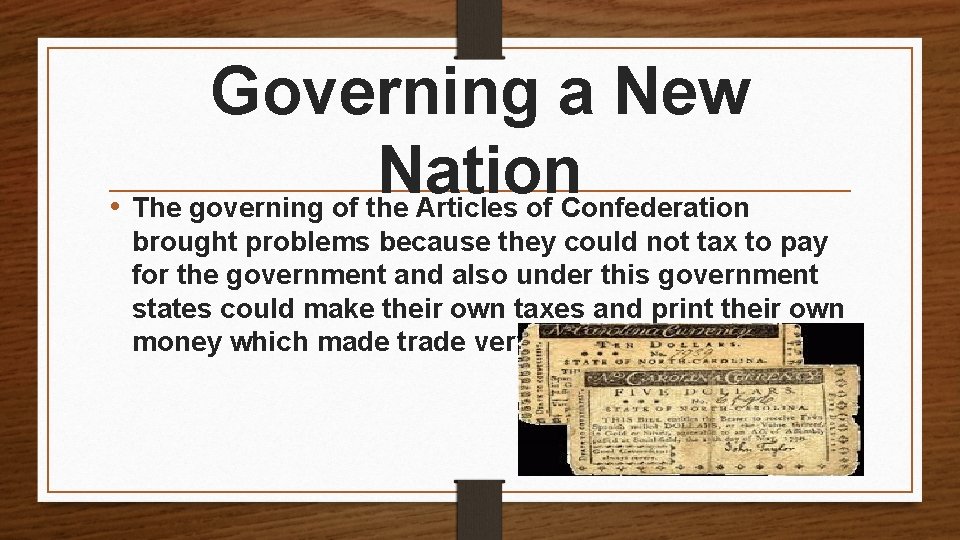
Governing a New Nation • The governing of the Articles of Confederation brought problems because they could not tax to pay for the government and also under this government states could make their own taxes and print their own money which made trade very difficult.
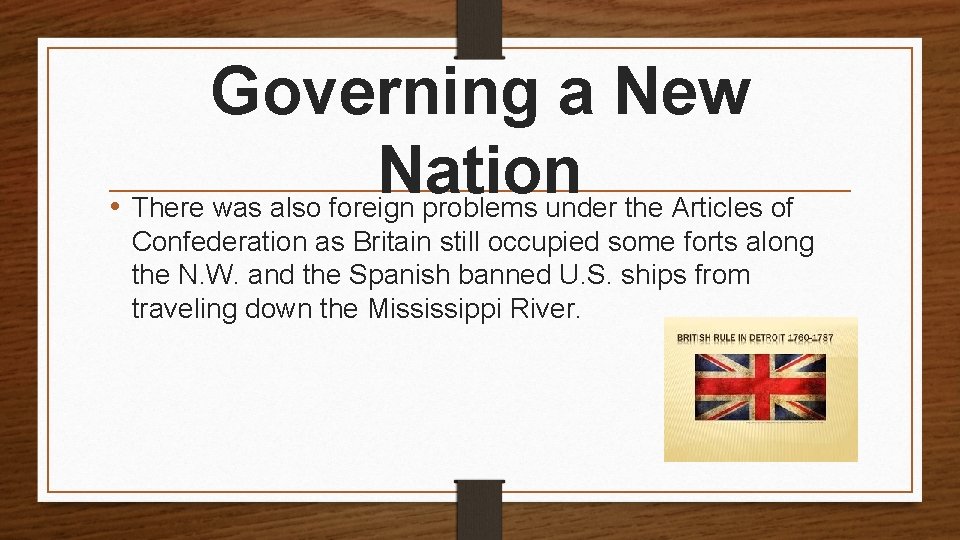
Governing a New Nation • There was also foreign problems under the Articles of Confederation as Britain still occupied some forts along the N. W. and the Spanish banned U. S. ships from traveling down the Mississippi River.
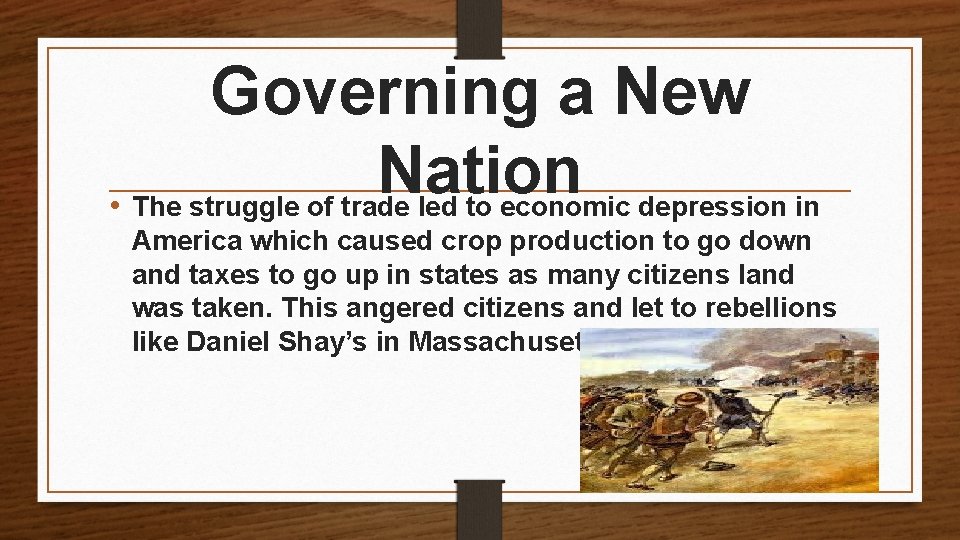
Governing a New Nation • The struggle of trade led to economic depression in America which caused crop production to go down and taxes to go up in states as many citizens land was taken. This angered citizens and let to rebellions like Daniel Shay’s in Massachusetts in 1786.
Constitutional Convention • How many delegates met in Philadelphia in the summer of 1787? • What was the purpose of the delegates meeting?
Constitutional Convention • After the failure of the Articles of Confederation 55 delegates met in Philadelphia to revise the Articles of Confederation but after meeting the delegates agreed that it was time for a new system.
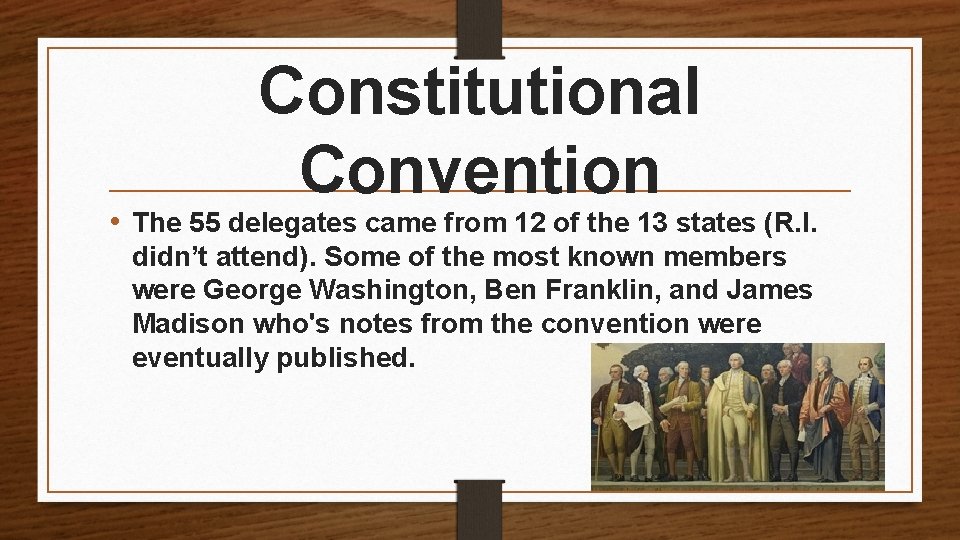
Constitutional Convention • The 55 delegates came from 12 of the 13 states (R. I. didn’t attend). Some of the most known members were George Washington, Ben Franklin, and James Madison who's notes from the convention were eventually published.
Constitutional Convention • What was the main goal of the Va. Plan ask for? • How did Va. Plan go about attaining this goal? • How did the Va. Plan want laws created under the new government system?
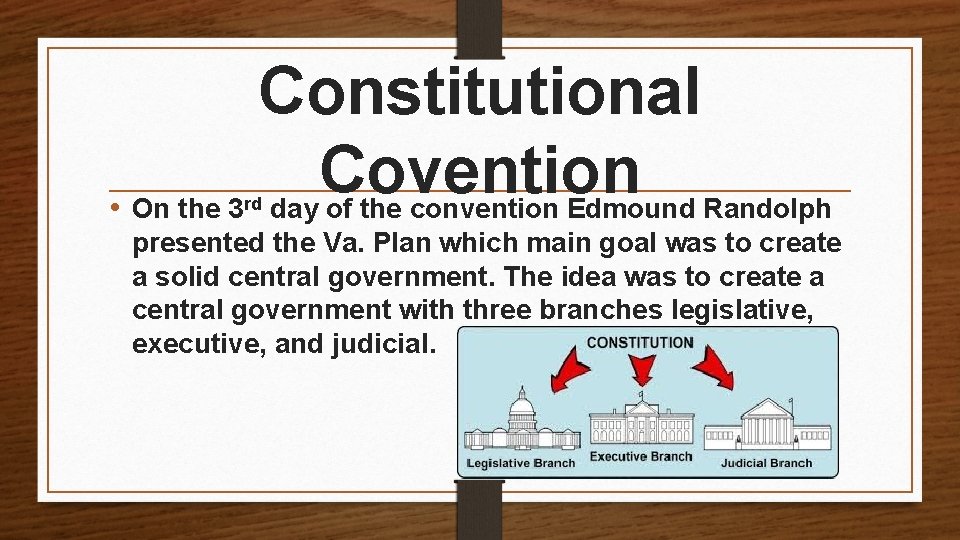
Constitutional Covention • On the 3 day of the convention Edmound Randolph rd presented the Va. Plan which main goal was to create a solid central government. The idea was to create a central government with three branches legislative, executive, and judicial.
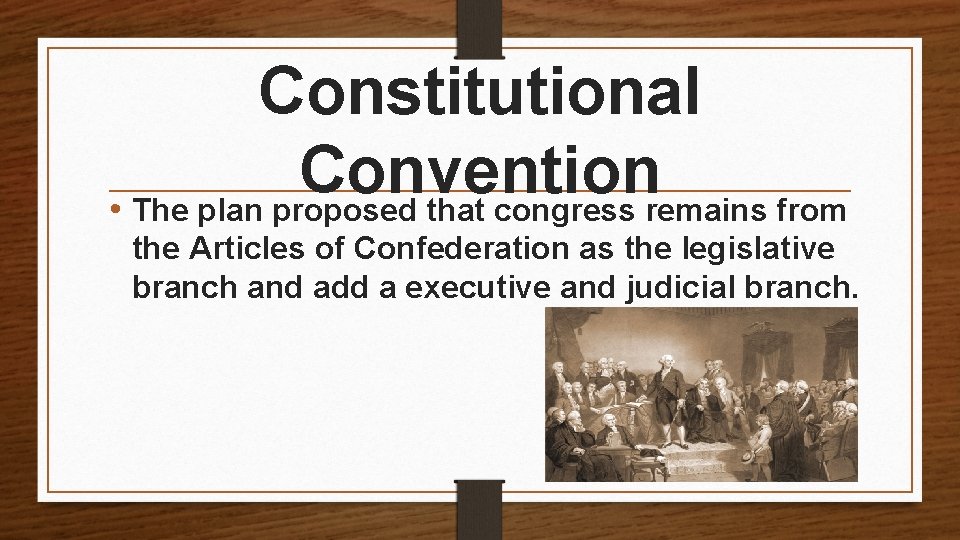
Constitutional Convention • The plan proposed that congress remains from the Articles of Confederation as the legislative branch and add a executive and judicial branch.
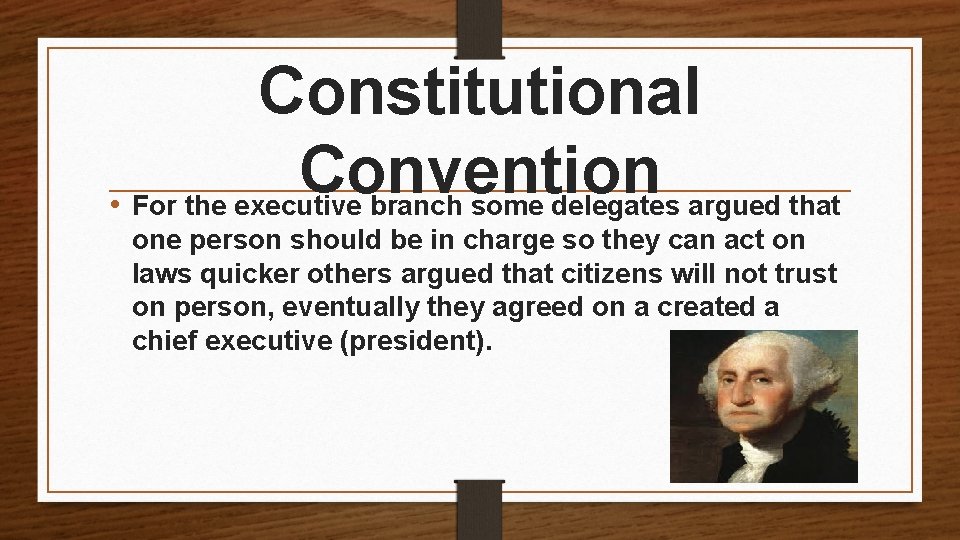
Constitutional Convention • For the executive branch some delegates argued that one person should be in charge so they can act on laws quicker others argued that citizens will not trust on person, eventually they agreed on a created a chief executive (president).
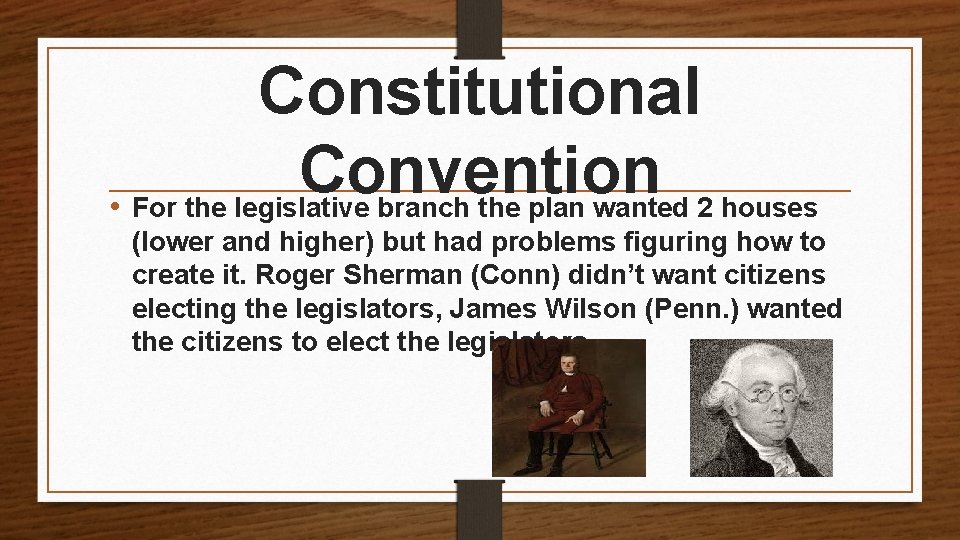
Constitutional Convention • For the legislative branch the plan wanted 2 houses (lower and higher) but had problems figuring how to create it. Roger Sherman (Conn) didn’t want citizens electing the legislators, James Wilson (Penn. ) wanted the citizens to elect the legislators.
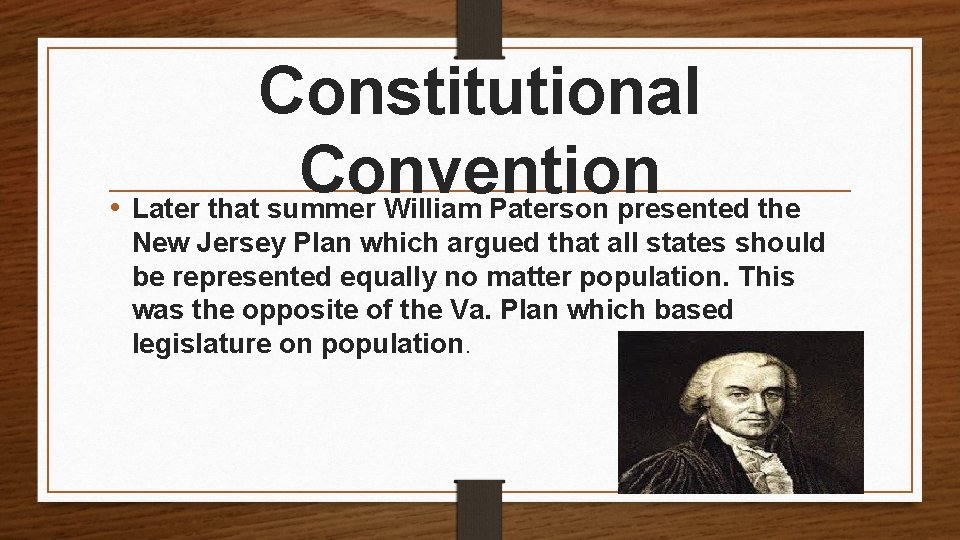
Constitutional Convention • Later that summer William Paterson presented the New Jersey Plan which argued that all states should be represented equally no matter population. This was the opposite of the Va. Plan which based legislature on population.
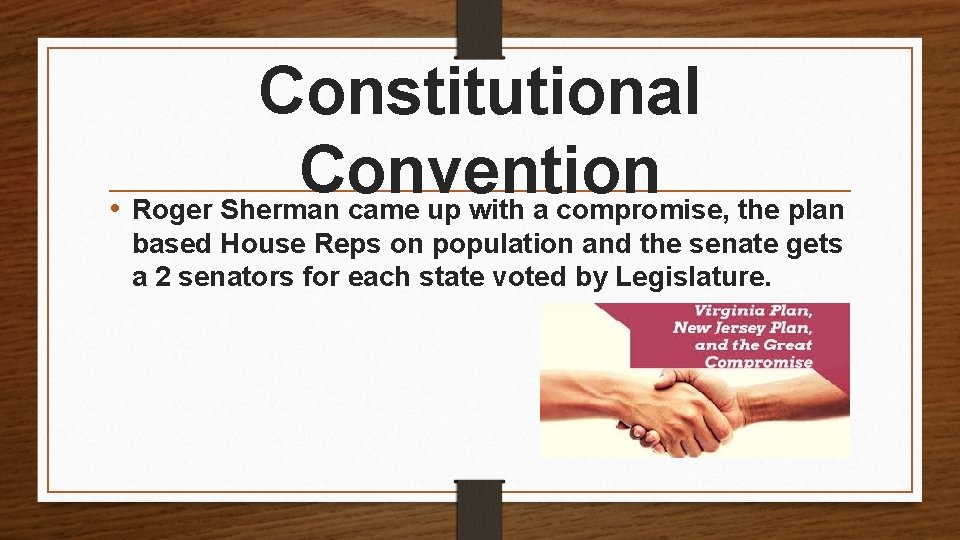
Constitutional Convention • Roger Sherman came up with a compromise, the plan based House Reps on population and the senate gets a 2 senators for each state voted by Legislature.
Constitutional Convention • How did Congress deal with slavery in the constitution? • How did Congress deal with slave trade? • When did delegates agree on the constitution?
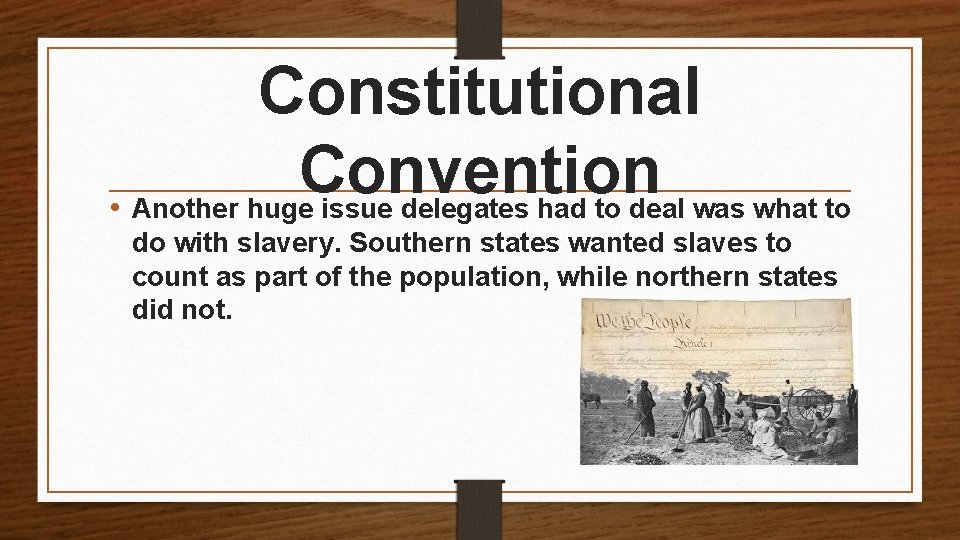
Constitutional Convention • Another huge issue delegates had to deal was what to do with slavery. Southern states wanted slaves to count as part of the population, while northern states did not.
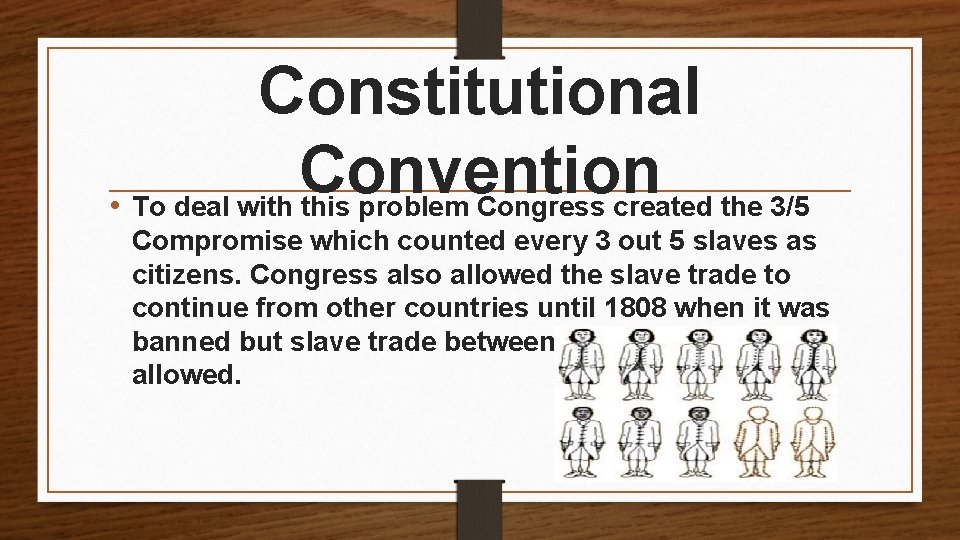
Constitutional Convention • To deal with this problem Congress created the 3/5 Compromise which counted every 3 out 5 slaves as citizens. Congress also allowed the slave trade to continue from other countries until 1808 when it was banned but slave trade between states was still allowed.
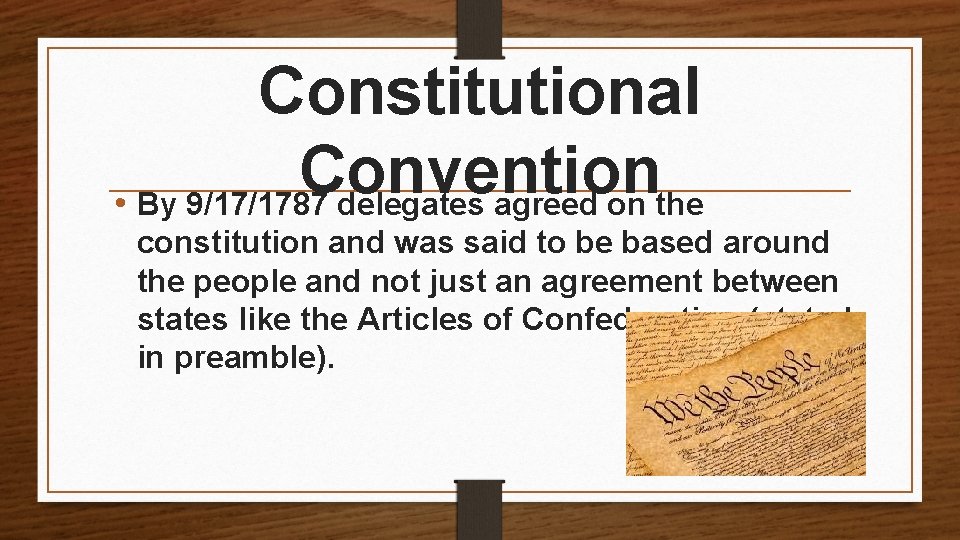
Constitutional Convention • By 9/17/1787 delegates agreed on the constitution and was said to be based around the people and not just an agreement between states like the Articles of Confederation (stated in preamble).
Debating the Constitution • What was the difference between federalist and antifederalist? • Who wrote the federalist papers and what were they about? • What did antifederalist argue?
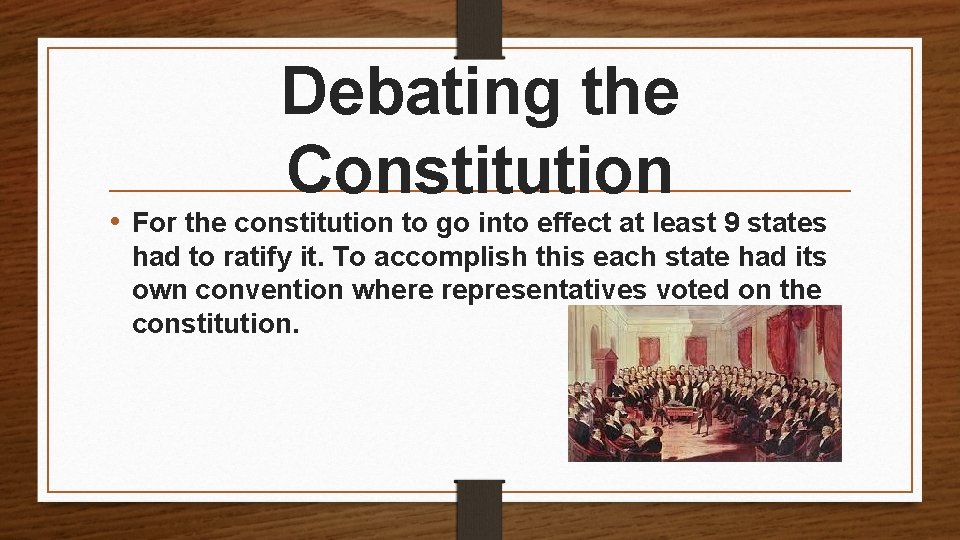
Debating the Constitution • For the constitution to go into effect at least 9 states had to ratify it. To accomplish this each state had its own convention where representatives voted on the constitution.
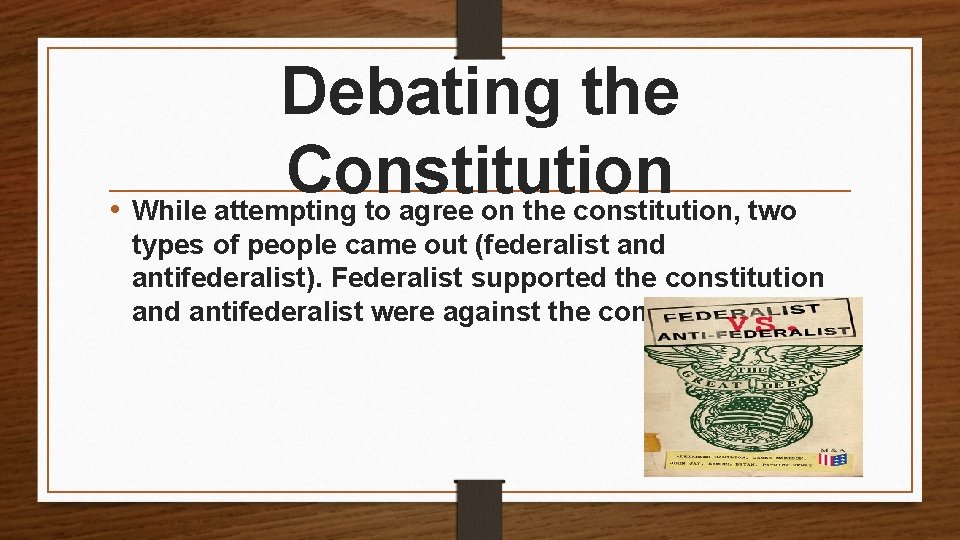
Debating the Constitution • While attempting to agree on the constitution, two types of people came out (federalist and antifederalist). Federalist supported the constitution and antifederalist were against the constitution.
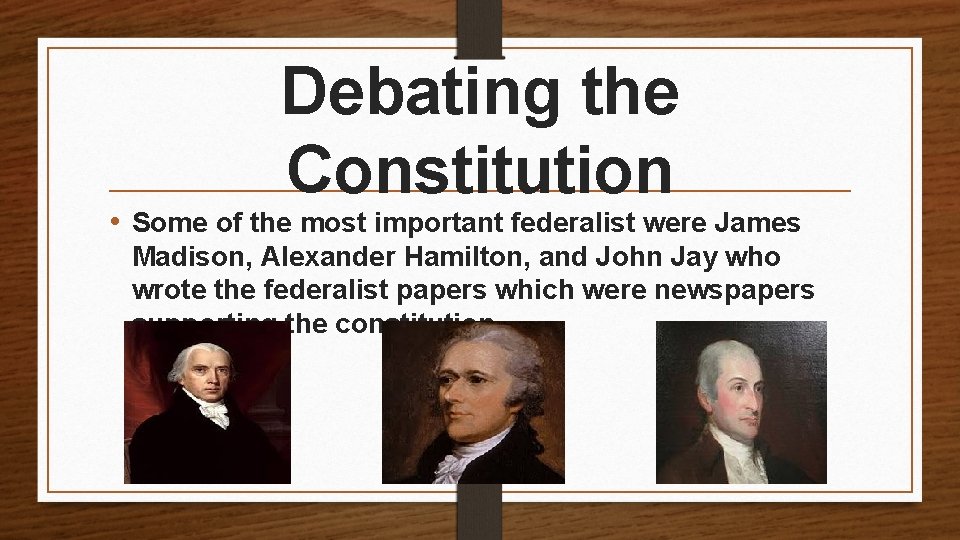
Debating the Constitution • Some of the most important federalist were James Madison, Alexander Hamilton, and John Jay who wrote the federalist papers which were newspapers supporting the constitution.
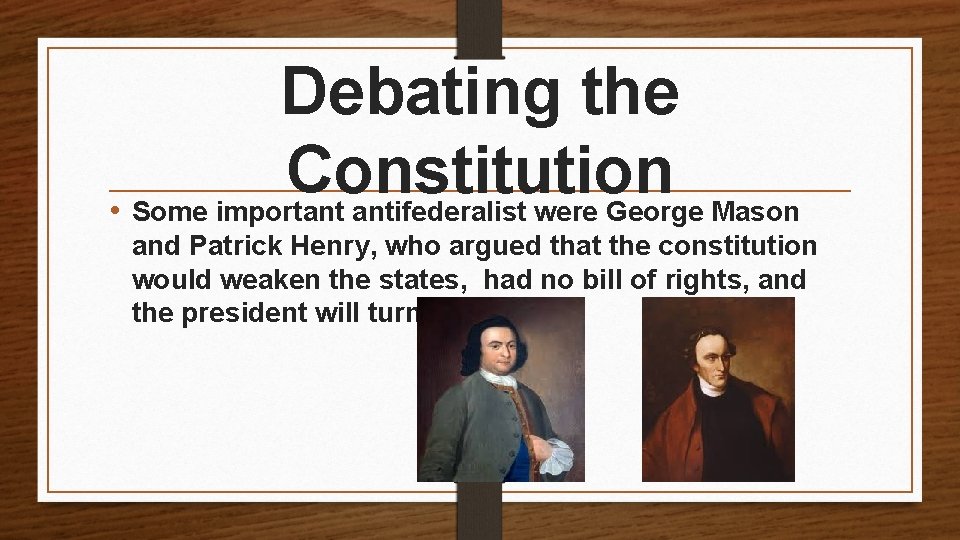
Debating the Constitution • Some important antifederalist were George Mason and Patrick Henry, who argued that the constitution would weaken the states, had no bill of rights, and the president will turn into a king.
Debating the Constitution • Who was the 1 state to ratify the constitution? st • Why was Va decision on the constitution was so important? • Which state put the constitution into effect?
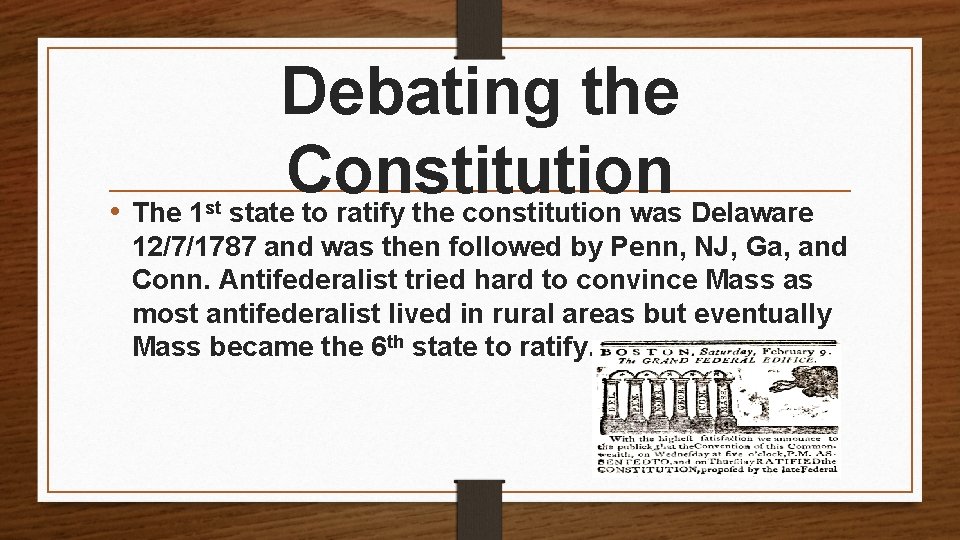
• The 1 st Debating the Constitution state to ratify the constitution was Delaware 12/7/1787 and was then followed by Penn, NJ, Ga, and Conn. Antifederalist tried hard to convince Mass as most antifederalist lived in rural areas but eventually Mass became the 6 th state to ratify.
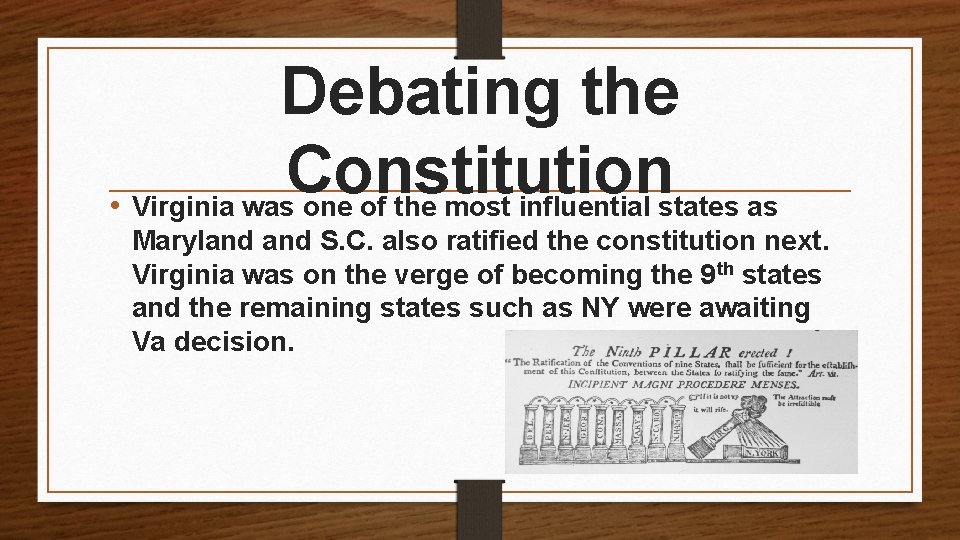
Debating the Constitution • Virginia was one of the most influential states as Maryland S. C. also ratified the constitution next. Virginia was on the verge of becoming the 9 th states and the remaining states such as NY were awaiting Va decision.
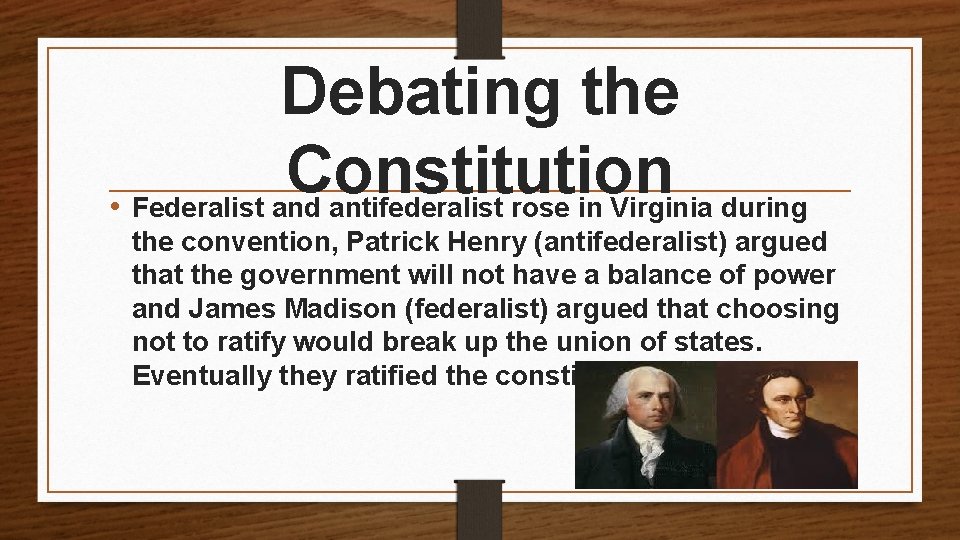
Debating the Constitution • Federalist and antifederalist rose in Virginia during the convention, Patrick Henry (antifederalist) argued that the government will not have a balance of power and James Madison (federalist) argued that choosing not to ratify would break up the union of states. Eventually they ratified the constitution (89 to 79 vote)
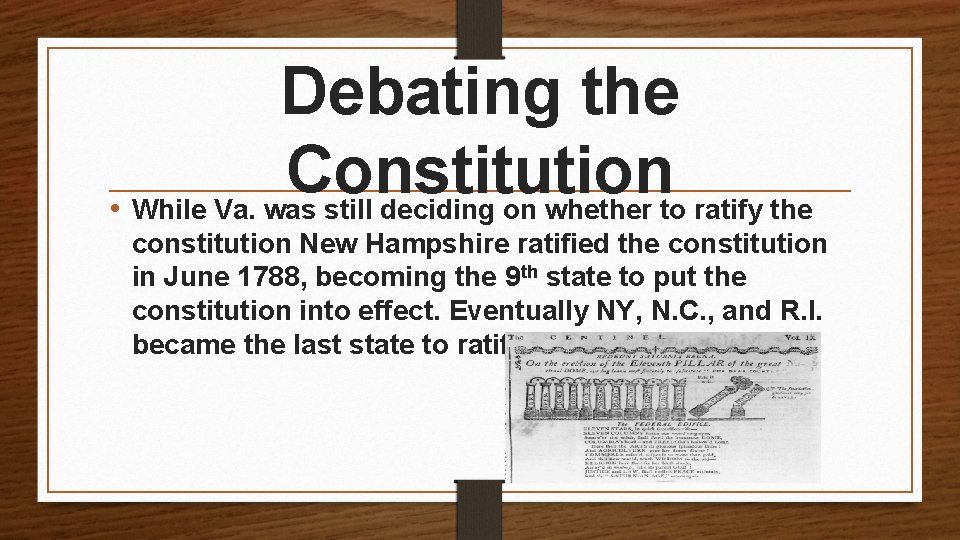
Debating the Constitution • While Va. was still deciding on whether to ratify the constitution New Hampshire ratified the constitution in June 1788, becoming the 9 th state to put the constitution into effect. Eventually NY, N. C. , and R. I. became the last state to ratify in May 1790.
Debating the Constitution • When did congress come together to address the basic rights of each citizen? • What are the first 10 Amendments of the constitution called? • Which Amendments protect the rights of the accused? • Which Amendments limit the power of the national government?
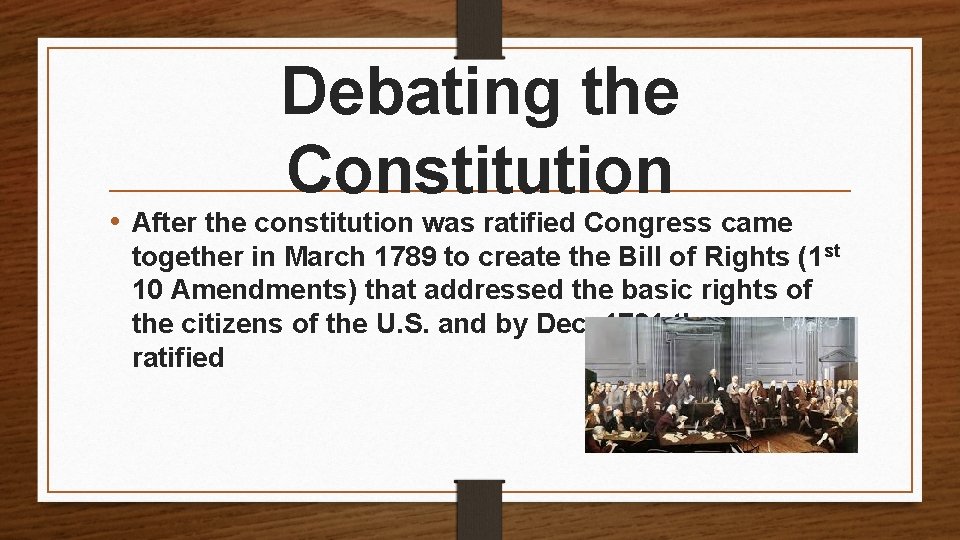
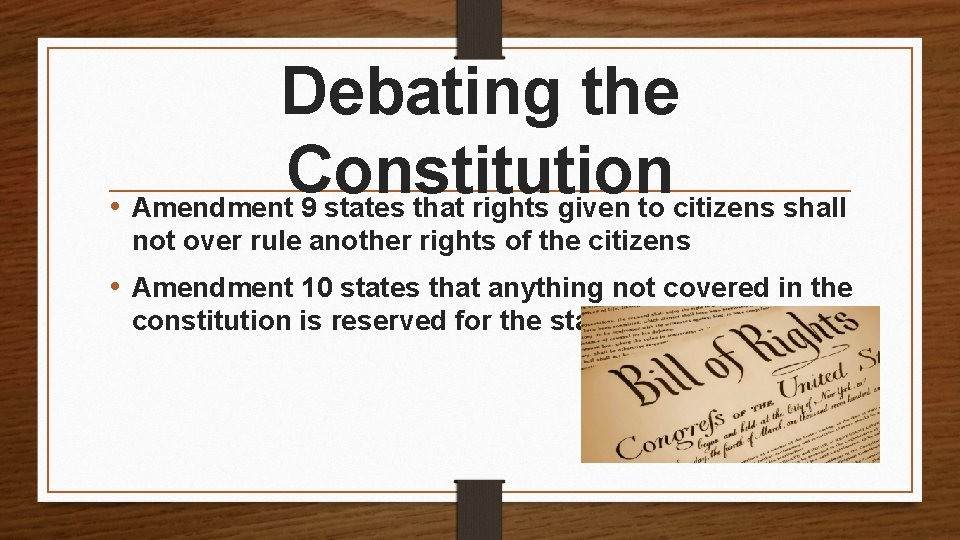
Debating the Constitution • After the constitution was ratified Congress came together in March 1789 to create the Bill of Rights (1 st 10 Amendments) that addressed the basic rights of the citizens of the U. S. and by Dec. 1791 they were ratified
Debating the Constitution • Amendment 1 gave freedom of speech, religion, and the press • Amendment 2 gave citizens the right to bare arms • Amendment 3 stated the a congress couldn’t force citizens to house soldiers • Amendment 4 protect citizens against unreasonable searches
Debating the Constitution • Amendments 5 states that citizens cant incriminate themselves or double jeopardy • Amendment 6 gives those accused a right to a speedy trial • Amendment 7 gives those accused the right to a trial by jury • Amendment 8 eliminates excessive bails given by government
Debating the Constitution • Amendment 9 states that rights given to citizens shall not over rule another rights of the citizens • Amendment 10 states that anything not covered in the constitution is reserved for the states.
- Slides: 47