
Creating a coaching culture for students How can

- Slides: 20
Creating a coaching culture for students How can coaching strategies help us to solve student problems? Creating a Coaching Culture 1
Outline and objectives of session • To share our current experiences of student support in this and other schools. • To understand the GROW and STRIDE strategies for coaching. • To explore how these coaching strategies could work in practice with students. • To consider how we can most effectively begin to create a coaching culture. Creating a Coaching Culture 2
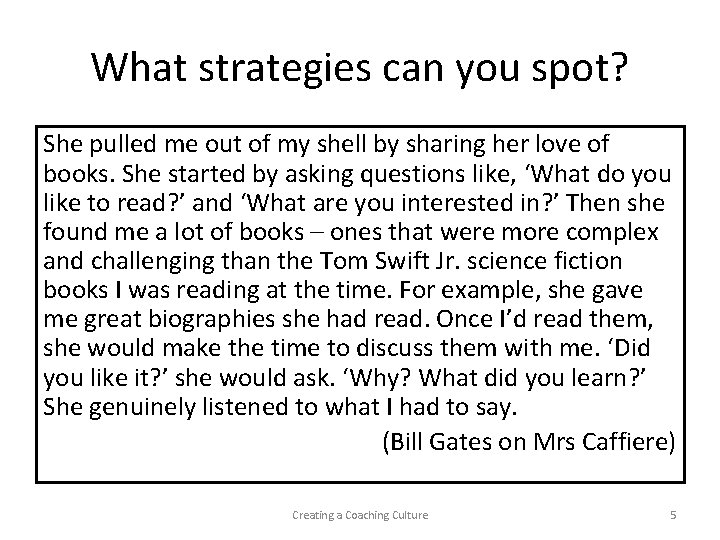
A teacher who changed my life She pulled me out of my shell by sharing her love of books. She started by asking questions like, ‘What do you like to read? ’ and ‘What are you interested in? ’ Then she found me a lot of books – ones that were more complex and challenging than the Tom Swift Jr. science fiction books I was reading at the time. For example, she gave me great biographies she had read. Once I’d read them, she would make the time to discuss them with me. ‘Did you like it? ’ she would ask. ‘Why? What did you learn? ’ She genuinely listened to what I had to say. (Bill Gates on Mrs Caffiere) Creating a Coaching Culture 3
Who was the teacher who changed your life? • Think about a teacher or trusted adult who changed the way that you thought about yourself, and helped you to flourish. • Take a little time to share your story with those at your table. • Who was your favourite teacher, and why? Creating a Coaching Culture 4
What strategies can you spot? She pulled me out of my shell by sharing her love of books. She started by asking questions like, ‘What do you like to read? ’ and ‘What are you interested in? ’ Then she found me a lot of books – ones that were more complex and challenging than the Tom Swift Jr. science fiction books I was reading at the time. For example, she gave me great biographies she had read. Once I’d read them, she would make the time to discuss them with me. ‘Did you like it? ’ she would ask. ‘Why? What did you learn? ’ She genuinely listened to what I had to say. (Bill Gates on Mrs Caffiere) Creating a Coaching Culture 5
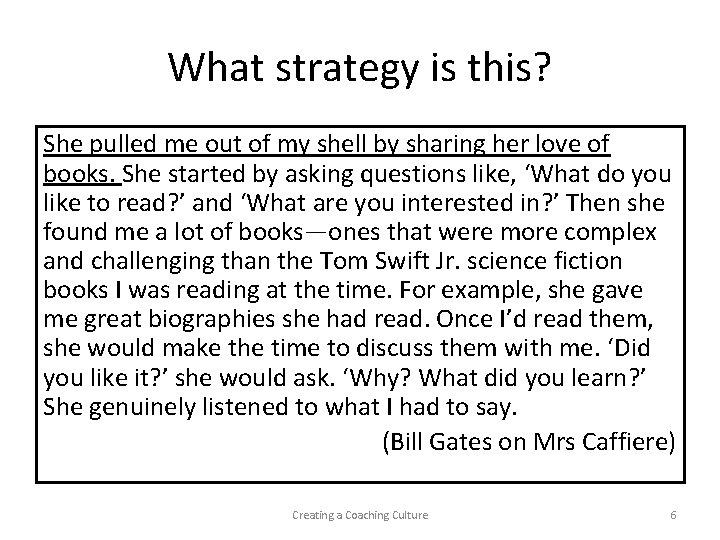
What strategy is this? She pulled me out of my shell by sharing her love of books. She started by asking questions like, ‘What do you like to read? ’ and ‘What are you interested in? ’ Then she found me a lot of books—ones that were more complex and challenging than the Tom Swift Jr. science fiction books I was reading at the time. For example, she gave me great biographies she had read. Once I’d read them, she would make the time to discuss them with me. ‘Did you like it? ’ she would ask. ‘Why? What did you learn? ’ She genuinely listened to what I had to say. (Bill Gates on Mrs Caffiere) Creating a Coaching Culture 6
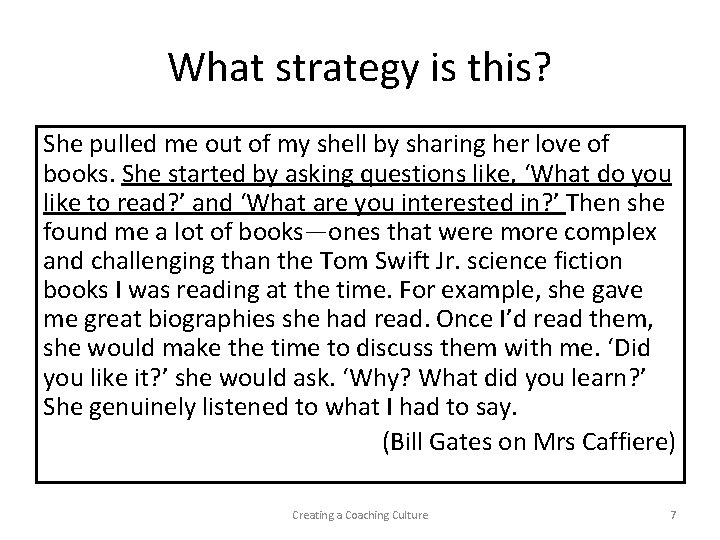
What strategy is this? She pulled me out of my shell by sharing her love of books. She started by asking questions like, ‘What do you like to read? ’ and ‘What are you interested in? ’ Then she found me a lot of books—ones that were more complex and challenging than the Tom Swift Jr. science fiction books I was reading at the time. For example, she gave me great biographies she had read. Once I’d read them, she would make the time to discuss them with me. ‘Did you like it? ’ she would ask. ‘Why? What did you learn? ’ She genuinely listened to what I had to say. (Bill Gates on Mrs Caffiere) Creating a Coaching Culture 7
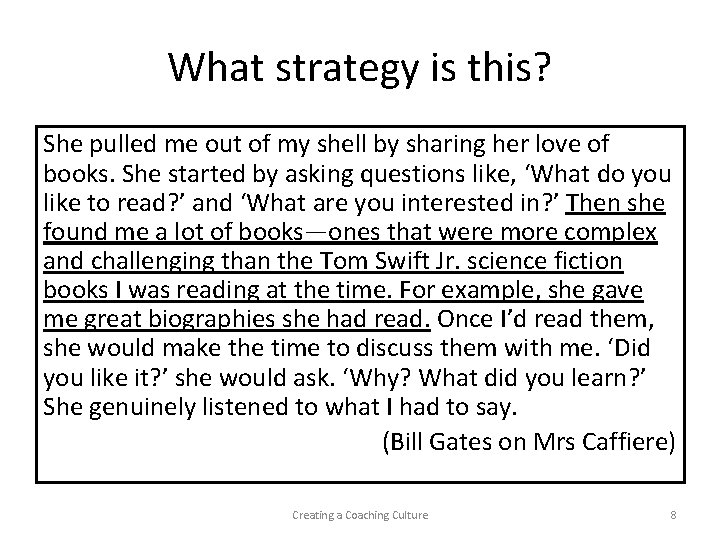
What strategy is this? She pulled me out of my shell by sharing her love of books. She started by asking questions like, ‘What do you like to read? ’ and ‘What are you interested in? ’ Then she found me a lot of books—ones that were more complex and challenging than the Tom Swift Jr. science fiction books I was reading at the time. For example, she gave me great biographies she had read. Once I’d read them, she would make the time to discuss them with me. ‘Did you like it? ’ she would ask. ‘Why? What did you learn? ’ She genuinely listened to what I had to say. (Bill Gates on Mrs Caffiere) Creating a Coaching Culture 8
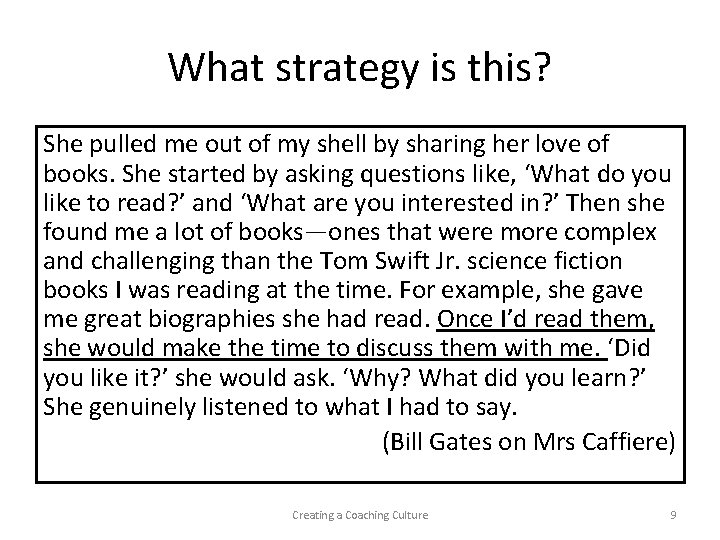
What strategy is this? She pulled me out of my shell by sharing her love of books. She started by asking questions like, ‘What do you like to read? ’ and ‘What are you interested in? ’ Then she found me a lot of books—ones that were more complex and challenging than the Tom Swift Jr. science fiction books I was reading at the time. For example, she gave me great biographies she had read. Once I’d read them, she would make the time to discuss them with me. ‘Did you like it? ’ she would ask. ‘Why? What did you learn? ’ She genuinely listened to what I had to say. (Bill Gates on Mrs Caffiere) Creating a Coaching Culture 9
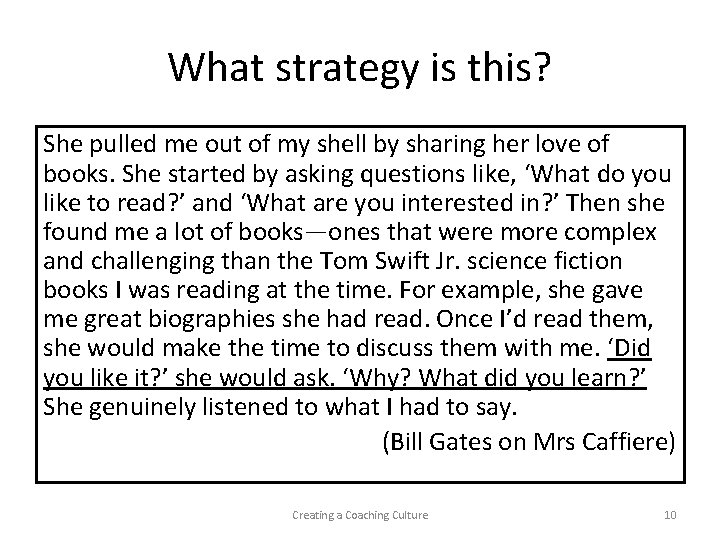
What strategy is this? She pulled me out of my shell by sharing her love of books. She started by asking questions like, ‘What do you like to read? ’ and ‘What are you interested in? ’ Then she found me a lot of books—ones that were more complex and challenging than the Tom Swift Jr. science fiction books I was reading at the time. For example, she gave me great biographies she had read. Once I’d read them, she would make the time to discuss them with me. ‘Did you like it? ’ she would ask. ‘Why? What did you learn? ’ She genuinely listened to what I had to say. (Bill Gates on Mrs Caffiere) Creating a Coaching Culture 10
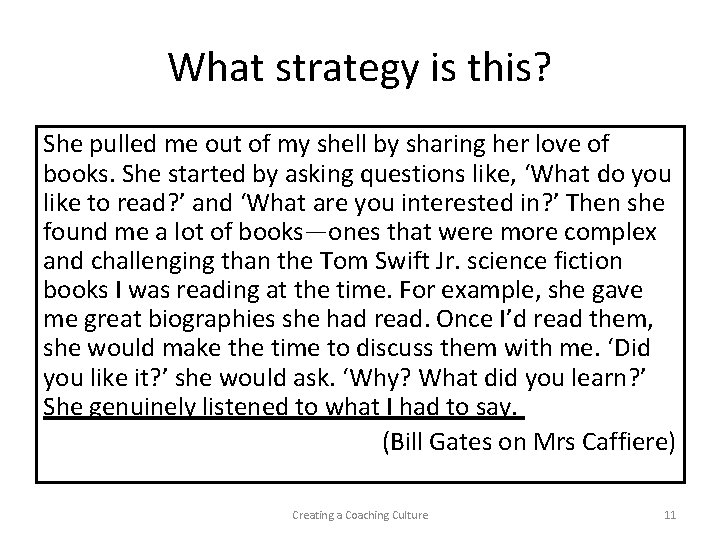
What strategy is this? She pulled me out of my shell by sharing her love of books. She started by asking questions like, ‘What do you like to read? ’ and ‘What are you interested in? ’ Then she found me a lot of books—ones that were more complex and challenging than the Tom Swift Jr. science fiction books I was reading at the time. For example, she gave me great biographies she had read. Once I’d read them, she would make the time to discuss them with me. ‘Did you like it? ’ she would ask. ‘Why? What did you learn? ’ She genuinely listened to what I had to say. (Bill Gates on Mrs Caffiere) Creating a Coaching Culture 11
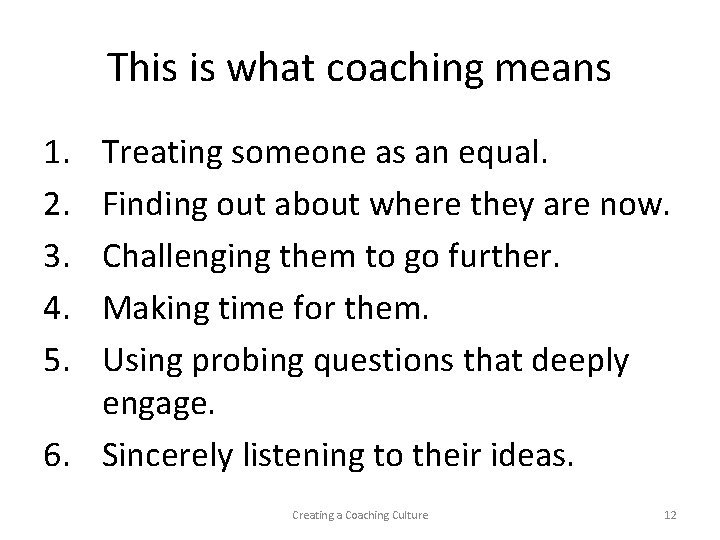
This is what coaching means 1. 2. 3. 4. 5. Treating someone as an equal. Finding out about where they are now. Challenging them to go further. Making time for them. Using probing questions that deeply engage. 6. Sincerely listening to their ideas. Creating a Coaching Culture 12
What was the best way you ever supported a student? • The expression ‘enhanced life chances’ is a common one in educational evaluations. What have you done that you think enhanced a student's life chances? • Discuss in your group. • What makes this incident in particular stand out for you? What kind of strategies did you use? Creating a Coaching Culture 13
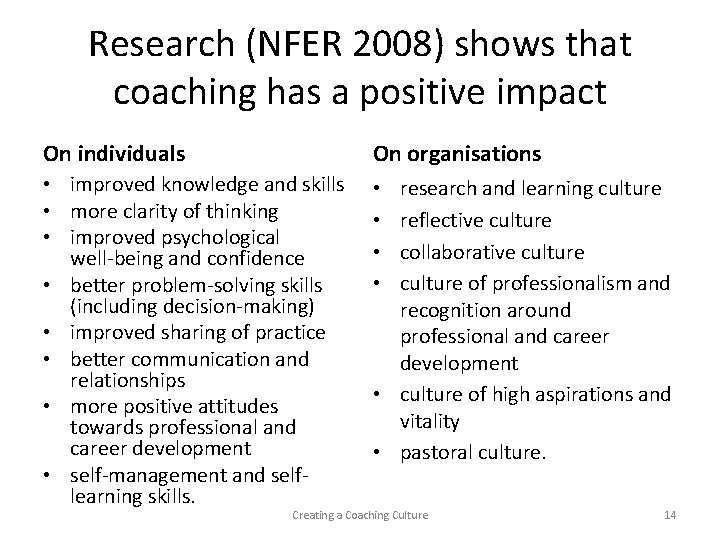
Research (NFER 2008) shows that coaching has a positive impact On individuals On organisations • improved knowledge and skills • more clarity of thinking • improved psychological well-being and confidence • better problem-solving skills (including decision-making) • improved sharing of practice • better communication and relationships • more positive attitudes towards professional and career development • self-management and selflearning skills. • • research and learning culture reflective culture collaborative culture of professionalism and recognition around professional and career development • culture of high aspirations and vitality • pastoral culture. Creating a Coaching Culture 14
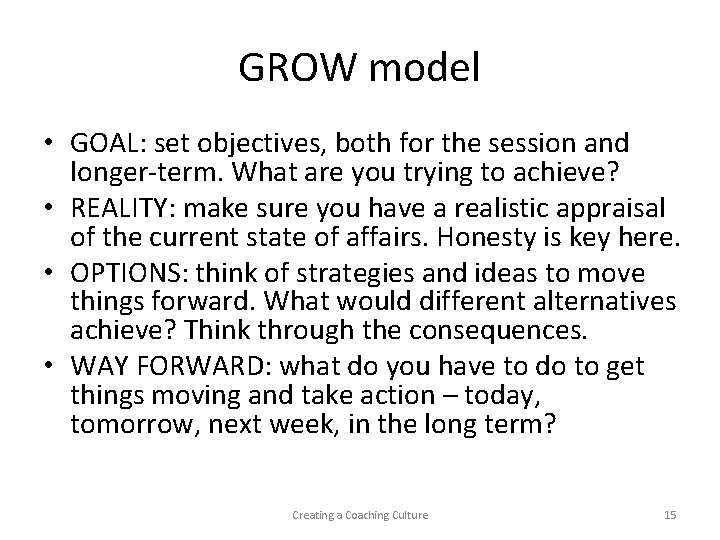
GROW model • GOAL: set objectives, both for the session and longer-term. What are you trying to achieve? • REALITY: make sure you have a realistic appraisal of the current state of affairs. Honesty is key here. • OPTIONS: think of strategies and ideas to move things forward. What would different alternatives achieve? Think through the consequences. • WAY FORWARD: what do you have to do to get things moving and take action – today, tomorrow, next week, in the long term? Creating a Coaching Culture 15
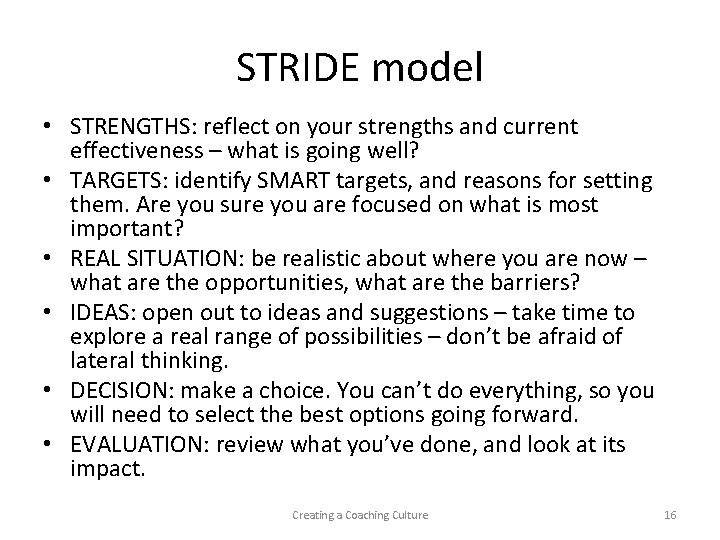
STRIDE model • STRENGTHS: reflect on your strengths and current effectiveness – what is going well? • TARGETS: identify SMART targets, and reasons for setting them. Are you sure you are focused on what is most important? • REAL SITUATION: be realistic about where you are now – what are the opportunities, what are the barriers? • IDEAS: open out to ideas and suggestions – take time to explore a real range of possibilities – don’t be afraid of lateral thinking. • DECISION: make a choice. You can’t do everything, so you will need to select the best options going forward. • EVALUATION: review what you’ve done, and look at its impact. Creating a Coaching Culture 16
Let’s coach the school! Creating a Coaching Culture 17
Discussion space • Which model do you think is most helpful – GROW or STRIDE? • Discuss in your table groups, using either the scenarios that you have been given, or those which you have brought to the session. • For each, decide which model you think would work most effectively in this situation. Creating a Coaching Culture 18
Where are we now? • How effectively do we currently use coaching strategies in school? • In your group, use the green sticky notes to come up with examples of where you think that we are currently using effective coaching techniques. • Then use the yellow ones to come up with examples where you think current practice could be improved by using coaching strategies. Creating a Coaching Culture 19
Feedback Please put all your sticky notes on the display board. Creating a Coaching Culture 20